
doi:10.1155/2010/132910
Research Article
Coordinated Transmission of Interference Mitigation and
Power Allocation in Two-User Two-Hop MIMO Relay Systems
Hee-Nam Cho, Jin-Woo Lee, and Yong-Hwan Lee
School of Electrical Engineering and INMC, Seoul National University, Kwan-ak P.O. Box 34, Seoul 151-600, Republic of Korea
Correspondence should be addressed to Hee-Nam Cho,[email protected]
Received 30 October 2009; Revised 11 May 2010; Accepted 15 June 2010
Academic Editor: Guosen Yue
Copyright © 2010 Hee-Nam Cho et al. This is an open access article distributed under the Creative Commons Attribution License, which permits unrestricted use, distribution, and reproduction in any medium, provided the original work is properly cited.
This paper considers coordinated transmission for interference mitigation and power allocation in a correlated two-user two-hop multi-input multioutput (MIMO) relay system. The proposed transmission scheme utilizes statistical channel state information (CSI) (e.g., transmit correlation) to minimize the cochannel interference (CCI) caused by the relay. To this end, it is shown that the CCI can be represented in terms of the eigenvalues and the angle difference between the eigenvectors of the transmit correlation matrix of the intended and CCI channel, and that the condition minimizing the CCI can be characterized by the correlation amplitude and the phase difference between the transmit correlation coefficients of these channels. Then, a coordinated user-scheduling strategy is designed with the use of eigen-beamforming to minimize the CCI in an average sense. The transmit power of the base station and relay is optimized under separate power constraint. Analytic and numerical results show that the proposed scheme can maximize the achievable sum rate when the principal eigenvectors of the transmit correlation matrix of the intended and the CCI channel are orthogonal to each other, yielding a sum rate performance comparable to that of the minimum mean-square error-based coordinated beamforming which uses instantaneous CSI.
1. Introduction
The use of wireless relays with multiple antennas, so-called multi-input multioutput (MIMO) relay, has received a great attention due to its potential for significant improvement of link capacity and cell coverage in cellular networks [1– 8]. Previous works mainly focused on the capacity bound of point-to-point MIMO relay channels from the information-theoretic aspects [9,10]. Recently, research focus has moved into point-to-multipoint MIMO relay channels, so-called multiuser MIMO relay channel [11]. When relay users and direct-link users coexist in multiuser MIMO relay channels, it is of an important concern to develop a MIMO relay transmission strategy that mitigates cochannel interference (CCI) caused by the relay [4]. However, the capacity region of the multiuser MIMO relay channel is still an open issue in interference-limited environments [12–14]. It is a com-plicated design issue to determine how to simultaneously schedule relay users and direct-link users, and how to co-optimize the transmit beamforming and the power of MIMO relays without major CCI effect [15].
In a multiuser MIMO cellular system, recent works have shown that the CCI caused by adjacent base stations (BSs) can be mitigated with the use of coordinated beamforming (CBF) [15–17]. They derived a closed-form expression for the minimum mean square error (MMSE) and zero-forcing (ZF)-based CBF [15] in terms of maximizing the signal-to-interference plus noise ratio (SINR) [18,19]. However, they did not consider the user scheduling together and may require a large feedback signaling overhead and computa-tional complexity due to the use of instantaneous channel state information (CSI) at every frame [20]. Moreover, it can suffer from so-called channel mismatch problem due to the time delay for the exchange of instantaneous CSI via a backbone network among the BSs [21, 22]. As a consequence, previous works for multiuser MIMO cellular systems may not directly be applied to multiuser MIMO relay systems.
channel is often correlated in real environments [26,27]. It is shown that the channel correlation is associated with the scattering characteristics, antenna spacing, Doppler spread, and angle of departure (AoD) or arrival (AoA) [27]. In spite of efforts on the capacity of correlated single/multiuser MIMO channels [28–33], the capacity of correlated mul-tiuser MIMO relay channels remains unknown. This moti-vates the design of an interference-mitigation strategy with the use of channel correlation information in a multiuser MIMO relay system.
Along with the interference mitigation, it is also of an interesting topic to determine how to allocate the transmit power of the relay since the capacity of MIMO relay channel is determined by the minimum capacity of multihops [1–4]. It was shown that the minimum capacity can be improved by adaptively allocating the transmit power according to the channel condition of multihops [34–36]. However, it may need to consider the effect of CCI in a multiuser MIMO relay system [4,11]. Nevertheless, to authors’ best knowledge, few works have considered combined use of CCI mitigation and power allocation in a multiuser MIMO relay system.
In this paper, we consider coordinated transmission for the CCI mitigation and power allocation in a correlated two-user two-hop MIMO relay system, where one is served through a relay and the other is served directly from the BS. (We consider a simple scenario of two hops, which is most attractive in practice because the system complexity and transmission latency are strongly related to the number of hops [4].) The proposed coordinated transmission scheme utilizes the transmit correlation to minimize the CCI in an average sense. To this end, it is shown that the CCI can be expressed in terms of the eigenvalues and the angle difference between the eigenvectors of the transmit correlation matrix of the intended and the CCI channel, and that the condition minimizing the CCI can be characterized by the correlation amplitude and the phase difference between the transmit cor-relation coefficients of these channels. Using the statistics of the CCI, a coordinated user-scheduling criterion is designed with the use of eigen-beamforming to minimize the CCI in an average sense. The transmit power is optimized for rate balancing between the two hops, yielding less interference while maximizing the minimum rate of the two hops. It is also shown that the proposed scheme can maximize the achievable sum rate when the principal eigenvectors of the transmit correlation matrix of the intended and the interfered user are orthogonal to each other, and that the maximum sum rate approaches to that of the MMSE-CBF while requiring less complexity and feedback signaling overhead.
The rest of this paper is organized as follows.Section 2 describes a correlated two-user two-hop MIMO relay system in consideration. In Section 3, previous works are briefly discussed for ease of description. Section 4 proposes a coordinated transmission strategy for the CCI mitigation and power allocation, and analyzes its performance in terms of the achievable sum rate. Section 5 verifies the analytic results by computer simulation. Finally, conclusions are given inSection 6.
Notation. Throughout this paper, lower- and uppercase boldface are used to denote a column vectoraand matrixA, respectively;AT andA∗, respectively, indicate the transpose and conjugate transpose of A;a denotes the Euclidean norm of a; tr(A) and det(A), respectively, denote the trace and the determinant ofA;IMis an (M×M) identity matrix; E{·}stands for the expectation operator.
2. System Model
Consider the downlink of a two-user two-hop MIMO relay system with the use of half-duplex decode and forward (DF) protocol as shown inFigure 1, where the BS transmits the signal to the relay during the first time slot, and the relay decodes/re-encodes and transmits it to user i during the second time slot. We refer this link to the relay link. Simultaneously, the BS transmits the signal to userkduring the second time slot through the frequency band allocated to useri, which is referred to the access link. We assume that only a single data stream is transmitted to users. We also assume that the BS and the relay, respectively, transmit the signal usingM1andM2antennas with own amplifiers [35],
and that each user has a single receive antenna (primarily for the simplicity of description).
LetH(1)1 =
h(1)1 · · · h(1)M2be an (M1×M2) channel
matrix from the BS to the relay and h(2)i be an (M2×1)
channel vector from the relay to useri, where the superscript (n) indicates the time slot index. Then, during the first time slot, the received signal at the relay can be represented as
y1(1)=
PBSΓ(1)1 H (1)∗ 1 x
(1) 1 +n
(1)
1 , (1)
where PBS is the transmit power of the BS, Γ(1)1 denotes
the large-scale fading coefficient of the first hop, x(1)1 =
w1(1)s (1) 1 , andn
(1)
1 is an (M2×1) additive white Gaussian noise
(AWGN) vector with covariance matrixσ2
1IM2. Here,w (1) 1 and s(1)1 denote an (M1×1) transmit beamforming vector with
unit norm and the transmit data, respectively. During the second time slot, the received signal of useriandkcan be, respectively, represented as
yi(2)=
PRSΓ(2)i h (2)∗
i x
(2)
i +n
(2)
i ,
y(2)k =PBSΓ(2)k h (2)∗
k x
(2)
k +
PRSΓ(2)k,CCIh (2)∗
k,CCIx
(2)
i +n
(2)
k ,
(2)
wherePRS is the transmit power of the relay,h(2)k,CCIdenotes
an (M2×1) CCI channel vector from the relay to userk, and n(2)i andn(2)k denote zero-mean AWGN with varianceσi2and σk2, respectively.
When H(1)1 experiences spatially correlated Rayleigh fading, it can be represented as [37]
H(1)1 =R(1)1 /2H(1)1 G(1)1 /2, (3)
whereH(1)1 denotes an uncorrelated channel matrix whose
BS ... M1
CSIs from relay or users
H(1)1
h(2)k,CCI Co-channel interference
Figure1: Modeling of a two-user two-hop MIMO relay system.
zero-mean complex Gaussian random variables with unit variance; R(1)1 /2 and G(1)1 /2, respectively, denote the square
root of the transmit and receive correlation matrix (i.e.,
R(1)1 =R(1)
(to derive the statistical characteristics of the CCI and analyze its geometrical meaning in following sections, we consider the exponential decayed correlation model, which is physi-cally reasonable in the sense that the correlation decreases as the distance between antennas increases [24,25])
R(1)1 =
complex-valued transmit and receive correlation coefficient, respectively. Here, α(1)1 ,β(1)1 (0 ≤ α(1)1 ,β(1)1 ≤ 1) and θ1(1),(1)1 (−π ≤θ1(1),(1)1 ≤π) denote those amplitude and
phase, respectively. Similarly,h(2)i can be represented as
h(2)i =R(2)i /2h(2)i
where h(2)i denotes an uncorrelated channel vector whose elements are i.i.d. zero-mean complex Gaussian random variables with unit variance and ρ(2)i (= α
Ri(2) is a positive semidefinite Hermitian matrix, it can be decomposed as [39]
matrix whose columns are the normalized eigenvectors of
Ri(2), andΛ(2)i is an (M2×M2) diagonal matrix whose diagonal
elements are{λ(2)i,1,. . .,λ(2)i,M2}, whereλ (2)
i,1 ≥ · · · ≥λ(2)i,M2 ≥0.
We defineu(2)i,maxby the principal eigenvector corresponding
to the largest eigenvalueλ(2)i,1 ofR (2)
i (i.e.,u(2)i,1 =u (2)
i,max).
3. Previous Works
λ(2)
k,CCI,2u (2)
k,CCI,2
Δ(2)i,k,2=0 Δ(2)i,k,1=π
2
λ(2)k,CCI,1u(2)k,CCI,1
M2=2 u(2)
i,max
(a)
λ(2)k,CCI,2u(2)
k,CCI,2 Nullspace ofu(2)
k,CCI,1
Δ(2)
i,k,2=/ π 2 Δ(2)i
,k,3=/ π 2
Δ(2)i ,k,1=
π
2 λ
(2)
k,CCI,1u (2)
k,CCI,1
λ(2)
k,CCI,3u (2)
k,CCI,3
M2=3 u(2)
i,max
(b)
Figure3: Design concept of the coordinated eigen-beamforming with geometrical interpretation.
θ=0
θ(2)i
Δθ(2)
i,k =π
RS
θ(2)k ,CCI
θ=π M2=2
(a)
θ=0
θi(2) θi(2)
Δθ(2)
i,k =
2π 3
Δθ(2)i,k = 2π
3
RS θk(2),CCI
θ=π M2=3
(b)
Figure4: Design concept of the coordinated eigen-beamforming with physical interpretation.
3.1. Eigen-Beamforming (Eig.BF). With the transmit correla-tion informacorrela-tion, the transmitter can determine the eigen-beamforming vector by the principal eigenvector of the transmit correlation matrix (i.e.,w(2)k =u(2)k,max), yielding an achievable rate bounded as [28]
R(2)k,Eig.BF≤log2
1 +γ(2)k λ (2)
k,max
, (7)
where γ(2)k (= PBSΓ(2)k /σk2) denotes the average SNR of user k. However, this scheme may experience the performance degradation in interference-limited environments.
3.2. MMSE Interference Aware-Coordinated Beamforming (MMSE-CBF). The MMSE-CBF designed for a cell two-user MIMO cellular system can be applied to a two-two-user two-hop MIMO relay system where users are equipped with multiple receive antennas [15]. (Unlike our system model, the MMSE-CBF assumes that each user has multiple receive antennas since it jointly optimizes the transmit beamforming and receive combining vector to maximize the SINR [15]. However, the design concept is applicable even when each
user has a single receive antenna.) In this case, the SINR of userkcan be represented as
SINR(2)k = γ (2)
k f
(2)∗
k H
(2)∗
k w
(2)
k w
(2)∗
k H
(2)
k f
(2) k 1 +γ(2)k,CCIfk(2)∗H(2)k,CCI∗ w(2)i w
(2)∗
i H
(2)
k,CCIf
(2) k
= γ
(2)
k f
(2)∗
k H
(2)∗
k w
(2)
k w
(2)∗
k H
(2)
k f
(2) k
fk(2)∗IN+γ(2)k,CCIH (2)∗
k,CCIw
(2)
i w
(2)∗
i H
(2)
k,CCI
fk(2),
(8)
whereNis the number of receive antennas of each user,fk(2)
denotes an (N×1) receive combining vector of userk, and
H(2)k andH(2)k,CCI denote an (M1×N) channel matrix from
the BS to userkand an (M2×N) CCI channel matrix from
the relay to userk, respectively. Equation (8) is known as a Rayleigh quotient [40] and is maximized whenfk(2)(before the normalization) is given by [41]
fk(2)=IN+γ(2)k,CCIH (2)∗
k,CCIw
(2)
i w
(2)∗
i H
(2)
k,CCI
−1
Achievable rate
Power-saving effect
2nd hop:R(2)i,C-Eig.BF(PRS) 1st hop:R(1)i,C-Eig.BF(PBS) PRS
PRS,max
PRS,opt PRS
Max-min solution: R(1)i,C-Eig.BF(PBS)=R(2)i,C-Eig.BF(PRS,opt)
Figure5: Design concept of the proposed power allocation scheme.
which is the principal singular vector ofγ(2)k H (2)∗
k w
(2)
k w
(2)∗ k
×H(2)k (IN+γ(2)k,CCIH (2)∗
k,CCIw
(2)
i w
(2)∗
i H
(2)
k,CCI)
−1
. The correspond-ing SINR and the achievable rate of userkare, respectively, given by
SINR(2)k
=γ(2)k w (2)∗
k H
(2) k
×IN+γ(2)k,CCIH (2)∗
k,CCIw
(2)
i w
(2)∗
i H
(2)
k,CCI
−1
H(2)k ∗w(2)k ,
R(2)k,MMSE-CBF=log2
1 + SINR(2)k .
(10)
Given the receive combing vectorfk(2), the transmit beam-forming vector can be determined by
w(2)k =vmax
⎧ ⎪ ⎨ ⎪ ⎩ ⎛ ⎝H(2)
i,CCIH
(2)∗
i,CCI+
1
γ(2)i,CCI
IM1
⎞ ⎠
−1
H(2)k H(2)k ∗
⎫ ⎪ ⎬ ⎪ ⎭,
(11)
wherevmax{A}is the principal singular vector of matrixA
andH(2)i,CCIdenotes an (M1×N) CCI channel matrix from the
BS to useri. However, the channel gain ofH(2)i,CCIis very small
due to large path loss and shadowing effect [2]. The transmit beamforming and receive combining vector for userican be determined in a similar manner.
4. Proposed Coordinated Transmission
In this section, we design a coordinated transmission strategy for CCI mitigation and power allocation in a correlated two-user two-hop MIMO relay system. To this end, we first investigate the statistical characteristics of the CCI, and then describe the design concept for the CCI mitigation and power allocation. Finally, we derive the performance of the proposed scheme in terms of the achievable sum rate.
4.1. Statistical Characteristics of Cochannel Interference. In a spatially correlated channel, the channel gain is statistically concentrated on a few eigen-dimensions of the transmit cor-relation matrix [29]. In this case, the eigen-beamforming is
known as the optimum beamforming strategy when a single data stream is transmitted to the user [28]. When the eigen-beamforming is applied to the relay (i.e., w(2)i = u(2)i,max), the CCI power from the relay can be represented in terms of the eigenvalue λ(2)k,CCI,m and the inner-product between
u(2)i,maxandu(2)k,CCI,m, whereλ (2)
k,CCI,mandu (2)
k,CCI,mdenote themth eigenvalue and eigenvector ofR(2)k,CCI. The following theorem provides the main result of this subsection.
Theorem 1. The average CCI from the relay with the use of eigen-beamforming can be represented as
σ(2)k,CCI=γ
(2)
k,CCI
M2
m=1
λ(2)k,CCI,mcos2Δ (2)
i,k,m, (12)
whereΔ(2)i,k,m(=(u (2)
i,max,u
(2)
k,CCI,m))denotes the angle difference
betweenu(2)i,maxandu(2)k,CCI,m.
Proof. Whenwk(2) = u(2)k,maxandw(2)i =u(2)i,max, the instanta-neous SINR of userkcan be represented as
SINR(2)k = γ (2)
k h
(2)∗
k u
(2)
k,max
2
1 +γ(2)k,CCIh (2)∗
k,CCIu
(2)
i,max
2. (13)
It can easily be shown that the average CCI can be represented as
σ(2)k,CCI=γ (2)
k,CCIE
h(2)k,CCI∗ u(2)i,max2
. (14)
Since h(2)k,CCI = R(2)k,CCI/2h(2)k,CCI and E{h(2)k,CCI∗ Ah(2)k,CCI} = tr(A) [40], (14) can be rewritten as
σ(2)k,CCI=γ (2)
k,CCItr
R(2)k,CCIu(2)i,maxu(2)i,max∗. (15)
tr(AB)=tr(BA) [40] that
This completes the proof of the theorem.
It can be seen that the CCI is associated with the eigenvalue λ(2)k,CCI,m and the angle difference Δ(2)i,k,m between
u(2)i,max and u(2)k,CCI,m form = 1, 2,. . .,M2. This implies that
the CCI can be controlled by adjusting λ(2)k,CCI,m and Δ (2)
i,k,m
in a statistical manner. In a highly correlated channel, the CCI can be minimized (or maximized) by makingΔ(2)i,k,max(=
Corollary 2. WhenM2=2, the average CCI can be simplified
to
Proof. Since the eigenvalues and the corresponding eigenvec-tors ofR(2)k,CCIforM2=2 can be, respectively, represented as
[8]
This completes the proof of the corollary.
It can be seen from Corollary 2 that the CCI depends on the correlation amplitudeα(2)k,CCIand the phase difference Δθ(2)i,k betweenρi(2)andρ
(2)
k,CCI. In a highly correlated channel
(i.e.,α(2)k,CCI=1), the CCI can be minimized (or maximized)
when Δθi(2),k = π (or Δθ (2)
i,k = 0). This implies that the principal eigenvectoru(2)i,maxandu
(2)
k,CCI,maxare orthogonal (or
parallel) to each other whenΔθi(2),k =π(orΔθ
Proof. The eigenvalues and the corresponding eigenvectors ofRk(2),CCIforM2=3 can be, respectively, represented as (refer
Λ(2)k,CCI=
This completes the proof of the corollary.
Like Corollary 2, when M2 = 3, the CCI depends on
k,CCI. However, the phase
difference minimizing the CCI depends on the number of antennas. UnlikeM2 = 2, the CCI can be minimized when Δθ(2)i,k = 2π/3 for M2 = 3. This implies that the principal
eigenvectoru(2)i,maxandu (2)
k,CCI,maxare orthogonal to each other
when Δθ(2)i,k = 2π/3 (refer to Appendix B for the proof).
Figure 2depicts the average CCI power according to Δθi(2),k whenγ(2)k,CCI =10 dB,α(2)k,CCI =1.0, 0.8, 0.6, andM2 =2, 3.
It can be seen that the CCI is minimized atΔθ(2)i,k = π (or
Δθ(2)i,k =2π/3) whenM2=2 (orM2=3) asα(2)k,CCI → 1.
4.2. Design Concept of the Proposed Coordinated Eigen-Beamforming. FromTheorem 1, we can deduce the design concept of the interference mitigation to minimize the CCI in a statistical manner when the BS’s users and relay’s users coexist. The main challenge is to determine how to simultaneously schedule the BS’s user and the relay’s user without major CCI effect. Based on Theorem 1, the reasonable solution is to select a pair of users whose principal
eigenvectors u(2)i,max and u(2)k,CCI,max are orthogonal to each
other, that is,
Δ(2)i,k,max=u(2)i,max,u(2)
k,CCI,max = π
2, (27)
where i and k denote the indices of selected users. We refer this criterion to the coordinated eigen-beamforming. Figure 3 illustrates the design concept of the coordinated eigen-beamforming with geometrical interpretation. It can be shown that the principal eigenvectoru(2)
i,maxis orthogonal
tou(2)
k,CCI,max regardless ofM2. However, the CCI power has
a different behavior according to M2. When M2 = 2, a
pair of users satisfying (27) can uniquely be determined sinceu(2)
k,CCI,2is only orthogonal to the principal eigenvector
u(2)
k,CCI,max. This implies that the direction of u (2)
i,max should
be equal to that of u(2)
denotes a parallel relationship of two complex vectors. It can be inferred that the CCI remains as much asλ(2)k,CCI,2 when
M2 = 2. On the other hand, when M2 = 3, there may
exist many pairs of users since the null-space of u(2)
k,CCI,max
is two-dimensional. This implies that arbitrary vectors on the null-space are always orthogonal to u(2)
k,CCI,max. In this
case, it is desirable for the relay to select a user with the principal eigenvector minimally inducing the CCI power. This is because u(2)i,max and u(2)
k,CCI,m are not orthogonal to each other for m = 2, 3, and the CCI power remains as selected by the relay.
The proposed coordinated eigen-beamforming can be fully characterized by the phase difference betweenρ(2)i and
ρ(2)
k,CCI. From Corollaries 2 and 3, it can be inferred that
the condition minimizing the CCI forM2 antennas can be
determined as
Δθi(2),k = 2π
M2.
(28)
(Although we do not consider the case forM2 ≥ 4 due to
−6
SINRk,C-Eig.BF + opt. PA(approximation) SINRk,C-Eig.BF + max. PA
SINRk,C-Eig.BF + max. PA(approximation) (a) Average SINR
0 Rk,C-Eig.BF + opt. PA(approximation) Rk,C-Eig.BF + opt. PA(simulation) Rk,C-Eig.BF + max. PA(upper bound) Rk,C-Eig.BF + max. PA(approximation) Rk,C-Eig.BF + max. PA(simulation)
(b) Achievable rate Figure6: Performance of userkwith the proposed scheme according toγ(2)k .
eigenvectors ofR(2)k,CCI, (28) can straightforwardly be verified by the manner described in AppendicesAandB.)
Figure 4illustrates physical meaning of the coordinated eigen-beamforming. It can be seen that the CCI is minimized when the phases ofρ(2)i andρ(2)k
,CCIare scattered as much as
possible.
4.3. Performance Analysis
Theorem 4. The average SINR of userkwith the use of the proposed coordinated eigen-beamforming can be approximated as
where SINR(2)k,approxis the approximated average SINR of userk.
Proof. It can be shown from (13) that
, it can be shown from multivariate
2
RMMSE-CBF+ max. PA RC-Eig.BF+ opt. PA RC-Eig.BF+ max. PA
RNC-Eig.BF+ max. PA RSVD/ZFBF+ max. PA (a)M2=2
RMMSE-CBF+ max. PA RC-Eig.BF+ opt. PA RC-Eig.BF+ max. PA
RNC-Eig.BF+ max. PA RSVD/ZFBF+ max. PA (b)M2=3
Figure7: Performance comparison according toΔθ(2)i,k.
It can be shown after some mathematical manipulation that [41]
This completes the proof of the theorem.
It can be seen from (12) and (29) that SINR(2)k,approx
depends on the eigenvaluesλ(2)k,maxandλ(2)k,CCI,m, and the angle difference Δ(2)i,k,m. Although SINR(2)k,approx depends on M2 as
seen in Corollaries2 and3, it is maximized by selecting a
pair of users whose angle differenceΔ(2)i,k,maxisπ/2 in a highly correlated channel.
Theorem 5. The proposed coordinated eigen-beamforming can provide an achievable sum rate approximately represented as
where RC-Eig.BF denotes an approximated upper bound of the achievable sum rate.
Proof. Using the Jensen’s inequality [39], the achievable sum rate is bounded as
RC-Eig.BF=Rk,C-Eig.BF+Ri,C-Eig.BF
combining vector of the relay. From (29), the upper bound of userkcan be approximated as
Assuming that maximum ratio combining (MRC) is used at the relay [15], the achievable rate of useriis bounded as
Since tr(G(1)1 )=
!M2
m=1λ(1)1,m =M2and tr(R(1)1 u(1)1,maxu(1)1,max∗ )= λ(1)1,max, (38) can be represented as
Ri,C-Eig.BF
≤1
2min
log21 +γ(1)1 M2λ(1)1,max
, log21 +γ(2)i λ(2)i,max.
(39)
Thus, it can be shown from (37) and (39) that
RC-Eig.BF
≈log2
⎡ ⎢ ⎢ ⎢ ⎣1 +
γ(2)k λ(2)k ,max
1 +σ(2)k,CCI+ γ(2)k λ(2)k
,maxσ (2)2
k,CCI
1 +σ(2)k,CCI 3
⎤ ⎥ ⎥ ⎥ ⎦
+1 2min
log21 +γ(1)1 M2λ(1)1,max
, log21 +γ(2)i λ(2)i,max.
(40)
This completes the proof of the theorem.
It can be seen that the proposed coordinated eigen-beamforming maximizes the achievable sum rate when
Δ(2)
i,k,max = π/2 (i.e., yielding zero interference and large
beamforming gain) in a highly correlated channel.
4.4. Allocation of Transmit Power. Although the CCI can effectively be controlled by adjusting the angle difference between the principal eigenvectors of two users, it cannot be minimized in an instantaneous sense. This issue can be alleviated by allocating the relay transmit power as low as possible since the CCI power is proportional to the relay transmit power. However, the transmit power needs to be allocated to maximize the minimum rate of two hops. It may be desirable to allocate the transmit power considering the CCI mitigation in a joint manner. The main goal is to allocate the transmit power to reduce the CCI while maximizing the achievable rate of the relay link.
Suppose that PBS ≤ PBS,max and PRS ≤ PRS,max since
the BS and relay are not geographically colocated [35], where PBS,max and PRS,max denote the maximum power of
the BS and the relay, respectively, and that the transmit power of the BS is given by PBS. Then, it is desirable to
determine the minimum transmit power of the relay to achieve the rate of the first hop. Figure 5 illustrates the concept of the proposed power allocation. When PRS = PRS,max, the achievable rate of the relay link is determined
as R(1)i,C-Eig.BF(PBS) since R(1)i,C-Eig.BF(PBS) < R(2)i,C-Eig.BF(PRS,max).
Thus, the transmit power of the relay can be determined by the crossing point between the achievable rate of the first and the second hop.
Theorem 6. The transmit power of the relay can be determined with the consideration of CCI mitigation as
κopt PRS,opt
PBS =
Γ(1)1 σi2
Γ(2)i σ2 1
M2λ(1)1,max
λ(2)i,max , (41)
whereκopt(0≤κopt≤PRS,max/PBS)is the transmit power ratio between the BS and the relay.
Proof. By means of max-min optimization [35], the achiev-able rate of the relay link can be maximized when
γ(1)1 M2λ(1)1,max=γ (2)
i λ
(2)
i,max. (42)
Since γ(1)1 = PBSΓ(1)1 /σ12andγ (2)
i = PRSΓ
(2)
i /σ
2
i, (42) can be rewritten as
PBSΓ(1)1 σ2
1
M2λ(1)1,max= PRSΓ(2)i
σ2
i
λ(2)i,max. (43)
After simple manipulation, it can be seen that
κopt PRS,opt
PBS = Γ(1)1 σi2
Γ(2)i σ2 1
M2λ(1)1,max
λ(2)i,max . (44)
This completes the proof of the theorem.
It can be seen that the optimum power allocation is associated with the path loss ratioΓ(1)1 /Γ(2)i and the principal eigenvalue ratioλ(1)1,max/λ(2)i,max between the two hops. In fact, κopt is inversely proportional to the achievable rate of each
hop. For example, asα(2)i increases,R(2)i,C−Eig.BFincreases due to large beamforming gain. In this case, it is desirable to decreaseκopt to balance the rate between two-hops, or vice
versa.
4.5. Scheduling Complexity. We define the complexity mea-surement as the number of the required user pairs and compare the scheduling complexity for two user-scheduling schemes; the proposed and the instantaneous CSI-based user-scheduling schemes. For ease of description, we assume thatTSTandTLTdenote the feedback period of short-term
and long-term CSI, respectively, where TLT is a multiple
of TST. We also assume that the BS and the relay have an
equal number of users (i.e.,K/2). To provide fair scheduling opportunities to allK users duringTLT, the proposed
user-scheduling scheme needs to consider (K/2)2 cases at the first scheduling instant and (K/2−1)2 cases at the second scheduling instant. Thus, it needs to considerSLTscheduling
cases duringTLT, given by
SLT=
TLT/TFrameDLT
l=1
*K
2 −(l−1)
+2
, (45)
where TFrame denotes the time duration of a single frame
and DLT denotes the portion allocated to a pair of users
during TLT, that is, DLT = 2TLT/KTFrame. On the other
1.5 2 2.5 3 3.5 4 4.5
A
chie
vable
sum-r
at
e,
R
(bps/Hz)
0 0.1 0.2 0.3 0.4 0.5 0.6 0.7 0.8 0.9 1 Correlation amplitude,α
M1=M2=2 γ(2)k =0 dB Δθ(2)i,k =π
RMMSE-CBF+ max.PA RC-Eig.BF+ opt.PA RC-Eig.BF+ max.PA
RNC-Eig.BF+ max.PA RSVD/ZFBF+ max.PA (a)M2=2
1.5 2 2.5 3 3.5 4 4.5 5 5.5
A
chie
vable
sum-r
at
e,
R
(bps/Hz)
0 0.1 0.2 0.3 0.4 0.5 0.6 0.7 0.8 0.9 1 Correlation amplitude,α
M1=M2=3 γ(2)k =0 dB Δθi(2),k =2π/3
RMMSE-CBF+ max. PA RC-Eig.BF+ opt. PA RC-Eig.BF+ max. PA
RNC-Eig.BF+ max. PA RSVD/ZFBF+ max. PA (b)M2=3
Figure8: Performance comparison according toα.
0 1 2 3 4 5 6 7 8 9
A
chie
vable
sum-r
at
e,
R
(bps/Hz)
−10 −8 −6 −4 −2 0 2 4 6 8 10 Average SNR,γ(2)k (dB)
M1=M2=2 α=0.9 Δθi(2),k =π
RMMSE-CBF+ max. PA RC-Eig.BF+ opt. PA RC-Eig.BF+ max. PA
RNC-Eig.BF+ max. PA RSVD/ZFBF+ max. PA (a)M2=2
1 2 3 4 5 6 7 8 9 10 11
A
chie
vable
sum-r
at
e,
R
(bps/Hz)
−10 −8 −6 −4 −2 0 2 4 6 8 10 Average SNR,γk(2)(dB)
M1=M2=3 α=0.9 Δθ(2)i,k =2π/3
RMMSE-CBF+ max. PA RC-Eig.BF+ opt. PA RC-Eig.BF+ max. PA
RNC-Eig.BF+ max. PA RSVD/ZFBF+ max. PA (b)M2=3
Figure9: Performance comparison according toγ(2)k .
the feedback per each frame [43,44]. It can be shown that the instantaneous CSI-based user-scheduling scheme needs to considerSSTscheduling cases duringTLT, given by
SST= TLT TST
K
2
2
. (46)
For example, whenTLT = 300 ms,TST = TFrame = 5 ms,
and K = 10, the proposed scheme needs to consider
SLT=
!5
l=1[5−(l−1)]
2=
55 scheduling cases. Here,DLT=
12. On the other hand, the instantaneous CSI-based scheme needs to consider SST = 60·52 = 1500 scheduling cases.
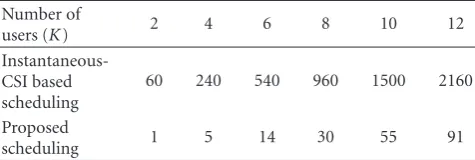
Table 1 depicts the scheduling complexity comparison according to K whenTLT = 300 ms and TST = TFrame =
5 ms. It can be seen that the proposed scheme requires lower scheduling complexity and smaller feedback signal overhead than the instantaneous CSI-based scheme as K
Table1: Scheduling complexity according toKwhenTLT=300 ms
andTST=TFrame=5 ms.
Number of
users (K) 2 4 6 8 10 12
Instantaneous-CSI based scheduling
60 240 540 960 1500 2160
Proposed
scheduling 1 5 14 30 55 91
5. Performance Evaluation
The analytic results and performance of the proposed coordinated eigen-beamforming with the optimum power allocation (RC-Eig.BF+Opt.PA) and maximum power
alloca-tion (RC-Eig.BF+Max.PA) are verified by computer
simula-tion. For comparison, we consider three MIMO relay transmission schemes; the MMSE-CBF with maximum power allocation (RMMSE-CBF+Max.PA) [15], the
noncoordi-nated eigen-beamforming with maximum power allocation (RNC-Eig.BF+Max.PA) [28], and the singular value
decompo-sition and ZF beamforming (SVD/ZFBF) with maximum power allocation (RSVD/ZFBF+Max.PA) [11, 20]. (User k can
select the relay as its serving node through a cell selection algorithm [45]. Then, our system can be converted into a concatenated MIMO system comprising single-relay MIMO channel for the first hop and MIMO broadcast channels (BC) for the second hop. In this case, the MIMO-SVD and linear precoding such as ZF beamforming can be employed to achieve the multiplexing gain, respectively [11,20,37].) We assume that each link has the same correlation amplitude (i.e.,α(1)1 =α
(2)
i =α
(2)
k =α
(2)
k,CCI=α),
and that the relay is placed at 0.7 km from the BS.
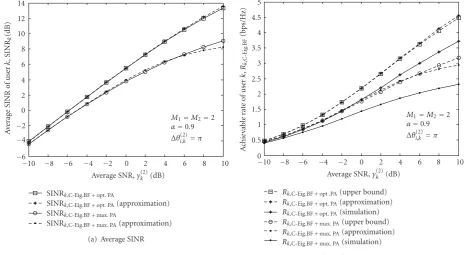
Figures 6(a) and 6(b), respectively, depict the average SINR and the achievable rate of userk with the use of the proposed scheme according to γ(2)k whenM1 = M2 = 2, α = 0.9, and Δθ(2)i,k = π. It can be seen from Figure 6(a) that the approximated average SINR in (29) agrees well with the real average SINR in (30), implying that the upper bound of the achievable rate can be precisely approximated to (37). Although the analytic and simulation results have somewhat discrepancy in terms of the achievable rate due to the Jensen’s loss (in a Rayleigh fading channel, the Jensen’s loss is 0.83 bps/Hz at high SNR region [39]) (e.g., this gap is about 0.79 bps/Hz at γ(2)k = 10 dB as seen in Figure 6(b)), the analytic results still keep the behavior of actual performance.
Figures7(a)and7(b), respectively, depict the achievable sum rate of the proposed scheme according toΔθ(2)i,k forM1= M2 =2 and 3 whenα=0.9 andγ(2)k =0 dB. It can be seen that RC-Eig.BF+Opt.PA approaches to RMMSE-CBF+Max.PA when Δθ(2)i,k =πforM2 =2 (orΔθi(2),k =2π/3 forM2 =3). This
is mainly because the proposed scheme eliminates the most of CCI by making the angle difference between u(2)i,max and
u(2)k,CCI,maxorthogonal. It can also be seen thatRC-Eig.BF+Opt.PAis
larger thanRC-Eig.BF+Max.PAregardless ofΔθi(2),k, which means
that the CCI can also be reduced by minimizing the transmit power of the relay. The sum rate gap betweenRC-Eig.BF+Max.PA
andRNC-Eig.BF+Max.PA has a different behavior according to M2. When M2 = 2, the sum rate gap increases as Δθi(2),k increases. On the other hand, when M2 = 3, it somewhat
decreases for 2π/3 < Δθi(2),k ≤ π asΔθ (2)
i,k increases. This is because the condition minimizing the CCI depends onM2
as well asΔθ(2)i,k. Although the SVD/ZFBF-based relay scheme provides the multiplexing gain without the CCI effect [11], its sum rate is somewhat limited due to the rank deficiency of the first hop in a spatially correlated channel [37,46].
Figure 8depicts the achievable sum rate according toα
whenM1=M2=2, 3,Δθ(2)i,k =2π/M2andγ(2)k =0 dB. It can be seen that as αincreases, the proposed scheme provides the sum rate comparable to that of the MMSE-CBF. This is mainly because the most of CCI is concentrated on the direction of the principal eigenvector ofR(2)k,CCI in a highly correlated channel. In this case, the most of CCI can be eliminated by selecting users whose angle differenceΔ(2)i,k,max
close toπ/2. It can also be seen thatRC-Eig.BF+Opt.PAis larger
thanRC-Eig.BF+Max.PAregardless ofα, and thatRC-Eig.BF+Max.PA
is nearly equal to RNC-Eig.BF+Max.PA when α is small. This
implies that the proposed power-allocation rule yields less interference than the maximum one. The SVD/ZFBF-based relay scheme outperforms the proposed scheme by having more degrees of freedom in a weakly correlated channel. This is mainly because the bottleneck effect due to the rank deficiency is eased asαdecreases.
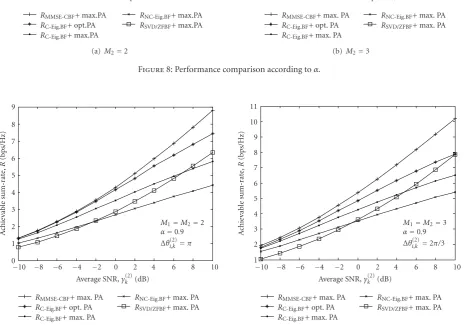
Figure 9depicts the achievable sum rate of the proposed scheme according toγ(2)k whenM1 = M2 = 2, 3,α = 0.9,
andΔθ(2)i,k =2π/M2. It can be seen thatRMMSE-CBF+Max.PAis
always larger than RC-Eig.BF+Opt.PA regardless of γ(2)k since it can maximize the SINR by optimally handling the tradeoff between the CCI cancellation and the noise suppression [19]. Nevertheless, it can be seen that the sum rate gap between
RMMSE-CBF+Max.PAandRC-Eig.BF+Opt.PAis very marginal in low
SNR region, (e.g., 0.08 bps/Hz gap (or 0.31 bps/Hz gap) for
M2=2 (orM2=3)). This implies that the proposed scheme
is quite effective near the cell boundary or coverage hole.
6. Conclusions
Appendices
A. Derivation of Eigenvalues and
Eigenvectors of
R
When
M
2=
3
By the definition in [40], an eigenvector u of a transmit correlation matrixRsatisfies the equation
(R−λI3)u=0, (A.1)
where user and time slot index are dropped for simple notation. Since a necessary and sufficient condition for (A.1) is
det(R−λI3)=0, (A.2)
it can be explicitly expressed as
det
mathematical development, (A.3) can be rewritten as
A3−,s2+ 2s-A+ 2s2=0. (A.4)
Since (A.4) has three solutionsA=(−s±√s2+ 8s)/2 ands,
the eigenvalues ofRcan be obtained as
λ1=1 + α
corresponding to themth eigenvalue ofR, let us plugλmback into (A.2) and solveum =
um,1 um,2 um,3
T. It can be
shown after some manipulation that themth eigenvectorum can be determined as
um=
This completes the proof of (25).
B. Orthogonal Property of Two Principal
Eigenvectors When
M
2=
3
Without the loss of generality, the time slot index is dropped for simple notation. It can be shown from (A.6) that the principal eigenvector of userican be represented as
ui,max
References
[1] T. Cover and A. E. Gamal, “Capacity theorems for the relay channel,”IEEE Transactions on Information Theory, vol. 25, no. 5, pp. 572–584, 1979.
[2] R. Pabst, B. H. Walke, D. C. Schultz et al., “Relay-based deployment concepts for wireless and mobile broadband radio,”IEEE Communications Magazine, vol. 42, no. 9, pp. 80– 89, 2004.
[3] H. Hu, H. Yanikomeroglu, D. D. Falconer, and S. Periyalwar, “Range extension without capacity penalty in cellular net-works with digital fixed relays,” in Proceedings of the IEEE Global Telecommunications Conference (GLOBECOM ’04), vol. 5, pp. 3053–3058, Dallas, Tex, USA, November 2004. [4] S. W. Peters, A. Y. Panah, K. T. Truong, and R. W. Heath
jr., “Relay architectures for 3GPP LTE-advanced,”EURASIP Journal on Wireless Communications and Networking, vol. 2009, Article ID 618787, 14 pages, 2009.
[5] G. J. Foschini and M. J. Gans, “On the limits of wireless com-munications in a fading environment when using multiple antennas,”Wireless Personal Communications, vol. 6, no. 3, pp. 311–335, 1998.
[6] I. E. Telatar, “Capacity of multi-antenna Gaussian channels,”
European Transactions on Telecommunications, vol. 10, no. 6, pp. 585–595, 1999.
[7] A. Goldsmith, S. A. Jafar, N. Jindal, and S. Vishwanath, “Capacity limits of MIMO channels,”IEEE Journal on Selected Areas in Communications, vol. 21, no. 5, pp. 684–702, 2003. [8] G. Caire and S. Shamai, “On the achievable throughput of a
multiantenna Gaussian broadcast channel,”IEEE Transactions on Information Theory, vol. 49, no. 7, pp. 1691–1706, 2003. [9] B. Wang, J. Zhang, and A. Høst-Madsen, “On the capacity
of MIMO relay channels,”IEEE Transactions on Information Theory, vol. 51, no. 1, pp. 29–43, 2005.
[10] C. K. Lo, S. Vishwanath, and R. W. Heath Jr., “Sum-rate bounds for MIMO relay channels using precoding,” in
Proceedings of the IEEE Global Telecommunications Conference (GLOBECOM ’05), pp. 1172–1176, St. Louis, Mo, USA, November 2005.
[11] C.-B. Chae, T. Tang, R. W. Heath Jr., and S. Cho, “MIMO relaying with linear processing for multiuser transmission in fixed relay networks,”IEEE Transactions on Signal Processing, vol. 56, no. 2, pp. 727–738, 2008.
[12] T. Han and K. Kobayashi, “A new achievable rate region for the interference channel,” IEEE Transactions on Information Theory, vol. 27, no. 1, pp. 49–60, 1981.
[13] R. H. Etkin, D. N. C. Tse, and H. Wang, “Gaussian interference channel capacity to within one bit,” IEEE Transactions on Information Theory, vol. 54, no. 12, pp. 5534–5562, 2008. [14] G. Bresler and D. Tse, “The two-user Gaussian interference
channel: a deterministic view,” European Transactions on Telecommunications, vol. 19, no. 4, pp. 333–354, 2008. [15] C. B. Chae, I. S. Hwang, R. W. Heath Jr., and V.
Tarok, “Interference aware-coordinated beamforming
system in a two-cell environment,” submitted to
IEEE Journal of Selected Areas in Communications,
http://nrs.harvard.edu/urn-3:HUL.InstRepos:3293263. [16] K. Gomadam, V. R. Cadambe, and S. A. Jafar,
“Approach-ing the capacity of wireless networks through distributed interference alignment,” in Proceedings of the IEEE Global Telecommunications Conference (GLOBECOM ’08), vol. 19, pp. 1–6, New Orleans, La, USA, November 2008.
[17] C.-B. Chae, D. Mazzarese, N. Jindal, and R. W. Heath Jr., “Coordinated beamforming with limited feedback in the
MIMO broadcast channel,”IEEE Journal on Selected Areas in Communications, vol. 26, no. 8, pp. 1505–1515, 2008. [18] C. B. Peel, B. M. Hochwald, and A. L. Swindlehurst, “A
vector-perturbation technique for near-capacity multiantenna multiuser communication—part I: channel inversion and regularization,”IEEE Transactions on Communications, vol. 53, no. 1, pp. 195–202, 2005.
[19] J. Joung and Y. Lee, “Regularized channel diagonalization for multiuser MIMO downlink using a modified MMSE criterion,”IEEE Transactions on Signal Processing, vol. 55, no. 4, pp. 1573–1579, 2007.
[20] T. Yoo and A. Goldsmith, “On the optimality of multiantenna broadcast scheduling using zero-forcing beamforming,”IEEE Journal on Selected Areas in Communications, vol. 24, no. 3, pp. 528–541, 2006.
[21] Q. Ma and C. Tepedelenlioˇglu, “Practical multiuser diversity with outdated channel feedback,”IEEE Transactions on Vehic-ular Technology, vol. 54, no. 4, pp. 1334–1345, 2005.
[22] M. Nicoli, O. Simeone, and U. Spagnolini, “Multislot esti-mation of frequency-selective fast-varying channels,” IEEE Transactions on Communications, vol. 51, no. 8, pp. 1337– 1347, 2003.
[23] P. Lombardo, G. Fedele, and M. M. Rao, “MRC performance for binary signals in Nakagami fading with general branch correlation,”IEEE Transactions on Communications, vol. 47, no. 1, pp. 44–52, 1999.
[24] S. L. Loyka, “Channel capacity of MIMO architecture using the exponential correlation matrix,” IEEE Communications Letters, vol. 5, no. 9, pp. 369–371, 2001.
[25] A. F. Naguib,Adaptive antennas for CDMA wireless network, Ph.D. dissertation, Stanford University, Stanford, Calif, USA, 1996.
[26] K. I. Pedersen, J. B. Andersen, J. P. Kermoal, and P. Mogensen, “A stochastic multiple-input-multiple-output radio channel model for evaluation of space-time coding algorithms,” in
Proceedings of the IEEE Vehicular Technology Conference, vol. 2, pp. 893–897, Boston, Mass, USA, October 2008.
[27] 3GPP, “Spatial channel model for multiple input multiple out-put (MIMO) simulations,” Tech. Rep. TR 25.996, September 2003.
[28] C. Brunner, W. Utschick, and J. A. Nossek, “Exploiting the short-term and long-term channel properties in space and time: eigenbeamforming concepts for the BS in WCDMA,”
European Transactions on Telecommunications, vol. 12, no. 5, pp. 365–378, 2001.
[29] M. T. Ivrlaˇc, W. Utschick, and J. A. Nossek, “Fading cor-relations in wireless MIMO communication systems,”IEEE Journal on Selected Areas in Communications, vol. 21, no. 5, pp. 819–828, 2003.
[30] S. Vishwanath, N. Jindal, and A. Goldsmith, “Duality, achievable rates, and sum-rate capacity of Gaussian MIMO broadcast channels,”IEEE Transactions on Information Theory, vol. 49, no. 10, pp. 2658–2668, 2003.
[31] H. Weingarten, Y. Steinberg, and S. Shamai, “The capacity region of the Gaussian multiple-input multiple-output broad-cast channel,”IEEE Transactions on Information Theory, vol. 52, no. 9, pp. 3936–3964, 2006.
[32] T. Y. Al-naffouri, M. Sharif, and B. Hassibi, “How much does transmit correlation affect the sum-rate scaling of MIMO Gaussian broadcast channels?”IEEE Transactions on Communications, vol. 57, no. 2, pp. 562–572, 2009.
channels,”IEEE Transactions on Communications, vol. 57, no. 9, pp. 2597–2599, 2009.
[34] Y. Liang and V. V. Veeravalli, “Gaussian orthogonal relay channels: optimal resource allocation and capacity,” IEEE Transactions on Information Theory, vol. 51, no. 9, pp. 3284– 3289, 2005.
[35] Y. Liang, V. V. Veeravalli, and H. V. Poor, “Resource allocation for wireless fading relay channels: max-min solution,”IEEE Transactions on Information Theory, vol. 53, no. 10, pp. 3432– 3453, 2007.
[36] M. Dohler, A. Gkelias, and H. Aghvami, “2-hop distributed MIMO communication system,”Electronics Letters, vol. 39, no. 18, pp. 1350–1351, 2003.
[37] A. Paulraj, R. Nabar, and D. Gore, Introduction to Space-Time Wireless Communications, Cambridge University Press, Cambridge, UK, 2003.
[38] W. C. Jakes,Microwave Mobile Communications, Bee Press, New York, NY, USA, 1993.
[39] D. Tse and P. Vishwanath,Fundamentals of Wireless Communi-cation, Cambridge University Press, Cambridge, UK, 2005.
[40] S. Gilbert, Linear Algebra and Its Applications,
BROOKS/COLE, Pacific Grove, Calif, USA, 1998.
[41] R. A. Horn and C. R. Johnson,Matrix Analysis, University of Cambridge Press, New York, NY, USA, 4th edition, 1990. [42] V. G. Jenson and G. V. Jeffreys, Mathematical Methods in
Chemical Engineering, Academic Press, New York, NY, USA, 1963.
[43] D. Gesbert and M.-S. Alouini, “How much feedback is multi-user diversity really worth?” inProceedings of the IEEE International Conference on Communications, pp. 234–238, Paris, France, June 2004.
[44] T. Tang, R. W. Heath Jr., S. Cho, and S. Yun, “Opportunistic feedback for multiuser MIMO systems with linear receivers,”
IEEE Transactions on Communications, vol. 55, no. 5, pp. 1020– 1032, 2007.
[45] K.-W. Lee, J.-Y. Ko, and Y.-H. Lee, “Fast cell site selection with interference avoidance in packet based OFDM cellular systems,” inProceedings of the IEEE Global Telecommunications Conference (GLOBECOM ’06), pp. 1–5, San Francisco, Calif, USA, October 2006.
![Real time processing on the road: a guided tour of [iks]'s abstr/cncr setup](data:image/gif;base64,R0lGODlhAQABAIAAAP///wAAACH5BAEAAAAALAAAAAABAAEAAAICRAEAOw==)