R E S E A R C H
Open Access
Channel-aware MAC performance of
AMC-ARQ-based wireless systems
Loren Carrasco
*, Guillem Femenias and Jaume Ramis
Abstract
This paper proposes a novel framework for the cross-layer design and optimization of wireless networks combining adaptive modulation and coding (AMC) at the physical (PHY) layer with automatic repeat request and channel-aware multiuser scheduling protocols at the data link control (DLC) layer. The proposed framework is based on the use of first-order two-dimensional discrete time Markov chains (DTMCs) jointly modeling the AMC scheme and the amplitude and rate of change of the wireless channel fading envelope. The behavior of the scheduler is embedded into the multidimensional PHY layer Markov model through the use of a service-vacation process. Using this PHY-media access control (MAC) Markov model, the quality of service performance at the DLC layer is discussed considering two different approaches. The first one relies on an analytical framework that is based on the multidimensional DTMC jointly describing the statistical behavior of the arrival process, the queuing system, and the PHY layer. The second one is rooted in the use of the effective bandwidth theory to model the packet arrival process and the effective capacity theory to model the PHY/MAC behavior. Both the DTMC-based and effective bandwidth/capacity-based approaches are analyzed and compared in a cross-layer design aiming at maximizing the average throughput of the system where constraints on the maximum tolerable average packet loss and delay are to be fulfilled.
Keywords: Adaptive modulation and coding; Automatic repeat request; Channel-aware scheduling; Markov models; Effective capacity; Cross-layer design
1 Introduction
Scheduling and automatic repeat request (ARQ) error control protocols at the data link control (DLC) layer and adaptive modulation and coding (AMC) strategies at the physical (PHY) layer are some of the key technolo-gies underpinning state-of-the-art and next-generation wireless communication systems. They are used to opti-mize resource utilization while providing support to a wide range of multimedia applications with heteroge-neous quality of service (QoS) requirements. However, owing to the strong dependencies between DLC and PHY layers in wireless networks, efficiency in system perfor-mance may not be warranted using a strictly layered optimization approach. Consequently, cross-layer designs able to jointly optimize the scheduling, ARQ, and AMC functions should be devised.
*Correspondence: [email protected]
Mobile Communication Group, University of the Balearic Islands (UIB), Ctra. de Valldemossa Km. 7,5, Palma 07122, Spain
Although many recent works focus on cross-layer designs that combine AMC schemes with ARQ error con-trol protocols (see, e.g.,[1-12]), proposals also incorporat-ing the multiuser schedulincorporat-ing process at the media access control (MAC) sublayer are much less common (see, e.g.,[13-15]). Liu et al. in [15] presented an opportunis-tic scheduling scheme to improve the delay performance of secondary users with bursty traffic in cognitive radio (CR) systems. They consider a relay-assisted CR network with a decode-and-forward relaying scheme. Cooperative beamforming is used by the relays to forward packets in either idle or busy time slots without causing interfer-ence to primary users. However, in the proposed scheme, although there is a scheduler planning the transmissions of the source and the relays, only one user is considered and the use of AMC is not taken into account. Poggioni et al. in [13] developed a theoretical framework based on a finite-state Markov chain (FSMC) modeling a hetero-geneous multiuser scenario where groups of users with different QoS requirements coexist. In this analysis, it
is assumed that the Markov chain steady-state probabil-ities of any user can be considered independent from the steady-state probabilities of all the other users in the system. Furthermore, it is assumed that the steady-state probabilities of different users belonging to the same QoS class are identical. These assumptions restrict the possible application scenarios of this approach as they imply that the traffic and channel characteristics are exactly the same for all users belonging to the same QoS class.
The first-order amplitude-based finite state Markov chain (AFSMC) model developed by Le et al. in [5], includ-ing both the AMC and ARQ procedures, was extended by the same authors in [14] to incorporate the multiuser scheduling process. The max-rate multiuser scheduler was included in the model through a service-vacation process allowing a manageable number of system states irrespective of the number of users sharing the channel. Nevertheless, the analysis in [14] suffers from an inaccu-rate modeling of the flat-fading wireless channel caused by the use of a first-order AFSMC (see [9-12] for an in-depth discussion of this and related issues). Moreover, the approach in [14] does not define a cross-layering scheme as a means to optimize the system performance, and on top of this, users are assumed to operate in channels with equal characteristics, thus restricting the usefulness of the presented results.
In this paper, capitalizing on the approach described in [14], a service-vacation process is used to embed the channel-aware scheduling protocol behavior into the AMC/ARQ multidimensional discrete time Markov chain (DTMC) model described in some of our previous con-tributions [9-12]. Our approach is based on a first-order two-dimensional (2D) Markov model for the wireless flat-fading channel that, as was shown in [9-12], solves most of the drawbacks of the AFSMC model used in [1-8,13,14]. In addition to the max-rate scheduling algorithm discussed in [14], our approach can be extended to the analysis of more sophisticated scheduling algorithms, including the proportional fairness multiuser scheduler. Moreover, it is not constrained by assumptions on the users’ traffic and/or channel characteristics. Furthermore, as in [10], two of the principal approaches used in the technical literature to model the DLC layer behavior, namely the DTMC model [4,5] and the effective capacity and effec-tive bandwidth theories [16], are compared in this paper. Both schemes are used to jointly characterize the effects of the multiuser scheduler, the ARQ error control protocols, and the AMC strategies. Finally, another contribution of this paper is the proposal of a cross-layer optimization design that, by tuning selected system parameters such as the average target packet error rate (PER) and/or the average packet arrival rate, is able to coordinate the behav-ior of AMC, ARQ, and scheduling procedures. The main
objective is to optimize the global system performance in terms of average throughput, delay, queue length, and packet loss ratio.
The organization of this paper is as follows: The sys-tem model is introduced in Section 2, including sub-sections describing the AMC scheme, the PHY layer first-order 2D Markov model, and the joint MAC-PHY Markov model. Sections 3 and 4 describe the max-rate and proportional fair schedulers, respectively. Section 5 is devoted to discuss the different approaches that have been used to analyze the interactions between PHY and DLC layers, namely the embedded DTMC approach and the effective bandwidth/capacity theory-based approach. The PHY-MAC cross-layer designs for max-rate and pro-portional fair schedulers are described in Section 6. In Section 7, analytical and Monte Carlo simulation results are used to validate our model and to estab-lish a fair comparison between DTMC-based and effec-tive bandwidth/capacity-based cross-layer approaches. Finally, the paper concludes in Section 8 with a summary of the main results and contributions.
2 System model and assumptions
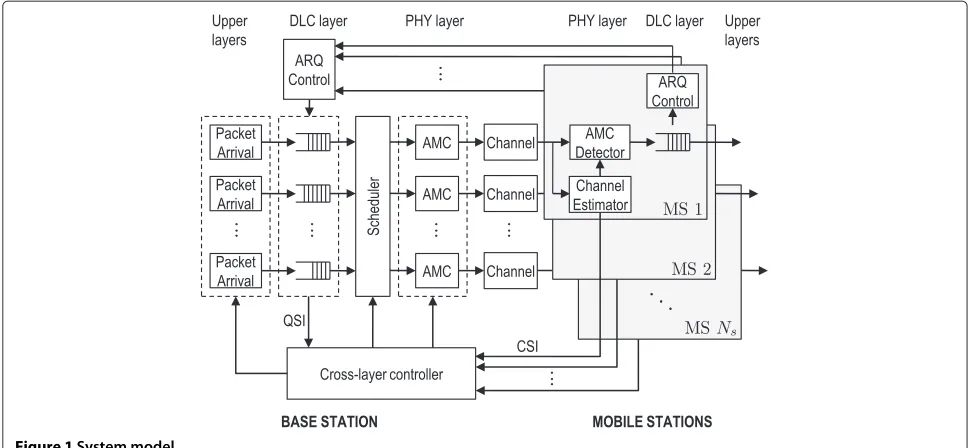
A block diagram of the system under consideration is shown in Figure 1. As it can be observed, the downlink scenario of a wireless system with a base station (BS) servingNsusers is considered. At the BS, there areNs sep-arate radio link level buffers that are used to queue packet arrivals corresponding to every user connected to the BS. These buffers operate in a first-in-first-out (FIFO) fash-ion and can store up toQ= {Q1,. . .,QNs}packets, where Qu is the queue length of useru. The scheduler, based on channel state information (CSI) collected from theNs users and using a time division multiplexing scheme, takes scheduling decisions to allocate transmission opportuni-ties to active users. Adaptive transmission is performed by using an ARQ error control scheme at the DLC layer and an AMC strategy at the PHY layer. The processing unit at the DLC layer is a packet and the processing unit at the PHY layer is a frame. The link is assumed to support QoS-guaranteed traffic characterized by a maximum average packet delayDlmaxand a target link layer packet loss rate
(PLR)Plmax.
The AMC scheme is assumed to have a set Mp =
{0,. . .,Mp−1}ofMppossibletransmission modes (TMs), each of which corresponding to a particular combination of modulation and coding strategies. It is assumed that when the system uses TMn∈Mp, it transmitspn=bRn packets per frame, whereRndenotes the number of infor-mation bits per symbol used by TMnandbis a parameter that determines the number of transmitted packets per frame, which is up to the designer’s choice. For conve-nience, we consider thatp0 < · · · < pMp−1, withp0 = 0
Figure 1System model.
andpMp−1 Cp. As it was shown in [9], depending on the channel conditions and the QoS requirements of the different users, some of theseMp possible TMs may be deemeduseless, and thus, only a setM= {0,. . .,Mu−1} ofMu usefulTMs will be available to the AMC scheme for useru. It will be assumed that when useruis allocated usefulTMn∈Mu, the system transmitsc
npackets and, for convenience, we also consider thatc0< · · ·<cMu−1, withc0≥0 andcMu−1=Cu≤Cp.
A Rayleigh block-fading model [17] is adopted for the propagation channel, according to which the channel is assumed to remain invariant over a time frame intervalTf and is allowed to vary across successive frame intervalsa. Perfect CSI is assumed to be available at the receiver side, and thus, an ideal frame-by-frame TM selection process is performed at the AMC controller of the receiver. Fur-thermore, an error-free and instantaneous ARQ feedback channel is assumed.
As in [5,9-12], we assume that the packet generation of useru adheres to a discrete batch Markovian arrival process (BMAP). As stated by Blondia in [18], a D-BMAP can be described by substochastic matrices Uua, a = 0, 1, 2,. . .,n, of the order Au × Au, with ele-mentsuua(i,j)denoting the probability of a transition from phase i to phase j with a batch arrival of size a and
∞
a=0
Au
j=1uua(i,j)=1. The transition probability matrix can be obtained asUu=∞a=0Uua.
Owing to the Markovian property of the arrival process, we haveωu = ωuUuandωu1Au = 1, whereωudenotes the D-BMAP steady-phase probability vector and1Au is an all-ones column vector of lengthAu. Then, the average arrival rateλucan be calculated as
λu=ωu Au−1
a=0
aUua1Au. (1)
It will be assumed that the average arrival rate to the DLC layer λu is a system parameter that can be con-trolled through a traffic shaping and modeling mechanism in order to comply with the QoS requirements of the system.
2.1 Adaptive modulation and coding
Letγνudenote the instantaneous received signal-to-noise ratio (SNR) of user u at time instant t = νTf. For the assumed Rayleigh block-fading channel model, γνu
can be modeled as an exponentially distributed random variable with mean γu = E{γνu}. Givenγνu, the objec-tive of AMC is to select the TM that maximizes the data rate while maintaining an average PER less than or equal to a prescribed value Pu0. To this end, and according to [3], the entire SNR range is partitioned into a set of nonoverlapping intervals defined by the parti-tion u,m = 0,γ1u,m,γ2u,m,. . .,γMu,mu−1,∞
and TM n
2.2 Two-dimensional Markov channel modeling
Let us define the rate of change of the fading as δνu = γνu−1−γνu. Let us also divide the ranges ofγνuandδνuinto sets of nonoverlapping 2D cells defined by the partitions u,c = 0,γ1u,c,γ2u,c,. . .,γKu,−c1,∞and= {−∞, 0,∞}, respectively. A first-order 2D Markov channel model can now be defined where each state of the channel corre-sponds to one of such cells. That is, the Markov chain state of the channel at time instantt= νTf can be denoted as ζuν =χνu,uν ,ν=0, 1,. . .,∞, whereχνu =kif and only ifγku,c< γνu≤γku+,c1, anduν =0 (oruν =1) if and only if
δνu<0 (orδνu≥0).
In our approach the partitionu,c is designed assum-ing that the observable dummy output of our improved first-order 2D Markov model at time instant t = νTf belongs to a codebook of nominal values of SNRu,c =
1u,c,2u,c,. . .,Ku,c. The Max-Lloyd algorithm [20,21], developed for the optimum design of nonuniform quan-tizers, is then used to determine the partition and code-book minimizing the mean square error betweenγνuand the quantizer output.
2.3 Physical layer 2D Markov model
Based on the TM selection process used by the AMC scheme (which is defined by the partition u,m) and the first-order 2D Markov channel mod-el (which is characterized by the partitions u,c and ), the range of γνu is partitioned into the set of nonoverlapping intervals defined by u,m,c = notes the number of PHY states corresponding to user u, and γ1u,m,c,. . .,γNu,m,cu particular combination of TM and channel state. As in Subsection 2.2, the range ofδνuis also partitioned into the set of nonoverlapping intervals= {−∞, 0,∞}.
Using this 2D partitioning, a first-order 2D Markov model for the PHY layer of userucan be defined where each state corresponds to one of such 2D rectangular-shaped cells. Furthermore, the PHY layer Markov chain state at time instantt=νTf is denoted byςuν =
ϕνu,uν ,
ν = 0, 1,. . .,∞, whereϕuν ∈ {0,. . .,NPHYu −1}represents the combination of TM and channel state in this frame interval anduν ∈ {0, 1}is used to denote theupordownb characteristic of the instantaneous SNR over the time frame intervalt=(ν−1)Tf. At any time instantt=νTf, the PHY layer state can be univocally identified by an inte-ger numberyuν = 2ϕνu+νu, withyuν ∈ {0,. . ., 2NPHYu − 1}, which can be characterized by an steady-state prob-abilityPPHY(yuν) and a corresponding conditional average
PER PERPHY(yuν). Additionally, the PHY layer FSMC will
be characterized by a transition probability matrixHus =
Hiu,j
0≤i,j≤2NPHYu −1
, where Hiu,j = Pr{yuν+1 = j|yuν = i}. Throughout this paper, the steady-state probabilities, the conditional average PERs, and the state-transition prob-abilities have all been computed either numerically or by simulation.
2.4 Joint PHY-MAC layer Markov model
Channel-aware-only schedulers can be incorporated to the joint PHY-MAC Markov model by means of a service-vacation process [14]. When a particular useruis selected for transmission in a given time slot, it is said that this user PHY layer is in service; otherwise, it is said to be on vacation. The parameterzu ∈ {0, 1}is used to denote the service(zu = 0)or vacation(zu = 1)state. The decision wether a useruwill be in service or vacation during the next time slot will depend on the possible PHY layer states of all users in the next time slot and on previous schedul-ing decisions. A D-step memory in the service-vacation process represents the scheduling dependence onD previ-ous decisions and can be used to account for an increased degree of fairness between users.
The joint PHY-MAC layer FSMC state for user u at
time instant t = νTf is denoted by the vector of ran-dom variablesιuν =(zuν,zuν−1,. . .,zνu−D+1,yuν). At any time instant t = νTf, the joint PHY-MAC layer state can be univocally identified by an integer numbernuν withnuν ∈ {0,. . .,NPHY-MACu −1}, whereN
u
PHY-MAC=2
D+1Nu
PHY. The joint MAC-PHY layer will be in state nuν with a steady-state probability PPHY-MACu (n
u
ν). Taking into account that useru
transmits only when it is in service, the different PHY-MAC states will have a transmission rate (TR), measured in packets per slot, ofcnu
ν = cyuν(1−z
u
ν), wherecyu ν is the TR characterizing PHY layer state yuν. Furthermore, the
PHY-MAC layer FSMC will be described by a transition probability matrixPus =
that can be analytically calculated for a significant number of scheduling schemes. Without loss of generality, these probabilities are derived in the following sections for the max-rate and proportional fair algorithms, which, in both cases, can be modeled by a service-vacation process with one-step memory (D=1).
3 The max-rate scheduling example
can attain this maximum rate, the scheduler chooses one of them randomly. Although this case was covered in [14], several modifications are included in our analysis in order to adapt it to the 2D PHY layer model and, also, to gener-alize its application to more realistic scenarios with users experiencing heterogeneous average SNRs.
In one-step memory service-vacation processes,
scheduling decisions only rely on the actual system state, and thus, the state transition probabilities in (2) can be simplified toPui,j = Przuν+1,yuν+1|zuν,yuν. The transition probability matrix can be expressed as
Pus =
PHY) matrix with elements Sui,j(k,l)=Przνu+1=j,yuν+1=l|zνu=i,yuν =k.
Without loss of generality, user u = 1 is considered to be the user of interest and, for notation simplicity, it is assumed that z1ν = zν and y1ν = yν. Taking into
account that the PHY layer and service-vacation processes are independent, the elements of theS1i,j matrices can be written as
the latter term being an element of the PHY layer state transition probability matrixH1s. Moreover, sincezν+1 ∈
{0, 1}, it holds that
cussed. Considering now that the service state at timeν
depends only on the PHY layer state at timeν, it holds that
Przν+1=0|zν =i,yν+1=l,yν =k
Assumingzν = 0, the denominator of (3) can be
calcu-lated as layer is in statek, can only be in service if the rest of users have a PHY layer state with a lower or equal TR. When ausers (including user 1) can transmit at maximum TR, then user 1 is chosen for transmission with a probability 1/a. Thus,
The numerator of (3) can be written as
Przν =z,zν+1=v|yν =k,yν+1=l
In order to obtain the terms inside the summations of this expression, two different cases should be considered:
1. Case 1 (zν+1=0,zν=0). In this case, user 1 is in
service during time slotsνandν+1if its PHY states
in these time slots arek and l, respectively. This will
only happen when the potential TRs of the other
Ns−1users are smaller than or equal to the TRs of
user 1 in PHY statesk and l during time slotsνand
ν+1, respectively. Ifa and b users (including user 1)
can transmit at maximum TR during theνandν+1
time slots, respectively, then user 1 will be granted transmission for both time slots with probability
1/(ab). Therefore, in this case the probabilities in (5)
can be calculated as
transition from the vacation state during time slotν
to the service state atν+1. The service state in time
transmit at maximum TR and user 1 is selected for
transmission with probability1/b. A vacation state
during time slotνcan happen as a result of two
different situations, either there are users with higher
TRs than user 1 ora users (including user 1) can
transmit with the maximum TR and user 1 is not
selected with probability(1− 1a). Then, in case 2, the
probabilities in (5) can be obtained using
Pr{zν=1,zν+1=0,y2ν,. . .,yNνs,yν2+1,. . .,yNν+s1|yν=k,yν+1=l}
4 The proportional fair scheduling example
Originally proposed in the wired network scheduling con-text, a proportional fair (PF) scheduler promises a trade-off between the maximization of average throughput and system fairness. At each time instant, the user experi-encing the highest instantaneous rate with respect to its average rate is scheduled. That is, user q is selected for transmission during time slotνif
q=arg max
ν is the average rate of user u. The scheduler
defined in (8) maximizes the logarithmic sum of system throughput [22]. The average rate can be computed as a moving average over a time window of lengthW, that is,
Tνu+1=
W→∞Tuas the stationary through-put of useruand
Hu=
2NPHYu −1
y=0
cy[ 1−PERPHY(y)]PPHY(y)
as the userueffective channel average rate. In this case, using the results presented by Holtzman in [23] and assuming that the fast fading components of all users in the system are identically distributed, it can be shown thatif the rate of useru is a function of its SNR f(γνu), the fixed point equation described in [23] has a unique solution when the throughputs are proportional to the average rate given byf(γν) =H. Thus, given usersuand
Hu. The transition probability matrix can be constructed as in the max-rate example. Expres-sions (4), (6), and (7) can be rewritten by substituting the
TRscyu
ν with the corresponding PF weightsF
u
ν. Nowaand
bwill denote the number of users with the maximum PF weights during time slotsνandν+1, respectively.
5 Queueing model and analysis
Once the PHY layer and MAC sublayer have been prop-erly modeled, the queuing behavior of the DLC layer has to be introduced in the analysis. Two different techniques are proposed.
5.1 Queuing Markov model-based approach
Following the work described in [9-12], the queueing pro-cess induced by both the ARQ protocol and the AMC scheme can be formulated in discrete time with one time unit equal to one frame interval. Each user’s subsystem states are observed at the beginning of each time unit. Let
σνu=quν,auν,ιuν denote the userusubsystem state at time 1} represents the combination of PHY layer state and scheduling decision for user u during this frame inter-val. Focusing on the set of time instants t = νTf, ν = 0, 1,. . .,∞, the transitions between statesσνuare Marko-vian. Therefore, an embedded Markov chain can be used to describe the underlying queueing process for each useru.
In previous work, we developed the embedded Markov chains describing the underlying queueing process for different AMC schemes, such as the ones described in 802.11 and 802.16 proposals, and different ARQ proto-cols, including infinitely persistent ARQ [9,10], hybrid ARQ [11], and truncated hybrid ARQ [12] schemes. Using the same technique described in Subsection 2.4, the MAC layer can be incorporated to the models described in these papers and the multiuser case could be also analyzed for those systems. In this paper, as an example and without loss of generality, we have used the model developed in [10] using the transmission mode pool of the IEEE 802.11a system combined with an infinitely persistent selective repeat (SR) ARQ procedure and it has been adapted to the multiuser case. The state space of the useru embed-ded finite state Markov chain is Su = Su
Taking into account that infinitely persistent SR-ARQ is used at the DLC layer, and assuming that it is conditioned on the instantaneous channel fading, the transmission outcomes (success or failure) of consecutive packets in a frame interval are independent, and the probability that kpackets of useruare successfully transmitted (leave the queue) givencnu
p(n
Thus, the probability thathpackets are successfully trans-mitted given that there areqpackets in the queue before transmission and the PHY-MAC layer changes from state nuμto statenuμ can be expressed as in (10) capturing all the cases where h packets are successfully transmitted given that there are q pack-ets in the queue before transmission can be express-ed in matrix form as Tuh,q = D
denote a diagonal matrix with the elements of the vectorx in its main diagonal. Notice that forq≥CNu
PHY-MAC−1=C
u,
the probabilities in these matrices do not depend onqand Tuh,q=Tuh,Cu.
Letqμ=qandqμ =q+Au−l−1 be the number of
packets in the queue of useruin two consecutive framesc. Also, letaandhbe the number of arriving packets and the number of packets successfully transmitted in the first one of these frame intervals, respectively. In this case,qμ −
qμ = Au−l−1= a−horh=l−Au+a+1. Thus,
given that 0≤l−Au+a+1≤min{q,Cu}orAu−l−1≤
a ≤ Au −l+ min{q,Cu} −1, and 0 ≤ a ≤ Au −1, the probability that the queueing system changes from a generic stateSμu = (q,aμ,nμ) ∈ Suto another generic
PHY-MACterms capturing all the cases where the queue length changes fromq packets in one frame interval to q+Au−l−1 packets in the next frame interval can be expressed in matrix form as
Auq,l= transition matrix of the Markov chain can then be written as sition probabilities in these matrix blocks do not depend onq, and therefore, for simplicity this index can be omit-ted, that is, Auq,l = Aul and Auq,l = Aul for all q ≥
Cu.
To derive the system performance measures, we need to obtain the steady-state probability vectors correspond-ing to each level of the transition matrix, which can be calculated using the fact that the transition probabil-ity matrix Pu and steady-state probability vectorπu = vector of all ones with the appropriate length. To calcu-lateπu, the method described by Le et al. in [5] is used to reduce the complexity in solving the matrixPu.
5.2 Performance measures
In our finite buffering ARQ-based error control system with infinite persistence, the PLR of useru,Plu(measured in packets per second), is simply equal to the buffer over-flow probability. As in [5], we denote byVuk the stationary vector describing the probabilities thatkpackets are lost due to buffer overflow upon arrival of a burst of data pack-ets. Assuming that a batch ofapackets arrive at the link layer buffer, if there areq> Qu−apackets in the queue at the end of the previous frame interval andhpackets are successfully transmitted, then the number of packets that will be lost due to buffer overflow isk=a−h−Qu+q. Therefore,Vuk can be written as
Vuk =
The PLR of user u can then be calculated as the ratio between the average number of lost packets due to buffer overflowNluand the average number of arriving packets
λuin one frame interval, that is,
Pul =Nlu/λu =(1/λ)
Au−1
k=1
Given the PLR, the average throughput (measured in packets per frame) can be calculated as
ηu=λu(1−Pul). (16)
Then, using the well-known Little’s formula [24], the aver-age delay can be calculated as
Dul =Luq/λ(1−Pul)=Luq/ηu, (17)
whereLuqdenotes the average number of packets in queue
of useru, which can be obtained asLuq=Q u
q=1qπuq1.
5.3 Effective bandwidth/capacity-based approach The DLC layer can also be modeled by applying the effective bandwidth/capacity-based approach [16]. The effective capacity and effective bandwidth allow the anal-ysis of the so-called PLR bound probability. The analanal-ysis is analogous to the one developed in [10]. The effective bandwidth of the D-BMAP arrival process of useru, char-acterized by a transition matrixUu, can be calculated as [25]EuB(ψ )= ψ−1log(ϒUu(ψ )), whereϒUu is the Perron-Frobenius eigenvalue of the matrix Uu = D(u)Uu,
with
eλu0ψ,. . .,eλuAu−1ψ, where λu
n denotes the number of packets per frame generated when the source
of user uis in staten. The effective capacity of the ser-vice process that models the behavior of the MAC and PHY layers for the user of interest, which is character-ized by a transition probability matrixPus, can be obtained asEuC(ψ ) = −ψ−1log(ϒPu(−ψ )). In this expression,ϒPu
denotes the Perron-Frobenius eigenvalue of the matrix
Puυν = D(υ
u
ν)Pus, with υuν
e−˘cu0ψ,. . .,e−˘cu(4NuPHY−1)ψ, wherec˘un denotes the number of packets per frame leav-ing the queue when the PHY-MAC for useruis in state n, which, for an SR-ARQ infinitely persistent scheme, can be calculated as c˘nu = cnu
k=0kp
(nu)
k,cnu with p
(nu) k,cnu defined in (9).
The effective bandwidth/capacity-based approach can only provide statistical QoS guarantees. For instance, the target link layer PLRPlmax can only be guaranteed with
a small violation probability, that is, Pr{Plu ≤ Plmax} ≈
κue−ψu∗Plmax ≤ , whereψu∗is the unique real solution of EuB(ψ )−EuC(ψ )= 0 andκuis the relation between aver-age arrival rateAu limψ→0EuB(ψ )and average service rateSu limψ→0EuC(ψ ), as shown by Tang and Zhang in [26]. It is worth stating at this point that except for low input data rates, the tail probability tends to overesti-mate the packet loss probability and it can only be used as
long asA S. Then, the throughput of userucan be calculated as
ηu=λu(1−Pul)≈λu(1−κue−ψu∗Q u
).
6 Cross-layer design
Given the sets of maximum allowable queue lengthsQ= {Q1,. . .,QNs}, average SNRs γ¯ = { ¯γ1,. . .,γ¯Ns}, nor-malized maximum Doppler frequencies fdTf with fd = {fd1,. . .,fNs
d }, and assuming the use of the MR algorithm in the MAC layer, the derived PHY-MAC-DLC model basi-cally depends on both the set of prescribed average PERs P0 = {P10,. . .,PN0s}, withP0u being a real number in the range =[ 0, 1], and the set of measured or estimated arrival packet rates λu ∈ , where is the range of feasible arrival rate values controlled by the traffic shap-ing mechanism. Thus, if the users in the system are to support QoS-guaranteed traffic characterized by a max-imum PLR Plmax and a maximum average packet delay Dlmax, the proposed cross-layer design must aim at
deter-mining the prescribed average PER vectorP0and average packet arrival rate vector λ = {λ1,. . .,λNs} solving the constrained optimization problem given by
P0opt,λopt =arg max P0∈,λ∈ˆ
Ns
u=1
ηu(P0,λ)
subject toPul(P0,λ)≤Plmax, ∀u Dul(P0,λ)≤Dlmax, ∀u.
(18)
A similar cross-layer design can be derived for the PF algorithm, but taking into account that this algorithm maximizes the logarithmic sum of throughput, the opti-mization function must be designed accordingly as
P0opt,λopt =arg max P0∈,λ∈ˆ
Ns
u=1
log(ηu(P0,λ)). (19)
In both cases, the analytical expressions forηu,Plu, and Dul do not leave much room for developing efficient algo-rithms in solving our constrained optimization problem. However, considering that P0 and λ lie in a bounded space u × u, a multidimensional exhaustive search can be used to numerically solve the proposed cross-layer optimization problem.
7 Numerical results
In order to verify the validity of the proposed cross-layer framework, analytical results will be confronted with computer simulation results obtained using Clarke’s statistical Rayleigh fading model of the wireless flat-fading channel [27]. Unless otherwise specified, numerical results are presented for the following default parameters: a normalized maximum Doppler frequencyfdTf =0.02, a queue lengthQ=50, a number of channel statesK=10,
a parameter b = 2, and a D-BMAP parameterized to
obtain a truncated Poisson process with a variable average arrival rateλ. These parameters apply to all users in the system.
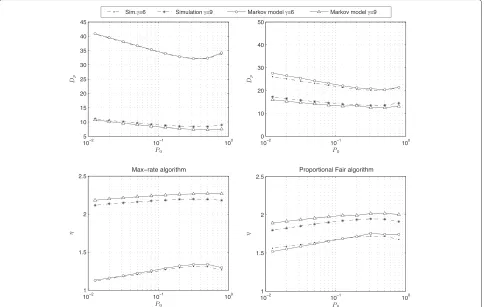
Figure 2 shows the dependence of the average delayDul and throughputηuon the target average PERPu0of the two users in the system. In this figure,P10 andP20 have been set to a common valueP0in order to show the
analyt-ical and simulation results of both users simultaneously. As it can be observed, in all cases, the behavior of the simulation of the system under consideration with differ-ent scheduling algorithms, namely the MR algorithm (left) and the PF algorithm (right), is faithfully reproduced by our analytical PHY-MAC-DLC layer model. In particular, it is interesting to note how the shape and location of the minimum/maximum of the curves obtained by simulation (Clarke’s model) coincide with those obtained using the analytical framework, even for a small number of chan-nel statesK. The accuracy in determining the location of the maximum of the throughput and the minimum of the average packet loss rate or the average packet delay is par-ticularly important in order to ensure an optimal cross-layer design. Regarding the scheduling performance, it can be observed in Figure 2 that, as expected, PF attains higher fairness at the expense of a global throughput loss.
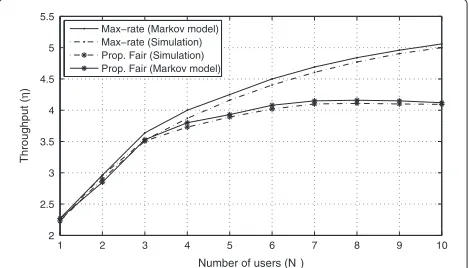
Figure 3 shows the system sum throughput as a func-tion of the number of active users in the system when using either the MR or the PF scheduling algorithm. Results presented in this figure have been obtained by placingNsusers on the coverage area at distancesR/(Ns+ 1), 2R/(Ns+1),. . .,NsR/(Ns+1)from the BS, whereR denotes the cell radius. The traffic arrival for each active user in the system has been modeled as a D-BMAP param-eterized to obtain a truncated Poisson process with an average arrival rateλ 3 packets/frame. Furthermore, the target PER has been set toPu0 = 10−0.4, for allu ∈ {1,. . .,Ns}. As it can be observed, the sum throughput increases with the number of active users in the system.
1 2 3 4 5 6 7 8 9 10
2 2.5 3 3.5 4 4.5 5 5.5
Number of users (Ns)
Throughput (
η
)
Max−rate (Markov model) Max−rate (Simulation) Prop. Fair (Simulation) Prop. Fair (Markov model)
However, it can also be seen that the sum throughput gain is subject to the diminishing capacity returns as the number of users increases. Furthermore, as expected, Figure 3 shows that the MR algorithm achieves a higher
sum throughput in comparison with the PF strategy, at the cost of unfair treatment of the arriving traffic flows.
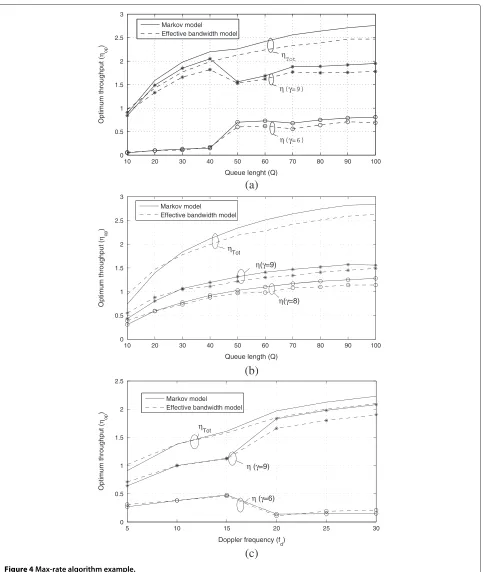
Figure 4a,b,c shows the system sum throughput and per-user throughput when applying the cross-layer
optimi-10 20 30 40 50 60 70 80 90 0
0.5 1 1.5 2 2.5 3
Queue lenght (Q)
Optimum throughput (
η op
)
Markov model Effective bandwidth model
η(γ=6) η(γ=9)
ηTot
10 20 30 40 50 60 70 80 90 100 100
0 0.5 1 1.5 2 2.5 3
Queue length (Q)
Optimum throughput (
η op
)
Markov model Effective bandwidth model
ηTot
η(γ=9)
η(γ=8)
5 10 15 20 25 30
0 0.5 1 1.5 2 2.5
Doppler frequency (fd)
Optimum throughput (
η op
)
Markov model
Effective bandwidth model
η (γ=9)
η (γ=6) ηTot
(a)
(b)
(c)
zation defined in (18) for the MR algorithm. These figures have been obtained applying a maximum affordable PLR Plmax ≤ 0.01 and using either a Markov model or the effective bandwidth/capacity-based approach to model the DLC buffer behavior as described in Section 5. As expected, the effective bandwith approximation tends to overestimate the PLR, thus predicting a lower throughput than the Markov model except for low input data rates. The optimization process further increases the aggre-gate throughput of the MR policy while maintaining a desired level of QoS in the form of a maximum PLR. This is accomplished by tuning the PHY layers of the users through theP0u parameters and shaping the users’ average arrival rate λu. Figure 4a reveals that for short queue lengths (Q < 50), the higher sum throughput is obtained by assigning a very low P0 to the user with a
lower average SNR (γ =6 dB), which results in a very low throughput for that user. The same behavior is observed in Figure 4c for high Doppler frequencies (fd > 20 Hz).
When the queue length increases or the Doppler fre-quency decreases, the system achieves higher capacity by assigning similarP0values to both users and the
through-put of the lower SNR user increases accordingly. Logically, when both users are subject to similar average SNR val-ues, as shown in Figure 4b, the maximum sum throughput is always achieved by assigning similarP0values.
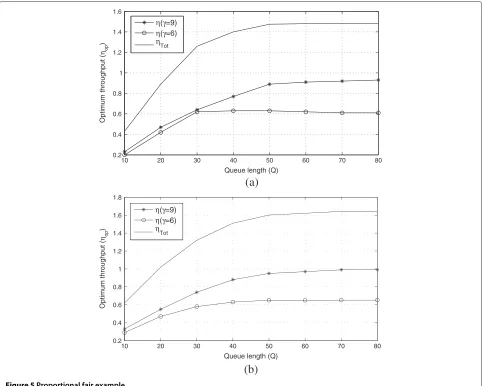
Figure 5a,b shows the aggregated and per-user through-puts obtained when applying the cross-layer optimization defined by (19) for the PF algorithm. Results presented in Figure 5a have been derived using a maximum packet loss constraintPlmax≤0.01 and a maximum average delay constraintDlmax ≤ 10. As expected, for low values of the queue length,Q<40, the constraint limiting the through-put is the packet loss, which is mainly caused by the buffer overflow, and therefore, the throughput increases withQ. For higher queue lengths,Q>50, the limiting constraint is the maximum average delay, and in this case, addi-tional increases in the queue length have a negligible effect
10 20 30 40 50 60 70 80
0.2 0.4 0.6 0.8 1 1.2 1.4 1.6
Queue length (Q)
Optimum throughput (
ηop
)
η(γ=9) η(γ=6) ηTot
10 20 30 40 50 60 70 80
0.2 0.4 0.6 0.8 1 1.2 1.4 1.6 1.8
Queue length (Q)
Optimum throughput (
ηop
)
η(γ=9) η(γ=6) ηTot
(a)
(b)
over the throughput. Figure 5b depicts results obtained when using an optimization performed using the effec-tive bandwidth model formulated in (19). In this case, the constraint in (19) has been modified to Pr{Dul(P0,λ) ≥ Dlmax} ≤ ∀u, as the effective bandwidth theory only offers statistical QoS guarantees. The specific values of the constraint used to generate this figure are Pr{Dul ≥50} ≤ 0.01 ∀u. Results presented in Figure 5b show a similar behavior as those in Figure 5a. For a queue length below Q=50, the limiting constraint is the PLR, and therefore, the throughput increases withQ. In contrast, forQ>50, the active constraint is the maximum affordable delay, which does not depend on the queue length, causing the throughput to remain nearly constant with respect to the queue length.
8 Conclusions
This paper extends the analytical framework presented in [10] to incorporate the MAC sublayer in the proposed analytical model that now includes a multiple-user-shared channel scenario. Channel-aware-only schedulers have been embedded in a joint PHY-MAC Markov model by using a service-vacation process to model the schedul-ing decisions. Two widely used schedulschedul-ing rules have been considered, the MR and PF algorithms. As in [10], two different approaches have been used to model the DLC level queueing behavior: an analytical Markov model and an approach based on the effective bandwidth the-ory. Results show that the use of the effective band-width approach significantly simplifies the global model and is therefore an interesting technique to use by the resource allocation algorithms. Numerical examples con-firm that the derived performance metrics obtained with the PHY-MAC-DLC analytical model faithfully reproduce simulation results. It is important to point out that the multiple user model obtained in this paper can be easily adapted to include truncated or hybrid ARQ techniques in the DLC layer as it was proposed in [11,12]. Finally, a cross-layer design interrelating the PHY, MAC, and DLC layers has been described. The obtained results show the potential of cross-layer resource allocation designs where slot-by-slot decisions are left to simple and efficient channel-aware schedulers, such as the MR or PF algo-rithm, while QoS control is performed at a higher level by well-selected optimization functions. These optimization functions enhance and complement the scheduling algo-rithms while maintaining an adequate QoS performance by modifying average parameters of the different layers in the system. The proposed cross-layer approach fits in the radio resource management (RRM) framework proposed for state-of-the-art networks such as LTE that define a division between fast dynamic layer 1 and layer 2 RRM functions working at the transmission time interval level and semi-dynamic layer 3 RRM procedures.
Endnotes
aIt is assumed in this paper that the frame duration is
smaller than the coherence time of the channel. bIfγu
ν < γνu−1, then the instantaneous SNR is
descending and it can be tagged asdown(δuν =1); on the contrary, ifγνu≥γνu−1, then the instantaneous SNR is ascending and it can be tagged asup(δuν =0).
cThe maximum number of packet arrivals in one frame
interval is equal toAu−1, and the maximum number of successfully transmitted packets in one frame interval is equal to min{q,Cu}; thus, it is quite obvious that qμ−min{q,Cu} ≤qμ ≤qμ+Au−1 or
0≤l≤Au+min{q,Cu} −1.
Competing interests
The authors declare that they have no competing interests.
Acknowledgments
This work has been partially funded by MEC and FEDER through project COSMOS (TEC2008-02422) and project AM3DIO (TEC2011-25446).
Received: 28 January 2013 Accepted: 30 July 2013 Published: 23 August 2013
References
1. Q Liu, S Zhou, GB Giannakis, Cross-layer combining of adaptive modulation and coding with truncated ARQ over wireless links. IEEE Trans. Wireless Commun.3(5), 1746—1755 (2004)
2. Q Liu, S Zhou, GB Giannakis, Queuing with adaptive modulation and coding over wireless links: cross-layer analysis and design. IEEE Trans. Wireless Commun.4(3), 1142–1153 (2005)
3. Q Liu, S Zhou, GB Giannakis, Cross-layer scheduling with prescribed QoS guarantees in adaptive wireless networks. IEEE J. Selected Areas Commun.23(5), 1056–1066 (2005)
4. LB Le, E Hossain, AS Alfa, Service differentiation in multirate wireless networks with weighted round-robin scheduling and ARQ-based error control. IEEE Trans. Commun.54(2), 208–215 (2006)
5. LB Le, E Hossain, AS Alfa, Radio link level performance evaluation in wireless networks using multi-rate transmission with ARQ-based error control. IEEE Trans. Wireless Commun.5(10), 2647–2653 (2006) 6. F Ishizaki, GU Hwang, Cross-layer design and analysis of wireless networks
using the effective bandwidth function. IEEE Trans. Wireless Commun. 6(9), 3214–3219 (2007)
7. M Poggioni, L Rugini, P Banelli, inProceedings of the IEEE Global Telecommunications Conference (GLOBECOM). Analyzing performance of multi-user scheduling jointly with AMC and ARQ (Washington, D.C., 26), pp. 3483–3488
8. X Wang, Q Liu, GB Giannakis, Analyzing and optimizing adaptive modulation coding jointly with ARQ for QoS-guaranteed traffic. IEEE Trans. Veh. Technol.56(2), 710–720 (2007)
9. J Ramis, L Carrasco, G Femenias, inProceedings of the IEEE GLOBECOM. A two-dimensional Markov model for cross-layer design in AMC/ARQ-based wireless networks (New Orleans, 30 Nov–4 Dec 2008), pp. 4637–4642 10. G Femenias, L Carrasco, J Ramis, Using two-dimensional Markov models
and the effective-capacity approach for cross-layer design in AMC/ARQ-based wireless networks. IEEE Trans. Veh. Technol.58(8), 4193–4203 (2009)
11. J Ramis, G Femenias, F Riera-Palou, L Carrasco, inProceedings of the IEEE GLOBECOM. Cross-layer optimization of adaptive multi-rate wireless networks using truncated chase combining HARQ (Miami, 6–10 Dec 2010) 12. J Ramis, G Femenias, Cross-layer design of adaptive multirate wireless
networks using truncated HARQ. IEEE Trans. Veh. Technol.60(3), 944–954 (2011)
14. LB Le, E Hossain, AS Alfa, Delay statistics and throughput performance for multi-rate wireless networks under multiuser diversity. IEEE Trans. Wireless Commun.5(11), 3234–3243 (2006)
15. J Liu, W Chen, Z Cao, YJ Zhang, Delay optimal scheduling for cognitive radios with cooperative beamforming: a structured matrix-geometric method. IEEE Trans. Mobile Comput.11(8), 1412–1423 (2012) 16. D Wu, R Negi, Effective capacity: a wireless link model for support of
quality of service. IEEE Trans. Wireless Commun.2(4), 630–643 (2003) 17. E Biglieri, G Caire, G Taricco, Limiting performance of block fading
channels with multiple antennas. IEEE Trans. Inf. Theory.47(4), 1273–1289 (2001)
18. C Blondia, A discrete time batch Markovian arrival process as B-ISDN traffic model. Belgian J. Oper. Res. Stat. Comput. Sci.32(3/4), 3–23 (1993) 19. IEEE,802.11: Standard for Wireless LAN Medium Access Control (MAC) and
Physical Layer (PHY) Specifications. (IEEE, New York, 1997) 20. J Max, Quantization for minimum distortion. IRE Trans. Inf. Theory.
IT-6, 7–12 (1960)
21. SP Lloyd, Least squares quantization in PCM. IEEE Trans. Inf. Theory. IT-28, 129–137 (1982)
22. KKH Kim, Y Han, inProceedings of the IEEE PIMRC. An efficient scheduling algorithm for QoS provision in wireless packet data transmission (Lisboa, 15–18 Sept 2002), pp. 73–77
23. J Holtzman, inProceedings of the IEEE PIMRC. Asymptotic analysis of the proportional fair algorithm (San Diego, 30 Sept–3 Oct 2001), pp. F33—F37 24. L Kleinrock,Queuing Systems,vol. 1. (Wiley, New York, 1975)
25. C Chang (ed.),Performance Guarantees in Communication Networks, 1st edn. (Springer, Berlin, 2000)
26. J Tang, X Zhang, Cross-layer modeling for quality of service guarantees over wireless links. IEEE Trans. Wireless Commun.6(12), 4504–4512 (2007) 27. RH Clarke, A statistical theory of mobile radio reception. Bell Syst. Tech. J.
47(6), 957–1000 (1968)
doi:10.1186/1687-1499-2013-213
Cite this article as:Carrascoet al.:Channel-aware MAC performance of
AMC-ARQ-based wireless systems.EURASIP Journal on Wireless
Communica-tions and Networking20132013:213.
Submit your manuscript to a
journal and benefi t from:
7Convenient online submission
7 Rigorous peer review
7Immediate publication on acceptance
7 Open access: articles freely available online
7High visibility within the fi eld
7 Retaining the copyright to your article