R E S E A R C H
Open Access
Segmentation of PolSAR image by using an
automatic initialized variational model and a
dual optimization approach
Zongjie Cao
*, Ying Tan and Jilan Feng
Abstract
This paper presents a variational model based segmentation approach for polarimetric synthetic aperture radar (PolSAR) images. The formulation for PolSAR image segmentation is based on a scaled Wishart distribution based continuous Potts model, which can partition the image domain into distinct regions with respect to the statistical property of PolSAR data. To make the segmentation efficient, a duality based optimization approach is utilized to minimize the energy functional. Moreover, an automatic initialization approach which takes the unsupervisedH–a
classification result of the polarimetric data as input is used to initialize the segmentation process. This approach can estimate the appropriate number of clusters and the corresponding classification map for the PolSAR data, which are used as the input of the following variational segmentation approach. In such a way, the proposed approach is carried out in a fully unsupervised way. Both of the polarimetric decomposition features and the statistical characteristics are used to get the final segmentation result, which helps to increase the accuracy. Experimental results demonstrate the effectiveness of the proposed approach. Without any artificial supervision, the proposed approach can produce superior segmentation results than results obtained with random initialized variational approach andWishart–H–aclassification approach.
Keywords:PolSAR Image segmentation, Variational model, Primal-dual method, Polarimetric decomposition, Automatic initialization
1. Introduction
Segmentation is an important step for SAR image pro-cessing and interpretation. It can provide useful informa-tion for many SAR applicainforma-tions such as automatic target recognition, classification, crop monitoring and so on. SAR images are inherently corrupted by speckle noise, which degrades the quality of SAR data and makes the segmentation of SAR images difficult. Speckle filters, such as Lee filter and Frost filter, can be used to smooth the speckle noise before segmentation [1,2]. However, speckle reduction methods also cause information loss, which is undesired for further processing. Other methods based on wavelet transform and multi-scale analysis are also utilized for SAR image segmentation [3]. Neverthe-less, there is no universal segmentation methods exist due to the variety and complexity of SAR images.
The emergence of variational methods provides an-other sort of methods for SAR image segmentation. Using of variational models for image segmentation started from the application of Snakes model [4], and got a great advancement when Osher and Sethian put forward the level set method [5]. I. B. Ayed et al. [6] proposed a level set based SAR image segmentation method. The energy functional for SAR image segmenta-tion is built based on the Gamma distribusegmenta-tion, which can model the statistical property of SAR data. Then they extended their level set based SAR image segmenta-tion approach to deal with PolSAR image segmentasegmenta-tion [7]. PolSAR images are different from single-channel SAR images in the data storage form. The vector or matrix valued PolSAR data brings new issues such as data modeling and computational complexity. In [7], the segmentation of PolSAR images is tackled by taking ad-vantage of the scaled Wishart distribution of coherency matrix and a multi-phase level set approach. Although * Correspondence:[email protected]
School of Electronic Engineering, University of Electronic Science and Technology of China, Chengdu, Sichuan 611731, People's Republic of China
this methods shows effectiveness for PolSAR image seg-mentation, there are still spaces to explore. Firstly, the level set method is known to be time-consuming, espe-cially for multi-phase image segmentation. Furthermore, the signed-distance function based representation makes the energy functional to be non-convex with respect to the level set functions, which causes energy optimization issues such as the existence of local minimum. Last but not the least, artificial supervision is still a crucial factor for obtaining satisfactory segmentation results for pre-vious variational PolSAR image segmentation approa-ches. The number of clusters is often pre-determined by subjective observation. Due to the existence of local mi-nimum, a good initialization is also in need because dif-ferent initializations may lead to difdif-ferent segmentation results.
In order to deal with the aforementioned problems, in this paper a variational model based PolSAR image seg-mentation approach is presented. First of all, based on the continuous Potts model, the energy functional for PolSAR images is established by taking advantage of the scaled Wishart distribution of the coherency matrix. In this model, clusters are represented by indicator func-tions. Compared to level set based region representation, using of cluster indicator functions is more direct and clear. It also makes it possible to relax the energy func-tional to be convex, which is a great advantage for opti-mizing consideration. The scaled Wishart distribution based energy is minimized with a duality based ap-proach, which has shown its efficiency for optimizing continuous Potts model based energies [8]. This ap-proach can obtain global optimal value for the Potts model, which is a desired property for the segmentation of PolSAR images with complex scene. Nevertheless, in the approach of [8], the feature model parameters for every cluster should be estimated before the energy mi-nimization is performed. The number of clusters also needs to be determined. This difficulty is tackled by using a polarimetric decomposition based automatic ini-tialization technique [9]. Cloude and Pottier [10] pro-posed an unsupervised classification method by using
the H–a decomposition. The H–a plane which
re-presents the scattering mechanisms is divided into eight zones, resulting in the partition of terrains with different physical scattering characteristics. This method is un-supervised but the result is rough due to the effect of speckle noise. The output of this rough classification could be used as initialization conditions for other more sophistic classification methods. However, the optimal number of clusters is not always equal to eight. So another step is added to estimate the appropriate num-ber of clusters. The automatic initializing step brings two benefits. Firstly, the number of clusters and the initialization statement for the segmentation are both
determined by PolSAR data itself. As a result, the pro-posed PolSAR image segmentation approach is fully unsupervised. A good initialization also increases the ef-ficiency of the segmentation process. Secondly, the proposed approach combines the polarimetric decom-position based classification method and the statistical based variational segmentation method together. This means different features are integrated into the proposed approach to determine the final segmentation result, which helps to increase the segmentation accuracy.
The outline of this paper is as follows: In Section 2, the proposed variational segmentation approach is pre-sented, including the scaled Wishart distribution based Potts model and the duality based optimizing method. The H–a decomposition based automatic initialization method is introduced in Section 3. In Section 4, the experiments are carried out by using the real polarimet-ric SAR datas collected by AIRSAR and UAVSAR. The effectiveness of the proposed PolSAR segmentation ap-proach is verified. Results of several other methods,
in-cluding the Wishart–H–a classification method and
traditional variational segmentation method with ran-dom/artificial initialization, are also provided and compared with the result of the proposed approach. The paper is concluded in Section 5.
2. The proposed segmentation model
In this section, the energy functional for PolSAR image segmentation and the energy minimization approach is introduced. The energy functional is based on the continuous Potts model, but makes use of the scaled Wishart distribution, which is suitable for modeling the statistical property of PolSAR data. The established en-ergy is minimized with a duality based method.
2.1. Scaled Wishart distribution and maximum likelihood classification of PolSAR data
The data of fully polarimetric SAR is collected and stored in the scattering matrix S. Each element Spq re-presents the complex scattering coefficient of transmit-ting polarization state pand receiving polarization state
q. By using the Pauli decomposition, the scattering matrix S can be transformed into a scattering vector k. For the reciprocal backscattering case Shv=Svhthe scat-tering vector can be written as
k¼ 1ffiffiffi
2
p ½ShhþSvv; ShhSvv; 2ShvT ð1Þ
After multi-look processing, the coherency matrix is given as
T¼1 l
Xl
i¼1
wherel is the number of looks, * is the complex conju-gate andkis thei–thsample scattering vector.
Assuming that the scattering vector has a Gaussian distribution, the coherency matrix could have a scaled Wishart distribution withndegrees of freedom, i.e.
pðT;CÞ ¼n
qnj jTnq
exptr n C1T
K nð ;qÞj jCn ð3Þ
where K(n,q) =π(1/2)q(q−1)Γ(n)⋯ Γ(n−q+ 1), tr is the operator to compute the trace of a matrix, the polari-metric dimension q= 3 for the reciprocal case, andCis the cluster center coherency matrix.
The PolSAR data can be classified according to the maximum-likelihood (ML) criterion. Define the distance between one PolSAR data sampleTand a cluster center
Cias: of thei–thcluster,mis the number of clusters. The pixel belongs to thei–thcluster if
dmðT;CiÞ<dm T;Cj
;j¼1;. . .;m;j≠i ð5Þ
then the images can be classified by using equation (5) if the cluster center is given. However, the pixel based ML classification is easy to be affected by speckle noise. Vari-ational segmentation models add another regularization term to overcome the impact of speckle noise.
2.2. Scaled Wishart distribution based Potts model One of the widely used variational models for image seg-mentation is the Potts model [11] which was proposed by Potts in 1952. It can partition the continuous domain into disjoint subdomains by minimizing [8]:
min characteristic of the i–th subdomain, |∂Ωi| expresses the length of the boundaries of subdomainsΩi.
Let functionui(x,y)∈[0, 1] denotes the indicator func-tion of disjoint subdomains Ωi,i= 1. . .m. The function
fi(x,y) is defined as the distance between one PolSAR data sample T(x,y) and the mean coherency matrix of thei–thregionCi:
fiðx;yÞ ¼dðT;CiÞ ¼Inj j þCi tr Ci1T
ð7Þ
Then the scaled Wishart distribution based Potts en-ergy functional can be written as follows:
min
2.3. Energy minimization by using a dual method
E. Bae et al. [8] proposed a dual method to minimize the Potts model. We adopt this method to minimize our scaled Wishart distribution based segmentation energy for the sake of computational efficiency.
The minimization of the total variation (TV) term in (8) can be converted to a max problem [12,13]:
λ∬
Ωj∇ujdxdy¼ maxp∈Cλ ∬Ω∇u⋅pdxdy¼maxp∈Cλ ∬Ωudiv pð Þdxdy ð10Þ
wherepis an auxiliary variable. The discrete divergence operator div:Y→X is defined by div=− ∇* (∇* is the adjoint operator of ∇). For every p ∈ Yand u ∈ X we haveh −divp,uiX=hp,∇uiY. IfYand X be the same set, the second equal sign in formula (10) is established. In the rest of this paper, the variable u is called primal variable and pis called dual variables [8]. According to the max-min theorem in references [14] and the con-straint of ui(x,y) in formula (9), equation (8) can be changed into the following format, i.e. the dual model:
max
As the dual model (11) is smooth and non-differentiable, the minimization is difficult. To deal with this problem, E. Bae et al. [8] proposed an smooth ap-proximation model. This apap-proximation is based on the observation that one could use a function g (u) to
ap-proximate an asymptotic function g∞ via g1¼
max
The smooth Potts model (12) can be efficiently solved by a projected gradient algorithm. The basic idea of the projected gradient algorithm is that maximum the dual model (12) with respect to the variables pi,i= 1,. . .,m
can be decomposed into two steps. At the first step, the variables pi,i= 1,. . .,m are updated by using the gradient-descend algorithm. Then they are projected into the domain Cλ. This algorithm can be summarized
as Algorithm 1 [8]:
Algorithm 1:
Where Projc is the projection operator to the convex setC;
(6) Repeat step (2)-(5) until some convergence crite-rion is satisfied;
Because the energy incorporates the definitionfi=fi(x,
y) =d(T,Ci), this algorithm is suitable for PolSAR image segmentation. However, this algorithm requires the ini-tial value of ui,i= 1,. . .,m as input. Thus the initia-lization is a key issue for the segmentation. In the next section, an automatic initialization approach is intro-duced for initializing the segmentation process.
3. Automatic initialization of the segmentation The initialization plays a crucial role in the segmentation of PolSAR images. As the number of clusters is an im-portant parameter in segmentation [9], most segmenta-tion methods about fully polarimetric SAR data use a predefined number of clusters. However, to determine the number of clusters by subjective observation is not
suitable for processing huge amount of PolSAR data. In practice, it is preferred to determine the number of clusters automatically based on the property of fully po-larimetric SAR data. There are several methods for adap-tive clustering, which can select the optimal number of clusters [15-17]. For PolSAR data, the H-α decompos-ition [10] based classification methods can partdecompos-ition the data into 8 clusters in an unsupervised manner. Al-though the classification result is rough due to the impact of speckle noise, it can still provide a good initialization of other sophistic classification methods. However, the number of clusters is fixed to 8, which is not always the truth for PolSAR images with various scenes. In the work of Cao et al. [9], the authors stated a method to get the appropriate number of clusters and the corresponding classification map. They use the SPAN/H/a/A initialization method to define the value of the M. In this paper, we just use the H/a initialization method to determine the value of M and adopt the si-milar method to define the number of the clusters. The experiment results demonstrate that this initialization method of M = 8can also get a good segmentation re-sults. In the next parts, the H-α decomposition and automatic initialization method will be presented.
3.1. Cloude-pottier decomposition
The Cloude-Pottier decomposition is based on the eigenvalue analysis of the polarimetric coherence matrix
T [10]. Due to the matrix T is a positive semi-definite Hermite matrix,Tcan be decomposed into the following format: matrixU3can be written as:
U3¼ the targets phase angles.
Equation (16) can be further decomposed into
T¼λ1e1e1Tþλ2e2e2Tþλ3e3e3T ð18Þ where eiare eigenvectors of matrixT.
H¼ X
The entropy H characterizes the randomness of the
target scattering. When H is low, the medium can be
considered as weakly depolarizing, and a dominant scattering mechanism exists, which corresponds to the largest eigenvalue. When His high, the situation will be opposite and full eigenvalue spectrum should be con-sider. Especially whenH = 1, the scattering degrades to random noise and no information can be acquired by polarimetric observation.
Angleαis a continuous parameter ranging from 00to 900 which represents the average targets scattering mechanism. The definitions of αi,i= 1, 2, 3 are as for-mula (17). Specifically, whenα= 00, the scattering mech-anism can be considered as isotropic scattering. As α increases, the scattering mechanism will move from di-pole scattering (α= 450) to double bounced scattering (α> 450), and finally reach to the dihedral mechanism (α= 900).
3.2. Merge the similar clusters
To estimate the appropriate number of clusters, the similar clusters should be merged to given the classifica-tion map with different number of clusters. To deter-mine if two clusters should be merged, the following hypothesis is made:
COn the basis of formula (3), the likelihood function is:
L
UnderH1hypothesis, it is
LðCj ÞLðϕi CjϕjÞ ¼YNi coherency matrices respectively, Niand Niare the num-ber of data withini-thandj–thcluster respectively, and
i≠j. Let:
then the likelihood-ratio can be expressed as:
Λij¼ L Cjϕiϕj
Taking the logarithm of formula (24), and ignoring the constant terms, the distance measureDm(Ci,Cj) between
CiandCiat them–thiteration can be given by
Then the two clusters with the minimum distanceDm (Ci,Cj) can be merged. Perform the cluster merging pro-cedure recursively until the number of clusters is equal to the permitting minimal number of clusters.
3.3. Estimating the number of clusters
With the classification result of different number of clusters, the optimal number of clusters can be selected as following. Let m be the current number of clusters. Giving a cluster ϕiand the corresponding cluster center
Ci, in accordance with formula (3), the probability dens-ity function ofTcan be written as
pðT;ϕiÞ ¼n
qnj jTnq
exptr n Ci1T
K nð ;qÞj jCin
ð26Þ
For m clusters, the mixture probability density func-tion is: ency matrices, them–thdata log-likelihood can be given by:
Lmð Þ ¼X a non-decreasing function aboutm. As a result the num-ber of clusters cannot be estimated by Lm(X) However, the change in the value of Lm(X) provides useful in-formation for determine the number of clusters. The change of the data log-likelihood can be measured by:
Dmð Þ ¼X Lmþ1ð Þ X Lmð ÞX ð30Þ
Then, the optimum clusters can be decided by using the following expression:
mopt ¼ minfm Dj mð ÞX ≤εg;m¼1;. . .;M1 ð31Þ
Whereεis a small threshold. In the work of Cao et al. [9],εis determined in an automatic way. Here, the value ofεis set in an experiential way, but it can still lead to a reasonable result. Then the appropriate number of clusters is obtained with the minimumDm(X).
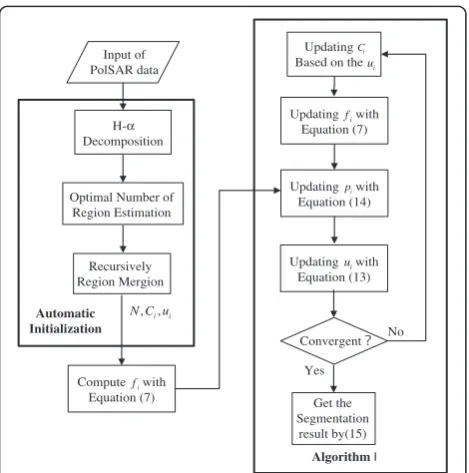
In this paper, the value ofMis 8 as theH–a classifica-tion is used. The classificaclassifica-tion map corresponding to the optimal number of clusters can be also obtained. Then they are feed into the variational segmentation block, which is taken as the initializing condition for the ite-ration minimization process. The whole process of the proposed PolSAR segmentation process is demonstrated in Figure 1.
4. Experimental results
Real PolSAR datas are taken to test the proposed ap-proach. We take the AIRSAR data and UAVSAR data as examples to verify the effectiveness of our method. These data sets are part of real fully PolSAR data sets that collected by the AIRSAR and UAVSAR respectively. The types of both datas are multi-look, and the sizes are 400 × 600 for the two data sets. We don’t use the speckle filter to preprocess them. For the two data sets, we set the threshold asε= 1e−10. When the number has been determined, the automatic initialization can be obtained on the basis of the Section 3. Moreover, the results va-lidate the effectiveness of the automatic initialization approach.
4.1. Segmentation results of AIRSAR data
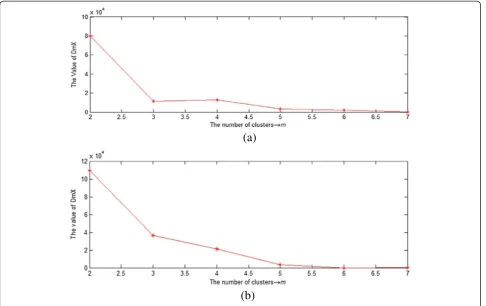
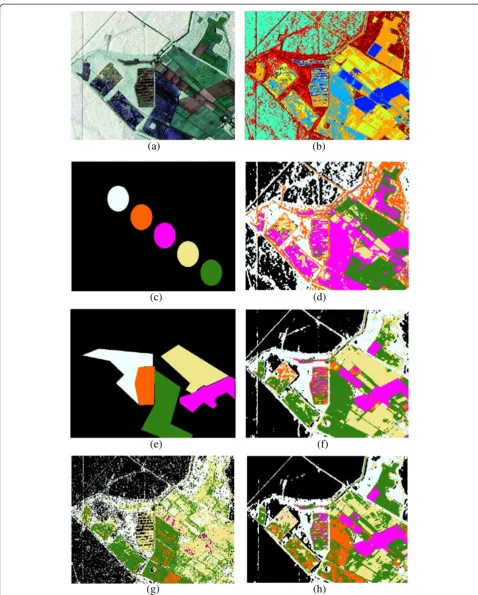
For the AIRSAR data (Flevoland area), the Dm(X) is drawn in Figure 2(a). The chart shows that the optimal number of clusters is seven. Figure 3 presents the seg-mentation results of Flevoland area. The power image and the Wishart–H–a classification result are put in Figure 3(a) and in Figure 3(b) respectively, to make us compare conveniently. In Figure 3(c), one primal vari-able is set as the background, that is the black cluster. The other 6 primal variables are random circles with other six colors. Figure 3(d) is the corresponding seg-mentation result, which is rough due to the unreason-able initialized cluster centers. In Figure 3(d), the orange cluster and green cluster occupy the most areas of the image, some other colors have embedded in the orange cluster and some areas have been mixed with several colors. Thus, the segmentation result in Figure 3(d) shows that this initializing method could not get a rea-sonable result. In Figure 3(e), 6 primal variables are initialized by manual quadrangles and the last one is initialized as the black background. The result is shown in Figure 3(f ). In Figure 3(f ), the white cluster has some pixels that belong to the light green cluster, and some clusters do not have smooth edges. Even though it is realizable to segment the PolSAR data into seven clusters in a general way, the manual quadrangles contain the arti-ficial prior knowledge which is assumed by people. The automatic initialization based on the scaled Wishart
distri-bution and H–a decomposition is in Figure 3(g), and
Figure 3(h) is the corresponding result. The proposed ap-proach unites scattering characteristic with statistical cha-racteristic, resulting in a better segmentation result when there is no a priori knowledge. Clusters are well separated in Figure 3(h) with little cluster mixing phenomenon. The edges are also smooth.
4.2. Segmentation results of UAVSAR data
For the UAVSAR data, from the colored span image that shown in Figure 4(a), it can be observe that this scene is i
covered by 5 or 6 terrain types. In Figure 2(b), the value ofDm(X) with different number of clusters is shown. We can determine the optimal number of clusters is 6 on the basis of the automatic initialization procedure. It is expected to segment this data into 6 clusters, i.e. the white forest, green forest, dark green fields, light green fields, dark red-brown fields, and blue fields. The seg-mentation results of the proposed method and several other PolSAR image segmentation methods are given in Figure 4. In Figure 4(b), the segmentation result of the
Wishart−H–amethod is presented. The impact of spec-kle noise can be clearly observed. Many pixels in the cluster of green forest are misclassified. The segmenta-tion result obtained by using the variasegmenta-tional model with various initialization conditions are also given in Figure 4 (c)-(h). The initialization in Figure 4(c) of primal varia-bles is set to be some circles, which leads that the cluster center coherency matrices are set unreasonable. It can be observed that the segmentation result is poor, as the Figure 4(d) explains. There are some clusters have been mixed, like the black cluster and white cluster. We can’t distinguish the white forest from the green forest. In Figure 4(e), the initialization of primal variable is set ar-tificially as some irregular polygons, the corresponding result is given in Figure 4(f ). Compared to the result in
Figure 4(d), the segmentation is smoother because the cluster center coherency matrices are set artificially in a supervised way. All 6 clusters are well distinguished. But the segmentation result shows that some part of the dark green fields has been divided into the blue fields or the light green fields. The comparison of Figure 4(d) and Figure 4(f ) clearly show the effect of the initial con-ditions on the final segmentation result. So a reasonable initialization is in need. The automatic initialization on the basis of H–a decomposition is as Figure 4(g). The initial value of M is 8. According to the formula (31) and the estimated number of m, the minimum Dm(Ci,
Cj) should be merged until m = 6. The segmentation re-sult is in Figure 4(h), which is close to the rere-sult in Figure 4(f ). This demonstrated the effectiveness of the proposed automatic initialized variational segmentation approach. Moreover, in clusters which have complex scattering mechanism the power image, the segmenta-tion result of the proposed approach can discriminative different scattering mechanisms better than the result in Figure 4(f ).
These results show that the proposed approach is more convictive than the traditional variational segmentation and Wishart–H–a classification approach for segmenta-tions of PolSAR images in a completely unsupervised way.
(a)
(a)
(b)
(c)
(d)
(e)
(f)
(g)
(h)
(a)
(b)
(c)
(d)
(e)
(f)
(g) (h)
5. Conclusion
This paper proposed a novel dual model and an auto-matic initialization approach for the PolSAR image segmentation problems. Since we employ the projected gradient algorithm to segment images, we could get the segmentation results of PolSAR images in a short time. Besides, the results of random initialization and manual quadrangles initialization declare that inappropriate initia-lizations would generate unsatisfactory segmentation re-sults. The automatic initialization includes scaled Wishart distribution andH–adecomposition, which combine scat-tering characteristic with statistical characteristic, giving rise to a better segmentation result. The traditional me-thod don’t use the scattering characteristic, the results in Section 4 show that our automatic algorithm out-performs the general initialization under the condition of unsupervised.
Competing interests
The authors declare that they have no competing interests.
Funding
This work is supported by the Fundamental Research Funds for the Central Universities under Projects ZYGX2009Z005 and the National Natural Science Foundation of China under Projects 61271287.
Received: 24 December 2012 Accepted: 16 January 2013 Published: 19 February 2013
References
1. JS Lee, MR Grunes, SA Mango, Speckle reduction in frequency and multi-polrizationsarimagery. IEEE Trans. Geosci. Remote Sens.29, 534–544 (1997) 2. J Xiao, J Li, A Moody, A detail-preserving and flexible adaptive filter
for speckle suppression in SAR imagery. Int. J. Remote Sens. 24, 2451–2465 (2003)
3. E Mingolla, A neural network for enhancing boundaries and surface synthetic aperture radar images. Neural Networks12(3), 499–511 (1999) 4. M Kass, A Witkin, D Terzopoulos, Snakes: Active contour models. Int. J.
Comput. Vis.4(1), 321–331 (1987)
5. S Osher, J Sethian, Fronts propagating with curvature dependent speed: algorithms based on the hamilton-jacbion formulation. Journal of Computational Physics79(1), 12–49 (1988)
6. IB Ayed, A Mitiche, Z Belhadj, Multiregion level-set partitioning of synthetic aperture radar images. IEEE Trans. Pattern Analysis and Machine Intelligence 27, 793–800 (2005)
7. B Ayed, A Mitiche, Z Belhadj, Polarimetric image segmentation via maximum- likelihood approximationand efficient multiphase level-sets. IEEE Trans. Pattern Analysis and Machine Intelligence28, 1493–1500 (2006) 8. E Bae, J Yuan, XC Tai, Global minimization for continuous multiphase
partitioning problems usingdual approach. Int. J. Comput Vis. 92(1), 112–129 (2011)
9. F Cao, W Hong, Y Wu, E Pottier, An unsupervised segmentation with an adaptive number of clusters using the span/h/α/a space and the complex wishart clustering for fully polarimetric sar data analysis. IEEE Trans. Geosci. Remote Sens.45, 3454–3467 (2007)
10. SR Cloude, E Pottier, An entropy based classication scheme for land applications of polarimetric SAR. IEEE Trans. Geosci. Remote Sens. 35(1), 68–78 (1997)
11. RB Potts, Some generalized order–disorder transformations. Proceedings of the Cambridge PhilosophicalSociety48, 106–109 (1952)
12. A Chambolle, An algorithm for total variation minimization and applications. Journal of MathematicalImaging and Vision20(1–2), 89–97 (2004) 13. Y Meyer,Oscillating Patterns in Image Processing and Nonlinear Evolution
Equations(The Fifteenth Dean Jacqueline B. Lewis Memorial Lectures, Boston, MA, USA: American Mathematical Society, 2001)
14. I Ekeland, R Teman,Convex Analysis and Variational Problems(PA. USA, Society for Industrial and Applied Mathematics Philadelphia, 1999) 15. M Lehsaini, H Guyennet, M Feham, An efficient cluster-based
self-organisation algorithm for wireless sensor networks. International Journal of Sensor Networks7(1–2), 85–94 (2010)
16. AS Raghuvanshi, S Tiwari, R Tripathi, N Kishor, Optimal number of clusters in wireless sensor networks: a FCM approach. International Journal of Sensor Networks12(1), 16–24 (2012)
17. B Singh, DK Lobiyal, An energy-efficient adaptive clustering algorithm with load balancing for wireless sensor network. International Journal of Sensor Networks12(1), 37–52 (2012)
doi:10.1186/1687-1499-2013-34
Cite this article as:Caoet al.:Segmentation of PolSAR image by using
an automatic initialized variational model and a dual optimization approach.EURASIP Journal on Wireless Communications and Networking
20132013:34.
Submit your manuscript to a
journal and benefi t from:
7Convenient online submission 7Rigorous peer review
7Immediate publication on acceptance 7Open access: articles freely available online 7High visibility within the fi eld
7Retaining the copyright to your article