R E S E A R C H A R T I C L E
Ability to understand and correctly follow HIV self-test kit
instructions for use: applying the cognitive interview technique in
Malawi and Zambia
Musonda Simwinga1*, Moses K Kumwenda2*§ , Russell J Dacombe3 , Lusungu Kayira2, Agness Muzumara1, Cheryl C Johnson4,5, Pitchaya Indravudh2, Euphemia L Sibanda6 , Lot Nyirenda3, Karin Hatzold7 ,
Elizabeth L Corbett2,5, Helen Ayles1,8and Miriam Taegtmeyer3
Corresponding author:Moses K Kumwenda, Malawi Liverpool Wellcome Trust Clinical Research Programme, P.O. Box 30096, Chichiri, Blantyre 3, Malawi. Tel: +265 999 981 677. ([email protected])
*These authors have contributed equally to the work.
Abstract
Introduction: The ability to achieve an accurate test result and interpret it correctly is critical to the impact and effectiveness of HIV self-testing (HIVST). Simple and easy-to-use devices, instructions for use (IFU) and other support tools have been shown to be key to good performance in sub-Saharan Africa and may be highly contextual. The objective of this study was to explore the utility of cognitive interviewing in optimizing the local understanding of manufacturers’IFUs to achieve an accurate HIVST result.
Methods: Functionally literate and antiretroviral therapy-naive participants were purposefully selected between May 2016 and June 2017 to represent intended users of HIV self-tests from urban and rural areas in Malawi and Zambia. Participants were asked to follow IFUs for HIVST. We then conducted cognitive interviews and observed participants while they attempted to complete the HIVST steps using a structured guide, which mirrored the steps in the IFU. Qualitative data were analysed using a thematic approach.
Results: Of a total of 61 participants, many successfully performed most steps in the IFU. Some had difficulties in understand-ing these and made errors, which could have led to incorrect test results, such as incorrect use of buffer and readunderstand-ing the results prematurely. Participants with lower levels of literacy and inexperience with standard pictorial images were more likely to struggle with IFUs. Difficulties tended to be more pronounced among those in rural settings. Ambiguous terms and transla-tions in the IFU, unfamiliar images and symbols, and unclear order of the steps to be followed were most commonly linked to errors and lower comprehension among participants. Feedback was provided to the manufacturer on the findings, which resulted in further optimization of IFUs.
Conclusions: Cognitive interviewing identifies local difficulties in conducting HIVST from manufacturer-translated IFUs. It is a useful and practical methodology to optimize IFUs and make them more understandable.
Keywords:HIV self-test; performance;in vitrodiagnosis; instructions for use; Zambia; Malawi
Additional Supporting Information may be found online in the Supporting information tab for this article.
Received10 May 2018;Accepted18 January 2019
Copyright©2019 World Health Organization; licensed by IAS. This is an open access article distributed under the terms of the Creative Commons Attribution IGO License https://creativecommons.org/licenses/by/3.0/igo/legalcode which permits unrestricted use, distribution and reproduction in any medium, provided that the original work is properly cited. In any reproduction of this article there should not be any suggestion that WHO or the article endorse any specific organization or products. The use of the WHO logo is not permitted. This notice should be preserved along with the article’s URL.
1
|
I N T R O D U C T I O N
HIV self-testing (HIVST) is increasingly being introduced as a testing approach recommended by the World Health Organi-zation (WHO) to reach those who may not otherwise test [1,2]. Key advantages of HIVST are its high acceptability among men, young people and key populations, who often pre-fer the privacy and convenience of self-testing over other HIV testing options [3]. Without the ability to perform the test and
interpret the results correctly, many of the potential benefits of HIVST are lost [4].
comprehensive assessment before site inspection and labora-tory evaluations of performance are conducted. Approval implies that resource-limited settings can have confidence that self-use products have been rigorously evaluated [6]. At the time of writing, one product has been prequalified by WHO with four approved for procurement with donor funds on an interim basis by the Global Fund’s Expert Review Panel for Diagnostics [7].
The results of HIVST by untrained users have been shown to be relatively accurate though variable. Both oral fluid- and blood-based HIVST have shown acceptable accuracy [8], espe-cially when conducted with additional support in small-scale assessments in sub-Saharan Africa [9-15]. External packaging, instructions for use (IFU) and any supplementary materials can impact the ability of users to correctly perform a self-test and interpret the results. In Zimbabwe, overly wordy instruc-tions were shown to result in poor outcomes in rural settings [15]. In South Africa, poor self-test outcomes were reported among healthcare workers who did not receive clear instruc-tions on how to use and interpret the results of oral fluid-based tests [13]. A study comparing the usability of different prototypes of oral fluid- and blood-based tests found partici-pants confused by IFUs, even when the instructions had been specifically adapted for self-test use [8]. Video evaluation showed multiple errors in specimen collection, use of buffer, read times and interpretation of results, regardless of whether the kit was oral fluid based or blood based [16]. Errors per-sisted even after self-test prototypes were further adapted [9,10,12,14,17]. Blood-based self-tests have been shown to be more sensitive than oral fluid-based tests, but evidence sug-gests that invalid results among self-testers may be also be higher [18-21]. Such variability presents a dilemma to poten-tial implementers and to country regulatory authorities, and defeats the purpose of HIVST.
Cognitive interviewing has often been used to identify likely sources of response error in survey questionnaires. Using ver-bal probing to guide“thinking out loud,” it evaluates people’s comprehension of specific words and phrases, assessing rele-vance and acceptability in a particular context [22,23]. We aimed to estimate the utility of cognitive interviewing in opti-mizing the local understanding of manufacturers’ IFUs to achieve an accurate HIVST result. To do this, we adapted cog-nitive interviewing techniques to include not only verbal com-prehension but also in-depth qualitative interviews and the observation of the ability to follow instructions. We tested the use of this adapted approach to cognitive interviewing for IFU optimization in two African countries with low literacy levels– Malawi and Zambia.
2
|
M E T H O D S
This study was nested within the Self-Testing Africa (STAR) con-sortium, a large-scale evaluation of HIVST in Malawi, Zambia and Zimbabwe [24]. Before conducting the cognitive interviews, pro-fessional translators hired by the manufacturers had translated the IFUs into the local languages (Chichewa in Malawi, and Bemba, Nyanja and Tonga in Zambia). The translated IFUs are available at: https://www.psi.org/star-hiv-self-testing-africa/.
Participants were purposefully selected to represent intended users of HIV self-tests. We included adult men and
women aged≥18 years; 44 participants in Malawi (May 2016 to June 2017) and 17 participants in Zambia (May to August 2016). They were recruited from primary health facilities when they presented for HIV testing, and were eligible for inclusion if they demonstrated functional literacy when asked to read a short text in the local language and self-reported that they were HIV negative or of unknown status and were not on antiretroviral therapy (ART). Participants were from six communities – two rural and two urban communities in Malawi, and one rural and one urban community in Zambia. We included both rural and urban communities as literacy levels and comprehension of IFUs was likely to vary between these [25]. Cognitive interviews were conducted with them; in Malawi, we used three iterations, with each stage informing further refinement and adaptation of IFUs; 20 participants used the first iteration, 12 used the second iteration and 12 used the third iteration. Changes made at each stage in the interactive process were communicated to the manufacturer through e-mails. In Zambia, we additionally recruited partici-pants who received an HIVST at their home to ensure that the context (e.g. lighting) in which HIVST was conducted was considered. In Zambia, one iteration of the IFU was used and evaluated by all participants, and suggested changes communi-cated to the manufacturer through email.
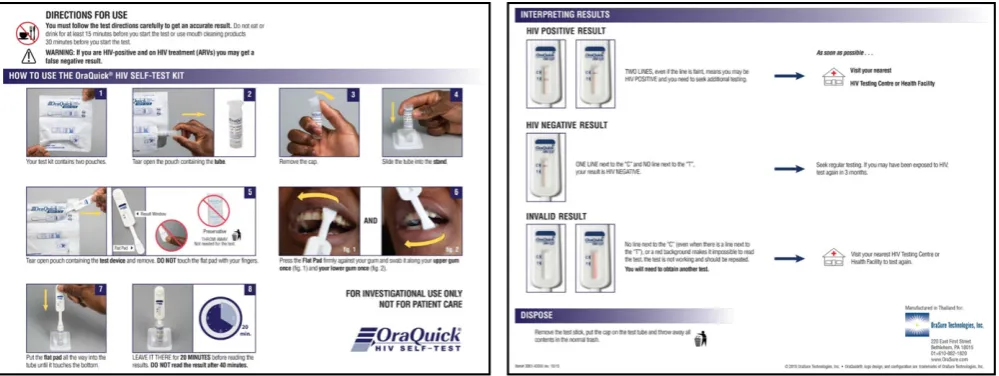
Trained research assistants recruited participants. A struc-tured guide that mirrored the steps depicted in the IFUs illus-trated in Figure1 informed the interviews. All participants were then given an OraQuick HIV Self-Test kit, which con-tained this manufacturer’s original IFU. They were asked to (1) read the instructions, (2) reflect on the pictorial and word instructions and explain these to the social scientist, (3) per-form the actions depicted, and (4) reflect on how easy or diffi-cult other members of their community would find the word and pictorial instructions. Scripted probes were included in the guide to ensure better understanding at each step, and research assistants were also trained to use spontaneous probes. Daily debriefing of field experiences was done to enhance the rigour of the cognitive interviewing process.
In Malawi, research staff took detailed observation notes at each step of the process. In Zambia, interviews were recorded, transcribed, translated into English and saved on password-secured computers at the research offices. Data from both countries were analysed deductively and we used a thematic approach based on the various steps in the testing process. The comparative analysis presented here uses data from the second Malawian iteration and the single Zambian iteration, as these very closely matched the early feedback incorporated by the manufacturer from the first Malawian iteration. This involved researchers familiarizing themselves with the data, developing codes and then merging the codes into broader themes.
Readers should note that there were fewer steps in this manufacturer’s original IFU than those in the final iteration included in our Table S1 that can be found in the supplemen-tary materials submitted with this paper, because additional steps were added to the IFU as a result of early iterations.
2.1
|
Ethical considerationsthe London School of Hygiene and Tropical Medicine (LSHTM) Ethics Committee [Ref: 10566]. In Zambia, the study was approved by the University of Zambia Biomedical Research Ethics Committee [Ref: 013-11-15] and LSHTM Ethics Com-mittee [Ref: 10632]. All study participants provided informed consent.
3
|
R E S U L T S
A total of 61 participants were included in this study. Over half of the participants in both countries understood the text and pictures used in the IFUs and could correctly conduct the self-test and interpret the results. Performance errors, how-ever, were identified at each of the 15 steps outlined in the manufacturer’s original IFU, including unanticipated difficulties with opening the packet through to kit disposal. We present the results thematically and provide illustrative quotations. A summary table in the supplementary materials presents partic-ipants’experiences at each step of following the IFU and com-pares results by country.
Over half of the participants found the textual and pictorial instructions to be complementary. Participants with lower lit-eracy levels reported that the pictorial instructions improved their comprehension of the written instructions. When pic-tures were too difficult to understand, participants indicated that they used the textual instructions instead, such as the picture(s) in a step on when to start “timing the test.” Other factors that limited participants’ understanding and perfor-mance of certain instructions included translation errors, use of complicated terms, use of unfamiliar images and symbols, and the order in which the text and pictures describing the steps were presented.
3.1
|
Language (use of complicated terms) and lowliteracy
Translations and the use of complicated terms led to some misunderstanding of the IFUs and user errors. Sometimes these issues arose from translation errors in the IFUs
themselves, and at other times it was lack of familiarity with certain terms. For example, some participants in Zambia found the translated word for“pouch”in the instructions too difficult to understand.
Two pouches? Someone would get confused, yes. At least put simpler words because someone would ask, “what are pouches?” and may be guess that these are pouches (fe-male, 29 years, Kanakantapa, rural, Zambia).
The translation of “flat pad” in instruction 7 was also diffi-cult for some people in Malawi and failure to understand the meaning of the local word resulted in a few participants touching the“flat pad” as illustrated by this quote:Both sides are flat pads. The instruction should read,“gwirani kwakukuluko osati kwakung’ono”[touch the large side and not the smaller side] (female, 44 years, Madziabango, rural, Malawi).Participants also found words and phrases like “swab,” “press the pad firmly” confusing. This resulted in some participants doing odd things like pressing the pad hard“so that it could accumulate an ade-quate specimen”or placing the pad on their teeth and gums.
A related challenge was the variation in languages and dia-lects used within countries. Rural areas tended to use the original languages while urban areas tended to use colloquial versions. In Malawi, the Chichewa translation of the word gum wasusininibut some participants from rural Malawi said this was a confusing translation and suggested nkhama
instead. Thus, rural populations with poor literacy were more likely to struggle with understanding the messages in the IFUs and thereby made more errors. Rural participants who did comprehend IFUs and completed the self-test correctly indi-cated that they relied on the pictorial instructions rather than the text.
3.2
|
Unfamiliar images and symbolsImages and pictorial illustrations in the IFU were meant to enhance understanding and performance of the instructions when used individually or complementarily with the word instructions. However, participants did not understand the
meaning of some images that were not familiar to their local context. Over half the participants in both countries incor-rectly interpreted the cutlery symbol in the directions at the top of the IFU (see Table S1) due to lack of familiarity with using cutlery for eating:
. . . the picture does not make sense. What does the cutlery mean? Use a toothbrush and Colgate and put in mind that most Malawians do not use forks [male, 20 years, Zing-wangwa urban, Malawi].
Instead, participants from both countries interpreted the image to mean “avoid cutting oneself,” “do not eat or drink contents of the test-kit” and “do not use a knife or fork to open the test kit.” The fact that over half of the participants performed this and other instructions successfully points to the fact that pictorial and word instructions complemented each other and common sense prevailed.
A red line was drawn through images/pictures to warn par-ticipants not to carry out certain actions such as not to pour out the liquid (instruction 5). However, over half the partici-pants preferred crossed red lines as used in warning signs in Malawi and Zambia.
If this picture was like this (makes a gesture with crossed hands to make an X) it would show that you should not do this. . .(female, 35 years, Mtendere, urban, Zambia).
3.3
|
Presentation of images and instructionsCircumstances that made interpretation difficult included information that was clustered within an instruction. Instruction number one contained images of a wristwatch, a digital watch and a phone to illustrate the importance of having a timing device. Some participants felt that having several images talking about one thing was misleading: It is not clear. Is it a time or a date? (male, 29 years, Limbe, urban, Malawi). Indeed, over half the participants did not have timing devices; a potential challenge for ensuring correct reading times even if the instruction was clearly under-stood.
Different font types, sizes and colours also created confu-sion. Some participants observed that the instruction about removing the test device from the pouch was written in a small font and therefore difficult to see. Other participants said that the presentation of instructions in different font sizes and colours could prompt users to think that the instruc-tions in question were not important.
Some word instructions did not have corresponding pictorial instructions and vice versa. For instance, the written state-ment that users should not use “mouth cleaning products 30 minutes before you start the test” did not have a corre-sponding picture/image. This affected the participants’ under-standing of the instructions.
3.4
|
Order, clarity and adequacy of instructions/messages
The order or positioning of instructions was critical to avoid confusion. The red capitalized instruction “IF YOU READ
BEFORE 20 MINUTES, RESULTS MAY NOT BE CORRECT” came after the user had tested and had been told to“leave the test device in the tube for 20 minutes before reading the results” without telling the user the implications of reading the results earlier than 20 minutes or after 40 minutes. According to the participants, presenting the implications ear-lier could have enhanced understanding of and adherence to instructions.
Inadequate information was also a source of poor cognition of the instructions. For example, a warning that being on ART may lead to incorrect (false-negative) results was included, because retesting to confirm a previously known positive status has previously been reported and can lead to a false-negative self-test result [15,26,27]. However, participants found this message to be confusing and did not understand how someone who is infected with HIV could obtain negative results when the intention of the test-kit was to detect HIV:How does one that is HIV positive get negative results? (female, 22 years, Mpemba, rural, Malawi). I don’t understand, how can you get a false-negative result? (female, 29 years, Kanakantapa, rural, Zambia).
4
|
D I S C U S S I O N
Our study aimed to evaluate the utility of cognitive interview-ing in optimizinterview-ing the local understandinterview-ing of manufacturers’ IFUs to achieve an accurate HIVST result. This study was nested within the STAR consortium, a large-scale evaluation of HIVST in Malawi, Zambia and Zimbabwe. We used cognitive interviewing in Malawi and Zambia, two African countries with low literacy levels, to rapidly identify how well users of oral fluid-based HIV self-test kits were able to understand IFUs and their ability to obtain accurate results.
The use of cognitive interviewing in the iterative creation and improvement of questionnaires and health promotion materials has been described elsewhere, particularly for exploring how survey questions are understood by research participants and how these require significant contextual adap-tation [28-30]. Results from cognitive interviews often show that some survey questions are appropriately interpreted by respondents, and others show significant differences between what the researchers intended them to measure and what they actually do [31,32]. We found the same with IFU with some instructions being easy to understand and conduct as intended by the manufacturers and others not. We adapted these methods by combining the step-by-step drill down on each IFU instruction with qualitative data capture and observed the errors. This allowed us to gain additional insights on how to best tailor support materials, which was not possi-ble from less targeted interviews, even when supported by video observation [16]. We found the principle of cognitive interviewing to be an essential element, i.e. taking time to explore the understanding of each instruction, statement or question.
confidence in their ability to self-test in Zambia [36]. Providing an in-person demonstration resulted in high sensitivity of oral fluid self-testing in KwaZulu Natal [17], which did not happen when the oral fluid test was conducted unsupervised in similar settings [12]. Demonstrations of how to use the kit are an integral part of our studies in Malawi, Zambia and Zimbabwe [10,11,37,38]. Demonstration materials do, however, need to be tailored to the context. Men who have sex with men in South Africa preferred fingerstick self-testing but were better able to perform the oral fluid tests resulting in the need for additional instructional resources for blood-based testing in this context [39]. Ortblad et al. reported that when peer edu-cators working with female sex workers in Uganda gave an HIVST demonstration based on materials developed without detailed knowledge of common misunderstandings, the sex workers struggled to correctly interpret the test results [40]. In Zimbabwe, on the other hand, where female sex workers were shown a video based on findings from cognitive inter-views, they were able to correctly perform and interpret oral fluid-based HIVST [38]. Training lay people, including women with untested male partners, on how to demonstrate a self-test may be another option. In Malawi and Kenya, HIVST delivered to the male partners of pregnant women resulted in high uptake and increased couples’testing [41-43]. Over time, as knowledge and awareness of HIVST increases, the need for cognitive interviewing is likely to decline.
Our findings were used to provide feedback to the manu-facturer and resulted in further optimization of IFUs as well as the development of demonstrations used in the STAR pro-ject to further improve performance. However, iterations and adaptation of the actual IFUs are neither possible nor desir-able for every community, every key population or subgroup. They are also not possible from a regulatory point of view, since regulators and WHO prequalification regard only the IFUs in the final prequalified product as approved package inserts, allowing only simple changes for clarification and translation [44]. The onus is thus on programmes to ensure appropriate introduction of HIVST. A practical toolkit aimed at programmes wishing to introduce HIVST is now being devel-oped to provide further guidance on how to optimize HIVST implementation, including guidance on how to conduct and interpret findings from cognitive interviews exploring IFUs.
Our study had several limitations, such as different data col-lection techniques. Data colcol-lection in Malawi was captured using an observational checklist while a digital audio recorder was used in Zambia. However, the differences in data captur-ing techniques did little to influence our analysis, since the focus of data synthesis was on how each client understood each instruction, and how they practically translated word and pictorial instructions when performing an HIVST. Malawi con-ducted three iterations with the aim of improving the IFUs at each iterative stage while Zambia only had a single iteration and fewer participants, and this might have influenced our findings, although the comparison used the same IFU iteration and the same principles of cognitive interviewing methods. Professional translations done by the manufacturers had sev-eral problems and required revisions by researchers within the study team in both countries. Finally, similar cognitive interviews conducted in Zimbabwe a year before this study informed the development of study tools in Malawi and Zam-bia; however, as the team iteratively changed the IFUs several
times, there was no version that exactly matched the ones used in Malawi and Zambia. We felt that the methods did not overlap sufficiently to include them, limiting the potential for comparison in a third context.
5
|
C O N C L U S I O N S
Cognitive interviewing provided an excellent methodological approach to assessing IFU but required some adaptation to include direct observation of test performance. The adapted cognitive methodology we used highlighted several errors that were common across both countries and helped us to deter-mine the nature of support users might need and to pre-empt common test performance problems, through improved trans-lations and adaptation of manufacturers’ IFUs. Efforts to fur-ther optimize performance may not always be feasible through IFUs alone but may require the addition of demon-strations and support tools in settings and populations with low education and literacy levels.
A U T H O R S’ A F F I L I A T I O N S
1
Zambart, Lusaka, Zambia;2Malawi Liverpool Wellcome Trust Clinical Research Programme, Blantyre, Malawi; 3
Department of International Public Health, Liverpool School of Tropical Medicine, Liverpool, UK;4
HIV and Global Hepatitis Department, World Health Organization, Geneva, Switzerland; 5
Clinical Research Department, Faculty of Infectious and Tropical Diseases, London School of Hygiene and Tropical Medicine, London, UK; 6
Centre for Sexual Health HIV and AIDS Research, Harare, Zimbabwe;7
Population Services Inter-national, Johannesburg, South Africa;8
Department of Infectious Disease Epide-miology, London School of Hygiene and Tropical Medicine, London, UK
C O M P E T I N G I N T E R E S T S
No potential conflict of interest is reported by the authors.
A U T H O R S’ C O N T R I B U T I O N S
MS and MK wrote first draft and led the entire writing process. LK and AM were the principal data collectors and contributed to the first draft. PI, ES, LN and RD also contributed to first draft and reviewed subsequent iterations. CJ, KH, ELC and HA provided a thorough review of the drafts and contributed to the second draft. MT contributed to all the iterations and provided technical guidance to MS and MK.
A C K N O W L E D G E M E N T S
The authors thank all the participants in Zambia and Malawi. Beate Ringwald critically reviewed the manuscripts and supported the referencing and Bandana Malhotra who edited to improve clarity and readability. The findings were reviewed and discussed by all members of the qualitative research network of STAR. This work was funded by UNITAID as part of the STAR consortium.
R E F E R E N C E S
1. World Health Organization. Guidelines on HIV self-testing and partner notifi-cation: supplement to consolidated guidelines on HIV testing services. Geneva, Switzerland: World Health Organization;2016.
2. Johnson C, Baggaley R, Forsythe S, van Rooyen H, Ford N, Napierala Maved-zenge S, et al. Realizing the potential for HIV self-testing. AIDS Behav.2014;18 Suppl 4:S391–5. https://doi.org/10.1007/s10461-014-0832-x.
5. World Health Organization. Technical specifications series for submission to WHO prequalification–diagnostic assessment: human immunodeficiency virus (HIV) rapid diagnostic tests for professional use and/or self-testing. Geneva: World Health Organization;2016. Licence: CC BY-NC-SA 3.0 IGO. 26 p. 6. World Health Organization. WHO prequalification of in vitro diagnostics pub-lic report. Product: OraQuick HIV self-test. WHO reference number: PQDx 0159-055-01 (version 2.0). Geneva, Switzerland: World Health Organization; 2017[cited 2018 Mar 10]. Available from: http://www.who.int/diagnostics_labo ratory/evaluations/pq-list/170720_final_amended_pqdx_0159_055_01_oraquick_ hiv_self_test_v2.pdf
7. The Global Fund to Fight AIDS, Tuberculosis and Malaria. List of HIV diag-nostic test kits and equipments classified according to the Global Fund Quality Assurance Policy (version 17). Geneva, Switzerland: The Global Fund; 2017 [cited 2018 Mar 10]. Available from: https://www.theglobalfund.org/media/ 5878/psm_productshiv-who_list_en.pdf
8. Figueroa C, Johnson C, Ford N, Sands A, Dalal S, Meurant R, et al. Reliability of HIV rapid diagnostic tests for self-testing compared with testing by health-care workers: a systematic review and meta-analysis. Lancet HIV.2018;5(6): e277–90. https://doi.org/10.1016/s2352-3018(18)30044-4.
9. Asiimwe S, Oloya J, Song X, Whalen CC. Accuracy of un-supervised versus provider-supervised self-administered HIV testing in Uganda: a randomized implementation trial. AIDS Behav. 2014;18(12):2477–84. https://doi.org/10. 1007/s10461-014-0765-4.
10. Choko AT, Desmond N, Webb EL, Chavula K, Napierala-Mavedzenge S, Gaydos CA, et al. The uptake and accuracy of oral kits for HIV self-testing in high HIV prevalence setting: a cross-sectional feasibility study in Blantyre, Malawi. PLoS Med.2011;8(10):e1001102. https://doi.org/10.1371/journal.pmed. 1001102.
11. Choko AT, MacPherson P, Webb EL, Willey BA, Feasy H, Sambakunsi R, et al. Uptake, accuracy, safety, and linkage into care over two years of promot-ing annual self-testpromot-ing for HIV in Blantyre, Malawi: a community-based prospec-tive study. PLoS Med. 2015;12(9):e1001873. https://doi.org/10.1371/journal. pmed.1001873.
12. Kurth AE, Cleland CM, Chhun N, Sidle JE, Were E, Naanyu V, et al. Accu-racy and acceptability of oral fluid HIV self-testing in a general adult population in Kenya. AIDS Behav.2016;20(4):870–9. https://doi.org/10.1007/s10461-015-1213-9.
13. Pant Pai N, Behlim T, Abrahams L, Vadnais C, Shivkumar S, Pillay S, et al. Will an unsupervised self-testing strategy for HIV work in health care workers of South Africa? A cross sectional pilot feasibility study. PLoS ONE.2013;8(11): e79772. https://doi.org/10.1371/journal.pone.0079772.
14. Smith P, Wallace M, Bekker LG. Adolescents’experience of a rapid HIV self-testing device in youth-friendly clinic settings in Cape Town South Africa: a cross-sectional community based usability study. J Int AIDS Soc. 2016;19 (1):21111. https://doi.org/10.7448/ias.19.1.21111.
15. Mavedzenge SN, Sibanda E, Mavengere Y, Hatzold K, Mugurungi O, Ncube G, et al. Supervised HIV self-testing to inform implementation and scale up of self-testing in Zimbabwe. 8th IAS Conference on HIV Pathogenesis, Treatment and Prevention (IAS 2015); 2015 Jul 19-22; Vancouver. [cited 2018 May 4]. Available from: http://hivst.org/tools/2016120supervised-hiv-self-testing-to-inf orm-implementation-and-scale-up-of-self-testing-in-zimbabwe
16. Peck RB, Lim JM, van Rooyen H, Mukoma W, Chepuka L, Bansil P, et al. What should the ideal HIV self-test look like? A usability study of test proto-types in unsupervised HIV self-testing in Kenya, Malawi, and South Africa. AIDS Behav. 2014;18 Suppl 4:S422–32. https://doi.org/10.1007/s10461-014-0818-8.
17. Martinez Perez G, Steele SJ, Govender I, Arellano G, Mkwamba A, Hadebe M, et al. Supervised oral HIV self-testing is accurate in rural KwaZulu-Natal, South Africa. Trop Med Int Health.2016;21(6):759–67. https://doi.org/10.1111/ tmi.12703.
18. Gaydos CA, Hsieh Y-H, Harvey L, Burah A, Won H, Jett-Goheen M, et al. Will patients “opt in” to perform their own rapid HIV test in the emergency department? Ann Emerg Med. 2011;58(1 Suppl 1):S74–8. https://doi.org/10. 1016/j.annemergmed.2011.03.029.
19. Ibitoye M, Frasca T, Giguere R, Carballo-Dieguez A. Home testing past, pre-sent and future: lessons learned and implications for HIV home tests. AIDS Behav.2014;18(5):933. https://doi.org/10.1007/s10461-013-0668-9.
20. Lee VJ, Tan SC, Earnest A, Seong PS, Tan HH, Leo YS. User acceptabil-ity and feasibilacceptabil-ity of self-testing with HIV rapid tests. J Acquir Immune Defic Syndr. 2007;45(4):449–53. https://doi.org/10.1097/QAI.0b013e318095a 3f3.
21. de la Fuente L, Rosales-Statkus ME, Hoyos J, Pulido J, Santos S, Bravo MJ, et al. Are participants in a street-based HIV testing program able to perform
their own rapid test and interpret the results? PLoS ONE.2012;7(10):e46555. https://doi.org/10.1371/journal.pone.0046555.
22. Willis GB. Cognitive interviewing: a“how to”guide, from the short course
“reducing survey error through research on the cognitive and decision pro-cesses in surveys.”Meeting of the American Statistical Association, Dallas (TX); 1999.
23. Willis GB, Artino AR Jr. What do our respondents think we’re asking? Using cognitive interviewing to improve medical education surveys. J Grad Med Educ. 2013;5(3):353–6. https://doi.org/10.4300/jgme-d-13-00154.1.
24. HIV Self-Testing Africa. The STAR Initiative [Internet]. Washington, DC: PSI [cited 2018 Dec 28]. Available from: https://www.eatright.org/]; https://www.psi. org/star-hiv-self-testing-africa
25. Zhang Y. Urban-rural literacy gaps in Sub-Saharan Africa: the roles of socioeconomic status and school quality. Comp Educ Rev.2006;50(4):581–602. https://doi.org/10.1086/507056.
26. Johnson CC, Sands A, Urassa W, Baggaley R. Alert, but not alarmed–a comment on“Towards more accurate HIV testing in sub-Saharan Africa: a multi-site evaluation of HIV RDTs and risk factors for false positives.”J Int AIDS Soc. 2017;20(1):22042. https://doi.org/10.7448/ias.20.1.22042.
27. Moore A, Cassidi T, Steele SJ, Shroufi A, Ntuli N, Ndani L, et al. Self-testing: an effective means of increasing HIV-testing and status awareness. 9th IAS Conference on HIV Science (IAS 2017); 2017 July 23-27; Paris, France. [cited 2018 Mar 10]. Available from: http://www.ias2017.org/Portals/1/Files/IAS2017_ LO.compressed.pdf
28. Egger-Rainer A. Enhancing validity through cognitive interviewing. A methodological example using the Epilepsy Monitoring Unit Comfort Question-naire (EMUCQ). J Adv Nurs.2019;75(1):224–33. https://doi.org/10.1111/jan. 13867.
29. Vreeman RC, Nyandiko WM, Ayaya SO, Walumbe EG, Inui TS. Cognitive interviewing for cross-cultural adaptation of pediatric antiretroviral therapy adherence measurement items. Int J Behav Med.2014;21(1):186–96. https://d oi.org/10.1007/s12529-012-9283-9.
30. Drennan J. Cognitive interviewing: verbal data in the design and pretesting of questionnaires. J Adv Nurs. 2003;42(1):57–63. https://doi.org/10.1046/j. 1365-2648.2003.02579.x.
31. De Silva MJ, Harpham T, Tuan T, Bartolini R, Penny ME, Huttly SR. Psycho-metric and cognitive validation of a social capital measurement tool in Peru and Vietnam. Soc Sci Med.2006;62(4):941–53. https://doi.org/10.1016/j.socscimed. 2005.06.050.
32. Bowden A, Fox-Rushby JA, Nyandieka L, Wanjau J. Methods for pre-testing and piloting survey questions: illustrations from the KENQOL survey of health-related quality of life. Health Policy Plan.2002;17(3):322–30. https://doi.org/10. 1093/heapol/17.3.322.
33. Tonen-Wolyec S, Batina-Agasa S, Muwonga J, N’kulu F, Bouassa RSM, Belec L. Evaluation of the practicability and virological performance of finger-stick whole-blood HIV self-testing in French-speaking sub-Saharan Africa. PLoS ONE. 2018;13(1):e0189475. https://doi.org/10.1371/journal.pone.0189475. 34. Tonen-Wolyec S, Mboup S, Gresenguet G, Bouassa RB, Belec L. Insufficient education is a challenge for HIV self-testing. Lancet HIV. 2018;5(7):e341. https://doi.org/10.1016/s2352-3018(18)30141-3.
35. Wei C, Yan L, Li J, Su X, Lippman S, Yan H. Which user errors matter during HIV self-testing? A qualitative participant observation study of men who have sex with men (MSM) in China. BMC Public Health.2018;18(1):1108. https://doi. org/10.1186/s12889-018-6007-3.
36. Zanolini A, Chipungu J, Vinikoor MJ, Bosomprah S, Mafwenko M, Holmes CB, et al. HIV self-testing in Lusaka Province, Zambia: acceptability, comprehen-sion of testing instructions, and individual preferences for self-test kit distribu-tion in a populadistribu-tion-based sample of adolescents and adults. AIDS Res Hum Retroviruses.2017;34(3):254–60. https://doi.org/10.1089/aid.2017.0156. 37. Kapaku KN, Neuman M, Maluzi K, Sigande L, Nalubamba M, Taegtmeyer M, et al. Is OraQuick®
HIV-self-testing valid among intended users? Analysis from a clinical performance study in Lusaka, Zambia. 9th IAS Conference on HIV Science (IAS 2017); 2017 July 23-27; Paris, France. [cited 2018 May 4]. Available from: http://www.ias2017.org/Portals/1/Files/IAS2017_LO.compressed. pdf
38. Sibanda EL. Usability and validity of oral fluid self-tests among intended users: experiences from Malawi, Zambia and Zimbabwe. 9th IAS Conference on HIV Science (IAS 2017); 2017 July 23-27; Paris, France. [cited 2018 May 4]. Available from: http://programme.ias2017.org/Programme/Session/76
40. Ortblad KF, Musoke DK, Ngabirano T, Nakitende A, Haberer JE, McConnell M, et al. Female sex workers often incorrectly interpret HIV self-test results in Uganda. J Acquir Immune Defic Syndr. 2018;79(1):e42–5. https://doi.org/10. 1097/QAI.0000000000001765.
41. Masters SH, Agot K, Obonyo B, Napierala Mavedzenge S, Maman S, Thiru-murthy H. Promoting partner testing and couples testing through secondary dis-tribution of HIV self-tests: a randomized clinical trial. PLoS Med.2016;13(11): e1002166. https://doi.org/10.1371/journal.pmed.1002166.
42. Gichangi A, Wambua J, Gohole A, Mutwiwa S, Njogu R, Bazant E, et al. Pro-vision of oral HIV self-test kits triples uptake of HIV testing among male part-ners of antenatal care clients: results of a randomized trial in Kenya. 21st International Aids Conference (AIDS 2016); 2016 Jul 18-22; Durban, South Africa;2016[cited 2018 May 4]. Available from: http://www.aids2016.org/Porta ls/0/File/AIDS2016_Abstracts_LOW.pdf
43. Choko AT, Kumwenda MK, Johnson CC, Sakala DW, Chikalipo MC, Fielding K, et al. Acceptability of woman-delivered HIV self-testing to the male partner, and additional interventions: a qualitative study of antenatal care participants in
Malawi. J Int AIDS Soc. 2017;20(1):21610. https://doi.org/10.7448/ias.20.1. 21610.
44. World Health Organization. Reportable changes to a WHO prequalified in vitro diagnostic medical device. Geneva, Switzerland: World Health Organiza-tion;2016.
S U P P O R T I N G I N F O R M A T I O N
Additional Supporting Information may be found in the online version of this article: