R E S E A R C H
Open Access
Understanding STDMA via computer
simulation: feasibility to vehicular safety
applications, configurations, and time
synchronization errors
Jae-Han Lim
Abstract
Recently, several researchers have proposed to employ self-organized time division multiple access (STDMA) as an alternative Medium Access Control (MAC) protocol of vehicular communications and have studied STDMA to verify its feasibility to vehicular safety applications. However, most of studies have mainly focused on comparing STDMA with enhanced distributed channel access (EDCA) and have several limitations to reveal the feasibility: (1) they have not considered time synchronization error and (2) they have evaluated STDMA with only a single set of configurable parameters. Thus, the feasibility of STDMA to vehicular safety applications still remains unexplored and is an open issue. In this paper, we examine the performances of STDMA to confirm two points: (1) whether or not STDMA is feasible to safety applications even with time synchronization error and (2) whether or not proper configuration really helps to improve the performances. Our simulation results corroborate that current form of STDMA is not feasible to vehicular safety applications and we can improve STDMA via proper parameter configurations.
Keywords: Vehicular safety applications, STDMA, Feasibility, Time synchronization error, Configuration
1 Introduction
In 2009, the US government reported that more than 33,800 people were killed and more than two million peo-ple were injured from vehicle accidents [1]. To reduce the accidents, many academic researchers and car manu-facturers have developed active safety systems that relied on vehicular communications. Specifically, vehicles notice the possibility of an accident by exchanging their sta-tus information (e.g., position, speed, and acceleration), thereby being able to prepare for the accident before it happens.
Enhanced distributed channel access (EDCA) is a default Medium Access Control (MAC) protocol of ded-icated short-range communications (DSRC), which is the de facto standard for vehicular communications [2]. The core mechanism of EDCA is carrier sense multi-ple access with collision avoidance (CSMA/CA), which
Correspondence: [email protected]
Electronics and Telecommunications Research Institute, 218 Gajeong-ro, Yuseong-gu, 34129 Daejeon, Korea
controls multiple access in adistributedmanner. The dis-tributed nature of CSMA/CA makes EDCA robust to frequent topology changes in vehicular networks. How-ever, EDCA is not suitable to vehicular safety applications, which require high delivery ratio and low latency [3]. This is because the random nature of CSMA/CA causes unpre-dictable delay, which leads to frequent violation of latency requirement. Even more, CSMA/CA is prone to packet collisions, which decrease delivery ratio [4, 5].
It is well-known that time division multiple access (TDMA) can address the challenges of EDCA. Specifi-cally, when employing TDMA for vehicular communica-tions, the upper bound of delay can be guaranteed and packet collisions rarely happen even in high vehicle den-sity due to a well-organized time schedule [6, 7]. However, for organizing time schedule well, we require a central controller (e.g., road side unit (RSU)), of which implemen-tation and management is costly.
To address the challenges of EDCA and TDMA, sev-eral researchers have proposed to adopt Self-organized TDMA (STDMA) as an alternative MAC for vehicular
communications [9–11]. STDMA has both determinis-ticanddistributednatures. More specifically, each vehi-cle transmits a packet according to a time slot schedule (deterministic) and chooses its own time slot by itself (dis-tributed). Thus, STDMA seems to be feasible tovehicular safety applications.
Even if there have been previous simulation studies when STDMA was used for vehicular networks [9–14], they have mainly focused on comparing network perfor-mances of CSMA/CA with those of STDMA and have concluded that STDMA was more suitable to vehicu-lar networks than CSMA/CA. But, these studies could not confirm the feasibility of STDMA to vehicular safety applications because they have several missing points— (1) no consideration of time synchronization error and (2) evaluation with a single set of configurations. We will explain why considering these two points are critical for feasibility study and improvement of STDMA in the following paragraph.
First, the previous studies have been based on unrealistic assumption that practical errors (e.g., time synchroniza-tion error) did not occur in vehicular communicasynchroniza-tions. However, time synchronization error often occurs when losing global positioning system (GPS) signal; this error can degrade network performances of STDMA. Thus, we cannot confirm the feasibility of STDMA just using the simulation results of the previous studies. Second, previous studies have considered only a single set of con-figurations, even though STDMA is often associated with MAC and PHY configurable parameters. Hence, even if previous studies have shown that STDMA was not fea-sible to vehicular safety applications, there is room for improvement by configuring STDMA parameters care-fully. Thus, we must verify that proper configurations really help to improve STDMA performance. Moreover, we emphasize that understanding the impact of each configurable parameter can provide rich set of hints for configuring parameters to improve STDMA. More specif-ically, we must show clearly which performance measure (e.g., packet delivery ratio (PDR), delay) is associated with each parameter.
At this point, we can raise two important questions: “(1) Can STDMA support vehicular safety applications even with the practical errorand (2)proper configurations contribute to improvement of STDMA?” To answer these questions, in this paper, we conduct in-depth simulation studies on STDMA as follows. First, we study impacts of time synchronization errors on STDMA performances. Second, we investigate STDMA performances by varying several system parameters.
Simulation results demonstrate that STDMA with typi-cal parameter settings [8, 9] is limited to be used for vehic-ular safety applications and can be enhanced via proper configurations. Then, we investigate what are mainly
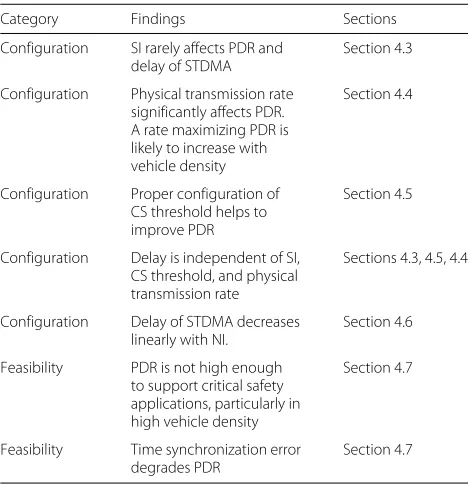
attributed to such limitations and suggest guidelines for improving STDMA to fit in with vehicular safety appli-cations. In Table 1, we summarize key findings on (1) feasibility of STDMA to vehicular safety applications (Feasibility) and (2) hints for suitable configurations ( Con-figuration). We emphasize that our study will help to understand the characteristics of STDMA and our find-ings will pave the way for improving the current form of STDMA.
The contributions of this paper are three-folds.
• We analyze STDMA performances with practical
errors that can occur in real worlds (e.g., time synchronization error) and evaluate the feasibility of STDMA to vehicular safety applications in such situations. We confirm that the current form of STDMA is not feasible to vehicular safety applications.
• We study the impact of configurable parameters,
confirm that proper setting of each configurable parameter really helps to improve STDMA performance, and provide a set of hints for configurations based on observations.
• We suggest guidelines for STDMA improvement to
be suitable to vehicular safety applications.
The rest of this paper is organized as follows. In Section 2, we introduce previous works on STDMA evaluation. In Section 3, we briefly explain STDMA. In Section 4, we evaluate STDMA thoroughly and verify the feasibility of STDMA to vehicular safety applications. In Section 5, we provide several suggestions for improving STDMA based
Table 1Summary of key findings in our study
Category Findings Sections
Configuration SI rarely affects PDR and delay of STDMA
Section 4.3
Configuration Physical transmission rate significantly affects PDR. A rate maximizing PDR is likely to increase with vehicle density
Section 4.4
Configuration Proper configuration of CS threshold helps to improve PDR
Section 4.5
Configuration Delay is independent of SI, CS threshold, and physical transmission rate
Sections 4.3, 4.5, 4.4
Configuration Delay of STDMA decreases linearly with NI.
Section 4.6
Feasibility PDR is not high enough to support critical safety applications, particularly in high vehicle density
Section 4.7
Feasibility Time synchronization error degrades PDR
on simulation findings. In Section 6, we conclude our work.
2 Related work
2.1 Mechanisms for improving vehicular networks Many researchers have made effort to improve per-formances of vehicular networks by proposing several mechanisms. In [33] and [39], authors have proposed routing algorithms to enhance performances of vehicu-lar networks. The authors in [28, 30, 34] have provided guidelines that helps to improve routing mechanisms in vehicular networks. The authors in [29] focused on delay-constraint topology control problem and proposed interference-based topology control mechanism. In [32], a resource allocation mechanism was proposed in self-organizing LTE, which might be useful when LTE is adopted for inter-vehicle communications.
Many researchers have attempted to enhance security of vehicular networks [31, 37, 38, 41, 43, 44, 46]. In [31], the authors focused on security problems in Internet of Things (IoT), in which vehicles are one of main elements. The authors in [38] introduced a threshold credit-based incentive mechanism to make devices robust to com-promise attacks in cloud-assisted vehicular delay tolerant network (DTNs). In [37, 41, 43, 44, 46], the authors have proposed key security algorithms that can be applied to vehicular networks. Moreover, some researchers have broaden the spectrum of possible applications of vehicu-lar communications: multimedia services [35] and cloud computing [36, 42, 45].
2.2 Simulation studies on EDCA and STDMA for vehicular networks
Many researchers have confirmed via computer simula-tion that EDCA could not satisfy stringent delay and PDR requirements of safety services in high vehicle density. Simulation studies in [24, 25] have demonstrated that net-work congestion was mainly attributed to low PDR of EDCA. In [4], the authors showed via simulation that the current form of EDCA was not suitable to vehicular safety messaging and proposed two mechanisms for improving EDCA: access category (AC) isolation and virtual divi-sion. In [20], the authors conducted experimental studies on DSRC in a real driving situations from a perspective of network engineers. In [22, 23], the authors argued that EDCA had limitations to support safety message dissem-ination if only a DSRC band was used and have proved the limitations via computer simulations. Then, they have proposed to exploit both DSRC band and TVWS band.
There have been previous simulation studies when STDMA is used for vehicular networks [9–14]. In [9], the authors focused on throughput of STDMA via simulation studies. In [10], the authors analyzed the real-time prop-erties of CSMA/CA and STDMA via simulation studies
in highway scenarios and revealed that STDMA was bet-ter than CSMA/CA. The authors in [11] pointed out that CSMA/CA was not suitable to vehicular safety applica-tions and showed that STDMA outperformed CSMA/CA. In [12], the authors focused on the hidden terminal problem when using CSMA and STDMA for vehicular communications. The authors in [13] conducted simu-lation studies on CSMA/CA and STDMA in terms of MAC delay with two message settings: 300 bytes/10 Hz and 800 bytes/2 Hz. In [14], the authors made efforts to reveal when slot allocation collisions happen in STDMA. However, previous works have mainly focused on com-paring performances of CSMA/CA with those of STDMA when applying them to vehicular beaconing and they have not considered important factors to truly under-stand the characteristic of STDMA: (1) impact of time synchronization error and (2) impact of several config-urable parameters. Thus, we need to develop a quanti-tative understanding of STDMA in realistic situations by considering all missing points of the previous studies.
3 Self-organized time division multiple access (STDMA)
Self-organized time division multiple access (STDMA) is a deterministic MAC protocol, whereby vehicles can access wireless medium at their designated time slots. In STDMA, vehicles determine their own transmission schedules by themselves (i.e., select their own time slots) based on channel measurements. As shown in Fig. 1, time is divided into frames and the frame is further divided into multiple time slots.
STDMA is composed of four phases: (1) initialization phase, (2) network entry phase, (3) first frame phase, and (4) continuous operation phase. In an initialization phase, vehicles listen to wireless channel and store channel activ-ities during one time frame (e.g., the occupation of each slot and a position of the slot owner). In an entry phase, vehicles select their first time slots within a frame, which is denoted by nominal transmission slot (NTS). The details of selecting a time slot will be explained in the following paragraph. In the first frame phase, the vehicle selects time slots for the rest of the frame using the mechanism simi-lar to that used in the network entry phase. The last phase of STDMA is a continuous operation phase, where vehi-cles exploit NTSs that are chosen in the first frame phase. However, to adapt to network topology change, vehicles select new NTSs afternframes.
Fig. 1Time frame structure of STDMA
randomly chooses nominal start slot (NSS) from current slot up to NI. Third, a vehicle sets selection interval (SI) around NSS and randomly picks its NTS within SI. Finally, a vehicle checks an availability of NTS. More specifically, if the chosen NTS is already occupied by someone else based on the previous measurements, a vehicle selects the closest unoccupied slot within SI. However, if all slots within SI are occupied, the vehicle selects the slot of which owner is furthest away from itself. This is because an amount of interference tends to be smaller as the distance from the interferer is getting longer.
4 In-depth analysis of STDMA using simulator In this section, we perform an in-depth simulation study of STDMA using NS-2 simulation [15]. In this study, we isolate the impact of time synchronization errors and the impact of configurable parameters. First, we investi-gate STDMA according to configurable parameters (i.e., SI, NI, CS threshold, and a physical transmission rate) to get insight on how to configure each parameter for performance enhancement. To isolate the effect of each parameter, we change one parameter while fixing others to default settings and assume that there are no time syn-chronization errors. Next, we focus on the impact of time synchronization errors, which can happen in practical operations.
4.1 Simulation setup
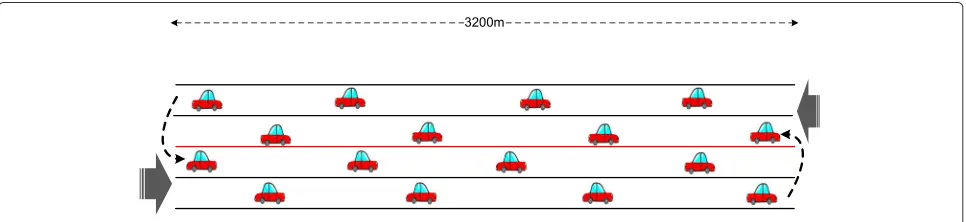
Figure 2 illustrates a topology used in our simulation study. In the study, we consider a two-way two mile road
segment with four lanes as we can find in many highways. To model vehicle mobility, we adopt a car-following model proposed by Gipps [26]. We summarize default simula-tion settings in Table 2. For PHY layer protocol, we follow IEEE 802.11p [4]. In MAC layer setting, we use STDMA system parameters that are calculated from message size (345 bytes), message generation interval (100 ms)1 and physical transmission rate (3 Mbps). More specifically, the size of unit time slot is derived by dividing a message size by physical transmission rate [10]2. Then, we can obtain NI by dividing an average report interval (e.g., beacon interval) by the size of a unit time slot. Finally, we cal-culate SI based on NI3. The noise power in our study is -104 dBm, which is derived from Bolzman constant, temperature, and bandwdith4. We use Nakagami fading model, which is well-known to be suitable to describe radio propagation in vehicular communications [40].
4.2 Performance measures
We exploit two important performance measures for vehicular safety applications: packet delivery ratio (PDR) and communication delay [3]. The two performance mea-sures are defined as follows.
• Packet delivery ratio (PDR): a ratio of the number of
vehicles that receive a packet (nreceive) to the number
of vehicles within a transmission range of a sender (ntarget).
• Communication delay: an interval between a packet
generation time and a packet reception time.
Table 2Default system parameters
Parameter Value
Average transmission range 500 m
Physical transmission rate 3 Mbps
Channel model Nakagami fading model
Message generation 345 bytes/100 ms
Number of vehicles Variable
Noise power (dBm) −104 dBm
Parameters for STDMA (NI, SI, slot size) = (90, 18, 1.1 ms)
We should note that we do not consider packet losses caused by buffer overflow in calculating PDR. In reality, the overflow rarely happens when we adopt STDMA for broadcasting a vehicular safety message. Specifically, vehi-cles can transmit their packets at least once every NI, which is comparable to packet generation interval. This implies that the number of packets in the queue is no more than one, which is much smaller than the typical queue size. Thus, buffer overflow does not happen when we employ STDMA.
4.3 Impact of service interval
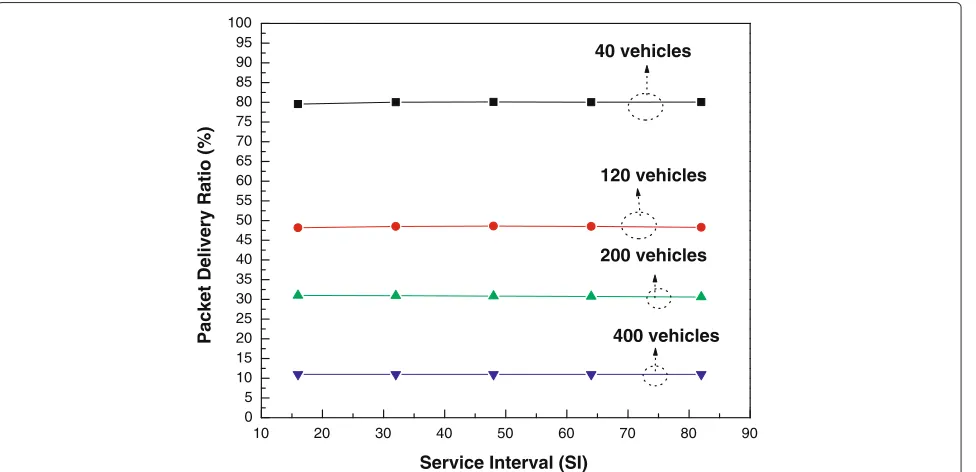
In Fig. 3, we observe that PDR of STDMA does not vary with SI5, which is somewhat counter-intuitive. In STDMA, packet collisions happen when more than two vehicles in a close vicinity select the same time slot; the probability of selecting the same slot rarely changes with SI due to the following reason. For selecting the same slot, two vehicles must satisfy the following two conditions:
(1) SIs of two vehicles must overlap and (2) two vehicles must select the same slot within the overlapping part. The first event becomes more probable as SI rises, whereas the probability of the second event decreases with the rise in SI. As a result, we conclude that the probability of select-ing the same slot by two vehicles is rarely affected by SI.6
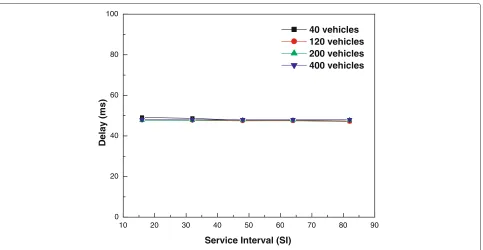
The delay of STDMA does not change with SI, as depicted in Fig. 4. This is because the dominant factor of the delay is queuing delay, which is determined by the message generation time and vehicle’s designated time slot. It is obvious that the message generation time is inde-pendent of SI. Moreover, the vehicle’s designated time slot is rarely affected by the size of SI. Hence, the delay is not affected by the size of SI.
4.4 Impact of physical transmission rate
Even if the physical layer of vehicular communications (i.e., IEEE 802.11p) supports multiple physical transmis-sion rates, only the single rate (e.g., 3 Mbps) has been employed in previous simulation studies [4, 5, 9–14]. However, we expect that PDRs of STDMA could be affected by the transmission rate and proper selection could improve the PDRs. Hence, in this subsection, we will confirm our hypothesis by evaluating the PDRs of STDMA with various physical transmission rates. To understand the impact of the transmission rate clearly, we will further describe the physics of how the rate affects PDRs of STDMA in the following paragraph.
It is well-known that a failure to receive packets is mainly attributed to two factors: (1) packet collisions and
10 20 30 40 50 60 70 80 90 0
5 10 15 20 25 30 35 40 45 50 55 60 65 70 75 80 85 90 95 100
400 vehicles 200 vehicles 120 vehicles 40 vehicles
Packet Delivery Ratio (%)
Service Interval (SI)
10 20 30 40 50 60 70 80 90 0
20 40 60 80 100
Delay (ms)
Service Interval (SI)
40 vehicles 120 vehicles 200 vehicles 400 vehicles
Fig. 4Delay of STDMA according to service interval (SI) when the number of vehicles is 40, 120, 200, and 400
(2) decoding failure due to channel error, which can be quantified with the probability of collision and the proba-bility of decoding error, respectively. First, the probaproba-bility of collision decreases with the rate and vice versa. This is because we can include more time slots within NI as the rate increases.7 Recall that packet collision happens when more than two vehicles in a close vicinity select the same time slot; thus, the increase in the number of slots within NI reduces the collision probability. Second, it is obvious that the probability of decoding error rises with the transmission rate.
Figure 5 demonstrates that the lowest transmission rate is not always optimal in terms of PDR. Specifically, when the number of vehicles is small, a low transmission rate tends to become optimal (e.g., 6 Mbps when there are 40 and 80 vehicles). This is because a decoding failure is a dominant factor of reception failures rather than a packet collision in low vehicle density. Thus, the adop-tion of lower transmission rate leads to higher PDR. On the contrary, when the number of vehicles is large, a high transmission rate is normally an optimal rate in terms of PDR (e.g., 18 Mbps when there are 400 vehicles).8 This is because a packet collision is a dominant factor rather than a decoding error in high vehicle density. Notably, even if the optimal rate ranges from 6 to 18 Mbps in Fig. 5, transmission rates outside this range could become an optimal rate. For example, the optimal rate could fall down to 3 Mbps when channel conditions become worse (e.g., when large amount of multi-path fading and seri-ous shadowing by obstacles occurs) in low vehicle density.
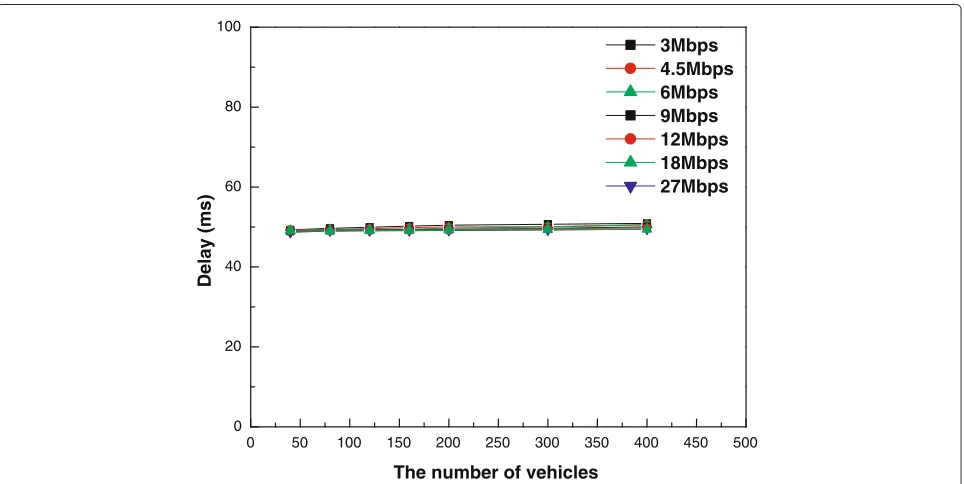
Moreover, the optimal rate could go up to 27 Mbps when channel conditions become better in high vehicle density. Similar to Section 4.3, the delay is independent of the transmission rate, as depicted in Fig. 6. It is obvious that a queuing delay accounts for a large portion of the delay; the queuing delay is determined by (1) the message generation time and (2) time assigned for each vehicle, both of which are independent of the transmission rate. Hence, the delay does not depend on the transmission rate.
It is noted that delays of STDMA are independent of the number of vehicles while PDR decrease with the num-ber. This is because delay is mainly attributes to queuing delay, which is determined by (1) message generation time and (2) time assigned for each vehicle, both of which are independent of the number of vehicles. In contrast, PDR is significantly affected by the number of vehicles because the probability of packet collision rises with the number of vehicles. More specifically, packet collision happens when more than two vehicles choose the same time slot; the probability that more than two vehicles choose the same slot increases with the number of vehicles.
4.5 Impact of carrier sensing threshold
0 100 200 300 400 500 0
5 10 15 20 25 30 35 40 45 50 55 60 65 70 75 80 85 90 95 100
18Mbps 12Mbps
12Mbps 12Mbps 9Mbps 6Mbps
6Mbps 3Mbps
4.5Mbps 6Mbps 9Mbps 12Mbps 18Mbps 27Mbps
Packet Delivery Ratio (%)
The number of vehicles
Fig. 5PDR of STDMA according to the number of vehicles when various physical transmission rates are used. Thetext pointed by each arrowis a physical transmission rate that maximizes PDR in each “the number of vehicles” setting
explain which factors are mainly attributed to the PDR pattern in more detail.
Vehicles become insensitive in signal detection as CS threshold grows and such insensitivity helps to improve PDR if CS threshold is less than a crossover point. Recall that a vehicle records whether or not each slot is idle
in its monitoring table and selects its transmission slot among all the idle slots recorded in the table. Obvi-ously, the insensitivity increases with CS threshold; thus, the number of idle slots recorded in the table increases with a CS threshold. This implies that a probability that more than two vehicles selects the same transmission slot
0 50 100 150 200 250 300 350 400 450 500 0
20 40 60 80 100
Delay (ms)
The number of vehicles
3Mbps 4.5Mbps 6Mbps 9Mbps 12Mbps 18Mbps 27Mbps
-105 -100 -95 -90 -85 -80 -75 -70 -65 0
10 20 30 40 50 60 70 80 90 100
110 40 vehicles
120 vehicles 200 vehicles 400 vehicles
Packet Delivery Ratio (%)
CS threshold (dBm)
Fig. 7PDR of STDMA according to the CS threshold when the number of vehicles is 40, 120, 200, and 400
decreases as a CS threshold rises. In contrast, the insensi-tivity in signal detection contributes to PDR degradation if CS threshold passes the crossover point. In most wire-less communication systems, receivers first detect a signal of a packet, then decode the packet [21]. In the regime whereby CS threshold is too high, receivers fail to detect a large fraction of packets. In other words, the detection
failure is a dominant factor that influences PDR in this regime; thus, PDR degrades with CS threshold.
We learn two important lessons from these observations as follows. First, we necessarily find an optimal CS thresh-old to improve PDR and the optimal threshthresh-old is different according to the number of vehicles (e.g.,−84 dBm in 40 vehicles and−81 dBm in 120 vehicles). Thus, we need to
-105 -100 -95 -90 -85 -80 -75 -70 -65
0 20 40 60 80 100
Delay (ms)
CS threshold (dBm)
40 vehicles 120 vehicles 200 vehicles 400 vehicles
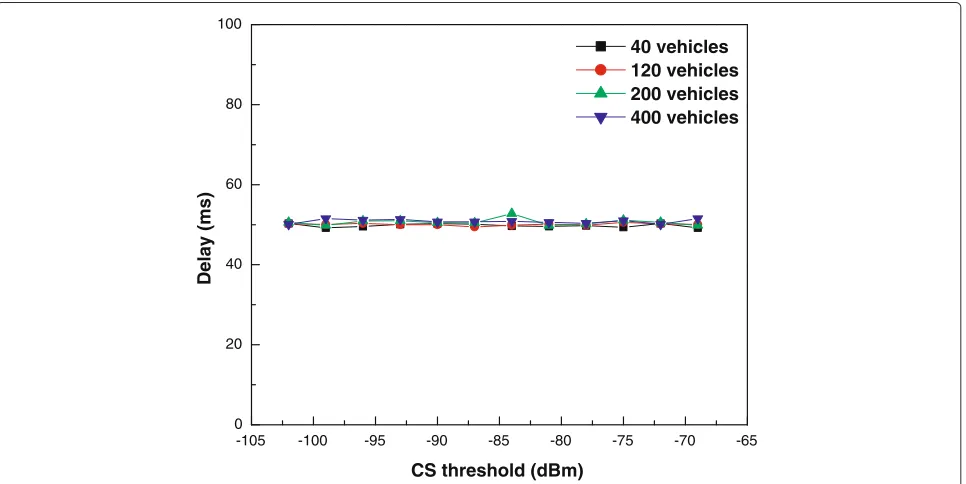
devise a mechanism that adapts CS threshold to a vehicle density. Second, we cannot reduce a delay by tuning a CS threshold.
4.6 Impact of nominal increment
In previous subsections, we observe that delays are unsat-isfactory for vehicular safety services even with various configurations (e.g., 50 ms in Figs. 4, 6, and 8. Fifty milliseconds is independent of SI, a physical transmission rate, CS threshold, and the number of vehicles.). We must note that the delay observed in the previous subsections are almost half of nominal increment (NI) (e.g., we config-ure NI to be comparable to 100 ms). Thus, we expect that delays of STDMA can be reduced via proper configuration of NI, and we will validate our hypothesis in this subsec-tion. Before showing simulation results, we will explain (1) how NI is configured to be less than traffic generation interval and (2) how vehicles select their time slots with this configuration in the following two paragraphs.
STDMA protocol recommends to set NI to be com-parable to average packet generation interval [8, 9]. For example, we often configure NI to be comparable to bea-con interval (e.g., 100 ms) in vehicular safety services. To reduce the physical duration of NI, we decrease the num-ber of time slots comprising NI rather than reduce the unit slot size. This is because the size is decided by a trans-mission rate, which must be isolated from NI to clearly understand the effect of NI. For example, in this subsec-tion, we configure NI to be comparable to 99 m and 33 ms, by setting the unit slot size to be 1.1 ms and the number of slot to be 90 and 30, respectively.
A principle to assign a time slot is that each vehicle can transmit its packet once every generation interval while reducing delay as much as possible. For this purpose, we include one more step (i.e., check a message queue before transmission) and do not follow the suggestion of the cur-rent protocol [8, 9] about configuration of NI. Specifically, vehicles decide NI independent of generation interval and select their own slots every NI. At every time slot, they check whether to have packets to send in their TX queues. If having packets to send, they transmit their own pack-ets; otherwise, despite having right for channel access (i.e., its turn to transmit), they just monitor the channel rather than transmit their packets.
In Fig. 9, we notice that the delay of STDMA is signifi-cantly reduced by changing NI from 90 to 30. To be spe-cific, the average delay is around 16 ms when NI is 30 (i.e., physical duration is 33 ms), whereas the delay is around 50 ms when NI is 90. Here, we must note two points. First, the delay is upper-bounded by NI. This is because every vehicle can have at least one chance to transmit its packet, i.e., at least one slot is assigned, within NI. Second, the average delay is half of NI, which is strikingly similar to results in previous subsections.
4.7 Impact of time synchronization errors
In STDMA, time synchronization is important since syn-chronization error causes slot misalignment, which can induce additional packet collisions. To be specific, even if two vehicles in the vicinity select different time slots, the slot misalignment might cause overlap between their transmissions. Obviously, this overlap causes packet col-lision, which degrades network performance. Thus, we need to study STDMA performance when time synchro-nization error exists.
In practical situations, time synchronization error hap-pens when vehicles fail to receive global positioning sys-tem (GPS) signal due to large obstacles (e.g., bridges). More specifically, when failing to receive GPS signal, vehi-cles cannot update its local time using clock info in GPS signal; thus, they fail to align local time clocks to global GPS clock. In this case, vehicles suffer from time synchro-nization error since local clock generators among vehicles have slight difference. In our simulation study, we assume that vehicles fail to receive GPS signal when located under the bridge and suffer from time synchronization errors with a 100 ppm clock skew rate [19]. Regarding bridge placement, we consider a wide bridge with 10 lanes, which can be found in I-405 freeway area in Los Angeles (http:// maps.google.com).
Figure 10 shows that the time synchronization error induces additional packet collision in STDMA. Specifi-cally, PDR is getting smaller as the number of bridges increases. This is because reception errors of GPS signal becomes more frequent as the number increases. Thus, slot misalignment induces additional packet collisions, thereby reducing PDR.
5 Discussion
5.1 Limitations of current STDMA
In previous section, we observe that our simulation results on PDR are so disappointing that a current form of STDMA is not feasible to vehicular safety applications [3]. Here, the current form of STDMA is referred to as STDMA following configurations suggested in [8] (e.g., NI is equal to traffic generation interval, SI is one fifth of NI). For example, as depicted in Fig. 10, PDR is around 30 % when 400 vehicles are deployed in a 2 mi road; PDR becomes smaller when those vehicles suffer from time synchronization error. In addition, we notice that delay of STDMA is less satisfactory than is required to support critical safety applications with typical config-urations of NI. For example, pre-crash sensing requires communication delay less than 20 ms according to [3]. However, Figs. 4, 6, and 8 demonstrate that average delays are 50 ms when we configure NI to be equal to typical beacon interval, i.e., 100 ms.
0 50 100 150 200 250 300 350 400 450 0
20 40 60 80 100
Delay (ms)
The number of vehicles
STDMA with NI=90 STDMA with NI=30
Fig. 9Delay of STDMA according to number of vehicles when nominal increment (NI) is 30 and 90
applications. Thus, it is crucial to improve STDMA par-ticularly when there are a large number of vehicles. To understand the limitations of current STDMA clearly, we will describe what are attributed to low PDR and long delay in the following two paragraphs.
The reasons of low PDR are threefolds. First, STDMA lacks an organized schedule in time slot assignment. As
we mentioned in Section 3, a vehicle selects its own time slot in the network entry phase and several steps com-prising the phase include random selection. Specifically, NSS (or NS) is selected randomly within NI (second step), and time slot is selected randomly among idle slots within SI (third step). It is obvious that vehicles often select the same slot due to these random selections, and we expect
0 100 200 300 400 500 0
5 10 15 20 25 30 35 40 45 50 55 60 65 70 75 80 85 90 95 100
no bridge 3 bridges 5 bridges
Packet Delivery Ratio (%)
The number of vehicles
that a probability of this event increases with a vehicle density. Second, even with a centralized coordination, a fraction of vehicles inevitably choose the same slot if the number of vehicles in the range of each other exceeds the number of slots within NI. For example, in Fig. 3, the number of slots within NI is 90, while the number of vehicles within a close vicinity (a circle with radius 500 m) is 133 when there are 400 vehicles in a 2 mi road. This implies that more than 32 % of the vehicles in a close vicinity must choose the same time slot even with a centralized controller. Third, current STDMA lacks a mechanism for adapting configurable parameters to net-work conditions. As shown in Sections 4.4 and 4.5, careful selection of a physical transmission rate and that of CS threshold can improve PDR of STDMA by up to 40 and 150 %, respectively.
The main reason for long delay is that we just follow suggestions of the current form of STDMA, which are not tailored to vehicular safety applications. Specifically, the current STDMA suggests to configure NI to be compara-ble to beacon interval, of which typical value is 100 ms and becomes longer if integrated with congestion control. It is obvious that average delay of deterministic protocol like STDMA is almost half a period for slot assignment, which corresponds to NI in STDMA. Hence, a delay of STDMA is long in such NI setting.
5.2 Guidelines for improvement
In this subsection, we briefly introduce how to improve STDMA based on our observations and analysis. One solution that can be easily derived from our observations is to adapt system parameter configurations to network conditions (e.g., vehicle density, channel errors). Specif-ically, to reduce delay, we necessarily diminish NI. For example, if network designers consider services of which delay bound is 20 ms (e.g., pre-crash sensing), we suggest to configure NI comparable to 20 ms because the delay of STDMA is upper-bounded by NI. In addition, to improve PDR, we necessarily configure a physical transmission rate and CS threshold. More specifically, we set a low trans-mission rate in low vehicle density and a high transtrans-mission rate in high density; we should find optimal CS threshold in terms of PDR.
We should note that the adaptive rate selection might induce another problem. Specifically, the improvement of an adaptive rate selection comes from a customiza-tion of slot size to message transmission time. However, unorganized customization of slot size may induce hetero-geneity of transmission rates among vehicles in the vicin-ity. The heterogeneity, in turn, causes slot misalignment, which can be a reason of packet collision. Fortunately, a cluster-based mechanism has benefits in making cluster members share the same parameters (e.g., transmission rate). Therefore, as a future work, we will propose a new
mechanism that improves STDMA based on a clustering mechanism.
The second suggestion is to employ an organized slot schedule. This solution is derived from our analysis above: random nature in slot selection degrades performances of STDMA. It is straightforward that the organized schedule can diminish collisions, thereby improving PDR. However, the organized schedule must be accompanied by a cen-tral controller (e.g., RSU), of which implementation and management are costly [23]. To circumvent this problem, we suggest to exploit a clustering mechanism, by which an organized schedule is possible within a cluster (i.e., the schedules of vehicles in the vicinity can be organized).
To summarize, our suggestion for improvement are as follows.
• Adaptive selection of a physical transmission rate and
a CS threshold (PDR)
• Adaptive selection of NI (delay)
• Organized schedule via clustering mechanism (PDR)
5.3 Towards improving STDMA: dynamic configuration In this subsection, we propose a dynamic configuration to improve STDMA performance. Among three parameters mentioned in Section 5.2, we focus on CS threshold and NI because we can configure these two parameters in a distributed manner. Recall that dynamic configuration of a physical transmission rate could degrade performance if vehicles in the vicinity exploit different rates; thus, a centralized method is necessary to control the transmis-sion rate over the network, such as clustering mecha-nism. However, clustering sometimes induce additional overhead; thus, configuration of a physical transmission rate must be accompanied by careful design of clustering mechanism. Therefore, we do not consider configuring a transmission rate in this paper9.
0 100 200 300 400 500 0
5 10 15 20 25 30 35 40 45 50 55 60 65 70 75 80 85 90 95 100
dynamic configuration static configuration
Packet Delivery Ratio (%)
The number of vehicles
Fig. 11Comparison of dynamic configurations with static configuration in terms of PDR
we exploit a table-driven approach. More specifically, each vehicle computes and preloads the optimal configura-tion table before driving10, in which optimal CS thresh-old is defined according to vehicle densities and channel noise; each vehicle finds optimal value in the table during driving.
To show the efficiency of dynamic configurations, we compare STDMA performances with dynamic con-figurations to those with typical static concon-figurations. As depicted in Figs. 11 and 12, dynamic configu-rations improve PDR by up to 71 % and reduce delay by up to 300 % over static configurations. We
0 50 100 150 200 250 300 350 400 450 0
20 40 60 80 100
Delay (ms)
The number of vehicles
dynamic configuration static configuration
emphasize that this improvement comes from con-figuring only two parameters. Thus, we can further enhance STDMA performances by additionally con-figuring a physical transmission rate and integrating with an organized schedule, which will be our future work.
6 Conclusions
In this paper, we studied the performance of STDMA when it was adopted for vehicular safety applications. We found that STDMA guarantees an upper bound of delay, but PDR was not high enough to support vehic-ular safety applications, especially in high vehicle den-sities. Even more, we noticed that time synchronization error degraded PDR and the error was uncorrelated with delay. Through an in-depth analysis of simulation results, we provided rich set of hints for configuring system parameters—(1) we should decrease NI for reducing delay, (2) we should adapt a physical transmission rate to vehi-cle density for improving PDR, and (3) we should find optimal CS threshold for enhancing PDR. We also pro-vided other suggestions for improvement. We hope that these results help to understand the characteristics of STDMA and encourage researchers to improve STDMA performance.
Endnotes
1Society for Automotive Engineers (SAE) [16] defines
100 ms to be a default generation period for periodic vehicle message. Moreover, the size of safety message is variable. For example, SAE 2735 specifies that the size of basic safety message (BSM) is variable [16] due to variable size of BSM payload part II (0∼500 bytes) [27]. Thus, we follow the size of safety message suggested in [4], which is generally accepted by industries. However, these values are just default settings.
2We assume that only beacon with the same size is
transmitted. However, message sizes can be various if sev-eral services are supported. In this case, we set the unit slot size that are comparable to the longest transmission duration.
3Default setting of SI is one fifth of NI [9–11]. However,
this is just a default setting, which can change for further improvement.
4We assume that thermal noise dominates the
noise, which can be derived from Boltzman constant, bandwidth, and the temperature of typical wireless transceiver (http://en.wikipedia.org/wiki/Johnson%E2 %80%93Nyquist_noise).
5The unit of SI is an integer. However, the integer
can be translated into the continuous length of time by multiplying it with the unit slot of STDMA.
6Simple mathematical calculation reveals that the
prob-ability that the first event and the second event happen simultaneously is independent of SI, if we do not consider the case of selecting another slot due to busy slot selection at the first time.
7In STDMA, we can customize a unit time slot to the
transmission rate. Thus, as the rate grows, the size of the unit slot, which in turn, increases the number of slots within NI.
8According to [17], the life-critical accidents happens
at least once per year when the speed is above 35 mph. Moreover, the normal gap between two vehicles is around 1.5 s, which is equivalent to 30 m gap [18]. Thus, as con-sidering 4-lane road with 2 mi, we consider the number of vehicles can be up to 400.
9Due to similar reason, we do not consider an organized
schedule in this paper even if the organized schedule can further improve performances of STDMA.
10The naive approach to derive optimal parameters is
brute-force search. Even if it takes much time to derive optimal parameters using brute-force approach, comput-ing before drivcomput-ing needs not to be real-time [23].
Acknowledgements
The authors wish to thank the Associate Editor and anonymous reviewers for their constructive suggestions and helpful comments.
Authors’ contributions
The author analyzed STDMA performances with practical errors that can occur in real worlds (e.g., time synchronization error) and evaluated the feasibility of STDMA to vehicular safety applications in such situations. The author confirmed that current form of STDMA is not feasible to vehicular safety applications. The author confirmed that proper setting of each configurable parameter really helps to improve STDMA performance and provided a set of hints for configurations based on observations. The author suggested guidelines for STDMA improvement to be suitable to vehicular safety applications.
Competing interests
The author declares that he has no competing interest.
Received: 26 April 2016 Accepted: 28 July 2016
References
1. U.S. Dept.,Transportation National Highway Safety Admin. (Traffic Safety Facts, Washington, DC, USA, 2003)
2. IEEE Standard for Information Technology Telecommunications and Information Exchange Between Systems Local and Metropolitan Area Networks Specific Requirements; Part 11: Wireless LAN Medium Access Control (MAC) and Physical Layer (PHY) Specifications; Amendment 6: Wireless Access in Vehicular Environments. IEEE Std, 802.11p (2010) 3. Ahmed-Zaid, et al., Vehicle Safety Communications—Applications
4. S Sharafkandi, et al., inProc. of IEEE Vehicular Network Conference (VNC). Using EDCA to Improve Vehicle Safety Message, (2012), pp. 70–77 5. J-H Lim, et al., inProc. of IEEE Globecom. Interaction between EDCA and
HCCA: Simulation Study of DSRC for Work Zone Safety, (2013), pp. 42–47 6. J-M Chung, et al., Time Coordinated V2I Communications and Handover
for WAVE Networks. IEEE J. Sel. Area Commun.29(3), 545–558 (2011) 7. H Aboubakr, et al., VeMAC: A TDMA-based MAC protocol for reliable
broadcast in VANETs. IEEE Trans. Mob. Comput.12(9), 1724–1736 (2013) 8. Recommendations ITU-R M.1371-1. Technical characteristics for universal
shipborne automatic identification system using time division multiple access in the VHF maritime mobile band
9. A Alonso, et al., inProc. of IEEE VTC. Throughput of Self-Organizing Time Division Multiple Access MAC Layer for Vehicular Networks Based on Measured SNR Time-Series, (2011)
10. K Bilstrup, inProc. of ITS World Congress. On the Ability of the 802.11p MAC Method and STDMA to Provide Predictable Channel Access, (2009) 11. VD Khainar, et al., Simulation based evaluation of highway road scenario
between DSRC/802.11p MAC protocol and STDMA for vehicle-to-vehicle communication. J. Transp. Technol.3, 88–104 (2013)
12. K Sjoberg, et al., inProc.of IEEE VTC. How Severe is the Hidden Terminal Problem in VANETs when Using CSMA and STDMA? (2011)
13. K Sjoberg, et al., inProc. of IEEE IWCMC. Delay and Interference Comparison of CSMA and Self-Organizing TDMA when Used in VANETs, (2011), pp. 1488–1493
14. T Gaugel, et al., inProc.of IEEE VNC. In-Depth Analysis and Evaluation of Self-Organizing TDMA, (2013), pp. 79–86
15. The Network Simulator, ns-2. http://www.isi.edu/nsnam/ns 16. DRAFT SAE J2735 Dedicated Short Range Communications (DSRC)
Message Set Dictionary. Rev 0.7, Jam (2006)
17. MC Taylor, et al., The effects of drivers’ speed on the frequency of road accidents, Transport Research Lab (TRL) Report 421, Crowthorn, Berkshire, England, TRL Limited (2000)
18. D Sun, et al., inTRB 86th Annual Meeting Compendium of Papers CD-ROM. An In-Depth Analysis on Vehicle Following Gaps in Highway Work Zones: The Direct and Interdependent Impact of Leading Vehicle (Transportation Research Board of the National Academies, Washington, D.C., 2007) 19. T Sun, et al.,Measurement Study of Path Capacity in 802.11b Based Wireless
Networks. (The Wireless Traffic Measurements and Modeling Workshop, Seattle, USA, 2005)
20. F Bai, et al., inProc. of ACM MOBICOM. Toward Understanding
Characteristics of Dedicated Short Range Communications (DSRC) From a Perspective of Vehicular Network Engineers, (2010), pp. 329–340 21. R Stanica, et al., inProc. of IEEE MASS. Physical Carrier Sense in Vehicular
Ad-Hoc Networks, (2011), pp. 580–589
22. J-H Lim, et al., Interplay between DSRC and TVWS: optimal strategy for safety message dissemination. IEEE J. Sel. Area Commun. (JSAC).32(11), 2117–2133 (2014)
23. J-H Lim, et al., inProc. of IEEE ICNC 2015. Safety Message Dissemination in NLOS Environments of Intersection Using TV White Space, (2015), pp. 451–455
24. Z Wanget, et al., inProc.of ACM VANET. How Much of DSRC is Available for Non-Safety User? (2008), pp. 23–29
25. J Yin, et al., inProc.of ACM VANET. Performance Evaluation of Safety Applications over DSRC Vehicular Ad Hoc Networks, (2004), pp. 1–9 26. JJ Olstam, et al.,Comparison of Car-Following Models, VTI Meddelande 960A.
(Swedish National Road and Transport Research Institute, Linkping, Sweden, 2004)
27. J Kenney, Dedicated Short-Range Communications (DSRC) Standards in the United States. Proc. IEEE.99(7), 1162–1182 (2011)
28. T Meng, et al., Spatial reusability-aware routing in multi-hop wireless networks. IEEE Trans. Comput.65(1), 244–255 (2016)
29. XM Zhang, et al., Interference-based topology control algorithm for delay-constrained mobile Ad hoc networks. IEEE Trans. Mob. Comput. 14(4), 742–754 (2015)
30. P Li, et al., Reliable multicast with pipelined network coding using opportunistic feeding and routing. IEEE Trans. Parallel Distrib. Syst.25(12), 3264–3273 (2014)
31. Q Jing, et al., Security of the Internet of Things: perspectives and challenges. Springer Wirel. Netw.20(8), 2481–2501 (2014)
32. D López-Pérez, et al., On distributed and coordinated resource allocation for interference mitigation in self-organizing LTE networks. IEEE/ACM Trans. Networking.21(4), 1145–1158 (2013)
33. Y Zeng, et al., Directional routing and scheduling for green vehicular delay tolerant networks. Springer Wirel. Netw.19(2), 161–173 (2013) 34. M Youssef, et al., Routing metrics of cognitive radio networks: a survey.
IEEE Commun. Surv. Tutor.16(1), 92–109 (2014)
35. M-K Jiau, et al., Multimedia services in cloud-based vehicular networks. IEEE Intell. Transp. Syst. Mag.7(3), 62–79 (2015)
36. J Wan, et al., VCMIA: a novel architecture for integrating vehicular cyber-physical systems and mobile cloud computing. ACM/Springer Mob. Netw. Appl.19(2), 153–160 (2014)
37. T Wang, et al., Survey on channel reciprocity based key establishment techniques for wireless systems. Springer Wirel. Netw.21(6), 1835–1846 (2015)
38. J Zhou, et al., Secure and privacy preserving protocol for cloud-based vehicular DTNs. IEEE Trans. Inf. Forensics Secur.10(6), 1299–1314 (2015) 39. J Liu, et al., A survey on position-based routing for vehicular ad hoc
networks. Springer Telecommun. Syst.62(1), 15–30 (2016)
40. W Viriyasitavat, et al., Vehicular communications: survey and challenges of channel and propagation models. IEEE Veh. Technol. Mag.10(2), 55–66 (2015)
41. H Yang, et al., Provably secure three-party authenticated key agreement protocol using smart cards. Elsevier Comput. Netw.58, 29–38 (2014) 42. J Wan, et al., IoT Sensing framework with inter-cloud computing capability
in vehicular networking. Electron. Commer. Res.14(3), 389–416 (2014) 43. B Liu, et al., Toward incentivizing anti-spoofing deployment. IEEE Trans.
Inf. Forensics Secur.9(3), 436–450 (2014)
44. J Liu, et al., Leveraging software-defined networking for security policy enforcement. Elsevier Inf. Sci.327, 288–299 (2016)
45. J Wan, et al., Context-aware vehicular cyber-physical systems with cloud support: architecture, challenges and solutions. IEEE Commun. Mag. 52(8), 106–113 (2014)
46. Z Yan, et al., A security and trust framework for virtualized networks and software defined networking. Wiley Secur. Commun. Netw. (2015). onlinelibrary.wiley.com/doi/10.1002/sec.1243/full
Submit your manuscript to a
journal and benefi t from:
7Convenient online submission
7 Rigorous peer review
7Immediate publication on acceptance
7 Open access: articles freely available online
7High visibility within the fi eld
7 Retaining the copyright to your article