R E S E A R C H
Open Access
An accurate method for solving a singular
second-order fractional Emden-Fowler
problem
Muhammed I Syam
1*, HM Jaradat
2, Marwan Alquran
3and Safwan Al-Shara’
2*Correspondence: [email protected] 1Department of Mathematical Sciences, College of Science, UAE University, Al-Ain, United Arab Emirates
Full list of author information is available at the end of the article
Abstract
In this paper, we study a singular second-order fractional Emden-Fowler problem. The reproducing kernel Hilbert space method (RKHSM) is employed to compute an approximation to the proposed problem. The construction of the reproducing kernel based on orthonormal shifted Legendre polynomials is presented. The validity of the RKHSM is ascertained by presenting several examples. We prove the existence of solution of the singular second-order fractional Emden-Fowler problem. The
convergence of the approximate solution using the proposed method is investigated. The uniform convergence of the approximate solution to the exact solution is presented. Error estimation to the proposed method is proven. The results reveal that the proposed analytical method can achieve excellent results in predicting the solutions of such problems.
MSC: 76A05; 76W05; 76Z99; 65L05
Keywords: singular second-order fractional Emden-Fowler problem; nonlinear initial value problem; reproducing kernel Hilbert space method
1 Introduction
Recently, fractional initial and boundary value problems have been studied extensively. Several forms of them have been proposed in standard models, and there has been a sig-nificant interest in developing numerical schemes for their solutions. Several numerical techniques, such as Laplace and Fourier transforms [1, 2], Adomian decomposition and variational iteration methods [3, 4], eigenvector expansion [5], differential transform and finite differences methods [6, 7], power series method [8], residual power series method [9–12], collocation method [13], operational matrix of fractional integration method [14, 15], and wavelet method [16, 17], are used to solve such problems. Many applications of fractional calculus to various branches of science such as engineering, physics and eco-nomics can be found in [18, 19]. Considerable attention has been given to the theory of fractional ordinary differential equations and integral equations [20, 21]. Additionally, the existence of solutions of ordinary and fractional boundary value problems using monotone iterative sequences has been investigated by several authors [22–25]. Some applications are discussed by Singh et al. [26]. They analyze a new fractional model of chemical kinetics system related to a newly discovered Atangana-Baleanu derivative with fractional order
having nonsingular and nonlocal kernel. Also, Singh et al. [27] presented a reliable algo-rithm based on the local fractional homotopy perturbation. Moreover, Singh et al. [28] proposed a new numerical algorithm, namely q-homotopy analysis Sumudu transform method (q-HASTM), to obtain the approximate solution for the nonlinear fractional dy-namical model of interpersonal and romantic relationships.
A reproducing kernel Hilbert space method (RKHSM) is a useful framework for con-structing approximate solutions of linear and nonlinear boundary value problems. In re-cent years, a lot of attention has been devoted to the study of RKHSM to investigate various scientific models. The RKHSM, which accurately computes the series solution, is of great interest to applied sciences. This technique gives the solution in a rapidly convergent series with components that can be easily computed. We use the RKHSM to solve this problem since it is easy to implement and it gives very accurate results. This method is used for the investigation of several scientific applications, see [29–32] and [33–35]. Kumar et al. [36] presented a new numerical scheme based on a combination of q-homotopy analysis approach and Laplace transform approach to examine the Fitzhugh-Nagumo (F-N) equa-tion of fracequa-tional order. Kumar et al. [37] constituted a numerical algorithm based on the fractional homotopy analysis transform method to study the fractional model of Lienard’s equations. Baleanu et al. [38–44] considered the exact solutions of wave equations by the help of the local fractional Laplace variation iteration method (LFLVIM). They developed an iterative scheme for the exact solutions of local fractional wave equations (LFWEs).
In this paper, we discuss how to solve the following class of second-order fractional Emden-Fowler problems:
D2αu(x) + λ xαD
αu(x) +h(x)gu(x)=f(x), x∈(0, 1),1
2<α≤1, (1.1) subject to
u(0) =a, Dαu(0) =b, (1.2)
whereaandbare constants. Whenα= 1,λ= 2, andh(x) = 1, Eq. (1.1) becomes the Lane-Emden type equation. With some special forms ofg(u(x)), they describe many phenom-ena in mathematical physics and astrophysics such as the thermal behavior of a spherical cloud of gas, theory of stellar structure, theory of thermionic currents, and isothermal gas spheres. We use the RKHSM to solve it. We derive the reproducing kernel and the RKHSM. In addition, we prove the existence and uniform convergence of the approximate solution using this approach. Error estimation for our approximation is proved. Moreover, some numerical examples are presented in Section 6 to show the efficiency of the proposed method.
2 Preliminaries
In this section, we review the definition and some preliminary results of Caputo fractional derivatives as well as the definition of fractional shifted Legendre functions and their prop-erties.
Definition 2.1 The Riemann-Liouville fractional integral operatorIαof orderα> 0 on
the usual Lebesgue spaceL1[0, 1] is given by
Iαf(x) = 1
(α) x
0
f(t) (x–t)1–αdt,
I0f(x) =f(x),
where(ζ) =0∞tζ–1e–tdtis the Euler gamma function, see [18, 45, 46]. For anyf ∈L1[0, 1],α,β≥0, andγ > –1,Iαexists for anyx∈[0, 1] and
Iαxγ = (γ+ 1)
(α+γ + 1)x α+γ
. (2.1)
Definition 2.2 The Caputo fractional derivative of orderαis defined by
Dαf(x) =In–αDnf(x) = 1
(n–α) x
0
f(n)(t)
(x–t)α–n+1dt
provided that the integral exists, wheren= [α] + 1, [α] is the integer part of the positive real numberα,x> 0.
The Caputo fractional derivative satisfies the following properties forf ∈L1[0, 1] and
α,β≥0:
IαDαf(x) =f(x) – n–1
k=0
f(k)0+x k
k! (2.2)
and
Dαxβ= (β+ 1)
(β–α+ 1)x β–α
. (2.3)
The basic concept of this paper is Legendre polynomials. For this reason, we study some of their properties.
Definition 2.3 The Legendre polynomials{k(x) :k= 0, 1, 2, . . .}are the eigenfunctions of
the Sturm-Liouville problem
1 –x2
k(x)
+k(k+ 1)k(x) = 0, x∈[–1, 1].
In order to use these polynomials on the interval [0, 1], we define the shifted Legendre polynomials bySi(x) =i(2x– 1). It is easy to see that
1
0
whereδij= 1, i=j
0, i=j. In this paper, we use orthonormal fractional shifted Legendre functions
which are defined bySi(x) =√(2i+ 1)αSi(xα),i= 0, 1, 2, . . . . Then 1
0
Si(x)Sj(x)xα–1dx=δij.
The reproducing kernel Hilbert space method is a useful numerical technique to solve nonlinear problems. The reproducing kernel is given by the following definition.
Definition 2.4 LetAbe a nonempty abstract set. A functionK:A×A→Cis a
repro-ducing kernel of the Hilbert spaceHif and only if • K(·,x)∈Hfor allx∈A,
• (φ(·),K(·,x)) =φ(x)for allx∈Aandφ∈H.
The second condition is called the reproducing property, and a Hilbert space which possesses a reproducing kernel is called a reproducing kernel Hilbert space (RKHS).
3 Construction of a reproducing kernel with fractional shifted Legendre functions form
Let
=SpanS0(x),S1(x), . . . ,Sn(x)
be the set of all orthonormal fractional shifted Legendre functions of degree≤nα with the following inner product:
u(y),v(y)= 1
0
u(y)v(y)yα–1dy
and the norm
u u(y),u(y).
It is easy to see thatis a Hilbert space. In the next theorem, we show thatis a repro-ducing kernel space, and we present its reprorepro-ducing kernel.
Theorem 3.1 is a reproducing kernel space,and its reproducing kernel is
Kn(x,y) = n
i=0
Si(x)Si(y). (3.1)
Proof Ifu(x)∈, then
u(x) = n
i=0
αiSi(x).
Thus, for anyy∈[0, 1],
Kn(·,y) = n
i=0
and
u(x),Kn(x,y)= n
i=0
αiSi(x), n
j=0
Sj(x)Sj(y)
= n
i=0
n
j=0
αiSj(y)Si(x),Sj(y)
= n
i=0
n
j=0
αiSj(y) =u(y),
which completes the proof.
4 Analysis of RKHSM for a second-order fractional linear initial Emden-Fowler problem
In this section, we discuss how to solve the following class of second-order fractional linear initial Emden-Fowler problems:
D2αu(x) + λ xαD
α
u(x) =f(x), x∈(0, 1),1
2<α≤1, (4.1) subject to
u(0) = 0, Dαu(0) = 0. (4.2)
Let
Lu(x) =D2αu(x) + λ xαD
α u(x).
ThenLis a linear operator. Let{x1,x2, . . . ,xn}bennodes of nodes in the interval [0, 1]. In
this paper, we choose
xj=1 +cos( πj
n)
2 , j= 1, 2, . . .n.
Let
ψi(x) =LηKn(x,η)η=xi
fori= 1, 2, . . . ,n,ψn+1(x) =Sn+1(x), andψn+2(x) =Sn+2(x). Using the Gram-Schmidt
or-thonormalization to generate orthonormal basis{ψ_i(x)}ni=1+2of, we have
_
ψi(x) = i
j=1
αijψj(x), (4.3)
Then, for anym∈ {1, 2, . . . ,n},
. This implies that
Lun(xk) =f(xk)
fork= 1, 2, . . . ,n.
In the next theorem, we present the error estimate of our approximation.
Theorem 4.2 Let un(x)be the approximate solution of Eq. (4.1)in the spaceand u(x)be
the exact solution of Eq. (4.1).If{xi}ni=1is n nodes in[0, 1]and f(x)∈C4[0, 1],then
sup
x∈[0,1]
u(x) –un(x)≤Ch3,
where C is constant and
h= max
i∈{1,2,...,n–1}|xi+1–xi|.
Proof Let
Rn(x) =Lun(x) –f(x).
From Theorem 4.1, we see that
fori= 1, 2, . . . ,n. Using Roll’s theorem, we get
Rn(yi) = 0, yi∈(xi,xi+1),i= 1, 2, . . . ,n– 1,
and
Rn(zi) = 0, zi∈(yi,yi+1),i= 1, 2, . . . ,n– 2.
Let li(x) be an interpolating polynomial of degree 1 ofRn(x) atz1 andzi+1, wherei∈ {1, 2, . . . ,n– 2}. Thenl≡0 on [zi,zi+1]. Then there existsζi∈[xi,zi+1] and a constantωi such that
Rn(x) =Rn(x) –li(x) =R
(4)(ζi)
2 (x–zi)(x–zi+1)≤ωih
2, x∈[xi,zi +1].
Thus,
sup
x∈[0,1]
Rn(x)≤ωh2,
whereω=max{ω1,ω2, . . . ,ωn–2}. Hence,
Rn(x) = x
yi
Rn(t)dt, x∈[xi,xi+1],i= 1, 2, . . . ,n– 1,
which implies that
Rn(x)≤ sup
x∈[0,1]
Rn(x)|x–yi| ≤ωh2h=ωh3.
Moreover,
Rn(x) = x
xi
Rn(v)dv, x∈[xi,xi+1],i= 1, 2, . . . ,n– 1,
which implies that
Rn(x)≤ sup x∈[0,1]
Rn(x)|x–xi| ≤ωh3h=ωh4.
Thus,
sup
x∈[0,1]
Rn(x)≤ωh4.
Now,
Rn(x)21=R2n(0) + 1
0
Rn2(x)dx
for some positive constantκ. Thus, u(x) –un(x)
=L
–1Rn(x)
≤L–1Rn(x)1
≤L–1
κh
3=h3,
where=L–1
κ. Then
sup
x∈[0,1]
u(x) –un(x)≤ch3.
In case that the initial condition is given by
u(0) =a and Dαu(0) =b,
we use the following change of variable:
y(x) =u(x) –a–bxα.
Thus, our problem becomes
D2αy(x) + λ xαD
α
y(x) =g(x), x∈(0, 1), 0 <α(x) < 1, subject to
y(0) =Dαy(0) = 0,
whereg(x) =f(x) +bλxα. Then we apply the procedure which is described in this section.
5 Analysis of RKHSM for the second-order fractional nonlinear initial Emden-Fowler problem
In this section, we discuss how to solve the following class of second-order fractional non-linear initial Emden-Fowler problems:
D2αu(x) + λ xαD
αu(x) +h(x)gu(x)=f(x), x∈(0, 1),1
2<α≤1, (5.1) subject to
u(0) =a, Dαu(0) =b. (5.2)
Let
(x,u) =h(x)gu(x).
We construct a homotopy as follows:
H(u,κ) =D2αu(x) + λ xαD
α
whereκ∈[0, 1] is an embedding parameter. Ifκ= 0, we get a linear equation
D2αu(x) + λ xαD
α
u(x) –f(x) = 0
which can be solved by using RKHSM as we described in the pervious section. Ifλ= 1, it turns out to be Problem (4.1). Following the homotopy perturbation method [47], we expand the solution in terms of the homotopy parameterκas
u=u0+κu1+κ2u2+κ3u3+· · ·. (5.4)
Substitute Eq. (5.4) into Eq. (5.3) and equate the coefficients of identical powers ofλto get the following system:
To solve the above equations, we use the RKHSM which is described in the previous sec-tion, and we obtain
uk(η) =
From Eq. (5.4), it is easy to see that the solution to Problem (5.1)-(5.2) is given by
We approximate the solution of Problem (5.1)-(5.2) by
uN,M(x) = m
k=0
n
i=1
i
j=1
αijwk(xj)ψ_i(x)
. (5.7)
6 Results and discussion
In this section, we apply the fractional shifted Legendre functions reproducing kernel method outlined in the previous sections to solve numerically the following five exam-ples. Note that the maximum number of terms in the series isM= 15. Let the absolute error be defined by
eα= max
x∈[0,1]
D2αu(x) + λ xαD
αu(x) +h(x)gu(x)–f(x).
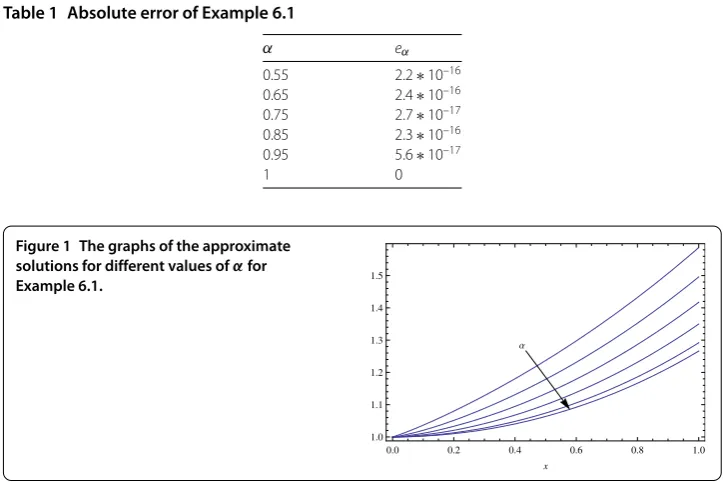
Example 6.1 Consider the following second-order fractional Emden-Fowler problem:
D2αu(x) + 1 xαD
αu(x) –u(x) = 0, x∈(0, 1), (6.1)
subject to
u(0) = 1, Dαu(0) = 0. (6.2)
The graphs of the approximate solutions for different values ofαare given in Figure 1. The absolute error obtained by the presented method is shown in Table 1.
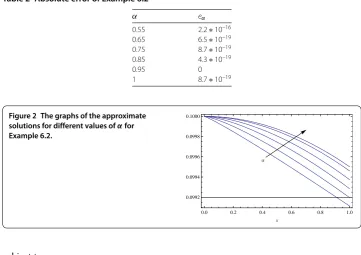
Example 6.2 Consider the following second-order fractional Emden-Fowler problem:
D2αu(x) + 1 xαD
α
u(x) + 2u3(x) = 0, x∈(0, 1), (6.3)
Table 1 Absolute error of Example 6.1
α eα
0.55 2.2∗10–16
0.65 2.4∗10–16
0.75 2.7∗10–17
0.85 2.3∗10–16
0.95 5.6∗10–17
1 0
Table 2 Absolute error of Example 6.2
α eα
0.55 2.2∗10–16
0.65 6.5∗10–19
0.75 8.7∗10–19
0.85 4.3∗10–19
0.95 0
1 8.7∗10–19
Figure 2 The graphs of the approximate solutions for different values ofαfor Example 6.2.
subject to
u(0) = 0.1, Dαu(0) = 0.
The graphs of the approximate solutions for different values ofαare given in Figure 2. The absolute error obtained by the presented method is shown in Table 2.
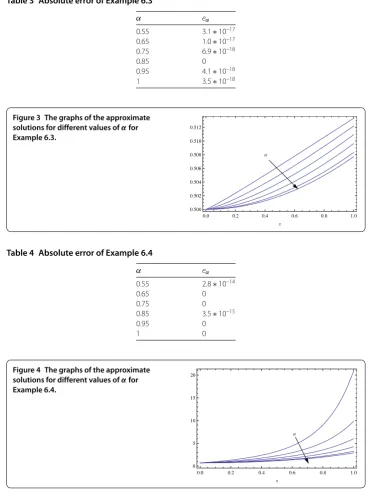
Example 6.3 Consider the following second-order fractional Emden-Fowler problem:
D2αu(x) + 1 xαD
α
u(x) –u3(x) + 3u3(x) = 0, x∈(0, 1), (6.4)
subject to
u(0) = 0.5, Dαu(0) = 0. (6.5)
The graphs of the approximate solutions for different values ofαare given in Figure 3. The absolute error obtained by the presented method is shown in Table 3.
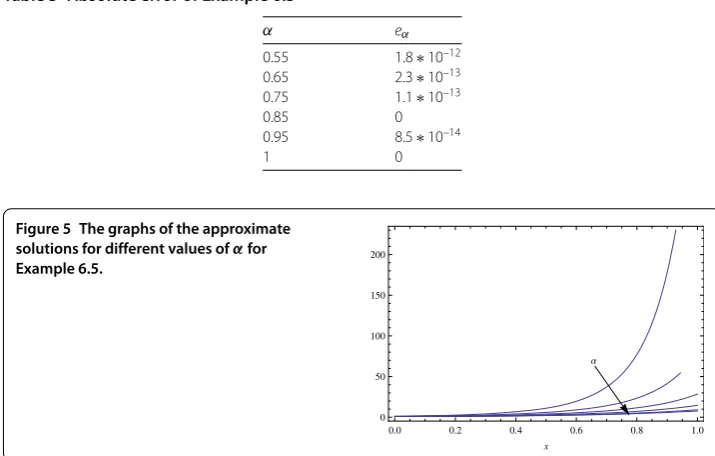
Example 6.4 Consider the following second-order fractional Emden-Fowler problem:
D2αu(x) + 2 xαD
α
u(x) –6 + 4x2αu(x) = 6 – 6x2α– 4x4α, x∈(0, 1), (6.6)
subject to
u(0) = 0.7, Dαu(0) = 0. (6.7)
Table 3 Absolute error of Example 6.3
α eα
0.55 3.1∗10–17
0.65 1.0∗10–17
0.75 6.9∗10–18
0.85 0
0.95 4.1∗10–18
1 3.5∗10–18
Figure 3 The graphs of the approximate solutions for different values ofαfor Example 6.3.
Table 4 Absolute error of Example 6.4
α eα
0.55 2.8∗10–14
0.65 0
0.75 0
0.85 3.5∗10–15
0.95 0
1 0
Figure 4 The graphs of the approximate solutions for different values ofαfor Example 6.4.
Example 6.5 Consider the following second-order fractional Emden-Fowler problem:
D2αu(x) + 4 xαD
αu(x) –18 + 9x4αu(x) = 20 – 36x3α– 18x6α, x∈(0, 1), (6.8)
subject to
u(0) = 1, Dαu(0) = 0. (6.9)
Table 5 Absolute error of Example 6.5
α eα
0.55 1.8∗10–12
0.65 2.3∗10–13
0.75 1.1∗10–13
0.85 0
0.95 8.5∗10–14
1 0
Figure 5 The graphs of the approximate solutions for different values ofαfor Example 6.5.
7 Conclusions
In this paper, we study the second-order fractional Emden-Fowler problem. The repro-ducing kernel Hilbert space method (RKHSM) is employed to compute an approximate solution to the proposed problem. The construction of the reproducing kernel based on the orthonormal shifted Legendre polynomials is presented. The validity of the RKHSM is ascertained by presenting five of our examples. It is worth mentioning that we get the same results as those in Wazwaz [48] for Examples 6.3-6.5 whenα= 1. We prove the exis-tence of solution of the second-order fractional Emden-Fowler problem. The convergence of the approximate solution using the proposed method is investigated. The uniform con-vergence of the approximate solution to the exact solution is presented. Error estimation to the proposed method is proven. The results reveal that the proposed analytical method can achieve excellent results in predicting the solutions of such problems.
Acknowledgements
The authors would like to thank the reviewers for the valuable comments. Funding
Not Applicable
Availability of data and materials Not Applicable
Competing interests
The authors declare that they have no competing interests. Authors’ contributions
The contribution of the authors is equal. All authors read and approved the final manuscript. Author details
1Department of Mathematical Sciences, College of Science, UAE University, Al-Ain, United Arab Emirates.2Department of Mathematics, Al al-Bayt University, Mafraq, Jordan.3Department of Mathematics and Statistics, Jordan University of Science and Technology, P.O. Box: 3030, Irbid, 22110, Jordan.
Publisher’s Note
Springer Nature remains neutral with regard to jurisdictional claims in published maps and institutional affiliations.
References
1. Gaul, L, Klein, P, Kemple, S: Damping description involving fractional operators. Mech. Syst. Signal Process.5, 81-88 (1991)
2. Podlubny, I: Fractional Differential Equations: An Introduction to Fractional Derivatives, Fractional Differential Equations, to Methods of Their Solution and Some of Their Applications. Academic Press, New York (1999) 3. Al-Khaled, K, Momani, S: An approximate solution for a fractional diffusion-equation using the decomposition
method. Appl. Math. Comput.165(2), 473-483 (2005)
4. Das, S: Analytical solution of a fractional diffusion equation by variational iteration method. Comput. Math. Appl.
57(3), 483-487 (2009)
5. Suarez, L, Shokooh, A: An eigenvector expansion method for the solution of motion containing fractional derivatives. J. Appl. Mech.64, 629-635 (1997)
6. Arikoglu, A, Ozkol, I: Solution of fractional integro-differential equations by using fractional differential transform method. Chaos Solitons Fractals40(2), 521-529 (2009)
7. Meerschaert, M, Tadjeran, C: Finite difference approximations for two-sided space-fractional partial differential equations. Appl. Numer. Math.56(1), 80-90 (2006)
8. Odibat, Z, Shawagfeh, N: Generalized Taylor’s formula. Appl. Math. Comput.186(1), 286-293 (2007)
9. Alquran, M, Al-Khaled, K, Chattopadhyay, J: Analytical solutions of fractional population diffusion model: residual power series. Nonlinear Stud.22(1), 31-39 (2015)
10. Alquran, M: Analytical solution of time-fractional two-component evolutionary system of order 2 by residual power series method. J. Appl. Anal. Comput.5(4), 589-599 (2015)
11. Alquran, M, Al-Khaled, K, Sarda, T, Chattopadhyay, J: Revisited Fisher’s equation in a new outlook: a fractional derivative approach. Physica A438, 81-93 (2015)
12. Jaradat, HM, Al-Shara, S, Khan, QJA, Alquran, M, Al-Khaled, K: Analytical solution of time-fractional
Drinfeld-Sokolov-Wilson system using residual power series method. IAENG Int. J. Appl. Math.46(1), 64-70 (2016) 13. Al-Mdallal, Q, Syam, M, Anwar, MN: A collocation-shooting method for solving fractional boundary value problems.
Commun. Nonlinear Sci. Numer. Simul.15(12), 3814-3822 (2010)
14. Li, Y, Sun, N: Numerical solution of fractional differential equations using the generalized block pulse operational matrix. Comput. Math. Appl.62, 1046-1054 (2011)
15. Pandey, R, Bhaedwaj, A, Syam, MI: An efficient method for solving fractional differential equations using Bernstein polynomials. J. Fract. Calc. Appl.5(1), 129-145 (2014)
16. Li, Y: Solving a nonlinear fractional differential equation using Chebyshev wavelets. Commun. Nonlinear Sci. Numer. Simul.15, 2284-2292 (2010)
17. Wu, J: A wavelet operational method for solving fractional partial differential equations numerically. Appl. Math. Comput.214(1), 31-40 (2009)
18. Kilbas, A, Srivastave, H, Trujillo, J: Theory and Applications of Fractional Differential Equations. North-Holland Mathematics Studies, vol. 204. Elsevier Science BV, Amsterdam (2006)
19. Samko, SG, Kilbas, AA, Marichev, OI: Fractional Integrals and Derivative. Theory and Applications. Gordon and Breach, Yverdon (1993)
20. Lakshmikantham, V, Vatsala, A: Basic theory of fractional differential equations. Nonlinear Anal.69, 2677-2682 (2008) 21. Zhang, S: Existence of solution for a boundary value problem of fractional order. Acta Math. Sci.26, 220-228 (2006) 22. Agarwal, RP, Benchohra, N, Hamani, S: A survey on existing results for boundary problems of nonlinear fractional
differential equations and inclusions. Acta Appl. Math.109, 973-1033 (2010)
23. Lakshmikantham, V, Vatsala, A: General uniqueness and monotone iterative technique for fractional differential equations. Appl. Math. Lett.21, 828-834 (2008)
24. Oldham, K, Spanier, J: The Fractional Calculus. Academic, New York (1974) 25. Pao, CV: Nonlinear Parabolic and Elliptic Equations. Plenum Press, New York (1992)
26. Singh, J, Kumar, D, Baleanu, D: On the analysis of chemical kinetics system pertaining to a fractional derivative with Mittag-Leffler type kernel. Chaos27, 103113 (2017)
27. Singh, J, Kumar, D, Nieto, J: A reliable algorithm for local fractional Tricomi equation arising in fractal transonic flow. Entropy18(6), 206 (2016). https://doi.org/10.3390/e18060206
28. Singh, J, Kumar, D, Al Qurashi, M, Baleanu, D: A novel numerical approach for a nonlinear fractional dynamical model of interpersonal and romantic relationships. Entropy19(7), 375 (2017). https://doi.org/10.3390/e19070375 29. Geng, F, Cui, M: Solving a nonlinear system of second order boundary value problems. J. Math. Anal. Appl.327,
1167-1181 (2007)
30. Du, J, Cui, M: Solving the forced Duffing equations with integral boundary conditions in the reproducing kernel space. Int. J. Comput. Math.87, 2088-2100 (2010)
31. Siyyam, HI, Syam, MI: An accurate solution of the Poisson equation by the Chebyshev-Tau method. Am. J. Comput. Appl. Math.85(1), 1-10 (1997)
32. Syam, MI, Al-Sharo’, SM: Collocation-continuation technique for solving nonlinear boundary value problem. Comput. Math. Appl.37, 11-17 (1999)
33. Attili, B, Furati, K, Syam, MI: An efficient implicit Runge–Kutta method for second order systems. Appl. Math. Comput.
178(2), 229-238 (2006)
34. Syam, MI, Siyyam, HI: Numerical differentiation of implicitly defined curves. J. Comput. Appl. Math.108(1-2), 131-144 (1999)
35. Syam, M: The modified Broyden-variational method for solving nonlinear elliptic differential equations. Chaos, Solitions & Fractals32(2), 392-404 (2007)
36. Kumar, D, Singh, J, Baleanu, D: A new numerical algorithm for fractional Fitzhugh-Nagumo equation arising in transmission of nerve impulses. Nonlinear Dyn. (2017). https://doi.org/10.1007/s11071-017-3870-x
37. Kumar, D, Agarwal, RP, Singh, J: A modified numerical scheme and convergence analysis for fractional model of Lienard’s equation. J. Comput. Appl. Math. (2017) http://doi.org/10.1016/j.cam.2017.03.011
39. Jafari, H, Baleanu, D, Khan, H, Khan, R, Khan, A: Existence criterion for the solution of fractional orderp-Laplacian boundary value problems. Bound. Value Probl.2015, 164 (2015). https://doi.org/10.1186/s13661-015-0425-2 40. Baleanu, D, Jafari, H, Khan, H, Johnston, S: Results for mild solution of fractional coupled hybrid boundary value
problems. Open Math.13, 601-608 (2015)
41. Baleanu, D, Khan, H, Jafari, H, Khan, RA, Alipour, M: On existence results for solutions of a coupled system of hybrid boundary value problems with hybrid conditions. Adv. Differ. Equ.2015, 318 (2015)
42. Baleanu, D, Agarwal, R, Khan, H, Khan, R, Jafari, H: On the existence of solution for fractional differential equations of order 3 <δ1≤4. Adv. Differ. Equ.2015, 362 (2015)
43. Khan, H, Alipour, M, Khan, R, Tajadodi, H, Khan, A: On approximate solution of fractional order logistic equations by operational matrices of Bernstein polynomials. J. Math. Comput. Sci.14, 222-232 (2015)
44. Khan, H, Jafari, H, Khan, R, Tajadodi, H, Johnston, S: Numerical solutions of the nonlinear fractional-order Brusselator system by Bernstein Polynomials. Sci. World J.2014, Article ID 257484 (2014)
45. Caputo, M: Linear models of dissipation whose Q is almost frequency independent, Part II. Geophys. J. Int.13, 529-539 (1967)
46. Syam, MI, Siyyam, H, Al-Subaihi, I: Tau-Path following method for solving the Riccati equation with fractional order. Journal of Computational Methods in Physics2014, Article ID 207916 (2014)
47. Ariel, PD, Syam, MI, Al-Mdallal, QM: The extended homotopy perturbation method for the boundary layer flow due to a stretching sheet with partial slip. Int. J. Comput. Math.90(9), 1990-2002 (2013)