Evaluating The Efficacy Of Active Reading
Software In Enhancing EFL Learners’ Reading
Comprehension Skills
Imran Khan, Ainol Haryati Ibrahim, Asiah Kassim, Raja Muhammad Ishtiaq Khan
Abstract: Reading ability of the learners plays a pivotal role in their academic success. Reading without comprehension affects learners’ learning outcomes. However, the development of learners’ reading ability has always been a great challenging task for language teachers. The efficacy of computer-assisted language (CALL) in improving language skills has been endorsed by many studies under different socio-cultural settings. However, in Saudi EFL context, using CALL in teaching and learning languages is still scarce and there are more for researchers to explore. The current study intended to examine the effects of Active Reading Software (ARS) on reading comprehension skills of Saudi EFL learners at tertiary level. A quasi-experimental study was carried out at Majmaah University involving 30 EFL learners, which were equally clustered into a control group and an experimental group. A four- week treatment incorporating the ARS was assigned to the experimental group, while the control group received the same learning materials in a traditional classroom setting. Data acquired from the study were evaluated using t-test. Findings revealed a substantial difference between the mean scores of the two groups in terms of reading comprehension; the experimental group outperformed the control group. These results indicate that utilizing ARS can further enhance the EFL learners’ reading comprehension skills and thus, it can be assumed that the ARS software can be a facilitative learning tool in the teaching and learning of reading.
KeyWords: ARS, CALL, Comprehension skills, EFL learners, Language proficiency
—————————— ——————————
1. INTRODUCTION
Reading is one of the fundamental language abilities which add to the students' scholastic achievement. Reading ability serves a base for all learning, social and economic development and it can enhance overall language proficiency (Qrqez & Ab Rashid, 2017). Comprehension is the ability to comprehend the words beyond their surface meaning and to identify the relationship between various concepts presented within the text (Smith, 2004). Comprehension is geared up by certain comprehension skills which are indispensible for overall comprehension performance. Among these component skills, activation of relevant prior knowledge is core to comprehension (Brown, Palincsar, & Armbruster, 1984). In EFL context; reading process is more complex because it depends on various factors which determine its success or failure. These factors include lack of exposure to English texts, limited use of technology, teacher-centered approaches to teaching and learning reading skill and lack of motivation (Al-Seghayer, 2014; Hazaea & Alzubi, 2016; Rajab & Al-Sadi, 2015)
English is scarcely used outside the class, and this is one of the reasons behind the poor language skills of Saudi
students (Khan, 2011). Many Saudi EFL, even at tertiay level, learners read English text without comprehension and they merely rely on guessing because their comprehension skills are not developed properly (Al-Qahtani, 2016). Lack of reading habits among Saudi EFL learners also affect their reading proficiency (Zaharna, 1995). Other reasons which can be ascribed to poor reading comprehension of Saudi EFL learners are conventional based approaches adopted by many language instructors (Alkhaleefah, 2017). In many Saudi educational institutions, reading is taught without intervention of technology; grammar translation methods of teaching still prevails, as a result students’ performance in language learning remains unsatisfactory (Al-Nafisah, 2011). Reading and writing skills are the least developed language skills for Saudi EFL learners (Meniado, 2016). The reasons for this can be ascribed to numerous aspects, such as lack of interest and motivation, limited exposure to English reading texts and inability to use comprehension skills (Alrabai, 2016). In Saudi EFL reading classrooms, teachers translate difficult words into Arabic and students rarely make use of comprehension skills to understand and interpret meanings from a reading text (Alfallaj, 2017). According to the annual report of International English language Testing System (IELTS, 2014), Saudi students achieve lowest scores in IELTS exams unlike other Arabic countries. Translation and rote-memorization are two dominant aspects of Saudi EFL classrooms which cause boredom and demotivation on the part of the learners. However, the situation can be improved if students are exposed to interesting and authentic reading materials through the integration of computer technology in the language classes (Ishtiaq, Ali, & Salem, 2017). In the past many researchers investigated various ways and techniques to improve reading practices in Saudi Arabia. Therefore, a substantial amount of empirical studies envisaged the progressive role of technology in reading development (Alharbi & Drew, 2014; Alwehaibi, 2015; Mitchell & Alfuraih, 2017). With the integration of technology, the learning environments today are very interactive and adaptive facilitating learners to pursue their
____________________________
Imran Khan, English Language Lecturer, Al-Majmaah University, Kingdom of Saudi Arabia.Email: [email protected]
Ainol Haryati Ibrahim, Associate Professor Centre for Modern Language & Human Sciences, Universiti Malaysia Pahang, Kuantan, Pahang, Malaysia.
Email: [email protected]
Asiah Kassim, PhD scholar, Centre for Modern Language & Human Sciences, Universiti Malaysia Pahang, Kuantan, Pahang, Malaysia Email: [email protected].
Raja Muhammad Ishtiaq Khan
English Language Lecturer, Al-Majma’ah University, Zulfi, Kingdom of Saudi Arabia
learning goals in an individualized manner. In the time of technology advancement, learners are tech-savvy and can utilize technology more effectively in learning a language. Computers as a learning tool are very adaptive which could interpret a language for users and offer productive feedback, make corrections and enhance learners’ interaction, promoting effective learning (Zimmerman & Tsikalas, 2005). Computer as an instructional tool can be used to motivate learners towards reading and improve their linguistic skills for over all academic success (Alresheed, Raiker, & Carmichael, 2017). In the last decade, numerous studies examined the role of technological tools in language teaching in Saudi Arabia, but majority of these studies focused on teachers’ perception and learners’ attitude towards CALL. The current study, therefore, attempted to fill the existing gap in the educational research in Saudi EFL context by investigating the role of the Active Reading Software in improving tertiary level learners’ reading comprehension skills for academic performance and language proficiency exams.
2. LITERATURE REVIEW
2.1 Reading and Technology
In the recent decades, the efficacy of technology in the instruction of reading comprehension has been tackled by several studies. The effective use of technology has not only facilitated teaching and learning process but cultivated positive attitudinal changes in the learners in the recent years (Chun, Kern, & Smith, 2016). Teaching reading has been a great challenge for EFL language teachers because it is a laborious task and it tends to acquaint learners with the culture of the target language and that could be hard without technology intervention (Fogarty et al., 2017). In the traditional reading classrooms, learners do not get access to authentic reading materials (Taj, Ali, Sipra, & Ahmad, 2017). In education, ICT is used across the world which has improved the quality and standard of language pedagogy (Arkorful & Abaidoo, 2015). With the introduction of computers as instructional and learning tools, the research in the field of education made a revolutionary progress (Stošić, 2015). Feedback is an essential part of learning process. Computer as a learning tool, provides constructive feedback during the course of learning activity (Van der Kleij, Feskens, & Eggen, 2015). The integration of technology has great impact in education where reading teachers are encouraged to encompass new technology into their teaching methods for effective results (Golonka, Bowles, Frank, Richardson, & Freynik, 2014). Technology-assisted teaching of reading provides enormous opportunities for the learners to get access to diverse reading materials which they can practice any time anywhere (Van Wyk & Louw, 2008). The current section will discuss the available literature regarding the usefulness of technology in ESL and EFL reading comprehension classes.
Alharbi (2018) studied the effects of hyper texts on reading performance of EFL learners at Al Qassim University, Saudi Arabia. The participants were 72 EFL male learners and their distribution into four groups used random procedure; one control and three experimental.The three experimental groups received treatment with glossed reading text and the other group treated conventionally. Their study utilized pre
participation was voluntary. As a treatment to the experimental, the researcher used computer concept making software for seven weeks. They researcher adopted quantitative and qualitative procedure to collect data. For analysis of data, SPSS was used. Findings shown remarkable improvement in the mean score of the participants engaged in the treatment group with respect reading comprehension. First, the participants of study were medical students studying English as ESP. Second, their English proficiency level is better than EFL learners at Majmaah University. Al Shebli and Abdulla (2014) explored the efficacy of technological devices on leaners’ reading achievement and learning attitudes in UAE. Seventh grade learners were engaged in the study. Division of the groups used random method. A Pretest was administerd to both groups. Experimental group was given compueter-based reading materials while the control group received same reading lessons in printed form. Post-test was taken to evalute their mean scores on reading comprehension. Attitude questionaaire was used to measure learners’ attitudes towards CALL. The results showed positive attitudes towards CALL and the experimental group achieved high mean score on reading comprehension postest. Howerver, the subjects involved were from different social background and were all female students. Therefore, the results can not be generalized to all EFL learners. In conclusion, the literature review of the above relevant of studies provided empirical evidence that technology plays pivotal role in improving learners’ reading comprehension skills. However, majority of these studies conducted in different social and learning contexts, focused on school level students, explored learners’ attitudes, teachers’ perception and evaluated technology role on improving reading comprehension of junior students in ESL contexts. Moreover, many previous studies did not offer a comprehensible theoretical frameworks in the domain of techonolgy- enhanced reading performnace. The current study provides insights on the effective role of using technology for improving English teaching practices and learning experiences in EFL context in Saudi Arabia. Therefore, there is a need to conduct a comprehensive experimental study with technology intervention, focusing on the improvement of Saudi EFL learners’ reading comprehension skills not only for institutional academic success but preparing learners for future success in standardized language proficiency tests like IELTS, TOEFL, SAT and GMAT.
2.2 Theoretical Perspective of Reading
Theoretically, reading comprehension is varied, vast and complex. Researchers on reading proposed different theories to explain the nature and principles of reading at ESL and EFL levels. Since the introduction of technology in teaching a language, a flux of new theories developed by the researchers which could help to understand the nature and concepts of reading (McNamara, 2012). Most CALL programs underpin their principle and theories from Second Language Acquisition (SLA) framework. Most of the SLA theories describe how languages are learned, taught and how these learning materials can be developed. Therefore, majority of CALL studies focus on SLA for creating E-learning environment for learners that promote effective language leaning (Cook, 2016). The theoretical
background of the studies conducted in the domain of EFL and ESL reading using technology is always in state of flux (Alyousef, 2006). Krashen (1981) theory of second language acquisition fifth hypothesis; input hypothesis, has been adopted by many researchers of language using technology as supportive or scaffolding tool (Chapelle, 2009). According to the input hypothesis, best language acquisition is possible when learners are exposed to comprehensible input under low anxiety and low affective filter environment (Krashen, 1981). Teaching reading with the intervention of technology can be effective because in a technological learning environment the affective filter is always low and defensive free (Coady, 1997). For effective learning, learners should have the freedom to choose the reading materials of their choice or the ones that motivate them and this idea endorses the principle of Zone of Proximal Development (ZPD) theory (Bliss, Askew, & Macrae, 1996) . If students get access to authentic reading materials as comprehensible input, the integration of technology may increase their reading comprehension performance and motivation for learning (Yang, 2011). Schema theory is core to the studies of reading comprehension at all levels. In Schema theory, reader’s prior knowledge plays fundamental role in improving learners’ reading comprehension. According to schema theory, reading establishes a connection between reader, content, writer and readers’ prior knowledge about the subject (Nassaji, 2002). Many studies support the role of schema activation in improving reading comprehension performance (An, 2013; Liu, 2015; Rumelhart, 2017). Schema theorists endorses the effective use of technology in activating learner’s prior knowledge by exposing learners to authentic materials related to their background knowledge (Xie, 2017). Schema theory is one of the reading theories which is widely used in technology-based instruction of reading comprehension (Pearson, Kamil, Mosenthal, & Barr, 2016; Xie, 2017). Technology is very effective in activating learners’ prior knowledge by exposing learners to variety of online learning activities and tasks (Hahnel, Goldhammer, Naumann, & Kröhne, 2016). Dual Code Theory, proposed by (Paivio, 1991), is one of the most dominant theories of cognition. This theory gives systematic and comprehensive illustrations of all various concepts of literacy pertaining to cognition, comprehension, decoding and readers’ response in reading (Sadoski & Paivio, 2013). According to this theory human cognition comprises of two cognitive subsystems; logogens responsible for language and imagens deals with concrete nonverbal images, events or objects (Sadoski & Paivio, 1994). Reading involves a process of constructing mental representation of codes; the first is verbatim text information or surface form includes text base knowledge or exact content of the text and propositional text base form which is mental, abstract meaning of language (Mih & Mih, 2008). Technology- based teaching can combine both levels of codes; linguistic and formation of imagery’ to enhance reading comprehension of EFL learners.
3. RESEARCH QUESTIONS
A. What are the effects of ARS on reading comprehension skills of Saudi EFL learners at Majmaah University? 1. Is there any significant difference in the mean scores
between the reading comprehension pretest and posttest for both experimental and control groups?
2. Is there any significant difference between the mean scores of the experimental group and the mean scores of the control group in the reading posttest?
4. METHODOLOGY
The present study employed quantitative procedure to collect data. It adopted a quasi-experimental pretest- posttest control group design (Ary, Jacobs, Sorensen, & Razavieh, 2010). The quantitative data were collected using reading proficiency test. Both the groups; experimental and control, took pretest before commencing the treatment and a post-test was managed toward the end of the treatment that lasted for four weeks. The experimental group received treatment using Active Reading Software while the control group received same reading materials in printed form. Data from both pre-test and post-test were analysed using SPSS.
4.1 Participants
The study included 30 participants of first year EFL learners enrolled in the B.A program at Majmaah University 2016. Majmaah University was founded in 2009, located in the province of Al Majmaah, 180 km north of Riyadh city. All the participants were male Saudi citizens aged ranging from 19 to 22 years. The participants were assigned into different groups administratively on the basis of their placement test results upon their admission. Taking intensive course is compulsory for all students who wish to enrol for B.A English program at Majmaah University. However, in this study, the researcher used TOEFL Junior reading test to confirm the homogeneity of the participants in reading
comprehension. On account of the proficiency test result, participants were clustered into two groups of similar number. Pretest was administered prior to the intervention began.
4.2 Treatment and Procedure
In the current study, the experimental group received intervention for the period of four weeks. The treatment was given from Active Reading Software which was installed in the computers labs. Active Reading Software is developed by Clarity English.com. Active Reading Software has six levels of reading sections, starting from elementary to advanced level. Active Reading Software focuses on 8 reading comprehension skills; getting main idea, making inferences, extracting stated and unstated details, identifying the theme, the purpose of the text and others. Each reading section has a number of reading exercises and activities based on the reading skills intended to be developed. Students learn vocabulary from cloze exercises which has different levels of complexity starting from simple to complex words. Each reading task is connected to progress report with instant feedback. For the pilot study, two levels, pre-intermediate and intermediate levels were chosen. Each level has ten reading topics, and they were given as a treatment to experimental group in five sessions. Each session lasted for one and half hours twice a week. In the first session students were given training about the usage of software and the process of registration was completed. In each session students practiced four lessons. Each lesson focused on developing particular reading skills. The control group was taught in a regular classroom using the same reading topics in printed forms. The only difference is the mode of teaching; the experimental group was taught through computer software (ARS) while the control group from the printed paper without technology intervention. Intervention procedure of ARS is given in table below.
Table1. Weekly Activities of ARS Intervention
No Components Activities Focussed Reading Skills
Week 1 1. The Doctor says 2. Choosing a Holiday 3. Making a Journey
a) Video Introduction
b) Predict contents from the headings c) Cloze Exercises
d) Scanning& skimming e) Questions / Answers
1. Getting main idea
2. Understanding stated details 3. Inferring unstated details 4. Recognizing word referents 5. Synonyms and Anonyms
Week 2 1. Travel Advice 2. Health & Food 3. Pet Animals
a) Video Introduction b) Predict contents from the headings c) Cloze Exercises d) Scanning for specific e) Questions / Answers
1. Getting main ideas
2. Understanding stated details 3. Synonyms and Antonyms 4. Making Conclusion 5. Author’s purpose Week 3 1. Pets
2. Cultures 3. Find a Job
a) Video Introduction b) Predict contents from the headings
c) Cloze Exercises d) Scanning for specific e) Questions / Answers
1. Recognizing main ideas 2. Understanding stated details 3. Eliciting Author’s purpose 4. Producing new ideas 5. Cause and Effect
Week 4 1. Dangerous Sports 2. Using a dictionary 3. Different Cultures
a) Video Introduction b) Predict contents from the headings
1. Getting main ideas
c) Cloze Exercises d) Scanning for specific e) Questions / Answers
4. Identifying word referents 5. Making prediction
4.3 Testing Instrument
The main research instrument used in this study was reading achievement test developed by the researcher. This test was constructed on the basis of the eight reading comprehension skills intended to be developed. The reading test consisted of four reading passages with forty multiple choice questions. Each correct response carries one mark and there is no negative marking. The total score of the test was 40. The test was prepared with the help of two language teaching experts. For the validity purpose, it was given to 15 EFL well experienced experts. Besides this it was sent to ten other researchers from other universities. The final draft of the test was prepared on the basis of experts’ recommendations and suggestions. Readability index test was also used to check its suitability for the learners. Finally, the test was piloted on 30 EFL learners. Reliability of the reading test was measured using Kuder Richardson 20 and it was found to be reliable as (α= 0.732).
5. Data Analysis and Discussion
5.1 Tests for Assumptions
Prior to conducting data analysis, tests of assumptions were completed. Shapiro Wilk test and Kolmogorov-Smirnov test were administered to determine the normality
of the data. The results showed that the data were normally distributed. Coin tossing technique was used to ensure randomization of the participants into respective groups (Ary et al., 2010). In experimental research, 15 participants in each of the control and experimental groups are sufficient Creswell (2002). Therefore, parametric tests were used because it met all the assumptions.
5.2 Pre-test Results
The current study adopted quasi-experimental pretest posttest design. Therefore, the participants in both the groups took pretest before the commencement of intervention. Table 2 presents the descriptive statistics of the pretest scores for the experimental and control groups. Normality test was run and the data were found normal. Therefore, an independent-sample t-test was conducted to compare the reading comprehension scores between the experimental group and the control group in the pretest. The result of the t-test indicated that there was no significant difference in the scores for the experimental group (M=23.23, SD= 4.43) and the control group (M=22.99, SD=3.89). Both groups are relatively homogeneous in terms of reading comprehension proficiency.
Table2. Descriptive Statistics of Pretest
Group Statistics
Student ID N Mean Std. Deviation Std. Error Pretest
Comprehension Score
Experimental Group Control Group
15 15
23.2333 22.9992
4.43471 3.89994
1.14505 1.00696
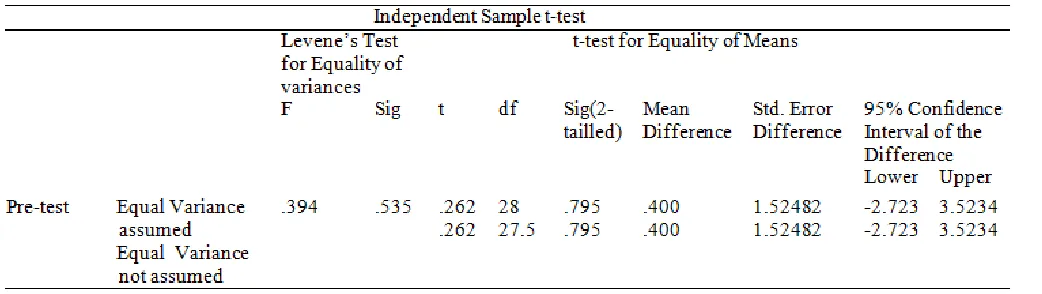
In order to evaluate differences in variances, Levene’s test was employed which is normally used to find equality in variances. Levene’s test found the assumption of homogeneity of variance was met, p = .535; therefore a
two-tailed independent sample t-test based on equal variances was carried out. No significant difference in the pretest scores between the experimental and control groups was found t(28)= .26, p = .80.
Table 3. Results of Independent Sample t-test (Pretest)
5.3 Post-Test Results
Table 4 shows the mean scores of the experimental group and the control group on posttest. The mean score of experimental (N =15) was 27.6 (M = 27.6) which is 69 % of maximum score of 40 marks. It shows that the mean score of experimental group is higher on posttest as compared to that of control group (N = 15) 24.9. Standard deviation of experimental group was 2.1 (SD =2.1) and standard error was .55 (SEM = .55).Standard deviation of control group was 1.4 (SD= 1.4) and standard error mean was .38 (SEM = .38). The descriptive analysis of posttest shows
significant difference in the overall results of experimental and control groups. It can be concluded that experimental group improved in terms of reading comprehension skills against its counterpart because of ARS intervention. The occurrence of significant difference in the mean scores of experimental and control groups in terms of reading comprehension skills can be attributed to the use of ARS. Therefore, the inferential results of the post-test supported the hypothesis that ARS instruction can improve EFL learners’ reading comprehension skills.
Table 4. Descriptive Results (Post-test)
Group Statistics
Student ID N Mean Std. Deviation Std. Error Posttest
Comprehension Score
Experimental Group Control Group
15 15
27.60 24.93
2.131 1.486
.55032 .38380
The current study investigated the effects of using ARS on students’ reading comprehension proficiency. Data obtained from the participants’ reading comprehension pre and post tests were computed. Paired samples t-tests and descriptive analysis were conducted to find any statistically significant differences in the results of the pretest and
posttest for both groups. As shown in Table 5, that the experimental group progressed considerably in the posttest in reading comprehension performance (M= 28, SE= .55032), t(14)= - 3.073, p < .05. This significant difference in the participants’ posttest reading comprehension performance can be attributed to the use of ARS.
Table5. Results of Paired t-test of the Experimental Group on the Pre-test and Post-test
Group Variable Tests No. Mean St. Deviation T Value df Sig(2-tailed)
Experimental Reading Comprehension
Pre Post
15 15
23.3 27.6
4.43471 2.13140
-3.073 14 .008
The mean scores of control group in reading comprehension performance on pretest and posttest were computed using paired sample t-test. Table 6 describes that there is a statistical difference in the mean scores of the control group in terms of reading comprehension on posttest. However, the descriptive statistics of paired sample t-test highlighted the difference in the mean scores
of control group on posttest but it was statistically not significant (M= 24.9, SE=1.48645), t(14)-1.620, p > .05. The result shows that the p value (p= .127) is greater than p, .05. Therefore, we can conclude that the difference in the mean scores of control group posttest reading comprehension performance is statistically not significant.
Group Variable Tests No. Mean St. Deviation T Value df Sig(2-tailed) Control Reading
Comprehension
Pre Post
15 15
22.9 24.9
3.899942 1.48645
-1.620 14 .127
In conclusion, the results of the current study are in line with the study by Saeidi and Yusefi (2012). Their study investigated the effect of computer software (Rosetta Stone) on reading comprehension. They also adopted quasi- experimental pre-test post-test design. The participants were 40 EFL learners. The experimental group received treatment through computer software, Rosetta stone for three weeks. The posttest analysis showed significant difference in the mean scores of experimental group in terms of reading comprehension. The participants were high school level students with different social background. The results of the study are also partially similar to the study by Ikonta and Ugonna (2015). In their study, the effect of computer software was used to improve the reading compression of ESL learners. The findings of these studies revealed effective role of computer software on improving reading comprehension skills of the learners. It was hypothesised that ARS could enhance the reading capability of EFL learners. Therefore, the inferential results of the post-test supported the hypothesis that ARS based instruction can improve EFL learners’ reading comprehension skills. In the present study, ARS reading activities helped the participants’ reading comprehension skills because ARS offered authentic reading exercises in a stress free learning environment. ARS provided learners with ample opportunities to work on their own space in a student-centered approach to develop their reading comprehension skills.
6. IMPLICATIONS
The current study carries important pedagogical implications for foreign language teaching that effective learning can be promoted by employing well-designed tasks in low filter conditions with the help of ARS intervention. Technology has the potential to create anxiety free and low-filter language input environment for the learners (Johnson, Wisniewski, Kuhlemeyer, Isaacs, & Krzykowski, 2012). Technology assistance in language pedagogical practices not only facilitates the process but motivates the learners to achieve their academic goals. Therefore, it is highly recommended for language instructors to utilize all the available resources of ICT and innovative technology as supportive and scaffolding tools to enhance language proficiency of the learners. Therefore, it can be inferred that incorporating ARS in teaching and learning process can assist the teachers to motivate the learners towards reading, and it can also help the learners to improve their linguistic skills for academic success and reading comprehension skills specifically for language proficiency exams. The current study carries important implications for administrators, curriculum planners, and language instructors that they should create an environment for successful implication of ARS in learning institutions.Educational Stakeholders can encourage instructors to make use of all available resources of ICT to promote effective learning. Curriculum designers and
planners can incorporate ARS reading materials in the current syllabi to enable learners to develop their reading comprehension skills for academic success and language proficiency exams. Moreover, an integration of ARS reading materials into the syllabi will develop learners’ self-learning skills for independent learning.
7. LIMITATIONS
The current study has certain limitations which can be ascribed to administrative constraints where the research is conducted. For more generalized results, research must have vast canvass in terms of sample size, gender and resources. The main limitation of the current study is that it takes only male participants; this is because of social and administrative constraints. Secondly, the sample size is small as it focused on a single college instead of multiple colleges in the university. Finally, the current study employed researcher made instruments for data collection due to the non-availability of standardized instruments. Though, consistent measures have been adopted to secure its reliability and validity before utilizing in the current study.
8. CONCLUSION
REFERENCES
[1] Al -Nafisah, K. (2011). Saudi EFL students’ reading interests. Journal of King Saud University-Languages and Translation, 23(1), 1-9.
[2] Al-Qahtani, A. A. (2016). Why Do Saudi EFL Readers Exhibit Poor Reading Abilities? English Language and Literature Studies, 6(1), 1.
[3] Al-Seghayer, K. (2014). The four most common constraints affecting English teaching in Saudi Arabia. International Journal of English Linguistics, 4(5), 17.
[4] Alfallaj, F. S. S. (2017). Reading Competence of the Saudi EFL Learner: Empowering the Teachers through Linguistics. Advances in Language and Literary Studies, 8(3), 12-17.
[5] Alharbi, & Drew, S. (2014). Using the technology acceptance model in understanding academics’ behavioural intention to use learning management systems. International Journal of Advanced Computer Science and Applications, 5(1), 143-155. [6] Alkhaleefah, T. A. (2017). Saudi EFL Learners’
Reported Reading Problems and Strategic Processing of Text Types: A Think-aloud Case Study. Reading Psychology, 38(7), 687-730. [7] Alrabai, F. (2016). Factors underlying low achievement
of Saudi EFL learners. International Journal of English Linguistics, 6(3), 21.
[8] Alresheed, S., Raiker, A., & Carmichael, P. (2017). Integrating computer-assisted language learning in Saudi schools: A change model Handbook on digital learning for K-12 schools (pp. 369-380): Springer.
[9] Alwehaibi, H. O. (2015). The Impact of Using Youtube in EFL Classroom on Enhancing EFL Students' Content Learning. Journal of College Teaching & Learning, 12(2), 121-126.
[10] Alyousef, H. S. (2006). Teaching reading comprehension to ESL/EFL learners. Journal of language and learning, 5(1), 63-73.
[11] An, S. (2013). Schema Theory in Reading. Theory & Practice in Language Studies, 3(1).
[12] Ary, D., Jacobs, L., Sorensen, C., & Razavieh, A. (2010). Introduction to research in education. Belmont, CA: Cengage Learning: Inc.
[13] Bliss, J., Askew, M., & Macrae, S. (1996). Effective teaching and learning: Scaffolding revisited. Oxford review of Education, 22(1), 37-61.
[14] Brown, A. L., Palincsar, A. S., & Armbruster, B. B. (1984). Instructing comprehension-fostering activities in interactive learning situations. Learning and comprehension of text, 255-286.
[15] Chapelle, C. A. (2009). The relationship between second language acquisition theory and computer‐ assisted language learning. The Modern Language Journal, 93, 741-753.
[16] Coady, J. (1997). 1 1 L2 vocabulary acquisition through extensive reading. Second language vocabulary acquisition: A rationale for pedagogy, 225.
[17] Cook, V. (2016). Second language learning and language teaching: Routledge.
[18] Hahnel, C., Goldhammer, F., Naumann, J., & Kröhne, U. (2016). Effects of linear reading, basic computer skills, evaluating online information, and navigation on reading digital text. Computers in Human Behavior, 55, 486-500.
[19] Hazaea, A. N., & Alzubi, A. A. (2016). The effectiveness of using mobile on EFL learners’ reading practices in Najran University. English Language Teaching, 9(5), 8.
[20] Ikonta, N. R., & Ugonna, N. C. (2015). The effect of Rosetta Stone (computer-assisted language learning) software on English as second language students’ proficiency in English language. African Educational Research Journal, 3(1), 69-79. [21] Ishtiaq, M. I., Ali, Z., & Salem, M. S. (2017). An
Experimental Study of the Effect of Student Teams Achievement Divisions (STAD) on Vocabulary Learning of EFL Adult Learners.
[22] Johnson, T., Wisniewski, M. A., Kuhlemeyer, G., Isaacs, G., & Krzykowski, J. (2012). Technology adoption in higher education: Overcoming anxiety through faculty bootcamp. Journal of Asynchronous Learning Networks, 16(2), 63-72. [23] Khan, I. A. (2011). Learning difficulties in English:
Diagnosis and pedagogy in Saudi Arabia. Educational Research, 2(7), 1248-1257.
[24] Krashen, S. D. (1981). Second language acquisition and second language learning: Oxford University Press.
[25] Liu, Y. (2015). An Empirical Study of Schema
Journal of Language Teaching and Research, 6(6), 1349-1356.
[26] McNamara, D. S. (2012). Reading comprehension strategies: Theories, interventions, and technologies: Psychology Press.
[27] Meniado, J. C. (2016). Metacognitive Reading Strategies, Motivation, and Reading Comprehension Performance of Saudi EFL Students. English Language Teaching, 9(3), 117-129.
[28] Mih, V., & Mih, C. (2008). The construction of mental representation during reading; inferences generation: Babes-Bolyai Universität.
[29] Mitchell, B., & Alfuraih, A. (2017). English language teaching in the Kingdom of Saudi Arabia: Past, present and beyond. Mediterranean Journal of Social Sciences, 8(2), 317-325.
[30] Nassaji, H. (2002). Schema theory and knowledge‐ based processes in second language reading comprehension: A need for alternative perspectives. Language Learning, 52(2), 439-481. [31] Paivio, A. (1991). Dual coding theory: Retrospect
and current status. Canadian Journal of Psychology/Revue canadienne de psychologie, 45(3), 255.
[32] Pearson, P. D., Kamil, M. L., Mosenthal, P. B., & Barr, R. (2016). Handbook of reading research: Routledge.
The Case of First and Second Year Students at Yarmouk University in Jordan.
[34] Rajab, H., & Al-Sadi, A. (2015). An empirical study of reading habits and interests of Saudi university EFL learners. International Journal of Linguistics, 7(2), 1-16.
[35] Rumelhart, D. E. (2017). Schemata: The building blocks of cognition Theoretical issues in reading comprehension (pp. 33-58): Routledge.
[36] Sadoski, M., & Paivio, A. (1994). A dual coding view of imagery and verbal processes in reading comprehension.
[37] Sadoski, M., & Paivio, A. (2013). Imagery and text: A dual coding theory of reading and writing: Routledge.
[38] Saeidi, M., & Yusefi, M. (2012). The Effect of Computer-Assisted Language Learning on Reading Comprehension in an Iranian EFL Context. Paper presented at the EUROCALL Conference.
[39] Smith, F. (2004). Understanding reading: A psycholinguistic analysis of reading and learning to read: Routledge.
[40] Xie, X. (2017). The influence of schema theory on foreign language reading comprehension. The English Teacher, 9.
[41] Yang, F. (2011). A study on the application of input theory to reading instruction in vocational college. Theory and Practice in Language Studies, 1(7), 903-905.
[42] Zaharna, R. S. (1995). Understanding cultural preferences of Arab communication patterns. Public Relations Review, 21(3), 241-255.