1648
Mobile Commerce Pattern Mining Behavior
Prediction Based On Kernel SVM
N.Karthikeyan, Dr S.Selva Brunda
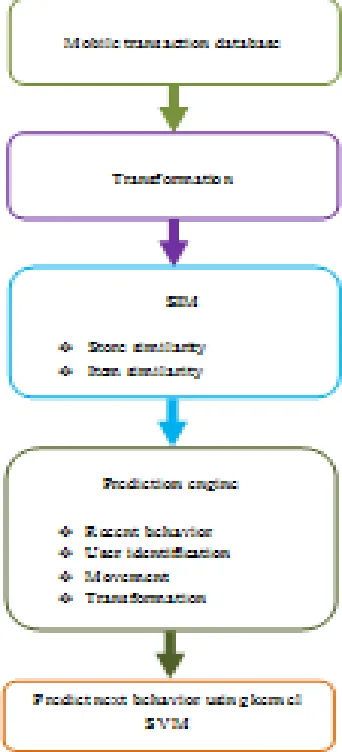
ABSTRACT: We suggest an implementation for the mining and prediction of mobile user’s actions and purchase transactions together. The implementation gives the user with data about that all shops a specific product is accessible and that shop gives the best proposal. With the help of this application we can create the Live shopping by the user without having to go to each shop and query. Mobile Commerce, also called as M-Commerce or commerce, is the aptitude to conduct commerce with the help of a mobile device. Research is performed using Mining and Prediction of Mobile Users’ Commerce Behaviors like their movements and purchase transactions. In our projected research we have envisioned to suggest a mobile commerce behavior prediction primarily the input information are taken from a mobile transaction database it comprises a store item information and item store information we have transform this information with the help of transformation have extract a data’s on the basis of a similarity bases now we have a store data and item data also it encompasses a store similarity and item similarity data’s from that we have taken a similarity data’s and stock that data’s these data’s are provided in to the Similarity Inference Model SIM for calculating the similarities amongst stores and items that are two basic mobile commerce entities measured in this paper these are given n to the prediction engine also it have a user transaction, identification and movement from these engine, we have envisage the user behavior with the help of Kernel based SVM.
Keywords: -mobile commerce, behavior prediction, transformation, kernel SVM, SIM
————————————————————
1.
INTRODUCTION
The use of mobile and its services together with its consumers has been amassed a lot because of variety of development in assured implementations and features like smart phone, GPS technology, detectors, wireless communication and sensors. These services aid us in using it from any portion of the world. Both industry and academia were inclined by the amassed research on mobile commerce methods and its compensations [1]. The procedure of retrieving hidden predictive data from large information base and use of this predicted data for future usage is mentioned as data mining. Suppose any issues arise in the future then it can be effortlessly reassured with the help of the information or values that are investigated in the past [2].This mostly focuses on promoting numerous business methods like Marketing, production, distribution of products, sales and mobile commerce. Data mining can be performed with the help of four simple stages that includes grouping of tasks, division of numerous grouped tasks trailed by regression that aids to perceive the faults and finally associated rule learning to designate the similarity in two dissimilar things [9]. To get a evident info view of both mobile consumers and mobile commerce behaviors data mining has been extremely utilized for extracting important data from huge datasets [6].The information services delivered by mobile atmosphere quite seems to be good if and only if it aids us in perceiving the users behavior [11]. Even though data mining bids numerous services it cannot be utilized for investigating the user’s behavior in mobile-commerce atmosphere and hence this serves as the one among the main disadvantages of data mining [13]. One among the data mining approaches is pattern mining that aids us to detect available patterns in original data that can be utilized for providing some additional data or for some future usage. Mining of mobile series patterns in MC surroundings designates the act of signifying the motion and purchase pattern of consumers though it does not designates the user’s behavior [14]. Henceforth
1649
novel inventive business models and user behavior in M-commerce [10]
2.
LITERATURE SURVEY
The aggregate enhancement in wireless communications and internet facilities endorses the use of wireless handed devices such as mobile phones and laptops by the users. Data mining together with its prediction aids in the detection of consumers behavior and purchase transactions. Mining the recurrent transaction database aids the users a lot. S. Jacinth Evangeline, et al. [16] had familiarized such a method oriented concept. That method just helped in forecasting the frequent purchased transaction of user’s items. The chief method utilized for the application of frequent transaction database was Systolic tree application. That helped the users by making them aware of the stores and items that were heretofore unsure for them. That method quite performed well in all environs on terms of its reliability and performance.Industry and academia were prejudiced by the expansion of mobile commerce. Shiju George, et al. [17] deliberated about Mobile Commerce Surveyor (MCS) that was utilized for both data mining and extrapolation of user’s motion together with their purchase transactions. MCS mostly limited three steps that were as followed 1. The relationship within two dissimilar items and stores could be examined with the help of Similarity Model (SM); 2. Personal Mobile Commerce Pattern Mine (PMCP-Mine) algorithm to perceive users Personal Mobile Commerce Pattern 3.The prophesied users behavior could be investigated easily with the help of Personal Mobile Commerce Behavior Predictor (PMCBP). That method also made the mobile users aware of the stores and items that were not known to them earlier. In addition to those amenities the concept of credit scheme also permitted the users enjoy their purchase by contribution some aids for them. With the upsurge in enlargement of wireless communications, mobile implementations, web applications, and perceiving devices such as GPS, PDA and smart phones the business model has been helped a lot. Devices like GPS aids in tracking the exact location of users precisely with the help of assured applications such as Google map. Ms. V. C. Belokar, et al. [18] absorbed on the tools utilized for mining mobile user’s behavior together with their business transactions with the help of data mining and prediction methods. Data mining aided in the extraction of hidden data from a assortment of large amount of database and that prediction aided in recognition of user’s behavior together with the purchase transactions made by the users. application of confident distinctive features on smart phones permitted the recognition of purchase transactions easier. In the emerging atmosphere the indispensable thing is to concentrate more about the users using the mobile together with its applications and emerging technologies. There is a chance for illegal problem that may arise throughout transactions. Henceforth, it is indispensable to offer the required security and privacy for transactions. Tejal V. Deshmukh, et al. [19] transported that their aim was to concentrate more on the end users who communicated with the scheme with the help of m-commerce. That technique promoted growth on dissimilar mobile applications both on local phones and high version phones. So there came a condition to deliver the better use of those facilities on transactions to recognize the location of shop malls that
1650
3.
PROBLEM IDENTIFICATION
Some of the problems related with the available literature survey approaches of mobile commerce methods are deliberated as follows
1. At this time, novel user’s behavior and purchase transactions are prophesied just on the basis of the consistent old consumer whose behavior is virtually similar as the new one. So the prediction would be fairly accurate if the novel user follows the similar manner as that of the old similar user if not there ascend the exertion in exact prediction of purchase transactions along with their movement. In addition this also creates damaged frequent pattern mining.
2. SIM is mostly utilized to identify the relations between two different stores and items. However this documentation does not performs and also expected and sometimes it fails in finding relations within stores and items. It is conceivable only with high version phones. Hence it fails to content customers at all the levels. It gives service for novel user’s on the basis of their hobbies provided by them at the time of registration and if the user wishes to buy some other alternative item from the store that is quite dissimilar from their hobbies then in such situation MCE fails for novel users.
3. Now grouping is performed with the help of finding the resemblances in mobile transactions that includes some drawbacks related with it. Clustering algorithm utilized here does not support non spatial data that is the vital one. In order to get the better result in grouping the number of steps utilized for grouping keeps on aggregate and henceforth this is a time consuming procedure.
4. This technique fails to offer the services for the consumers at personalized level where the user’s personal behaving or can’t be investigated. Mining of user’s behavior via images in mobile devices is also not possible. Low version phones do not have the conveniences for using this implementation and henceforth this technique could not content all the users. This aids as the time consuming method for the non frequent users.
5. Similarity technique that is utilized for finding relation within two uninterested items is appropriate only for mathematical content and it is ill appropriate for categorical data. This aids as the main drawbacks here. Extraction of information is much more challenging for the novel users as they have no previous available patterns.
6. There happens an awkward connection within the movement and purchase of transactions due to the unexpected continuous crusade of the user’s. This aids as the main problems in prediction of user’s movement and purchase transactions. This technique takes the support of SIM to accommodate novel user’s that does not yield accurate results because of imperfection in prediction and user’s.
7. Associated rule mining utilized here encompasses two phases in which the first phase is more parsimoniously stronger than the overall phase utilized for calculation. This aids as the disadvantage. ARM is not apposite for information with dissimilar dimensions. This mining does not aids as the worth data for non- technically oriented consumers.
8. This is not appropriate for investigating the user’s personal behavior. If perceived that would aid as the big improvement. It evades the use of enhanced concept
oriented kernel technique for mining procedure. As deliberated above the available approaches in literature survey offers numerous issues that could be rectified by the proposed technique.
4.
PROPOSED METHODOLOGY
1651 Fig 1: Proposed Mobile Commerce Based Pattern Mining
Behavior Prediction 4.1. Behavior Prediction
In this module, we predict the users’ future mobile commerce behaviors that include movements and transactions. MCBP (Mobile Commerce Behavior prediction) events the similarity scores of every PMCP with a user’s fresh mobile commerce behavior by taking store and item similarities into account. In MCBP, three notions are considered; the sites of PMCPs with high similarity to the user’s new mobile commerce behavior are measured as prediction knowledge. More new mobile commerce behaviors hypothetically have a superior effect on subsequent mobile commerce behavior predictions. PMCPs with higher support give greater confidence for predicting users’ subsequent mobile commerce behavior.
4.2. Mobile Commerce
MCE is for the most portion used to forestall the client practices, for instance, their motions and purchase exchange. GPS is used to record the client motion history. Its goal is to probably foresee the behavior of individual clients. The mobile network database keeps up point by point store information that includes the arena. The mobile clients motion within the stores and purchase the things and all these information are put away in mobile transaction
database. PMCP-Mining uses the PMCP-Tree to foresee the relentless mobile transactions. The MCE Framework has three apparatuses,
Similarity Inference Model (SIM) - measure the likenesses amongst stores and things.
PMCP-Mine Algorithm-productive revelation of portable clients.
Mobile Commerce Behavior Prediction (MCBP) - antedating the mobile client behavior.
4.2.1. Similarity Inference Model (SIM)
Suggest a parameter-less data mining model, termed Similarity Inference Model is a parameter-less data mining model used to switch the undertaking of registering store and thing resemblances. Before processing the SIM, regulate two databases, in specific, SID and ISD, from the mobile exchange database. A segment SIDpq in database
SID typifies that a client has bought thing q in store p, though a passage ISDxy in database ISD typifies that a
client has assimilated thing x in store y. Conjecturing the SIM to catch the similarity score within stores/things. For each match of stores or things, SIM employs them a similarity score. SIM used two diverse surmising heuristics for the similarity of stores and things as a few stores, for instance, general stores, may provide dissimilar sorts of things. By implementing a alike similarity inference heuristics to both of stores and things, dissimilar sorts of things might be observed as similar as numerous grocery stores are observed as similar. In light of our heuristics, if two stores provide many similar things, the stores are probably going to be similar; when two things are sold by many dissimilar stores, the stores are probably not going to be alike. Meanwhile, the store similarity and thing similarity are related, registering those qualities iteratively. For the store similarity, deliberate that two stores are more similar when their supplied things are more similar. Assumed two stores sp and sq, figure their similarity SIM (sp; sq) by determining the normal similarity of thing sets gave by sp and sq. For each thing sold in sp (and, individually, sq), first trace the most alike thing sold in sq (and, separately, sp). Here, the store similarity can be industrialized by averaging all similar thing sets.
4.2.2. Discovery of PMCPs
In this arena, we depict the PMCP-Mine algorithm to mine the personal mobile commerce patterns effectively. The PMCP-Mine is boosted by the TJPF algorithm that is an Apriori. In any case, we sentry that the TJPF does not consider client ID, that is important for finding personal mobile behaviors. The PMCP-Mine is achieved in a base up way. The PMCP-Mine is segregated into three primary stages:
1) Frequent Transaction Mining: A Frequent-Transaction is a couple of store and things representative every now and again made obtaining exchanges. In this stage, we primary find every single Frequent Transaction for every client.
1652
3) PMCP Mining: This stage is mining all designs of length k from patterns of length k _ 1 in a base up form.
4.2.3. Mobile Commerce Behavior Predictor (MCBP)
To provide a high accuracy mobile commerce behavior predictor (MCB), it chiefly concentrates on individual portable pattern mining. Furthermore, to defeat the expectations disappointment problem and fuse the resemblances of stores and things into the mobile commerce behavior prediction MCBP that measures the resemblance score of each individual versatile pattern mining with a client's late mobile commerce behavior by bearing in mind store and thing similarities. In MCBP, the sites of individual mobile pattern mining with high similarity to the client's late mobile commerce behavior are measured as expectation data; later mobile commerce behaviors perhaps have greater importance on next mobile commerce behavior predictions; individual mobile pattern mining with greater support provide more protuberant certainty to foreseeing clients' subsequent mobile commerce behavior. At this time, we have prophesied a mobile commerce behavior with the help of kernel based SVM.
4.3. Kernel Based Support Vector Machine:
In this mobile commerce scheme we have anticipated a user subsequent purchase behavior with the help of these kernel based SVM. Subsequently, the finest attributes are transported to fusion kernel support vector machine for the attitude of categorization. Currently, the selected attribute from the formerly progression is professionally affianced for the isolation of the two module. For the rule of processing the non-linear process, the kernel functions are ongoing in the SVM categorization. There are two very significant phases in the SVM process like the preparation phase and the effortless stage.
Training phase: Presently, the output of attribute choice is delivered as the input of the preparation stage. The input utility supplies the group of values which cannot be alienated. Approximately each and every one of the probable isolation of the position places are comprehend by a hectic plane. In the Lagrange pattern, it is probable to put the partition of the hectic plane standard vector during the divergent kernel task. In this association, a kernel symbolizes a few tasks, which communicate to a dot product for definite kind of attribute recording. Yet, recording a position into a better quality dimensional gap is probable to direct to unnecessary assessment period and enormous storage requirements. By the outcome, in concrete achieve, an original kernel task is introduced which is competent of openly approximating the dot product in the better-quality dimensional gap. The frequent edition of the kernel task is delivered as follows.
U ,V
U V (1)K T
In this view, the mainstream broadly affianced kernel tasks comprise the linear kernel, Polynomial kernel, Quadratic kernel, Sigmoid and the Radial Basis task. Quantified beneath are the terms for the dissimilar kernel task For Linear Kernel: linear k(U,V)uTvc (2)
Where u,v signifies the inner products in linear kernel and
c is a constant.
For Quadratic Kernel:
) 3 ( 1 ) , ( 2 2 c v u v u V U quad k
Where,u,v -are the vectors of the polynomial kernel
function in the input space
For Polynomial Kernel:
, 0 (4)) ,
(
e T k U V u v c
poly
For Sigmoid Kernel:
, 0 (5)tanh ) ,
(U V u vc
sig k T
The efficiency of the SVM reliably concerned with on the variety of the kernel. In the incidence of the attribute gap being linearly inseparable, it has to be logged into a better-quality dimensional gap by the Radial basis task kernel, in order that the anxiety seems as linearly detachable. Moreover, the amalgamation of any two kernel task is skillful to defer outstanding accuracy than that assimilated by using some single kernel task. In the original process, an unique KSVM is foreseen, committed for the noteworthy development in the categorization scheme. At this point, two kernel tasks like the linear and the quadratic kernel task are mutual to defer unresolved presentation ratios. The uniting Equations 6 and 7 the standard is expectable as suggested in the original method. The mutual kernel task is effectively betrothed in the KSVM and the standard of the
kernel task, avg k(U,V )is distributed beneath.
( , ) ( , )
(6)2 1 ) ,
(U V lin U V quad U V
avg k k k
1 (7)2 1 ) , ( 2 2 c v u v u c v u V U
avg k T
In the kernel Support Vector Machine, two kernels like the linear and quadratic are utilized into description for the rule of classify the search links. The merger of two consequences, the standard of the outcome is gifted and industrialized to classification.
1653
In this paper, these are given n to the prediction engine also it have a user transaction, identification and association from these engine we have envisage the user behavior with the help of Kernel based SVM.
5. RESULT AND DISCUSSION
This section shows the result we obtained for our proposed technique in comparison with the existing technique. Our technique is implemented in Java (jdk 1.7) that has system configuration as core2duo processor with clock speed of 2.3GHZ and RAM as 2GB and that runs Windows7 OS.
Evaluation metrics
By using the evaluation metrics Sensitivity, Specificity and Accuracy, the performance of the system is evaluated. The normal count values such as True Positive (TP), True Negative (TN), False Positive (FP) and False Negative (FN) are utilized here.
Sensitivity
The proportion of actual positives which are correctly identified is the measure of the sensitivity. It relates to the ability of test to identify positive results.
Specificity
The proportion of negatives which are correctly identified is the measure of the specificity. It relates to the ability of test to identify negative results.
Accuracy
We can compute the measure of accuracy from the measures of sensitivity and specificity as specified below.
100
FN FP TN TP
TN TP Accuracy
5.2. Performance Evaluation
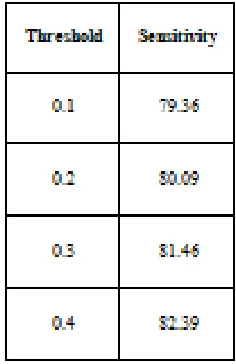
The performance of proposed method is evaluated by using accuracy, sensitivity and specificity values. The below tabulated below indicates the parameter values for different images.
Table I: Performance measures of the proposed techniqu
Fig 2: Graph for sensitivity evaluation measures
Utilizing the proposed method for fig 2, the evaluation measures for sensitivity value is 79.36% for threshold 0.1and the threshold value 0.2, 0.3, and 0.4 were getting 80.09%, 81.46% and 82.39%.
Table II: Performance measures of the proposed technique
Threshold Specificity
0.1 69.48
0.2 70.08
0.3 71.09
1654 Fig 3:Graph for specificity evaluation measures
Utilizing a proposed method for fig 3, the evaluation measures for specificity value is 69.48% for threshold 0.1 and the threshold value 0.2, 0.3 and 0.4 were getting 70.08%, 71.09% and 72.68%.
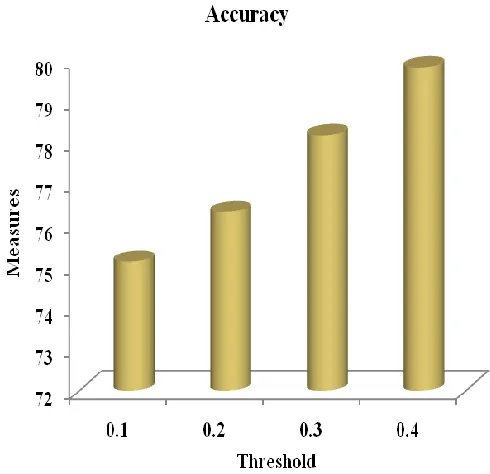
Table III: Performance measures of the proposed technique
Threshold Accuracy
0.1 75.12
0.2 76.32
0.3 78.18
0.4 79.82
Fig 4: Graph for accuracy evaluation measures
Utilizing a proposed method for fig 4, the evaluation measures for accuracy value is 75.12% for threshold 0.1 and the threshold value 0.2, 0.3 and 0.4 were getting 76.32%, 78.18%, and 79.82%.
5.3Comparative Analysis
Our proposed Kernel based SVM for the mobile commerce behavior prediction is measured by using an evaluation measures based on threshold. From the below table we could say that our proposed method has better accuracy on comparing to the existing SVM classifier. The comparison outcomes could be better understood using the following table V.
Table IV: Sensitivity Comparison for Proposed and Existing method
Threshold KSVM SVM
0.1 75.12 75.48
0.2 76.32 75.89
0.3 78.18 77.58
0.4 79.82 79.15
1655
the existing SVM method. For threshold 0.1 the sensitivity value is 75.12% using the proposed KSVM while utilizing the existing SVM the sensitivity value is 75.48%. For threshold 0.2 the sensitivity value is 76.32% using the proposed KSVM while utilizing the existing SVM the sensitivity value is 75.89%. For threshold 0.3 the sensitivity value is 78.18% using the proposed KSVM while utilizing the existing SVM classifier the sensitivity value is 77.58% which is higher than the existing method. For threshold 0.4 the sensitivity value is 79.82% using the proposed KSVM while utilizing the existing SVM the sensitivity value is 79.15% when we compare these existing SVM results to our proposed KSVM result will obtain a high results.
Fig 5: Graph for proposed and existing sensitivity comparison
From fig 5 it is clear that the sensitivity value of evaluation measures is high for the proposed method than the existing method.
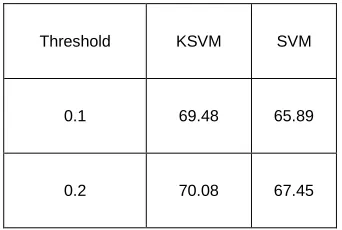
Table V: Specificity Comparison for Proposed and Existing method
Threshold KSVM SVM
0.1 69.48 65.89
0.2 70.08 67.45
0.3 71.09 66.45
0.4 72.68 67.98
Table V represents the specificity comparison of the behavior prediction method using the proposed KSVM and the existing SVM method. For threshold 0.1 the specificity value is 69.48% using the proposed KSVM while utilizing the existing SVM the specificity value is 65.89%. For threshold 0.2 the specificity value is 70.08% using the proposed KSVM while utilizing the existing SVM the specificity value is 67.48%. For threshold 0.3 the specificity value is 71.09% using the proposed KSVM while utilizing the existing SVM the specificity value is 66.45% which is higher than the existing method. For threshold 0.4 the specificity value is 72.68% using the proposed KSVM while utilizing the existing SVM the specificity value is 67.98% when we compare these existing SVM results to our proposed KSVM result will obtain a high results.
Fig 6:Graph for proposed and existing specificity comparison
1656 Table VI: Accuracy Comparison for Proposed and Existing
method
Threshold KSVM SVM
0.1 75.12 71.58
0.2 76.32 70.45
0.3 78.18 75.68
0.4 79.82 77.28
From fig 7 it is clear that the accuracy value of evaluation measures is high for the proposed method than the existing method.
Fig 7:Graph for proposed and existing accuracy comparison
Table VI represents the accuracy comparison of the behavior prediction method using the proposed KSVM and the existing SVM method. For threshold 0.1 the specificity value is 75.12% using the proposed KSVM while utilizing the existing SVM the accuracy value is 71.58%. For threshold 0.2 the accuracy value is 76.32% using the proposed KSVM while utilizing the existing SVM the accuracy value is 70.45%. For threshold 0.3 the accuracy value is 78.18% using the proposed KSVM while utilizing the existing SVM the accuracy value is 75.68% which is higher than the existing method. For threshold 0.4 the accuracy value is 79.82% using the proposed KSVM while
utilizing the existing SVM the accuracy value is 77.28% when we compare these existing SVM results to our proposed KSVM result will obtain a high results.
CONCLUSION
The
kernel SVM based mobile commerce in pattern mining behavior prediction study have some phases namely transformation, ruling store similarity and item resemblance, predict user behavior. Primarily, we have taken information from a mobile transaction databases it comprises a store item information and item store data we have convert this data with the help of transformation we have extract a data’s on the basis of a similarity bases now we have a store information and item data also it comprises a store similarity and item similarity data’s from that we have occupied a similarity data’s and supply that data’s these data’s are specified in to the Similarity Inference Model SIM for calculating the similarities amongst stores and items that are two rudimentary mobile commerce entities measured in this paper these are given n to the prediction engine also it have a user transaction, empathy and movement from these engine we have predict the user behavior with the help of Kernel based SVM. The efficacy of the assessment measures is very high by bestowing very good accuracy outcomes and also forecasts next behavior of the user is very accurate consequences. From the outcomes, we have displayed that the kernel based SVM used in our projected work outdoes the other classifiers SVM by facilitated very good accurateness of 77.36%.REFERENCE
[1]. Qi liu, haiping ma, enhongchenandhuixiong, ―A Survey Of Context-Aware Mobile Recommendations", International Journal of Information Technology & Decision Making, Vol.12, pp.139-172, December 2013.
[2]. S. Jacinth Evangeline, K.M. Subramanian, Dr. K. Venkatachalam, ―Survey On Personal Mobile Commerce Pattern Mining And Prediction", International Journal of Advanced Research in Computer Engineering & Technology (IJARCET),Vol.2, pp. 3163-3167, December 2013. [3]. S.Krithika1 , M.Moorthi," Prediction Of M-Commerce User Behavior By A Weighted Periodical Pattern Mining", International Journal of Advanced Research in Computer and Communication Engineering, Vol. 2, pp.2351-2357, June 2013.
[4]. Eric Hsueh-Chan Lu, Wang-Chien, "A Framework for Personal Mobile Commerce Pattern Mining and Prediction", In Proceedings of IEEE Transaction on Knowledge and Data engineering, Vol. 24, No. 5, pp. 769-782, May 2012
1657
Research and Applications (IJERA), Vol.3, pp.238-242, June 2013.
[6]. Vignesh.S 1, Robert.P 2, Vignesh.U 3, Bharathidasan.D4, Rajasekaran.S5," Mining Frequent Patterns and Prediction of User Behavior in Mobile Commerce", International Journal of Application or Innovation in Engineering & Management (IJAIEM),Vol.2, pp.299-304, March 2013.
[7]. J. Mohabath1, S. J. Vivekanandan," Social Engine for Pattern Mining and Prediction of Mobile Commerce Users",International Journal of Science and Research (IJSR),Vol.3, pp.1258-1265, December 2014.
[8]. Chang-RyongKo,"Research Trends and Its Determinants in Mobile Commerce Research (1999-2012) ", Asian Journal of Innovation and Policy (2013), pp.150-171, November 2013. [9]. G.Dhivya, "An effective filtering dynamic
transaction datasets using time series with location based services model", International Journal of Innovative Research in Engineering Science and Technology, Vol.3, pp.48-52, August 2015.
[10]. Dr. Abdullah Alshbou, "Mobile Commerce: Business Intelligence and the Impact of its Performance on Managerial Decision Making ", International Journal of Applied Science and Technology, Vol. 4, pp.282-291, July 2014.
[11]. Shiow-yang Wu, Member, IEEE, and Hsiu-HaoFan,"Activity-Based Proactive Data Management in Mobile Environments "IEEE transactions on mobile computing, Vol. 9, pp.391-404, March 2010.
[12]. V. ManoChitra 1, S. Shanthi2, S. Syed Shajahaan,"Mining Mobile Sequential Pattern in a Location Aware Environment",International Journal of Computer Science and Mobile Computing,Vol.2, pp.159-165, October 2013.
[13]. Krishna K. Mohbey1 and Ghanshyam Singh Thakur," Constraint based Interesting Location and Mobile Web Service Sequence Mining in M-Commerce Environment", Journal of Theoretical and Applied Electronic Commerce Research, Vol.11, pp.84-95, January 2016.
[14]. D. Preetha 1, .K.Mythili," A hybrid weighted periodical pattern mining and prediction for personal mobile commerce",International Journal of Advances in Computer Science and Technology, Vol.2, pp.127-133, August 2013.
[15]. Dr. M.V. Brahmananda Reddy," Mining Frequent Patterns and Prediction of Mobile Sequential Pattern Mining", International Journal of Computer Science information and Engg,., Technologies, Vol.E3, pp.1-6, September 2013.
[16]. S. Jacinth Evangeline, "Efficiently Mining the Frequent Patterns in Mobile Commerce Environment ", International Journal of Innovation and Scientific Research, Vol.5, pp.30-39, JULY 2014.
[17]. Shiju George, "Enhanced mobile commerce with pattern mining and prediction", International Journal of Engineering & Science Research, Vol.4, pp.208-211, APRIL 2014.
[18]. Ms. V. C. Belokar, "Mobile sequential pattern mining in location based service environment ", International Journal of Electronics and Computer Science Engineering, Vol.3, pp.1328-1339.
[19]. Tejal V. Deshmukh , " A Survey on: Analysis of Pattern Mining and Behavior Prediction in M-Commerce", International Journal of Computer Applications , Vol.71, pp.19-23, June 2013. [20]. ReshmaCherian ,"Individual Mining and Prediction
of Patterns for Improving Mobile Commerce ", International Journal of Computer Applications, Vol.66, pp.18-22, March 2013.
[21]. S SabariGiri Murugan1, T Ganesan, "A skeleton for productive mining & prediction in m-commerce environment ", International Journal of Science, Technology & Management, Vol.o4, pp.76-82, MARCH 2015.