Damage Detection Method Using Support Vector Machine and
First Three Natural Frequencies for Shear Structures
Hien HoThu*, Akira Mita
Department of System Design Engineering, Keio University, Yokohama, Japan Email: *[email protected]
Received March 21, 2013; revised April 22, 2013; accepted April 30, 2013
Copyright © 2013 Hien HoThu, Akira Mita. This is an open access article distributed under the Creative Commons Attribution Li-cense, which permits unrestricted use, distribution, and reproduction in any medium, provided the original work is properly cited.
ABSTRACT
A method is proposed for detecting damage to shear structures by using Support Vector Machine (SVM) and only the first three natural frequencies of the translational modes. This method is able to determine the damage location in any story of a shear building with only two vibration sensors; to obtain modal frequencies, one sensor on the ground detects an input and the other on the roof detects the output. Based on the shifts in the first three natural frequencies, damage location indicators are proposed, and used as new feature vectors for SVM. Simulations of five-story, nine-story and twenty-one-story shear structures and experiments on a five-story steel model were used to test the performance of the proposed method.
Keywords: Support Vector Machine; Damage Detection; Natural Frequency; System Identification; Damage Location
Indicator
1. Introduction
Structural health monitoring (SHM) has become a major focus of research in the area of structural dynamics. Many damage detection algorithms based on the modal properties of a structure including the natural frequencies, mode shapes, curvature mode shapes and modal flexibil- ities have been studied for several decades. However, most algorithms have difficulty identifying the precise location and magnitude of the damage. Moreover, even if such identification is possible, the accuracy and reliabil- ity of the properties are not sufficient [1].
Although frequency shift methods are simple and easy to apply, they have significant practical limitations. For instance, the measurements have to be very precise if the level of damage is not great. In addition, the change in the natural frequency associated with a certain mode in a structure does not provide any spatial information about where the damage occurred, because modal frequencies are global properties of the structure. Salawu [2] pre- sented a review on detection of structural damage through changes in frequency. The approach is based on the fact that natural frequencies are sensitive indicators of structural integrity. The relationship between fre- quency changes and structural damage was discussed.
In 1998, Doebling et al. [3] reviewed the literature on
vibration-based damage identification methods. Many of the methods use changes in the natural frequencies to detect damage. The amount of literature is large; they comprise not only applications to various structures, but also theoretical work on the use of frequency shifts for damage detection.
Many methods perform well at frequency-based dam- age identification in small degrees of freedom. For larger engineering structures, the number of obtained natural frequencies is less than the number of structural elements. This is one of the reasons why frequency change me- thods have limited abilities to detect damage [4]. To overcome these problems, some researchers have been using the substructure method [5], error matrix method [6], sensitivity-based method [7], combine sensitivity and statistical-based methods [8], and so on.
The SVM is a powerful tool for pattern recognition and it seems useful for detecting the location of damage. This requires data from the undamaged and damaged structure successfully train and classify the structure into damaged and undamaged classes. SVM has better gener- alization performance than other methods of problems of damage detection and location [9]. Meyer [10] presented a benchmark study comparing the performance of SVMs with other classification techniques for natural and artifi- cial datasets.
ratory of Keio University, demonstrated that damage detection methods using SVM worked well in many cases. The scope of this work is to develop an improved method to identify the location of damage by using a limited number of sensors. We know that a natural fre- quency change associated with a certain mode does not provide spatial information about structural damage, but multiple natural frequency changes can give such infor- mation. However, in practical situations, the obtained natural frequencies are usually smaller than the degrees of freedoms. The proposed method only requires the first three natural frequencies. The first three natural frequen- cies are used to obtain the new damage location indica- tors. These indicators are the feature vectors for pattern recognition.
thstor
N y
2. Damage Detection of Structures Using
Support Vector Machine
2.1. Sensitivity of Damage Location Indicators
The rth natural circular frequency, 0
r
, of an N-degree-
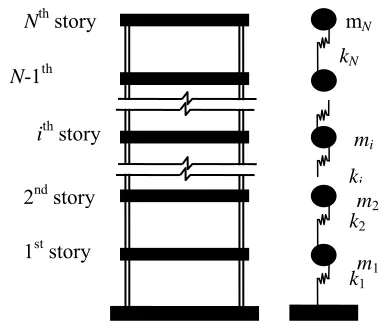
of-freedom (as shown in Figure 1) undamaged structure
was given as Equation (9) in [16]:
r 2 1 s
0 0
1
π 2 1 in
2 2 1
r N 0 (1)
where is the first frequency of undamaged structure.
0 1 0
π 2 1
2 2 1
r N
th
0 of r r sin 2 r
(2)
The wave propagation constant mode of safe state can be defined as:
0 1 0 ω rcsin 2ω r 0
r r r
i i 0 2 1 π 2a 2 1 r r N
r of th
r
(3)
Moreover, the 0 mode of the ith element
damaged state was calculated by:
(4) The change i due to damage i
γr
to the ith ele-
ment, can be obtained from Equation (28) in [17]:
1 N 1 2 1 N 1 r i r i N i N i r 0
i
π 2r 1
cos sin 0.5
2 2N 1
π 2r 1
cos 0.5
2 2N 1
π 2r 1 cos 2 1 2r
2 2N 1 2
cos 1.5
π 2r 1 cos 2 1 2r
2 2N 1 2
1. sin
sin
sin
sin 5 2
r i i i i N N i i (5)
2ndstory
1ststory
kN
N-1th
ith story m
[image:2.595.326.517.84.245.2]i ki m2 k2 m1 k1 mN
Figure 1. Simplified structural model with N-DOFs.
From Equation (5) above, it can be seen that the change, γr
ωr
i , depends only on the location of damage
(i) and the degree of freedom N.
The change i in the rth natural circular frequency
due to γr i
can be found by combining Equations (3)- (5):
1 0
γ ω 2 sin
2 r r i i (6)
The change in the natural frequency can be calculated from Equations (1) and (6):
0
π 2r 1
sin sin
2 2 2N 1
r r
r i i
i r (7)
which is the same as Equation (29b) in [17].
The above relation showed that the damage was related to the shifts in the natural frequencies. The ratio of the change in the rth and sth frequencies can be used as
a pattern depending on the location of the damage:
π 2 1 π 2 1
sin sin
2 2 1 2 2 1
sin sin 2 2 r rs i i s i r s i i s r l N N (8)
Equation (8) demonstrates the sensitivity of the change in ratio of the shift of a few natural frequencies to the location of the damage. This should be able to be used as a damage location index.
2.2. Construction of Feature Vectors for Support Vector Machine
[image:2.595.54.290.364.744.2]To solve this problem, we define new damage location indicators that have good pattern recognition ability with only the first three natural frequencies. By using the ratio in Equation (8), we defined two damage location indica-tors:
Original feature space
High dimensional space
n
R
Original feature space
n
x
xR
2 21
1
2
π 3 sin
2 19
sin sin
i i
i
l
1
π 1 sin
2 19
2 2
i i
(9a)
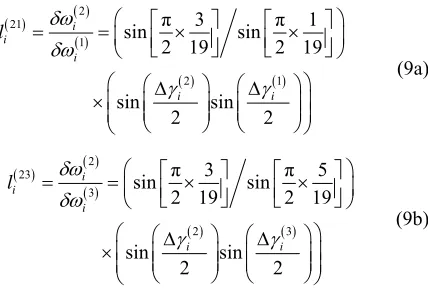
2 23
3
2
π 3 sin
2 19
sin sin
i i
i
l
3
π 5 sin
2 19
2 2
i i
21 23
l
21, 23
l l
(9b)
The changes in i and i can be used as feature
vectors. They may be able to be used as to identify the damage location by using a few lower modal frequencies.
l
2.3. Support Vector Machine
The Support Vector Machine (SVM) is a mechanical learning system that uses a hypothesis space of linear functions in a high dimensional feature space [18,19]. It has been used for structural damage detection because of its ability to form an accurate boundary from a small amount of training data.
The simplest model, Linear SVM (LSVM), works when the data are linearly separable in the original fea- ture space. In most cases, nonlinear classification using the same procedure as in LSVM is possible as a result of introducing nonlinear functions called Kernel functions without having to be conscious of the actual mapping space. This extension to nonlinear feature spaces is called Nonlinear SVM (NSVM) (Figure 2).
3. Numerical Verification
To show the feasibility of the proposed method, N-story
structures were modeled as one-dimensional lumped mass shear models, as shown in Figure 1. Structures
with N = 5, 9 and 21 stories were analyzed. Three per-
cent was chosen as the damping ratio for all modes. The data sampling frequency was 200 Hz.
A reduction in the story stiffness was regarded as damage to the structure. Training feature vectors were generated by assuming three levels of stiffness reduction, 10%, 20%, and 30%, for each story, and the correspond- ing feature vectors i i were generated for each
damage pattern. A feature vector consisting of zero ele- ments was used to indicate the undamaged structure.
[image:3.595.313.536.85.163.2]Assuming five levels of stiffness reduction, 8%, 16%,
Figure 2. Non-linear SVM.
24%, 32% and 40% for each story, (5 × N) feature vec-
tors were used to verify the proposed method. The first five data corresponded to 8%, 16%, 24%, 32% and 40% stiffness reductions in the first story. The second five data are for the stiffness reduction in the second, third, etc., sets of five data were for the stiffness reductions in the second, third story, and so on. The last data indicated the no damage case.
SVMi denotes a machine that distinguishes the pattern
with damage in the ith story from the other patterns.
3.1. Five-story Shear Structures (N = 5)
We considered a five-story structure with the same mass and the same stiffness for all stories: mi = 1000 ton, ki = 2
× 103 MN/m.
The undamaged natural frequencies of the structure were obtained as 2.03, 5.91, 9.32, 11.98 and 13.66 Hz for the 1st, 2nd, 3rd, 4th and 5th modes, respectively.
As mentioned above, a reduction in story stiffness was regarded as damage to the structure. Five damage cases (damage to the 1st, 2nd, 3rd, 4th and 5th stories) were stud-
ied.
Figure 3 shows the output of SVMi with the feature
vectors being the change in the first three modal frequen- cies
i 1, i 2, i 3
of the previous method [12-14].Here, we can see some miss-classifications in the outputs of SVM1 and SVM3.
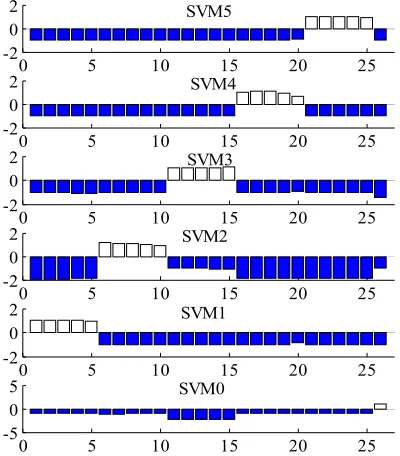
Figure 4 shows the results when our new damage lo-
cation indicators were used as the feature vectors. There were no miss-classifications in these results.
3.2. Nine-Story Shear Structure (N = 9)
The spring-mass system with nine degrees of freedom was used to demonstrate the sensitivity analysis. The stiffness of each story was assumed to be 1.3 × 10³
MN/m.
Mass of nine stories:
m1 = 1000 ton, m2 = 950 ton, m3 = 900 ton,
m4 = 850 ton, m5 = 800 ton, m6 = 750 ton,
m7 = 700 ton, m8 = 650 ton, and m9 = 600 ton.
The undamaged natural frequencies of the structure were obtained as 1.12, 3.16, 5.14, 6.99, 8.64, 10.03, 11.14, 12.07 and 13.22 Hz for the 1st, 2nd, 3rd, 4th··· and
9th modes, respectively.
Nine cases of damage (damage to the 1st, 2nd, 3rd, 4th···
and 9th stories) were studied.
[image:3.595.73.287.151.296.2]0 5 10 15 20 25 -20
0 20
SVM0
0 5 10 15 20 25
-5 0 5
SVM1
0 5 10 15 20 25
-20 0
200 5 10 SVM215 20 25 -50
0
500 5 10 SVM315 20 25 -10
0
100 5 10 SVM415 20 25 -20
0 20
[image:4.595.70.270.82.370.2]SVM5
Figure 3. Outputs from SVM0 through 5 with change in first three natural frequencies of five-story shear structure.
0 5 10 15 20 25
-5 0
50 5 10 SVM015 20 25
-2 0
20 5 10 SVM115 20 25
-2 0
20 5 10 SVM215 20 25
-2 0
20 5 10 SVM315 20 25
-2 0
20 5 10 SVM415 20 25
-2 0
2 SVM5
Figure 4. Outputs from SVM0 through 5 with two damage location indicators of five-story shear structure.
in the natural frequencies of nine modes when damage occurred in each story of the simulation. By focusing on the sensitivities of 1st, 2nd and 3rd modal frequencies; they
could be feature vectors that would be reasonable patterns for SVM.
1 2 3 4 5 6 7 8 9
0 0.05 0.1
Mode order Damage to 1st story
1 2 3 4 5 6 7 8 9
0 0.05
0.1 Damage to 2nd story
1 2 3 4 5 6 7 8 9
0 0.05
0.1 Damage to 3rd story
8% 16% 24% 32% 40%
1 2 3 4 5 6 7 8 9
0 0.05 0.1
Damage to 4th story
1 2 3 4 5 6 7 8 9
0 0.05 0.1
Damage to 5th story
C
ha
ng
e in
n
atu
ra
l f
re
qu
en
cie
s
1 2 3 4 5 6 7 8 9
0 0.05 0.1
Damage to 6th story
1 2 3 4 5 6 7 8 9
0 0.05 0.1
Damage to 7th story
1 2 3 4 5 6 7 8 9
0 0.05
0.1 Damage to 8th story
1 2 3 4 5 6 7 8 9
0 0.05 0.1
Damage to 9th story
21 23
,
[image:4.595.313.539.89.477.2]l l
[image:4.595.72.272.407.635.2]Figure 5. Change in natural frequencies when damage oc-curred.
Figure 6 shows the sensitivity of the first three natural
frequencies of the nine-story shear structure to the loca- tion of damage. For each natural frequency, there were some locations where one of these frequencies is the most sensitive to the damage, while there are other loca- tions at which the damage has little influence on the fre- quency.
From Figure 6, the influence of the damage location
on the first natural frequency decreases with the height in story; this means the first natural frequency is the most sensitive to damage at the 1st story. In contrast, the sec-
ond natural frequency is the most sensitive to damage at the 1st and 7th story. Similarly, there are three peaks at the
1st, 4th and 8th story in the third natural frequency.
Figure 7 shows distinctive patterns
i i
de-pending on the location where the damage occurred.
Figure 8 shows the output of SVMi in which the fea-
1 2 3 4 5 6 7 8 9 0
0.05 0.1
Mass The 1st mode
1 2 3 4 5 6 7 8 9 0
0.05
0.1 The 2
nd
mode
Se
ns
itiv
ity
o
f
N
atu
ra
l F
re
qu
en
cie
s
8% 16% 24% 32% 40% 1 2 3 4 5 6 7 8 9 0
0.05
0.1 The 3
rd mode SVM9
Figure 6. Sensitivity of natural frequencies when damage occurred in 9-story shear structures of different masses.
Figure 7. Change in two damage location indicators of nine- story simulation.
cies i i i , as in the previous method
[12-14]. It is clear that there are some miss-classifica- tions in the outputs of SVM1, SVM2, SVM5, SVM6, and SVM8.
1, 2, 3
This nine-story shear structure was excited by Gaus- sian white noise, to simulate an input such as an earth- quake, and 5% noise was added to the acceleration re- sponses of the structure.
When the feature vectors with our new damage loca- tion indicators were used, there were no miss-classifi- cation (Figure 9 (no noise) and Figure 10 (5% noise)).
These feature vectors could also detect the locations of a small amount of damage (8% stiffness reduction).
3.3. Twenty-One-Story Shear Structure (N = 21)
A twenty-one-story shear structure was used to verify that this method would work for tall buildings. The stiff- ness of each story was assumed to be 1.3 × 10³ MN/m.
0 10 20 30 40
-200
20 SVM0
0 10 20 30 40
-50
5 SVM1
0 10 20 30 40
-200
20 SVM2
0 10 20 30 40
-200
20 SVM3
0 10 20 30 40
-200
20 SVM4
0 10 20 30 40
-2 -10
SVM5
0 10 20 30 40
-200
20 SVM6
0 10 20 30 40
-20 -100
SVM7
0 10 20 30 40
-100
10 SVM8
0 10 20 30 40
-200 20
Figure 8. Outputs from SVM0 through 9 with the change in the first three natural frequencies of a nine-story shear structure.
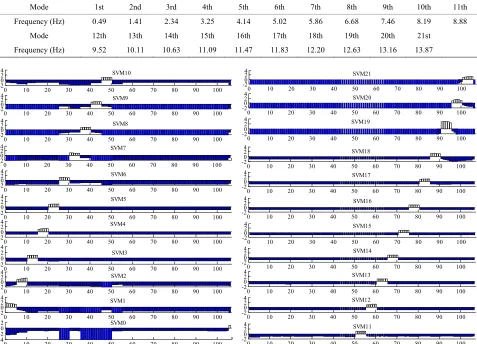
The masses of story are listed in Table 1. The undam
aged natural frequencies are shown in Table 2.
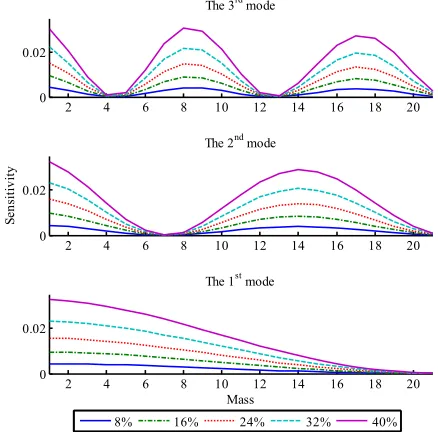
Figure 11 shows the sensitivity of the first three natu-
ral frequencies of the 21-story shear structure together with the locations of the damage. Figure 12 shows re-
sults of our method. These figures indicate that the me- thod is applicable to high-rise buildings.
4. Experimental Verification
4.1. ExperimentsA series of experiments was performed to verify the per- formance of our approach. We designed a five-story shear frame model (Figure 13 (left)).
The story mass was the mass of the aluminum floor slabs (2.43 kg for each floor).
The story stiffness was taken to be that of the bronze plate springs (0.0025 × 0.03 × 0.24 m3) used as the col-
umns. Young’s modulus of bronze is 1 × 10¹¹ N/m2, so
the interfloor stiffness was 1.3563 × 10⁴ N/m. The struc-
0 10 20 30 40 -50
5 SVM0
0 10 20 30 40
-20
2 SVM1
0 10 20 30 40
-20
2 SVM2
0 10 20 30 40
-50
5 SVM3
0 10 20 30 40
-50
5 SVM4
0 10 20 30 40
-20
2 SVM5
0 5 20 30 40
-20
2 SVM6
0 10 20 30 40
-20
2 SVM7
0 10 20 30 40
-20
2 SVM8
0 10 20 30 40
-20
[image:6.595.320.523.84.429.2]2 SVM9
Figure 9. Outputs from SVM0 through 9 with two damage location indicators for a nine-story shear structure (no noise).
The damage was simulated in the experiment by re- placing the original columns with weaker ones (0.003 × 0.006 × 0.24 m3; see
Figure 13 (right)). Replacing two
columns in each story reduced the story stiffness by 32.72%.
The basement of the structure was set on bearings so that the structure could experience ground motion. The force input to the structure was provided with an electro- dynamic shaker. One acceleration sensor was installed in the basement to measure the ground motion.
Sensors installed on each floor plate were used to measure the acceleration responses of each floor. First, the structure was measured in the healthy state with all the original columns. The shaker provided the force input to the structure in order to obtain the acceleration data.
Then, two columns of one floor were replaced with weaker columns to simulate single-story damage cases on each story. The shaker provided the same excitation again, and the accelerometers measured the acceleration data of the damaged structure.
0 10 20 30 40
-5 0
50 10 20SVM0 30 40
-2 0
2 SVM1
0 10 20 30 40
-2 0
20 10 20SVM2 30 40
-5 0
5 SVM3
0 10 20 30 40
-5 0
5 SVM4
0 10 20 30 40
-2 0
2 SVM5
0 10 20 30 40
-2 0
2 SVM6
0 10 20 30 40
-2 0
20 10 20SVM7 30 40
-2 0
2 SVM8
0 10 20 30 40
-2 0
[image:6.595.62.284.88.439.2]2 SVM9
Figure 10. Outputs from SVM0 through 9 with two damage location indicators for a nine-story shear structure (5% noise).
2 4 6 8 10 12 14 16 18 20
0 0.02
Mass The 1st mode
2 4 6 8 10 12 14 16 18 20
0 0.02
The 2nd mode
Se
ns
it
iv
ity
2 4 6 8 10 12 14 16 18 20
0 0.02
The 3rd mode
8% 16% 24% 32% 40%
[image:6.595.313.532.480.696.2]Table 1. Mass of twenty-one-story structure.
Story 1st 2nd 3rd 4th 5th 6th 7th 8th 9th 10th 11th Mass (ton) 1000 980 960 940 920 900 880 860 840 820 800
[image:7.595.60.537.183.539.2]Story 12th 13th 14th 15th 16th 17th 18th 19th 20th 21st Mass (ton) 780 760 740 720 700 680 660 640 620 600
Table 2. Undamaged natural frequencies of twenty-one-story structure.
Mode 1st 2nd 3rd 4th 5th 6th 7th 8th 9th 10th 11th Frequency (Hz) 0.49 1.41 2.34 3.25 4.14 5.02 5.86 6.68 7.46 8.19 8.88
Mode 12th 13th 14th 15th 16th 17th 18th 19th 20th 21st Frequency (Hz) 9.52 10.11 10.63 11.09 11.47 11.83 12.20 12.63 13.16 13.87
0 10 20 30 40 50 60 70 80 90 100 -4
-20
20 10 20 30 40 50SVM060 70 80 90 100 -20
2
40 10 20 30 40 50SVM1 60 70 80 90 100 -20
2 4
SVM2
0 10 20 30 40 50 60 70 80 90 100 -20
2 4
SVM3
0 10 20 30 40 50 60 70 80 90 100 -20
2
40 10 20 30 40 50SVM4 60 70 80 90 100 -20
2
40 10 20 30 40 50SVM560 70 80 90 100 -20
2
40 10 20 30 40 50SVM660 70 80 90 100 -20
2
4 SVM7
0 10 20 30 40 50 60 70 80 90 100 -20
2
4 SVM8
0 10 20 30 40 50 60 70 80 90 100 -20
2
40 10 20 30 40 50SVM960 70 80 90 100 -20
2
4 SVM10
0 10 20 30 40 50 60 70 80 90 100 -20
2
4 SVM11
0 10 20 30 40 50 60 70 80 90 100 -20
2
40 10 20 30 40 50SVM1260 70 80 90 100 -20
2
40 10 20 30 40 50SVM1360 70 80 90 100 -20
2
40 10 20 30 40 50SVM1460 70 80 90 100 -20
2
4 SVM15
0 10 20 30 40 50 60 70 80 90 100 -20
2
4 SVM16
0 10 20 30 40 50 60 70 80 90 100 -20
2
40 10 20 30 40 50SVM1760 70 80 90 100 -20
2 4
SVM18
0 10 20 30 40 50 60 70 80 90 100 -20
2
40 10 20 30 40 SVM1950 60 70 80 90 100 -20
2
40 10 20 30 40 50SVM2060 70 80 90 100 -20
2
4 SVM21
Figure 12. Outputs from SVM0 through 21 with two damage location indicators of twenty-one-story shear structure.
4.2. Verification Results
Although accelerators were installed on all stories, only the data from the top and bottom sensors were used to obtain the modal frequencies. The modal frequencies were calculated from the time histories of the vibration experiments by using the subspace identification method devised by Verhaegen and Dewilde [20].
The feature vectors were formed from damage location indicators that were made by feeding identified modal frequencies to SVM0 and SVMi (i = 1, 2,···, 5). These
SVMs were constructed by training feature vectors ex- plained in Part 3.1.
Figure 14 shows the results of the experimental veri-
fication. The data number corresponds to the damaged
story; data number 6 indicates the undamaged case. This figure shows there were no miss-classifications. We may conclude that the proposed method is applicable to real- istic problems.
5. Conclusion
[image:7.595.60.537.188.532.2]Figure 13. Experimental setup of a five-story steel model (left) with undamaged and “damaged” columns (right).
0 1 2 3 4 5 6
-5 0 5
SVM0
0 1 2 3 4 5 6
-2 0
20 1 2 3SVM14 5 6 -5
0
50 1 2 3SVM24 5 6 -2
0
20 1 2 3SVM34 5 6 -2
0
20 1 2 3SVM44 5 6 -2
0
2 SVM5
Figure 14. SVM outputs for experimental data.
spectrum is flat, we may identify those parameters using the output data. If that is the case, the proposed method needs only one sensor. The damage location indicators were formed in terms of the ratio of the change in the first three natural frequencies and used as new feature vectors for SVM. Simulations of five-story, nine-story
and twenty-one-story shear structures and experiments on five-story steel model were used to test the per- formance of the proposed method.
6. Acknowledgements
This work was supported in part by a Grant-in-Aid No. 22310103 (PI: A. Mita) and Grant-in-Aid to the Global Center of Excellence Program for the “Center for Educa- tion and Research of Symbiotic, Safe and Secure System Design” from the Ministry of Education, Culture, Sport, Science and Technology of Japan.
REFERENCES
[1] A. Mita, “Structural Dynamic for Health Monitoring,” Sankeisha Co., Ltd, Nagoya, 2003.
[2] O. S. Salawu, “Detection of Structural Damage through Changes in Frequency: A Review,” Engineering Struc- tures, Vol. 19, No. 9, 1997, pp. 718-723.
doi:10.1016/S0141-0296(96)00149-6
[3] S. Doebling, et al., “Damage Identification and Health
Monitoring of Structural and Mechanical Systems from Changes in Their Vibration Characteristics: A Literature Review,” Los Alamos National Laboratory, Los Alamos, 1998.
[4] N. Stubbs, T. H. Broome and R. Osegueda, “Non-Des- tructive Construction Error Detection in Large Space Structures,” AIAA Journal, Vol. 28, No. 1, 1990, pp. 146-
152. doi:10.2514/3.10365
[5] Z. Xing and A. Mita, “A Substructure Approach to Local Damage Detection of Shear Structure,” Structural Con- trol and Health Monitoring, Vol. 19, No. 2, 2011, pp.
309-318. doi:10.1002/stc.439
[6] J. Sidhu and D. J. Ewins, “Correlation of Finite and Model Test Studies of a Practical Structure,” Proceedings of the 2nd International Modal Analysis Conference, So- ciety for Experimental Mechanics, USA, 1984, pp. 756- 762.
[7] H. P. Zhu and Y. L. Xu, “Damage Detection of Mono- Coupled Periodic Structures Based on Sensitivity Analy- sis of Modal Parameter,” Journal of Sound and Vibration,
Vol. 285, No. 1-2, 2005, pp. 365-390. doi:10.1016/j.jsv.2004.08.012
[8] A. Messina, E. J. Williams and T. Contursi, “Structural Damage Detection by a Sensitivity and Statistical-Based Method,” Journal of Sound and Vibration, Vol. 216, No.
5, 1998, pp. 791-808. doi:10.1006/jsvi.1998.1728
[9] B. Samanta, K. B. Al-Balushi and S. A. Al-Araimi, “Arti- ficial Neural Networks and Support Vector Machines with Genetic Algorithm for Bearing Fault Detection,” En- gineering Applications of Artificial Intelligence, Vol. 16,
No. 7-8, 2003, pp. 657-665. doi:10.1016/j.engappai.2003.09.006
[10] D. Meyer, F. Leisch and K. Hornik, “The Support Vector Machine under Test,” Neurocomputing, Vol. 55, No. 1-2,
[image:8.595.82.267.361.646.2]sis of Shear Structures Using Support Vector Machine,”
KSCE Journal of Civil Engineering, Vol. 7, No. 6, 2003, pp. 683-689. doi:10.1007/BF02829138
[12] M. Shimada and A. Mita, “Damage Assessment of Bend- ing Structures Using Support Vector Machine,” Smart Structures and Material 2005: Sensors and Smart Struc- tures Technologies for Civil, Mechanical and Aerospace,
San Diego, 2005, pp. 923-930.
[13] M. Shimada, A. Mita and M. Q. Feng, “Damage Assess- ment of Structures Using Support Vector Machines under Various Boundary Conditions,” Smart Structures and Material 2006: Sensors and Smart Structures Technolo- gies for Civil, Mechanical and Aerospace Systems, San
Diego, 2006.
[14] R. Taniguchi and A. Mita, “Support Vector Machine Based Active Damage Detection Method,” Proceedings of the 4th International Workshop on Structural Health Monitoring, Stanford University, Stanford, 2003, pp. 749-
756.
[15] A. Mita and A. Fujimoto, “Active Active Detection of Loosened Bolts Using Ultrasonic Waves and Support Vector Machines,” Proceeding of the 5th International Workshop on Structural Health Monitoring, Stanford
University, Stanford, 2005, pp. 1017-1024.
[16] J. E. Luco, H. L. Wong and A. Mita, “Active Control of the Seismic Response of Structures by Combined Use of Base Isolation and Absorbing Boundaries,” Earthquake Engineering and Structural Dynamics, Vol. 21, 1992, pp.
525-541. doi:10.1002/eqe.4290210606
[17] H. Zhu and M. Wu, “The Characteristic Receptance Me- thod for Damage Detection in Large Mono-Coupled Pe- riodic Structures,” Journal of Sound and Vibration, Vol.
251, No. 2, 2002, pp. 241-259. doi:10.1006/jsvi.2001.3988
[18] V. N. Vapnik, “The Nature of Statistical Learning The- ory,” Springer, Berlin, 1995.
doi:10.1007/978-1-4757-2440-0
[19] N. Christianini and J. Shawe-Taylor, “Support Vector Ma- chines and Other Kernel-Based Learning Methods,” Cam- bridge University Press, Cambridge, 2000.
[20] M. Verhaegen and P. Dewilde, “Subspace Model Identi- fication Part 1: The Output-Error State-Space Model Iden- tification Class of Algorithms,” International Journal of Control, Vol. 56, No. 5, 1992, pp. 1187-1210.