1779
Spanning Tree Approach For Protecting Segment
Level Failure In Fiber Wireless (Fiwi) Access
Network
Uma Rathore Bhatt, Pramod Kumar Yadav, Nitin Chouhan
Abstract: In the present scenario, as the number of internet users and mobile devices are growing rapidly, there is need of high speed internet connectivity. Passive Optical Network (PON) provides larger bandwidth but at higher cost. Similarly wireless mesh network (WMN) provides high scalability, rapid deployment at relatively low cost but it is bandwidth limited due to channel interference. Hybrid fiber wireless network is the key to get high speed internet at lower cost. It has the merits of both networks i.e. PON and WMN. Survivability is one of the key issues in fiber wireless network because of the failure of components like ONU and OLT etc. In this paper we propose a solution for ONU and OLT failure. To handle ONU level failure we select backup ONUs in each segment of FiWi, in such a way that traffic from affected ONU can be effectively rerouted to backup ONU in minimum hop distance. For OLT level failure, we deploy network using spanning tree. Simulation result shows that proposed method results in low network cost in terms of reduced backup fiber length.
Index Terms: Backup fiber, Fiber failure, Fiber-Wireless (FiWi) Access Network, Survivability —————————— ——————————
1.
INTRODUCTION
The propitious technology used for broad band access network is passive optical network due to its advantage such as high bandwidth and transmission stability but constraint with mobility. Wireless networks are able to provide global access because of its cheaper cost and higher flexible service to the end user but it is bandwidth limited. Fiber wireless (FiWi) is hybrid architecture gives the advantage of optical and wireless network such as scalability, flexibility, high bandwidth and cost effectiveness with better quality of services [1-4]. The FiWi architecture (as shown in fig1) is basically divided into two parts for better understanding of network i.e. front end and back end. Front end consists of wireless network basically mesh topology whereas back end consists of passive optical network mainly tree topology. Integration of FiWi network is done by two methodologies i.e. PON with Wi-Max and PON with WMN [5]. In PON with Wi-max, the PON is connected at the back end with base station and Wi-Max at front end. ONUs are acting as an interface between PON and Wi-Max. It reduces end to end delay but it faces survivability issue due to tree topology, to overcome this drawback PON is integrated with WMN. In PON with WMN, PON is integrated with ONUs and ONUs in FiWi are equipped with wireless functionality to collect the traffic from wireless front end. The traffic further is sent to OLT through the optical back end. Finally, OLT inject the traffic into backbone network.
Survivability is an integral part while planning and deploying any network. In FiWi network two kind of failures namely distribution fiber failure (ONU level failure) and feeder fiber failure (OLT level failure). ONU level failure arises due to distribution fiber cut and to overcome it, wireless routing is done between failed ONU to nearby ONUs of FiWi. OLT level failure occurs due to OLT failure or feeder fiber cut; in this case the traffic of failed segment is transferred to another segment of FiWi with the help of backup fiber.
Fig. 1. Architecture of FiWi [6]
In this paper, to handle ONU level failure we select backup ONU in each segment and transfer the traffic of affected ONU to backup ONU in a minimum hop way. For OLT level failure also known as segment level failure, we use spanning tree to deploy backup fiber among different segments.
__________________________
Dr. Uma Rathore Bhatt is currently an Assistant Professor in Department of Electronics &Telecommunication Engineering, Institute of Engineering & Technology, Devi Ahilya University, Indore - 452001, India. E-mail: [email protected]
Pramod kumar Yadav is pursuing Master degree in Digital Communication from Institute of Engineering & Technology, Devi Ahilya University, Indore, India. E-mail: [email protected]
Nitin Chouhan is pursuing PhD degree from Institute of Engineering & Technology, Devi Ahilya University, Indore, India. E-mail:
1780
2
LITERATURE
REVIEW
Various algorithms for survivability are discussed as follows: In [6] author proposed a distribution fiber protection scheme to make survivable FiWi network. The traffic from affected ONU is rerouted to its back up ONU via wireless path in an optimal way. The author ensures maximum coverage area and satisfied the delay, capacity and connectivity constraint while selecting backup path. In case of mobile devices like tablets and smart phones, which require the use of small cells, author proposed a FiWi network with integrated small cell and Wi-Fi (ISCW) [7]. For alternative of ONU and wireless routers, an ISCW is used to give wireless coverage for the Wi-Fi users to improve survivability. In paper [8], author investigated single segment failure with taking account of changing traffic in FiWi. A new protection technique based on daily traffic demand (PS-DTD) is suggested for declination. Author divided the segment into three parts according to daily traffic business area, resident area and hybrid area segment. Then backup fiber is deployed among hybrid area and business-resident area by forming a nominal cost maximum matching problem in the weighted bipartite graph. The authors of [9] present an OBOF (Optimizing Back-up ONUs selection and backup fiber deployment) scheme for both categories of failure. In case of distribution fiber failure, for choosing a backup ONUs, a Simulated Annealing algorithm is used. For feeder fiber failure, an EGCE (Enhanced Greedy Cost Efficiency) Algorithm is used which efficiently apply the residual capacity of the segment and deploy backup fiber between them. The author recommended an AGP (Auxiliary Graph Based Protection) scheme [10] which is better than OBOF scheme for both type of failures. For selecting backup ONUs, a Maximum Protection and Minimum Hops Number (MPMHN) scheme is implemented and for backup fiber, Maximum Protection and Minimum backup Fiber Length (MPMFL) scheme is used. A Ring based protection considering multiple failures (RPMF) algorithm is proposed in [11] for multiple segment failures simultaneously. They connected all the segments of FiWi network in a ring fashion to grant a survivable FiWi network. For both type of breakdown, the author of [5] is proposed an algorithm, which works efficiently if breakdown occurs. A Sharing Backup Radio (SBR) scheme is used for distribution fiber failure, in which every ONU is allotted a partner ONU with a radio backup path. A Shortest Protection Ring (SPR) scheme is used for feeder fiber failure, which uses Genetic algorithm to cluster the segment and then connect backup fiber between segments with protection ring way. For multiple segment failure, the author [12] proposed a multi way protection scheme. Firstly, a backup ONU is selected in each segment and then a backup fiber between the segments is deployed in such a way that overall blocking probability is minimum in the network. Author in [13] has used a novel Protection for cloud integrated WOBAN in case of distribution fiber failure. The traffic from affected ONU is transmitted to backup ONU with the constraint of delay, cost and coverage. For deployment of backup fiber among backup ONUs different author uses ring topology. In ring topology, all the segments of FiWi network are connected in a ring manner. Due to this overall backup fiber cost of the network is increases. For reducing fiber cost we propose a spanning tree mechanism in which all the segments are covered without forming a close loop which results in reduced fiber length. In this work spanning tree is constructed among the backup ONUs which are optimally placed in the network.
3 PROBLEM
FORMULATION
In the present work we consider the survivability issue of FiWi network and for that we propose an efficient algorithm. Notation used and system model are discussed in this section. 3.1 Notations
The notations used in our work are:
Length
Network
NL
:
segments
of
Number
NS
:
NS
i
i
by
indexed
Segment
S
i:
1
:
i S
ONU
Number
of
ONUs
in
the
segment
S
N
i:
i S
j
ONU
indexed
by
j
in
S
ONU
i:
i S
WR
Number
of
WRs
in
S
N
i:
i S
j
WR
indexed
by
j
in
S
WR
i:
i S
ONU
Backup
ONU
in
segment
S
B
i:
j i j iS
and
S
segment
the
in
ONU
backup
between
S
S
l
,
:
Distance
otherwise
and
WR
of
ONU
primary
the
is
ONU
an
if
taking
Binary
i j ONU WR j i0
1
variable
:
i j ONUWR
between
ONU
and
WR
D
ji
:
Distance
ONU
and
WR
router
wireless
between
number
hop
Wireless
Hop
WRONU:
3.2 System model
We consider the FiWi network in to NL*NL network area. This area is further divided into NS number of segments. Wireless routers are randomly placed in FiWi network. In each segment three ONUs are randomly deployed. Now we allow communication between wireless routers and ONUs of a particular segment on the basis of limited hop number. We optimize ONUs position in each segment in such a way that all the WRs can communicate. We select backup ONU in each segment in such a way that traffic of the particular segment can transfer to its backup ONU in a minimum hop way. Our objective is to minimize the total backup fiber length ―(1)‖: Minimize
NS i NS i j j i
S
S
l
1 1)
,
(
(1)For fulfillment of this objective we used spanning tree.
3.3 Proposed Algorithm
In the present work we consider survivability issue and for that we present an Algorithm which works in three stages:
1. Optimization of ONUs 2. Selection of backup ONUs
3. Backup fiber deployment in between selected backup ONUs
3.3.1 Optimization of ONUs
1781
Set
(
ONU
Si)
[
WR
Si]
|
wireless
hop
hop
limit
j
(2)Now, we make the set of those wireless routers which are not connected to any ONU of the segment. For unconnected routers we displace position of that ONU, whose all the routers are already connected to other ONUs. The new position of this ONU is chosen in such a way that it connects maximum number of unconnected wireless routers in a limited hop way. Further, if a wireless routers is found unconnected then we place a new ONU in particular segment to provide connectivity. In this way we optimize the position of ONU in each segment by ensuring proper connectivity to all the routers of the segment.
3.3.2 Selection of backup ONU
In this stage, for deploying backup fiber among the segments, we select one backup ONU from each segment. The selection of backup ONU is done in such a way that all the other ONUs of that segment can communicate with backup ONU in a minimum hop way. For doing this first we find the hop number between all the wireless routers and every ONU according to ―(3)‖.
i
S
WR
N
k
ONU
k
WR
Hop
ONU
WRs
TotalHop
1
(3)Then we find the hop number between ONUs and ONU according to ―(4)‖.
i
S
ONU
N
k
ONU
k
ONU
Hop
ONU
ONUs
TotalHop
1
(4) (4)Now we add this total hop number for every ONU. We select that ONU as a backup ONU of that segment which has minimum total hop number. In this way, we select a backup ONU from each segment.
3.3.3 Backup fiber deployment between selected backup ONUs
In this stage, a fiber cable is deployed between selected backup ONUs from each segment. Deployment of fiber cable is done in such a way that length of the cable is least. In previous works, author deployed backup fiber by using ring topology but we have used spanning tree for deployment of backup fiber because it optimizes the length of backup fiber as compared to ring and other topologies. From the group of all possible spanning tree we selected one, which provides
minimum length of fiber. Pseudo code of proposed work
Input NS, wireless router position
1. Initially place the ONUs randomly in each segment
2. for i=1:NS
3. Si
ONU
N
j
for
1
:
4.
limit
hop
|
]
[
)
(
hop
wireless
WR
ONU
Set
Si Sij
5. end for
6. if all the wireless routers of that segment connected with ONUs
7. No optimization of ONUs takes place
8. else
9. find that router which are not connecting with ONUs
10. end if
11. displace position of that ONUs whose all wireless routers connect to other ONUs
12. position of ONU is so displace that unconnected wireless routers connect with ONUs
13. still any wireless router unconnected then place new ONU for that router
14. end for 15. for i=1:NS
16. Si
ONU
N
j
for
1
:
17. Si
WR
N
k
for
1
:
18. j k j k ONU WR ONU WR
Hop
TotalHop
19. j
j j j ONU ONU ONU ONU
Hop
TotalHop
20. end for 21. j j j k j ONU ONU ONU WR ONU
TotalHop
TotalHop
TotalHop
22. end for
23.
ONU S
ONU
TotalHop
B
i
min
24. end for25. Deploy backup fiber among the backup ONU of each segment using spanning tree mechanism 26. Choose that spanning tree which has minimum
backup fiber length Output Total length backup fiber
1782
spanning tree method.
4
SIMULATION
SETTINGS
AND
RESULTS
4.1 Simulation Settings
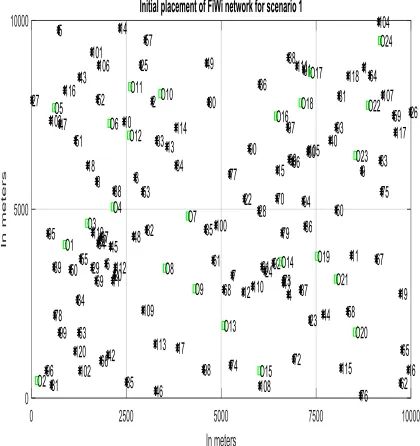
We simulate the FiWi network using MATLAB tool. In the simulation, the considered FiWi network area is 10000*10000 unit area. This area is further divided into 8 segments. In each segment there are 3 ONUs which are randomly placed. The number of wireless routers is five times the number of ONUs in FiWi network. Therefore 120 routers are randomly deployed in the network. Result for scenario 1 is shown below.
4.2 Simulation Results
Fig2 shows the initial placement of FiWi network consisting of eight segments, 120 wireless routers and 3 ONUs, which are randomly placed in each segment for scenario 1.
Fig. 2. Initial placement of FiWi network
Fig. 3. Optimized FiWi network
1783 Fig. 4. Deployment of backup fiber among randomly selected
backup ONUs
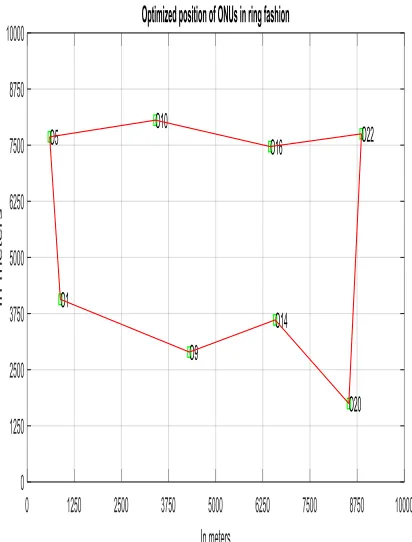
In proposed work, firstly deployment of backup fiber among randomly selected backup ONUs from each segment is done, After that deployment of backup fiber using spanning tree among randomly selected backup ONUs from each segment i.e.1to 8 is, ONU3, ONU4, ONU7, ONU12,ONU13,ONU16,ONU20,ONU22 are as shown in fig5. For optimization, selection of a backup ONU from each segment is performed. The selection of backup ONU is in such a way that all the other ONUs and WRs are communicating to each other in minimum hop way. The backup ONUs in segment 1 to 8 is ONU1, ONU5, ONU9, ONU10, ONU14, ONU16, ONU20 and ONU22. Now we deploy backup fiber among the selected backup ONUs of the segments in an existing ring approach as shown in fig6. In the fig. backup ONU of each segment is shown for scenario 1. The whole segment is connected in a ring fashion. Every segment has two backup paths if the failure occurs in the network.
Fig. 5. Deployment of backup fiber in Random network using spanning tree
Fig. 6. Deployment of Backup fiber in Ring fashion
1784 Fig. 7. Deployment of backup fiber in spanning tree fashion
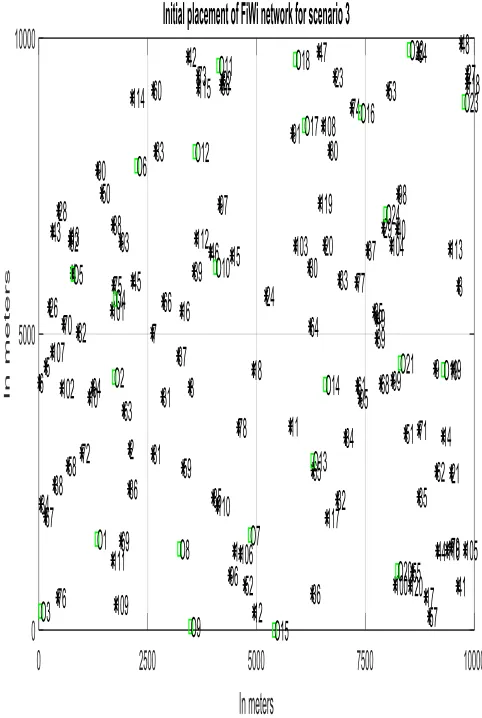
In order to analyze the worthiness of proposed method we consider two more scenario namely scenario2 & 3 are as shown in fig8 and fig9 respectively.
Fig. 8. Initial placement of FiWi network for scenario 2
Fig. 9. Initial placement of FiWi network for scenario 3
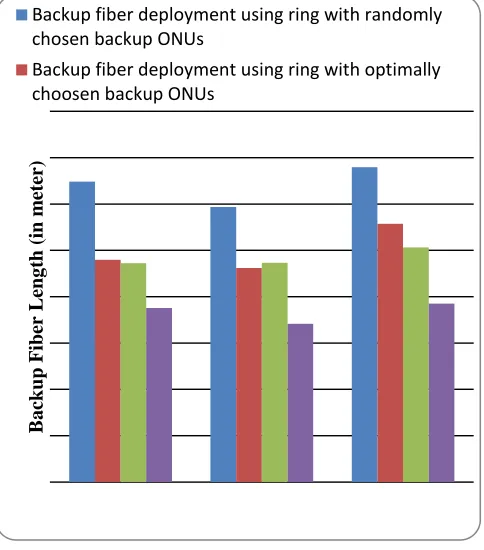
1785 Fig. 10. Comparison of total Backup fiber length of three
different scenarios
5 CONCLUSION
In this paper, we focus on the survivability issue of FiWi network. For distribution fiber failure (ONU level failure) we select backup ONU in each segment and transfer the traffic of affected ONU to backup ONU in minimum hop way. For OLT level failure i.e. segment level failure, spanning tree is used to deploy the backup fiber in order to obtain minimum length of backup fiber. Simulation results show that length of backup fiber for random position of ONUs in ring fashion is always greater for all three scenarios. Whereas spanning tree with optimally placed ONUs always gives best performance in terms of reduced backup fiber length. Hence the proposed algorithm is better for deployment of survivable FiWi network.
REFERENCES
[1] N. Ghazisaidi, M. Maier," Fiber-wireless (Fi-Wi) access networks: a survey," in IEEE Commun, vol. 47, pp.160– 167, 2007.
[2] N. Ghazisaidi, M. Maier," Fiber-wireless (Fi-Wi) access networks: challenges and opportunities," in IEEE Network,vol. 25, pp.36–42, 2011.
[3] M. Maier, N. Ghazisaidi, M. Reisslein," The audacity of fiber-wireless (Fi-Wi) networks,'' in Proc. ICST Int, Conf. Access Networks, pp. 16–35, 2008.
[4] U.R. Bhatt, P. K. Yadav, N. Chouhan," Fi-Wi Architecture and Survivability," in Proceedings of Recent Advances in Interdisciplinary Trends in Engineering & Applications (RAITEA), 2019.
[5] Y. Liu, Q. Song, L. Bing, M. Rui, ―Protection based on backup radios and backup fibers for survivable Fiber-Wireless (Fi-Wi) access network‖ in Journal of Network and Computer Applications, vol. 36, pp. 1057–1069, 2013.
[6] C. Lim et. al.," Hybrid Fiber Wireless Network: An optimization Framework for Survivable deployment," in jornal of optical
comm. network, pp. 466-478, 2017.
[7] L. Guo et. et. al.," Optimization and deploymant of survivable Fi-Wi access network with integrated small cell and Fi-Wi-Fi," in IEEE network,2015.
[8] H. Zhang et. al.," A new protection scheme Based on Daily traffic Demand for survivable Fi-Wi access network," in IEEE Network,2018.
[9] Y. Liu et. al., ―Optimizing Backup Optical Network-Units Selection and Backup fiber deployment in Survivable Hybrid wireless Optical Broadband Access Network,‖ in Journal of Light wave Technology, Vol.30, pp. 10, 2012.
[10]Y. Liu. et. al., ―Auxiliary graph based protection for survivable Fiber-Wireless (Fi-Wi) access network considering different levels of failures,‖ in Optical Fiber Technology, vol. 18, pp. 430-439, 2012.
[11]Y. Liu et. al., ―Ring-based Protection Scheme for Survivable Fiber-Wireless (Fi-Wi) Access Network Considering Multiple Failures,‖ in IEEE, 2012.
[12]U. R. Bhatt et. al.," Multi way protection scheme to handle multiple failures for cost efficient Fiber Wireless access netwrok," in Trends in opto-electro and optical comunication,vol.5, pp.1-15, 2015.
[13]Y. Liu et.al.," Planning of survivable cloud integrated Wireless optical broadband access network against distribution fiber failure," in optical switching and network, pp.217-255, 2014.
Back
u
p
F
ib
er
Leng
th
(
in
m
et
er
)
Backup fiber deployment using ring with randomly chosen backup ONUs
![Fig. 1. Architecture of FiWi [6]](https://thumb-us.123doks.com/thumbv2/123dok_us/8624945.1414653/1.612.337.571.408.642/fig-architecture-of-fiwi.webp)