Iot Sourced Real Time PV, Wind And Fuel Cell
Models For Micro And Nano Grids
L. P. Sivakumar, S. B. Ron Carter, K. Premkumar, T. Thamizhselvan, M. Vishnu Priya
Abstract: Integration of Renewable energy in Grid is increasing enormously. The main Grid comprises of multiple Micro Grids and numerous Nano Grids. Micro Grid is a localized Grid that can disconnect from the Main Grid to operate autonomously when the Main Grid fails. Nano Grids consists of small Micro Grids which supplies power to single building or a small area. In order to pre-determine the electrical system parameters in the Nano and Micro Grids, the mathematical model of proposed RE sources (Photovoltaic PV, Wind, Fuel cell) are developed and analyzed through real time data. The IOT based cloud is to be used to acquire real time data from various locations. The designed mathematical model is to be simulated by suitable software package and experimentally evaluated through the recent embedded TEXAS INSTRMENTS LAUNCH PAD‘s (MSP432E401Y, CC3220SF), Arduino Due and (Raspberry pi) hardware. The both simulated and emulated outputs are compared and equated in real time.
Index Term: Solar PV, Wind Energy, Fuel Cell, Micro grid, Nano Grid, IoT.
—————————— ——————————
1
INTRODUCTION
Integration of Renewable energy in Grid is increasing enormously [1-2]. The main Grid comprises of multiple Micro Grids and numerous Nano Grids. Micro Grid is a localized Grid that can disconnect from the Main Grid to operate autonomously when the Main Grid fails. Nano Grids consists of small Micro Grids which supplies power to single building or a small area. In order to pre-determine the electrical system parameters in the Nano and Micro Grids, the mathematical model of proposed RE sources (Photovoltaic PV, Wind, Fuel cell) are developed and analyzed through real time data [3-6]. The IOT based cloud is to be used to acquire real time data from various locations. The designed mathematical model is to be simulated by suitable software package and experimentally evaluated through the recent embedded TEXAS INSTRMENTS LAUNCH PAD‘s (MSP432E401Y, CC3220SF), Arduino Due and (Raspberry pi) hardware. The both simulated and emulated outputs are compared and equated in real time [14-25]. In this paper, internet of things has been integrated with renewable energy resources such as solar PV, wind energy and fuel cell. IoT used to monitor the parameters of the renewable energy sources for monitoring and controlling in micro and nano grid system. The rest of paper as follows, abbreviation used in this paper is described in the next section. Section 3 provides the details of the literature survey. Methodology and materials used is explained in the section 4. Simulation model of IoT
and renewable system is described in the section 5. Experimental of the real time system is PROVIDED IN THE SECTION 6.CONCLUDING REMARKS IS GIVEN IN THE SECTION 7.
2
A
BBREVIATIONIOT Internet Of Things
PV Photovoltaic
TI Texas Instruments
GPIO General Purpose Input Output
SEIG Self-Excited Induction Generator DAC Digital To Analog Converter
ADC Analog To Digital Converter
I2C Inter Integrated Circuit SPI Serial Peripheral Interface
DNL Differential Nonlinearity INL Integral Nonlinearity
HMI Human Machine Interface
SOC System on Chip
DSO Digital Storage Oscilloscope
MPPT Maximum Power Point Tracking
EPROM Erasable Programmable Read Only Memory
HTTP HyperText Transfer Protocol
3
P
REVIOUS WORKSAs the world population increases the need of energy also gets increased the demand changes with respect to the usage of technology, population and other geo-political factors. Most of the energy demand is met by the energy produce by conventional energy sources but it is associated with the problem of pollution as well as in some cases there is a demand for cooling the machineries used. Comparing the disadvantage of conventional energy sources with the renewable sources, the latter becomes the clear winner. In solar and in wind there comes a need for energy conversion by means of converters. Hybrid Energy System combines many energy sources. To combine those, we need to have a common platform to get the data and to act upon that data so IoT becomes the obvious choice the get data and to act upon it. In IoT all the device is provided with an IP for data
__________________________________
*L.P.Sivakumar, EEE department, Rajalakshmi Engineering College, Chennai, Tamilnadu, India. Email: [email protected]
S.B.Ron Carter, EEE department, Rajalakshmi Engineering College, Chennai, Tamilnadu, India. Email: [email protected]
K.Premkumar, EEE department, Rajalakshmi Engineering College, Chennai, Tamilnadu, India. Email: [email protected]
T.Thamizhselvan, EEE department, Rajalakshmi Engineering College, Chennai, India. Email: [email protected] M.Vishnu Priya, ECE department, Saveetha School Engineering,
989
exchange. The exchanged data should be managed in a common platform that is secure enough to protect the data. To pre-determine the electrical parameters in the Nano and Micro Grids, the mathematical model of the Photovoltaic (PV) Array, Wind Turbine, Doubly-Fed Induction generator, Permanent magnet synchronous generator, Self-excited induction generator and Fuel Cell are to be implement in the physical Texas Instruments Launch pad (embedded controlled hardware) and raspberry pi 3 B are hardware used. The entire programming of the above system will be handled by embedded Simulink coder. The proposed real time system will be evaluated through the suitable real hardware and emulated systems. The PV system continues to provide energy to a part of the network even after the process of islanding. This at times becomes hazardous for the people who are maintaining the network [1, 13]. The network is simulated using MATLAB/Simulink environment, algorithm and real-time implementation is done in the same environment. For getting the accurate result as that of the real world model dSPACE 1104 can be used [2]. The effects of interactions between electrical and mechanical components are not accurately taken into account [3] as it will further complicate the simulation processThe micro grid provides opportunities for new entrants in hybrid energy generation space as in hybrid energy generation the need for solar goes high compared to wind also the scope of IoT is also expected to be in uptrend [4]. While integrating solar with the micro grid appropriate interfacing algorithm has to be employed to achieve effective interfacing. Here IoT plays the major role for data collection and in co-ordination. MPPT has also to be used where solar find its position. Appropriate converters to be used based on the demand [5, 6]. The operation of Self Excited IG is not the same of both linear and Non-linear loads, its non-linearity can be successfully compensated with the addition of capacitor bank [7]. The usage of microcontrollers and PLC should be chosen based on the type of application [8].
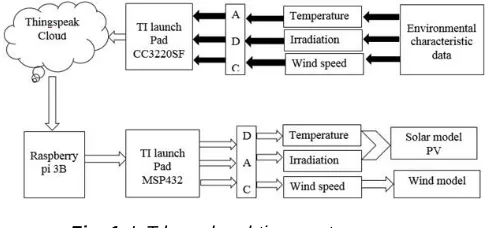
The data transmitted from different locations through transmission systems of various types met with the problem of different time stamping [9]. While interconnecting various energy sources in the micro grid [11, 12, 26, 27] appropriate synchronizing techniques has to be followed. An advanced PEM fuel cell mathematical model is described and realized in four ancillaries in the MATLAB–Simulink environment [14-25]. To design and develop the hybrid energy system model based on IOT for Micro and Nano grid real time model for analyzing the performance and characteristic based on this analysis, protective and future protection of the system is decided. To develop a program using MATLAB and Raspberry pi 3 B, CC2000, CC3220SF, Arduino Due hardware for fetching data from various place. The figure 1 shows the block diagram of IoT sourced PV, wind and fuel cell models for Micro and Nano grids. The Environmental characteristic data such as temperature, irradiation and wind speed are measured using suitable sensors which is an analog signal. The measured signals are fed into ADC which converts analog signal into digital signal. ADC used in our model is Ic mcp3008 which is a 10-bit data transfer medium. Digital signals are uploaded to Thing speak cloud Platform through TI Launchpad CC3220SF. Data stored in the cloud is downloaded using Raspberry pi 3B and fed TI launch Pad MSP432E401Y. Digital data is now converted back again to analog data using DAC, which is Ic mcp4725 12-bit data transfer medium. Analog data is now fed
as input to various proposed models and the corresponding outputs from the models are obtained.
4 M
ATERIALS AND METHODThe main components used are: ADC (MCP3008)
TI Launch pad CC3320SF Raspberry pi 3b
TI Launch pad MSP432E401Y DAC (MCP4725)
ADC (Analog to Digital Converter) MCP3008 device is a 10 bit SAR type ADC coupled with a sample and hold circuit. The MCP3008 can be programmed to have 4 different pseudo-differential input pairs i.e., it can be considered as 8 different inputs. SPI protocol provides the provision to communicate with the device by means of serial communication. Up to 200ksps conversion rate is possible with this IC. This particular IC can be operated at voltages levels in between 2.7V & 5.5V. IoT operation is made possible with the board Launchpad CC320 as it offers on board devices like accelerometer, Wi-Fi and protocols for security. The Raspberry Pi 3 has 40-pin general-purpose input-output (GPIO). The High of GPIO corresponds to 3.3V and LOW of GPIO corresponds 0V. Thus, by analyzing different climatic conditions at different places and accessing the data through common cloud platform. This enhances the proper selection of location for installation of various Renewable Energy (RE) sources and to yield maximum output from the proposed models. The real time data are sourced via IOT based cloud system. The complete process involved in IoT is given in figure 1.
Fig. 1. IoT based real-time system
5
S
IMULATION MODEL OF PHOTO VOLTAIC(PV),
WIND AND FUEL CELL5.1 PV with IoT using Thingspeak platform
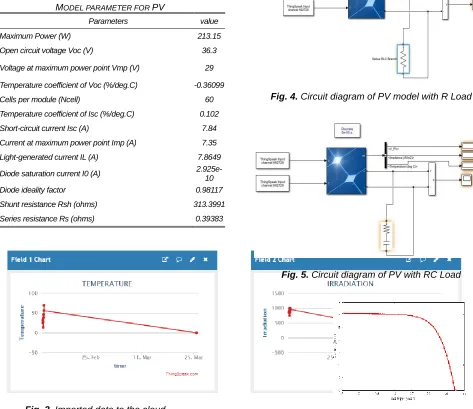
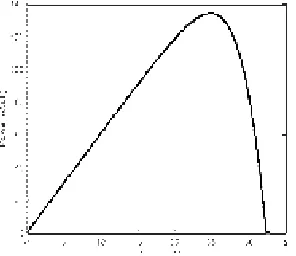
The figures 2 and 3 are the data send to cloud. ThingSpeak is an open-source Internet of Things (IoT) application and API to store and retrieve data from things using the HTTP protocol over the Internet or via a Local Area Network. ThingSpeak is an IoT analytics platform service that allows you to aggregate, visualize, and analyze live data streams in the cloud. You can send data to ThingSpeak from your devices, create instant visualizations of live data, and send alerts using web service like MATLAB analytics inside ThingSpeak, you can write and execute MATLAB code to perform preprocessing, visualizations, and analyses. IoT platform ThingSpeak have been used for data transmission and to get data, the same data is retrieved and was given as input to the Matlab/Simulink PV model for simulation as depicted in figures 4 and 5. Figure 6 shows the simulated output of the PV model.
TABLE1
MODEL PARAMETER FOR PV
Parameters value
Maximum Power (W) 213.15
Open circuit voltage Voc (V) 36.3
Voltage at maximum power point Vmp (V) 29
Temperature coefficient of Voc (%/deg.C) -0.36099
Cells per module (Ncell) 60
Temperature coefficient of Isc (%/deg.C) 0.102
Short-circuit current Isc (A) 7.84
Current at maximum power point Imp (A) 7.35
Light-generated current IL (A) 7.8649
Diode saturation current I0 (A) 2.925e-10 Diode ideality factor 0.98117
Shunt resistance Rsh (ohms) 313.3991
Series resistance Rs (ohms) 0.39383
Fig. 2. Imported data to the cloud
Fig. 3. Data written on the cloud
Fig. 4. Circuit diagram of PV model with R Load
991 Fig. 6. PV output simulation for I-V and power
TABLE2
MODEL PARAMETER FOR SEIG
Parameters value
Nominal mechanical output power (W) 1.5e6
Base power of the electrical generator (VA) 1.5e6/0.9
Base wind speed (m/s) 12
Maximum power at base wind speed (pu) 0.73
Base rotational speed (p.u. of base generator speed) 1.2 Pitch angle beta to display wind-turbine power
characteristics (beta >=0) (deg) 0
SEIG (Self-Excited Induction Generator) code clear; T = 30;
Ts = 1e-4; sim_t = 0:Ts:T;
ln = length(sim_t); f = 60; w = 2*pi*f; Lm = 0; Ls = 3.49/w; Lr = Ls; Rs = 0.696;
Rr = 0.743;
Lsm = Ls; Lrm = Lr; Wg = 385; P = 4;
Td = 15; J = 0.2;
Rl = 150; Ll = 50e-3; Vds = 0.5; Vqs = 0.5; C = 57e-6; Ki = 0.21; Kv = 0.29;
Kw = J/w;
Ids = zeros(ln,1); Iqs = zeros(ln,1); Idr = zeros(ln,1); Iqr = zeros(ln,1); Vcd = zeros(ln,1); Vcq = zeros(ln,1); Ild = zeros(ln,1); Ilq = zeros(ln,1); for k = 2:ln;
m = k-1;
Te = (3/2)*(P/2)*Lm*(Ids(m)*Iqr(m) - Iqs(m)*Idr(m));
Wg = Wg + Kw*Ts*(P/(2*J))*(Td - Te); G = 1/(Lm^2-Ls*Lr);
Ids(k) = Ids(m) + Ki*Ts*G*(Lr*Rs*Ids(m) - Wg*Lm^2*Iqs(m) - Lm*Rr*Idr(m) - Wg*Lm*Lr*Iqr(m) + Lr*Vcd(m) - Lm*Vds);
Iqs(k) = Iqs(m) + Ki*Ts*G*(Wg*Lm^2*Ids(m) + Lr*Rs*Iqs(m) + Wg*Lm*Lr*Idr(m) - Lm*Rr*Iqr(m) + Lr*Vcq(m) - Lm*Vqs);
Idr(k) = Idr(m) + Ki*Ts*G*(-Lm*Rs*Ids(m) + Wg*Lm*Ls*Iqs(m) + Ls*Rs*Idr(m) + Wg*Lr*Ls*Iqr(m) - Lm*Vcd(m) + Ls*Vds);
Iqr(k) = Iqr(m) + Ki*Ts*G*(-Wg*Lm*Ls*Ids(m) - Lm*Rs*Iqs(m) - Wg*Lr*Ls*Idr(m) + Ls*Rr*Iqr(m) - Lm*Vcq(m) + Ls*Vqs);
Vcd(k) = Vcd(m) + Kv*Ts*(Ids(k)-Ild(m))/(C);
Vcq(k) = Vcq(m) + Kv*Ts*(Iqs(k)-Ilq(m))/(C); Ild(k) = Ild(m) + Ki*Ts*(Vcd(k)/Ll - Rl/Ll*Ild(m));
Ilq(k) = Ilq(m) + Ki*Ts*(Vcq(k)/Ll - Rl/Ll*Ilq(m)); Im = sqrt((Ids(k)+Idr(k))^2+(Iqs(k)+Iqr(k))^2);
Lm = 0.205 + 0.0053*Im - 0.0023*Im^2 + 0.0001*Im^3;
% Lm = 1.1*(0.025+0.2974*exp(-0.00271*Im));
Ls = Lm + Lsm; Lr = Lm + Lrm; end
5.2 Simulation of SIEG with code
The simulation is done with the help of MATLAB software. The components required for simulation are taken from Simulink support package. After taking the components they are connected as shown in figure 6. For each component the value is set by double clicking it, as per our requirement
Fig. 7. Output voltage of SEIG
The given input is temperature, irradiation and output are taken across IOT as depicted in figure 7. The simulation for real time weather characteristic data using Internet of Things is performed and analyzed by MATLAB/Simulation software. The simulation output is successfully viewed.
6.
H
ARDWARE DESCRIPTION&
O
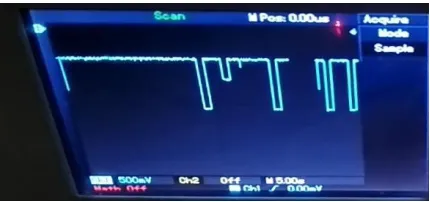
UTPUTdeployed on the Raspberry pi 3B hardware which acts as a master from which data transferred to ARDUINO DUE (slave). Communication between master and slave takes place through I2C bus. According to the variations given on input (i.e.) irradiation the corresponding output is visualized in DSO (Digital Storage Oscilloscope). The slave consists of inbuilt DAC which helps to convert the digital signal to analog signal and which is displayed in the DSO (Digital Storage Oscilloscope).
Fig.8. Real time simulation of PV model
Fig. 9. Output waveform of Real-time hardware
Thus, real time simulation for proposed models are achieved using embedded hardware and are shown in the figure 8 and 9.
7.
C
ONCLUSIONThe combined usage of various energy sources available at the locality will provide an effective solution for future energy demand by way of integrating the sources using micro grid. As the sources and the loads are highly interconnected in a micro grid there is a demand of data communication to the data centre. This can be achieved by the effective usage of IoT concepts, so that the real-time data can be transferred to the general co-ordinating centre time to time. Real-time data will make the co-ordinating centre to decide upon the various possible options available to meet the energy demand of the particular locality. TI boards, Arduino and Raspberry pi have been used to feed and to retrieve data form the cloud.
R
EFERENCES[1] M.E. Ropp, M. Begovic and A. Rohatgi: ‗Prevention of Islanding in Grid-Connected Photovoltaic Systems‘. Progress in Photovoltaics: Research and Application, 1999, Appl. 7, 39-59.
[2] M. Ciobotaru, T. Kerekes and R. Teodorescu: ‗PV inverter simulation using MATLAB/Simulink graphical
environment and PLECS blockset‘. IECON 2006 - 32nd Annual Conference on IEEE Industrial Electronics, 2006.
[3] Roohollah Fadaeinedjad: ‗Simulation of a Wind Turbine with Doubly Fed Induction Generator by FAST and Simulink‘. IEEE Transaction on Energy Conversion, June 2018, Vol. 23, No. 2, pp. 691-700. [4] Deepak Kumar Aagri and Altanai Bisht: ‗Export and
Import of Renewable energy Hybrid Microgrid via IoT‘. 2018 3rd International Conference On Internet of Things: Smart Innovation and Usages (IoT-SIU) [5] Michael Bardwell, Jason Wong, Steven Zhang and
Petr Musilek: ‗Design Considerations for IoT-Based PV Charge Controllers‘. IEEE World Congress on Services, DOI 10.1109/SERVICES.2018.00043, pp. 59-60.
[6] Prakhar Srivastava, Mohit Bajaj and Ankur Singh Rama: ‗IoT Based Controlling of Hybrid Energy System using ESP8266‘. IEEE, DOI 978-1-5386-1138-8/18.
[7] D. Vimalakeerthy, M. Sivakumar and G. Sugumaran: ‗Analysis of Wind Driven Induction Generator with impact of Non-Linear Loads‘. International Journal of Pure and Applied Mathematics, 2018, Vol. 118, No. 24.
[8] SBR Carter and A Selvaraj: ‗Design and Implementation of PLC based Elevator‘. International Journal of Computer Applications, 2013, Vol. 68, No. 7.
[9] Kalaiarasi.D and M.Monisha. ‗ENHANCEMENT OF HYBRID POWER SYSTEMS USING IOT‘, International Journal of Advanced Research Trends in Engineering and Technology (IJARTET), Vol. 3, Special Issue 19.
[10]K. Premkumar, T. Thamizhselvan, M. Vishnu Priya, S B Ron Carter and LP Sivakumar; ‗Fuzzy Anti-Windup PID Controlled Induction Motor‘. International Journal of Engineering and Advanced Technology (IJEAT), ISSN: 2249 – 8958, Volume-9 Issue-1, October 2019. [11]LP. Sivakumar, M. Arutchelvi, ‗Control of Grid
Converters for PV Array Excited WindDriven Induction Generators with Unbalanced and Nonlinear Loads‘ was publish in the International Journal of Electrical Power and Energy Systems Vol. 59, pp.188–203, Jul 2014 (10.1016/j.ijepes.2014.02.019) ELSEVIER. [12]LP. Sivakumar, M. Arutchelvi, ―Modified composite
power control strategy for grid connected wind‐PV systems with unbalanced nonlinear current‖ published in the International Transactions on Electrical Energy Systems E2587, 26 April 2018 WILEY.
[13]Thamizhselvan, T., Seyezhai, R., Premkumar, K., ―Maximum power point tracking algorithm for photovoltaic system using supervised online coactive neuro fuzzy inference system‖, Journal of Electrical Engineering, (2017) 17 (1), pp. 270-286.
[14]K. Premkumar and B.V. Manikandan , ―Stability and Performance Analysis of ANFIS Tuned PID Based Speed Controller for Brushless DC Motor,‖ in Current Signal Transduction Therapy, vol.13, no.1, 2018, pp. 19-30.
993
Recurrent Fuzzy Neural Network Based Controller for Brushless DC Motor,‖ Electric Power Components and Systems, vol.45, no.20, 2018, pp.2304-2317. [16]K. Premkumar and B.V. Manikandan , ―GA-PSO
optimized online ANFIS based speed controller for Brushless DC motor,‖ in Journal of Intelligent & Fuzzy Systems, vol. 28, no. 6, 2015, pp. 2839-2850.
[17]K. Premkumar and B.V. Manikandan , ―Online Fuzzy Supervised Learning of Radial Basis Function Neural Network Based Speed Controller for Brushless DC Motor,‖ in Lecture Notes in Electrical Engineering, vol.326, 2015, pp.1397-1405.
[18]K. Premkumar and B.V. Manikandan, ―Novel bacterial foraging-based ANFIS for speed control of matrix converter-fed industrial BLDC motors operated under low speed and high torque,‖ in Neural Computing and Applications, vol. 29, no.12, June 2018, pp.1411– 1434.
[19]M. John Prabu, P. Poongodi, and K. Premkumar, ―Fuzzy supervised online coactive neuro-fuzzy inference system-based rotor position control of brushless DC motor,‖ in IET Power Electronics, vol.9, no.11, September 2016, pp.2229 – 2239.
[20]K. Premkumar and B. V. Manikandan, "Adaptive fuzzy logic speed controller for brushless DC motor," in 2013 International Conference on Power, Energy and Control (ICPEC), Sri Rangalatchum Dindigul, 2013, pp. 290-295.
[21]K. Premkumar, and B.V. Manikandan, ―Speed control of Brushless DC motor using bat algorithm optimized Adaptive Neuro-Fuzzy Inference System,‖ in Applied Soft Computing, vol.32, 2015, pp.403-419.
[22]K. Premkumar, and B.V. Manikandan, ―Fuzzy PID supervised online ANFIS based speed controller for brushless dc motor,‖ Neurocomputing, vol.157, 2015, pp.76-90.
[23]K. Premkumar, and B.V. Manikandan, ―Bat algorithm optimized fuzzy PD based speed controller for brushless direct current motor,‖ in Engineering Science and Technology, an International Journal, vol. 19, no.2, 2016, pp.818-840.
[24]K. Premkumar, and B.V. Manikandan, ―Adaptive Neuro-Fuzzy Inference System based speed controller for brushless DC motor,‖ in Neurocomputing, vol.138, 2014, pp. 260-270.
[25]Shyam, D., Premkumar, K., Thamizhselvan, T., Nazar Ali, A., Vishnu Priya, M, ―Symmetrically modified laddered H-bridge multilevel inverter with reduced configurational parameters‖, International Journal of Engineering and Advanced Technology, 9(1), 2019, pp.5525-5532.
[26]T. P. V. Preethishri, K. S. Kumar and P. Sivakumar, "Embedded emulator of photovoltaic array and wind driven induction generator by using digital signal controller (tms320f28335)," India International Conference on Power Electronics 2010 (IICPE2010), New Delhi, 2011, pp. 1-7. doi: 10.1109/IICPE.2011.5768195
[27]R. Muralekrishnen and P. Sivakumar, "Improving the power quality performance for distributed power generation," 2012 International Conference on Computing, Electronics and Electrical Technologies