Faculteit Wetenschappen Center Leo Apostel
for Interdisciplinary Studies
Design and Control
of Self-organizing Systems
PhD Dissertation presented by
Carlos Gershenson
Promoters: Prof. Dr. Bart D’Hooghe and Prof. Dr. Francis Heylighen Advisors: Prof. Dr. Bruce Edmonds
Prof. Dr. Bernard Manderick Prof. Dr. Peter McBurney Prof. Dr. Ann Now´e
C
ONTENTS
Contents iii
List of Figures vi
List of Tables viii
Abstract ix
Acknowledgements xi
1 Introduction 1
1.1 Motivation . . . 2
1.2 Aims . . . 3
1.3 Outline . . . 3
1.3.1 How to Read the Thesis . . . 4
1.3.2 How the Thesis was Written. . . 6
2 Complexity 9 2.1 Introduction . . . 10
2.2 Classical Thinking . . . 10
2.3 Complexity. . . 11
2.4 Indeterminacy . . . 14
2.5 Nonlinearity and Chaos . . . 17
2.6 Adapting to Complexity . . . 19
2.7 Conclusions . . . 21
3 Self-organization 23 3.1 Introduction . . . 24
3.2 The Representation-Dependent Dynamics of Entropy . . . . 24
3.3 The Role of the Observer . . . 29
3.4 Ontological Issues . . . 30
iv CONTENTS
3.5.1 Artificial self-organizing systems . . . 33
3.5.2 Levels of abstraction . . . 34
3.5.3 Coping with the unknown . . . 34
3.6 Conclusions . . . 35
4 A General Methodology 37 4.1 Introduction . . . 38
4.2 The Conceptual Framework . . . 38
4.3 The Methodology . . . 43
4.3.1 Representation . . . 44
4.3.2 Modeling . . . 46
4.3.3 Simulation . . . 53
4.3.4 Application . . . 54
4.3.5 Evaluation . . . 55
4.3.6 Notes on the Methodology . . . 55
4.4 Discussion . . . 56
4.5 Conclusions . . . 59
5 Self-organizing Traffic Lights 61 5.1 Introduction . . . 62
5.2 Applying the Methodology I . . . 63
5.3 Experiments: First Results . . . 69
5.4 Applying the Methodology II . . . 76
5.5 Experiments: Second Results . . . 77
5.6 Applying the Methodology III . . . 81
5.7 Experiments: Third Results . . . 83
5.8 Applying the Methodology IV. . . 85
5.9 Discussion . . . 87
5.9.1 Adaptation or optimization? . . . 88
5.9.2 Practicalities . . . 89
5.9.3 Environmental benefits . . . 90
5.9.4 Unattended issues . . . 91
5.10 Conclusions . . . 92
6 Self-organizing Bureaucracies 95 6.1 Introduction . . . 96
6.2 Designing Self-organizing Bureaucracies. . . 98
6.3 The Role of Communication . . . 100
6.3.1 Decision Delays . . . 104
6.4 The Role of Sensors . . . 104
CONTENTS v
6.6 The Role of Context . . . 109
6.7 A Toy Model: Random Agent Networks . . . 110
6.7.1 Using self-organization to improve performance . . . 112
6.7.2 Simulation Results . . . 113
6.7.3 RAN Discussion . . . 115
6.8 Conclusions . . . 123
7 Self-organizing Artifacts 125 7.1 A Scenario . . . 126
7.2 Requirements for self-organizing artifacts . . . 127
7.3 Achieving self-organization . . . 129
7.4 Learning to communicate . . . 130
7.5 Learning to cooperate . . . 131
7.6 Learning to coordinate . . . 133
7.7 Conclusions . . . 135
8 Conclusions 137 8.1 Achievements . . . 138
8.1.1 Limitations . . . 139
8.2 Future Work . . . 140
8.3 Philosophical Implications . . . 142
8.3.1 Objectivity or Subjectivity? Contextuality! . . . 142
8.3.2 The Benefits of Self-organization . . . 143
Bibliography 145
Glossary 167
L
IST OF
F
IGURES
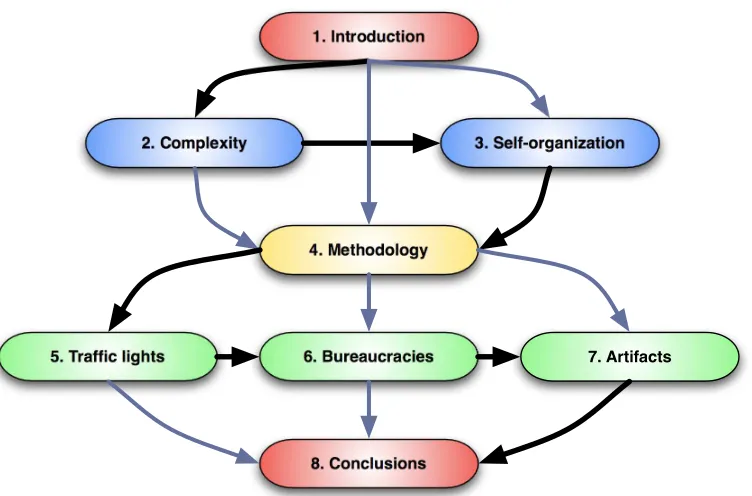
1.1 Thesis map . . . 5
2.1 Is it a duck, a rabbit, or both? . . . 15
2.2 The same sphere seen from different angles . . . 16
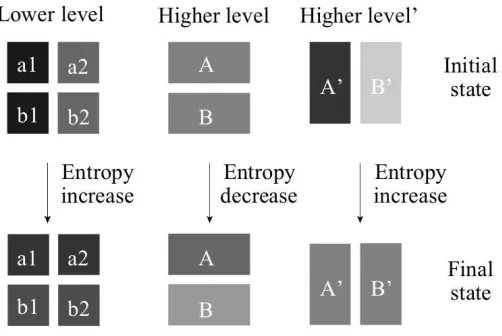
3.1 Entropy increases and decreases for the same system . . . . 27
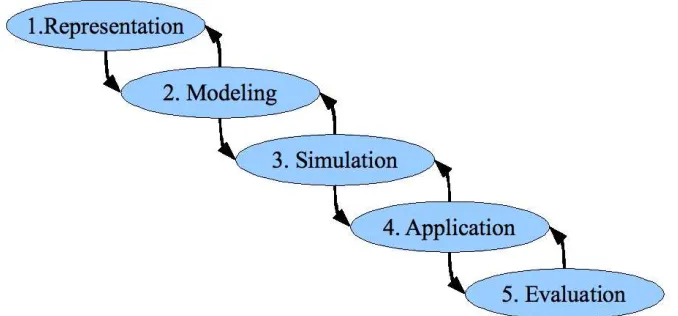
4.1 Diagram relating different stages of Methodology. . . 44
4.2 Detailed diagram of Methodology. . . 57
5.1 Screenshot of a part of the traffic grid. . . 65
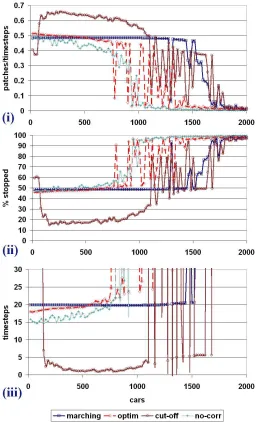
5.2 Results for standard methods . . . 70
5.3 Results for self-organizing methods . . . 71
5.4 Full synchronization . . . 75
5.5 Second results for standard methods . . . 78
5.6 Second results for self-organizing methods . . . 79
5.7 Comparison of initial and average number of cars . . . 80
5.8 Simulation of the Wetstraat and intersecting streets . . . 83
5.9 Wetstraat results . . . 85
5.10 Potential implementation ofsotl-platoon. . . . 86
6.1 Asynchronous communication . . . 102
6.2 Response delay . . . 103
6.3 Hierarchy represented as a network . . . 108
6.4 Dynamics of a random agent network ofN = 25,K = 5 . . . 111
6.5 RAN self-organization mechanism . . . 112
6.6 Results forN = 15,K = 1. . . 114
6.7 Results forN = 15,K = 2. . . 116
6.8 Results forN = 15,K = 5. . . 117
6.9 Results forN = 15,K = 15. . . 118
6.10 Results forN = 100,K = 1. . . 119
6.11 Results forN = 100,K = 2. . . 120
LIST OF FIGURES vii
L
IST OF
T
ABLES
5.1 Parameters of NetLogo simulations. . . 72 5.2 Vehicle count per hour, Wetstraat . . . 83 5.3 Emissions by idling engines on Wetstraat . . . 91
A
BSTRACT
Complex systems are usually difficult to design and control. There are several particular methods for coping with complexity, but there is no general approach to build complex systems. In this thesis I propose a methodology to aid engineers in the design and control of complex systems. This is based on the description of systems as self-organizing. Starting from the agent metaphor, the methodol-ogy proposes a conceptual framework and a series of steps to follow to find proper mechanisms that will promote elements to find solutions by actively interacting among themselves. The main premise of the methodology claims that reducing the “friction” of interactions be-tween elements of a system will result in a higher “satisfaction” of the system, i.e. better performance.
A general introduction to complex thinking is given, since designing self-organizing systems requires a non-classical thought, while practical notions of complexity and self-organization are put forward. To illustrate the methodology, I present three case studies. Self-organizing traffic light controllers are proposed and studied with multi-agent simulations, outperforming traditional methods. Methods for improving communication within self-organizing bureaucracies are advanced, introducing a simple computational model to illustrate the benefits of self-organization. In the last case study, requirements for self-organizing artifacts in an ambient intelligence scenario are discussed. Philosophical implications of the conceptual framework are also put forward.
A
CKNOWLEDGEMENTS
It takes several years to build up a PhD. And it is impossible to do so alone. Along these years, many mentors, colleagues, and friends have influenced my research, formation, and life in different aspects.
I am in debt with my promoters, Francis Heylighen, Diederik Aerts, and Bart D’Hooghe, who have shared their knowledge and experience, and whose support has gone well beyond the academic.
Collaborations with Johan Bollen, Jan Broekaert, Paul Cilliers, Seung Bae Cools, Atin Das, Bruce Edmonds, Ang´elica Garc´ıa Vega, Stuart Kauff-man, Tom Lenaerts, Carlos de la Mora, Marko Rodriguez, Ilya Shmule-vich, Dan Steinbock, Jen Watkins, and Andy Wuensche have enriched my research. I have learned a lot from interacting with them.
Hugues Bersini, Jean-Louis Denebourg, Marco Dorigo, Bernard Man-derick, Gregoire Nicolis, Ann Nowe, Luc Steels, Ren´e Thomas, Jean Paul Van Bendegem, Frank Van Overwalle, and other professors at the VUB and ULB have provided me with great advice and inspiration.
Being in Brussels, I had the opportunity to interact with several re-search groups akin to my interests in both VUB and ULB. I am grateful for the discussions and good times I’ve had with the members of the Evolu-tion, Complexity and Cognition Group and the Centrum Leo Apostel the AI Lab, IRIDIA, and CeNoLi. The ideas presented here were influenced especially by Ricardo Barbosa, Vassilios Basios, Bart De Vylder, Anselmo Garc´ıa Cant ´u Ros, Erden G ¨oktepe, Carlos de la Mora, Marko Rodriguez, Francisco Santos, and Cl´ement Vidal.
I appreciate the time, support, and advices given by Juan Juli´an Merelo Guerv ´os and the GeNeura team at the Universidad de Granada. The five months I spent with them were crucial for the development of this thesis.
The possibility of a PhD does not come out of nowhere. This research would not have been possible without the formation and influences I re-ceived at Sussex University, especially from Inman Harvey, Ezequiel Di Paolo, Chris Thornton, and Andy Clark; and as an undergraduate in Mex-ico, especially from Javier Fern´andez Pacheco, Jaime Lagunez Otero, Pe-dro Pablo Gonz´alez P´erez, and Jos´e Negrete Mart´ınez.
xii Acknowledgements
I appreciate the discussions, advice, help, and inspiration I received from Maximino Aldana, Mark Bedau, Pamela Crenshaw, Kurt Dresner, Gast ´on Escobar, Jochen Fromm, Peter Furth, Nagarjuna G., Alexander Gorbulski, Stephen Guerin, David Hales, Dirk Helbing, Uri Hershberg, Bernardo Huberman, Genaro Ju´arez Mart´ınez, Stuart Kauffman, Iavor Kostov, David Krakauer, Stefan L¨ammer, Taivo Lints, Diana Mangalagiu, Peter McBurney, Mike McGurrin, Barry McMullin, Richard Michod, Luis Miramontes, Kai Nagel, Mikhail Prokopenko, Daniel Polani, Andreas Schadschneider, Frank Schweitzer, Cosma Shalizi, Ricard Sol´e, Sorin Solomon, Steven Strogatz, Hideaki Suzuki, Seth Tisue, Richard Watson, George Whitesides, Stephen Wolfram, Franco Zambonelli, H´ector Zenil, and many others to whom I owe an apology for my bad memory.
Several anonymous referees have helped with their comments, critics and suggestions to improve the ideas presented here.
I thank the minister of Mobiliteit en Openbare Werken of Brussels, Pas-cal Smet, Kenneth Vanhoenacker, and Philippe Boogaerts from the Minis-terie van het Brussels Hoofdstedelijk Gewest for their time and for provid-ing data for the Wetstraat simulations.
This research was partially $upported by the Consejo Nacional de Ciencia y Teconolg´ıa (CONACyT) of Mexico and by the Fonds Wetenschappelijk Onderzoek (FWO) of Flanders.
Gracias a mi familia y amigos, por su apoyo y comprensi ´on, tan lejos y tan cerca...
Nadeda mo,
vs to|
nevozmonobez teb.
ta rabota
C
HAPTER
1
I
NTRODUCTION
“Everybody’s Hive” Carlos Gershenson
2006.
Acrylic on canvas, 65x80 cm. Merelo Guerv ´os collection.
2 Motivation
Our world becomes more complex every day. To cope with it, the sys-tems we design and control also need to become more complex, increasing the complexity of the world. This increase in complexity is characterized by a growth in number and diversity of elements of systems and their interactions. Every year there are more people, more computers, more devices, more cars, more medicines, more regulations, more problems. Since complexity has crawled into all the aspects of our lives, its study is very important for all disciplines. Traditional approaches are becoming obsolete, as they were developed for a simpler world. Thus any advance-ment in the general understanding of complex systems (Bar-Yam, 1997) will have a potential impact in sciences, engineering, and philosophy.
“Classical” approaches are still very useful, but only in problem do-mains that are static and comprehensible. An exact solution can be found, and this solution will hold. But with an increase of complexity, problem domains become dynamic, requiring for dynamic solutions that will be able toadaptto the changes in the problem domain (Ashby,1947a).
1.1
Motivation
“Simplicity is no reason, difficulty is no excuse” —Bruce Edmonds
One conceptual approach to build adaptive systems involves design-ing the elements of a system to findby themselvesthe solution of the prob-lem. Like this, when the problem changes, the elements are able to dynam-icallyfind a new solution. We can say that such a systemself-organizes.
Even when the concept of self-organization (Ashby,1947b;Heylighen, 2003b) is very promising to solve complex problems, and has been used for more than half a century, it remains somewhat vague, and it is not widespread. The aim of this work is to enhance our understanding of self-organization, and to exploit it to build systems that will be able to cope with complex problem domains. With the experience gained by building such systems, our understanding of them is also increased.
There is as yet no general methodology to design and control self-organizing systems. This thesis is a step towards developing one, pro-viding new insights to build systems able to solve complex problems.
Introduction 3
to be in a viability zone defined by the user. However, it becomes very complicated to steer the variables of a complex system due to inherent nonlinearities. How can such systems be steered? And how to design systems that will be steered easily? These are main questions for my research. There is no universal answer, but the aim is to increase our understanding of complex systems.
1.2
Aims
The aims of this thesis are the following:
• To propose novel notions of complexity and self-organization (Sec-tions2.3and3.5).
• To propose a general Methodology to aid the design and control of self-organizing systems. In principle, it could be applied in any do-main to help people build and steer complex systems (Chapter4). • To explore and analyse control mechanisms for self-organizing traffic
lights with computer simulations. These should be able to adapt to changing traffic conditions autonomously, considerably improving traffic flow over traditional control methods (Chapter5).
• Using the Methodology, to propose solutions for improving commu-nication within bureaucracies, sensing public satisfaction, dynamic modification of hierarchies, and contextualization of procedures. To exemplify benefits of self-organization in bureaucracies with a sim-ple computational model (Chapter6).
• To propose properties required by protocols of self-organizing arti-facts in an ambient intelligence scenario (Chapter7).
1.3
Outline
After this introductory chapter, Chapter 2 discusses concepts related to complexity, noting why they require a shift from classical thinking. Sev-eral examples are given, and a notion of complexity is put forward.
4 Outline
showing the partial dependence on the observer to judge whether a sys-tem is self-organizing or not.
Chapter4is the central part of the thesis, presenting a general method-ology to design and control self-organizing systems. For this, a novel con-ceptual framework is introduced, and the different steps of the Method-ology are described. Three case studies are presented to illustrate the Methodology (Chapters 5, 6, and7). Since these are at different stages of development, some are able to illustrate the Methodology only partially.
In Chapter5, Self-organizing traffic lights are presented. This project has developed concepts, abstract, and realistic simulations, almost ready to be deployed in a real city, making this the “less incomplete” case study. The simulations show that self-organizing methods outperform consider-ably traditional methods, even when the former ones use very simple rules and no direct communication. The models are interesting in themselves, as platoons are promoted by the local algorithms, which in certain abstract cases achieve “full synchronization”, i.e. they do not stop at all.
The self-organizing bureaucracies project described in Chapter 6is at an earlier stage, presenting concepts and an abstract simulation. Solutions are proposed for improving communication within bureaucracies, sens-ing public satisfaction, dynamic modification of hierarchies, and contex-tualization of procedures. A novel computational model—random agent networks—is presented, along with simulation results, to illustrate the benefits of self-organization in abstract organizations.
Chapter 7 presents self-organizing artifacts, focusing on communica-tion protocols. This chapter contains only concepts, as simulacommunica-tions would only repeat results byde Jong(2000), which were developed in a slightly different context. The concepts presented illustrate a scenario where de-vices can learn to communicate, with whom to cooperate, and how to del-egate and coordinate specialized tasks.
Conclusions of the thesis and future work are presented in Chapter8, together with philosophical implications.
A map of the thesis can be appreciated in Figure1.1.
1.3.1
How to Read the Thesis
Introduction 5
3 . S e lfo rg a n iz a tio n 1 . In tro d u c tio n
2 . C o m p le x ity
4 . M e th o d o lo g y
5 . T ra ffi c lig h ts
8 . C o n c lu s io n s
6 . B u re a u c ra c ie s 7 . A rtifa c ts
6 Outline
Chapters2and3are rather philosophical. Still, the concepts discussed in them are useful to understand the rest of the thesis. Chapter4also dis-cusses philosophical concepts, but it is aimed mainly at engineers. Chap-ters5,6, and7present case studies to illustrate the Methodology, but they can be interesting for their own domain.
Throughout the dissertation, different text styles were used to enhance readability. Examples use sans-serif font of pine green colorand notions and definitions use italic sans-serif font of orange red color. The text is hyperlinked (references, figures, tables, equations, chapters, sections, etc.), making it easy to navigate through the electronic version of this document. The Bibliography entries include references to the pages where they are cited. Also, URLs are provided for material that is available online. A short Glossary specifies the sense in which different terms are used across the thesis. An Index may be useful to quickly find relevant topics within the text.
1.3.2
How the Thesis was Written
This dissertation is the outcome of several years of research, which pro-duced several articles. Some of these articles were taken as the basis for the chapters of the thesis. For reasons of presentation, the order of the Chapters does not coincide with the chronological order in which the ideas presented within were developed. Most of the contents of Chapters7and 5 were developed before Chapter 4, and actually the Methodology was abstracted from those case studies, which here are presented to illustrate it.
Chapter 2 is based mainly on Gershenson and Heylighen (2005), but some of the ideas were already developed in Gershenson (2002b). The philosophical ideas of Chapter 3 were presented in Gershenson and Heylighen (2003). Chapter 4 is the central part of the thesis, presenting a Methodology to design and control self-organizing systems. It is based onGershenson(2006a). Elements of Sections2.3 and 3.5 are also introduced in that paper. The Methodology is also outlined in Gershenson (2007). The major part of the work presented in Chapter 5 was published in Gershenson (2005), except for Sections 5.6 and 5.7. The results of these were obtained by Seung Bae Cools (2006), under the supervision of Bart D’Hooghe and myself, and are also presented in Cools, Gershenson, and D’Hooghe (2007). Chapter 6 is based on Gershenson(2006b) and Chapter7onGershenson and Heylighen(2004).
use-Introduction 7
C
HAPTER
2
C
OMPLEXITY
This chapter1 proposes some basic concepts that help us to think and speak about complexity. We review classical thinking and its intrinsic drawbacks when dealing with complexity. We then show how indeterminacy and unpredictability are related to complexity. Finally, we argue that engineering complex systems will require the design of systems capable of adapting by themselves to unforeseen circumstances.
1Based onGershenson and Heylighen(2005);Gershenson(2002b,2006a).
10 Introduction
2.1
Introduction
In recent decades, the study of complex systems (Bar-Yam, 1997) has been transforming the way we view our world (Morin, 2006; Heylighen, Cilliers, and Gershenson, 2007). As with any scientific advancement, the development of theories and concepts related to complexity have also had implications for philosophy (Gershenson, 2002b;Gershenson, Aerts, and Edmonds,2007)
In the next section, classical thinking and its drawbacks are reviewed. In Section2.3, concepts related to complexity are presented, several exam-ples are given, and a recursive notion of complexity is introduced. Sections 2.4 and 2.5 review problems that classical thinking faces when dealing with complexity, and Section2.6presents different ways in which systems can cope with complexity.
2.2
Classical Thinking
The majority of scientific models—as well as much of our intuitive understanding—implicitly rely on a “classical” or Cartesian mode of thinking, which is expressed most explicitly in the classical or Newtonian mechanics that dominated the scientific worldview until the beginning of the 20th century. It is based on the following assumptions (Heylighen,
1990a):
• reductionism or analysis: to fully understand a system you should de-compose it into its constituent elements and their fundamental prop-erties.
• determinism: every change can be represented as a trajectory of the system through (state) space, i.e., a sequence of states, following fixed laws of nature. These laws completely determine the trajec-tory towards the future (predictability) as well as towards the past (reversibility).
Complexity 11
• correspondence theory of knowledge: through observation, an agent can in principle gather complete knowledge about any system, creat-ing an internal representation whose components correspond to the components of the external system. This establishes a single, true, objective mapping from the realm of matter (the system) to the realm of mind (the representation).
• rationality: given such complete knowledge, in its interaction with the system, an agent will always choose the option that maximizes its utility function. Thus, the actions of mind become as determined or predictable as the movements of matter.
These different assumptions are summarized by theprinciple of distinc-tion conservadistinc-tion(Heylighen,1989,1990b): classical science begins by mak-ing as precise as possible distinctions between the different components, properties and states of the system under observation. These distinctions are assumed to be absolute and objective, i.e., the same for all observers. They follow the principles of Aristotelian logic: a phenomenon belongs either to category A, or to not A. It cannot be both, neither, in between, or “it depends”2. The evolution of the system conserves all of these distinc-tions, as distinct initial states are necessarily mapped onto distinct subse-quent states, and vice versa (causality, seeHeylighen(1989)). Knowledge is nothing more than another such distinction-conserving mapping from object to subject, while action is a mapping back from subject to object.
Certainly, we know that these assumptions represent ideal cases that are never realized in practice. Yet, most educated people still tend to as-sume that a complete and deterministic theory is an ideal worth striving for, and that the scientific method will lead us inexorably to an ever closer approximation of such objective knowledge. However, the lessons from complexity research point in a different direction (Morin,2006).
2.3
Complexity
What is complexity? Let us go back to the Latin root complexus, which means “entwined” or “embraced”. This can be interpreted in the follow-ing way: in order to have a complex you need: 1) two or more distinct parts, 2) that are joined in such a way that it is difficult to separate them. Here we find the basic duality between parts which are at the same time
2These principles can be neglected to comprehend paradoxes (Gershenson, 1998b,
12 Complexity
distinct and connected. Therefore, the analytical method alone won’t al-low us to understand a complex, as by taking apart the components it will destroy their connections. The elements are mutually entangled, so that a change in one element will propagate through a tissue of interactions to other elements, which in turn will affect even further elements, including the one that initially started the process. This makes the global behav-ior of the system very hard to track in terms of its elements. Unlike the simple ‘billiard-ball-like’ systems studied by classical mechanics, complex systems are the rule rather than the exception. Typical examples are a liv-ing cell, a society, an economy, an ecosystem, the Internet, the weather, a brain, and a city. These all consist of numerous elements whose interac-tions produce a global behavior that cannot be reduced to the behavior of their separate components (Gershenson and Heylighen,2005).
Complexity is itself a complex concept, as we cannot make an unambiguous distinction between simple and complex systems. Many measures of complexity have been proposed for different contexts, such as computational, social, economic, biological, etc. (Edmonds, 2000). Even more, there is no general definition of complexity, since the concept achieves different meanings in different contexts (Edmonds, 1999). Still, we can say that a system is complex if it consists of several interacting elements (Simon,1996), so that the behavior of the system will be difficult to deduce from the behavior of the parts. This occurs when there are many parts, and/or when there are many interactions between the parts.
For example, a cell is considered a living system, but the elements that conform it are not alive. The properties of life arise from the complex dynamical interactions of the components. The properties of a system that are not present at the lower level (such as life), but are a product of the interactions of elements, are sometimes called emergent (Anderson, 1972). Another example can be seen with gold: it has properties, such as temperature, malleability, conductivity, and color, that emerge from the interactions of the gold atoms, since atoms do not have these properties.
Complexity 13
feedback causes the well studied sensitivity to initial conditions and unpre-dictability in practice.
Even when there is no general definition or measure of complexity, a relativenotionof complexity can be useful:
Notion2.3.1 The complexity of a system Csys scales with the number of
its elements #E, the number of interactions #I between them, the com-plexities of the elements Ce, and the complexities of the interactions Ci
(Gershenson,2002b):3
Csys ∼ #E #I
P#E j=0Cej
P#I k=0Cik
(2.1)
The complexity of an interactionCi can be measured as the number of different possible interactions two elements can have.4 For example,
ev-erything else being equal, a firm will be more complex than another one if it has more divisions, if its divisions have more employees, if the divisions have more channels of interaction, and/or if its channel of interactions in-volve more person-to-person interactions. Another example: the complex-ity of a cellular automaton (CA) (von Neumann,1966; Wolfram, 1986) will be larger if it has more elements (more memory or space for computa-tions) and/or more interactions (larger neighborhoods). Also, a Boolean CA will tend to have less complexity than a multi-valued one (each cell is more complex, since it can have more possible states); and the complexity of the rules (interactions) will certainly have an effect on the complexity of the CA.
The problem of a strict definition of complexity lies in the fact that there is no way of drawing a line between simple and complex systems indepen-dently of a context. For example, the dynamics of a system with a complex structure can be simple (ordered), complex, or chaotic. Cellular automata and random Boolean networks are a clear example of this, where more-over, the interactions of their components are quite simple. On the other
3This can be confirmed mathematically in certain systems. As a general example,
random Boolean networksKauffman(1969,1993);Gershenson(2004b) show clearly that the complexity of the network increases with the number of elements and the number of interactions.
4Certainly, the number of possible interactions for certain elements is impossible to
14 Indeterminacy
hand, a structurally simple system can have complex and chaotic dynam-ics, such as the damped, driven pendulum.
Nevertheless, for practical purposes, the above notion will suffice, since it allows the comparison of the complexity of one system with another under a common frame of reference. Notice that the notion is recursive, so a basic level needs to be set contextually for comparing any two systems.
While we do not really need an absolute measure of complexity, using such relative notion may be useful to indicate when it becomes necessary to abandon our simple, classical assumptions and try to develop a more sophisticated model.
2.4
Indeterminacy
“Le certain n’est pas la v´erite et l’incertain n’est pas l’ignorance”5.
—Ilya Prigogine, 1997
Relinquishing classical thinking means giving up the principle of dis-tinction conservation. This implies, first, that we can no longer assume given, invariant distinctions: a distinction made by one observer in one context may no longer be meaningful—or even possible—for another ob-server or in another context.
This point was made most forcefully in quantum mechanics: in some circumstances, an electron appears like a particle, in others like a wave (Heylighen,1990a). Yet, according to classical thinking, particle and wave are mutually exclusive categories. In quantum mechanics, on the other hand, the “particle” and “wave” aspects are complementary: they are jointly necessary to characterize the electron, but they can never be seen together, since the observation set-up necessary to distinguish “particle-like” properties is incompatible with the one for “wave-“particle-like” properties. This was formulated by Heisenberg as the principle of indeterminacy: the more precisely we distinguish the particle-like properties, the more uncer-tain or indeterminate the wave-like properties become.
A more intuitive example of indeterminacy is the well-known ambigu-ous figure that sometimes looks like a rabbit, sometimes like a duck (see Figure 2.1). While both “gestalts” are equally recognizable in the draw-ing, our perception—like a quantum observation set-up—is incapable to see them simultaneously, and thus tends to switch back and forth between the two interpretations. Complementary properties, like the rabbit and
Complexity 15
Figure 2.1: Is it a duck, a rabbit, or both?
duck gestalts, are distinct yet joined together. But while we see the one, we cannot see the other!
Because of the correspondence assumption, classical thinking tends to confuse what things are and how we see or know them to be. Thus, ob-servers have engaged in controversies on “what things are”, while actu-ally disagreeing on how to model or represent these phenomena. When we speak about a phenomenon it is hard to specify whether we refer to the representation or to the represented, because our language does not make such a distinction, using the verb “to be” for both. To avoid such confu-sion I have proposed an ontological distinction between “absolute being” and “relative being” (Gershenson,2002b). The absolute being (abs-being) refers to what the thing actually is, independently of the observer (similar to Kant’sDing-an-sich). The relative being (rel-being) refers to the proper-ties of the thing as distinguished by an observer within a context. Since the observer is finite and cannot gather complete information, rel-beings are limited, whereas abs-beings have an unlimited number of features. Since new observers can contemplate any abs-being from new contexts, there exists an infinity of potential rel-beings for any abs-being. We can say that the rel-being is a model, while the abs-being is the modeled. Since we are all limited observers, it becomes clear that we can speak about reality only with rel-beings/models.
16 Indeterminacy
Figure 2.2: The same black-and-white sphere seen from three different an-gles.
(rel)be half black and half white, and so on. How can we decide which color the sphere (abs)is? Taking an average does not suffice, since it could be the case that more than ninety percent of people see the sphere white, and we would conclude that it is mostly white, while it actually (abs)is half white and half black. The best we can do is to indicate the perspective (context) for which the sphere (rel)is of a particular color. With real systems, we will never reach their abs-being, because there are always more properties (dimensions) than we can be aware of.This task would be like determining the color of an infinite-dimensional sphere when you can only see one two-dimensional projection at a time.
commu-Complexity 17
nity and a competitive arena, a rule-bound system and an open, creative environment, a hierarchy and a network.
There is no absolute, “best” model, as different rel-beings are appropri-ate for different contexts, and different purposes (Beer, 1966; Heylighen, 1990b). With a classical way of thinking, we can spend all our efforts in trying to decide whatisthe system. Complex thinking, on the other hand, allows us to contemplate different representations at the same time (e.g., by proposing a metarepresentation (Heylighen, 1990b)), in order to have a less-incomplete understanding of the system. To tackle concrete prob-lems, we can then choose the representation that is most appropriate for that specific context, being well aware that a different problem may re-quire a radical shift in representation. For example, if we are interested in the reasoning aspects of cognition, it might be appropriate to model it as a knowledge-based system. But if we are interested in the adaptive aspects of cognition, then a behavior-based system might be more appropriate. Or, when tackling internal conflicts it may be useful to see a firm as a network of interdependent communities; when optimizing production, as a matter-and information-processing mechanism.
Note that, even when we will not find “absolutely true” models, expe-rience will give us a pragmatic feedback for deciding which ones are more usefulfor a specific context, i.e. we are not claiming that models are entirely subjective.
2.5
Nonlinearity and Chaos
“Invention, it must be humbly admitted, does not consist in creating out of void, but out of chaos” —Mary Shelley
18 Nonlinearity and Chaos
A system is linear if effects (outputs) are proportional to their causes (inputs). For example, if you put twice as much ore in your furnaces, the plant will produce roughly twice as much steel. This can be understood through the principle of conservation of energy and matter: the amount that comes out depends directly on the amount you put in (though there will of course be a few losses here and there). But what happens if (part of) the output is redirected and added back to the input? In principle, the next output will be larger, since it uses both the input and the previous output, and therefore no longer proportional to the input alone. The next output will be even larger, as it uses not only the new input but the two previous outputs. For example, a firm can reinvest some of the money it gets for its products to increase production. Increasing production brings in more money and thus further increases production, leading to an exponential growth in output.
Thus, nonlinearity can be understood as the effect of a causal loop, where effects or outputs are fed back into the causes or inputs of the pro-cess. Complex systems are characterized by networks of such causal loops. In a complex, the interdependencies are such that a component A will af-fect a component B, but B will in general also afaf-fect A, directly or indirectly. A single feedback loop can be positive or negative. A positive feedback will amplify any variation in A, making it grow exponentially. The result is that the tiniest, microscopic difference between initial states can grow into macroscopically observable distinctions.
This is called sensitive dependence on initial conditions, and is a defin-ing feature ofchaos. Because the initial difference is too small to perceive, the principle of causality cannot help us in predicting the final outcome.
A well-known example of such a difficult-to-predict, chaotic system is the weather, as the fluttering of a butterfly in Brazil can grow into a hurricane devastating Texas. The observation that small causes can have large effects is obvious in social systems as well. For example, during a tense negotia-tion the tiniest hint of a smile on the lips of a CEO may create the impres-sion with the other party that he should not to be trusted, thus leading them to harden their stance, and finally reject a billion-dollar merger operation. Such a system in a sense creates distinctions, as an indistinguishably small difference in initial states leads to macroscopically distinct outcomes.
Complexity 19
system destroys distinctions, as distinct causes lead to the same outcome. Complex systems will typically exhibit a tangle of interconnected positive and negative feedback loops, where the effects of any change in a component cascade through an increasing number of connected components, in part feeding back, positively and/or negatively, into the initial component. If there is a variable time delay between these effects, it becomes in principle impossible to make predictions, because we do not know who will affect who first and thus whether an effect will be dampened before it has had the chance to get amplified or not (Gershenson, Broekaert, and Aerts, 2003). An example can be found in the stock exchange where stocks are bought and sold depending on their price, while the price is determined by how much is bought and sold. This intrinsic feedback loop has both negative and positive aspects. The law of supply and demand implies a negative feedback, since an increase in price normally reduces the demand, and this - after a variable delay - will reduce the price again. However, the parallel mechanism of speculation entails a positive feedback, as an increasing price makes buyers anticipate an even higher price in the future, thus enticing them to buy more of the stock now. The interaction between both nonlinear effects produces the chaotic movement of stock prices that are common in markets.
In the simpler situation where the delays are known (or can be ne-glected), it is sometimes possible to get at least a qualitative estimate of what can happen by identifying the signs (positive or negative) and the strengths of the different feedback loops in the network of influences. This method, which is often used to build computer simulations, is developed in the discipline of system dynamics (Sterman,2000).
2.6
Adapting to Complexity
“Tendencies tend to change...”
20 Adapting to Complexity
in cybernetics (Heylighen and Joslyn, 2001), artificial intelligence (Russell and Norvig, 1995), neural networks (Rumelhart et al., 1986), multi-agent systems (Wooldridge, 2002; Schweitzer, 2003), genetic algorithms (Mitchell,1996), chaos control (Chen and Yu, 2003), and many other disciplines. Research is going on still, trying to design and build systems that are even more adaptive.
To adapt to any change, whether anticipated or not, it suffices to com-pensate for any perceived deviation of the actual situation from the de-sired course. This is the basic method of feedback control: correcting errors after the fact (Heylighen and Joslyn, 2001). If the reaction comes quickly enough, before the problem has had the chance to grow, feedback-based regulation can be extremely effective. The core innovation that en-gendered the field of cybernetics was the observation that it does not mat-ter how complicated the system of factors and inmat-teractions that affect a variable that we wish to keep under control: as long as we have some means of counteracting the deviation, the underlying causality is irrele-vant (Kelly,1994).For example, it does not matter which complicated com-bination of social, political or technological changes causes an economy to overheat: in general, the central bank can regulate the rate of growth by increasing its interest rates.
Feedback control, however, still requires that we have a sufficiently broad repertoire of counteractions at our disposal (requisite variety), and that we know which action to execute in which circumstances (requisite knowledge) (Heylighen and Joslyn, 2001). The cybernetic law of requisite variety(Ashby,1956) notes that the greater the variety of perturbations that the system may be subjected to, the larger the variety of actions it needs to remain in control.For example, the social brain hypothesis (Dunbar,2003) states that the evolution of the complex human brain was promoted by the increasing complexity of its social environment. In other words, a complex (variable) brain is required to cope with a complex (variable) environment.
Complexity 21
need deterministic models or predictions: having realistic default expecta-tions with the possibility to correct for errors or excepexpecta-tions after they have appeared works pretty well in practice. Moreover, we can tackle as yet unencountered combinations of circumstances by aggregating the recom-mendations made by different learned associations in proportion to their strength,e.g. using the method of spreading activation (Heylighen,1999). That is how our brains deal everyday with other complex systems: col-leagues, children, pets, computers, etc. However, much to our dismay and frustration, most designed systems still lack this characteristic. For example, computers programmed according to rigid rules cannot recover on their own when something goes wrong (Heylighen and Gershenson,
2003).
To be able to adapt and anticipate, a system should also be robust (von Neumann, 1956; Jen, 2005). If a system is fragile, it will “break” (Ashby, 1947a) before it is able to counteract a perturba-tion. Thus, we can say that a system is robust if it continues to function in the face of perturbations (Wagner, 2005). This can be achieved with modularity (Simon, 1996; Watson, 2002), degeneracy (Fern´andez and Sol´e, 2004), distributed robustness (Wagner, 2004), or redundancy (Gershenson, Kauffman, and Shmulevich,2006).
Complex systems will combine adaptation, anticipation, and robust-ness to cope with their unpredictable environment. In the remaining chapters we will see how we can—as engineers—use self-organization to achieve this.
2.7
Conclusions
“Life is a constant adaptation”
unpre-22 Conclusions
dictable way. At best, we can make context-dependent distinctions and use them to build a partial model, useful for a particular purpose. But such model will never be able to capture all essential properties of the sys-tem, and a novel context will in general require a different model.
This chapter did not so much propose specific tools and techniques for dealing with complex systems, as this would require a much more exten-sive discussion. Moreover, introductions to and reviews of existing con-cepts are available elsewhere, e.g. Kelly (1994); Heylighen (1997, 2003b); Battram(2002). Instead we have brought forth a number of ideas that al-low us to better understand and speak about complex systems that will be necessary in the following chapters. First, we must be aware that real complex systems are not completely predictable, even if we know how they function. We should be prepared to deal with the unexpected events that complexity most certainly will bring forth, by as quickly as possible correcting any deviation from our planned course of action. To achieve this kind of error-based regulation we should not try to predict or deter-mine the behavior of a complex system, but to expect the most probable possibilities. This will make it easier for us to adapt when things go off-course. Because then we are ready to expect the unexpected.
C
HAPTER
3
S
ELF
-
ORGANIZATION
This chapter1 presents a philosophical exploration of the conditions under which we can model a system as self-organizing. These involve the dynamics of entropy and the purpose, aspects, and description level chosen by an observer. We show how, changing the level or “graining” of description, the same system can appear self-organizing or self-disorganizing. We discuss ontological issues we face when studying self-organizing systems, and defend that self-organization is a way of observing systems, not an absolute class of systems. Aside from the philosophical debate, we present a practical notion of self-organization that will be useful in the next chapters for engineering self-organizing systems.
1Based onGershenson and Heylighen(2003);Gershenson(2006a).
24 Introduction
3.1
Introduction
“It is as though a puzzle could be put together simply by shaking its pieces.” —Christian De Duve, Life Evolving, p. 22.
The term self-organization has been used in different areas with different meanings, as in cybernetics (von Foerster, 1960; Ashby, 1962; Heylighen and Joslyn, 2001), thermodynamics (Nicolis and Prigogine, 1977), biology (Camazine et al., 2003; Feltz et al., 2006), mathematics (Lendaris, 1964), computer science (Heylighen and Gershenson, 2003; Mamei et al., 2006; Kohonen, 2000), complexity (Schweitzer, 1997), information theory (Shalizi, 2001), evolution of language (de Boer, 1999; Steels, 2003), synergetics (Haken, 1981), and others (Sk˚ar and Coveney, 2003) (for a general overview, see (Heylighen, 2003b)). Many people use the term “self-organization”, but it has no generally accepted meaning, as the abundance of definitions suggests. Also, proposing such a definition faces the philosophical problem of defining “self”, the cybernetic problem of defining “system”, and the universal problem of defining “organization”. We will not attempt to propose yet another definition of self-organizing systems. Nevertheless, in order to try to understand these systems better, we will explore the following question: which are the conditions necessary to call a system “self-organizing”? We do so by combining insights from different contexts where self-organizing systems have been studied.
In the following section we explore the role of dynamics in self-organizing systems. We provide examples of systems that are self-organizing at one level but not at another one. In Section3.3we note the relevance of the observer for perceiving self-organization. We discuss some deeper conceptual problems for understanding self-organizing systems in Section 3.4. In Section 3.5 we present a practical notion to describe self-organizing systems that will be useful in the remainder of the thesis.
3.2
The Representation-Dependent Dynamics
of Entropy
Self-organization 25
of entropy. The second law of thermodynamics states that in an isolated system, entropy can only increase, not decrease. Such systems evolve to their state of maximum entropy, or thermodynamic equilibrium. There-fore, physical self-organizing systems cannot be isolated: they require a constant input of matter or energy with low entropy, getting rid of the internally generated entropy through the output of heat (“dissipation”). This allows them to produce “dissipative structures” which maintain far from thermodynamic equilibrium (Nicolis and Prigogine, 1977). Life is a clear example of order far from thermodynamic equilibrium.
However, the thermodynamical concept of entropy as the dissipation of heat is not very useful if we want to understand information-based sys-tems2. For that, we need the more general concept ofstatistical entropy(H) which is applicable to any system for which a state space can be defined. It expresses the degree of uncertainty we have about the state s of the system, in terms of the probability distributionP(s).
H(P) =−X s∈S
P(s) logP(s) (3.1)
In this formulation, the second law of thermodynamics can be expressed as “every system tends to its most probable state” (Beer, 1966). This is in a sense a tautological law of nature, since the probabilities of the states are determined by us according to the tendencies of systems. At a molecular level, the most probable state of an isolated system is that of maximum entropy or thermodynamic equilibrium, where the molecules are distributed homogeneously, erasing any structure or differentiation. But does this apply as well to open complex systems embedded in dynamic environments?
We have to be aware that probabilities are relative to a level of obser-vation, and that what is most probable at one level is not necessarily so at another. Moreover, a state is defined by an observer, being the conjunction of the values for all the variables or attributes that the observer consid-ers relevant for the phenomenon being modeled. Therefore, we can have different degrees of order or “entropies” for different models or levels of observation of the same entity.
Let us illustrate this with the following, very simple example. Con-sider a system with four possible “microstates”, a1, a2, b1, and b2, at the
lowest, most detailed level of description. At the higher, more abstract level of description, we aggregate the microstates two by two, defining two
2Among other reasons—unlike matter and energy—information is not a conserved
26 The Representation-Dependent Dynamics of Entropy
macrostates:A={a1, a2}andB ={b1, b2}. This means that the system is
in macrostateAif it is either in microstatea1 or in microstatea2. The
prob-abilities of the macrostates are simply the sum of the probprob-abilities of their sub-states. Let us suppose that we start from an initial probability distribu-tionP1 so that P(a1) =P(b1) = 0.1and P(a2) = P(b2) = 0.4. This implies
P(A) = P(B) = 0.5. We can calculate the statistical entropyH(P) using Equation 3.1, obtainingHl(P) ≈1.72at the lower level, andHh(P) = 1at
the higher level.
Now consider a second distribution P2, P(a1) = P(a2) = 0.2 while
P(b1) =P(b2) = 0.3. Therefore,P(A) = 0.4andP(B) = 0.6. Now we have
Hl(P)≈ 1.97at the lower andHh(P) ≈ 0.97at the higher level.
Subtract-ing the initialH from the second, we have∆Hl = Hl(P2)−Hl(P1)≈ 0.24
at a lower level and ∆Hh = Hh(P2)− Hh(P1) ≈ −0.029 at the higher
level. We have a change of distribution where entropy is decreased at the higher level organization”), and increased at the lower level (“self-disorganization”). To get the inverse change, we can just assume the final states to be the initial ones and vice versa. We would then have self-organization at the lower level and self-disself-organization at the higher level. This can be represented graphically in Figure3.1, where tones of gray represent the probabilities of the states (darker color = lower value). The macrostates provide a coarse-grained (Hobbs,1985) representation of the system, while the microstates provide a fine-grained one. We can visual-ize entropy as homogeneity of colors/probabilities. At the lower level, the distribution becomes more homogeneous, and entropy increases. At the higher level, the distribution becomes more differentiated.
Entropy not only depends on higher or lower levels of abstraction, but also on how we set the boundaries between states. Let us define alterna-tive macrostates: A′, which has a
1 and b1 as sub-states, and B′, with a2
and b2 as sub-states. Using the same values as above for the
probabili-ties, we see that for the alternative macrostates the initial Hh′(P) ≈ 0.72
and the final Hh′(P) = 1. So we have that ∆Hh′ ≈ 0.27, which means
that the statistical entropy increases in this macrorepresentation, while it decreases in the previous one. The system appears to be self-organizing or disorganizing, depending not only on the level at which we observe it, but also on how we do the “coarse-graining” of the system, that is to say, which variables we select to define the states.
The variables defined by the values (A,B), respectively (A′
, B′
Self-organization 27
Figure 3.1: Entropy, seen as homogeneity, increases at lower level, while it might increase or decrease at the higher level, depending on how we divide the states.
Similarly, an aspect system can be defined as a functional part of a system, limited to some of its properties or aspects (Ten Haaf et al.,2002, Ch. 3).
Let us illustrate this with swarming behavior. Groups of agents can be seen as subsystems of the swarm. The positions of all agents define one aspect system, while their velocities define another aspect system. Assume we start with non-moving agents scattered all over the simulated space. The position aspect is characterized by maximum entropy (agents can be anywhere in space), while the velocity aspect has minimum entropy (all have the same zero velocity). According to typical swarming rules, the agents will start to move with varying speeds towards the center of the swarm while mutually adjusting their velocities so as not to bump into each other. This means that their states become more concentrated in position space, but more diffuse in velocity space. In other words, entropy decreases for the positions, while increasing for the velocities. Depending on the aspect we consider, the swarm self-organizes or self-disorganizes!
28 The Representation-Dependent Dynamics of Entropy
Markov process, where a statesi is mapped stochastically onto any num-ber of other statessjwith a fixed transition probabilityP(si →sj). To turn a deterministic dynamics into a stochastic one, it suffices to apply coarse-graining, aggregating a number of microstates into a single macrostate. Transitions from this macrostate can now go to any other macrostate that includes one of the microstates that were the initial destinations of its mi-crostates.
It can be proved that the statistical entropy of a distribution cannot de-crease if and only if the Markov process that describes the mapping from initial to final distribution isdoubly stochastic(Koopman,1978). This means that for the matrix of transition probabilities between states, the sum over a row and the sum over a column must be one. The sum over a row (prob-ability of a given state ending in any state of the state space) is necessarily one, by definition of probability. However, the sum over a column is not a probability but can be seen as a measure of the “attractiveness” or “fitness” F of a statesi:
F(si) =X
j
P(sj →si) (3.2)
High fitness (F > 1) of a state s means that on average more tran-sitions enter s than leave s (the sum of all transition probabilities leav-ings can never be >1). Thus, while the process runs, high fitness states become more probable, and low fitness states less probable, increasing their differentiation, as would be expected from a process undergoing self-organization.
A doubly stochastic process is defined by the requirement thatF(si) = 1,∀si. This corresponds to the entropy increasing processes studied in tra-ditional thermodynamics. In a more general process, probability even-tually concentrates in the high fitness states, decreasing overall entropy if the initial distribution is more homogeneous, increasing it if it is more “peaked”. Therefore, a necessary and sufficient condition for a Markov process to allow self-organization is that it has a non-trivial fitness func-tion, i.e. there exist states such thatF(s)6= 1. The sum of all probabilities must be 1. Therefore, if∃F(s) >1 ⇔ ∃F(s′
) <1. This condition is equiv-alent to saying that the dynamics has a differential “preference” for cer-tain statessover other states s′
. Any dynamics that allows attractors has such an inbuilt preference for attractor states over basin states (Heylighen, 2003b). This is the most general case, and the one typically found in com-plex systems.
Self-organization 29
in the examples we discussed, it is possible to determine a matrix of tran-sition probabilities that maps the one onto the other. This matrix will in general not be doubly stochastic, and therefore allow self-organization as well as disorganization. Therefore, the same system, described in differ-ent aspects or levels of abstraction can be modeled as self-organizing in the one case, as self-disorganizing in another. Thus, it will depend par-tially on the observer, who decides on the granularity and aspects of the system to be observed, whether a system will be called self-organizing or not.
3.3
The Role of the Observer
“The question is not whether something is wrong with subjectivity. We are embedded in it, so we can only deal with it, or be blind and attempt to ignore it”
We have to be aware that even in mathematical and physical models of self-organizing systems, it is theobserverwho ascribes properties, aspects, states, and probabilities; and therefore entropy or order to the system. But organization is more than low entropy: it is structure that has a function orpurpose (Heylighen and Gershenson, 2003). Stafford Beer (1966) noted a subtle but very important issue: what under some circumstances can be seen as organization, under others can be seen as disorder, depending on the purpose of the system. He illustrates this idea with the following example: When ice cream is taken from a freezer, and put at room tem-perature, we can say that the ice cream disorganizes, since it loses its purpose of having an icy consistency. But from a physical point of view, it becomes more ordered by achieving equilibrium with the room, as it had done with the freezer.3 Again, the purpose of the system is not an objective property of the system, but something set by anobserver.
W. Ross Ashby noted decades ago the importance of the role of the observer in relation to self-organizing systems:
“A substantial part of the theory of organization will be con-cerned with properties that are not intrinsic to the thing but are relational between observer and thing” (Ashby, 1962, p. 258, em-phasis in original).
Certainly there should be a correlate in the world to the observations. By generalizing the second law of thermodynamics, we can see that the
3Thermodynamic entropy can be seen as order or disorder in different situations (e.g.
30 Ontological Issues
system through time will reach a more “probable” or “stable” configu-ration. We can say that it will reach an equilibrium or attractor4. The observer then needs to focus his/her viewpoint, in order to set the pur-poseof the system so that we can see the attractor as an “organized” state and to see it at the right level and aspect, and then self-organization will be observed. We can see that this is much more common than what in-tuition tells us. Not only lasers, magnets, B ´enard rolls, ant colonies, or economies can be said to be self-organizing. Even an ideal gas can be said to be self-organizing, if we say (contrary to thermodynamics) that the equilibrium state where the gas homogeneously fills its container, is “or-dered” (Beer,1966;Nicolis and Prigogine,1977). Most dynamical systems can be said to be self-organizing (Ashby, 1962). Self-organization is a way of modeling systems, not a class of systems. This does not mean that there is no organization independently of the observer, but rather that self-organization is everywhere.
Of course, not all systems are usefully described as self-organizing. Most natural systems can be easily fit into the class “self-organizing”, unlike the simple mechanisms we find in physics textbooks. Most artificial systems are hard to see as self-organizing. Many are not dynamic, others involve only one element, and most of the rest follow sequences of rules that can be easily understood. Therefore there is no need to explain their functioning with the problematic concept of “self-organization”.
We have said that any dynamical system, if observed “properly”, can be seen as self-organizing. But if we set a different purpose or description level, then almost any dynamical system can be called self-disorganizing, i.e. if we decide to call the attractors of a system “disorganized”. An economy will not be seen as self-organizing if we look only at a short timescale, or if we look at the scale of only one small business. An ant colony will not be self-organizing if we describe only the global behavior of the colony (e.g. as an element of an ecosystem), or if we only list the behaviors of individual ants. We have to remember that the description of self-organization is partially, but strongly, dependent on the observer.
3.4
Ontological Issues
“Objects do not depend on the concepts we have of them”
4In some chaotic systems, this can take practically infinite time. But as systems
Self-organization 31
One of the most common problems when discussing self-organizing systems is the meaning of emergence. Self-organizing systems typically have higher level properties that cannot be observed at the level of the elements, and that can be seen as a product of their interactions (more than the sum of the parts). Some people call these properties emergent. The problem we face is ontological. According to classical thought, there is only one “true” description of reality. In this case, a system cannot be at the same time a set of elements and a whole with emergent properties. But by introducing the ontological distinction between “absolute being” and “relative being” (Gershenson,2002b)(discussed in Section2.4), we can clarify the issue.
We can observe anyabs-being from an infinity of perspectives and de-scribe an infinity of potential properties or aspects. Nevertheless, most rel-beings and contexts are similar, since they are inspired by the same abs-being seen by similar observers from a similar point of view. This enables us to share knowledge, but it is because of the different nuances in the differentrel-beings and contexts that we fail to agree in every situation.
We can then say that the observation of a system at different abstraction levels or in different aspects is merely a difference in the perspective, and therefore the systemrel-is different (only for the observers). But the system abs-is the same thing itself, independently of how we describe it. We can observe a cell as rel-being a bunch of molecules or as rel-being a living structure. But it abs-is both and even more. Rel-beings can be seen as different models or metaphors for describing the same thing. A change in the metaphor does not change the thing. If we define emergence as a process that requires a change of the model (Rosen, 1985) in order to better understand and predict the system (Shalizi,2001), then it becomes clear that there is no magic. Any dynamical systemabs-is self-organizing and self-disorganizing at the same time, in the sense that it can potentially rel-be both.
Another confusion may arise when people describe systems as the lower levelcausingchange in the emergent properties of the same system. Vice versa, downward causation is the idea that higher level properties constrain or control components at the lower level (Campbell, 1974). Speaking about causality between abstraction levels is not accurate (Gershenson, 2002b), because actually they abs-are the same thing. What we could say is that when we observe certain conditions in the lower level, we can expect to observe certain properties at a higher level, and vice versa. There is correlation, but not actual causation.
32 Self-organization: A Practical Notion
which is the one we should choose? As Prem (1993) suggests, the level should be the one where the prediction of the behavior of the system is easiest; in other words, where we need least information to make predic-tions5 (Shalizi,2001). Certainly, this will also depend on which aspects of a system we are interested in predicting. We can speculate that this pre-diction is possible because of regularities in the system at that particular level, and that this is what leads people to try to describe how the simple properties cause the not so simple ones, either upward or downward.
We should note that neither objective nor subjective descriptions alone are sufficient to describe organizing systems. This is because self-organization is described by an observer embedded within a context, but it needs to be contrasted with an objective system. We can call this ap-proach acontextualdescription (Gershenson,2002c;Edmonds,2001), since the same description of an object can be accurate in some contexts and not in others.
3.5
Self-organization: A Practical Notion
“Natural processes should be judged different from mechanical ones because they are self-organizing” —Immanuel Kant
In the previous sections we saw that it is problematic to give a precise definition of a self-organizing system, since any dynamical system can be said to be self-organizing or not, depending partly on the observer (Gershenson and Heylighen, 2003; Ashby, 1962): If we decide to call a “preferred” state or set of states (i.e. attractor) of a system “organized”, then the dynamics will lead to a self-organization of the system. We face similar circumstances with the definitions of cognition (Gershenson, 2004a), intelligence (Gershenson,2001), life (Krakauer and Zanotto,2006), and complexity (Gershenson, 2002b): there is no sharp boundary to distinguish systems that belong to the category and those which do not and they are partially determined by the observer describing the system and its purpose.
However, it is not necessary to enter into a philosophical debate on the theoretical aspects of self-organization to work with it, so a practical notion will suffice for the purposes of this thesis:
Notion3.5.1 A system described as self-organizing is one in which
ele-ments interact in order to achieve dynamically a global function or behav-ior. (Gershenson,2006a)
Self-organization 33
This function or behavior is not imposed by one single or a few ele-ments, nor determined hierarchically. It is achieved autonomously as the elements interact with one another. These interactions produce feedbacks that regulate the system. All the examples of complex systems mentioned in Chapter2fulfill this notion of self-organization. More precisely, instead of searching for the necessary conditions for a self-organizing system— since any system can fulfill the most general conditions—the question can be formulated as follows: when is it useful to describe a system as self-organizing? This will be when the system or environment is very dynamic and/or unpredictable. If we want the system to solve a problem, it is use-ful to describe a complex system as self-organizing when the “solution” is not known beforehand and/or is changing constantly. Then, the solution is dynamically striven for by the elements of the system. In this way, sys-tems can adapt quickly to unforeseen changes as elements interact locally. In theory, a centralized approach could also solve the problem, butin prac-ticesuch an approach may require too much time to compute the solution and would not be able to keep the pace with the unpredictablechanges in the system and its environment. This would occur when the system or its environment changes in less time than the one required to calculate a solution. For example, if it takes one week with a supercomputer to cal-culate the solution of a problem, and this problem changes once a year, a centralized approach can suffice. But if the problem changes every day, by the time a solution is found, i.e. after one week, this might not be the best one for the actual problem.
3.5.1
Artificial self-organizing systems
34 Self-organization: A Practical Notion
degreeautonomous, since at least a part of their actual behavior will not be determined by a designer.
Certainly self-organization is not the only approach for designing and controlling systems, and in many cases it is not appropriate. But it can be very useful in complex systems where the observer cannota priori con-ceive of all possible configurations, purposes, or problems that the system may be confronted with. Examples of these are organizations (corpora-tions, governments, communities), traffic control, proteomics, distributed robotics, allocation of ecologic resources, self-assembling nanotubes, and complex software systems (Heylighen and Gershenson, 2003), such as the Internet.
3.5.2
Levels of abstraction
In order to understand self-organizing systems, two or more levels of ab-straction(Gershenson,2002b) should be considered: elements (lower level) organize in a system (higher level), which can in turn organize with other systems to form a larger system (even higher level). The understanding of the system’s behavior will come from the relations observed between the descriptions at different levels. Note that the levels, and therefore also the terminology, can change according to the interests of the observer.For example, in some circumstances, it might be useful to refer to cells as elements (e.g. bacterial colonies); in others, as systems (e.g. genetic reg-ulation); and in others still, as systems coordinating with other systems (e.g. morphogenesis).
3.5.3
Coping with the unknown
As we saw in Section 2.6, a complex system can cope with an unpre-dictable environmentautonomously using different but closely related ap-proaches:
• Adaptation (learning, evolution) (Holland, 1995). The system changes to cope with the change.
• Anticipation (cognition) (Rosen, 1985). The system predicts a change to cope with, and adjusts accordingly. This is a special case of adaptation, where the system does not require to experience a situation before responding to it.