M-Commerce
Rajni Arora: Assistant Prof in D.A.V College, Pundri
ABSTRACT:
In today era, the internet and technologies help businesses in streamlining business processes
have helped companies to compete in new ways and have engendered all together new types of
business opportunities. In the current Business organizations, mobile commerce or M Commerce
has been entered in finance, services, retails, telecommunication and information technology
services. Mobile commerce (M-Commerce) is an emerging business paradigm in which the
buying and selling of products and services is done through mobile equipment. These
equipments are mobile phones, personal digital assistant (PDA) or other hand held wireless
devices. In this paper, we have discussed the concept of M-Commerce, its framework and future
of m-commerce.
Key words: M-commerce, IT, Business Organization, Wireless Technology.
1. Introduction
:The term M-Commerce stands for mobile commerce. This phrase mobile commerce was
originally coined in 1997 by Kevin Duffey to mean the delivery of electronic commerce
capabilities directly into the consumer’s hand residing anywhere in the world using wireless
technology. Mobile commerce is the browsing, buying and selling of products and services on
wireless handheld devices such as cellular telephone and personal digital assistants. Mobile
commerce enables a new mode of information exchange and purchases, and it presents an
unexplored domain.
According to Webagency, (2001) Mobile Commerce is the use of information technologies and
communication technologies for the purpose of mobile integration of different value chains an
business processes, and for the purpose of management of business relationships.”
Mobile Commerce is the subset of e-commerce, which includes all e-commerce transactions,
2. Literature Review
: M-commerce can be defined as “any transaction with a monetaryvalue that is conducted via a mobile telecommunications network” [Durlacher 1999]. Sadeh
[2002] characterizes m-commerce more broadly, as “the emerging set of applications and
services people can access from their Internet-enabled mobile devices.” Mobile is becoming the
dominant means for accessing communications primarily because deploying mobile network is
not only more cost-efficient but also mobile provides greater flexibility and convenience to its
subscribers than landline telephone (Sanjay, 2007).
Sujata P et.al (2013) states that M-commerce is subset of commerce, which includes
E-commerce transaction carried out using a mobile device. Manjoor Amir (2010) states that there
are several benefits and advantages in adopting E-commerce. It is helpful for doing transactions
at home. It also gives an universally accepted quality, security and reliability of product so that
major part of share can be increased by particular website. Lehman defines M-Commerce as “the
use of mobile hand-held devices to communicate, inform, transact and entertain using text and
data via connection to public and private networks.
According to Malladi et al. (2002), mobile wireless technologies consist of two aspects-mobility
and computing. They claimed that mobile computing represents users’ continuous access to
network resources without limitation of time and location. M-commerce should not be viewed as
e-commerce with limitations, but rather as a unique form of e-commerce with its own unique
benefits (Scornavacca et al., 2006).
3. M-Commerce Framework [6]:
To understand application and technology used in M-commerce, there is need to develop
framework of m commerce. This framework defines several multiple layers and simplifies its
design so that different interested users (vendors, providers and designers) can better avail the
benefits of m-commerce. This framework has four levels [Varshney 2002].
M-commerce Applications Wireless user infrastructure Mobile middleware
a)
Applications of Mobile Commerce:
Ticket on mobile:
Tickets can be booked and cancelled on the mobile with the help of simple application download or by accessing WAP portals of various travel agents. Mobile ticketing for airports and railway stations, ticket can be purchased by mobile phones using different variety of technologies.
Purchase and delivery: Anyone can easily purchase ringtones, wallpapers and game from mobile phones. It is also possible to buy a movie on a mobile device in a couple of seconds.
Location services: The location of mobile phone user is an important piece of information used during mobile commerce applications. It gives information like Local maps Local weather
People tracking and monitoring
Information services: A large amount of information can be delivered to mobile phones user in much the same way as it is delivered to pc. These services include
Financial records News services Sport results Traffic data
Mobile Banking: Mobile banking is an important aspect in human life. M-commerce allows their users to not only access information, but also make transaction for ex. Purchasing stocks, remitting money via mobile phones. This service is referred to as Mobile Banking.
Auction: It enables the user to participate in auction irrespective of their physical location. User can participate in bid and pay the payments through mobiles.
Mobile distance education: Applications extending distance/virtual education support for mobile users everywhere.
Mobile Purchase: M-commerce allow customers to shop online at any time in any location. Customers can browse and order products by using a cheap and secure payment method. Instead of bulk paper catalogues, retailer can send customer a list of products. Retailers will also be able to track customers at all time and notify them of discount at local stores that the customers would be interested in.
Entertainment Service and games: It providing the entertainment services to user on per event or subscription basis.
Mobile marketing and advertising: Mobile marketing is easy and have effective response. Now a day’s companies like Samsung, Dell, LG etc are spending money on mobile marketing and find good response from the customer.
b) Wireless User Infrastructure: It plays an important role in m-commerce. It includes
mobile services in terms of memory, display and communication functionalities. Many hand
held devices helps in this range from short range Bluetooth to wireless LAN. WAN, video
streaming GPS (for location Support) etc.
c) Mobile Middleware: It is an important component in developing M-commerce
application. It provides support for location, services discovery, Access control,
Authentication, communication faults. It provide common programming infrastructure for
and smart user interface is needed to operate M-commerce service effectively and an
operating system which manage resource to support its implementation.
d) Wireless Network Infrastructure: It also plays an important role in M-commerce as
user received service quality depends on available resources and capability of wireless
networks. Many applications of M-commerce require different network infrastructure.
For ex mobile financial service require high level of wireless infrastructure. There are
some general networking requirements, location management, multicast support, network
dependability ability to come across multiple wireless network for better use of
M-Commerce service/ applications.
4. M-Commerce Services:
M-commerce has been entered in finance, services, retails,tele--communication and information technology services. In these sectors, M-Commerce is not only
being widely accepted but also it plays a vital role in business/ commerce.
Financial services: It includes mobile banking (when customer use their mobile devices
to access their accounts and pay their bills) as well as brokerage service, in which stock
quotes can be displayed and trade.
Service/retail: It provides the ability to consumer for placing the order and pay for orders
through any mobile device.
Telecommunications: Mobile has played a significant role in communication
technology. It includes message transfer, voice data transfer, service requirements, bill
payment and account review via mobile telecommunications.
Information service: It includes the delivery of financial news, sports figures and traffic
5. Future of M-commerce:
The most prominent commerce trend is its own growth. According to Forrester, annual
m-commerce sales are predicted to quadruple to $31 billion in the next five years. In 2012, some
ecommerce sites (like Amazon) saw remarkable growth, while most businesses experienced only
limited m-commerce success. However, one thing they all have in common is that they now
universally recognize m-commerce as an important way to enhance their brand, increase their
sales and keep up with competitors. In short, the future of m-commerce is bright, and looks like
it’s getting even brighter. Another trend in m-commerce is that customers desire more
information on mobile websites. Studies show that 80% of Smartphone users want more product
information when shopping on their mobile devices. The last big trend, by far, is the rise of tablet
commerce. Much of it has to do with the nature of tablets themselves. With their larger screens
and portability, tablets make it easier to navigate mobile ecommerce websites. These features
make it no surprise that 55% of tablet owners use their tablets for online shopping, whereas only
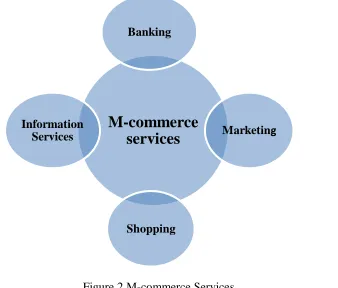
28% of Smartphone owners shop on that device. Furthermore, tablets in general are growing in Figure 2 M-commerce Services
M-commerce
services
Banking
Marketing
Shopping Information
popularity. Studies showed that in 2012, about 29% of adults owned a tablet, compared to 13%
in 2011. These factors combined have led people to envision a bright future for tablet commerce.
According to eMarketer, tablets commerce is predicted to reach $24 billion in 2013 and make up
for more than 9% of all online sales. 2014 has been a landmark year for Indian e-commerce with
billions of dollars invested across top commerce players. Most of this investment has gone into
the development of infrastructure, marketing & manpower. Interestingly, most of the market ing
money is being spent to grow the mobile base. Smartphones and "Mobile Only" Internet users
are growing rapidly and India is expecting to double its base of Smartphone and mobile internet
subscribers by the end of 2015.
6. Conclusion:
Mobile commerce is an interesting and challenging area of research and development
M-commerce applications and wireless devices are growing rapidly, with the help of m-M-commerce
anyone can get the knowledge of whole world on their Smartphone, can access and manage their
bank accounts,save time, entrainment, health care, education, traffic problems and travelling and
ticketing are some of the areas where commerce giving benefits in our lives. The future of
m-commerce is very bright but there is some need to increase the development in specific area like
secure transaction, better shopping experience and enhanced graphics to increase the m
References:
1. U. Varshney, Mobile commerce: Applications and technologies, A tutorial, in: ACM International Conference on Mobile Computing and Networking (MobiCom) (July 2001).
2. Matthew, J., Sarker, S., Varshney, U. (2004) “M-Commerce Services: Promises and
Challenges,” Communications of AIS, Vol. 2004 Issue 14, pp.1-11.
3. Urbaczewskj, A., Valacich, J., Jessup, L. (2003) “Mobile Commerce: Opportunities and
Challenges,” Communications of the ACM, December, Vol. 46 Issue 12, pp. 30-32.
4. Kumar, S., Zahn, C. (2003) “Mobile communications: evolution and impact on business
operations,” Technovation, June, Vol. 23 Issue 6, pp. 515-520.
5. Coursaris, C., Hassan in, K. (2002) “Understanding M-Commerce,” Quarterly Journal of
Electronic Commerce, Vol. 3 Issue 3, pp. 247-271.
6. U. Varshney, R. Vetter, Mobile commerce: framework, applications and networking support, Mobile Networks and Applications 7 (3) (2002) 185– 198.
7. J.A. Senn, The emergence of m-commerce, Computer 33 (12) (2000) 148– 150.
8. Kumar, D. (2009). Mobile Commerce, Managing Director Rose India Technologies Pvt. Ltd.
9. Kumar, S., & Zhan, C. (2003). Mobile communications: evolution and impact on business operations, Technovation, June, Vol. 23 Issue 6, pp. 515-520.
10. Sanjay K. S. (2007). the diffusion of mobile commerce in India, Department of Humanities and Social Sciences, Indian Institute of Technology, Kanpur.
11. Sharma, D. (2009). Government Policies & Regulations: Impact on Mobile Commerce in Indian Context, Indian Broadcasting (Engineering) Services, Government of India.
12. Stafford, T., Gillenson, M. (2003). Mobile Commerce: What It Is and What It Could Be, Communications of the ACM, December, Vol. 46 Issue 12, pp. 33-34.
13. Sadeh, N., M-Commerce: Technologies, Services, and Business Models. New York: John Wiley & Sons, 2002.
14. Okazaki S(2005) : New Perspectives on M-commerce Research. Published in Journal of Electronic Commerce Research, VOL. 6, NO.3, 2005 Page 161
15. S.J. Barnes, B. Corbitt, Mobile banking: concept and potential, International Journal of Mobile Communications 1 (3) (2003) 273– 288.
16. www.wikipedia.org/wiki/Mobile_commerce.
![Figure 1 M-commerce Frame work [Varshney 2002]](https://thumb-us.123doks.com/thumbv2/123dok_us/8605557.1395265/3.612.114.473.108.356/figure-m-commerce-frame-work-varshney.webp)