Available online: https://edupediapublications.org/journals/index.php/IJR/ P a g e | 1514
RILT Mechanism Based Impulse Detection for Data Mining Applications
G.V.R.K Alekya Devi1, G. Uday Kumar2, B.Naresh3
1 B. Tech Scholar, Department of Computer Science Engineering, Siddhartha Institute of Engineering and
Technology, Vinobha Nagar, Ibrahimpatnam, Hyderabad, Telangana 501506.
2 Department of Computer Science Engineering, Siddhartha Institute of Engineering and Technology, Vinobha
Nagar, Ibrahimpatnam, Hyderabad, Telangana 501506.
3 Department of Computer Science Engineering, Siddhartha Institute of Engineering and Technology, Vinobha
Nagar, Ibrahimpatnam, Hyderabad, Telangana 501506.
Abstract: Idea impulsion is a fundamental issue for any data examination circumstance including momentarily asked for data. In prescient investigation and machine taking in, the idea impulsion implies that the quantifiable properties of the goal variable, which the model is trying to foresee, change after some time in unforeseen ways. This causes issues in light of the way that the desires end up being less exact over the long time. The term idea alludes to the sum to be shown. In the latest decade Process mining developed as a strategy that utilizes the logs of information course of action with an explicit ultimate objective to mine, separate and update the methodology estimation. Idea impulsion in the process is restricted by applying factual theory testing strategies. The proposed strategy is tried and endorsed on few of the reality and counterfeit process logs, results about procured are promising toward successfully limiting the sudden methodology impulsion in process-log, results got are promising toward proficiently restricting the sudden idea impulsion in process-log. We present the principal online instrument for identifying and overseeing idea impulsion, which depends on conceptual understanding and successive examining, together with late learning systems on information streams. We propose a Semi-regulated order calculation for information streams with Revenant idea Impulsion and Limited Tagged
information, called RILT, in which, a choice tree is received as the arrangement display. The found procedure models can be utilized for an assortment of examination purposes. At long last, we examined the difficulties, diverse process mining calculations, arrangement of process mining methods.
I. INTRODUCTION
Available online: https://edupediapublications.org/journals/index.php/IJR/ P a g e | 1515
change their working methodology. It is apparent that the financial accomplishment of an association is increasingly reliant on its capacity to respond and adjust to changes in its working condition. As such, versatility and changes has been analyzed start to finish with respect to business process administration (BPA). For example, process-aware data systems (PADSs) [4] have been extended to have the ability to flexibility acclimate to changes at the same time. Best in class work flow administration (WFM) and BPA structures [5] give such flexibility. Also, in structures not driven by WFM/BPM structures, (for instance, the use of therapeutic frameworks) there is significantly more adaptability as strategies is controlled by people rather than information frameworks. A critical number of the present information frameworks are recording a lot of event logs. Process mining is a modestly new research strategy went for finding, watching, and improving authentic strategies by expelling gaining from event logs [6]. Despite the fact that adaptability and change have been considered top to bottom with regards to WFM and BPA systems, contemporary process mining methods accept the procedures to be in a consistent state. For instance, while finding a procedure show from occasion logs, it is expected that the procedure toward the start of the recorded period is the same as the procedure toward the finish of the recorded period. Using ProM, we have analyzed processes in more than 100 organizations. These practical experiences show that it is very unrealistic to assume that the process being studied is in a steady state. As mentioned earlier, processes may change to adapt to changing circumstances. Theory cluster refers to the circumstance in which the procedure is changing while at the same time being investigated. There is a requirement for strategies that arrangement with such second-arrange flow.
Breaking down such changes is of most extreme significance when supporting or enhancing operational procedures and to acquire an exact understanding on process executions at any moment of time. When managing theory clusters in process mining, the accompanying three fundamental difficulties emerge. In this paper, we concentrate on two of the difficulties: 1) change (point) recognition and change restriction and 2) characterization. We define different features and propose a framework for dealing with these two problems from a control-flow perspective. Finally, we demonstrate the guarantee of the systems proposed in this paper on a real-life contextual investigation from a substantial government e-market in India.
II. RELATED WORK
Available online: https://edupediapublications.org/journals/index.php/IJR/ P a g e | 1516
the earliest opportunity; 2) to recognize clusters from once-off interference and adjust to changes, however be strong to disturbance; and 3) to work in under information arrival time and utilize constrained memory for capacity. In this setting, numerous versatile calculations have been created (e.g., overviews [11], [12]). Throughout the latest two decades various examiners have been wearing down process versatility. In [13] and [14] accumulations of normal change designs are depicted. In [15] and [16] expansive logical orders of the distinctive versatility philosophies and segments are given. Ploesser et al. [17] have portrayed business process changes into three general orders: 1) sudden; 2) eager; and 3) change. This characterization is utilized as a part of this paper, however now with regards to occasion logs. Despite the many publications on flexibility, most process mining techniques assume a process to be in a steady state. A notable exception is the approach in [18].
This approach uses process mining to provide an aggregated overview of all changes that have happened so far. This approach, in any case, assumes that change logs are accessible, i.e., adjustments of the work flow display are recorded. Now at this time, very less data systems give such change logs. Subsequently, this paper concentrates on theory cluster in process mining accepting just an occasion log as information. The theme of theory cluster is very much concentrated in different branches of the information mining and machine learning group. Theory cluster has been examined in both managed and unsupervised settings and has been appeared to be essential in numerous applications [10], [12], [19]– [22]. The problem of concept drift, however, has not been considered in the process mining setting. Not at all like in information mining and machine realizing, where theory cluster concentrates on changes in basic
structures, for example, factors, theory cluster in process mining manages changes to complex artifacts,
for example, process models depicting
simultaneousness, decisions, circles, and cancelation. In spite of the fact that encounters from information mining and machine learning can be utilized to research theory cluster in process mining, the complicity of process models and the idea of process change pose new difficulties. This paper expands the work introduced in [10]. In this extended paper, we present the point of theory cluster in process mining and present the essential thought and the highlights catching the qualities of follows in an occasion sign in a more thorough way. In addition, this extended paper gives a universal structure to taking care of theory clusters in process mining and shows subtle elements on the acknowledgment of the approach in the ProM system. Furthermore, this paper reports new experimental results of the proposed approach. More specifically, in this extended paper, we study the influence of population size on change point detection and the applicability of the approach in dealing with gradual drifts.
Available online: https://edupediapublications.org/journals/index.php/IJR/ P a g e | 1517
consider features characterizing the traces and 2) this system is appropriate just for change location though our structure is pertinent for both change (point) recognition and change restriction.
Furthermore, the tool support provided by the authors has some limitations in its applicability. The tool does not detect change points and does not work on logs with multiple process changes, i.e., it does not detect the presence/absence of multiple changes and does not report when (the trace index) process changes have happened. The tool just reports that a change exists and terminates (if changes exist) and does not terminate if no changes exist. In contrast, our tool can handle multiple process changes and can detect both the presence of and the points of change in addition to being able to assist in change localization.
III.PROPOSED SYSTEM
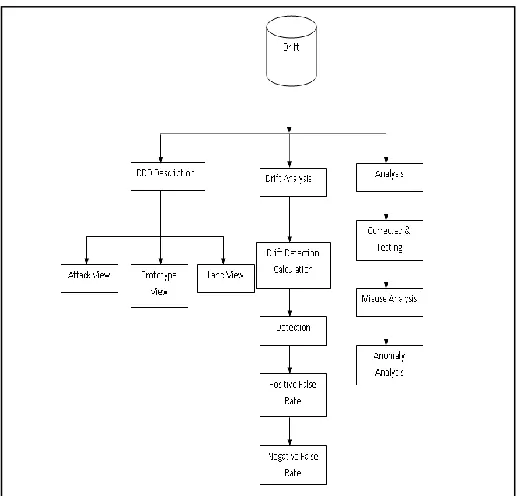
Proposed calculation to be displayed in this segment means to deal with revenant idea impulsing information streams with unlabeled information the preparing stream of RILT with the approaching of gushing information untagged information are labeled at leaves utilizing a grouping methodology and the data of untagged information is reused for the developing of the tree the revenant idea impulsing discovery is introduced utilizing idea bunches kept up at leaves to dodge the space flood over-fitting with the consistently developing of the tree, a pruning component is received when achieving a period Lastly to follow the execution of the present characterization demonstrate, forecast results are assessed intermittently in the Prequential estimation Technique subtle elements engaged with this handling.
RILT Algorithm
Input: A Stream of instances=I ; Minimum number of split examples = nmin ; period of detection = PD ; period of pruning = PP ; output period increment = OP
Output: Classification Error
Procedure RILT {I, nmin, PD, PP, OP}
To exploit untagged data, we adopt k-Means to create concept clusters and implement tagging, because k-Means is a simple and efficient clustering algorithm for numerical attributes. The clustering algorithm will be activated if there are new labeled information at the present leaf Based on these created concept groups the greater part class technique is utilized to label untagged information.
Step 1: Create a tree ‘T’ with number of leafs ‘l’; Step 2: for each instance-e∈E;
Step 3: store the correspoding information by soritng ‘e’ into an available leaf ‘l’;
Step 4: if the arrived imstances count at ‘l’ meets nmin
Step 5: Tag the untagged instances at leaf ‘l’ in k-Means; Step 6: Install a split test and grow children leaves; Step 7: if arrived number of instances % PD==0
Step 8: Detect revenant concept impulsion using history concept clusters ad new ones;
Step 9: If number of instances arrived % PP==0
Step 10: Install the bottom-up search and pune subtrees regarding the classification error;
Step 11: If number of instances arrived % OP==0
Available online: https://edupediapublications.org/journals/index.php/IJR/ P a g e | 1518
Figure 1: Proposed System Architecture
A. Clustering Algorithms based Concept
impulsion/Drift
Use clustering for detecting concept drifts every trace is converted to a vector of maximal repeats. As characterized a maximal repetition in a sequence s is characterized as a subsequence that happens in a maximal combine. A maximal match in an arrangement s is a subsequence shows in s at two particular positions and with the end goal that the component to the quick left (ideal) of the appearance of position is not the same as the component to one side (ideal) of the indication. The time dimension is further added to each vector. Agglomerative Hierarchical Clustering (AHC) with the base fluctuation standard is utilized as the bunching calculation. There is no openly accessible usage of the calculation to test or incorporate. Three fairly basic manufactured cases were utilized to test the calculation the deliberate metric was the exactness of clustering. Their algorithm had assigned the traces to correct clusters in 70% to 100% cases.
B. Adaptive Windows
The calculation is exceedingly subject to the picked population capacity. If this parameter is too little then the plot can contain a great deal of disturbance therefore either the noise can be misconstrued as theory clusters will be left undetected between arbitrary troughs where theory clusters. If the population estimate turns out to be too huge then the time complicity of the calculations declines and a few clusters may end up plainly undetected.
Simulation Verification
Algorithm 1 Change Point Detection
1: Let 𝑃1and 𝑃2 be the two populations where we have detected a
change (i.e., its hypothesis test’s p-value<𝑝̂).
2: Split the two populations 𝑃1and 𝑃2 into halves, 𝑃11and 𝑃12 for
𝑃1and 𝑃21and 𝑃22 for 𝑃2.
3: Apply hypothesis tests on the left (𝑃11 and 𝑃12), center (𝑃12
and 𝑃21), and right (𝑃21and 𝑃22) population pairs illustrated. Let
𝑝𝑙𝑒𝑓𝑡, 𝑝𝑐𝑒𝑛𝑡𝑒𝑟, 𝑎𝑛𝑑 𝑝𝑟𝑖𝑔ℎ𝑡 be their respective p-values.
4: Let 𝑝𝑚𝑖𝑛= min {𝑝𝑙𝑒𝑓𝑡, 𝑝𝑐𝑒𝑛𝑡𝑒𝑟, 𝑝𝑟𝑖𝑔ℎ𝑡}. Let 𝑃𝑚𝑖𝑛1 and 𝑃𝑚𝑖𝑛2 be
the corresponding populations of 𝑝𝑚𝑖𝑛.
5: If 𝑝𝑚𝑖𝑛<𝑝̂, set 𝑃1=𝑃𝑚𝑖𝑛1 and 𝑃2=𝑃𝑚𝑖𝑛2 , goto step 1, else return
the index/time point corresponding to the trace at end of 𝑃𝑚𝑖𝑛1 as
Available online: https://edupediapublications.org/journals/index.php/IJR/ P a g e | 1519
The experiments demonstrate that the features and the framework proposed in this paper for handling concept impulsions show significant promise in detecting behavioral changes by analyzing event logs.
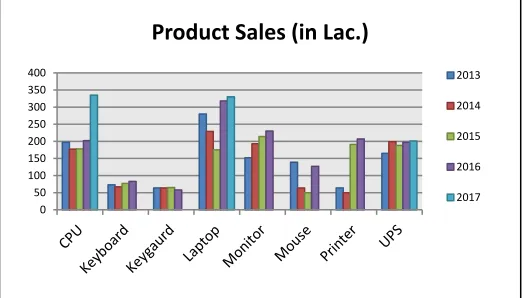
Figure 8: Product mining analysis
To simulate the concept impulsion process in data mining, we created the data log consisting of various electrical appliances from the government e-market place in India for the duration of 5 years i.e., from
2013 to 2017 years, which equals 60 logs. Total number of products considered here is 8. We had shown that the mining classification with concept impulsion with the red zone, which indicates that the sudden change occurs in product selling i.e., gradual
increment or decrements to assess the
product monthly and yearly review.
CONCLUSIONS AND FUTURE WORK
In this paper, we have exhibited the purpose of hypothesis impulsion in process mining, i.e., examining process changes in perspective of event logs. We proposed include sets and methods to adequately recognize the adjustments in occasion logs and distinguish the districts of progress in a procedure. Our underlying outcomes demonstrate that heterogeneity of cases emerging in light of process changes can be viably managed by recognizing impulsions. When change focuses are identified, the occasion log can be apportioned and broke down. This is the initial phase toward managing changes in any procedure checking and investigation endeavors. We have considered changes just as for the control flow viewpoint showed as sudden and slow impulsions.
1) Change-design specific highlights: In this, we displayed extremely conventional highlights (in view of pursues/goes before connection). These highlights are neither finished nor adequate to recognize all classes of changes. An imperative heading of research is to define highlights taking into account diverse classes of changes and to explore their viability. A scientific classification/classification of progress designs and the fitting highlights for recognizing changes as for those examples are required.
2) Holistic methodologies: In this, we considered about contemplations on change acknowledgment and
Algorithm 2 Change Detection using Adaptive Windows
Require: a minimum population size 𝑤𝑚𝑖𝑛, a maximum population
size 𝑤𝑚𝑎𝑥, p-value threshold 𝑝̂, a step size k, and a data stream of
values D
1: let 𝑃𝑙𝑒𝑓𝑡 and 𝑃𝑟𝑖𝑔ℎ𝑡 be two populations of size 𝑤𝑚𝑖𝑛 with 𝑃𝑟𝑖𝑔ℎ𝑡
starting at the first index after the end of 𝑃𝑙𝑒𝑓𝑡
2: repeat
3: Apply hypothesis test over 𝑃𝑙𝑒𝑓𝑡 and 𝑃𝑟𝑖𝑔ℎ𝑡. Let p be its p-value
4: if p< 𝑝̂ then
5: identify the change point within 𝑃𝑙𝑒𝑓𝑡 and 𝑃𝑟𝑖𝑔ℎ𝑡 using
Algorithm 1
6: create two new populations 𝑃𝑙𝑒𝑓𝑡, and 𝑃𝑟𝑖𝑔ℎ𝑡, of size 𝑤𝑚𝑖𝑛 with
𝑃𝑙𝑒𝑓𝑡, starting at the first index after the end of 𝑃𝑟𝑖𝑔ℎ𝑡 and 𝑃𝑟𝑖𝑔ℎ𝑡,
starting at the first index after the end of 𝑃𝑙𝑒𝑓𝑡, . Set 𝑃𝑙𝑒𝑓𝑡= 𝑃𝑙𝑒𝑓𝑡,
and 𝑃𝑟𝑖𝑔ℎ𝑡= 𝑃𝑟𝑖𝑔ℎ𝑡 ,
. 7: else
8: Extend the left and right populations by step size k. Reassign the right population to start at the first index after the end of the extend left population 𝑃𝑙𝑒𝑓𝑡.
9: if the size of the population is ≥ 𝑤𝑚𝑎𝑥 then discard the left
population 𝑃𝑙𝑒𝑓𝑡. Split the right population 𝑃𝑟𝑖𝑔ℎ𝑡 into two halves
and use them as the left and right populations. 10: end if
11: end if
12: until the end of 𝑃𝑟𝑖𝑔ℎ𝑡 doesn’t reach the end of D
0 50 100 150 200 250 300 350 400
Product Sales (in Lac.)
2013
2014
2015
2016
Available online: https://edupediapublications.org/journals/index.php/IJR/ P a g e | 1520
confinement with respect to sudden and constant changes to the control-stream perspective of a technique. The information and asset points of view are likewise, be that as it may, similarly vital. Highlights and methods that can empower the location of changes in these different points of view should be found. Moreover, there could be examples where in excess of one point of view (e.g., both control and asset) change at the same time. Cross breed approaches thinking about all parts of progress comprehensively should be created.
3) Recurring impulsions: When managing repeating impulsions, notwithstanding change point discovery and change restriction, it is essential to distinguish the variant(s) that repeat. This requires strong measurements to survey the similitude between process variations or potentially occasion logs.
REFERENCES
[1] (2010). All-in-one Permit for Physical Aspects: (Omgevingsvergunning) in a Nutshell
[2] United States Code. (2002, Jul.). Sarbanes-Oxley Act of 2002, PL 107-204, 116 Stat 745
[3] W. M. P. van der Aalst, M. Rosemann, and M. Dumas, “Deadline-based escalation in process-aware information systems,” Decision Support Syst., vol. 43, no. 2, pp. 492–511, 2011.
[4] M. Dumas, W. M. P. van der Aalst, and A. H. M. Ter Hofstede, ProcessAware Information Systems: Bridging People and Software Through Process Technology. New York, NY, USA: Wiley, 2005.
[5] W. M. P. van der Aalst and K. M. van Hee, Workflow Management: Models, Methods, and Systems. Cambridge, MA, USA: MIT Press, 2004.
[6] W.M.P.vanderAalst,Process Mining: Discovery, Conformance and Enhancement of Business
Processes. NewYork, NY, USA:SpringerVerlag, 2011.
[7] F. Daniel, S. Dustdar, and K. Barkaoui, “Process mining manifesto,” in BPM 2011 Workshops, vol. 99. New York, NY, USA: Springer-Verlag, 2011, pp. 169–194.
[8] R. P. J. C. Bose, W. M. P. van der Aalst, I. Žliobait˙e, and M. Pechenizkiy, “Handling concept drift in process mining,” in Proc. Int. CAiSE, 2011, pp. 391–405.
[9] J. Carmona and R. Gavaldà, “Online techniques for dealing with concept drift in process mining,” in Proc. Int. Conf. IDA, 2012, pp. 90–102. [10] J. Schlimmer and R. Granger, “Beyond
incremental processing: Tracking concept drift,” in Proc. 15th Nat. Conf. Artif. Intell., vol. 1. 1986, pp. 502–507.
[11] A. Bifet and R. Kirkby. (2011). Data Stream Mining: A Practical Approach, University of Waikato, Waikato, New Zealand [Online]. Available:
http://www.cs.waikato.ac.nz/~abifet/MOA/Strea mMining.pdf
[12] I. Žliobait˙e, “Learning under concept drift: An Overview,” CoRR, vol. abs/1010.4784, 2010
[Online]. Available:
http://arxiv.org/abs/1010.4784
[13] N. Mulyar, “Patterns for process-aware information systems: An approach based on colored Petri nets,” Ph.D. dissertation, Dept. Comput. Sci., Univ. Technol., Eindhoven, The Netherlands, 2009.
[14] B. Weber, S. Rinderle, and M. Reichert, “Change patterns and change support features in process-aware information systems,” in Proc. 19th Int., 2007, pp. 574–588.
Available online: https://edupediapublications.org/journals/index.php/IJR/ P a g e | 1521
[16] H. Schonenberg, R. Mans, N. Russell, N. Mulyar, and W. M. P. van der Aalst, “Process flexibility: A survey of contemporary approaches,” in Proc. Adv. Enterprise Eng. I, 2008, pp. 16–30.
[17] K. Ploesser, J. C. Recker, and M. Rosemann, “Towards a classification and lifecycle of business process change,” in Proc. BPMDS, vol. 8. 2008, pp. 1–9.
[18] C. W. Günther, S. Rinderle-Ma, M. Reichert, and W. M. P. van der Aalst, “Using process mining to learn from process changes in evolutionary systems,” Int. J. Business Process Integr. Manag., vol. 3, no. 1, pp. 61–78, 2008.
[19] M. van Leeuwen and A. Siebes,
“StreamKrimp: Detecting change in data streams,” in Proc. Mach. Learn. Knowl. Discovery Databases, 2008, pp. 672–687.
[20] I. Žliobait˙e and M. Pechenizkiy. (2010). Handling Concept Drift in Information Systems
[Online]. Available:
http://sites.google.com/site/zliobaite/CD_applicat ions_2010.pdf
[21] H. Wang, W. Fan, P. S. Yu, and J. Han, “Mining concept-drifting data streams using ensemble classifiers,” in Proc. 9th ACM SIGKDD Int. Conf. Knowl. Discovery Data Mining. 2003, pp. 226–235.
[22] D. Brzezinski and J. Stefanowski, “Reacting to different types of concept drift: The accuracy updated ensemble algorithm,” IEEE Trans. Neural Netw.Learn.Syst., Apr. 2013.
G.V.R.K Alekya Devi is a student of b.tech fourth year in Computer science from Siddhartha Institute of Engineering and Technology. Her subjects of interest are Data Mining and Cloud Computing.
G.Uday Kumar, M.Tech, working as Asst. Prof at CSE Dept in Siddhartha Institute of Engineering and Technology, Ibrahimpatnam. His area of interest is Design Patterns, Operating System, Software Project Management, Computer Organization and Cloud Computing
B.Naresh , M.Tech, working as Asst. Prof at CSE Dept in Siddhartha Institute of Engineering and Technology, Ibrahimpatnam. His area of interest is
Database Management System ,Computer