Electronic Thesis and Dissertation Repository
6-25-2014 12:00 AM
The Relationship between Implicit and Explicit Processing in
The Relationship between Implicit and Explicit Processing in
Statistical Language Learning
Statistical Language Learning
Nicolette B. Noonan
The University of Western Ontario
Supervisor Dr. Lisa Archibald
The University of Western Ontario
Graduate Program in Health and Rehabilitation Sciences
A thesis submitted in partial fulfillment of the requirements for the degree in Master of Science © Nicolette B. Noonan 2014
Follow this and additional works at: https://ir.lib.uwo.ca/etd
Part of the Cognition and Perception Commons, Cognitive Psychology Commons, and the First and Second Language Acquisition Commons
Recommended Citation Recommended Citation
Noonan, Nicolette B., "The Relationship between Implicit and Explicit Processing in Statistical Language Learning" (2014). Electronic Thesis and Dissertation Repository. 2130.
https://ir.lib.uwo.ca/etd/2130
This Dissertation/Thesis is brought to you for free and open access by Scholarship@Western. It has been accepted for inclusion in Electronic Thesis and Dissertation Repository by an authorized administrator of
(Thesis format: Monograph)
by
Nicolette B. Noonan
Graduate Program in Health and Rehabilitation Sciences
A thesis submitted in partial fulfillment of the requirements for the degree of
Master of Science (Speech and Language Science)
The School of Graduate and Postdoctoral Studies The University of Western Ontario
London, Ontario, Canada
© Nicolette B. Noonan 2014
ii
Abstract
Statistical language learning is an implicit process wherein language learners track sequential
statistics in fluent speech, and may it facilitate the learning of word boundaries. This process
is well studied, however, the cognitive mechanisms supporting it remain poorly understood.
The present thesis investigated whether domain-specific or cross-domain explicit working
memory engagement would impair implicit statistical learning of word boundaries in fluent
speech. Participants (n = 110) were exposed to an implicit statistical word segmentation
paradigm while concurrently engaged in no other task (control), or an explicit
domain-specific (verbal) or cross-domain (visuospatial) working memory task of either low- or
high-demand. Participants in the control task and either visuospatial task (low- and high-demand)
reliably segmented words from the artificial language, however those in either verbal
working memory condition (low- and high-demand) did not. These findings suggest an
interference effect on implicit verbal learning by explicit processing of material from the
same domain.
Keywords
Statistical language learning, language learning, word segmentation, implicit learning,
iii
Acknowledgements
The completion of this thesis comes with a great appreciation to those who have helped me along the way. I would first like to thank my advisor, Dr. Lisa Archibald, for being a tremendous mentor. She has helped me to grow as a researcher, a writer, and a scientist. I am looking forward to the next four years with Dr. Archibald, and all of the LWM Lab. I am truly grateful to work with such a wonderful group of researchers and tea
enthusiasts.
I would like to thank my advisory committee, Dr. Andrew Johnson and Dr. Paul Minda, for their advice in designing the experiment. This project truly reflects the strengths of a cross-domain influence from both speech and language sciences and psychology.
iv
Table of Contents
Abstract ... ii!
Acknowledgements ... iii!
Table of Contents ... iv!
List of Tables ... vi!
List of Figures ... vii!
List of Appendices ... viii!
Introduction ... 1!
Statistical learning of language ... 2!
What cognitive processes support statistical learning? ... 8!
Domain-specificity in statistical language learning ... 17!
The present study ... 19!
Method ... 20!
Participants ... 20!
Procedure ... 21!
Listening phase: Artificial language exposure. ... 22!
Concurrent working memory tasks. ... 24!
Test phase. ... 27!
Data Analysis ... 28!
Results ... 29!
Assessing the impact of task domain of an explicit task ... 30!
Assessing the impact of task load of an explicit task ... 31!
Further investigation of marginally significant results ... 32!
Analyzing working memory task scores ... 33!
v
References ... 43!
Appendix A: Scripts of Task Instructions (All Conditions) ... 50!
Appendix B: Ethics Approval ... 64!
vi
List of Tables
Table 1. Labeled planned simple contrasts with contrast coefficients from a one-way
ANOVA comparing experimental groups to controls………...……….…29
Table 2. Means and effect sizes of word identification scores for each experimental group
and controls……….31
Table 3. Descriptive statistics for working memory d’ scores with means and standard
vii
List of Figures
Figure 1. Schematic diagram of events in all task conditions. ... 25!
Figure 2. Boxplot of word identification test scores for experimental groups and controls ... 33!
viii
List of Appendices
Appendix A: Scripts of Task Instructions (All Conditions)………51
Appendix B: Ethics Approval……….65
Introduction
One of the hallmarks of human cognition is the ability to rapidly learn our
complex system of language without instruction and seemingly, without much effort. It is
proposed that the language learner undertakes this task via a process of statistical
language learning, wherein learners implicitly track the statistically predictable
regularities inherently present within language (Chun & Jiang, 2003; Conway &
Christiansen, 2006; Fiser & Aslin, 2001; Thiessen, Kronstein, & Hufnagle, 2013;
Turk-Browne, Jungé, & Scholl, 2005). Implicit statistical learning may be especially important
in early word segmentation (Saffran, Aslin, & Newport, 1996). What remains poorly
understood, however, are the cognitive mechanisms that support implicit statistical
learning. One growing area of interest (Ludden & Gupta, 2000; Saffran, Newport, Aslin,
Tunick, & Barrueco, 1997; Toro, Sinnett, & Soto-Faraco 2005) requiring more
systematic investigation is the extent to which implicit learning may be supported by
explicit cognitive processes such as working memory, a resource suggested to be
important in complex learning and word learning in particular (Baddeley, Gathercole, &
Papagno, 1988; Gathercole, 2006). The question of domain-specific effects in statistical
learning also requires further study. Findings of statistical learning of both phonological
and nonphonological patterns have led to the suggestion that statistical learning is a
domain-general mechanism (Evans, Saffran, & Robe-Torres 2009; Fiser & Aslin, 2001;
Kirkham, Slemmer, & Johnson, 2002; Reber, 1967), although domain-specific
interference effects may be possible depending on the stimuli. The purpose of the present
by systematically imposing concurrent explicit working memory demands involving
either same- (verbal) or cross-domain (visuospatial) stimuli.
Statistical learning of language
In the most general sense, statistical learning can be defined as the “discovery of
patterns in the input” (Reber, 1967). Natural languages are composed of statistically
reliable distributional patterns (Bloomfield, 1933; Harris, 1951). Indeed, some of the
earliest investigations of implicit learning demonstrated that learners exposed to an
artificial grammar string could learn the lawfulness of the stimuli without explicit
awareness or instruction (Reber, 1967). More recent research has demonstrated that
infant language learners are able to exploit statistical regularities of syllables within
words in order to segment words from fluent speech (Saffran, Aslin, et al., 1996). It is not
surprising then, that growing attention has been paid to the idea that language is
supported by a statistical learning mechanism (Altmann, 2002; Conway & Christiansen,
2005; Conway & Pisoni, 2008; Gupta & Dell, 1999; Kirkham, Slemmer, Richardson, &
Johnson, 2007; Kuhl, 2004; Pothos, 2007; Reber, 1967; Saffran, 2003; Turk-Browne et
al., 2005; Ullman, 2004). Indeed, the evidence demonstrates that implicit statistical
learning is important for word segmentation (Echols, Crowhurst, & Childers, 1997;
Goodsitt, Morgan, & Kuhl, 1993; Johnson & Jusczyk, 2001; Saffran et al., 1996), word
learning (Graf Estes, Evans, Alibali, & Saffran, 2007; Mirman, Magnuson, Graf Estes, &
Dixon, 2008; Saffran, 2001), learning phonemic contrasts (Maye, Werker, & Gerken,
2002), learning phonological patterns (Saffran & Thiessen, 2003), the acquisition of
Ullman, 2004), and simultaneous word segmentation and syntax acquisition (Saffran &
Wilson, 2003).
One of the first puzzles facing the language learner is uncovering the boundaries
between words in fluent speech. Unlike written language, spoken language does not
contain neat “white space” in between words to help learners segment words. Segmenting
words from fluent speech is a complicated task as there are multiple opposing cues within
spoken language that may demarcate word boundaries such as prosodic cues (Christophe,
Dupoux, Bertoncini, & Mehler, 1994; Cutler, 1994; Cutler & Norris, 1988), stress
patterns (Echols, 1993; Echols & Newport, 1992, Jusczyk, Houston, & Newsome, 1999),
and speakers’ tendency to rarely pause between words (Cole & Jakamik, 1980).
However, one cue that has been proposed to be reliable in segmenting words from fluent
speech are the statistically predictable relationships of syllables within words. The idea of
using statistical relationships between syllables to uncover words dates back to Harris
(1955), who proposed word units could be identified by uncovering correlational
relationships between individual phonemes. Later, Hayes and Clark (1970) proposed that
words could be segmented using a clustering mechanism based on correlations between
syllables.
Following this, Saffran and colleagues (Saffran, Newport, & Aslin 1996) sought
to clarify the clustering mechanism of Hayes and Clark (1970). The clustering
mechanism formalized probabilities of co-occurrence between syllables as transitional
probabilities. A transitional probability can be understood as the probability of Y given X
(Miller & Selfridge, 1950), and can be computed as:
!|!:!!"#$%#&'(!!"!!"#$!!"
A high transitional probability value indicates that the presence of X reliably predicts the
presence of Y. A low transitional probability value indicates that the presence of X does
not reliably predict the presence of Y. Using the example of the phase “pretty baby”
(/ ) as it occurs within a natural language corpus, the within-word transitional
probability of syllables could be computed as:
bi|beɪ:!!"#$%#&'(!!"!!"#$/beɪ/./bi/
!"#$%#&'(!!"!/beɪ/
Using the same example, the between-word transitional probability of syllables could be
computed as
beɪ|ti:!!"#$%#&'(!"#$%#&'(!!"!!"#$!!"!!//ti/!.ti/!/beɪ/
In this example, the value of the within-word transitional probability is higher than the
value of the between-word transitional probability. That is, the presence of / followed
by / is a more reliable relationship than /- predicting / as the word-final
syllable of pretty could be followed by an initial syllable for any number of subsequent
words, but / -/ as a word-initial syllable is followed by a limited number of syllables
(e.g.: baby, basil, bacon). Thus, the words pretty and baby could be segmented at this
between-word boundary based on transitional probabilities.
Although this approach appears computationally complex, research has
demonstrated with considerable consistency that language learners utilize transitional
probabilities to segment words from fluent speech. In one of the demonstrations of this
finding, Saffran, Newport, and Aslin (1996) examined whether participants could
segment words from an artificial language using only the transitional probabilities of
12 consonant-vowel (CV) syllables combined to create six trisyllabic words: babupu,
bypada, dutaba, patubi, pidabu, and tutibu. Because some syllables from the inventory
were reused in different words in the corpus, within-word transitional probabilities
ranged from 0.31 to 1.0. Between-word transitional probabilities were low, ranging from
0.1 to 0.2. Words were combined in random order within the language, with the
stipulation that no word was repeated. The auditory language stimuli were produced via a
speech synthesizer, and contained no other cues to word boundary such as syllable stress,
pauses, or contours. No instructions regarding the length or structure of words within the
language were given to participants. Participants listened to the language for 21 minutes.
Immediately following language exposure, participants were tested on their knowledge of
words from the language. At test, a word from the language was paired with a word foil
from the language and participants had to indicate “which of the two strings sounds more
like something you heard from the language”. Accuracy was judged as total items
correctly identified. Word foils were either part words or nonwords. Part words were
constructed by pairing a syllable pair from a word within the language, plus an additional
syllable from another word. For example, the first syllable of the word dutaba was altered
to create the part-word bitaba. Nonwords were constructed by combining three syllables
from the language that did not occur together within a word or across word boundaries,
such as in the test nonword padubu. Note that for the listener, the transitional
probabilities within padubu would be zero. Results indicated that participants performed
above chance, with a mean score of 27.2 out of a possible 36 (76% correct). This finding
simply by using the transitional probabilities of syllables with no additional cues to
segment words.
In a further study, Saffran and her colleagues (Saffran, Aslin et al. 1996)
examined this process in 8-month-old infants. Infants were exposed to an artificial
language produced by a speech synthesizer containing four trisyllabic words for two
minutes. The language contained no cues to word boundaries except for the transitional
probabilities of syllables within and between words. Using a novelty preference test,
infants demonstrated they could discriminate between words from the language and
nonwords. These results are particularly impressive as infants as young as 8 months with
only a brief familiarization phase were able to extract words from the speech stream
based on sequential statistics. Aslin and colleagues (Aslin, Saffran, & Newport, 1998)
later demonstrated that this discrimination was not based on frequency information (i.e.,
words did occur more frequently than test-item part words in the Saffran, Aslin et al.,
1996 study). Instead, infants discriminated on the basis of transitional probabilities above
and beyond frequency information. It is evident from these findings that language
learners have access to a powerful statistical learning mechanism responsive to the
statistical properties of language input.
Researchers have sought to examine when statistical learning of word boundaries
comes on line for infants. Jusczyk and Aslin (1995) demonstrated that 7.5-month-olds
were able to segment words from fluent speech, but 6-month-olds were not. After
demonstrating this ability in 6.5- to 7-month olds, Thiessen and Saffran (2003) suggested
that the ability to segment words by computing transitional probabilities might emerge
appeared to use syllable stress to segment words, while ignoring transitional probability
cues. It may be that the different strategies infants use to successfully segment words
emerge over the early stages of language acquisition, and that segmenting words using
computations of transitional probabilities may be of primary importance in the earliest
stages of language learning.
Further studies investigated whether infants grant lexical status to segmented
words. Saffran (2001) embedded newly segmented words or part-word foils in English
sentences to examine if infants demonstrated a preference for materials consistent with
their prior knowledge. Following artificial language exposure, infants preferred test
sentences containing words from the familiarized artificial language to part-word foils.
This demonstrated that the newly segmented words were more readily integrated into the
infant’s language of English. Graf Estes and collaborators (Graf Estes et al., 2007)
presented similar findings, supporting the hypothesis that infants treat newly segmented
words as lexical candidates. Here, infants were exposed to the statistical word
segmentation paradigm (Aslin et al., 1998; Saffran, Aslin, et al., 1996). The infants then
participated in a label-object association task, in which labels were words from the
speech stream or foil words. The authors found that infants preferred word labels to
nonword and part word labels, further supporting the notion that there is a connection
between word segmentation and linking words to meaning. Saffran’s (2001) and Graf
Estes’ and collaborators’ findings suggest that infants are not just learning the statistical
properties of sound sequences, but acquiring linguistic knowledge and integrating this
It is clear from the preceding review that there is mounting evidence that
statistical learning plays a role in language learning. Given this relationship, growing
interest has been focused on understanding the cognitive processes supporting statistical
learning. In particular, questions regarding possible interactions between implicit and
explicit processes, and domain-specificity have been raised.
What cognitive processes support statistical learning?
Statistical learning is considered an implicit process. However, it may be that
some minimal conscious awareness is necessary to support implicit learning. In contrast
to implicit processes, explicit processes require conscious, active, and purposeful effort
(Graf & Schacter, 1985; Reber, 1967, Schacter, 1987). For explicit learning, learners are
generating and testing hypotheses in order to adapt to changes in the environment.
Research has predominately focused on the separability of implicit and explicit learning
(Gabrieli, Fleischman, Keane, Reminger, & Morrell, 1995; Rodeiger & McDermott,
1993; Rugg, Mark, Walla, Schloerscheidt, Birch, & Allan, 1998; Schacter, 1987), but
some findings show that these two processes may interact. For example, in motor skill
learning explicit and implicit knowledge can be learned in parallel (Willingham &
Goedert-Eschmann, 1999). Furthermore, explicit knowledge becomes accessible
following implicit learning in the learning of visual scenes (Goujon, Didierjean, &
Poulet, 2013). As applied to language learning, infants’ explicit knowledge of previously
learned words can aid segmentation of subsequent words in a stream of speech
(Lew-Williams, Pelucchi, & Saffran, 2011). All of these findings point to some interaction
One theory related to statistical word segmentation that incorporates both implicit
and explicit processes is Thiessen, Kronstein and Hufnagle’s (2013) extraction and
integration framework. This is a memory-based framework of statistical learning offering
a two-process account as to how conditional relations between discrete representations
(such as words) can be learned. It is hypothesized that learners extract and store
statistically coherent units (words) within long-term memory and integrate across these
stored units within memory to identify a central tendency. The ability to extract patterns
such as candidate word forms is considered to rely on implicit learning of conditional
statistics such as transitional probabilities even before phonological cues to word
boundaries are discovered (Thiessen & Saffran, 2003). Once stored within long-term
memory, integration across word forms allows for the discovery of phonological
regularities to extract newly encountered words, such as lexical stress in English
(Thiessen & Saffran, 2007). It is possible that integration (and possibly extraction) relies
on explicit processing resources as elements in the input are only chunked together when
they are simultaneously held in attention (Perruchet, Tyler, Galland, & Peereman, 2004;
Thiessen et al., 2013).
With regards to explicit processes that may support implicit learning, two
potential candidates have been considered: Attention and working memory. Attention can
be defined as mental effort (Johnston & Dark, 1986), limited by central resources that are
shared amongst all concurrent tasks (Cowan, 1988). Attention is strongly linked to
learning generally (Nissen & Bullemer, 1987) probably because attention facilitates
processing of received stimuli. As such, at least minimal attentional focus may support
which the role of attention can be investigated in implicit learning is to examine the
negative impact on implicit learning of engaging attention in an attention-demanding
secondary task. And indeed, engaging explicit processes using attention-demanding
secondary tasks has been found to result in reduced implicit learning of artificial
grammar learning (Diens, Altman, Kwan, & Goode, 1995) and sequence learning (Nissen
& Bullemer, 1987).
Few studies have examined the relationship between implicit statistical language
learning and explicit attentional processes. Thiessen, Hill, and Saffran (2005) examined
whether infant-directed speech would help guide statistical word segmentation on the
premise that infant directed speech is more likely than adult directed speech to hold an
infant’s attention (e.g.: Werker, Pegg, & McLeod, 1994) and lead to improved memory
for segmented words (e.g.: Hertel & Rude, 1991; Rensink, O’Regan, & Clark, 2000). The
authors found that infant-directed speech had a facilitative effect on word segmentation.
One possibility is that increased attention to the stimuli improved memory for the
segmented words during the learning phase. Attentional engagement, however, was not
measured and so a possible role of attention in implicit learning is only speculative.
Indeed, Saffran and colleagues (Saffran, et al., 1997) argued against a role of attention in
implicit statistical learning based on findings that children and adults demonstrated
learning of an artificial language after 21 minutes of exposure while engaged in drawing
a picture. Nevertheless, the extent to which attention was captured by the drawing task is
unknown. As well, the study did not include a control group, making the role of attention
difficult to interpret. Results of a subsequent study by Ludden and Gupta (2000) shed
minutes of exposure to an artificial language, both groups exhibited learning of words
from the language, with greater levels of learning for the control group. Although highly
similar in design, the findings from the above studies conflict. Additionally, both face
methodological limitations. Thus, they do not offer clear evidence as to the impact of
explicit processing on implicit statistical language learning.
In their examination of the role of attention in statistical word segmentation, Toro,
and colleagues (2005) aimed to impose tasks that were more attention-demanding tasks
than in the Saffran et al. (1997) or Ludden and Gupta (2000) studies. Participants in the
Toro et al. study were exposed to an artificial language similar to the one used in Saffran
et al. Performance on word segmentation was compared across controls and those who
were engaged in a concurrent attention-demanding task, either in the auditory
(Experiments 1 and 3) or visual (Experiment 2) domain. The authors speculated that the
impact on the implicit learning task might differ based on the processing load of the
secondary task. Specifically, it was hypothesized that task-irrelevant information (i.e., the
artificial language) might undergo some processing if the demands of the secondary task
were low (Lavie, 1995; Rees, Frith, & Lavie, 2001), whereas if the secondary task is
sufficiently demanding, attentional resources may be depleted to a point where the
learning of word boundaries does not occur (Rees, Frith, & Lavie, 1997).
In Experiment 1, participants had to attend to an auditory stream and listen for
repeats in a familiar sound (e.g., car engine, door slamming, etc.). Sounds from the
auditory stream were 400-500ms in length, with a 250ms inter-stimulus interval (ISI),
giving a stimulus onset asynchrony (SOA) of 650-750ms. The authors titled this a
whereas performance for those in the high-attention load task was not significantly
different from chance (58%). A noticeable limitation within this design is that the sound
stream stimuli may have been a sensory mask for the speech stream. Thus, in Experiment
2, the authors used a high-attention load condition where participants attended to a visual
stream of pictures while concurrently being exposed to the artificial language.
Participants were to attend for and respond to repeating pictures. Pictures were presented
for 250ms for half of the subjects, and 500ms for the other half of participants, with an
ISI of 250ms. Thus, the SOA was either 500ms or 750ms with greater attention demands
imposed by the shorter SOA condition. Controls (no concurrent task) and participants in
the 750ms SOA group could successfully segment words from the speech stream above
chance levels (69% and 63% correct, respectively), whereas those in the 500ms SOA
group did not differ from chance (48% correct). In Experiment 3, the authors examined
the effect of having the distractor task within the speech stream itself. Participants in the
high-attention load group had to listen for and respond to a pitch change of 20Hz on
pseudo-randomly selected syllables within the speech stream. Here, word recognition
scores for control participants were above chance (64% correct), and the high-attention
load did not differ from chance (55% correct). From these findings, the authors
concluded that diverting attention with an attentionally demanding secondary task in
either the visual or auditory domain compromises statistical learning, especially for tasks
imposing a high processing load.
Toro et al.’s (2005) findings of reduced implicit learning when completing a
concurrent attention-demanding task imposing a high processing load raised the
learning, specifically, working memory. Working memory refers to both the storage and
manipulation of information in the current focus of attention (Baddeley & Hitch, 1974;
Cowan, 1999). According to the tripartite working memory model of Baddeley and Hitch
(1974), working memory is comprised of a domain-general central executive resource
responsible for the manipulation and processing of information necessary for the current
cognitive task, as well as two domain-specific short-term memory resources responsible
for the retention of phonological (phonological loop) or visuospatial information
(visuospatial sketchpad). The storage and processing demands of a working memory task
are thought to compete for required but limited attentional resources such that
performance is constrained by the cognitive load of the task (Barrouillet & Camos, 2001).
As a result, when cognitive load is high, fewer attentional resources can be shared for
other purposes. A plethora of research has established links between working memory
and complex cognitive tasks including learning across domains (Baddeley, Papagno, &
Vallar, 1988; Cantor & Engle, 1993; Daneman & Carpenter, 1980; Smith & DeCoster,
2000; Unsworth & Engle, 2005).
In order to examine the potential role of working memory in implicit learning,
Toro et al. (2005) examined statistical language learning after 21 minutes of exposure to
an artificial language while participants were engaged in a 2-back task. The 2-back task is
a variant of an n-back task widely considered to tap working memory (Conway, Kane,
Bunting, Hambrick, Wilhelm, & Engle, 2005; Kane & Engle, 2002). In an n-back task,
the participant is required to monitor a series of stimuli and to respond when a presented
stimulus is a match to the stimulus presented n trials previously. Subjects must
continuously dropping now irrelevant items from consideration. Verbal versions of the
task require monitoring of phonological information such as letter names whereas spatial
versions requiring monitoring of locations. The n-back task requires on-line monitoring,
updating, inhibiting, storage, and manipulation of information. Therefore, this task fits
with the definitional aspects of working memory (Baddeley & Hitch, 1974; Cowan,
1999) as involving the storage and processing of information in the current focus of
attention.
In Toro et al.’s (2005) study, participants simultaneously completing a visual
2-back task later identified words from an artificial language at a level significantly better
than chance, and equivalent with controls. Taken together with their findings of reduced
statistical language learning in the context of a attention-demanding secondary task from
the same study (Toro et al., 2005), the evidence of statistical learning while engaged in a
2-back task was suggested to indicate that attention, but not working memory, supported
implicit statistical learning.
It must be noted, however, that the attention-demanding secondary task employed
by Toro et al. (2005) involved either picture-matching or sound-matching on consecutive
stimuli. These tasks could be described as a 1-back task, where participants were required
to detect a repetition on consecutive pairs, and a 1-back task may still place a load on
working memory. Within the 1-back condition, maintenance processes are required to
hold the information within the focus of attention while two stimuli are compared.
Furthermore, there are updating processes involved with continually updating the
to-be-matched stimulus. Stimulus decision, selection, inhibition, and interference are also
processes are closely associated with working memory functions (Smith & Joindes,
1997). As well, 1-back tasks have been shown to elicit activation in areas of the
prefrontal cortex commonly associated with working memory processes (Braver, Cohen,
Nystrom, Joindes, Smith, & Noll, 1997). It may be that the picture- or sound-matching
tasks employed in the Toro et al. study, in fact, measured the influence of working
memory interference on implicit statistical language learning.
The possibility of the involvement of working memory in a statistical language
learning paradigm was further suggested by findings from a study by Evans and
colleagues (2009). Evans, Saffran, and Torres compared children with specific language
impairment (SLI) and typically developing children on their ability to segment words
using transitional probabilities of syllables from an artificial language. SLI is a relatively
common developmental impairment in which a child fails to learn language at the typical
rate, despite the absence of intelligence, hearing, or motor impairments, and with the
presence of typical educational and experiential opportunities (Leonard, 1998). Implicit
learning may be impaired in children with SLI, as made evident from learning deficits on
serial reaction time tasks (Tomblin, Mainela-Arnold, & Zhang, 2007) and artificial
grammar learning tasks (Plante, Gómez, & Gerken, 2002). Evans and colleagues
examined whether children with SLI were impaired in the implicit learning of speech or
sound information. After 21 minutes of exposure to an artificial language, children with
SLI were significantly poorer than their typically developing peers at identifying words
from the language, and that this was not correlated with age, nonverbal IQ, receptive
vocabulary, or expressive vocabulary. However, after increasing exposure to the artificial
In a similar study design, both groups were exposed to an artificial tone “language”
where tone sequences could be segmented based on transitional probabilities, similar to
words in the artificial language. The authors found that children with SLI were impaired
in this condition relative to typically developing peers after 21 and 42 minutes of
exposure, demonstrating an implicit learning deficit for the SLI group on a non-linguistic
task.
One possibility to explain the poor implicit word learning in children with SLI is
that they may not possess the necessary memory resources to form appropriately
specified phonological representations of newly learned words, whereas typically
developing children could. Furthermore, there was evidence of individual variability in
performance for children with SLI. It was suggested that individual differences in
working memory could account for these findings (Evans et al., 2009). Children with SLI
have been found to have a reduced working memory capacity relative to their peers,
specifically in the domain of verbal working memory (Archibald & Gathercole, 2006;
Ellis Weismer, Evans, & Hesketh, 1999; Montgomery 2000a, 2000b; Montgomery &
Evans, 2009). It may be that when working memory resources are insufficient as may be
the case in SLI, statistical language learning abilities are impaired.
It is clear from the preceding review that further examination of the role of
explicit processing in supporting implicit learning is warranted. In particular, the
potential role of working memory in statistical learning remains unclear. The present
thesis sought to examine this relationship systematically by evaluating the impact on
statistical language learning of working memory tasks with different cognitive loads
Domain
-specificity in statistical language learning
Implicit statistical learning is widely considered to be a domain-general learning
mechanism (Reber, 1967). Researchers have demonstrated the learning of transitional
probabilities between elements in sequence can be exhibited in multiple domains: Adults
and infants use transitional probabilities to segment tone sequences (Creel, Newport, &
Aslin, 2004; Evans et al., 2009; Saffran, Johnson, Aslin, & Newport, 1999; Saffran &
Griepentrog, 2001), visual sequences (Fiser & Aslin, 2001, 2002; Kirkham, Slemmer &
Johnson, 2002; Saffran, Pollak, Seibel, & Shkolnik, 2007; Turk-Browne et al., 2005), and
manual response sequences (Nissen & Bullemer, 1987). This variety of findings suggests
that statistical learning is a highly operational learning mechanism, and can be utilized for
learning across domains.
If we are to view statistical learning as a domain-general learning mechanism, it
could then be the case that learning is disrupted by cross-domain influences. The current
thesis examined this hypothesis as it pertains to the potential support of the explicit
processes of working memory on implicit learning. As mentioned previously, working
memory is comprised of a domain-general central executive and two domain-specific
short-term memory stores, the phonological loop and visuospatial sketchpad (Baddeley &
Hitch, 1974). If statistical language learning is reduced while engaged in an explicit
working memory task regardless of domain, then the most parsimonious explanation
would be that the domain-general central executive component of working memory
supports implicit learning. It should be noted, however, that the lack of a domain-general
effect of an explicit task would not rule out an alternate domain-general mechanism
It is important to note that the resulting knowledge from statistical learning is
stimulus-specific (Conway & Christiansen, 2006; Saffran & Thiessen, 2007). For
example, statistical language learning usually refers to the learning of phonological
forms. Although domain-specific effects have not been examined in detail in studies of
statistical language learning, domain-specific effects are documented widely for the
explicit process potentially supporting implicit memory and investigated in the current
thesis, working memory. Evidence for the domain-specificity of the short-term stores
within the working memory model (i.e., the phonological loop and the visuospatial
sketchpad) comes from tasks involving domain-specific interference effects. For
example, the recall of primary verbal material in an articulatory suppression task is
reduced when a secondary articulatory task interferes with the operations of the
phonological loop, but not when a non-articulatory secondary task is completed
(Baddeley, Lewis, & Vallar, 1984).
The phonological loop has been proposed to play a specific and important role in
the early learning of phonological word forms (Gathercole, 2006). Gathercole proposed
that initial encounters with phonological forms of novel words from verbal input are
represented within the phonological loop. These phonological representations form the
basis for a gradual process of abstracting a stable specification of the sound structure of
the novel word across repeated exposures (Brown & Hulme, 1996). It is through this
process of gradual extraction of relevant tokens that novel phonological forms become
lexicalized. Conditions that compromise the formation of initial phonological
representations (e.g., limited phonological short term memory resources) will necessarily
It is thought that information in the domain-specific phonological loop is entered
and retained in an explicit fashion, where learners have conscious access to the stored
information (Baddeley, 1986; Baddeley & Hitch, 1974). There is evidence, however, that
phonological information can access phonological storage through an implicit channel.
Consider the cocktail party effect: You are engaged in conversation in a crowded room,
and all of the speech around you is nothing more than a buzz. However, when someone
calls your name, your attention is immediately redirected (Cherry, 1953). This effect
demonstrates that we are able to access phonological information without allocating
conscious attention. Also, consider the unattended speech effect, where ignored
phonological information (both words and nonsense words) disrupts digit recall, a
phonological storage task (Salamé & Baddeley, 1982). Both of these effects illustrate that
unattended phonological material can gain obligatory access to the phonological store.
These findings leave open the possibility that phonological information is stored via a
unitary phonological storage mechanism responsible for retaining attended and
non-attended material. If this is the case, then engaging in any type of explicit phonological
task that occupies the phonological loop’s capacity may be expected to impair concurrent
implicit encoding of phonological information.
The present study
In this study, participants were exposed to in an implicit statistical word
segmentation task while concurrently engaged in an explicit working memory processing
task in the form of a computer-administrated n-back task, or were not engaged in a
concurrent task (control). The concurrent working memory task varied in whether the
monitoring of verbal or visuospatial stimuli. One goal of the study was to examine the
effect of engaging in an explicit working memory process on statistical language
learning. Reduced learning relative to the control group while engaged in any explicit
working memory task would suggest that engaging attention in any way impairs implicit
learning. On the other hand, performance dependent on the cognitive load of the task
such that concurrent tasks with higher cognitive demands result in lower learning levels
would specifically implicate working memory, and the central executive component in
particular. A second purpose of the study was to examine the domain-specific effects on
statistical learning. Findings of reduced learning when engaged in either verbal or
visuospatial concurrent tasks would indicate a domain-general effect, which, when taken
together with the cognitive load results, may further implicate the central executive
component of working memory. Domain-specific effects, on the other hand, would be
reflected in lower scores when engaged in same-domain (verbal) working memory tasks
regardless of cognitive load. Such a pattern would suggest a specific role of the
phonological loop in supporting implicit learning.
Method
Participants
Participants in the present study consisted of 110 adults (Mage = 20.22 years,
SDage= 3.35, Nmale = 30). Nineteen students were recruited from a senior-level high school
Psychology and Human Development course as part of a course project. Sixty-nine
students were recruited from the undergraduate psychology pool at Western University
from the summer undergraduate psychology pool at Western University and received
$10.00 for study completion. All subjects reported being monolingual English speakers
and had no uncorrected vision or hearing difficulties.
Procedure
Upon arrival, participants received a letter of information, signed a consent form,
and completed a short questionnaire to obtain the following demographic information:
Age, gender, first language, number of years speaking English, and presence of vision or
hearing difficulties. Testing took place in either a quiet computer testing lab (<8
participants) where the task was administered via individual PCs, or within a quiet testing
room (1 participant) where the task was administered via a laptop computer. After
completing the questionnaire, participants completed the listening phase (artificial
language exposure) of the study while engaged in one of five concurrent working
memory task conditions (no load; verbal, low load; verbal, high load; visuospatial, low
load; visuospatial, high load). Participants were quasi-randomly assigned to one of the
five conditions such that equal numbers completed each condition with no participant
factors determining group assignment. If participants were being tested in a computer
testing lab, all participants were entered into the same condition. If participants were
being tested privately, they were randomly assigned with the constraint of obtaining
matched group sizes. An attempt was made to keep group sizes approximately equal as
data collection progressed. Random draws from a group were discarded if a group was
larger than all others. Immediately following the language exposure and working memory
task completion, participants completed the test phase. Following study completion,
Listening phase: Artificial language exposure.
Artificial language stimuli. The artificial language employed in the present study
was based on the stimuli described by Saffran, Newport et al. (1996). The language
consisted of four consonants (p, t, b, d) and three vowels (a, i, u) which, when combined,
rendered an inventory of 12 CV syllables. These syllables were then combined to create
six trisyllabic “words” in an artificial language: patubi, tutibu, babupu, bupada, dutaba,
pidadi. Some syllables from the inventory occur more often within the language than
others (e.g.: bu occurs in three words, whereas ti occurs in one word). The word corpus in
the present artificial language used all 12 syllables, differing from the Saffran et al.
(1996) corpus, in which the syllable di was not included. Transitional probabilities of
syllables varied, and were higher within words (Range: 0.33 to 1.0) than across word
boundaries (Range: 0.1 to 0.2).
Recording the artificial language stimuli. Unlike Saffran et al.’s (1996) synthesized
stimuli, the artificial language in the present study was constructed from audiorecordings
of a female native-English speaker using a neutral vocal effort. Although the majority of
available evidence is based on findings from exposure to synthetic speech samples, more
recent work of Saffran and colleagues (Graf, Estes et al., 2007) and similar studies
(Lew-Williams et al., 2011; Pelucchi, Hay, & Saffran, 2009, Experiment 1) have employed
naturally produced speech and found similar effects.
Recordings were made in a double walled IAC sound booth with a pedestal
microphone (AKG C 4000B) located approximately 30cm from the speaker’s mouth and
routed to a USBPre 2 pre-amplifier (Sound Devices). Digitization was performed via
(Pioneer Hill Software, 2008). Recordings were made of each of the 12 target syllables in
the middle of a three-syllable sequence, within every coarticulation context required for
the language. For example, the syllable tu occurred in two words in the artificial
language, tutibu and patubi. For the word tutibu in the continuous artificial language
stream, the word-initial syllable tu could be preceded by the word-final syllables for the
remaining five words, bi, pu, da, ba, or di, and followed only by ti. Thus, recordings of
these six iterations were made. Alternatively, for the word patubi, the word-medial
syllable tu would be preceded only by the word-initial syllable pa and the word-final
syllable bi. Thus, recordings of this one iteration were made. Eight repetitions of each
sequence were recorded, and the token with the most neutral pitch contour and best sound
quality was chosen and uploaded into Sound Forge Audio Studio (Sony) editing software.
Creating the artificial language. Middle syllables from the recorded tokens were
extracted by identifying the final offset of vowel oscillation in the previous syllable to the
offset of vowel oscillation in the target syllable. The continuous artificial language stream
was created by concatenating the medial syllables to create random sequences of the
words. In this way, all syllables were spliced together in the same way throughout the
entire language regardless of whether the syllables were within a word or across word
boundaries. The language maintained a consistent speech rate (3.1 syllables/s) using a
time stretch and was normalized to a pitch of F0 = 196 Hz using Sound Forge Audio
Studio (Sony). There were no pauses between words. As such, there were no acoustic
cues to word boundaries. The artificial language was comprised of 490 tokens of each of
occurred twice in a row. This created 28 minutes of auditory language stimuli, divided
into four listening blocks of seven minutes each.
Listening phase procedure. The listening phase involved exposure to 28 minutes of
an artificial language divided into four 7-minute listening blocks, with 3-minute breaks in
between each block. Following Saffran, Newport, et al. (1996), participants were told
they would hear a nonsense language. No information was provided about the length or
the number of words within the language in all conditions. Those in the no load task
condition were seated in front of a computer displayed stimuli from the working memory
task, but were not instructed to attend to or perform memory operations on the working
memory stimuli. Those in a working memory task condition were instructed to complete
the working memory task, and this was highlighted to them as the primary task. This
deliberate use of vague instructions regarding the artificial language was done to
minimize the chance of participants trying to explicitly learn or “figure out” the language
during the experiment.
Concurrent working memory tasks.
Working memory task stimuli. The n-back task employed in the present study
involved presenting one of six alphabetic letters (P, G, T, K, W, C) in 72 point
sans-sheriff black font on a white background (see Figure 1). Letter case was randomized
across trials to avoid reliance on visual recognition of the letter instead of a verbal label
when required. The letter on a given trial appeared at random in 1 of 6 positions on the
screen. The positions of the letters on the screen were not centered in verbalizable spatial
pseudorandom locations. Letter name and position were counterbalanced across trials so
that each letter and position occurred with equal probability. Stimuli were presented for a
duration of 500 milliseconds (ms), with an interstimulus interval of 2500ms.
!
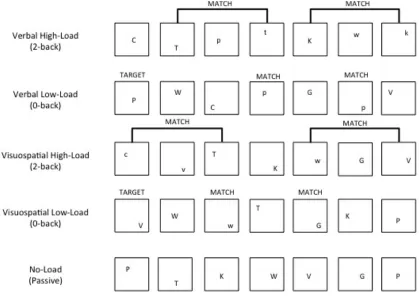
Figure 1. Schematic diagram of events in all task conditions.
Task conditions are labeled on the left-hand column. Each square represents a separate stimulus presentation within each task, as seen on a computer monitor for the participant. Stimuli were presented for 500ms, with a 2500ms blank screen in between each
presentation. Correct responses within each n-back task condition are labeled “MATCH”. Target stimuli for 0-back conditions are labeled “TARGET”.
Working memory task procedure. Participants in n-back conditions received task
instructions pertaining to their respective condition administered via E-Prime 2.08
(Schneider, Eschman, & Zuccolotto, 2002). A script of task instructions for each
condition is provided in the Appendix. Stimuli were presented via laptop computer using
conditions, while varying the type of processing and working memory requirements.
Stimuli were presented concurrently with the artificial language stimuli in four blocks of
seven minutes each. Each block contained a series of 140 trials, with matches in 30% of
trials. All participants in experimental conditions completed 30 practice trials prior to the
beginning of the task. Recall that the artificial language stimuli were presented to
participants through headphones during engagement in the n-back task or control
conditions. The n-back stimuli began immediately following the completion of the
practice trials. Artificial language stimuli began playing as presentation of the n-back
stimuli began.
The n-back task in the present study employed visuospatial and verbal material. In
visuospatial task conditions, participants were instructed to look for matches across
locations of stimuli on the screen. During instructions, the term “letter” was not used, and
all instructional examples used a red square to demonstrate spatial location. This was
done to ensure participants focused on visuospatial location and had no attachment to
verbal letter labels. In verbal task conditions, participants were instructed to look for
matches across letter names, regardless of letter case.
In 2-back conditions that imposed a heavy load on working memory, participants
had to decide if a stimulus on each trial matched a stimulus occurring two trials
previously (see Figure 1). This matching was performed on spatial locations for those in
the high-load visuospatial working memory condition, and letter names for those in the
verbal high-load working memory condition. Subjects had to update the sequence on
instructed at the start of each block to press space each time they encountered a match to
the 2-back stimulus.
In 0-back conditions that imposed a low working memory load, only the spatial
location or verbal name of the first stimulus of each block had to be remembered and
compared to subsequence stimuli. For those in a visuospatial condition, target locations at
the onset of an experimental block were indicated by a red target square. Participants
were informed of the target stimulus at the initiation of each block. Participants were
instructed at the start of each block to press space each time they encountered a match to
the target stimulus
In the No Load condition, participants saw the same sequence of stimuli that
participants in the working memory task conditions were exposed to. However, they were
not instructed to attend to or respond to the stimuli.
Test phase.
Test phase stimuli. Six nonword foils were constructed from the same 12 CV
syllables as the artificial language: pubati, tapudi, dupitu, tipabu, bidata, batipi.
Nonwords were created with the constraint that within word transitional probabilities
would be zero based on the participants’ previous artificial language exposure. Syllables
were drawn from the same recording inventory as the artificial language stimuli, with
appropriate coarticulation contexts.
Test phase procedure. Following the listening phase, participants immediately
entered the test phase delivered by E-Prime 2.08 (Schneider et al., 2002). The test format
was a two-alternative forced-choice task. Here, a word from the language was paired with
the artificial language. For each test item, participants heard two trisyllabic strings
separated by 500ms of silence. One of these strings was a word from the nonsense
language, and the other a nonword foil. The presentation of a word/nonword pair was
randomized across trials. Subjects were instructed to indicate which word “sounds more
like something you heard in the language”, and to select “A” or “L” on the keyboard to
indicate the first or second string, respectively. The instructions stayed on the screen for
the duration of the test phase. Each nonword was paired exhaustively with each word,
comprising 36 total test pairs. E-Prime 2.08 software recorded responses automatically.
Data Analysis
It must be noted that, of necessity, the present study was not fully factorial. In the
conditions involving a working memory task two factors were manipulated: Domain
(verbal; visuospatial) and load (low; high). In both cases, performance was compared to a
single control group, that is, the control group for ‘no domain’ and ‘no load’ was the
same. As such, the study did not have a full 3 (no domain, verbal, visuospatial) x 3 (no
load, low load, high load) design because the ‘no domain’ and ‘no load’ condition was
the same. As a result, a single, omnibus analysis of variance (3 x 3 ANOVA) could not be
completed on the data.
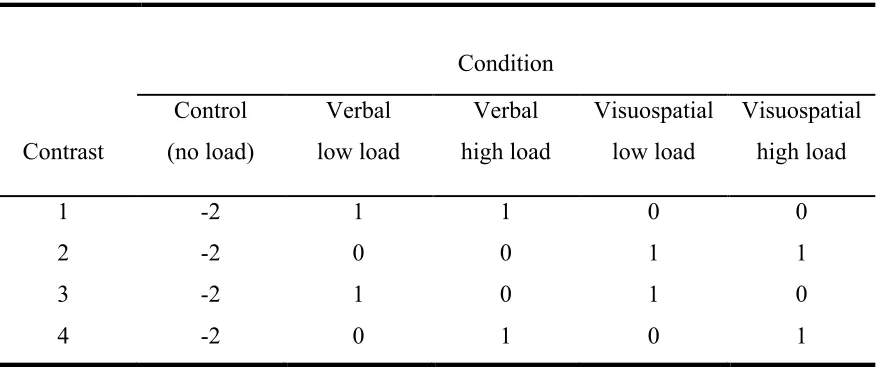
Instead, a single one-way ANOVA with a series of planned simple contrasts was
conducted to compare the mean of select experimental groups to a reference standard, the
control (no load/domain) group. Table 1 describes the contrasts that were conducted. To
examine the effect of task domain of an explicit task on implicit learning, Contrast 1
compared the groups completing a verbal task regardless of load (low load; high load) to
(low load; high load) to the control group. To examine the effect of task load of an
explicit task on implicit learning, Contrast 3 compared the groups completing a low load
task regardless of task domain (verbal; visuospatial) to the control condition, and
Contrast 4 compared the groups completing a high load task (verbal; visuospatial) to the
control group. In the case of significant results in these contrasts, comparisons between
relevant individual experimental groups (verbal, low load; verbal high load; visuospatial,
low load; visuospatial, high load) and the control group utilizing post hoc tests of least
significant difference were planned to examine mean differences between groups.!!
Table 1. Labeled planned simple contrasts with contrast coefficients from a one-way ANOVA comparing experimental groups to controls
Condition
Contrast
Control (no load)
Verbal low load
Verbal high load
Visuospatial low load
Visuospatial high load
1 -2 1 1 0 0
2 -2 0 0 1 1
3 -2 1 0 1 0
4 -2 0 1 0 1
Note. Values represent coefficient weights assigned within the regression model of each planned contrast.
Results
Recall that in the two-alternative forced-choice test, participants identified which
of two words came from the artificial language to which they had been exposed during
each group. The control group had the highest identification scores. Those in both the low
load and high load verbal task conditions had the lowest scores, while those in the low
load and high load visuospatial task conditions had scores somewhat lower than the
control group.
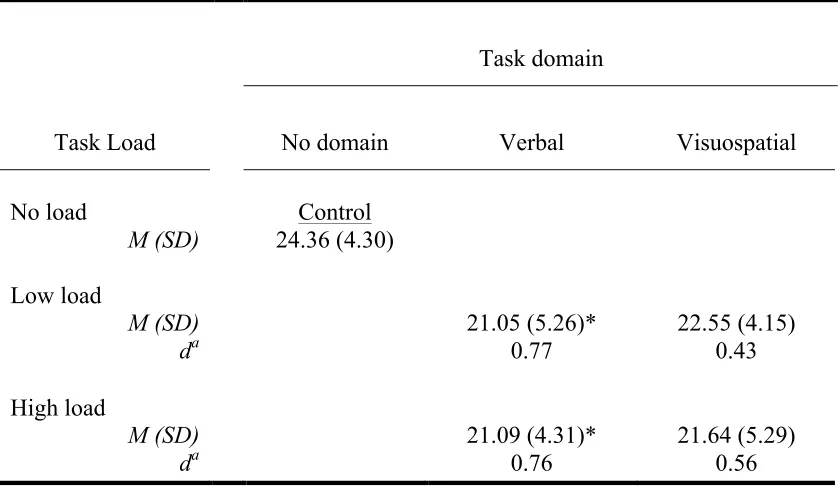
Table 2. Means and effect sizes of word identification scores for each experimental group and controls
Task domain
Task Load No domain Verbal Visuospatial
No load
M (SD)
Control 24.36 (4.30)
Low load
M (SD) da
21.05 (5.26)* 0.77
22.55 (4.15) 0.43
High load
M (SD)
da 21.09 (4.31)* 0.76 21.64 (5.29) 0.56
* p < .05
Note. n = 22 for each group; a: Cohen’s d effect size, calculated as effect size between independent experimental groups and the control group test scores.
Assessing the impact of task domain of an explicit task
The first series of simple contrasts compared word identification test scores across
task domains (control, verbal, and visuospatial) within a one-way ANOVA. Levene’s test
of homogeneity of variances was nonsignificant, F (4, 105) = 0.609, p > .05, so equal
variances were assumed when examining all contrast results. Contrast 1 comparing the
.008, indicating that those completing an explicit verbal task scored significantly lower
than the control group. Contrast 2 comparing the visuospatial (low and high load) to
controls was not significant, although results approached significance, t (1, 105) = -1.856,
p = .066, indicating that those in either visuospatial task group did not differ from
controls in their word identification scores. Results of post hoc tests on Contrast 1
revealed that those in both the verbal low load (p = .021) and the verbal high load (p =
.023) groups had significantly lower word identification scores than controls. The overall
one-way ANOVA comparing all groups was not significant, F (4, 105) = 9.917, p > .05.
Assessing the impact of task load of an explicit task
The second series of simple contrasts compared word identification test scores
across task load (control, low load, and high load). Contrast 3 comparing the low load
conditions (verbal and visuospatial) to controls was significant, t (1, 105) = -2.098, p =
.038. Post hoc analyses revealed that those in the verbal low load task had significantly
lower word identification scores than controls, p = .021. However, those in the
visuospatial low load task did not differ significantly from controls, p > .05. Contrast 4
comparing the high load conditions (verbal and visuospatial) to controls was significant, t
(1, 105) = -2.450, p = .016, indicating that those in a high load task group differed
significantly from controls. Post hoc tests revealed that those in a verbal high load task
had significantly lower word identification scores than controls, p = .023. Those in a
visuospatial high load task did not differ significantly from controls in word identification
Further investigation of marginally significant r
esults
The results clearly demonstrate significantly lower word identification scores
when participants were completing a concurrent explicit verbal task. The results for the
visuospatial and cognitive load conditions were less clear, with marginal or contrasting
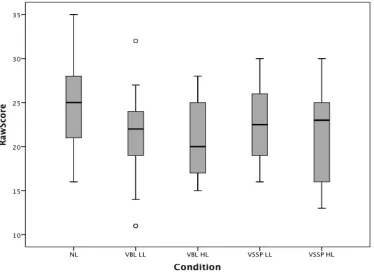
results in both cases. Figure 2 displays the boxplots for all study groups. The data were
normally distributed (skewness = -0.277 – 0.415; kurtosis = -1.436 – 0.484, all groups),
yet the verbal high-load (kurtosis = -1.438) and visuospatial high-load (kurtosis =
-1.107) groups were somewhat leptokurtic. As a result, additional evidence was sought
for the pattern of significant findings revealed in the ANOVAs by comparing mean ranks
in nonparametric analyses. Mann-Whitney U tests compared the word identification
scores for each experimental group to the control group. Results revealed significantly
lower word identification scores than controls for those completing a verbal task (low
load: U = 157.50, p < .05; high load: U = 143.50, p < .05). Those in a visuospatial
condition did not differ significantly from controls, and results did not approach
significance (low load: U = 189.00, p > .05; high load: U = 177.50, p > .05). These
results provide additional support for the nonsignificant findings in the ANOVA for the
visuospatial compared to control conditions. Regarding the significant findings in the
ANOVA for both the low and high load planned contrasts, the nonparametric analyses
confirm that these significant findings were driven by the poor performance on the verbal
!
Figure 2. Boxplot of word identification test scores for experimental groups and controls
Note. Raw scores represent total test items correct out of 36. Condition labels are as follows: NL = no load; VBL LL = verbal working memory, low load; VBL HL = verbal working memory, high load; VSSP LL = visuospatial working memory, low load; VBL HL = visuospatial working memory, high load.
Analyzing working memory task scores
In order to ensure that the working memory tasks imposed differing processing
loads as hypothesized, performance accuracy on the n-back task was compared across
groups. Performance accuracy was calculated as a d’ sensitivity score that takes into
account both hits (i.e., correctly responding when required) and false alarms (i.e.,
incorrectly responding when a response is not required) (Macmillan & Creelman. 1991).
D’ values are presented as z-scores, and can be calculated as:
Higher positive d’ z-values represent a higher proportion of hits, with a value of 0
representing chance responding. Descriptive statistics for all groups completing a
working memory task are shown in Table 3, and reveal generally higher scores for the
low load conditions. A 2 (working memory domain) x 2 (working memory load)
between-subjects ANOVA conducted on the d’ scores revealed one significant effect:
The main effect of task load was significant, F (1, 68) = 79.156, p < .001, with those in a
low-load task having higher d’ scores than those in a high-load task. The remaining
effects were not significant (task domain: F (1, 68) = .032, p > .05; interaction: F (1, 68)
= 1.874, p > .05).
Table 3. Descriptive statistics for working memory d’ scores with means and
standard deviations
Task Domain
Task Load Verbal Visuospatial Task Load M (SD)
Low Load 3.99 (0.48) 3.72 (1.14) 3.85 (0.89)
High Load 1.57 (0.85) 1.93 (1.18) 1.75 (1.03)
Task Domain M (SD) 2.47 (1.45) 2.65 (1.45)
Note. Bolded values significantly different at p < .05.
Discussion
! The present thesis aimed to investigate the cognitive processes supporting
statistical language learning by examining the influence of explicit domain-general or
this study, adults were exposed to a statistical word segmentation paradigm while
concurrently engaged in a working memory or control task. The working memory task
varied across domain and load, creating four working memory task conditions: 1) verbal
working memory, low load, 2) verbal working memory, high load, 3) visuospatial
working memory, low load, and 4) visuospatial working memory, high load. After 28
minutes of exposure to an artificial language, word recognition abilities were analyzed
and compared across working memory task groups. As expected, those in the control
group (no working memory task) were able to identify words from the artificial language.
Also, those concurrently completing either visuospatial working memory task, regardless
of task load, chose words from the artificial language at above chance rates. However,
those in a verbal working memory task condition, regardless of task load, had
significantly lower word identification scores than controls.
Some participants in the present study demonstrated implicit statistical language
learning of an artificial language. Those not engaged in any concurrent task performed
above chance in choosing between foils and words from an artificial language after a
relatively short exposure to the language. The language contained no additional cues to
segment words except for the transitional probabilities within and between syllables.
With such impoverished input, it is impressive that participants were able to correctly
identify words from the language. This result supports previous findings of implicit
statistical word segmentation (Saffran, Newport, et al., 1996), and demonstrates that
transitional probabilities might be a cue aiding language learners in segmenting words
Interestingly, statistical language learning was demonstrated in the present study
even when participants were engaged in a concurrent task. Specifically, there were no
implicit learning differences between groups engaged in a concurrent visuospatial
working memory task and those with no concurrent task. This finding is similar to those
from Saffran et al. (1997), in which participants were engaged in a drawing task while
concurrently exposed to a statistical word segmentation paradigm. Saffran et al.’s
participants were able to identify words from the artificial language, despite explicit task
engagement (but see, Ludden & Gupta, 2000). Findings from the current study suggest
engaging in an explicit secondary task does not necessarily impair statistical learning.
Rather, the results support the idea that implicit statistical learning can occur incidentally,
at least when concurrent task demands are visuospatial in nature: Occupying attention
with a secondary task did not result in a reduction in implicit learning.
Nevertheless, implicit learning was impaired in some cases in the present study.
Participants who were engaged in an explicit verbal working memory task while
concurrently exposed to the artificial language were unable to identify words from the
artificial language at test at the same level as controls. This finding provides clear
evidence of an interference effect of an explicit domain-specific (verbal) working
memory task on an implicit statistical language learning task. That is, engagement in
explicit verbal processing imposed a limit on implicit verbal learning. Reduced levels of
implicit learning have been demonstrated in previous studies when participants were
engaged in an explicit secondary task (Ludden & Gupta, 2000; Toro et al., 2005). None