IJISET - International Journal of Innovative Science, Engineering & Technology, Vol. 2 Issue 4, April 2015. www.ijiset.com
ISSN 2348 – 7968
736
Remote System Applications Access
Jaskirath Singh Makol1, Manish Yadav2, Nitesh Kumar3 and Vijay Dhama4
1Computer Engineering, Army Institute of Technology,
Pune, Maharashtra, India
2Computer Engineering, Army Institute of Technology,
Pune, Maharashtra, India
3Computer Engineering, Army Institute of Technology,
Pune, Maharashtra, India
4Computer Engineering, Army Institute of Technology,
Pune, Maharashtra, India
Abstract
In this paper, we will describe a system that allows remote access of a PC to a mobile phone. The proposed system is a simple, fast and secure one that allows mobile devices to interact with personal computers remotely on a network. The basic purpose of the system is to allow a mobile device to remotely access and control some of the features of the computer it is connected to, in real-time. This is like using mobile devices as remote control for personal computers. The system is based on simple client-server architecture wherein the client is the mobile device and server is the personal computer. The client requests to access the running processes on the server and to perform certain operations on them. The server responds by providing remote access to the client. The client is not given unfettered access to the server, so it can access and control a limited set of features only. The user access is kept as simple as possible with minimal setting up time.The system is user friendly and provides faster access leading to better performance than most existing systems. Keywords:Remote access; HTTP – Hypertext Transfer Protocol; REST – Representational State Transfer; JSON – JavaScript Object Notation; Client - server architecture
1.
Introduction
Remote access is simply a connection formed via a network to a computer in a remote location. This remote connection enables the local computer to interact with the remote computer. The local computer is the one that controls the connection and the remote computer is the one that is being accessed. So through remote connection a computer one can access another computer without being physically present on its keyboard. Remote access can be on a local network or on the internet. That means you can have access to computers of different departments in the same office remotely [1]. Also, you can have access to your work computer from your home computer by using remote desktop sharing software.
Most of the remote desktop software are based on Virtual Network Computing (VNC) technology. Virtual Network Computing (VNC) is a graphical desktop sharing system that uses the Remote Frame Buffer protocol (RFB) to remotely control another computer [1]. Although VNC is platform independent, there are some limitations:-
a) The VNC based remote solutions are slow performance wise.
b) These systems provide unfettered access to the local host [9].
There are other applications that use SSH protocol for securing the remote desktop sharing and file access. SSH is a remote login protocol used for interacting with a remote device. Although SSH is more secure than Telnet, it has some drawbacks:-
a) Usage via SSH is very complex, it is not user friendly. b) With many different implementations of the protocol,
interoperability has become an issue, e.g. different implementations of the server may crash the client and vice versa [1].
In this paper, we propose implementation of the system that transcends all the above limitations. In our system, the scope is limited to smartphones and laptops or desktop devices connected on a local network such as Wi-Fi. The remote access connection is based on client server model using HTTP. The system basically acts as a remote control with limited functionalities. The system allows only certain applications to be controlled that ensures the user does not have unfettered access to system. The server first authenticates the client that logs into the system. This involves validating the user’s credentials by the server. Once authenticated, the client can then select a particular application and request the server to change its state, for e.g. pausing a running song on a media player. The server interprets this request and performs operation on the particular process. This allows the mobile device to interact with the system in real time. All this is achieved by implementing a RESTful API for communication between the client and server. REST i.e. Representational State Transfer is a simple stateless architecture that runs over HTTP and is a lightweight, easy to use alternative to web services like SOAP [2][3].
IJISET - International Journal of Innovative Science, Engineering & Technology, Vol. 2 Issue 4, April 2015. www.ijiset.com
ISSN 2348 – 7968
737
design of the system, Section 4 describes the methodology of the system, Section 5 depicts the future work and Section 6 states the conclusion.
2.
Technology Stack
The technologies that are used in developing the system are discussed. On server side the following technology stack is used.
2.1. Linux
The remote server is being implemented on a machine running the Ubuntu distribution of GNU/Linux OS. Ubuntu is open source, easy to use and offers better customizability. The APIs that we want to implement for the working for our system can be easily coded in a Linux distribution.
2.2. Rails Server
Ruby on rails or simply Rails is an open source web application framework. It’s a software library that is built on Ruby. It enables easy creation of advanced database-driven websites using scaffolding and code generation, following convention over configuration, which means that if you stick to a certain set of conventions, a lot of features will work right out of the box with very little code.Ruby on Rails uses the Model-View-Controller (MVC) architecture to organize the web application programming. It is extremely productive, with Rails a web application could be developed at least ten times faster than with a typical Java framework [6].
The Rails web server that is being used in our system is Unicorn. Unicorn's principle is doing only what needs to be done by a web application server and delegating other responsibilities to modules that perform them better. Unicorn's master process spawns workers, as per user’s requirements, to serve the requests. This process also monitors the workers in order to prevent memory and process related staggering issues [5]. It uses the OS for load balancing, not allowing the requests to pile up against busy workers spawned. Also, all workers run within a given isolated address space, serving only one request at a time. Unicorn has the ability to listen to multiple interfaces.
2.3. Sidekiq
Sidekiq is a background message processing framework for Ruby. It is simple enough to integrate with any modern Rails application and delivers much higher performance than other existing solutions. Sidekiq allows you to move jobs into the background for asynchronous processing. The Sidekiq message format is quite simple and stable, it’s a Hash in JSON format.This requires three parts:-
1. Client
The Sidekiq client i.e. Rails Unicorn in our system, runs in the web application process and allows to push jobs into
the background for processing. The Sidekiq client API uses JSON.dump to send the data to Redis.
2. Redis
Redis provides data storage for Sidekiq. It holds all the job data along with runtime and historical data in a queue to power Sidekiq's Web UI.
3. Server
The Sidekiq is designed for asynchronous processing of jobs that can be completed in isolation and independent of each other. The Sidekiq server pulls jobs from the queue in Redis in the order in which they were pushed and processes them. Like web processes, Sidekiq boots Rails so that jobs and workers have full Rails API, including ActiveRecord, available for use. The server will instantiate the worker and pass the arguments. A 'worker' is defined as a thread currently processing a job. The Sidekiq server pulls the JSON data from Redis and uses JSON.load to convert the data back into Ruby types [7].
2.4. Ruby
Ruby is a dynamic, object oriented programming language created by Yukihiro Matsumoto. It’s a scripting language used mainly for web development. Some of the features of ruby are:-
a) High Level: Ruby is a high level language, syntax is very similar to English.
b) Interpreted: It means that there is no requirement of compiler to write and run ruby. It has the ability to make operating system calls directly. It includes string operations and regular expressions. It also provides immediate feedback during development.
c) Object oriented: It allows users to manipulate data structures called objects to build and execute programs. Everything in ruby is treated as an object. d) Quick and easy: In ruby, variable declarations are
unnecessary. Syntax is simple and consistent and memory management is automatic.
All the server-side scripting is done in ruby.
On the client side the Android platform is used for the GUI.
2.5. Android
Android is an open source Linux-based operating system for smartphones and tablets created by Google. It supports various applications, available through the Google Play Store. The Android platform allows end users to develop, install and use their own applications on top of the Android framework [8]. The Android architecture is divided into five layers:-
1. Kernel
d an 2 T li ar a) b c) d e) f) g 3 T li sp A in R en 4 T fo d 5 T A ar A o w F d A T an m sy p 3 T A sy A
display etc. Als nd all the devic
. Libraries This layer con
ibraries are wr re:-
) Surface M
compositin
) Media fram
video form
) System C
targeted for
d) OpenGL ES
for renderin ) SQLite: It’s
) SSL librar
Internet sec g) WebKit: It’
. Android Ru This layer cons
ike the Java Vi pecially for A Android applica nstance of th Runtime layer
nable the deve
. Application The application orm of Java developers for v
. Application This is the top-Android apps e re installed on Anyone can de
n Google Play without the nee
For our system done in Andro Android applica
The design of t n easy to acc multiple users ystem has an A
rovide the nec
.1. GUI
The Graphical Android platfo ystem that is u API [8]. After
IJISET - Internati
so, the kernel ce drivers.
nsists of And itten in C/C++
Manager: It
ng windowing m mework: This mats and codecs Libraries: St r ARM devices S Libraries: Th ng 2D and 3D s a database en ries: These li curity. ’s an open-sour
untime ists of the Dal irtual Machine Android. The ation to run in he Dalvik vi also consists o lopment of An
n Framework n framework p
classes. The various standar
ns
-most layer of e.g. contacts, m n the device a evelop these ap y Store. These d of integration
m, the Android oid Studio, wh ation developm
3.
Design
the proposed s cess and inter and not only Android app a essary API bac
User Interface orm. The And used to validat r successful a
onal Journal of Inn
handles the n
droid native l +. Some of the
manages the manager.
supports diffe s.
tandard C lib s.
hese are the gr graphics. ngine for Andro
ibraries are r
rce Web brows
lvik Virtual Ma e, but designed
Dalvik VM its own proces irtual machine of set of core ndroid apps in J
provides a set ese APIs can rd purposes.
the architectu music player, g
are present on pps and make e apps are ins n with the And
d app develop hich is the of ment.
of System
system is focu ractive system
peer-to-peer. as GUI and Ru ckend.
e has been de droid app pre te the user usin authentication, novative Science, www networking par ibraries. Thes major librarie
e display an
erent audio an
brary like lib
raphics librarie
oid.
responsible fo
ser engine.
achine which i d and optimize enables ever ss, with its ow e.The Androi libraries whic Java.
of APIs in th n be used b
ure. The variou games, etc. tha n this layer [8] them availabl stalled directly droid OS.
pment has bee fficial IDE fo
ssed to provid m that support This real-tim uby on Rails t
veloped on th esents a logi ng the backen , the user ca
Engineering & Te w.ijiset.com rt se es nd nd bc es or is ed ry wn id ch he y us at ]. le y, en or de ts me to he in nd an access th Applicati click awa 3.2. Wor The work four steps a) When
regist crede inform the A direc
b) The crede authe and detai is gi Figur usern displ
c) Once HTTP all t reque retrie sends the cl
echnology, Vol. 2
he application on manipulatio ay increasing th
rking
king of the sy s:-
n a new user ters herself b entials include mation is stor Android app ctly in the datab
Figure 1.
second step i entials which a entication, the
password com ls stored in the iven access to re 2. If use name and pas
ayed.
Figure 2. Clie
e the user has b P request mess the processes
est message u eve information s the list of all
lient in the JSO
Issue 4, April 201
n stack, throu on in this syste he ease of acce
stem is explai
interacts with by filling her a Username a red in a databa to fill the n base. Refer Fig
Client Server Inte
is user login. are validated by Rails server mbination of t e database. If a o the system, er enters wro sword, an app
ent Login and Auth
been authentic sage to the serv
running at t uses the GET n from the ser l the currently ON format, refe
5.
ISSN 234
ugh the rails em would be j
ss to the user.
ined in the fol
the system, s r credentials. and a Passwor ase. So the us necessary cred gure1.
raction
The user ent y the main serv
checks the us the user again authenticated, t
as shown be ong combinat propriate mes
hentication
ated, the user ver asking for a the server-sid T request met rver. The serv running proce fer Figure 3.
48 – 7968
server. ust one llowing he first These rd. This ser uses dentials ters her ver. For ername nst the the user elow in tion of sage is sends a a list of de. The
thod to ver then
d 3 T ar a) b c) T R H se im Figure
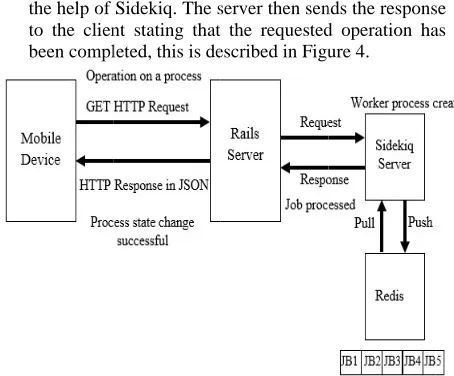
d) The client i in the GUI the server, running pro in the reque by client t player: http The Rails s the help of to the clien been compl
Figure
.3. Approach
The system is rchitecture. It i ) The client
OS. The us ) At the serv Linux mac main server ) The Sidek
processing
The system is a REST based ar HTTP is used erver. The abo mplementation
IJISET - Internati
3. Client requests
is now able to I. The client ag
this time, requ ocess. Again, est message. A to pause a ru p://root/api/vlc/ server performs Sidekiq. The s nt stating that leted, this is de
4. Client requests
h to Implemen
s broadly bas is implemented side is a mobil ser uses the An er side, the Ra chine running
r handling all t kiq is a secon the state chang
4.
Meth
a client-server rchitecture for d for commun ove mentioned n of the system
onal Journal of Inn
list of running pro
see a list of run gain sends a H uesting to chang
GET request m An example of
unning song i /?op=pause. s the requested server then sen the requested escribed in Figu
list of running pro
ntation
sed on the R d in following le device runni ndroid app for r ails server is im the Ubuntu O the client reque ndary server r ge requests by
hodology
system, essen application de nication betwe d technology st
.
novative Science, www
ocesses
nning processe HTTP request t ge the state of method is use the request sen in VLC medi
d operation wit nds the respons d operation ha
ure 4.
ocesses
REST service three steps:- ing the Androi remote access. mplemented on
OS. This is th ests.
responsible fo client.
ntially using th evelopment [4]
een client an tack is used fo
Engineering & Te w.ijiset.com es to a ed nt ia th se as es id a he or he ]. nd or The first GUI whe required details ar Figure 5. her userna credential system. T meaning accessed b present w running p running p of matche GET HT process [3 it further Sidekiq c to a que asynchron job from the worke returned response message out from t
Fig
Figure 6. S 5
echnology, Vol. 2
interaction of erein the user credentials i.e re stored in t The user then ame and passw ls and on auth The client is g
only some o by the client. A with the server
processes, the processes with
ed processes t TTP request to
3]. When the R r sends this re creates a worke eue at the R nous processin Redis queue fo er for that job
to the main to the client. on the interfac the system.
gure 5. Sequence D
Sequence Diagram
5.
F
5.2
Issue 4, April 201
the user is wi r registers her e. username a the PostgreSQ n logins to the word. The serve
hentication pr given limited of the server’ A default list o
. When the cli e server match
the default lis o the client. T o change the Rails server rec
equest to the er process for t Redis database ng of jobs. It p following the F b and processe
server, whic The user is a ce, Figure 6. T
Diagram - Connect
m - Client Server Re
Future Wor
5.
ISSN 234
ith the Android rself by enteri and password. QL database d e system by ty er validates the rovides access access to the ’s processes f all such proc ient requests a hes all the cu st and returns The user then s state of a r ceives such a r Sidekiq serve this job and pu e. Sidekiq pe pulls out a pa FIFO rule, insta
s it [7]. The r ch sends the able to see a The user can th
tion Establishment
emote Access Mec
rk
48 – 7968
IJISET - International Journal of Innovative Science, Engineering & Technology, Vol. 2 Issue 4, April 2015. www.ijiset.com
ISSN 2348 – 7968
740 The system is currently designed to work in the local
network only. The system can be extended to work on the internet using a proxy system which will work as middleware for the mobile device and the personal computer. Then the Android app of the system can be released in the user space for free download from the web. The system will then be made open source so that the source code is available to anyone who can then contribute any enhancement or bug fix to the system. Also, encryption protocol like HTTPS can also be implemented to make the request-response mechanism more secure.
6.
Conclusion
This system being RESTful in nature is very lightweight i.e. requiring less memory in comparison to other conventional web applications that use SOAP. It provides faster remote access to client as requests are handled asynchronously in complete isolation and independent of each other. Most importantly, the user is not given unfettered access to the system. The user can only change only certain limited processes which makes the system secure from the administrator’s perspective.
Acknowledgements
Prof. Nikita Gupta, project guide at Army Institute of Technology, Pune wishes to acknowledge Jaskirath Singh Makol, Manish Yadav, Nitesh Kumar and Vijay Dhama for developing a system to support remote applications access. The development of this system is totally attributed to the guidance of above mentioned.
References
[1] Bradley Mitchell, What Is Remote Access to Computer Networks?,http://compnetworking.about.com/od/inter
netaccessbestuses/f/what-is-network-remote-access.htm
[2] M. Vaqqas, RESTful Web Services: A Tutorial, http://www.drdobbs.com/web-development/restful-web-services-a-tutorial/240169069?pgno=1 [3] Dr. M. Elkstein,
Learn REST: A Tutorial, http://rest.elkstein.org/ [4] Margaret Rouse,
REST(representational state transfer), http://searchsoa.techtarget.com/definition/REST
[5] O. S. Tezer, A Comparison of (Rack) Web Servers for Ruby Web Applications,
https://www.digitalocean.com/community/tutorials/a- comparison-of-rack-web-servers-for-ruby-web-applications
[6] Daniel Kehoe, What is Ruby on Rails,
http://railsapps.github.io/what-is-ruby-rails.html [7] Mike Perham,
https://github.com/mperham/sidekiq/wiki [8] Rupali Sharma, Developing for Android - An
Introduction,
http://www.cprogramming.com/android/android_getti ng_started.html
[9] R.Manikandasamy, "Remote Desktop Connection Using Mobile Phone", International Journal of Science, Engineering and Technology Research (IJSETR) Vol. 2, Issue 8, August 2013, pp. 1629-1633
Jaskirath Singh Makolis currently pursuing Computer Engineering from Army Institute of Technology, Pune affiliated to Savitribai Phule Pune University.
Manish Yadav is also currently pursuing Computer Engineering from Army Institute of Technology, Pune affiliated to Savitribai Phule Pune University.
Nitesh Kumar is also currently pursuing Computer Engineering from Army Institute of Technology, Pune affiliated to Savitribai Phule Pune University.
Vijay Dhama is also currently pursuing Computer Engineering from Army Institute of Technology, Pune affiliated to Savitribai Phule Pune University.