ISSN (Print) : 2320 – 3765
ISSN (Online): 2278 – 8875
I
nternational
J
ournal of
A
dvanced
R
esearch in
E
lectrical,
E
lectronics and
I
nstrumentation
E
ngineering
(A High Impact Factor, Monthly, Peer Reviewed Journal)
Website: www.ijareeie.com
Vol. 8, Issue 4, April 2019
Autonomous Coconut Harvesting Robot
A.Nithishkumar1, M.Jayaprakash2, P.Theepak3, N.Senthilnathan4
Student, Dept. of EEE, Kongu Engineering College, Perundurai, Tamilnadu, India1 Student, Dept. of EEE, Kongu Engineering College, Perundurai, Tamilnadu, India2 Student, Dept. of EEE, Kongu Engineering College, Perundurai,Tamilnadu, India3 Professor, Dept. of EEE, Kongu Engineering College, Perundurai,Tamilnadu, India4
ABSTRACT:Coconut tree climbers are a rarity these days. The scarcity of labors disrupts harvesting cycles causing loss of income to the growers and less in productivity. Our objective of the project is to make a cost-efficient coconut tree climber that will reduce human labor and help farmers to get a better harvest in coconut farming. It saves time, labor cost and is reliable. The key thing is to make the job easier.The proposed concept is lighter than those existing by about 30% and is expected to be of low cost in nature due to its construction. It uses Radio frequency communication for its wireless operation and is done by using joystick. This will definitely encourage lot of people to come forward towards Coconut farming for the better productivity and harvest by the use of Automation and Technology.
KEYWORDS: Harvesting cycles, Automation, Technology, Radio frequency communication
I.INTRODUCTION
Our Country contributes to nearly 23% of total coconut production in the world, and is the second largest producer of coconuts in the world. About 92% of India’s total production is from south Indian states like Kerala, Tamil Nadu, Karnataka, etc. Coconut Production has a major impact on the agrarian economy of the country. But in the recent times there is an large shortage of coconut tree climbers, which have adversely affected the harvesting of coconuts throughout the country. It leads to disrupting harvesting cycles and less in productivity. This is mainly due to the risk factor involved in climbing coconut trees. There have been many accidents, some of which have even resulted in deaths; thus a requirement of an unmanned system for harvesting coconut trees has become relevant.
One of the main parts of this unmanned system would be the arm which is used for cutting coconuts. So the focus of this research work is on constructing a human controlled robotic arm dedicated to the coconut harvesting system to be used in a coconut tree climbing robot. Usually the coconuts are spread around the top of the coconut trees in an unpredictable way, and its stacks are very hard; therefore heavy-duty machinery is required. Furthermore, the robotic arm must have independent degrees of freedom to reach the desired area of the coconut palm and should be able to cut down coconuts without affecting the stability of the coconut harvesting system. The whole system will be user-friendly and cost-effective.
II.EXISTING MODEL AND METHODS
ISSN (Print) : 2320 – 3765
ISSN (Online): 2278 – 8875
I
nternational
J
ournal of
A
dvanced
R
esearch in
E
lectrical,
E
lectronics and
I
nstrumentation
E
ngineering
(A High Impact Factor, Monthly, Peer Reviewed Journal)
Website: www.ijareeie.com
Vol. 8, Issue 4, April 2019
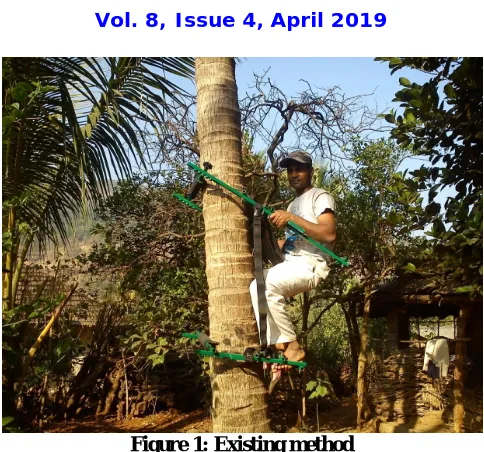
Figure 1: Existing method
This can be operated with the help of humans and it requires lot of human effort. It also causes human risk to the climber. Due to its risk involved, it is not highly preferred for unskilled climbers.
III.PROPOSED SYSTEM
Figure 2 : Block Diagram
ISSN (Print) : 2320 – 3765
ISSN (Online): 2278 – 8875
I
nternational
J
ournal of
A
dvanced
R
esearch in
E
lectrical,
E
lectronics and
I
nstrumentation
E
ngineering
(A High Impact Factor, Monthly, Peer Reviewed Journal)
Website: www.ijareeie.com
Vol. 8, Issue 4, April 2019
Figure 3: Mechanical Frame Figure 4: Spring Mechanism
IV. ROBOTIC ARM UNIT
It has two links and two motors, one for cutting purpose and the other to give the arm a rotating motion along a single axis. This model has comparatively less weight (about 1 Kg) and does not disturb the stability of the system. Being a simple design it joints this system actually quite stable. Also this model is the most cost efficient of the lot.
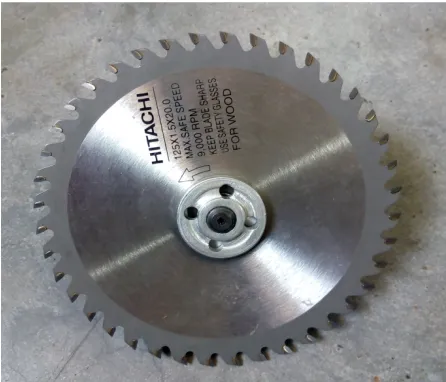
The arm is made of aluminium with a length of 170 cm. The arm can move up and down using DC motor by a pulley. The DC motor rotation is converted into linear motion using a timing-belt. The arm linear movement is designed to be able to reach the coconuts. At the top arm, a specifically designed saw is attached. The saw is designed
using brushless DC motors for high speed rotation in order to quickly cut the coconut stem. The blade is a sharp grinding for cutting.
ISSN (Print) : 2320 – 3765
ISSN (Online): 2278 – 8875
I
nternational
J
ournal of
A
dvanced
R
esearch in
E
lectrical,
E
lectronics and
I
nstrumentation
E
ngineering
(A High Impact Factor, Monthly, Peer Reviewed Journal)
Website: www.ijareeie.com
Vol. 8, Issue 4, April 2019
Wheels are driven by eight DC motors which are coupled to it. Also two motors are used for performing the robotic arm action. Two motors are for base movement and one shoulder movement. At the tip of the arm, there is a rotor blade provided which is used for cutting purpose, it is driven by a DC motor. The robot locates at center of mass outside of tree and uses wheels to climb vertically. The wheel mechanism is designed for a hybrid climbing method. The robot is able to switch between straight and spiral climbs using compression.
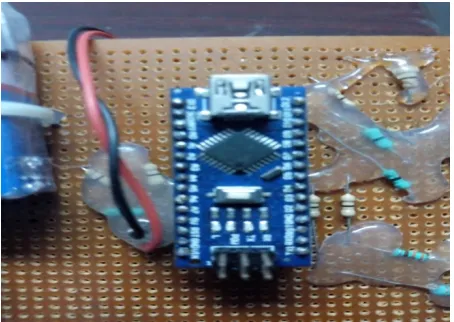
The wireless NRF24L01 module is used to control the entire system through RF Communication. It has transmitter and receiver module which carry and receive digital information for the wireless transmission. It can be controlled via joystick and is used for making the motors to operate in Forward, Reverse directions and Arm Cutting operations.
The Transmitter and receiving modules of the RF communication is shown in the figure below
Figure 3.17 Wireless transmitter module Figure 3.18Wireless Receiver (Joystick) V.RESULTS
ISSN (Print) : 2320 – 3765
ISSN (Online): 2278 – 8875
I
nternational
J
ournal of
A
dvanced
R
esearch in
E
lectrical,
E
lectronics and
I
nstrumentation
E
ngineering
(A High Impact Factor, Monthly, Peer Reviewed Journal)
Website: www.ijareeie.com
Vol. 8, Issue 4, April 2019
Figure 5: Overall Electrical Connections
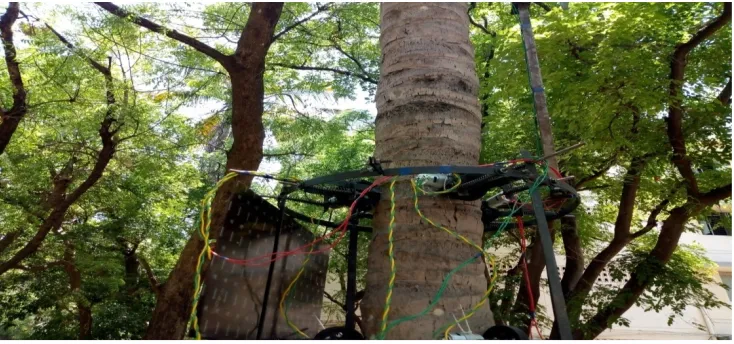
The Real implementation of our project is exhibited in the Coconut tree and is shown in the figure below
Figure 6 : Hardware implementation in Tree
REFERENCES
[1] Yeorem Yoon, Daniela Rus “Shady 3D: A Robot that climbs 3D Trusses” – IEEE International Conference on Robotics and Automation, Italy, April 2007
[2] Ackerman, Evan. “Treebot Learns to Autonomously Climb Trees.” IEEE Spectrum. Web. May 18, 2011.
[3] Y. Kushihashi, et al., “Development of Tree Climbing and Pruning Robot, Woody-1-Simplification of Control using adjust Function of Grasping Power” .Proceedings of JSME Conference on Robotics and Mechatronics, pp. 1A1- E08, 2006.
[4] .Devang P. Soni, Ranjana. M, N.A.Gokul, Swaminathan .S, “Autonomous Arecanut Tree Climbing and Pruning Robot”, pp-278-282 IEEE 2010..