ISSN 2348 – 7968
188
To Study the Effect of Pouring Temperature on Mechanical
Properties of Metal Matrix Composites (Al+4%Cu+5%SiC) in
Stir Casting
1
Anuraj Singh 2 Mohd Suhail 3Mohd Faizan Hasan 4 Mohd Reyaz-Ur-Rahim
Mechanical Engineering Integral University Lucknow,India
Abstract- In the present study a modest attempt has been
made to develop aluminum based silicon carbide particulate Metal Matrix Composites(MMC) with an objective to develop a conventional low cost method of producing MMCs and to obtain homogenous dispersion of ceramic material. Desired improvements in properties including specific strength, hardness and impact can be achieved by intelligently selecting the reinforcement
materials, their size, and shape and volume fraction.
It has been observed that melting and pouring conditions have directly or indirectly effect on mechanical properties of cast materials as hardness, percentage elongation, percentage reduction in diameter, toughness and so on. The knowledge of melting temperature of metals and alloys is necessary to estimate their corresponding pouring temperature.
Keywords: Metal Matrix Composites MMC’s, Cu,
Silicon Carbide SiC, SPSS, Stir, Pouring Temperature, UTM, Hardness.
Chemical composition
Metal matrix composites (Al+4%Cu+5%SiC)
Introduction
The increase in strength of composites due to smaller reinforcement particle size has been reported by many authors. Statistically, larger flaws and more defects are more likely to exist in larger particles and, therefore, will deteriorate the strength of composites when compared with the composites containing smaller particles. The smaller grain size in the composites
containing smaller reinforcement particles can also contribute to the increase in strength. The mechanical properties such as hardness, impact and strength is increase when grit size of reinforcement of SiC particle increase.
One of the major challenge when processing on 4% Cu + 5% SiC with balanced Aluminium Metal Matrix Composites are achieving a homogeneous distribution of reinforcement in the matrix as it has a strong impact on the properties and the quality of the material. Among discontinuous metal matrix composites, stir casting is generally accepted as a particularly promising route, currently practiced commercially. Its advantages lie in its simplicity, flexibility and applicability to large quantity production. It is also attractive because, in principle, it allows a conventional metal processing route to be used, and hence minimizes the final cost of the product.
The cost of preparing composites material using a casting method is about one-third to half that of competitive methods, and for high volume production, it is projected that the cost will fall to one-tenth. In general, the solidification synthesis of metal matrix composites involves producing a melt of the selected matrix material followed by the introduction of a reinforcement material into the melt, obtaining a suitable dispersion.
Observational Detail
ISSN 2348 – 7968
189
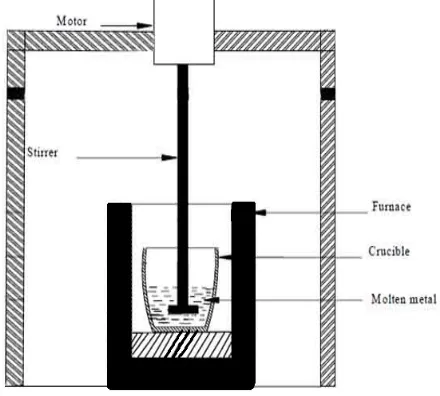
the matrix. For the work, a new stir caster was developed to fabricate MMC. The mixing equipment for this stage consisted of a driving motor capable of producing a rotation speed within the range of 600rpm, a control part for the vertical movement of the impeller and a transfer tube used for introducing the ceramic powders in the melt.
Fig 2.1 Schematic View of Experimental Set Up
Balanced aluminum alloy with copper were melted in graphite crucibles. At the same time the SiC particulate was preheated in a muffle furnace set at 1100°C for approximately 2 hour to remove surface impurities and assist in the adsorption of gases. The ceramic particles were then poured slowly and continuously into the molten metal and the melt was continuously stirred at 600 rpm.
In preparing metal matrix composites by the stir casting method, there are several factors that need considerable attention, including the difficulty of achieving a uniform distribution of the reinforcement material, wettability between the two main substances, porosity in the cast metal matrix composites, and chemical reactions between the reinforcement material and the matrix alloy.
Methodology/Design of Experiment
First of all, the balanced aluminium with 4% Cu was melted in a graphite crucible in an open hearth furnace. After automatic mechanical mixing is carried out for about 3 minutes at normal stirring rate 600 rpm and then poured into sand mould with pouring temperature 700°C, 725°C and 750°C respectively.
After that the balanced Al+4%Cu and 5% SiC (400-grit) were took. For this, the base metal Al+4%Cu
were preheated at 450°C for 3 hours in a electrical
resistance muffle furnace before and mixing the SiC
particles were preheated at 1100°C for 2 hours in a
electrical resistance muffle furnace to remove the moisture and surface oxidized.
Observation of Process Parameters
The variations of Izod impact with pouring temperatures are shown in fig.. The impact is increases initially for all
composites with pouring temperature at 700°C. It latter
attained its maximum value of all material types at
pouring temperature 725°C. After that it falls sharply at
the pouring temperature 750°C. From the figure, it can be
observed that the impact of the composite material-2 (Al + 4% Cu + 5% SiC) is higher than the base matrix material-1 (Al + 4% Cu). Thereafter, the increasing impact with increasing the grit sizes of SiC particles. The maximum impact attained when the reinforcement was
800-grit at pouring temperature 725° C.
BHN Test
ISSN 2348 – 7968
190
Si. no. Pouring Temp.(C)
Impact strength(MP)
Hardness (BHN)
UTS
1. 700 26.00 41.00 164.00
2. 725 29.56 41.96 175.00
3. 750 24.45 39.87 162.34
Impact Strength
Izod impact strength testing is standard method of determining impact strength. Izod impact test were conducted on notched sample. Standard square impact test specimen measured 75 mm x 10 mm x 10 mm with
notch depth of 2 mm and a notch of angle of 45°. The
machine could provide a range of impact energies from 0 to 164 Joule. The mass of the hammer was 22 kg. It was carried out for all specimens respectively.
Tensile Strength
Tensile strength is defined as a stress, which is measured as force per unit area. In the SI system, the unit is Pascal (Pa) or Newton’s per square metre (N/m²). For tensile test, we used Universal Testing Machine.
ISSN 2348 – 7968
191
RESULTS
The effects of input (independent) variables as pouring
temperatures (700°C, 725°C and 750°C) and material
type’s (varying with grit size of SiC particles) on output (dependent) variables as hardness, impact strength and ultimate tensile strength, statistically analysis were performed by using SPSS 17.0.
CONCLUSION
The significant conclusions of the studies carried out on balanced (Al + 4% Cu + 5% SiC) composites are as follows.
Cast balanced (Al + 4% Cu + 5% SiC)
composites were prepared successfully using liquid metallurgy techniques (stir rout).
Hardness of the composites found increased with
increased grit size of SiC.
Impact (Izod) of the composites found increased
with increased grit size of SiC.
The tensile strength of the composites found
increased with increased grit size of SiC.
The pouring temperature at 725°C which gave the
best optimum value of hardness, impact strength and ultimate tensile strength. When the pouring rate kept constant at 2.5 cm/s for all composites.
SCOPE FOR FUTURE WORK
We only consider three grit sizes (400, 600, and
800); chances may be that with further reduction in grit size mechanical properties of composite may decline.
We added only 5% SiC, however with further
addition of SiC particles mechanical properties
may improved as investigated by Singla M.
(2009) for Al and SiC casting.
Wear resistance may be the parameter which
defines the hardness and abrasive property of composite is the scope for future work.
Experiments are performed on open hearth
furnace chances of inclusion and blow holes may measure.
REFERENCES
1. Basavarajappa S, Dinesh A, (2004), Mechanical
properties of MMC’S- an experimental investigation, ISRS, 20-22.
2. Behera R, Dutta A, (2011), Role of SiCp on the
solidification rate and forgeability of stir cast LM6/SiCp MMCs, International Journal of Scientific & Engineering Research, Volume 2, Issue 1, January-2011
3. Chawla KK, (1998), Composite Materials, 2nd
edition. New York: Springer.
4. Chawla N., Chawla KK, (2006), “Metal matrix
composites in ground transportation”. JOM, 58(11) pp. 67-70.
5. Clyne TW, Withers PJ, (1993), “An introduction
to metal matrix composites”, 1st edition. Cambridge: Cambridge University Press.
6. Creese R., (1990), “Introduction to
manufacturing process and materials” Marcel Dekker Inc.
7. Dieter G., (1961), Mechanical Metallurgy,
McGraw-Hill, pp. 237-248, 132-137.
8. Geiger AI and Walker JA, (1991), “The
processing and properties of discontinuously reinforced aluminium composite”. JOM vol. 48, pp. 8-15.
9. Gruzleski J. et. al., (1990), “Treatment of liquid
ISSN 2348 – 7968
192
10. Hashim J, Looney L, Hashmi MSJ (1999). Metal
Matrix Composites: Production by the Stir casting method. Journal of Materials Processing Technology, 92-93 pp. 1-7.
11. Hull D, Clyne TW (1996). An introduction to
composite materials, 2nd edition, Cambridge, UK: Cambridge University Press.
12. Ibrahim IA, Mohamed FA, (1991), “Particulate
reinforced metal matrix composites – A review”. Journal of Materials Science, vol. 26, pp. 1137-1156.
13. Jit N, Tyagi A, (2011), Properties of
(A384.1)1-x [(SiC)p] (A384.1)1-x Composites by Keeping Particle
Size at 0.220 μm. WCE, London, vol. 3.
14. Jokhiyo M, Panhvar M, (2010), Manufacturing
of aluminium composite material using stir casting process. Mehran University Research Journal of Engineering & Technology, volume 30, NO. 1, January, 2011.
15. Kaufman J, (2004), “Aluminium Alloy Casting
Properties, Processes and Applications”, ASM International, Materials Park, USA.
16. Kelly A (1989). Concise Encyclopedia of
Composite Materials, Oxfrod, UK: Pergamon Press.
17. Kumar G, Rao C, (2011), Mechanical and
tribological behavior of particulate reinforced aluminium metal matrix composites – a review, Journal of Minerals & Materials Characterization & Engineering, Vol. 10, No.1, pp.59-91, 2011.
18. Matthews FL, Rawlings RD (1994). Composite