Available online: https://edupediapublications.org/journals/index.php/IJR/ P a g e | 1141
Identify of Ranking Problems and Fraud for Mobile apps
T. Ravi Krishna 1, K. Chiranjeevi 2
1PG Scholar, Dept of CSE, Sri Sunflower College of Engineering and Technology, Lankapalli,
Krishna Dist, AP.
2 Assistant Professor, Dept of CSE, Sri Sunflower College of Engineering and Technology,
Lankapalli, Krishna Dist, AP.
Abstract: We take new methods and techniques used for the finding the position of rankings in various mobile applications. Rankings play is major role in mobile applications and other products. Customers take applications depended on the ranking and also by reading the review and rating given to it Positioning extortion in the portable App market alludes to misleading changes with the reason for knocking up the Apps in the ubiquity list. It turns out to be more successive for App deplovementto uses shady means, The proposed model mines the leading sessions of mobile apps to precisely locate the ranking imposture. Additionally system finds ranking, rating and review process and investigation of different evidences, Theranking based evidences rating based evidences and review based evidences is done. We propose an optimization depend aggregation model to integrate all the evidences for position imposture. We findingthe proposed model with real-world App data aggressions from the Apple’s App Store for a long time period. Fuzzy Logic is uses many valued logic which produces the true value of variables. From the collected dataset input is fuzzy filed into member function. Rules isexecuted with input values to produce fuzzy output. Map a fuzzy output member functions into crisp output results which is used for position. Fuzzy model produces the true value for position of imposture ranking. Works well for large amount of data in order to increase the scalability.
Available online: https://edupediapublications.org/journals/index.php/IJR/ P a g e | 1142
1. INTRODUCTION
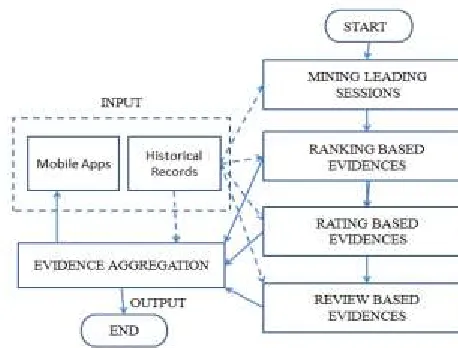
The number of mobile Apps has grown rapidly over the past few years. For example, as of the end of 2014, there are more than 13 million Apps at Google Play. To stimulate the development of mobile Apps, many App stores launched daily App leaderboards, which demonstrate the chart rankings ofmost popular Apps. Indeed, the App leaderboard is one of the most important ways for promoting mobile Apps. In Rating Based Evidences, specifically, after an App has been published, it can be rated by any user who downloaded it. Indeed, user rating is one of the most important features of App advertisement. An App which has higher rating may attract more users to download and can also be ranked higher in the leader board. Thus, rating manipulation is also an important perspective of ranking fraud. In Review Based Evidences, besides ratings, most of the App stores also allow users to write some textual comments as App reviews. Especially, this paper proposes a simple and effective algorithm to recognize the leading sessions of each mobile App based on its historical ranking records. This is one of the fraud evidence. Also, rating and review
Available online: https://edupediapublications.org/journals/index.php/IJR/ P a g e | 1143
challenges for developing recommender App system with security and privacy awareness. Specifically, the first challenge is how to efficiently analyze the security. The very recent trend followed in market by the corrupt App developers for bumping up of an App is to use deceptive means to intentionally boost their apps. Lastly, the chart rankings on a App store are also manipulated. This is usually implemented by using so-called “internet bots” or “human water armies” to raise the App downloads, ratings and reviews in a very little time. Venture Beat [2] is an article that reported, using ranking manipulation when an App was promoted, in Apple‟ s top free leader board it could be push forward from number 1,800 to the upmost 25 and new users more than 50,000- 100,000 could be acquired within a couple of days. In reality, such ranking fraud leads to great concerns to the industry of mobile App. For example, App developers who commit ranking fraud [3] in the App store, Apple has warned of cracking down on them. As per the observation the mobile apps does not always ranked high in the leader boards, in fact in some leading events only.
2. RELATED WORK
Available online: https://edupediapublications.org/journals/index.php/IJR/ P a g e | 1144
Construction, Document Filtering, Database Middleware Construction [6], [7] Spam Webpage Detection, Meta-Search. The main aim of the rank aggregation is to assigning the Real-valued score to individual entities by aggregating the every ranking provided by the base ranker. Sort the entities upon their score without change in generality. Median Rank aggregation sorts the entities upon the median of the rank in ranking list. Hierarchical fuzzy logic systems are an active research topic in the fuzzy logic system. It is focused on reduction of the exponential number of rules in control and other applications. If N membership functions are defined for each of l inputs then inputs then the number of possible fuzzy rules is Nl . The hierarchical fuzzy system approached gains recently most interest [8]. Systems like that process inputs in lower dimensional subspaces, combining the results in a binary tree structure. In this process, the physical interpretation and the ability to design such systems without much training is easily lost, though there are some proposals to restore it. Mobile app stores launched many apps daily in the leader boards which shows the chart ranking of popular apps. The leader board is the important for promoting apps. Original
application grade level decreases due to the arrival of fake apps. The users who are newly logging to the app stores, they decide based on the existing ranking, rating, reviews for the individual apps. In recent activities duplicate version of an application not burned or blocked. This is the major defect. Higher rank leads huge number of downloads and the app developer will get more profit. In this they allow Fake Application also. User not understanding the Fake Apps then the user also gives the reviews in the fake application. Exact Review or Ratings or Ranking Percentage are not correctly Calculated.
3. System Design
Available online: https://edupediapublications.org/journals/index.php/IJR/ P a g e | 1145
algorithm to recognize the leading session of every Application depends on previous records. At that point with the exploration of Apps ranking behaviors, this framework analyzes the fake Apps as often as possible have different ranking patterns in each leading session observed with ordinary Apps. The primary contribution of this framework is to it found the fake reviews and eliminates it. Mobile Apps are not always highly ranked in the leader board, only in few leading events. This leads to the formation of different leading sessions. In other words, fake ranking usually happens in the leading sessions. Therefore, fake ranking discovery of mobile Apps is actually done to detect fake ranking within leading sessions of mobile Apps.
Fig. 1. Ranking Fraud Detection for Mobile Apps
4. PROPOSED SYSTEM
Available online: https://edupediapublications.org/journals/index.php/IJR/ P a g e | 1146
issue. When an App was promoted by ranking manipulation it will be the top in the market, other users will buy the App. This activity affects other App reputation and some legal marketing campaigns, such as limited time discount.[10]
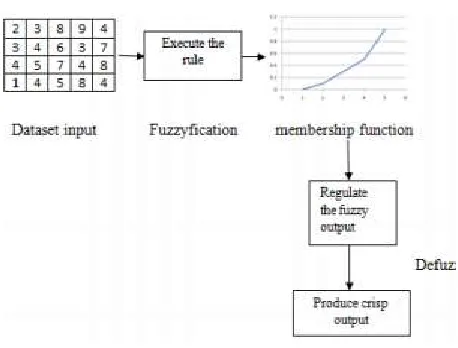
Fig No.2. Fuzzy System Overview
Fuzzy system is the consensus of all of the input and all of the rules. Weightings can be added to each rule in the rule base and weightings can be used to regulate the degree to which a rule affects the output values. These weightings may be static or dynamic. Fuzzifying all input values into fuzzy membership functions. Execute all application rules in the rule base to compute the fuzzy output functions. Defuzzifying the fuzzy output functions to get the crisp output values
5. Algorithm
A. Algorithm 1 Proposed Algorithm
Input: reviews
Output: find true or fake review
1. From every analysis develop testing dataset
2. apply J48 classification algorithm on testing dataset
3. j48 classification algorithm classify testing dataset
4. on the basis of result classify fake or true review
The proposed system contributes the new concept of recommendation system for the mobile applications to the number of users. [11] This is implements the apriori algorithm for the recommendations of the various applications that restricts some fake reviews for applications. The recommendation system works on the number of reviews and ratings are given by the users for the specific product[12].
B. Algorithm 2 FP-Growth
Input: MIMIC Data Set
Available online: https://edupediapublications.org/journals/index.php/IJR/ P a g e | 1147
Process:
1. Data set
2. FP-growth
3. FP-tree
4. Header Table
5. Conditional FP-tree
6. Repeat step 2 to 5
7. Generate Rules
C. Algorithm(Database)
KNN order (K-Nearest Neighbor) for question on to various databases. It is a non-parametric strategy utilized for order and relapse As a part of both cases, the information comprises of the k nearest preparing samples in the component space. The yield relies on upon whether k-NN is utilized for characterization or relapse:[13]
a. In k-NN order, the yield is a class participation. An item is ordered by a dominant part vote of its neighbors, with the article being appointed to the class most basic among its k closest. On the off chance that k = 1, then the item is essentially doled out to the class of that solitary closest neighbor
b. In k-NN relapse, the yield is the property estimation for the item. This quality is the normal of the estimations of its k closest neighbors.[14]
c. K-NN is a kind of occurrence based learning, or languid realizing, where the capacity is just approximated locally and all calculation is conceded until characterization. The kNN calculation is among the most straightforward of all machine learning calculations.
6. RESULT ANALYSIS
Available online: https://edupediapublications.org/journals/index.php/IJR/ P a g e | 1148
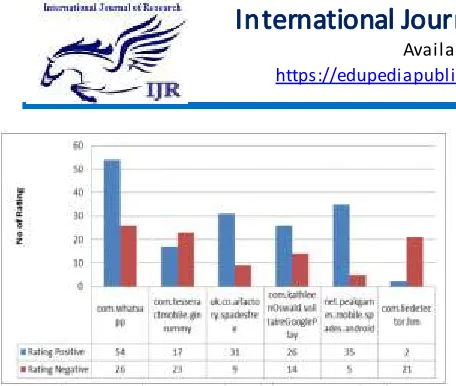
Fig. 3. Rating-Based Evidence Analysis
The performance evaluation on the basis of review-based evidences is shown in the following Figure 5. It displays the count of positive and negative reviews of respective apps. displays the average count of maintaining phase‟ si.e App Evidence-1 and also shows the respective session counts i.e App Evidence-2 of the apps in the figure 6. It isobserved that app having more number of sessions ultimately leads to low maintain phase. Hence the system considers that app as fraud with respect to ranking based evidences.
Fig. 4. Review-Based Evidence Analysis
7. CONCLUSION
Available online: https://edupediapublications.org/journals/index.php/IJR/ P a g e | 1149
similarity measure algorithm and detect the web rank. The proposed system is saves the time as well as memory than the previous system. Fuzzy system is mainly in the mobile app market helped to prevent download of fraud app. Each app’s ratings are normalized to the probability value according to the fuzzy logic technique. Normalized probability value is defuzzified to produce the crisp value successfully. Crisp value is show casing the fraud app ratings. The probability value declared the fraud percentage of the each app in its app history.
8. FUTURE WORK
We plan to study more effective fraud evidences and analyze the latent relationship among rating, review and rankings. Moreover, we will extend our ranking fraud detection approach with other mobile App related services, such as mobile Apps recommendation, for enhancing user experience.online review fraud discovery, mobile application recommendation. Each one of these techniques is feasibly handling ranking fraud detection. Besides, it optimized based aggregation technique to integrate all the evidences for assessing the
believability of leading sessions from mobile Apps.
9. REFERENCES
[1] (2014). [Online]. Available: http://en.wikipedia.org/wiki/ cohen’s_kappa
[2] (2012). apples-crackdown-on-app-ranking-manipulation/
[3] (2012). [Online]. Available: https://developer.apple.com/news/index.php ?id=02062012a
[4] Discovery of Ranking fraud for mobile apps.
HengshuZhu,HuiXiong,Seniormembers,IEE E,YongGe,andEnhongChen,Seniormember,I EEE,IEEE transactions on knowledge and data engineering,vol .27,No.1,January 2015.
[5] Detecting product review spammers using rating behaviors. E.-P. Lim, V.-A.Nguyen, N. Jindal, B. Liu, and H. W. Lauw. In Proceedings of the 19th ACM international conference on Information and knowledge management
Available online: https://edupediapublications.org/journals/index.php/IJR/ P a g e | 1150
ACM SIGKDD international conference on Knowledge discovery and data mining, KDD ’12, pages 985–993, 2012
[7] S. Xie, G. Wang, S. Lin, and P. S. Yu. Review spam detection via temporal pattern discovery. In Proceedings of the 18th ACM SIGKDD international conference on Knowledge discovery and data mining, KDD ’12, pages 823–831, 2012.
[8] A. Homaifar, E. McCormick, “Simultaneous Design of Membership Functions and Rule Sets for Fuzzy Controllers Using Genetic Algorithms”, Analysis of Fuzzy system, ITOFS’95, pages 643-658, 1995.
[9] W. Duch “Uncertainty of data, fuzzy membership functions, and multi-layer perceptions” Analysis of fuzzy system: neural networks, ITONN’04, pages 1-11, 2004.
[10] J. Mendel, “Uncertain Rule-Based Fuzzy Logic Systems: Introduction and New Directions”. NJ: Prentice Hall, 2001.
[11] N. Spirin and J. Han. ”Survey on web spam detection: principles and algorithms”.SIGKDD Explor. News l., 13(2):5064, May 2012.
[12] E.-P. Lim, V.-A.Nguyen, N. Jindal, B. Liu, and H. W. Lauw. ”Detecting product review spammers using rating behaviors”. In Proceedings of the 19th ACM international conference on Information and knowledge management, CIKM 10, pages 939948, 2010
[13] Ranking fraud Mining personal context-aware preferences for mobile users. H. Zhu, E. Chen, K. Yu, H. Cao, H. Xiong, and J. Tian. In Data Mining (ICDM), 2012 IEEE 12th International Conference on, pages1212–1217, 2012.