WI
Abstr of in better basis inspir estim Singu imag low c comp Keyw R inten radia often from and light imag requ extra prior featu C most enha autom for e [6,7] spars have noise coeff chara Z and deno param Nasr remo param SquaDWT- SV
ITH OPT
Dept. of C
ract: Satellite im sufficient enlig r visualization, s of optimal thr red Ant Lion O mation of thresh
ular Value Dec ge using inverse contrast satellit paring the resul
words: Contrast
Remotely sens nsity informat ation of the ob n distorted du m the object, s
environmenta tening etc., at ges [1, 2]. uired for bet action, which r to any fur ure extraction Classical histo t common a ancement. The mated due to enhancement ]. Having in sity, wavelet d e gained popu
e present in t fficient can b acter of wavel Zhang extende proposed a oise the wav
meters are em ri and Pour to ove the noi meters were are (LMS) al
Interna
VD BASE
TIMAL SH
A
K.Jaya Computer and Annamalai U Tamil Nadmages often ha ghtenment the i interpretation resholding and
Optimization ( holded DWT co omposition (SV e discrete wave te images in ter
ts with state-of
t enhancement,
I. INTRO
sed satellite i tion attained b bject and its in ue to poor det
similarity in r al condition s the time of ca For this reas tter visual p h is considere rther image and classific ogram equaliz and basic m ese technologi
their inheren that result in herent qualit domain image ularity for the the image wh e effectively let transform ed soft thresho
neural netw elet coefficie mbedded in t achieve bette se in the w
estimated b lgorithm with
Volu
ational Jou
Av
ED CONT
HAPE TU
ANT LIO
anthi d Information University du, Indiaave inferior perc mage acquisitio and subsequent
shape tuning p (ALO) algorithm oefficients. The VD) technique f let transformati rms of visual q f-the-art method
Ant Lion Optim
ODUCTION images compr by gathering ntensity. This ector sensitiv reflectance of such as haze, apturing result son contrast
perception an ed as a key
analysis like ation [3-5]. zation and its methods adop
ies cannot be nt nature of im
a number of ties like deco e enhancemen
last few deca hich is embed eliminated b [12-15]. olding functio work based m
ent [16, 17]. the thresholdi er flexibility a wavelet coef by employin h steepest gra
ume 9, No.
urnal of Ad
RESE
vailable On
TRAST E
UNING A
ON OPTIM
Science ceptual quality on system of th t digital analysi parameters. Them in the direc illumination in for scaling the i ion. The effecti quality and qua ds.
mizer, DWT, SV
rise waveleng electromagne
information a ity, weak sign f several obje
pollution, po t in low contr enhancement nd informati processing st e segmentatio
variants are t pted in ima generalized a mage depende f image artifa
omposition a nt based metho ades [8-11]. T dded with DW by the localiz
ns for denoisi methodology
Shape turni ing function and capability fficients. The ng Least Me adient of me
1, January
dvanced Re
EARCH PA
nline at ww
ENHANCE
AND THR
MIZATIO
due to environ he satellite capt is. The discrete e desired thresh ction of minimi
nformation in th intensity of the iveness of the p antitative perfor
VD, shape tunin
gth etic are nal cts oor ast is ion tep on, the age and ent cts and ods The WT zed ing to ing by y to ese ean ean sq va co pr ap ar an fo he A Ev Se pr im Th as of of of th co so pu O be po m be sh th de sin
y-February
esearch in C
APER
ww.ijarcs.in
EMENT
RESHOLD
ON ALGO
Dept. omental and alti tures poor cont e wavelet (DWT
holding and sh izing the mean he denoised thr image. The con proposed ALO rmance measur
ng parameters,
quare risk [18 alues for p omputational roposed a nov pproach [19] f re simultaneou nd to modify t or contrast enh
euristic opti Algorithm, Pa
volution, Arti earch are us rocessing prob In this pr mage is decom
he coefficien ssociated with f the wavelet c f optimum sha f minimizing he DWT coe omputational olution by ublished, na Optimizer (A enchmark op ossesses the minimum algo een employed hape tuning pa he image. The
enoised wavel ngular value d
y 2018
Computer
nfo
OF SATE
DING PA
ORITHM
L.Rof Computer S Annamal
Tamil N
tude factors of trast noisy imag T) coefficients o hape tuning par
n squared error resholded DWT ntrast enhanced based methodo es. The superio
satellite image
8]. To overc proper conve burden in L vel Particle Sw
for denoising usly intended the intensity in hancement [2 imization al article Swar ificial Bee Co sed effectivel blems [22-24] roposed meth mposed into s nts are mod h the image. T coefficient dep ape tuning pa
the mean squ efficients. Th
efficient alg exploring v ature inspire ALO) has ptimization p inherent pro rithmic param d in this meth arameters for e illumination let coefficient decomposition
Science
ISSNELLITE I
ARAMETE
M
R.SudhaScience and En ai University Nadu, India
the region it ch ges which need of these images rameters are sea r risk of the co T coefficients is d image is realiz ology has been ority of this me
s.
come the dep ergence and LMS algorithm
warm Optimiz . Recently pro
to eliminate nformation in 20, 21]. Popul lgorithms su rm Optimiza olony Optimiz ly for solvin
.
hodology low sub-bands by dified to elim The successfu
pends on the arameters guid
uared error ri his requires a gorithm for a various altern ed meta-heu
successfully roblems in operty of gr meter [25]. A
hodology to s denoising wav n information t is scaled on n for enhancin
N No. 0976-56
IMAGES
ERS USI
ngineering
haracterizes. Be d to be process s are denoised o arched by the n oefficients for s uncorrelated b zed by rebuildin validated on s ethod is exhibit
pendency of i to reduce m, Bhutada e zation (PSO) b oposed approa the noise elem n DWT coeffic
lation based M uch as Ge ation, Differ
zation and Cu ng various i
w contrast sat DWT coeffic minate the l noise elimin effective searc ded in the dire
isk (MSE-Ris a global, rel
achieving op natives. Rec uristic Ant solved se various field radient free ALO algorithm search the op velet coefficie n contained in n the applicati
Image reconstruction is performed using inverse wavelet transform on the noise free scaled wavelet coefficient.
The structure of this article is as follows. Section 2 presents a thresholding function model for estimating the thresholded wavelet coefficients for suppressing the noise associated with the image. Section 3 proposes ALO based approach for effective searching of optimal thresholding, shape tuning and asymptotic parameters as a problem of minimization of the MSE-Risk. Section 4 describes the proposed contrast enhancement strategy for illumination correction and noise elimination. Section 5 enumerates the quantitative performance measures related to the image enhancement for the purpose of analyzing the applicability of the proposed strategy and for comparing with existing methodologies. Section 6presents the simulation results of proposed approach to the low contrast noisy multiband input satellite images. Finally the inferences are concluded in Section 7.
II. MODELING OF THRESHOLDING FUNCTION AND PARAMETERS FOR DENOISING THE WAVELET
COEFFICIENTS
Enhancing a low contrast noisy satellite image in wavelet domain involves 2-D wavelet decomposition of the original image by applying 1-D DWT along the rows of the image first and then along the columns. The Daubechies wavelet transform such as db4 which has slightly longer support for scaling and wavelet coefficients than Haar wavelet has been applied. The DWT coefficients (LL, LH, HL & HH) contain frequency and noise elements. Optimal thresholding approach is applied for reducing the noise elements and SVD based approach is employed for correction of illumination information in the frequency elements.
The denoising problem of the satellite image is formulated as an optimization problem of minimizing the non-linear objective function with bound constraints. The original signal ‘x’ is contaminated by the unwanted noise ‘n’ that is embedded during the image acquisition stages. Image denoising is aimed for better estimation of noise free original signal by suppressing the noise signal. This can be achieved by selecting suitable thresholding values and functions which preserve the signal energy and suppress the noise energy.
Thresholding functions reported in the literature based on hard, soft, semisoft and garrote functions have some advantages over others. In general their over dependency on the functions selected and their inability of differentiable up to higher order makes the function rigid and affect its functionality. The effective denoising requires flexible thresholding function that can fine-tuned depends on the thresholding value.
The observed data vector of the input satellite image y= [y0,y1,…,yN-1] is the sum of original signal vector x= [x0, x1,…,xN-1] and noise vector n= [n1, n2,…,nN-1].
i.e y x n (1) The estimate of the original signal vector is obtained from the observed signal y by reducing the noise to achieve the estimate close to the original signal vector x. The criteria
used for the best estimate is to minimize the mean squared error risk associated with original signal energy.
, ∑ (2)
In wavelet domain, the energy of the original signal vector is concentrated in few large important coefficients and the noise energy is distributed in every coefficients. The estimate is obtained from the thresholding function and threshold value. The soft threshold function presented in ref. [15] has weak second order derivate while the function in Ref.[16] possesses infinite differentiable property with higher order derivatives are given by
, ,
2 1 1
2 1 | |
2 1
(3)
, , 0.5
(4) Where λ is threshold value and k is asymptote determination variable and p is derivative order determination constant.
Combining these two equations, Nasri presented a new function for simultaneous adjustment of thresholding function and value with infinite differentiability is
, , ,
0.5 1
0.5 | | | |
0.5 1
(5)
The proposed parameter s fine tunes the function f
thereby altering the shape of the thresholding function which is sensitive to the changes in λ. Here the estimate is thresholded wavelet coefficient, x is the wavelet coefficient of the input, λ is threshold value, k is asymptote determination variable and s is shape tuning parameter.
The thresholded wavelet coefficient is estimated with optimal λ, k and s which are searched in the direction to minimize the MSE-Risk. This can be formulated as optimization problem as follows
, , , , ∑ (6)
Subject to λmin λ λmax
0 k 1
smin s smax
coefficients by solving the above objective and in this methodology ALO algorithm is used to search the optimum thresholding and shape tuning parameters.
III. ALO BASED OPTIMAL SEARCHING OF THRESHOLDING AND SHAPE TUNING PARAMETERS
ALO developed by Mirjalili is a nature-inspired optimization algorithm mimicking the food capturing mechanism of antlions and their food ants in their habitat [25]. ALO copies this mechanism for searching optimal solution in multidimensional search space and this model is described as follows
A. Initialization
Ants and antlions represent the possible set of solutions in the hyper dimension at search space which is termed as search agents. Set number of ants NA, number of antlions NAL , number of random steps allowed for each ant NIt which is same as number of iterations, number of variables to be optimized NV and their lower bound (Ai) and upper bound (Bi). Random initial positions of each search agent is
(7)
Where Xi0 is the initial position of each search agent for a
particular dimension. The position of each search agent is initialized in all the dimensions of the problem. i.e for all variables. rand is a randomly generated number in the interval [0, 1].
The location of ants are stored in the matrix and used during searching process
,, ,, … … … … ,,
. . . . . . . .
, , … … ,
(8) Fitness of each ant is calculated based on the objective considered and stored in the following matrix
, , … … ,
, , … … ,
. .
, , … … ,
(9) The location of the ant lions in the same search space are also stored as
,, ,, … … … … ,,
. . . . . . . .
, , … … ,
(10) Each antlion fitness is calculated based on the objective considered and stored in the following matrix
, , … … ,
, , … … ,
. .
, , … … ,
(11)
B. Updation
During this step, possible solutions represented by antlions are modified in the direction of exploring the searching space to get global solution. It involves the following operations
Building trap
More hunger antlions tend to dig out larger traps during full moon for effective hunting. A roulette wheel is applied to model this aspect based on antlions’ fitness during iterations. Each ant is glued to a particular antlion during
Select Elite Antlion and update Xa based on Eq (18)
Yes No
Initialize ALO parameters NA, NAL , NIt and convergence criteria. Set λ, K & S as control parameters and their lower bound & upper bounds
Randomly generate initial population of Ants & Antlions based on Eq (1) and form matrices Xa & Xal.
Evaluate fitness for Ants & Antlions based on MSE-Risk given by Eq (6) and form matrices Fant & Fal
Iter=1
Building a trap for each ant by Roulette wheel.
Perform trapping, sliding, normalizing of ants based on Eqs. (12), (13) & (16) and evaluate fitness of each ant in
its latest position (Eq.6)
Set Xal=Xa
Is Fa > Fal
DWT Coefficients of the Equalized Image (LL, LH, HL, HH)
Check for Convergence
Thresholded DWT Coefficients by substituting the Elite Antlion parameters in Eq. (5)
Iter=Iter+1
Yes
Fig.1: ALO implementation for Optimal Estimation of Thresholded DWT Coefficients for
suppressing noise component
this step. Antlion having more fitness can catch more than one ant in this process. They have been evolved and adapted this way to improve their chance of survival. This mechanism shows high chances for catching ants.
Trapping in antlion's pits
Ant lions' traps affect the random walks of ants in the search space. Thereby Antlions direct ants towards unexplored search regions. This can be mirrored by the following equations
(12a)
(12b)
where is the minimum of ith variable in tth iteration, is the maximum of ith variable in tth iteration, is the minimum of all variables in tth iteration and is the maximum of all variables in tth iteration.
Sliding ants towards antlion
During the building and trapping steps, traps are built based on antlions’ strength and ants are required to shift their position randomly. When they judge there is an ant in the trap, they throw sand over the pit from the center to make the ant fall inside the pit. Thereby prevent the ant from escape. To model this step, the radius of ant's random circular walk is reduced adaptively depending on the present iteration level. The subsequent equations are introduced in this regard:
; ; , , 10 (13)
where I is a ratio that can be adaptively modified based on the iterative level, t is the present iteration, It is the maximum number of iterations, and w is a constant defined based on the iterative level (w = 2 when t > 0.1 , w = 3 when t > 0.5 , w = 4 when t > 0.75 , w = 5 when t > 0.9 , and w = 6 when t > 0.95 ).
Start with raw satellite multiband image
Perform Equalization using GHE
DWT for each band
LHE HLE HHE
LLE
Estimate Thresholded DWT Coefficient - ALO based optimal searching of λ, k & s
SVD to uncouple the illumination information in . Separate , , and find the max of UE
Calculate
Modify
Rebuild LL by Inverse of SVD.
LL
Reconstruct the image by IDWT
( , , ,
DWT for each band
LHO HLO HHO
LLO
SVD to uncouple the illumination information in LLO. Separate , , and find the max of UO
Contrast enhanced and denoised satellite image
The constant are used for correcting the precision level of exploitation. and equations mimics sliding process of the ant inside the pits by shrinking the radius of ant’s positions near to the trap. This guarantees exploitation of search space.
Normalize the Random walks of ants
Ant’s movement is stochastic in nature during the food searching process. This random walk is emulated for next movement as
0, 2 – 1 , 2 – 1,
… ., 2 – 1
(14) where cums calculates the cumulative sum and r(t) is defined as follows:
1 0 0.50.5 (15)
To keep the random walks inside the search space, they are normalized using the following equation inheriting (14)
(16)
where is the position of ith variable in tth iteration of a particular ant.
Catching prey and rebuilding the pit
The fitness of each ant in its present position is evaluated based on the objective function and is stored in the matrix. Update the antlion position to the latest position of the ant if the hunted ant has a better fitness otherwise keep the original antlion position for the next iteration. The latest antlion position is stored in the Xal matrix.
(17)
Elitism
It is crucial to keep the best solution obtained at each step of optimization task. The fittest ant lion acquired so far is preserved as the elite. Since the elite is the best antlion, it should be capable to affect the motions of all ants during the random walk thereby updating of ants position is occurred in the search space. Thus, it is mandatory that every ant randomly walks around a chosen antlion by the roulette wheel and the elite simultaneously. It is modeled as
(18)
C. Convergence
If the convergence criterion is not satisfied then the ants update their position based on step 2 for further exploration of the searching space otherwise the searching procedure is terminated. The position of elite antlion gives the best possible solution to the given optimization problem. The convergence criteria may be either an acceptable solution found or a state with no further improvement in solution has been reached or a predefined number of random walk have been completed
D. Implementation of ALO
The DWT coefficients are modified to eliminate the noise associated with the image. The successful noise elimination depends on the effective searching of optimum
shape tuning parameters for estimating better thresholded DWT coefficients. ALO implementation for optimal searching of threshold parameter λ, asymptotic parameter k and shape tuning parameter s for each sub-band in a direction of estimating the thresholded wavelet coefficients by minimizing the MSE-Risk is presented in Fig.1. Applying inverse DWT on the estimated thresholded DWT coefficients results a denoised image. Before applying IDWT on thresholded DWT coefficients, contrast enhancement step is performed which is detailed in the next section.
IV. PROPOSED ENHANCEMENT METHODOLOGY
Multi-band satellite images have poor contrast due to insufficient enlightenment in the area of the study and noise due to the communication channels of the image acquisition system. The input image is initially equalized on the application of generalized histogram equalization process. The equalized image and the original image are separated into LL, LH, HL and HH sub-bands by DWT. The equalized image DWT coefficients are corrected to suppress the noise component associated with the image. This process is carried out by the proposed ALO based optimal estimation of thresholded coefficients elaborated in section-3.
Let (LLO, LHO, HLO, HHO) be the sub-bands of original
image and (LLE, LHE, HLE & HHE) be the sub-bands of
equalized image. Noise suppressed equalized thresholded wavelet co-efficient be , , , .
The illumination information is embedded in the LL sub-band and the edge information is concentrated in other high frequency sub-bands. Correction is required in LL sub-band to enhance the illumination level of the satellite image. Singular Value Decomposition (SVD), a mathematical technique can be viewed as a tool to uncouple a particular vector from a matrix of having correlated vectors.
By applying SVD technique in coefficient the illumination information is separated from other vectors UE and VE .The existing illumination information is scaled
or corrected by a factor which is given by
. (19)
(20)
where UO is the matrix resulted from the application of
SVD on original LLO co-efficient. Rebuilding of new
low-low sub-band is carried out by taking the inverse SVD on illumination scaled UE , and VE as
(21)
Inverse DWT on , , , reconstructs
the contrast enhanced, edge preserved, denoised satellite image. The steps involved in the proposed approach are well documented in the Fig.2.
_ , , , (22)
V. PERFORMANCE MEASURES
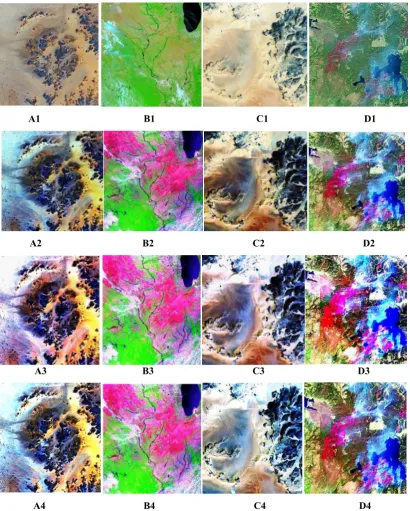
A1 B1 C1 D1
A2 B2 C2 D2
A3 B3 C3 D3
[image:6.595.95.506.75.587.2]A4 B4 C4 D4
Fig.3. A1–D1: Input satellite images [28-31], A2–D2: Enhancement based on DWT-SVD [20], A3–D3: Enhancement based on DWT-SVD-Cuckoo algorithm [20] and A4–D4: Enhancement based on proposed ALO algorithm.
Table I: Quantitative Performance Comparison for Images A-D
Test
Image DWT-SVD [20] DWT-SVD-CUCKOO [20] Proposed ALO
MSE PSNR (db)
MSE PSNR (db)
MSE PSNR (db)
A 5.9260 40.4032 1.4269 46.5870 0.9973 51.4651
B 0.7286 49.5058 0.3994 52.5163 0.3621 53.8439
C 6.0490 40.3139 1.1173 47.8914 0.8232 50.9498
[image:6.595.99.485.656.768.2]E1 F1 G1 H1
E2 F2 G2 H2
E3 F3 G3 H3
E4 F4 G4 H4
Fig.4. E1–H1: Input satellite images [28, 32-34], E2–H2: Enhancement based on DWT-SVD, E3–H3: Enhancement based on Cuckoo algorithm and E4–H4: Enhancement based proposed ALO algorithm.
Table-2: Quantitative performance comparison for images E-H
Test
Image MSE PSNR DWT-SVD DWT-SVD-CUCKOO Proposed ALO
(db) SSIM MSE PSNR (db) SSIM MSE PSNR (db) SSIM
E 1.2874 43.7623 0.7893 0.7475 55.0356 0.9162 0.5203 55.9861 0.9542
F 3.5021 41.3178 0.6925 0.9479 47.4428 0.7327 0.8136 49.5466 0.7782
G 3.8734 40.5497 0.6739 0.9790 48.2439 0.7251 0.8659 49.2759 0.7447
Structural content degradation can be inferred from SSIM index. The SSIM is used to compare the structures of original and thresholded image. The SSIM can take values in [-1, 1] range, and a higher value of SSIM shows better performance.
MSE is evaluated based on
∑ , , , (23)
where Io i, j is the intensity at coordinates (i, j) of the original image and Ie i, j is the intensity of coordinates (i, j) of the enhanced image. Here, x and y are the number of rows and columns in the image.
PSNR in db is computed using the following expression:
10 (24)
where Lmax is the maximum possible pixel value of the image.
The SSIM index is determined as:
, (25)
where, μo and μe stands for mean intensity of original image and enhanced image respectively, σo and σe indicates the standard deviations of original and enhanced respectively, σoe is the covariance between original and enhanced image. C1 and C2 are the constants, and are included to avoid instability when μ2
o and μ2e are very close to zero.
VI. SIMULATIONANDDISCUSSION
The reason behind the need for an efficient and optimized enhancement process is to interpret the captured image by eliminating the noise and improving the contrast between various attributes. This section demonstrates the effectiveness of ALO based methodology over SVD [11] and DWT-SVD-Cuckoo Search [20] by processing the remotely sensed sample images [ 28-34].
The ALO parameters employed should be chosen carefully for the efficient performance of the algorithm. Optimal thresholding and shape turning parameters are searched with number of ants is 30 and number of antlions is 20 (i.e number of search agents= 50) and maximum number of random walk NIt is 500. Convergence is obtained when there is no change in the fitness value for 50 consecutive generations or when maximum number of generations reached, whichever occur first. The bounds of the problem parameters λ, K & S are [1,150], [0.1, 1] and [1, 4].
Fig. 3 and Fig. 4 shows the sample images (A1-H1), DWT-SVD based processed images (A2-H2), output of existing cuckoo search based methodology (A3-H3) and the enhanced images of the proposed ALO based methodology (A4-H4). The numerical comparison of the performance measures are summarized in Table 1 and Table 2.
Contrast enhancement aims to project the minute details in the image more distinguishable for human understanding. Visual inspection of the enhanced images indicates that the proposed ALO based methodology is able to differentiate the minor details in the input image by achieving optimum contrast enhancement with reducing noise than the existing state of art methods. It is inferred from Table 1, ALO based enhanced image-A has a low MSE of 0.9973 than the output
of DWT-SVD- Cuckoo which results 1.4269. The improved MSE leads to higher PSNR value of the ALO based enhanced image due to its ability to suppress the noise effectively in the input satellite image. Qualitative and numerical measures of the output images also vindicate the effectiveness of the ALO algorithm for searching the optimal value of thresholding and shape tuning parameter which is essential for denoising of the image.
Degradation of structural information such as SSIM is an important criterion for analyzing the performance of the image enhancement techniques. In order to compare the adoptability of the proposed method for enhancement in terms of SSIM index proposed ALO, SVD and DWT-SVD-Cuckoo approaches are applied to four test images E, F, G & H. Their qualitative and numerical performances are presented in Fig-4 and Table-2 respectively. It is found from Table-2, SSIM index of the enhanced images based on the proposed approach is more than the existing approaches and their values are nearer to one. It implies that the structure of the original image is preserved in the proposed enhancement process. Visual and index measures proved the suitability of the proposed DWT-SVD-ALO based methodology for contrast enhancement of satellite images.
VII. CONCLUSION
In this paper, DWT-SVD based contrast enhancement of noisy satellite images with optimized adaptive thresholding function using ALO algorithm has been presented. The noise reduction of the wavelet coefficient is carried out by ALO based optimal searching of shape tuning parameters guided in the direction of minimizing the MSE risk of the DWT coefficients for better estimation of the thresholded wavelet coefficients. The illumination information in the thresholded coefficient is modified using SVD for improving the contrast of the image without compromising the natural structure. Qualitative and quantitative measures of test images demonstrate the suitability of the proposed DWT-SVD-ALO based methodology for contrast enhancement of satellite images than the existing methodologies.
VIII. ACKNOWLEDGEMENT
Authors thankfully acknowledge the support and facilities given by the authorities of Annamalai University, Annamalainagar, India to carry out this research work.
IX. REFERENCES
[1] Anji Reddy, “Remote Sensing and Geographical I M
nformation Systems”, Third Edition,BSP, 2008.
[2] Ravi. P Gupta, “Remote Sensing Geology”, Second Edition, Springer, 2003.
[3] S.E. Umbaugh, “Computer vision and image processing”, Prentice-Hall, New Jersey, 1998.
[4] R. C. Gonzalez and R. E. Woods,”Digital image
processing”, Englewood Cliffs, NJ, USA: Prentice-Hall, Oct. 2008.
[6] S. M. Pizer et al., “Adaptive histogram equalization and its variations”, Computer Vis., Graph., Image Process., vol. 39, no. 3, pp. 355–368, Sep. 1987.
[7] Menotti D, Najman L, Facon J, De Araujo AA. “Multi-histogram equalization methods for contrast enhancement and brightness preserving”, IEEE Transaction on Consumer Electronics, vol.53, no. 3, pp. 1186–94, 2007.
[8] Donoho D.L., Johnstone I.M., “Adapting to unknown
smoothness via wavelet shrinkage”, J. Am. Stat. Assoc., vol. 90, pp.1200 – 1224, 1995.
[9] Demirel H, Anbarjafari G., “Discrete wavelet transform-based satellite image resolution enhancement.” IEEE Trans Geosci Remote Sens, vol. 49, no.6, pp. 1997–2004, 2011. [10] Bhutada GG, Anand RS, Saxena SC., “Image enhancement
by wavelet-based thresholding neural network with adaptive learning rate.”, IET Image Process, vol. 5, no. 7, pp. 573– 82, 2011.
[11] Demirel H, Ozcinar C, Anbarjafari G., “Satellite Image contrast enhancement using discrete wavelet transform and singular value decomposition”, IEEE Geosci Remote Sens Lett, vol. 7, no. 2, pp. 333–337, 2010.
[12] Soni V, Bhandari A K, Kumar A, Singh GK.,”Improved sub-band adaptive thresholding function for denoising of satellite image based on evolutionary algorithms.”, IET Signal Process, vol. 7, no. 8, pp. 720–30, 2013.
[13] Bhandari A K, Kumar A,Padhy P K., “Enhancement of low contrast satellite images using discrete cosine transform and singular value decomposition.”, World Acad Sci Eng Tech, vol. 79, pp. 35–41, 2011.
[14] Bhandari AK, A. Kumar, S. Chaudhary, and G. Singh, “A new beta differential evolution algorithm for edge preserved colored satellite image enhancement.”, J. Multidimensional Syst. Signal Process, vol. 28, no.2, pp. 495–527,2017. [15] Bhandari AK, Soni V, Kumar A, Singh GK., “Artificial bee
colony-based satellite image contrast and brightness enhancement technique using DWT-SVD.”, International journal of remote sensing, vol 35, no. 5, pp. 1601- 1624, 2014.
[16] Zhang XP, Desai MD.,”Adaptive denoising based on SURE risk.”, IEEE Signal Process Lett, vol. 5, no. 10, pp.265–7, 1998.
[17] Zhang XP. ”Thresholding neural network for adaptive noise reduction.”, IEEE Trans Neural Network, vol. 12, no. 3, pp. 567–84, 2001.
[18] Nasri M, Pour HN. “Image denoising in the wavelet domain using a new adaptive thresholding function”, Elsevier J Neurocomput , vol. 72, pp. 1012–25, 2009.
[19] Bhutada GG, Anand RS, Saxena SC. “PSO-based learning of sub-band adaptive thresholding function for image denoising.”, Springer Signal, Image &Video Process. (SIViP), Vol. 6, pp. 1–7, 2012.
[20] Bhandari AK, V. Soni, A. Kumar, and G.K. Singh., “Cuckoo search algorithm based satellite image contrast and brightness enhancement using DWT– SVD.”, ISA Trans., vol. 53, no. 4, 1286–1296, 2014.
[21] Bhandari AK, D. Kumar , A. Kumar, and G.K. Singh., “Optimal sub-band adaptive thresholding based edge preserved satellite image denoising using adaptive differential evolution algorithm.”, Neurocomputing, vol. 174, pp. 698-721, 2016.
[22] Shilpa suresh, shyamlal., “Modified differential evolution algorithm for contrast and brightness enhancement of satellite images”, Applied soft computing, Vol. 61, 2017. [23] Shilpa suresh, shyam lal., “A novel adaptive cuckoo search
algorithm for contrast enhancement of satellite images.”, IEEE applied earth observations and remote sensing, 2017. [24] Jia Chen, Weiyu Yu, Jing Tian, Li Chen, Zhili Zhou.,
“Image contrast enhancement using an artificial bee colony algorithm”, Swarm and Evolutionary Computation, 2017. [25] Seyedali Mirjalili., “The Ant Lion Optimizer”, Advances in
Engineering Software, vol. 83, pp. 80-98, 2015.
[26] K.R. Subhashini, Satapathy, “Development of an Enhanced Ant Lion Optimization algorithm and its application in Antenna Array Synthesis.”, Applied Soft Computing, vol. 59, pp. 153-173, 2017.
[27] Amer Draa, Amira Bouaziz., “An artificial bee colony algorithm for image contrast enhancement”, Swarm and Evolutionary Computation, vol.16, pp. 69-84, 2014.
[28] http://www.gauss.ba/en/portfolio/satelitsko-snimanje/. [29] http://earthobservatory.nasa.gov/NaturalHazards/view.php?id
=20046.
[30] http://www.satimagingcorp.com/gallery/geoeye-1-Sahara-desert.html.
[31] http://earthobservatory.nasa.gov/IOTD/view.php?id=39125. [32]
https://www.satimagingcorp.com/gallery/geoeye-1/geoeye-1-namib-desert/.
[33] https://www.satimagingcorp.com/gallery/geoeye-1/geoeye-1-niagara/.