1384
Application of Singularly Perturbed Delay Differential
Equations in Intuitionistic Fuzzy MAGDM Problems
John Robinson P1, Indhumathi M2 1
Assistant Professor, Bishop Heber College, Tiruchirappalli, India. [email protected]
2
Research Scholar, Bishop Heber College, Tiruchirappalli, India. [email protected]
Abstract
-
In this paper, the Multiple Attribute Group Decision Making (MAGDM) problems with Intuitionistic Fuzzy Sets (IFSs) are investigated where the weights of the decision makers about the behaviour of attributes are provided in the form of Singularly Perturbed Delay Differential Equations (SPDDEs). The Decision maker weights are computed using the numerical solutions with a finite difference scheme on Shishkin mesh of SPDDEs. The Intuitionistic Fuzzy Ordered Weighted Averaging (IFOWA) and the Intuitionistic Fuzzy Hybrid Averaging (IFHA) operators are used to aggregate the intuitionistic fuzzy decision matrices. A new correlation coefficient of IFS is proposed and utilised to rank the best alternative. Feasibility and effectiveness of the proposed method is supported with a numerical illustration. Comparison of the proposed model is made with some of the existing distance measures, similarity measures and score functions of ranking the alternatives.Index Terms
-
MAGDM; Intuitionistic Fuzzy Sets; OWA operator; Singular perturbation problem; Delay differential equation; Shishkin mesh; Finite difference scheme.1. INTRODUCTION
In the year 1965, Zadeh [50] introduced the concept of fuzzy set. It contains only a membership function. Later Atanassov [1], [2] and [3] introduced the new type of fuzzy set named as Intuitionistic Fuzzy Sets (IFSs) which is the extension of the concept of fuzzy set. IFSs contains both the membership function and non-membership function. For decision making problems, Szmidt & Kacprzyk [40-44] found the distance between intuitionistic fuzzy sets. The relationship between intuitionistic fuzzy sets, L-fuzzy sets, interval-valued fuzzy sets and interval-valued intuitionistic fuzzy sets were established by Deschrijver & Kerre [10]. For different higher order intuitionistic fuzzy sets, the correlation coefficient was proposed and discussed by Robinson & Amirtharaj [31] to [36] and Robinson [37] and also utilized the correlation measures of ranking the best alternatives in the decision making problem. Yager [49] proposed the ordered weighted averaging (OWA) operator by giving some weights to all inputs according to their ranking positions. Based on its pioneer work, many extensions have been appearing over it to solve the problems of multi-criteria decision making problems. Some geometric aggregation operators for intuitionistic fuzzy sets was proposed and developed by Xu & Yager [48]. Xu also developed some arithmetic aggregation operators, such as the intuitionistic fuzzy weighted averaging (IFWA) operator, the intuitionistic fuzzy ordered weighted averaging
(IFOWA) operator, and the intuitionistic fuzzy hybrid aggregation (IFHA) operator in [46] and [47]. Robinson & Jeeva [38] proposed and discussed the various applications of numerical methods in MAGDM problems especially in situations where the weights of the decision makers are completely unpredictable.
1385 requires the introduction of a transformation of the
problem, which facilitates the necessary alignment of the mesh to the trajectory of the interior layer. For discontinuous source term, De Falco & O’Riordan [9] were proposed a uniformly convergent scheme for a system of two coupled singularly perturbed reaction-diffusion robin type and mixed boundary value problems.
Literature Survey on Delay Differential Equations
Extensive works on asymptotic and numerical methods for second order singularly perturbed delay differential problems are reported in the literature. In [5], a class of delay differential equations with a perturbation parameter
is examined. A hybrid finite difference scheme on an appropriate piecewise uniform mesh of Shishkin-type is derived in [6]. In [16] and [17], boundary value problems for second order singularly perturbed delay differential equations are treated. In [20], a boundary value problem for a second-order singularly perturbed delay differential equation is considered. The singular perturbation theory in ordinary differential equations is extended to delay differential equations with a fixed lag is discussed in [45]. The study in [11] is devoted to the numerical study of boundary value problems for singularly perturbed linear second-order differential-difference equations with a turning point. In [27], the solution to a singularly perturbed second order differential equation with a constant delay having finite element approximation method is studied. In [30], a numerical finite difference method to solve the boundary-value problem for singularly perturbed differential-difference equation, which contains only negative shifts in the differentiated term. In [39], they have studied a numerical solution of singularly perturbed differential-difference equations exhibiting dual layer behaviour. In [13] and [14], computational methods are presented for solving singularly perturbed delay differential equations with negative shift whose solution has boundary layer. In [18], a system of singularly perturbed ordinary differential equations of first order with given initial condition is considered. In [4], a parameter fitted scheme is proposed to solve singularly perturbed delay differential equations of second order with left and right boundary. In [16], a numerical method is proposed to solve boundary-value problems for singularly perturbed differential-difference equations with negative shift. A uniformly-convergent second order Richardson extrapolation technique for solving singularly perturbed delay differential equation is proposed in [24].In this paper, the decision maker presents his/her attribute weights in the form of a SPDDE. The SPDDEs are solved through numerical methods
with a newly proposed finite difference scheme on Shishkin mesh. There are three decision makers in this work whose weights are determined and normalized and utilized in decision making problems. We have investigated the MAGDM problem with intuitionistic fuzzy set for ranking the alternatives together with IFOWA and IFHA operators. Correlation coefficient of IFSs in the range [0,1] is proposed and utilised for ranking the alternatives. A numerical illustration is given to show the effectiveness of the proposed approach.
2. PRELIMINARIES
In this Section, some basic concepts about the IFSs and different classes of aggregation operators are presented.
DEFINITION: Intuitionistic Fuzzy Set, IFS [1-3]
An IFS A in X is given by
, A( ), A( )
,A x
x
x xX where
: 0,1 A X ,A: X
0,1 , with the condition0
A( )
x
A( ) 1,
x
x
X
. The numbers
A
x
and A
x represent, the membership degree and non-membership degree of the element x to the set A, respectively.DEFINITION: Hesitancy Degree of an IFS
For each IFS A in X, if
1
,
,
A
x
Ax
Ax
x
X
then A
x iscalled the degree of indeterminacy or hesitancy of x
to A, where 0 ≤
A
x 1, for all xX.2.1. Different classes of aggregation operators
Different types of aggregation operators are found in the literature for aggregating the information. Different families of OWA operators can be used by choosing a different manifestation of the weighting vector which in detail is discussed in [46], [47] and [49].
DEFINITION: Intuitionistic Fuzzy Weighted Averaging (IFWA) operator
Let
a
j
j,
j
,
for all j = 1,2,…,n be a collection of intuitionistic fuzzy values. The Intuitionistic Fuzzy Weighted Averaging (IFWA)operator,
IFWA Q
:
n
Q
is defined as:
1 2
1 1 1
, ,...,
1 (1 ) ,j j
n
n n
n
j j j j
j j j
IFWA a a a
a
1386
DEFINITION: Intuitionistic Fuzzy Ordered Weighted Averaging (IFOWA) operator
Let
a
j
j,
j
,
for all j = 1,2,…,nbe a collection of intuitionistic fuzzy values. The Intuitionistic Fuzzy Ordered Weighted Averaging
(IFOWA) operator
IFOWA Q
:
n
Q
is definedDEFINITION: Intuitionistic Fuzzy Hybrid Averaging (IFHA) Operator
Let
a
j
(
j,
j)
, for allj
1, 2,...,
n
be a collection of intuitionistic fuzzy values. The Intuitionistic Fuzzy Hybrid Aggregation (IFHA) operator,IFHA Q
:
n
Q
is defined as:3. CORRELATION COEFFICIENT OF INTUITIONISTIC FUZZY SETS(IFSs)
In this paper, we propose a new method for calculating correlation coefficient of IFSs based on the method proposed by Robinson & Amirtharaj [31] for calculating correlation coefficient of vague sets, taking not only the membership and non-membership grades into account but also the negation of
non-is defined as follows:
,
,
The following proposition and theorems are true for the above defined correlation coefficient.
Proposition: For
A B
,
IFS X
( )
, we have4. SINGULARLY PERTURBED DELAY DIFFERENTIAL EQUATIONS (SPDDEs)
1387 the history of the solution.
In this section, a novel numerical method is suggested to solve a second-order SPDDE of reaction-diffusion type. A hybrid finite difference scheme with an appropriate piecewise uniform Shishkin-type mesh is derived. It is shown that the method is almost second order convergence in the maximum norm, independent of the perturbation parameter.
The reduced problem corresponding to (1) and (2) is defined by
In comparison with that of uniform mesh, in piecewise-uniform mesh we give more mesh points in the inner domains so that the layer information can be obtained. A piecewise-uniform Shishkin mesh with N mesh intervals is now constructed on
The interval [0,1] is divided into three subintervals as follows:
[0, ]
( ,1
]
(1
,1].
The parameter
, which determine the points separating the uniform meshes, is defined by1 of N/8 mesh points is placed.
Similarly, the interval (1,2] is also divided into 3 subintervals (1,1
], (1
, 2
] and (2
, 2], using the same parameter
. In particular, when the parameter
takes on its left-hand value, theShishkin mesh
Nbecomes a classical uniform mesh throughout from 0 to 2.In practice, it is convenient to take N=8k,k
2
.4.2. Discrete problem
In this section, a hybrid finite difference scheme operator with an appropriate Shishkin mesh is used to construct a numerical method for (1) and (2).The discrete two-point boundary value problem is now defined to be:
1388 The Novel Hybrid Scheme for SPDDEs is given as:
1 1
This is used to compute numerical approximations to the solution of (1) and (2).
The following discrete results are analogous to those for the continuous case.
Lemma 4.2.1. Let conditionsa x( )b x( )2 and following discrete stability result.
Lemma 4.2.2. Let conditions a x( )b x( )2and
5. DETERMING EXPERTS WEIGHTS FOR MAGDM PROBLEMS USING SPDDEs
Problem proposed by the decision maker-1:
The decision maker represents weighting vector about the behaviour of the attributes in the form of the following Singularly Perturbed delay differential Equation: identified and the numerical solutions at those points are chosen and normalized for obtaining the weighting vector. Details of the weight vector from the decision maker-1 are given in the following table.
Table 1.Numerical Solution of
u x
( ) 4 ( )
u x
u x
(
1) 1
x
X Values of U(X) Weight vector 0.2500000 0.4534445 0.190232379 0.7500000 0.4536239 0.190307642 1.2500000 0.6758255 0.283527296 1.7500000 0.8007408 0.335932683Hence, the weighting vector given by the first decision maker is calculated as
0.190232379, 0.190307642,
D
0.250E-02 0.128E-02 0.643E-03 0.321E-03N
p
0.961E+ 00 0.999E+00 0.100E+01N p
D
0.544E+00 0.544E+00 0.529E+00 0.514E+00The order of convergence=0.9605488E+00. The error constant=0.5436762E+00.
It can be noted that as N increases and
decreases, the error decreases. Numerical solution of( ) 4 ( )
(
1) 1
Problem proposed by the decision maker-2:1389
( ) 4 ( ) ( 1) 2 u x u x u x
for
x
(0, 2),
2
( )
u x x where x [ 1, 0], (2)u 0.
Four distinct points based on the parameter
are identified and the numerical solutions at those points are chosen and normalized for obtaining the weighting vector. Details of the weight vector from the decision maker-2 are given in the following table.Table 3.Numerical Solution of
u x( ) 4 ( ) u x u x( 1) 2
X Values of U(X) Weight vector 0.2500000 0.6408602 0.261998543 0.7500000 0.5161290 0.211005530 1.2500000 0.6601004 0.269864384 1.7500000 0.6289553 0.257131543
Hence, the weighting vector given by the first decision maker is calculated as
0.261998543, 0.211005530, . 0.269864384, 0.257131543
T
w
The maximum point wise errors and the rate of convergence are calculated using the two mesh algorithm in [12] and are presented in table 4:
Table 4.Values of , , , for = and =0.9. 4
N N N N p
D D p C
128 256 512 10242
2
0.912E-03 0.458E-03 0.229E-03 0.115E-03 32
0.130E-02 0.653E-03 0.325E-03 0.162E-03 42
0.184E-02 0.927E-03 0.463E-03 0.231E-03 52
0.262E-02 0.133E-02 0.663E-03 0.331E-03 62
0.368E-02 0.190E-02 0.950E-03 0.474E-03N
D
0.368E-02 0.190E-02 0.950E-03 0.474E-03N
p
0.957E+00 0.997E+00 0.100E+01N p
D
0.789E+00 0.789E+00 0.768E+00 0.743E+00The order of convergence=0.9571305E+00. The error constant=0.7893250E+00.
It can be noted that as N increases and
decreases, the error decreases. Numerical solution of( ) 4 ( ) ( 1) 2
u x u x u x
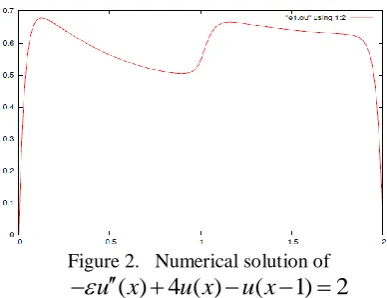
is displayed in figure
2.
Figure 2. Numerical solution of
( ) 4 ( )
(
1)
2
u x
u x
u x
Problem proposed by the decision maker-3:
The decision maker represents weighting vector about the behaviour of the attributes in the form of the following Singularly Perturbed delay differential Equation:
( ) (2
) ( )
(
1)
0
u x
x u x
u x
for x(0, 2),( ) 1
u x forx [ 1, 0], (2) 1u .
Four distinct points based on the parameter
are identified and the numerical solutions at those points are chosen and normalized for obtaining the weighting vector. Details of the weight vector from the decision maker-3 are given in the following table.Table 5.Numerical Solution of
u x( ) (2 x u x) ( )u x( 1) 0 X Values of U(X) Weight vector
0.2500000 0.4461796 0.426800856
0.7500000 0.3637271 0.347929484
1.2500000 0.1381052 0.132106931
1.7500000 0.09739275 0.093162729
Hence, the weighting vector given by the third decision maker is calculated as
0.426800856, 0.347929484, . 0.132106931, 0.093162729
T
The maximum point wise errors and the rate of convergence are calculated using the two mesh algorithm in [12] and are presented in table 6:
Table 6.Values of , , , for = and =0.9 4
N N N N p D D p C
128 256 512 10242
2
0.694E-03 0.344E-03 0.171E-03 0.854E-04 32
0.103E-02 0.507E-03 0.252E-03 0.125E-03 42
0.146E-02 0.719E-03 0.356E-03 0.177E-03 51390
The order of convergence=0.1014829E+01. The error constant=0.7937517E+00.
It can be noted that as N increases and
decreases, the error decreases. Numerical solution of( ) (2 ) ( ) ( 1) 0
6. ALGORTHIM FOR GROUP DECISION MAKING WITH INTUITIONISTIC FUZZY INFORMATION
Step:1 Use the IFOWA operator to aggregate all individual intuitionistic fuzzy decision matrices
k
k(
1, 2,3, 4)
to derive the collective overall preference intuitionistic fuzzy values
r
i
i
1, 2,
..
m
ofthe alternative Ai, with the weighting vectors of the decision makers.
Step:3 Calculate the correlation between the collective overall preference values
r
i and theStep:4 Calculate the correlation coefficient between the collective overall preference values
r
iand the select the best one.7. NUMERICAL ILLUSTRATION
Suppose that a tele-communication company intends to choose a manager for Research and Development department from five volunteers. The decision making committee is assessing the five concerned volunteers based on four attributes shown as follows:
C1-Proficiency in identifying research areas; C2-Proficiency in administration;
C3-Personality; C4-Self Confidence.
The five possible alternatives A ii
1, 2, 3, 4, 5
are tobe evaluated using intuitionistic fuzzy numbers by the three decision makers whose weighting vectors are calculated using singularly perturbed delay differential equation. The decision information is listed in the following matrices as follows:
1391 calculate the correlation coefficient as follows:
1 correlation coefficient, we get:
1 2 3 4 5
.
A
A
A
A
A
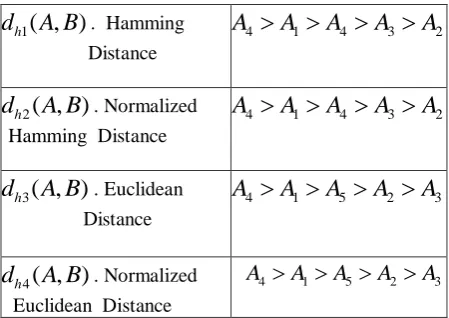
Using step 3 of the same algorithm proposed in the paper with different distance measures [15], we obtain the ranking of best alternatives and the results are obtain the ranking of best alternatives and the results are tabulated as follows:
Table 8. Comparison of the Ranking with Similarity
1392 4.
S
4(
X
ij)
A1A2A3A4A55.
S X
5(
ij),
0.3
6.
S X
5(
ij),
0.5
7.
S X
5(
ij),
0.7
5 2 3 4 1
A A A A A
5 2 3 4 1
A A A A A
2 3 5 4 1
A A A A A
8. DISCUSSION
In this work, the weights of the decision makers are presented in the form of Singularly Perturbed Delay Differential Equations whose solutions are sought through a new hybrid finite difference scheme operator with an appropriate Shishkin mesh which is used to construct numerical methods to solve the SPDDEs. From table 7, 8 and 9 it can be observed that using different ranking methods can yield differences in the ranking of best alternative. Since correlation coefficient can bring out the linear relationship between the variables under study, the ranking of alternatives based on the new proposed correlation coefficient of IFSs in this paper can be considered to be the best ranking process.
9. CONCLUSION
In this work, we have discussed about the weight determining methods together with weighted averaging operator and the ordered weighted averaging operator, which extend two of the most common aggregation operators to accommodate the situations where the input arguments are intuitionistic fuzzy values. The IFWA operator weights only the intuitionistic fuzzy arguments, while the IFOWA
operator weights only the ordered positions of the intuitionistic fuzzy arguments instead of weighting the intuitionistic fuzzy arguments themselves. We have developed the MAGDM model based on hybrid aggregation operator (IFHA), which weights both the given interval valued intuitionistic fuzzy value and its ordered position of the argument. In this paper, a new approach for determining weights of decision makers in group decision environment based on singular perturbation problem is proposed. The decision maker weights are calculated using the numerical solution of SPDDE of reaction-diffusion type problem and applied in MAGDM problems under intuitionistic fuzzy set. The weights calculated by the proposed method, which can relieve the influence of unfair arguments on the final results by assigning low weights to those unduly high or unduly low ones, and hence make the decision results more precise and reasonable when applied to decision making based on intuitionistic fuzzy information. Different comparisons were made with existing ranking
methods and the effectiveness of the proposed method was displayed by numerical illustration.
REFERENCES
[1] Atanassov, K. (1986): Intuitionistic fuzzy sets. Fuzzy Sets and Systems, 20(1), pp. 87-96.
[2] Atanassov, K. (1989): More on intuitionistic fuzzy sets. Fuzzy Sets and Systems, 33(1), pp. 37–46.
[3] Atanassov, K. (1994): New operations defined over the intuitionistic fuzzy sets. Fuzzy Sets and Systems, 61(2), pp. 137–142.
[4] Andargie, A.; Reedy, Y.N. (2012): An asymptotic-fitted method for solving singularly perturbed delay differential equations. Applied Mathematics, 3(8), pp. 895-902.
[5] Cen, Z. (2010): A second-order finite difference scheme for a class of singularly perturbed delay differential equations. International Journal of Computer Mathematics, 887(1), pp. 173-185. [6] Cen, Z. (2008): A hybrid finite difference
scheme for a class of singularly perturbed delay differential equations. Neural, Parallel, and Scientific Computations, 16(3), pp. 303-308. [7] Chen, T. (2011): Experimental analysis of score
functions in multi-criteria Decision making with intuitionistic fuzzy sets. Journal of the Chinese Institute of Industrial Engineers, 28(3), pp. 206-225.
[8] Chen, S.M.; Randyanto, Y. (2013). A novel similarity measure between intuitionistic fuzzy sets and its applications. International Journal of Pattern Recognition and Artificial Intelligence, 27(7), 1350021 (34 pages).
[9] Falco, C.De.; O’Riordan, E. (2004): Interior layers in a reaction-diffusion equation with a discontinuous diffusion coefficient. International Journal of Numerical Analysis Model, 40, pp. 1375-1392.
[10] Deschrijver, G.; Kerre, E. (2003): On the relationship between some extensions of fuzzy set theory. Fuzzy Sets and Systems, 133, pp. 227-235.
[11] Eloe, P.W.; Raffoul, Y.N.; Tisdell, C.C. (2005): Existence, uniqueness and constructive results for delay differential equations. Electronic Journal of Differential Equations, 2005(121), pp.1-11.
1393 [13]File, G.; Reddy, Y.N. (2013): Computational
method for solving singularly perturbed delay differential equations with negative shift. International Journal of Applied Science and Engineering, 11(1), pp. 101-113.
[14]File, G.; .Reedy, Y.N. (2014): A non-asymptotic method for singularly perturbed delay differential equations. Journal of Applied Mathematics and Informatics, 32(1-2), pp. 39-53.
[15]Grzegorzewski, P. (2003): Distances between intuitionistic fuzzy sets and/or interval-valued fuzzy sets based on the Hausdroff metric. Fuzzy Sets and Systems, 148, pp. 319-328.
[16]Kadalbajoo, M.K. Sharma, K.K. (2004): Numerical analysis of singularly perturbed delay differential equations with layer behavior. Applied Mathematics and Computation, 157(1), pp. 11-28.
[17]Kadalbajoo, M.K.; Sharma, K.K. (2005): Numerical treatment of boundary value problems for second order singularly perturbed delay differential equations. Computational and Applied Mathematics, 24(2), pp. 151-172. [18] Longtin, A.; Milton, J.G. (1988): Complex
oscillations in the human pupil-light reflex with mixed and delayed feedback. Mathematical Biosciences, 90(1-2), pp. 183-199.
[19]Mackey, M.C.; Glass, L. (1977): Oscillation and chaos in physiological control systems. Science, 197(4300), pp. 287-289.
[20]Manikandan, M.; Shivaranjani, N.; Miller, J.J.H.; Valarmathi, S. (2014): A parameter-uniform numerical method for a boundary value problem for a singularly perturbed delay differential equation. Advances in Applied mathematics, Springer Proceedings in Mathematics and Statistics 87, pp. 71-88. [21]Malley, R. E. O. (1974): Introduction to singular
perturbations. Academic press, New York. [22]Miller, J.J.H.; O’Riordan, E.; Shishkin, G.I.
(1996): Fitted numerical methods for singular perturbation problems. World scientific Publishing Co. Pvt. Ltd.
[23]Miller, J.J.H.; O’Riordan, E.; Shishkin, G.I. (2012): Fitted numerical methods for singular perturbation problems (Revised Edition). World Scientific, Singapore.
[24]Mohapatra, J.; Natesan, S.; (2008): Uniformly convergent second-order numerical method for singularly perturbed delay differential equations. Neural, Parallel, and Scientific Computations, 16(3), pp. 353-370.
[25]Murray, J.D. (2002): Mathematical biology: An Introduction (Third Edition).Springer.
[26]Nayfeh, A. H. (1973): Perturbation methods. John Wiley and sons,Newyork.
[27]Nicaise, S.; Xenophotons, C. (2103): Robust approximation of singularly perturbed delay differential equations by the hp finite element method. Computations Methods in Applied Mathematics, 13(1), pp. 21-37.
[28]Nelson, P.W.; Perelson, A.S. (2002): Mathematical analysis of delay differential equation models of HIV-1 infection. Mathematical Biosciences, 179(1), pp. 73-94. [29]O’Riordan, E. (2016): Interior layers in
singularly perturbed problems. Differential equations and Numerical Analysis, Springer, Proceedings in Mathematics & Statistics, 172. [30]Phaneendra, K.; Soujanya, GBSL.; Reddy, Y.N.
(2014): Numerical solutions of second order of singularly perturbed differential- difference equations with negative shift. International Journal of Nonlinear Science, 18(3), pp. 200-209.
[31]Robinson, J.P.; Amirtharaj, E.C.H. (2011): A short prime on the correlation coefficient of vague sets. International Journal of Fuzzy System Applications, 1(2), pp. 55-69.
[32]Robinson, J.P.; Amirtharaj, E.C.H. (2102a): Vague Correlation coefficient of Interval Vague sets. International Journal of fuzzy System Applications, 2(1), pp. 18-34.
[33]Robinson, J.P.; Amirtharaj, E.C.H. (2102b): A search for the Correlation coefficient of Triangular and Trapezoidal intuitionistic Fuzzy sets for Multiple Attribute Group Decision Making. Communications in computer and Information Sciences-283, Springer –Verlag, pp. 333-342. [34]Robinson, J.P.; Amirtharaj, E.C.H. (2014a):
MADM Problems with Correlation Coefficient of Trapezoidal Fuzzy Intuitionistic Fuzzy Sets. Advances in Decision Sciences, 2014, pp. 1-10. [35]Robinson, J.P.; Amirtharaj, E.C.H. (2014b):
Efficient Multiple Attribute Group Decision Making Models with Correlation Coefficient of Vague sets. International Journal of Operations Research and Information Systems. 5(3), pp. 27-51.
[36]Robinson, J.P.; Amirtharaj, E.C.H. (2015): MAGDM Problems with Correlation coefficient of Triangular Fuzzy IFS. International Journal of Fuzzy System Applications, 4(1), pp.1-32.
1394 Problems. International Journal of Fuzzy System
Applications, 5(3), pp. 42-76.
[38]Robinson, J.P.; Jeeva, S. (2017): Application of Jacobian& SOR Iteration process in Intuitionistic Fuzzy MAGDM Problems. Mathematical Sciences International Research Journal, 6(2), pp. 130-134. [39]Sirisha, L.; Reddy, Y.N. (2014): Numerical
solution of singularly perturbed differential-difference equations with dual layer. American Journal of Applied Mathematics and Statistics, 2(5), pp. 336-343.
[40]Szmidt, E.; Kacprzyk, J. (1997): On measuring distance between intuitionistic fuzzy sets. Notes IFS, 3, pp. 1-13.
[41]Szmidt, E.; Kacprzyk, J. (1997): Distance between intuitionistic fuzzy sets. Fuzzy Sets and Systems, 144, pp. 505-518.
[42]Szmidt, E.; Kacprzyk, J. (1997): Intuitionistic fuzzy sets in decision making. Notes IFS, 2(1), pp. 1-13.
[43]Szmidt, E.; Kacprzyk, J. (1998): Group decision making under intuitionistic fuzzy preference relations. Proceedings in Seventh International Conference IMPU’98, Paris, pp. 172-178. [44]Szmidt, E.; Kacprzyk, J. (1998): Applications of
intuitionistic fuzzy sets in decision making. Proceedings in Eighth International Conference EUSFLAT’98, Pamplona,pp. 150-158.
[45]Tian, H. (2003): Asymptotic expansion for the solution of singularly perturbed delay differential equations. Journal of Mathematical Analysis and Application, 28(1), pp. 678-696. [46]Xu, Z.S. (2007a): Intuitionistic fuzzy
aggregation operators. IEEE Transactions on Fuzzy System, 15(6), pp. 1179–1187.
[47]Xu, Z.S. (2007b): Intuitionistic preference relations and their application in group decision making. Information Sciences, 177(11), pp. 2363–2379.
[48]Xu, Z.S; Yager, R.R. (2006): Some geometric aggregation operators based on intuitionistic fuzzy sets. International Journal of General Systems, 35(4), pp. 417–433.
[49]Yager, R.R. (1998): On ordered weighted averaging aggregation operators in multi criteria decision making. IEEE Transactions on Systems, Man, and Cybernetics, 18(1), pp. 183-190. [50]Zadeh, L.A. (1965): Fuzzy Sets. Information and
Control, 8(3), pp. 338–356.