International Journal of Advanced Research in Computer Science
Abstract:In this paper we propose a new encryption algorithm, which is called as HASCII Algorithm. This encryption algorithm is simple and fast. It provides security and limits the added time cost for encryption and decryption to as to not degrade the performance of a database system which at last also degrades the performance of the whole system. Encryption in database systems is an important topic for research, as secure and efficient algorithms are needed that provide the ability to query over encrypted database and allow optimized encryption and decryption of data. Clearly, there is a compromise between the degree of security provided by encryption and the efficient querying of the database, because the operations of encryption and decryption greatly degrade query performance. Results of a set of experiments validate the functionality and usability of the proposed algorithm.
Keywords:Encryption, Database Security, Decryption, passwords, 2‟s Complement, ASCII
I. INTRODUCTION
Database security concerns the use of a broad range of information security controls to protect databases (potentially including the data, the database applications or stored functions, the database systems, the database servers and the associated network links) against compromises of their confidentiality, integrity and availability. It involves various types or categories of controls, such as technical, procedural/administrative and physical.
Databases can be treasure troves of sensitive information. They can contain customers' personal data, confidential competitive information, and intellectual property. Lost or stolen data, especially customer data, can result in brand damage, competitive disadvantage, and serious fines—even lawsuits. Many of today‟s privacy mandates require protecting data at rest, and the database is an obvious place where data accumulates and is potentially accessible to range of business systems and users. Organizations can choose to encrypt data at the application level, the database level, or the storage level. Encryption at the lowest of these levels, the storage level—on the disk or tape—guards against risk in the case where storage media are lost, but it does little to protect against malicious insiders or systems infected by malware . Application-level encryption on the other hand represents the other extreme by providing the highest degree of control, but it may not always be a viable approach. Because of these tradeoffs, many organizations are increasingly turning to database encryption as offering the best of both worlds when it comes to protecting data at rest—the protection goes further than storage level encryption and also avoids widespread changes in the application layer. [1]
As corporate networks become more and more open to the outside to accommodate suppliers, customers and partners,
network perimeter security is no longer sufficient to protect data. Industry experts have long recommended a “defense in depth” approach by adding layers of security around the data. With the network being regarded as inherently insecure, encrypting the data it is the best option, often cited as the “last line of defense”. In terms of database security, encryption secures the actual data within the database and protects backups. That means data remains protected even in the event of a data breach. [2]
Encryption mechanism can prevent users from obtaining data in an unauthorized manner. Encryption mechanism can verify the authentic origin of a data item. Encryption mechanism also prevents from leaking information in a database when storage mediums, such as disks, CD-ROM, and tapes, are lost. When data is stored in the form of cipher, we have to decrypt all the encrypted data before querying them. For this purpose, we put forward the innovative encryption algorithm, known as “HASCII Algorithm”. Our new encryption algorithm is efficient and reliable. It has accomplished security requirements and is fast enough for most widely used software. This encryption algorithm limits the added time cost for encryption and decryption and at the same time improves the performance of the query over encrypted database. We also provide a thorough description of the proposed encryption algorithm and its processes.[3]
II. ALGORITHM
A. Encryption :
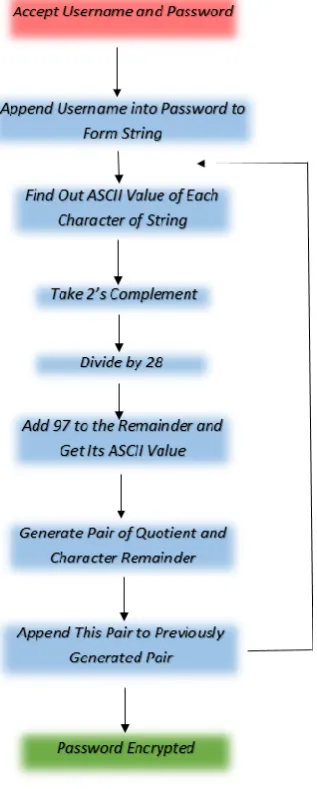
Figure-2 Shows steps followed in encryption. Steps are explained below.
Figure 1. Encryption and Decryption in HASCII algorithm
Figure 2. Encryption in HASCII algorithm
Accept username and password from the user
Generate a String with a Combination of username and password.
o Accept username
o Append Password to the Username only till length equal to that of the username. o If length of the appended password is less
than that of the username, make it equal by inserting blank spaces.
o If all characters of the password are not appended, repeat 1,2 and 3 else repeat 1 From the String Generated in Step 2 take a character.
Find out ASCII Value of that Character. Take 2‟s complement.
Divide that ASCII Value with 28.
Add 97 and convert that integer value to a Character according to ASCII.
Form pair of quotient and generated character. Append generated pair to String.
Repeat from Step 3 to Step 8 till all characters are read.
Exit, as encrypted password is obtained and stored in the database.
Figure 3. String Formation in HASCII algorithm
B. Decryption :
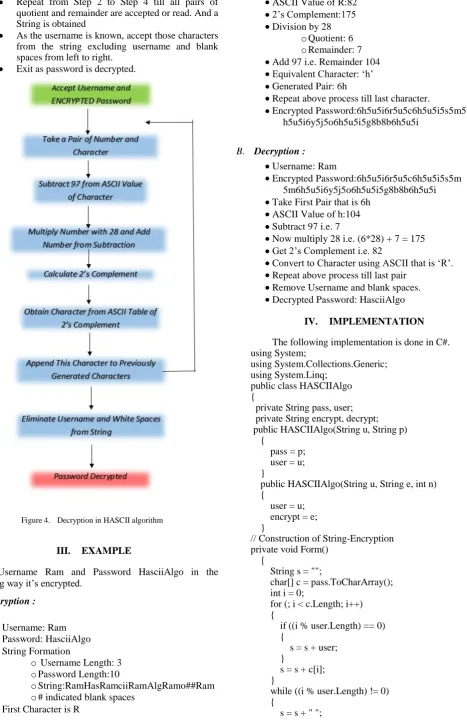
Figure-4 Shows decryption algorithm and steps followed is explained below.
Accept encrypted password from the database. Accept a pair of characters i.e. quotient and remainder which are not yet read.
Repeat from Step 2 to Step 4 till all pairs of quotient and remainder are accepted or read. And a String is obtained
As the username is known, accept those characters from the string excluding username and blank spaces from left to right.
Exit as password is decrypted.
Figure 4. Decryption in HASCII algorithm
III. EXAMPLE
Let Username Ram and Password HasciiAlgo in the following way it‟s encrypted.
A. Encryption :
Username: Ram Password: HasciiAlgo String Formation
o Username Length: 3 oPassword Length:10
oString:RamHasRamciiRamAlgRamo##Ram o# indicated blank spaces
First Character is R
ASCII Value of R:82 2‟s Complement:175 Division by 28
oQuotient: 6 oRemainder: 7 Add 97 i.e. Remainder 104 Equivalent Character: „h‟ Generated Pair: 6h
Repeat above process till last character.
Encrypted Password:6h5u5i6r5u5c6h5u5i5s5m5m6 h5u5i6y5j5o6h5u5i5g8b8b6h5u5i
B. Decryption :
Username: Ram
Encrypted Password:6h5u5i6r5u5c6h5u5i5s5m 5m6h5u5i6y5j5o6h5u5i5g8b8b6h5u5i Take First Pair that is 6h
ASCII Value of h:104 Subtract 97 i.e. 7
Now multiply 28 i.e. (6*28) + 7 = 175 Get 2‟s Complement i.e. 82
Convert to Character using ASCII that is „R‟. Repeat above process till last pair
Remove Username and blank spaces. Decrypted Password: HasciiAlgo
IV. IMPLEMENTATION
The following implementation is done in C#. using System;
using System.Collections.Generic; using System.Linq;
public class HASCIIAlgo {
private String pass, user; private String encrypt, decrypt; public HASCIIAlgo(String u, String p) {
pass = p; user = u; }
public HASCIIAlgo(String u, String e, int n) {
user = u; encrypt = e; }
// Construction of String-Encryption private void Form()
{
String s = "";
char[] c = pass.ToCharArray(); int i = 0;
for (; i < c.Length; i++) {
if ((i % user.Length) == 0) {
s = s + user; }
s = s + c[i]; }
while ((i % user.Length) != 0) {
i++;
public String Get_Decrypted_Value() { encrypting and decrypting the messages. It provides maximum security and limits the added time cost for encryption and decryption.
It has accomplished security requirements and is fast enough for most widely used software.
It has a variable key-length which offers better security.
The positions where the key would be used is not fixed (dynamic). Hence it offers confusion which in-turn increases the security of the system.
The encryption algorithm contains simple arithmetic operations which are easy to realize and implement. It reduces the time cost for encryption/decryption process as compared to algorithms like DES, AES, blue-fish, etc.
some other existing algorithms, still it requires a sufficient amount of time.
If careful observation is made on the cipher text, then it can be found that there are some repeating patterns of text which are nothing but the encryption of the keys. If the attacker gets to know the algorithm used then there is a possibility of information prediction. Although it is a very tough task, still it is not impossible to break the algorithm.
VI. CONCLUSION
HASCII algorithm takes some intermediate processing time for encryption and decryption purpose, but it also offers a very good and efficient security to the data which is needed to be protected. So, it involves a trade-off between the time performance and security performance factor.
VII. ACKNOWLEDGMENT
Through this acknowledgement, we express our sincere gratitude to all those people who have been associated with this project and helped us with it and made it a worthwhile experience. Firstly we extend our thanks to the various people who have shared their Signatures. Our deepest thanks to Ms.
Suchita Patil, the guide of our project for guiding us with attention and care. Also, we would like to express our gratitude to Prof. Swati Mali Deshpande and Prof. Pallavi Kulkarni for helping us. We would also thank our institution and our faculty members.
VIII. REFERENCES
[1] Bouganim L. and Pucheral P., “Chip-SecuredData Access: Confidential Data on Untrusted Servers,” in Proceedings of the 28th International Conference on Very Large Data Bases, China,pp. 131-142, 2002.
[2] Chen G., Chen K., and Dong J., “A Database Encryption Scheme for Enhanced Security and Easy Sharing,” in Proceedings of the 10th International Conference on Computer Supported Cooperative Work in Design, Nanjing pp. 1-6, 2006.
[3] Coppersmith D., “The Data Encryption Standard and Its Strength Against Attacks,” IBM Journal of Research and Development, vol. 38, no. 3, pp. 243-250, 1994.