Pattern Discovery in Text Mining Using Text
Patterns and Clustering
Manjiri M. More 1 , Prof. Archana S. Vaidya2
PG Student, Department of Computer Engineering, Gokhale Education Society’s R. H. Sapat College of Engineering,
Nashik, India1
PG Coordinator, Department of Computer Engineering, Gokhale Education Society’s R. H. Sapat College of
Engineering, Nashik, India2
ABSTRACT: Topic modeling has been generally acknowledged in the regions of machine learning and data mining, etc. It was proposed to produce statistical models to gather numerous topics in a collection of documents. A principal supposition for this strategy is that the documents in the collection are about one topic. Topic modeling, for example, LDA (Latent Dirichlet Allocation), was proposed to make statistical model to show multiple topics in a collection of documents, and this has been broadly utilized as a part of the fields of information retrieval. However, its adequacy in information filtering has not been very much assessed. Patterns are always thought to be more discriminative than single terms for describing documents. Determination of the most illustrative and discriminative patterns from the huge amount of discovered patterns becomes critical. To manage the limitation and issues, a novel information filtering model is proposed. Proposed model incorporates user information needs that are produced as far as different topics where every topic is appeared by patterns. Patterns are produced from topic models and are sorted out as far as their statistical and taxonomic feature and the most discriminative and representative patterns are proposed to the document relevance to the user’s information needs to filter out unessential documents. Experiments are conducted to find effectiveness of Maximum matched Pattern-based Topic model with Dimensionality Reduction (MPBTM-DR) by using TREC data collection Routers Corpus Volume 1.The results shows that MPBTM-DR model significantly outperforms term-based model.
KEYWORDS: Topic modeling, Text mining, Document relevance, Information filtering, Information retrieval. Latent dirichlet allocation
I.INTRODUCTION
issue is that the word based topic representation is confined to distinctively speak about documents which have diverse semantic content since numerous words in the topic representation are duplicate general words.
In this paper, we propose to choose the most discriminative and representative patterns, which are known as Maximum matched patterns, to speak about topics instead of utilizing frequent patterns. A new topic model, called MPBTM-DR (Maximum matched Pattern based Topic Model with Dimensionality Reduction) is proposed for document representation and relevance ranking. The patterns in the MPBTM-DR are all around organized with the goal that maximum matched patterns are efficiently and effectively used to represent and rank documents.
The association of this paper is as per the following. Section 2 audits the literature survey. In section 3, we present details of proposed work. Section 4 presents mathematical model. Section 5 contains experimental setup and results. Finally paper concludes in section 6.
II. LITERATURE SURVEY
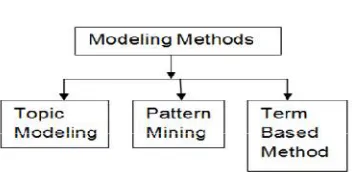
Fig 1: Three technical categories of modeling.
H.Zaragoza, S.Robertson, and M.Taylor in [1] demonstrates that term based methodology gives efficient computational execution, and also theories for term weighting. But it makes issue of polysemy and synonymy.
M. Ester,F. Beil,and X. Xu in [2] has proposed a pattern mining based procedures which is utilized to make practical and effective utilization of patterns to represent users interest and effectively get a few upgrades in effectiveness since pattern convey more semantic significance than terms.
A. Y. Ng,D. M. Blei, and M. I. Jordan, in [3] has displayed a topic modeling strategy which is a standout among the most liked probabilistic text modeling strategies and has been immediately acknowledged by machine learning and text mining . It consequently classifies documents in a collection by various topics and speaks each document with numerous topics and their respective distribution .It has ambiguity.
D. M. Blei and C. Wang in [7] proposed Probabilistic topic modeling which separate long term user interests by examine content and representing it in terms of latent topics decided from user profiles. The significant documents are controlled by a user-specific topic model that has been separated from the users information needs. These topic model based applications are all connected to long term user extraction needs and related to the task of this paper. But, there is a nonappearance of explicit discrimination in the greater part of the language model based methodologies and probabilistic topic models. This weakness shows that there are still a few gaps between the present models and what we have to accurately model the significance of documents.
H. D. Kim, Y. Lu , C. Zhai and , D. H. Park, in [8] has proposed frequent patterns which are pre-created from the original documents and after that embedded into the original documents as a part of the input to a topic modeling , for example, LDA(Latent Dirichlet Allocation). The resulting topic representations incorporate both individual words and pre-generated patterns.
S. Mukhopadhyay, J. Mostafa,W. Lam, and M. Palakal,in [9] has concentrated on a multilevel strategy to intelligent information filtering. A filtering model is recommended that partitions the overall task into subsystem functionalities and highlights the need for numerous adaptation techniques to cope with uncertainties. Proposed filtering framework executed taking into account the model, utilizing traditional methodology as a part of information retrieval and artificial intelligence. These techniques incorporate document representation by a vector space model, document classification by means of unsupervised learning, and user modeling through reinforcement learning. Framework filters information based on content and a user’s specific interest. The users interest are automatic learned with just limited user intervention as ideal relevance feedback for documents.
a ranking task. Techniques, for example, Naive Bayes and SVM appoint binary decisions to documents (irrelevant or relevant) as a special type of classification.
A. McCallum,X. Wang, and X. Wei [11] has proposed a topical n-Gram model which consequently and at the same time finds topics and extracts topically appropriate phrases. It has been consistently coordinated into the language modeling based IR task. Compared with word representation, phrases are more discriminative and convey more concrete semantics. Since phrases are less arguable than words, they have been broadly assessed as text representation for text retrieval, yet few studies here have demonstrated important enhancements in effectiveness.
D. H. Park, H. D. Kim, C. Zhai and Y. Lu in [12] demonstrate that the topics in the PBTM model are represented by patterns only.
G. Karypis, and A.Tagarelli in [13] has concentrated on a segment based way to clustering multi-topic documents. They tended to the issue of multitopic document clustering by leveraging the natural composition of documents in text segments, which bear one or numerous topics on their own.
Y. Li, N. Zhong, and S.T. Wu in [14] successful pattern discovery for text mining is proposed. Author concentrated on another and effective pattern discovery technique which incorporates the method of pattern deploying and pattern evolving, to improve effectiveness of utilizing and upgrading produced patterns for finding relevant and interesting information. In this work, an efficient pattern discovery strategy has been concentrated on to minimize the low-frequency and misinterpretation issues for data mining. The proposed approach utilizes two methods, pattern deploying and pattern evolving to refine the found patterns in text documents.
Our contribution is the use of dimension reduction techniques. Dimension reduction refers to the procedure of converting a set of data having vast dimensions into data with low dimensions ensuring that it conveys similar information concisely. Here we use missing values and low variance methods for dimensionality reduction. While exploring data, if we encounter too many missing values, we impute missing values because it would not have lot more details about data set. Also, it would not help to improve the power of model. Low variance method is useful where we have a constant variable (all observations have same value,10) in our data set. Power of model is not improved, because it has zero variance. In case of vast number of dimensions, we should drop variables having low variance compared to others because these variables will not explain the variation in target variables. In our contribution we also use document similarity clustering technique to recommend similar document to user as per his/her interest.
III. PROPOSED WORK
In proposed framework user’s interest with numerous topics are considered. The proposed model Maximum Matched Pattern-based Topic Model with Dimensionality Reduction made up of topic distributions describing topic preferences of every document or the document collection and pattern-based topic presentations demonstrating the semantic meaning of every topic. User’s interest includes various aspects identifying with different topics. The most motivating contribution of topic modeling is that it consequently arranges documents in a collection by various topics and represents to each document with various topics and their relating distribution.
A. Proposed System Architecture
In our proposed framework we have utilized MPBTM-DR model for information filtering 1) MPBTM-DR produce users interest model for various topic not for single topic.
2) Proposed model present topic preferences of collection of document and pattern based topic representation representing to the specific significance of every topic.
3) In this model pattern are partitioned into groups gathering called as equivalent classes in view of their characteristics and statistical features .In all present class pattern have same frequency and essential meaning with this structured representation .The majority part of representative pattern are recognized and this pattern utilized for information filtering.
4) When we get very much structured pattern based topic model then we proposed new ranking technique for document filtering. At the point when new document are coming in gathered documents then again maximum matched pattern are utilized to calculate importance of the new approaching document to the users interest.
example, LDA. The subsequent topic representations contain both individual words and pre-generated patterns. Our proposed model MPBTM-DR is not quite the same as the other model [18] as in the topics in the MPBTM-DR model are appeared by patterns only. Patterns in the model are very much organized so maximum matched patterns are distinguished and used to estimate. Collection of documents is given as input in the block diagram. Initially pattern improved LDA is utilized to discover most significant patterns which represent maximum matched patterns. Develop another transactional dataset from the LDA model which brings about document collection D. At that point, produce pattern based representations from the transactional dataset to show user needs of the collection D. When we get number of patterns some are helpful and a few patterns don’t have any significance. We are discovering most useful and long patterns from the arrangement of pattern. At that point most ranked pattern is utilized for information filtering. After that relevance ranking of document is done. Yield of the framework is most applicable documents from the collection of documents.
Fig 2: Proposed system (MPBTM-DR) Block Diagram
3.1 Pattern Enhanced LDA
Pattern is normally characterized as an arrangement of related terms or words. Patterns convey more semantic importance and are more understandable than individual words. It assumes an essential part in numerous data mining tasks coordinated toward finding interesting patterns in datasets. Pattern based representations are more meaningful and more accurate to represent topics than word-based representations.
Table 1: Example Results of LDA: Word-Topic Assignments
Topic Document Topic Id 1 words Topic Id 2 words Topic Id 3 words
Document Id 1 compute,image,software, image,compute
compute,language,sructure visual,logic,logic
Document Id 2 image,engine,engine visual,structure,compute,structure compute,model,learn Document Id 3 image,compute,visual,graphic visual,software,software,image engine,visual,logic,model Document Id 4 image,visual,environment language,structure,compute compute,model,logic
3.1.1 Construction of Transactional Dataset
The motivation behind the proposed design based strategy is to find related words (i.e., patterns) from the words allocate b y LDA to topics.
Let Rdi, Zjrepresent to the word-topic assignment to t o p i c Ziin d o c u m e n t di. Rdi, Zj is a sequence o f words relegated to t op i c Zj. We build an transaction dataset Γj for each word-topic assignment Rdi
,Zj to Zj , j=1,...,V and i=1,...,M here V is the number of topics and M is the number of documents. Let
Patterns Support
{compute},{structure},{compute, structure} 3
{visual}{structure, language},{language},{compute, language},{compute, structure, language} 2
T TDT TDT TDT
Document Id 1 {compute,image, software} {compute,language, structure} {visual,logic}
Document Id 2 {image,engine} {visual,structure, compute} {compute,model, learn} Document Id 3 {image, compute, visual, graphic} {visual,software, image} {engine, visual,logic, model} Document Id 4 {image,visual, environment} {language,structure, compute} {compute,model, logic}
Γ1 Γ2 Γ3
allocated t o topic Zj by LDA. For example from Table 1 for topic (Z1)in Document (d1 ) word-topic assignment is{compute, image, software, image, compute}after eliminating the repeated transaction dataset Γ1 is generated for topic (Z1 ) and {compute, image, software} be the topical document transaction (TDT).
Table 2: Transactional Datasets Generated from Table 1
3.1.2 Topic based Pattern Representation
Frequent patterns are created in this stage. Table 3 demonstrates the frequent patterns produced for (Z2).The frequent patterns are created from each transactional dataset.
Table 3: The Frequent Patterns for Computer (Z2), σ = 2
The f r e q u e n c y o f t h e itemset X is d e f i n e d a s | | ...(1)
Give σ minimum support threshold, then an itemset X in Γj is frequent if support(X) ≥ σ, here support(X) is the support of X which is the number of transaction in Γj having X.
3.1.3 Construction of Pattern Equivalence Class
The number of frequent patterns in topics is very large and a large portion of the patterns are not discriminative to speak about particular topic. As a conclusion, these topic representations are not sufficient to represent t o the documents a c c u r a t e l y . That implies the pattern based representation that represent to the user interest is not exact or adequate to be utilized to decide the importance of new documents. So the importance of the new documents is evaluated taking into account the most distinctive and representative patterns. These patterns are the more particular and representative p a t te r n s. Rather than frequent patterns, closed patterns are useful for topic representation and the numbers of these patterns are smaller than the number of frequent patterns for a dataset [16], [17].
1. Closed Itemset [15]: For a transactional d a t a s e t , an itemset X is a closed itemset i f there
exists no itemset X such that (1) X⊂ X′
‘
(2) support(X) = support(X′).2. Generator [15]: For a transactional dataset G, let X be a closed itemset and T(X) consists of all transactions
in Γ that contain X, then an itemset g is said to be a generator of X iff g ⊂ X, T (g) = T(X) and support(X) = support(g).
3. Equivalence Class[15]: For a transactional dataset , let X be a closed itemset and G(X) consist of all generators of X, then the equivalence class of X in Γ, denoted as EC(X),is defined as EC(X) = G(X) ∪{X}.
EC2,1 EC2,2 EC2,3
{compute, structure} {compute, structure , language} {visual}
{compute} {compute, language}
{structure} {structure,language}
{language}
Table 4: The Equivalence Classes i n (Z2)
Every t o p i c m a y b e having a set of equivalent classes. These equivalent classes are useful t o represent the user interest m o d e l . Let E (Zi ) is the set of equivalent classes of topic Zi and the user interest model for number of topics (V) are represented as UE ={ E(Z1 ),E(Z2 ),...,E(Zv )}. The proposed Information filtering model is pr esen t ed in t w o algorithms: user profiling (creating user i n t e r e s t models) algorithm and document filtering ( relevance ranking of incoming documents) algorithm
A. Algorithm (User Profiling)
Input: set of documents D, number o f topics V minimum support σj as threshold for topic Zj.
Output : user interest model, UE ={E(Z1 ),E(Z2 ),...,E(Zv )}.
1. Load collection o f input documents D 2. Perform stemming and r emove stop wor ds
3. Dimensions reductions based on user profile attribute
4. Apply L D A and g e n er a t e word-topic assignment for V number of topics 5. UE = { }
6. for each topic Zj do
7. Construct the Transaction Dataset Γ j
8. Generate all frequent patterns whose support(X) ≥ σ using pattern mining techniques 9. Construct equivalent classes E (Zj )
10. Construct user interest model UE = {E (Z1), E (Z2)...E Zv)} 11. End for
User profiling algorithm produces pattern based topic representations to represent the user’s in for mat i on needs. Algorithm uses f u n c t i o n s such a s c o n st r u c t i o n of t r a n s a c t i o n a l dataset, c onstr uc t ion of u s e r interest model a n d con str uction of equivalence class.
3.2 Document Relevance Ranking
Significance o f the d o c u m e n t s is assessed based on the user interest m o d e l to filter out irrelevant documents. The maximum matched patterns in the equivalent classes are helpful to assess the relevance of the new incoming documents to the user interest. In light of the relevance of the documents the new documents will be ranked.
3.2.1 Relevance Based on Equivalent Class Frequency
The count of the pattern present in the incoming document is also considered while estimating the relevance. The more number of presences of patterns, relevance of the document is more. Therefore document relevance is evaluated utilizing the equation
Rank E (d) = ………..(2) Where V is the quantity of topics and fjk represents the frequency of equivalent class. Represents the
maximum matched patterns to the equivalent classes is the topic distribution. Uniform distribution represents estimated uniform distribution and EC frequency is the Equivalent class frequency.
B. Algorithm (Document Filtering)
Output: ranked documents 1. Rank (d) =0
2. for each document d do 3. for each topic Zj do
4. for each equivalence classes do
5. Scan all the equivalent classes and find out the maximum matched pattern 6. for each maximum matched pattern which is exist in d
7. Calculate rank using equation 1
8. Check the distribution of pattern in the document d 9. End for
10. Calculate the equivalent class frequency 11. Update Rank (d) using the equation (1)
12. Rank E (d) = rank (d) + |MCdjk|0.5 * δ (MCdjk, d) *fj,k * ϑD,j 13. End for
14. End for 15. End for
The Document filtering algorithm ranks the incoming documents in view of the significance of the documents to the user’s needs. Algorithm scans the documents to find maximum matched pattern and update the ranking of documents.
IV. MATHEMATICAL MODEL S= {S, E, I, O, Fs, DD, NDD, Øs}
S: Initial state: User asks for information about a product. The user probably wants to find documents that contain information about different aspects of the product.
E: End state: User information needs are produced regarding relevant documents.
I: Input: A set of positive training documents and minimum support for topic.
O: Output: Ranking of documents.
Fs: Functions = {f1, f2, f3, f4, f5, f6} f1 → Construct transaction dataset, f2 → Construct user interest model, f3→ Construct equivalence class. f4 → Data dimensionality reduction f5 → Calculate rank
f6 → Update rank
DD: Deterministic Data: Ranked documents
NDD: Non- Deterministic Data: Øs: Processing will not be done
V. EXPERIMENTAL SETUP AND RESULTS A. Experimental Setup
The Reuters Corpus Volume 1 (RCV1) dataset contains a numerous topics and a lot of information. 100 sets of documents are utilized as a part of TREC [20] filtering track. In this paper, to separate from the term topic in the LDA model, the term collection is utilized to refer to a set of documents in the TREC dataset. The implementation environment for the proposed system uses the windows operating system, Java SE Development Kit 7 and Eclipse Juno version.
B. Results
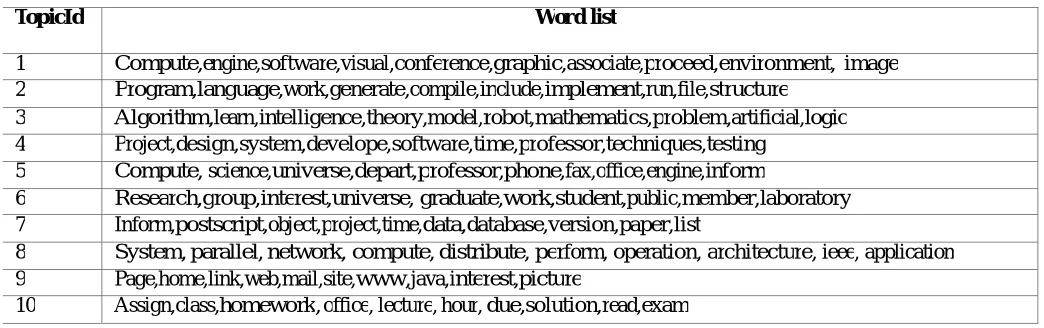
TopicId Word list
1 Compute,engine,software,visual,conference,graphic,associate,proceed,environment, image 2 Program,language,work,generate,compile,include,implement,run,file,structure
3 Algorithm,learn,intelligence,theory,model,robot,mathematics,problem,artificial,logic 4 Project,design,system,develope,software,time,professor,techniques,testing
5 Compute, science,universe,depart,professor,phone,fax,office,engine,inform
6 Research,group,interest,universe, graduate,work,student,public,member,laboratory 7 Inform,postscript,object,project,time,data,database,version,paper,list
8 System, parallel, network, compute, distribute, perform, operation, architecture, ieee, application 9 Page,home,link,web,mail,site,www,java,interest,picture
10 Assign,class,homework, office, lecture, hour, due,solution,read,exam
1. Euclidean distance is calculated by using formula below where, p = (p1, p2,..., pn) and q = (q1, q2,..., qn) are two documents .If answer is close to zero means document are more similar.
……….………….………...………(3)
2. Cosin similarity is calculated by using formula below where, two vectors of attributes, A and B, the cosine similarity, cos(θ), is represented using a dot product . If answer is close to one means document are more similar.
………...……….……….. (4)
3. Extended Jaccard coefficient is calculated by using formula below, where d1 and d2 are two documents. If answer is close to one means document are more similar.
Extended Jaccard coefficient= ∗
... (5)
4. To evaluate effectiveness of MPBTM-DR model. Two measures are used: F1 and MAP (Mean average precision)
F1 is calculated by F1= ∗ ∗
... (6)
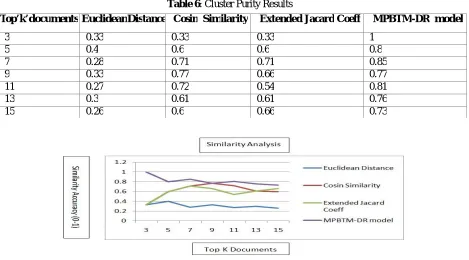
MPBTM-DR model outperform well compared with other term based methods. Here total 1740 documents are considered for analysis. Document contains total 10 topics. Result of recommendation is shown in fig 3. Figure shows recommended document ID, Rank value and document contents. Most ranked document appeared at first and least rank document appeared at last.
Top’k’documentsEuclideanDistance Cosin Similarity Extended Jacard Coeff MPBTM-DR model
3 0.33 0.33 0.33 1
5 0.4 0.6 0.6 0.8
7 0.28 0.71 0.71 0.85
9 0.33 0.77 0.66 0.77
11 0.27 0.72 0.54 0.81
13 0.3 0.61 0.61 0.76
15 0.26 0.6 0.66 0.73
Fig 3: Recommendation Result
Table 6: Cluster Purity Results
Fig 4: Document Purity Details
VII. CONCLUSION
numerous topics. In the filtering task, the MPBTM-DR chooses maximum matched patterns, for assessing the significance of incoming documents.
ACKNOW LEDGEMENT
We are happy to express o u r f e e l i n g s o f appreciation to all who rendered their important direction to us. We might want to express our gratefulness and on account of Prof. Dr. P. C. Kulkarni, Principal, G. E. S. R. H. Sapat College of Engg., Nashik. We are likewise appreciative t o Prof. N. V. Alone, Head of Department, Computer Engg., G. E. S. R. H. Sapat College of Engg., Nashik. We thank the unknown analysts for their r emarks.
REFERENCES
1) S. Robertson, H. Zaragoza, and M. Taylor, Simple BM25 extension to multiple weighted fields, in Proc. 13th ACM Int. Conf. Inform. Knowl. Manag. 2004, pp. 4249.
2) F. Beil, M. Ester, and X. Xu, Frequent term-based text clustering, inProc. 8th ACM SIGKDD Int. Conf. Knowl. Discov. Data Min.,2002, pp. 436442.
3) Y. Bastide, R. Taouil, N. Pasquier, G. Stumme, and L. Lakhal, Mining frequent patterns with counting inference, ACM SIGKDD Explorations Newslett., vol. 2, no. 2, pp. 6675, 2000.
4) H. Cheng, X. Yan, J. Han, and C.-W. Hsu, Discriminative frequent pattern analysis for effective classification, in Proc. IEEE 23rd Int. Conf. Data Eng., 2007, pp. 716725.
5) R. J. BayardoJr, Efficiently mining long patterns from databases, in Proc. ACM Sigmod Record, 1998, vol. 27, no. 2, pp. 8593. 6) X. Wei and W. B. Croft, LDA-based document models for ad-hoc retrieval, in Proc. 29th Annu. Int. ACM SIGIR Conf. Res.
Develop. Inform. Retrieval, 2006, pp. 178185.
7) C. Wang and D. M. Blei, Collaborative topic modeling for rec- ommending scientific articles,”in Proc. 17th ACM SIGKDD Int. Conf.Knowl. Discov. Data Min., 2011,pp. 448-456
8) D. M. Blei, A. Y. Ng, and M. I. Jordan, Latent dirichlet allocation,”J.Mach. Learn.Res., vol. 3, pp. 993-1022, 2003.
9) J. Mostafa,M.Palakal, and W.Lam, A multi- level approach to intelligent information filtering: Model, system,and evaluation,ACM Trans. Inform. Syst.,vol. 15,no. 4, pp. 368-399, 1997.
10) T. Hofmann, Probabilistic latent semantic indexing, in Proc. 22nd Annu. Int. ACM SIGIR Conf. on Res. Develop. Inform.
Retrieval, 1999, pp. 5057
11) X. Wang, A. McCallum, and X. Wei, Topical n-grams: Phrase and topic discovery, with an application to information retrieval, in Proc. 7th IEEE Int. Conf. Data Min., 2007, pp. 697702.
12) H. D. Kim, D. H. Park, Y. Lu, and C. Zhai, Enriching text representation with frequent pattern mining for probabilistic topic modeling, in Proc. Am. Soc. Inform. Sci. Technol., 2012, vol. 49, no.1, pp. 110.
13) A. Tagarelli and G. Karypis, A segment-based approach to clus- tering multi-topic documents, Knowl. Inform. Syst., vol. 34, no.3,pp. 563595, 2013.
14) N. Zhong, Y. Li, and S.-T. Wu, Effective pattern discovery for text mining, IEEE Trans. Knowl. Data Eng., vol. 24, no. 1, pp. 3044, Jan 2012.
15) Yang Gao, Yue Xu, and Yuefeng Li, Pattern-based Topics for Document Modelling in Information Filtering,in Knowledge and Data Engineering,2015.
16) M. J. Zaki and C.-J. Hsiao, CHARM: An efficient algorithm for closed itemset mining. in Proc. SDM, vol. 2, 2002, pp. 457473. 17) Y. Xu, Y. Li, and G. Shaw, Reliable representations for association rules, Data Knowl. Eng., vol. 70, no. 6, pp. 555575, 2011. 18) Y. Gao, Y. Xu, and Y. Li, Pattern-based topic models for informa- tion filtering, in Proc. Int. Conf. Data Min. Workshop
SENTIRE,2013, pp. 921928.
19) Ms Manjiri M. More, Prof. Archana S. Vaidya,A Survey Paper On Modeling Methods for Information Filtering And Relevance Rank- ing Of Documentsin International Research Journal of Engineering and Technology (IRJET) Volume: 02 Issue: 09 — Dec-2015
BIOGRAPHY
M.M.More Is pursuing the Masters in Computer from G.E.S. R. H. Sapat College o f Engg., Nashik under Pune University. She has pursued her Bachelor’s Degree in I n f o r m a t i o n T e c h n o l o g y from C u m m i n s c o l l e g e o f e n g i n e e r i n g f o r w o m e n , p u n e under Pune University.
A.S.Vaidya Is currently working as an Assistant Professor in the Computer Engineering Department of GESs R. H. Sapat College of Engineering Management Studies and