A Survey on Web Services Security Concern,
Solution and Its Limitation
Divya Pandey1 , Prof. Satpal Singh2 , Prof. Sumit Nema3
M.Tech. Student, Department of Computer Science Engineering, Global Engineering College, Jabalpur,
Madhya Pradesh, India1
Assistant Professor, Department of Computer Science Engineering, Global Engineering College, Jabalpur,
Madhya Pradesh, India2
Assistant Professor and Head of the Department, Department of Computer Science Engineering, Global Engineering
College, Jabalpur, Madhya Pradesh, India3
ABSTRACT: The WS-Security standard defines basic mechanisms to secure SOAP traffic, one message at a time. For
typical web services, however, using WS-Security independently for each message is rather inefficient; moreover, it is often important to secure the integrity of a whole session, as well as each message. To these ends, recent specifications provide further SOAP-level mechanisms.
I. INTRODUCTION
Web Services and Service-Oriented Architectures (SOAs) are often considered to be among the most important technological innovations of the last decade. Nevertheless, the benefits of these new approaches stand against some serious flaws these new technologies bring along. The most severe issues concern Web Service security [19]. The typical requirements for a secure system are integrity, confidentiality and availability. Any action targeting at violation of one of these properties is called an attack, the possibility for an attack is called vulnerability.
This article presents a list of security issues in the domain of Web Services. The list does not claim to be complete; it merely is a selection of the most impressive attacks we examined during our research. As this research focused on availability, most of the attacks belong to the category of Denial-of-Service (DoS) attacks [22].
The severity of DoS attacks can be seen in daily news, for example the Distributed Denial-of-Service (DDoS) attacks on Estonian governmental and commercial web sites in April/May 2007 [25]. These attacks were performed by botnets using network layer flooding techniques. As we will show in this article, DoS attacks on Web Ser- vices can be conducted with much less resource effort than against non-Web-Service systems.
The attacks cover a wide range of aspects. Starting with attacks on single Web Services without security measures, we further present attacks on WS-Security - enabled Web Services, and finally describe attacks on Web Services used in Web Service compositions. Although the latter are applicable for all types of Web Ser- vice compositions, we have chosen WS-BPEL (or BPEL for short) for attack demonstration, as it tends to become the leading Web Service composition standard.
The remainder of this article is organized as follows. In the next section, the basic concepts and terminolo- gies of Web Service security and BPEL are introduced. Section 3 lists vulnerabilities and attacks on Web Ser vices. Section 4 then discusses general countermeasure concepts, and Section 5 provides an attack classification scheme. Finally, in Section 6 we conclude about the work presented in this survey paper.
II. FUNDAMENTALS
2.1 WS-Security
Security defines a SOAP header block—the so-called security header —that carries the WS-Security extensions. Additionally, it defines how existing XML security standards like XML Signature [2] and XML Encryption [13] are applied to SOAP messages.
XML Signature allows XML fragments to be digitally signed to ensure integrity or to proof authenticity. The result of the signing operation—i.e. the encrypted digest—is placed in a Signature element, which again is added to the security header.
XML Encryption allows XML fragments to be encrypted to ensure data confidentiality. The encrypted fragment is replaced by an Encrypted Data element containing the ciphertext of the encrypted fragment as con- tent.
Further, XML Encryption defines an EncryptedKey element for key transportation purposes. The default ap- plication for an encrypted key is a hybrid encryption : an XML fragment is encrypted with a randomly generated symmetric key, which itself is encrypted using the public key of the message recipient. In SOAP messages, the EncryptedKey element if present must appear inside the security header.
In addition to encryption and signatures, WS-Security defines security tokens suitable for transportation of di- gital identities, e.g. UsernameToken or X.509 certificates.
An important characteristic of the mechanisms used in WS-Security is their high flexibility. They are appli- cable to arbitrary parts of the SOAP message, leaving all other parts unattended. As a consequence, Web Ser- vice servers and clients must negotiate a security policy defining the WS-Security elements to be used.
WS-SecurityPolicy [17] provides an XML syntax for declaring such security policies. In extension to the Web Service description, a server may use a WS-Security- Policy document for declaring its security needs. WS- SecurityPolicy allows to specify the parts of a SOAP message that shall be encrypted or signed, the algorithms to use and the required security tokens.
BPEL engine. These activities can be categorized into communication activities representing incoming or out- going Web Service calls, structure activities for execution order description, and other basic activities for additional tasks, such as process variable access, temporal constraints in workflow execution or fault handling. At runtime, each deployed BPEL process may have multiple process instances, which are concurrent execution contexts of the same process.
One key feature of BPEL-based Web Service composition is the ability to use asynchronous communication. A regular Web Service call consists of a request message, directly answered by a reply message. The requester must keep the connection to the server until the reply message arrives. Using a special language construct, BPEL enables asynchronous behaviour, allowing the requester to disconnect after sending its request. In this case, the reply message is delivered via a new connection initiated by the Web Service server, e.g. by invoking a Web Service on the original requester. This communication pattern is useful for long-running tasks that cannot be completed within timeout limits of a single Web Ser- vice call.
The specification in use for specifying the callback destination is WS-Addressing [11], allowing the reques- ter to specify an abstract endpoint reference within its request message, containing all information necessary for the BPEL engine to invoke the Web Service on the requester.
A further task a BPEL engine has to perform is message correlation. As a BPEL engine may run several in- stances of one BPEL process at the same time, it becomes necessary to use designated message data fields to identify the target process instance for an incoming Web Service message. These are called correlation sets in the context of BPEL.
III. ATTACKS
In this section we present a list of attacks on Web Ser- vices. For each attack an abstract attack methodology and impact is given, demonstrated by a concrete attack execution where appropriate. Additionally, countermeasures against the particular attacks are discussed.
3.1 Oversize Payload
cessing resources or network bandwidth. One “classic” way to perform such a Resource Exhaustion attack is to query a service using a very large request message. This is called an Oversize Payload attack [19].
Against Web Services, an Oversize Payload attack is quite easy to perform, due to the high memory consumption of XML processing. The total memory usage caused by processing one SOAP message is much higher than just the message size. This is due to the fact that most Web Service frameworks implement a tree-based XML processing model like the Document Order Model (DOM [12]). Using this model, an XML document like a SOAP message is completely read, parsed and transformed in- to an in-memory object representation, which occupies much more memory space than the original XML document. For common Web Service frameworks, we observed a raise in memory consumption of factor 2 to 30.
Example: An Axis Web Service was attacked using a large SOAP message document, which consisted of a long list of elements considered as parameter values of the Web Service operation1:
<Envelope> <Body>
<getArrayLength> <item>x</item> <item>x</item> <item>x</item> ...
</getArrayLength> </Body>
</Envelope>
The SOAP message had a total size of approx. 1.8
MB. The message processing induced a full CPU load for more than one minute and an additional memory usage of more than 50 MB. Enlarging the message to approx.
1.9 MB even resulted in an out-of-memory exception.
An obvious countermeasure against Oversize Payload attacks consists in restriction of the total buffer size (in bytes) for incoming SOAP messages. In this case, it is sufficient to check the actual message size and reject any message exceeding the predefined limit. This method is used by the .NET 2.0 frameworks, which discards all SOAP messages larger than 4 MB (in the default configuration). While this countermeasure is very simple to implement, it is not suitable for Web Service messages.
A more appropriate approach uses restrictions on the XML info set. This can be realized by modifying the XML schema inside the Web Service description and validating
incoming SOAP message to this schema [7]. Details of this approach can be found in section 4.
3.2 Coercive Parsing
One of the first steps in processing a Web Service request is parsing the SOAP message and transforming the con- tent to make it accessible for the application behind the Web Service. Especially when using namespaces, XML can become verbose and complex in parsing, compared to other message encodings. Thus, the XML parsing process allows other possibilities for a special kind of Denial-of- Service attacks, which is called Coercive Parsing attacks [19].
Example: The following attack was performed tar- geting an Axis2 Web Service. The attack used a conti- nuous sequence of opening tags:
<x> <x> <x> ...
Typical Coercive Parsing attacks targeting at resource exhaustion use a large number of namespace declara- tions, oversized prefix names or namespace URIs or very deeply nested XML structures. These types of attacks require different countermeasures.
An attack that is based on complex or deeply nested XML documents (like the one in the example above) can be fended by using schema validation (compare section
4).
Attacks misusing namespace declarations are harder to prevent. As the XML specification does neither limit the number of namespace declarations per XML element nor the length of the namespace URIs, any restriction on the number or length of namespace declarations would be arbitrary and could lead to unpredictable rejection of messages.
3.3 SOAP Action Spoofing
The actual Web Service operation addressed by a SOAP request is identified by the first child element of the SOAP body element. Additionally, the optional HTTP header field “SOAPAction” can be used for operation identification. Although this value only represents a hint to the actual operation, the SOAPAction field value is of- ten used as the only qualifier for the requested operation. This is based on the bogus optimization that evaluating the HTTP header does not require any XML processing.
This twofold operation identification enables two classes of attacks. The first one is executed by a man-in-the- middle attacker and tries to invoke an operation different from the one specified inside the SOAP body. It is based on modification of the HTTP header.
Example: The following attack was performed targeting a .NET Web Service. The deployed service provi- ded two operations: op1(string s) and op2(int x)— with the respective SOAP Action and message element also named opn. The following message (including the HTTP header) was sent to the service:
POST /Service.asmx HTTP/1.1 ...
SOAPAction: "op2" <Envelope> <Body> <op1> <s>Hello</s> </op1> </Body> </Envelope>
The method call that was triggered by this message was: op2(0). This shows that the operation is selected solely by the SOAP Action value from the HTTP header. Even worse, the “wrong” operation was executed despite of incompatible parameter names and types.
The example shows how modifications of the HTTP header can invoke methods that were not intended by the SOAP message creator. As the HTTP header is not secured by WS-Security and is newly created at every SOAP intermediary, it can easily be modified.
The second class of SOAP Action spoofing attacks is executed by the Web Service client and tries to bypass an HTTP gateway.
Example: The following attack was performed tar- geting an Axis2 Web Service. The deployed service pro- vided two operations: hidden and visible—with the respective SOAP Action and message element equally na- med. The following message (including the HTTP header) was sent to the service:
POST /axis2/testService HTTP/1.1 ...
SOAPAction: "visible" <Envelope>
</Envelope>
The Axis2 server actually ignored the SOAP Action value and invoked the hidden operation instead. If an HTTP border gateway—which of course operates on the HTTP header only—is configured to reject hidden and accept visible accesses, this attack allows calling hidden anyway.
A countermeasure to SOAP Action Spoofing attacks would be to determine the operation by the SOAP body content. Additionally, the operations determined by the HTTP header and by the SOAP body must be compa red and any difference should be regarded as threat and result in rejecting the Web Service request.
3.4 XML Injection
An XML Injection attack tries to modify the XML structure of a SOAP message (or any other XML document) by inserting content—e.g. operation parameters containing XML tags. Such attacks are possible if the special characters ”<” and ”>” are not escaped appropriately. At the Web Service server side, this content is regarded as part of the SOAP message structure and can lead to undesired effects.
Example: The following attack was executed against a .NET Web Service. The deployed service method has two parameters a and b, both of type xsd:int. This service was invoked using the following SOAP message:
<Envelope> <Body> <HelloWorld> <a> <b>1</b> </a> <b> 2 </b> </HelloWorld> </Body> </Envelope>
Such a message could result from an XML Injection attack: <b>1</b> was inserted as parameter content without escaping ”<” and ”>”. As the SOAP message obviously violates the Web Service schema, it should be rejected. But in fact, not only that the message was accepted by .NET, the resulting parameter values inside the service application for this request were: a = 1, b =
0. Thus, the attacker was able to modify the value of b just by modifying the content of a. It is easy to imagine a scenario in which this can lead to unintended service behaviour, e.g. access to restricted data.
An important step in detecting such attacks is a strict schema validation on the SOAP message, including data type validation as possible (see section 4). This would have rejected the message from the example attack.
IV. GENERAL COUNTERMEASURE APPROACHES
Attacks on Web Services—as on any other system rely on a large number of different vulnerabilities. Therefore, countermeasures against attacks are also very wide ranging. Nevertheless, there exist several general defense mechanisms.
4.1 Schema Validation
Schema validation can be used against attacks, which use messages that are not conform to the Web Service description. Such attacks are called deviation from protocol message syntax [18]. By validating incoming messages to the XML schema generated from the WSDL, the attack can be detected—like shown in section 3.2 and 3.4. Nevertheless, in current Web Service frameworks schema validation is not used or not activated by default. This is mainly due to performance reasons, as schema validation is expensive regarding CPU load and memory consumption.
Schema validation is also effective against some other attacks on Web Service applications, like SQL Injection or Parameter Tampering [19], which also use non-valid messages3.
4.2 Schema Hardening
The general idea is to analyze a schema e.g. from a Web Service description for constructs allowing unbounded large or complex XML trees. These constructs are modified to fulfill finite boundaries.
For example, if the Web Service description defines an unbounded list of elements4 , the list is converted into a list with limited number of elements. Inside the XML schema, the entry <element maxOccurs=”unbounded”> is replaced by <element maxOccurs=”n”>, where n is a finite number. For most services such a limit is easy to define. An advantage of this restriction—compared to a limit of the network buffer size—is that this limit can be included in the service’s “official” Web Service descrip- tion and thus becomes visible to clients in advance. A second application of schema hardening could be removal of non-public operations from the schema inside the Web Service description (see section 3.5).
There are a number of further possibilities for har- dening the Web Service description—and thus the XML schema generated. Details can be found in [7]. The sa- me article also discusses problems raised by processing schemas containing large “maxOccurs” values.
4.3 Strict WS-Security Policy Enforcement
A WS-Security Policy policy defines a minimum set of security tokens that have to be included within a SOAP message to fulfill the policy. The specification does not provide a possibility for declaring their maximum usage. So as discussed before an attacker may add an unbounded number of additional tokens, engaging the targeted system in costly cryptographic computations and forcing high memory consumption.
To avoid this, a good strategy is to consider the requirements from the WS-Security Policy document not only as a minimum requirement, but also as a maximum requirement. This means, a SOAP message must contain exactly the security tokens specified by the security policy not less, not more.
As pointed out in [6], this limitation does not restrict the functionality, but enables the detection of attacks using oversized cryptography and can help to mitigate their effects.
V. CLASSIFICATIONS
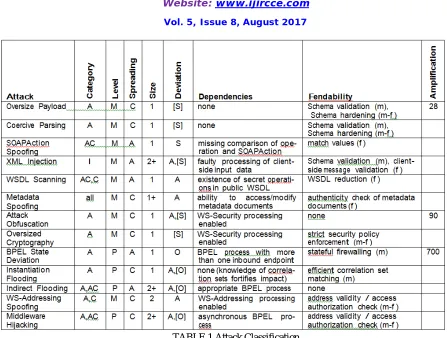
In an effort to categorize and systemize these numerous attacks, we took a closer look at their specific impacts. Table 1 shows a classification of the attacks described here, based on the following parameters.
Category: Describes the security property that is viola- ted by the attack. Possible values are confidentiality (C),
data integrity (I), avaliability/Denial-of-Service (A) or access control issues (AC).
Level: This value indicates whether the attack resides on messaging layer (M) or on process layer (P) as defined in
[27].
Spreading: Attacks can be application specific (A), targeting a specific Web Service framework only, or they can
be due to a conceptional (C) flaw of the under- lying protocol specifications.
Size: Some attacks target single Web Services, others involve several communication partners. The Size va- lue
gives the usual or minimal number of involved systems—apart from the attacker.
Deviation: Describes whether the attack generally uses syntactical (S), sequential (O), or semantical/appli- cation
specific (A) protocol deviation techniques. A [ • ] indicates potential, but not necessary deviation.
Dependencies: This parameter indicates how far an attack relies on prerequisites at the targeted Web Ser- vice
server, e.g. the existence of a specific operation or a necessary flaw in the Web Service description.
Fendability: A measure on how effective potential countermeasures can be in terms of mitigating (m) or even
completely fending (f ) the particular attacks. The intended countermeasure concepts are given as well. Note that the general countermeasure of performing access control is applicable to any of the attacks presented here, but it only mitigates the attack, and does not completely annihilate the possibility for an attack.
Amplification: This factor as defined in [16] is only applicable for flooding attacks and describes the rela- tion of
TABLE 1 Attack Classification
VI. CONCLUSIONS
Like every upcoming technology, Web Services are challenged by several security issues. The attacks presented in this article illustrate how easily an insufficiently secured Web Service server can be affected with a single or few messages. While some of the vulnerabilities are caused by implementation weaknesses, most of them exploit fundamental protocol flaws, abusing the given flexibility within WS-related standards.
Thus, in order to cope with these threats, Web Ser- vice developers and adopters must be aware of the vulnerabilities and their potential impact. Further, researchers need to examine the existing Web Service standards for further vulnerabilities in order to develop more accurate countermeasures. Only improvement of attack mitigation techniques along with integration into every Web- Service-driven system will face up with these challenges and help to make Web Services as secure as possible.
REFERENCES
1. Andrews T, Curbera F, Dholakia H, Goland Y, Klein J, Leymann F, Liu K, Roller D, Smith D, Thatte S, Tricko-vic I, Weerawarana S (2003) Business Process Execution Language for Web Services Version 1.1. Oasis Standard
2. Bartel M, Boyer J, Fox B, LaMacchia B, Simon E (2002) XML-Signature Syntax and Processing. W3C Recom-mendation
3. Bhargavan K, Fournet C, Gordon AD, O’Shea G (2005) An advisor for Web Services security policies. In: SWS’05: Proceedings of the 2005 workshop on Secure web services, ACM Press, New York, NY, USA, pp 1–9
4. Fernando R (2006) Secure web services with apache ram-part. Tech. rep., WSO2 Oxygen Tank
5. Gruschka N (2008) Schutz von Web Services durch erwei terte und effiziente Nachrichtenvalidierung. PhD thesis, Christian-Albrechts-University of Kiel, Germany
6. Gruschka N, Herkenh¨oner R (2006) WS-SecurityPolicy Decision and Enforcement for Web Service Firewalls. In: Proceedings of the IEEE/IST Workshop on Monitoring, Attack Detection and Mitigation
8. Gruschka N, Luttenberger N, Herkenh¨oner R (2006) Event-based SOAP message validation for WS- SecurityPolicy-Enriched web services. In: Proceedings of the 2006 International Conference on Semantic Web & Web Services
9. Gruschka N, Herkenh¨oner R, Luttenberger N (2007) Ac- cess Control Enforcement for Web Services by Event- Based Security Token Processing. In: Braun T, Carle G, Stiller B (eds) 15. ITG/Gi Fachtagung Kommunikation in Verteilten Systemen (KiVS 2007), pp 371–382 10. Gruschka N, Jensen M, Luttenberger N (2007) A Stateful Web Service Firewall for BPEL. Proceedings of the IEEE International Conference on Web Services (ICWS 2007)
11. Gudgin M, Hadley M, Rogers T (2006) Web Services Ad- dressing 1.0 - SOAP Binding. W3C Recommendation
12. Hors AL, Hegaret PL, Wood L, Nicol G, Robie J, Cham- pion M, Byrne S (2004) Document Object Model (DOM) Level 3 Core Specification. W3C Recommendation
13. Imamura T, Dillaway B, Simon E (2002) XML Encryp- tion Syntax and Processing. W3C Recommendation 14. Jayasinghe D (2006) SOA development with Axis2: Un- derstanding Axis2 basis. IBM developerWorks
15. Jensen M (2008) BPEL Firewall Abwehr von Angriffen auf zustandsbehaftete Web Services (german). VDM Verlag Dr. Mu¨ller, ISBN 9783836485517
16. Jensen M, Gruschka N, Luttenberger N (2008) The Impact of Flooding Attacks on Network-based Services. In: Proceedings of the IEEE International Conference on Availability, Reliability and Security
17. Kaler C, Nadalin (editors) A (2005) Web Services Security Policy Language (WS-SecurityPolicy) 1.1
18. Leiwo J, Nikander P, Aura T (2000) Towards network denial of service resistant protocols. In: Proc. of the 15th International Information Security Conference (IFIP/SEC) 19. Lindstrom P (2004) Attacking and Defending Web Service. A Spire Research Report
20. McIntosh M, Austel P (2005) XML signature element wrapping attacks and countermeasures. In: SWS ’05: Proceedings of the 2005 workshop on Secure web services, ACM Press, New York, NY, USA, pp 20–27
21. Nadalin A, Kaler C, Monzillo R, Hallam-Baker P (2006) Web Services Security: SOAP Message Security 1.1 (WS- Security 2004) 22. Needham RM (1994) Denial of service: an example. Commun ACM 37(11):42–46
23. Noga ML, Schott S, L¨owe W (2002) Lazy XML proces- sing. In: DocEng ’02: Proceedings of the 2002 ACM symposium on document engineering, ACM Press, New York,NY, USA, pp 88–94
24. Sch¨afer G (2005) Sabotageangriffe auf Kommunika- tionsstrukturen: Angriffstechniken und Abwehrmanah men. PIK 28 pp 130–139 25. Smith A (2007) Estonia: Under siege on the web. Time Magazine URL http://www.time.com/time/magazine/article/0,9171,1626744,00.html 26. The SAX Project (2002) Simple API for XML–SAX 2.0.1 URL http://www.saxproject.org