AN EXTENDED FRAMEWORK FOR IMPLEMENTING OF ENTERPRISE RESOURCE PLANNING FOR SMALL AND MEDIUM ENTERPRISES
MAJID AARABI
i
AN EXTENDED FRAMEWORK FOR IMPLEMENTING OF ENTERPRISE RESOURCE PLANNING FOR SMALL AND MEDIUM ENTERPRISES
MAJID AARABI
A thesis submitted in fulfilment of the requirements for the award of the degree of Doctor of Philosophy (Mechanical Engineering)
Faculty of Mechanical Engineering Universiti Teknologi Malaysia
Dedicated to:
My parents and my wife,
for their hope, support and encouragement.
My daughter, Pardis and my son, Amir Mohammad
ACKNOWLEDGEMENTS
Firstly, I wish to express my heartfelt gratefulness to the Almighty Allah (S.W.T) for the blessing and strength which He blessed me with during the completion of this research.
My sincerest gratitude goes to my main supervisor Associate Prof. Dr. Muhamad Zameri Mat Saman for his continuous support for my PhD study and research, for his motivation, advice, patience, enthusiasm and immense knowledge and my co-supervisor Associate Prof. Dr. Wong Kuan Yew for his guidance and advice and his encouragement from the beginning to the completion of the present research. Without their continued support and interest, this thesis would not have been completed. Furthermore, I am very grateful to Prof. Dr. Hooshang M. Beheshti for his support and motivation. I would also like to thank my earlier supervisor Prof. Dr. Ashraf Hafiz Amin Radwan.
I am also grateful to my family, especially my wife, for her support and psychological encouragement and the preparation of a quiet environment for my studies. Also, I am thankful to my children for their patience. The very genuine appreciation goes to my parents, who always motivated me.
ABSTRACT
ABSTRAK
TABLE OF CONTENTS
CHAPTER TITLE PAGE
DECLARATION ii
DEDICATION iii
ACKNOWLEDGEMENTS iv
ABSTRACT v
ABSTRAK vi
TABLE OF CONTENTS vii
LIST OF TABLES xiii
LIST OF FIGURES xv
LIST OF ABBREVIATIONS xviii
LIST OF APPENDICES xix
1 INTRODUCTION 1
1.1 Background of the Research 1
1.2 Statement of Problem 3
1.3 Objectives and Scope of the Research 4
1.4 Research Questions 5
1.5 Significance of the Research 6
1.6 Contributions of the Research 6
1.7 Thesis Structure 7
2 LITERATURE REVIEW 10
2.1 Overview 10
2.3 Enterprise Resource Planning (ERP) 13
2.3.1 ERP Systems in SMEs 13
2.3.2 The Role of Enterprise Architecture
Frameworks in ERP Systems 16
2.4 Framework Definitions 16
2.5 Enterprise Architecture Frameworks 17
2.5.1 Zachman Framework 19
2.5.2 Purdue Enterprise Reference Architecture
(PERA) 20
2.5.3 The Open Group Architecture Framework
(TOGAF) 22
2.5.4 Generalized Enterprise Reference
Architecture and Methodology 24
2.5.5 EA3 Framework 26
2.6 Comparison of the current EAFs 27
2.7 Using of EAFs for Information Systems 28
2.8 Using of EAFs in ERPs 30
2.9 SMEs need to ERP 32
2.10 ERP in SMEs 33
2.11 CSFs of ERP in SMEs 34
2.12 Discussion of CSFs 36
2.13 Frameworks of ERP Systems Implementation 42
2.13.1 Saunders and Jones Model 42
2.13.2 Myers et al. Framework 43
2.13.3 Jenson and Johnson Framework 45
2.13.4 Markus and Tanis Framework 46
2.13.5 Somers et al. Framework 46
2.13.6 Parr and Shank Framework 47
2.13.7 Kalakota and Robinson Framework 48
2.13.8 Umble et al. Framework 49
2.13.9 Ehie and Madsen Framework 51
2.13.10 Jing and Qiu Model 53
2.13.11 Kale Model 54
2.13.13 Otieno Model 57
2.13.14 Heydariyeh Model 59
2.14 Discussion on the Findings from Literature
Review 59
2.15 Summary 63
3 RESEARCH METHODOLOGY 64
3.1 Overview 64
3.2 Research Design 64
3.3 Stage 1: Background Theory and Literature
Review 67
3.4 Stage 2: Preliminary Study 67
3.5 Stage 3: Methodology of Research 70
3.6 Stage 4: Data Collection and Factor Analysis 70
3.6.1 Survey Instrument Development 71
3.6.2 Content Validation 72
3.6.3 Pilot Survey 72
3.6.4 Data Analysis 76
3.6.5 Sample Size 77
3.6.6 Adequacy Test of Sample 78
3.6.7 Convergent and Discriminant Validity 78
3.6.8 Reliability Checking 79
3.7 Stage 5: Develop the Specifications of SMEs
Framework 80
3.8 Stage 6: Proposing the Conceptual Framework 80 3.9 Stage 7: Relevance of CSFs and Implementation
Stages 81
3.10 Stage 8: Evaluation of Proposed Framework 82
3.10.1 Case Study Strategy 82
3.10.2 Determining Case Study Designs 84 3.11 Stage 9: Development of the Revised Framework 85 3.12 Stage 10: Validation of the Revised Framework 85
4 DATA COLLECTION AND ANALYSIS 87
4.1 Overview 87
4.2 Data Collection and Analysis 87
4.3 Requirements of SMEs' Framework 94
4.3.1 Generic and not prescriptive 95
4.3.2 Implementable 96
4.3.3 Simplified for Understanding 96
4.3.4 Facilitate the Communication 96
4.3.5 Link the Elements of Framework Clearly 97 4.3.6 Present Key ERP System Implementation
Process 97
4.3.7 Include Stakeholders Interface 97
4.3.8 Simple in Structure and Practical for
Implementation 98
4.3.9 Using Engineering Tools and Techniques 98 4.3.10 Include CSFs of ERP Systems
Implementation 98
4.3.11 Aid to Documentation 99
4.4 Discussion on Outcomes from Data Analysis 99
4.5 Summary 102
5 DEVELOPMENT OF CONCEPTUAL FRAMEWORK
FOR ERP IMPLEMENTATION 103
5.1 Overview 103
5.2 Conceptual Framework 103
5.3 Relevance of CSFs and ERP Implementation
Phases 108
5.3.1 Respondent Background 109
5.3.2 Results of the Interviews 111
5.3.3 Discussion of the Interviews 117
5.4 Summary 121
6 CASE ANALYSIS: ERP IMPLEMENTATION
6.1 Overview 122
6.2 Background of the Case Companies 123
6.2.1 Company A 123
6.2.2 Company B 124
6.2.3 Company C 124
6.2.4 Company D 125
6.2.5 Company E 125
6.2.6 Overview of Case Study Companies 126 6.3 Current Information Systems Implementation
Practice at Case Study 127
6.3.1 Company A 127
6.3.2 Company B 128
6.3.3 Company C 129
6.3.4 Company D 130
6.3.5 Company E 131
6.3.6 Cross Case Discussion of Information Systems Implementation Current
Practices 131
6.4 Evaluation of the Framework 133
6.4.1 Company A 133
6.4.2 Company B 134
6.4.3 Company C 135
6.4.4 Company D 136
6.4.5 Company E 136
6.4.6 Implementation Stage 137
6.4.7 Approaches and Elements of the
Framework 141
6.4.8 Comparative Summary of Case
Companies 144
6.5 Suggestions for Revision and Improvement 145
6.6 Development of Revised Framework 145
6.7 Validation of Revised Framework 151
6.8 Comparison of Proposed Framework with Others 153
7 CONCLUSION AND FUTURE WORK 156
7.1 Conclusion 156
7.2 Limitation of the Research 158
7.3 Recommendations for Future Work 158
REFERENCES 160
LIST OF TABLES
TABLE NO. TITLE PAGE
2.1 Definition of SMEs in different countries 11
2.2 The categorized ERP benefits 14
2.3 Zachman framework (Zachman, 1996) 19
2.4 Comparison of the current EAFs 28
2.5 The frequency of CSFs citation in SMEs 37
2.6 The frequency of CSFs citation in Large
Organizations 38
2.7 Comparing the Frequency of Citation of CSFs in
Large Organizations and SMEs 41
2.8 Comparison of implementation frameworks 61
3.1 Stage 1 - background theory and literature review 67
3.2 Stage 2 - preliminary study 68
3.3 Stage 3 - methodology of research 70
3.4 Stage 4 - data collection and factor analysis 71
3.5 Revision of questionnaire 73
3.6 Respondent characteristics 76
3.7 KMO and Bartlett's Test 78
3.8 Stage 5 - develop the specifications of SMEs
framework 80
3.9 Stage 6 - proposing the conceptual framework 81 3.10 Stage 7- relevance of CSFs and implementation
stages 81
3.13 Stage 10 - validation of the revised framework 86
4.1 Eigenvalues and Total Variances 89
4.2 Rotated Component Matrix (Varimax Rotation
Matrix) 89
4.3 Pearson correlation between CSFs and success rate
of ERP implementation 92
4.4 Pearson correlation between success rate and
scientific methodology of ERP implementation 92
4.5 Cronbach's Alpha 93
5.1 The responses of all respondents 112
5.2 Iteration of CSFs importance for implementation in
interviews 117
5.3 Priorities of related CSFs in each stage of
implementation 118
6.1 Overview of company and respondents backgrounds 126 6.2 Cross case comparison of information systems
implementation 132
6.3 Evaluation of the methodology processes 140
6.4 Cross-case evaluation of the approaches and
elements 143
6.5 Summary of suggestions from the case study
companies 145
LIST OF FIGURES
FIGURE NO. TITLE PAGE
1.1 Contributions of research scheme 7
1.2 Overview of research process and corresponding
chapters 8
2.1 Literature review scheme 10
2.2 The life cycle of PERA (Williams, 1994) 21
2.3 TOGAF architecture development method
(Harrison, 2007; Schekkerman, 2004) 22
2.4 GERAM framework (Bernus et al., 2003) 24
2.5 GERA architecture (Bernus et al., 2003) 25
2.6 EA3 Framework (Bernard, 2005) 26
2.7 IS function performance evaluation (Saunders and
Jones, 1992) 43
2.8 DeLone and McLean IS success model (DeLone
and McLean, 1992) 43
2.9 The framework of IS assessment (Myers et al.,
1997) 44
2.10 Jenson and Johnson framework (Jenson and
Johnson, 1999) 45
2.11 Markus and Tanis ERP implementation life cycle
(Markus and Tanis, 2000) 46
2.12 Somers et al. conceptual model of ERP
implementations (Somers et al., 2000) 47
2.13 Parr and Shank framework for ERP implementation
2.14 Kalakota and Robinson framework (Kalakota and
Robinson, 2001) 49
2.15 Umble et al. framework (Umble et al., 2003) 50 2.16 Five-stage ERP implementation framework (Ehie
and Madsen, 2005) 52
2.17 Interpretative structural model of ERP
implementation (Jing and Qiu, 2007) 53
2.18 Conceptual model for implementation of ERP in
SMEs (Kale et al., 2007) 54
2.19 Chan's theoretical framework of ERP
implementation (Chan, 2008) 55
2.20 Empirical ERP Implementation Model (EEIM)
(Otieno, 2010) 58
2.21 CSFs of ERP implementation model (Heydariyeh et
al., 2012) 60
3.1 Overview of research design 66
3.2 Case study model (Yin, 2009; 2011) 84
3.3 Basic type of designs for case studies (Yin, 2009;
2011) 85
4.1 Classified CSFs and related items 94
4.2 Cause-Effects Diagram of the Critical Success
Factors and Variances 100
5.1 Conceptual framework for ERP implementation in
SME 104
6.1 General view of reviewing and validation process
using case study 123
6.2 Diagram of ERP system implementation in
Company A 127
6.3 Diagram of ERP system implementation in
Company B 128
6.4 Diagram of ERP system implementation in
Company C 129
6.5 Diagram of ERP system implementation in
6.6 Diagram of ERP system implementation in
Company E 131
6.7 Revised framework of ERP Implementation for
SMEs 147
6.8 Detailed Phase one - Strategic Planning stage 148 6.9 Detailed Phase one – Business Architecture stage 149
6.10 Detailed Phase two (Design) stages 149
LIST OF ABBREVIATIONS
SMEs - Small and Medium Sized Enterprises ERP - Enterprise Resource Planning
EA - Enterprise Architecture
EAF - Enterprise Architecture Framework EFA - Exploratory Factor Analysis
IS - Information System IT - Information Technology
ICT - Information and Communication Technology PERA - Purdue University Reference Architecture TOGAF - The Open Group Architecture Framework ADM - Architecture Development Method
GERAM - Generalized Enterprise Reference Architecture and Methodology
GERA - Generic Enterprise Reference Architecture EA3 - Enterprise Architecture Cube
LIST OF APPENDICES
APPENDIX TITLE PAGE
A Items for Measuring of Critical Success Factors 176
B Final Revised Questionnaire for CSFs 178
C Measures for Evaluation of Success for
Information Systems 182
D Evaluation of the Framework for ERP
Implementation in SMEs 184
E Validation of the Revised Framework for ERP
Implementation in SMEs 195
F Interviewed Expert Specifications 202
G Relevance of Critical Success Factors (CSFs) and
1 CHAPTER 1
1 INTRODUCTION
1.1 Background of the Research
Enterprise Resource Planning (ERP) has been widely used in developed countries to integrate the information and to support decision making to achieve process improvement and competition in global market. Davenport (2004) predicted that ERP is an inevitable requirement for performance in the 21st century. There are some crucial drivers for ERP implementation, such as improving the business operations, integration of processes, reducing operational costs, making business decisions and supporting customer responsiveness. The ERP system providers are now trying to extend their market to companies in developing countries, Small and Medium-Sized Enterprises (SMEs), and different kinds of industries while preparing ERP systems. However, ERP systems of SMEs in developing countries are in the early stages. There are significant barriers facing SMEs in developing countries such as limitation of financial resources, human resources, poor management base and lacking of Information Technology (IT) experts.
Upadhyay and Dan, 2008; Upadhyay et al., 2011b; Walsh et al., 2010). Sometimes these SMEs fail to achieve the full potential efficiency and benefits of these systems which can improve the productivity and quality of decision making in these firms.
There is much research on ERP systems in developed countries but there is a scarcity of ERP systems in SMEs of developing countries. ERP implementation in SMEs is a crucial issue for academic researchers and practitioners who need a simple, comprehensive and appropriate framework to justify ERP systems thus ensuring the achievement of full potential efficiency and benefits.
Whereas numerous frameworks, models and methods have been proposed and applied by practitioners and researchers, most popular ones are based on software project implementation methods (Ehie and Madsen, 2005; Otieno, 2008; 2010; Zhang et al., 2003; Zhang et al., 2005). However, the current frameworks do not cover the requirements of ERP implementation lacking the necessary specifications of SMEs framework. Despite the preponderance of Enterprise Architecture Frameworks (EAFs) (Minoli, 2008; Saha, 2007; Schekkerman, 2004; Zachman, 2006; Zachman, 1996) for different purposes, none of them is easily implementable, comprehensive and suitable to be used as a purposeful framework for ERP implementation in SMEs. Furthermore, there are a number of studies which identify and evaluate the Critical Success Factors (CSFs) of ERP systems. Nevertheless, most of these studies have been conducted in developed countries and large enterprises. Therefore, the need for investigating SMEs in developing countries is inevitable.
Regarding the complexity and enterprise-wide nature of ERP projects, practitioners and researchers suggest the application of frameworks to provide a step by step guideline to clarify the implementation, evaluation and documentation of ERP processes (Chan, 2008; Ehie and Madsen, 2005; Heydariyeh et al., 2012; Jing and Qiu, 2007; Kale et al., 2007; Myers, 2003; Otieno, 2010; Somers and Nelson, 2001; Somers et al., 2000; Zachman, 2010; Zhang et al., 2005).
critical factors for successful implementation of ERP projects are delineated (Chan, 2008; Ehie and Madsen, 2005; Otieno, 2010).
The SMEs specifications, CSFs of ERP implementation and important issues of Enterprise Architecture Framework (EAF) were not considered in previous frameworks. Enterprise architecture and CSFs for ERP systems should also be contemplated while developing the framework in SMEs. The framework developed for the implementation of ERP systems can contribute to the current knowledge base through consideration of the EAF approach and critical success issues.
This study proposes a framework for implementing ERP systems in SMEs. This framework was validated in the case of Iranian SMEs to fulfill the specifications.
1.2 Statement of Problem
The problem investigated in the present research can be discussed from several perspectives. Firstly, ERP is one of the most important systems in the market to help companies to achieve their business objectives and to be strong enough in the competitive market. However, some difficulties and problems such as the enterprise-wide nature of the ERP and their discount of some CSFs affect the implementation of ERP systems. ERP failures can be attributed more to implementation rather than to software and hardware approaches. Regardless of the size of the firms, implementing an ERP system is one of the most challenging projects for any company. It should be mentioned that success in ERP project implementation does not come effortlessly and its benefits and return on investment are not immediately accessible. Rather, efficiency and benefits are obtained in the long time (Gargeya and Brady, 2005).
Thirdly, in comparison with Information Systems (ISs) research and other academic fields, theories on ERP system implementation have received less attention and most publications in the field of ERP systems implementation do not fully provide theoretical support (Zhang et al., 2005).
Fourthly, because of the numerous differences between SMEs and large enterprises, the models, methods and frameworks developed for large enterprises are often not applicable to SMEs (Dandridge, 1979; Deros et al., 2006; Radas and Bozic, 2009).
Finally, the Information and Communication Technology (ICT) development plan which defined the long term ICT operational planning and priorities of Iran from 2002 emphasized IT deployment in all sectors where one of the main aims is to support IT development through Iranian SMEs (Fathian et al., 2008). Furthermore, Iran is one of the pioneering developing countries where the implementation rate of the ERP systems has recently been increasing (Nikookar et al., 2010). In addition, because of the sanctions imposed by European countries and United States, the foreign ERP system providers are not interested in having agents to do business with Iranian companies. It also seems that the global ERP systems might not be economically justified in implementing ERP in Iranian SMEs, so the local providers of the software have tried to design and implement the needed ERP systems (Nikookar et al., 2010).
The implementation of ERP systems is very expensive and time consuming. So, a comprehensive operational framework, as a guideline for implementation of ERP systems in SMEs, is needed to prevent the project failures.
1.3 Objectives and Scope of the Research
The ultimate aim of this research is to develop a framework for implementation of ERP systems in SMEs in developing countries.
The main objectives of this study are:
i. To identify and classify the critical success factors of ERP systems in SMEs.
ii. To identify the relevance of the classified CSFs and implementation methodology stages.
iii. To develop an appropriate framework to implement ERP systems in SMEs.
The scope of the research is:
i. This study considers only Small and Medium Enterprises.
ii. This study includes both private and public SMEs in different industries (i.e. manufacturing, service, retail and education).
iii. The validation of the proposed framework by potential users as case studies.
1.4 Research Questions
Regarding the problem stated earlier and in achieving the objectives, the research work has attempted to answer the following four questions:
i. What are the critical success factors (CSFs) of ERP system implementation in SMEs?
ii. How are CSFs of ERP systems to be classified in SMEs?
iv. What is an appropriate framework for implementation of ERP systems in SMEs?
1.5 Significance of the Research
The significance of this research is: a. For practitioners:
i. The new proposed framework can be used as a guideline for implementation of ERP systems in SMEs.
ii. It will provide guidelines to specify various activities that are necessary for the successful implementation of the ERP systems in SMEs. Besides, it can be considered as a first step for development of various ERP application modules.
b. For researchers:
The proposed framework can serve as a foundation for research to improve ERP systems in SMEs of developing countries whereby their success rate is enhanced.
1.6 Contributions of the Research
Figure 1.1 Contributions of research scheme
1.7 Thesis Structure
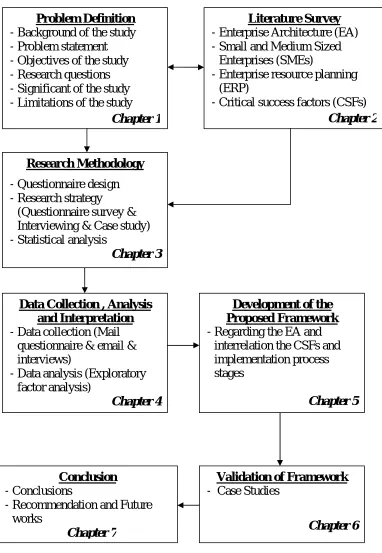
Contents of the thesis are organized into seven chapters. Figure 1.2 shows an overview of the research process and the corresponding chapters.
Chapter 1 focuses on the research background with regard to SMEs, ERP systems and enterprise architecture frameworks (EAFs).
Framework of ERP Implementation in SMEs
CSFs of ERP in SMEs of Developing Countries
Interrelationship of CSFs and EAF CSF s o f E RP Im p le m en ta ti on En ter p ri se A rc h it ec tu re F ra m ew o rks
Figure 1.2 Overview of research process and corresponding chapters
The thesis continues with a review of the literature on ERP systems and critical success factors of these systems in SMEs. Also, some enterprise architecture
Problem Definition
-Background of the study
-Problem statement
-Objectives of the study
-Research questions
-Significant of the study
-Limitations of the study
Chapter 1
Literature Survey
-Enterprise Architecture (EA)
-Small and Medium Sized Enterprises (SMEs)
-Enterprise resource planning (ERP)
-Critical success factors (CSFs)
Chapter 2
Research Methodology
-Questionnaire design
-Research strategy (Questionnaire survey & Interviewing & Case study)
-Statistical analysis
Chapter 3
Data Collection , Analysis and Interpretation
-Data collection (Mail questionnaire & email & interviews)
-Data analysis (Exploratory factor analysis)
Chapter 4
Conclusion
-Conclusions
-Recommendation and Future works
Chapter 7
Development of the Proposed Framework -Regarding the EA and
interrelation the CSFs and implementation process stages
Chapter 5
Validation of Framework
- Case Studies
frameworks relevant to this research and their usage in ERP systems are discussed in Chapter 2.
Chapter 3, is incorporating the research methodology employed, both qualitative and quantitative. The validation procedure of the framework is also outlined in Chapter 3.
160 8
9REFERENCES
Aaldammas, A. and AL-Mudimigh, A. S. (2011). Critical Success and Failure Factors of ERP Implementations: Two Cases from Kingdom and Saudi Arabia. Journal of Theoretical and Applied Information Technology, 28, 73-82.
Adam, F. and O'Doherty, P. (2003). ERP Projects: Good or Bad for SMEs? Second-wave enterprise resource planning systems: implementing for effectiveness. Akbulut, A. and Motwani, J. (2005). The Road to ERP Success: Understanding
End-User Perceptions. Journal of International Technology and Information Management, 14, 13.
Al-Mashari, M., Al-Mudimigh, A. and Zairi, M. (2003). Enterprise resource planning: A taxonomy of critical factors. European Journal of Operational Research, 146, 352-364.
Aladwani, A. M. (2001). Change management strategies for successful ERP implementation. Business process management journal, 7, 266-275.
Ale Ebrahim, N., Ahmed, S. and Taha, Z. (2010a). Critical factors for new product developments in SMEs virtual team. African Journal of Business Management, 4, 2247-2257.
Ale Ebrahim, N., Ahmed, S. and Taha, Z. (2010b). Virtual R&D teams and SMEs growth: A comparative study between Iranian and Malaysian SMEs. African Journal of Business Management, 4, 2368-2379.
Ale Ebrahim, N. A., Ahmed, S. and Taha, Z. (2009). Virtual R & D teams in small and medium enterprises: A literature review. Scientific Research and Essays, 4, 1575-1590.
Ballantine, J., Levy, M. and Powell, P. (1998). Evaluating information systems in small and medium-sized enterprises: issues and evidence. European Journal of Information Systems, 7, 241-251.
Bannock, G. (2005). The economics and management of small business: an international perspective. Psychology Press.
Bannock, G. and Daly, M. (1994). Small business statistics. Paul Chapman.
Beaver, G. and Prince, C. (2004). Management, strategy and policy in the UK small business sector: a critical review. Journal of Small Business and Enterprise Development, 11, 34-49.
Benbasat, I., Goldstein, D. K. and Mead, M. (1987). The case research strategy in studies of information systems. Mis Quarterly, 11, 369-386.
Bernard, S. A. (2005). An introduction to enterprise architecture. Bloomington, IN, USA, AuthorHouse.
Bernus, P., Nemes, L. and Schmidt, G. (2003). Handbook on enterprise architecture. Springer Verlag.
Bhagwani, A. (2009). Critical Success Factors In Implementing SAP ERP Software. M.Sc., The University of Kansas.
Blili, S. and Raymond, L. (1993). Information technology: threats and opportunities for small and medium-sized enterprises. International Journal of Information Management, 13, 439-448.
Brown, R. W. (2006). Implementation Of Enterprise Information Systems: A Comparative Study Of Enterpise Application Integration (EAI) vs Enterprise Resource Planning (ERP). The University of Texas at Arlington.
Buonanno, G., Faverio, P., Pigni, F., Ravarini, A., Sciuto, D. and Tagliavini, M. (2005). Factors affecting ERP system adoption: A comparative analysis between SMEs and large companies. Journal of Enterprise Information Management, 18, 384-426.
Cagliano, R. and Spina, G. (2002). A comparison of practice-performance models between small manufacturers and subcontractors. International Journal of Operations & Production Management, 22, 1367-1388.
Čelar, S., Mudnić, E., Gotovac, S. and Gotovac, E. M. S. (2011). Interrelation between ERP Modification and Modification’s Scheduling: Four SME Case Studies in Croatia. Journal of Mechanical Engineedng, 57, 27-30.
Chan, J. W. K. (2008). Prioritization the Critical Success Factors for ERP Implementation Project: Production Postponement Perspective. Industrial Engineering Research, 11.
Child, D. (2006). The essentials of factor analysis. London, Continuum Intl Pub Group.
Cohen, L. (2007). Research methods in education. RoutledgeFalmer.
Converse, J. M. and Presser, S. (1986). Survey questions: Handcrafting the standardized questionnaire. Beverly Hills, Sage Publications, Inc.
Cragg, P., Caldeira, M. and Ward, J. (2011). Organizational information systems competences in small and medium-sized enterprises. Information & Management, 48, 353-363.
Cronbach, L. J. and Shavelson, R. J. (2004). My current thoughts on coefficient alpha and successor procedures. Educational and Psychological Measurement, 64, 391-418.
Damaskopoulos, P. and Evgeniou, T. (2003). Adoption of New Economy Practices by SMEs in Eastern Europe. European Management Journal, 21, 133-145. Dandridge, T. C. (1979). Children are not little grown-ups: Small business needs its
own organizational theory. Journal of Small Business Management, 17, 53-57.
Davenport, T. H., Harris, J. G. and Cantrell, S. (2004). Enterprise systems and ongoing process change. Business process management journal, 10, 16-26. Dawson, J. and Owens, J. (2008). Critical success factors in the chartering phase: a
case study of an ERP implementation. International Journal of Enterprise Information Systems (IJEIS), 4, 9-24.
DeLone, W. H. and McLean, E. R. (1992). Information systems success: the quest for the dependent variable. Information Systems Research, 3, 60-95.
Deros, B. M., Yusof, S. M. and Salleh, A. M. (2006). A benchmarking implementation framework for automotive manufacturing SMEs. Benchmarking: An International Journal, 13, 396-430.
Dezdar, S. and Sulaiman, A. (2009). Successful enterprise resource planning implementation: taxonomy of critical factors. Industrial Management & Data Systems, 109, 1037-1052.
Dixit, A. K. and Prakash, O. (2011). A study of issues affecting ERP implementation in SMEs. International Refereed Research Journal, 2.
Doom, C., Milis, K., Poelmans, S. and Bloemen, E. (2010). Critical success factors for ERP implementations in Belgian SMEs. Journal of Enterprise Information Management, 23, 378-406.
Ehie, I. C. and Madsen, M. (2005). Identifying critical issues in enterprise resource planning (ERP) implementation. Computers in Industry, 56, 545-557.
El Sawah, S., Tharwat, A. A. E. F. and Rasmy, M. H. (2008). A quantitative model to predict the Egyptian ERP implementation success index. Business process management journal, 14, 288-306.
Engelsman, W., Quartel, D., Jonkers, H. and van Sinderen, M. (2011). Extending enterprise architecture modelling with business goals and requirements. Enterprise Information Systems, 5, 9-36.
Eseryel, U. Y. and Wolff, N. (2005a). Enterprise architecture as a context for ERP implementation. Journal of Enterprise Architecture, 1, 7-24.
Eseryel, U. Y. and Wolff, N. (2005b). Enterprise Architecture as a Context for ERP Implementation Journal of Enterprise Architecture, 1, 7-24.
Esteves, J. (2009). A benefits realisation road-map framework for ERP usage in small and medium-sized enterprises. Journal of Enterprise Information Management, 22, 25-35.
Eurostat (2004). European business: facts and figures: data 1998-2002. European Communities.
Fathian, M., Akhavan, P. and Hoorali, M. (2008). E-readiness assessment of non-profit ICT SMEs in a developing country: The case of Iran. Technovation, 28, 578-590.
Field, A. P. (2009). Discovering statistics using SPSS. SAGE publications Ltd. Fortune, J. and Peters, G. (2005). Information systems: Achieving success by
Fowler, F. J. (1995). Improving survey questions: Design and evaluation. Thousand Oaks, CA, Sage Publications, Inc.
Gable, G., Palmer, A. and Sedera, D. (2002). Enterprise Resources Planning Systems Impacts: A Delphi study of Australian public sector.
Gable, G. and Stewart, G. (1999). SAP R/3 implementation issues for small to medium enterprises. 1999. 779-781.
Gable, G. G., Sedera, D. and Chan, T. (2003). Enterprise systems success: a measurement model. 2003. Association for Information Systems.
Games, P. A. (1983). Curvilinear transformations of the dependent variable. Psychological Bulletin, 93, 382–387.
Ganesh, L. and Mehta, A. (2010). Critical success factors for successful enterprise resource planning implementation at Indian SMEs. International Journal of Business, Management and Social Sciences, 1, 65-78.
Gargeya, V. B. and Brady, C. (2005). Success and failure factors of adopting SAP in ERP system implementation. Business process management journal, 11, 501-516.
Ghobakhloo, M., Arias-Aranda, D. and Benitez-Amado, J. (2011). Adoption of e-commerce applications in SMEs. Industrial Management & Data Systems, 111, 1238-1269.
Guha, S., Grover, V., Kettinger, W. J. and Teng, J. T. C. (1997). Business process change and organizational performance: exploring an antecedent model. Journal of Management Information Systems, 14, 119-154.
Gunasekaran, A., Love, P. E. D., Rahimi, F. and Miele, R. (2001). A model for investment justification in information technology projects. International Journal of Information Management, 21, 349-364.
Haddara, M. and Zach, O. (2011). ERP Systems in SMEs: A Literature Review. 44th Hawaii International Conference on System Sciences, 2011. IEEE, 1-10. Hakim, A. and Hakim, H. (2010). A practical model on controlling the ERP
implementation risks. Information Systems, 35, 204-214.
Hamel, G. and Breen, B. (2007). The future of management. Harvard Business School Press.
Harrison, R. (2007). TOGAF Version 8.1. Van Haren Publishing.
He, Y. (2007). A comparative study of critical success Factors for ERP system implementation in China and Finland. Master of Science Thesis in Accounting, Swedish School of Economics and Business Administration. Heng Wang and Hou, J. (2012). Factors Affecting E-commerce Adoption and
Implementation in Small and Medium-Sized Enterprises. International Journal of Digital Content Technology and its Applications, 6, 167-173. Heydariyeh, S. A., Hosseini, S. M. S. and Mahmoodi, J. (2012). A New Framework
of Effective External and Internal Factors on the Success of Enterprise Resource Planning (ERP). Journal of Basic and Applied Scientific Research, 2, 2782-2795.
Ho, R. (2006). Handbook of univariate and multivariate data analysis and interpretation with SPSS. CRC Press.
Huang, Z. and Palvia, P. (2001). ERP implementation issues in advanced and developing countries. Business process management journal, 7, 276-284. Huin, S. F. (2004). Managing deployment of ERP systems in SMEs using
multi-agents. International Journal of Project Management, 22, 511-517.
Hunaiti, Z., Masa’deh, R., Mansour, M. and Al-Nawafleh, A. (2009). Electronic commerce adoption barriers in small and medium-sized enterprises (SMEs) in developing countries: the case of Libya. IBIMA Business Review, 2, 37-45. Ifinedo, P. (2007). An empirical study of ERP success evaluations by business and
IT managers. Information Management & Computer Security, 15, 270-282. Ifinedo, P. (2008). Impacts of business vision, top management support, and external
expertise on ERP success. Business process management journal, 14, 551-568.
Iskanius, P. (2009). Risk Management in ERP Project in the Context of SMEs. Engineering Letters, 17, 266-273.
Jafari, S. M., Osman, M., Yusuff, R. and Tang, S. (2006). ERP systems implementation in Malaysia: the importance of critical success factors. International Journal of Engineering and Technology, 3, 125-131.
Jenson, R. L. and Johnson, I. R. (1999). The enterprise resource planning system as a strategic solution. Information Strategy, 15, 28-33.
Jing, R. and Qiu, X. (2007). A study on critical success factors in ERP systems implementation. 2007 International Conference on Service Systems and Service Management, 2007 Chengdu IEEE, 1-6.
Juell–Skielse, G. (2006). ERP Adoption in Small and Medium Sized Companies. B.Sc., Licentiate Thesis, Department of Computer and Systems Sciences, Royal Institute of Technology, Stockholm, Sweden.
Kalakota, R. and Robinson, M. (2001). E-business 2.0: Roadmap for Success. Boston, MA, USA, Addison-Wesley Longman Publishing Co., Inc.
Kale, P., Banwait, S. and Laroiya, S. (2007). Enterprise Resource Planning Implementation in Indian SMEs: Issues and Challenges. National Institute of Technical Teachers' Training and Research, www. csi-sigegov. org/critical_pdf/27_242-248. pdf.
Kale, P., Banwait, S. and Laroiya, S. (2010). Performance evaluation of ERP implementation in Indian SMEs. Journal of Manufacturing Technology Management, 21, 758-780.
Kale, V. (2000). Implementing SAP R/3: The guide for business and technology managers. Sams.
Kaplan, R. M. and Saccuzzo, D. P. (2009). Psychological testing: Principles, applications, and issues. Belmont, CA, Wadsworth Cengage Learning.
Kartiwi, M. and MacGregor, R. C. (2007). Electronic commerce adoption barriers in small to medium-sized enterprises (SMEs) in developed and developing countries: A cross-country comparison. Journal of Electronic Commerce in Organizations (JECO), 5, 35-51.
Kim, Y., Lee, Z. and Gosain, S. (2005). Impediments to successful ERP implementation process. Business process management journal, 11, 158-170. Kirchmer, M. (1999). Business process oriented implementation of standard
software: how to achieve competitive advantage efficiently and effectively. Springer Verlag.
Kleindl, B. (2000). Competitive dynamics and new business models for SMEs in the virtual marketplace. Journal of Developmental Entrepreneurship, 5, 73-85. Koh, S., Simpson, M., Padmore, J., Dimitriadis, N. and Misopoulos, F. (2006). An
Koh, S. C. L. and Simpson, M. (2007). Could enterprise resource planning create a competitive advantage for small businesses? Benchmarking: An International Journal, 14, 59-76.
Kozina, M. (2006). Evaluation of Aris and Zachman frameworks as enterprise architectures. Journal of Information and Organizational Sciences, 30, 115-136.
Krantz, N. and Sköld, M. (2005). Critical Success Factors across the ERP life cycle: A study of SMEs in Jönköping County. M.Sc., Högskolan i Jönköping, Internationella Handelshögskolan, IHH, Informatik.
Krishnan, C. P. M. (2008). The New Age Of Innovation. New Tork, Tata McGraw-Hill Education.
Kumar, K. and Van Hillegersberg, J. (2000). ERP experiences and evolution. Communications of the ACM, 43, 23-26.
Lam, W. (2005). Investigating success factors in enterprise application integration: a case-driven analysis. European Journal of Information Systems, 14, 175-187. Lankhorst, M. (2009). Enterprise architecture at work: Modelling, communication
and analysis. Springer-Verlag New York Inc.
Lattin, J. M., Carroll, J. D. and Green, P. E. (2003). Analyzing multivariate data. Thomson Brooks/Cole Pacific Grove, CA.
Laukkanen, S., Sarpola, S. and Hallikainen, P. (2007). Enterprise size matters: objectives and constraints of ERP adoption. Journal of Enterprise Information Management, 20, 319-334.
Law, C. C. H. and Ngai, E. W. T. (2007). ERP systems adoption: An exploratory study of the organizational factors and impacts of ERP success. Information & Management, 44, 418-432.
Lee, C. K., Lee, H. H. and Kang, M. (2008). Successful implementation of ERP systems in small businesses: a case study in Korea. Service Business, 2, 275-286.
Levy, M. and Powell, P. (2000). Information systems strategy for small and medium sized enterprises: an organisational perspective. The Journal of Strategic Information Systems, 9, 63-84.
Purdue methodology using the axioms of engineering design. Computers in Industry, 34, 247-259.
Lim, N., Lee, T. and Park, S. (2009). A Comparative Analysis of Enterprise Architecture Frameworks Based on EA Quality Attributes. Software Engineering, Artificial Intelligences, Networking and Parallel/Distributed Computing, 2009. SNPD'09. 10th ACIS International Conference on, 2009. IEEE, 283-288.
Loh, T. C. and Koh, S. (2004). Critical elements for a successful enterprise resource planning implementation in small-and medium-sized enterprises. International journal of production research, 42, 3433-3455.
Lynch, A. and Wilson, C. (2009). To Identify Performance Measurement Priorities and Associated Decision-Making Scenarios in the SME. Journal of Academic Research in Economics (JARE), 2, 145.
Mabert, V. A., Soni, A. and Venkataramanan, M. (2003). The impact of organization size on enterprise resource planning (ERP) implementations in the US manufacturing sector. Omega, 31, 235-246.
MacGregor, R. and Vrazalic, L. (2004). Electronic Commerce Adoption in Small to Medium Enterprises (SMEs). A Comparative study of SMEs in Wollongong (Australia) and Karlstad (Sweden), University of Wollongong.
Maguire, S., Ojiako, U. and Said, A. (2010). ERP implementation in Omantel: a case study. Industrial Management & Data Systems, 110, 78-92.
Markus, M. L. and Tanis, C. (2000). The enterprise systems experience-from adoption to success. Framing the domains of IT research: Glimpsing the future through the past, 173, 207-173.
Meckel, M., Walters, D., Greenwood, A. and Baugh, P. (2004). A taxonomy of e‐business adoption and strategies in small and medium sized enterprises. Strategic Change, 13, 259-269.
Meredith, J. (1993). Theory building through conceptual methods. International Journal of Operations & Production Management, 13, 3-11.
Minoli, D. (2008). Enterprise architecture A to Z: frameworks, business process modeling, SOA, and infrastructure technology. Auerbach Publications.
Molina, A., Sánchez, J. M. and Kusiak, A. (1999). Handbook of Life Cycle Engineering: concepts, models and technologies. Springer.
Motwani, J., Subramanian, R. and Gopalakrishna, P. (2005). Critical factors for successful ERP implementation: Exploratory findings from four case studies. Computers in Industry, 56, 529-544.
Munoz, C. (2006). A real option strategic scorecard decision framework for IT project selection. Doctor of Philosophy, University of Central Florida Orlando, Florida.
Muscatello, J. R., Small, M. H. and Chen, I. J. (2003). Implementing enterprise resource planning (ERP) systems in small and midsize manufacturing firms. International Journal of Operations & Production Management, 23, 850-871. Myers, B. L. (2003). Information Systems Assessment: Development of a Comprehensive Framework and Contingency Theory to Assess the Effectiveness of the Information Systems Function. PhD, University of North Texas.
Myers, B. L., Kappelman, L. A. and Prybutok, V. R. (1997). A comprehensive model for assessing the quality and productivity of the information systems function: toward a theory for information systems assessment. Information Resource Management Journal.
Nach, H. and Lejeune, A. (2008). Implementing ERP in SMEs: Towards an Ontology Supporting Managerial Decisions. 2008. IEEE, 223-226.
Nachmias, C. F. and Nachmias, D. (2007). Research methods in the social sciences. Worth Publishers.
Nah, F. F. H., Zuckweiler, K. M. and Lau, J. L. S. (2003). ERP implementation: chief information officers' perceptions of critical success factors. International Journal of Human-Computer Interaction, 16, 5-22.
Ngai, E. W. T., Law, C. C. H. and Wat, F. K. T. (2008). Examining the critical success factors in the adoption of enterprise resource planning. Computers in Industry, 59, 548-564.
Nikookar, G., Yahya Safavi, S., Hakim, A. and Homayoun, A. (2010). Competitive advantage of enterprise resource planning vendors in Iran. Information Systems, 35, 271-277.
Noudoostbeni, A., Yasin, N. M. and Jenatabadi, H. S. (2009). To investigate the success and failure factors of ERP implementation within Malaysian small and medium enterprises. 2009 International Conference on Information Management and Engineering, 2009. IEEE, 157-160.
Oppenheim, A. N. (2000). Questionnaire design, interviewing and attitude measurement. Continuum Intl Pub Group.
Otieno, J. O. (2008). Enterprise Resource Planning (ERP) Systems Implementation Challenges: A Kenyan Case Study. 2008. Springer, 399-409.
Otieno, J. O. (2010). Enterprise Resource Planning Systems Implementation and Upgrade. PhD, School of Engineering and Information Sciences Middlesex University A thesis submitted to the School of Engineering and Information Sciences, Middlesex University.
Parr, A. and Shanks, G. (2000a). A model of ERP project implementation. Journal of Information Technology, 15, 289-303.
Parr, A. and Shanks, G. (2000b). A taxonomy of ERP implementation approaches. Tthe 33rd Annual Hawaii International Conference onSystem Sciences, 4-7 Jan, 2000 2000b Hawaii. IEEE, 10 pp. vol. 1.
Petroni, A. (2002). Critical factors of MRP implementation in small and medium-sized firms. International Journal of Operations & Production Management, 22, 329-348.
Poba-Nzaou, P., Raymond, L. and Fabi, B. (2008). Adoption and risk of ERP systems in manufacturing SMEs: a positivist case study. Business process management journal, 14, 530-550.
Quiescenti, M., Bruccoleri, M., La Commare, U., La Diega, S. N. and Perrone, G. (2006). Business process-oriented design of Enterprise Resource Planning (ERP) systems for small and medium enterprises. International journal of production research, 44, 3797-3811.
Radas, S. and Bozic, L. (2009). The antecedents of SME innovativeness in an emerging transition economy. Technovation, 29, 438-450.
Rao, S. S. (2000). Enterprise resource planning: business needs and technologies. Industrial Management & Data Systems, 100, 81-88.
Raymond, L., Bergeron, F. and Blili, S. (2005). The Assimilation of E-business in Manufacturing SMEs: Determinants and Effects on Growth and Internationalization. Electronic Markets, 15, 106-118.
Raymond, L. and Uwizeyemungu, S. (2007). A profile of ERP adoption in manufacturing SMEs. Journal of Enterprise Information Management, 20, 487-502.
Rockart, J. F. (1979). Critical success factors. Harvard business review, 57, 81-91. Saha, P. (2007). Handbook mof Enterprise Systems Architecture in Practice.
Information Science Reference.
Saunders, C. S. and Jones, J. W. (1992). Measuring performance of the information systems function. Journal of Management Information Systems, 63-82.
Scheer, A. W. (2000). ARIS - Business Process Modeling. Springer Verlag.
Scheer, A. W. and Habermann, F. (2000). Enterprise resource planning: making ERP a success. Communications of the ACM, 43, 57-61.
Scheer, A. W. and Nüttgens, M. (2000). ARIS architecture and reference models for business process management. Business Process Management, 301-304. Schekkerman, J. (2004). How to survive in the jungel of Enterprise Architecture
Frameworks Trafford.
Schekkerman, J. (2005). Trends in enterprise architecture.
Sessions, R. (2007). Comparison of the top four enterprise architecture methodologies.
Sevilla, R. C. and Soonthornthada, K. (2000). SME policy in Thailand: vision and challenges. Institute for Population and Social Research, Mahidol University. Shang, S. and Seddon, P. B. (2000). A comprehensive framework for classifying the
benefits of ERP systems. Americas Conference on Information Systems (AMCIS) 2000 Proceedings, 2000. 1005-1014.
Shehab, E., Sharp, M., Supramaniam, L. and Spedding, T. A. (2004). Enterprise resource planning: An integrative review. Business process management journal, 10, 359-386.
Snider, B. R. (2004). Enterprise resource planning implementations at small and medium sized enterprises: influential factors. Master, Haskayne School of Business (Management), University of Calgary.
Somers, T. M. and Nelson, K. (2001). The impact of critical success factors across the stages of enterprise resource planning implementations. 34th Hawaii International Conference on System Sciences (IEEE), 2001. IEEE, 10.
Somers, T. M., Nelson, K. and Ragowsky, A. (2000). Enterprise resource planning (ERP) for the next millennium: development of an integrative framework and implications for research. Proceedings of the Americans Conference on Information Systems (AMCIS), 2000 of Conference.
Stokes, D. and Wilson, N. (2010). Small business management and entrepreneurship. Cengage Learning EMEA.
Sumner, M. (1999). Critical success factors in enterprise wide information management systems projects. ACM SIGCPR 1999 conference, 1999. ACM, 297-303.
Tabachnick, B. and Fidell, L. (2007). Using multivariate statistics. 5th ed. Boston: Pearson Education.
Tang, A., Han, J. and Chen, P. (2004). A comparative analysis of architecture frameworks. Software Engineering Conference, 2004. 11th Asia-Pacific, 2004. IEEE, 640-647.
Taylor, M. and Murphy, A. (2004). SMEs and e-business. Journal of Small Business and Enterprise Development, 11, 280-289.
Tchokogue, A., Bareil, C. and Duguay, C. R. (2005). Key lessons from the implementation of an ERP at Pratt & Whitney Canada. International Journal of Production Economics, 95, 151-163.
Thomas, W. S. (2007). Achieving success through adoption of Enterprise Resource Planning: A quantitative analysis of SAP users in North and South America. Doctor of Philosophy, Capella University.
Thong, J. Y. L. (2001). Resource constraints and information systems implementation in Singaporean small businesses. Omega, 29, 143-156.
Umble, E. J., Haft, R. R. and Umble, M. M. (2003). Enterprise resource planning: Implementation procedures and critical success factors. European Journal of Operational Research, 146, 241-257.
Upadhyay, P., Basu, R., Adhikary, R. and Dan, P. K. (2010). A Comparative Study of Issues Affecting ERP Implementation in Large Scale and Small Medium Scale Enterprises in India: A Pareto Approach. International Journal of Computer Applications IJCA, 8, 24-28.
Upadhyay, P., Basu, R. and Dan, P. K. (2011a). Issues before Indian Small and Medium Scale Enterprises Opting for ERP Implementation. Information Intelligence, Systems, Technology and Management, 41-50.
Upadhyay, P. and Dan, P. K. (2008). An explorative study to identify the Critical Success Factors for ERP implementation in Indian small and medium scale enterprises. IEEE 2008 International Conference on Information Technology, 2008. IEEE, 295-299.
Upadhyay, P. and Dan, P. K. (2010). ERP in Indian SME’s: A post implementation study of the underlying critical success factors. Int'l Journal of Management Innovation Systems, 1.
Upadhyay, P., Jahanyan, S. and Dan, P. K. (2011b). Factors influencing ERP implementation in Indian manufacturing organisations: A study of micro, small and medium-scale enterprises. Journal of Enterprise Information Management, 24, 130-145.
Urbaczewski, L. and Mrdalj, S. (2006). A comparison of enterprise architecture frameworks. Issues in Information Systems, 7, 18-23.
Van Everdingen, Y., Van Hillegersberg, J. and Waarts, E. (2000). Enterprise resource planning: ERP adoption by European midsize companies. Communications of the ACM, 43, 27-31.
Walsh, G., Schubert, P. and Jones, C. (2010). Enterprise system investments for competitive advantage: An empirical study of Swiss SMEs. European Management Review, 7, 180–189.
Willcocks, L. P. and Sykes, R. (2000). Enterprise resource planning: the role of the CIO and it function in ERP. Communications of the ACM, 43, 32-38.
Williams, T. J. (1994). The Purdue enterprise reference architecture. Computers in Industry, 24, 141-158.
Winter, R. and Fischer, R. (2006). Essential layers, artifacts, and dependencies of enterprise architecture. Enterprise Distributed Object Computing Conference Workshops, 2006. EDOCW'06. 10th IEEE International, 2006. IEEE, 30-30. Wong, K. Y. and Aspinwall, E. (2004). Characterizing knowledge management in
the small business environment. Journal of Knowledge Management, 8, 44-61.
Wu, S. (2008). An Industrial Knowledge Reuse Oriented Enterprise Modeling Framework for Enterprise Management Information Systems. Research and Practical Issues of Enterprise Information Systems II Volume 1, 219-228. Xia, Y., Lok, P. and Yang, S. (2009). The ERP implementation of SME in China. 6th
International Conference on Service Systems and Service Management 2009 IEEE, 2009. Ieee, 135-140.
Yang, Y. and Green, S. B. (2011). Coefficient Alpha: A Reliability Coefficient for the 21st Century? Journal of Psychoeducational Assessment, 29, 377-392. Yin, R. K. (2009). Case study research: Design and methods. Sage publications,
INC.
Yin, R. K. (2011). Applications of case study research. Sage Publications, Inc.
Yingjie, J. (2005). Critical success factors in ERP implementation in Finland. Citeseer.
Yusof, S. M. (2000). Development of a Framework for TQM Implementation in Small Business. PhD, University of Birmingham.
Yusof, S. M. and Aspinwall, E. (2000a). A conceptual framework for TQM implementation for SMEs. The TQM magazine, 12, 31-37.
Yusof, S. R. M. and Aspinwall, E. M. (2000b). Critical success factors in small and medium enterprises: survey results. Total Quality Management, 11, 448-462. Zachman, J. (2006). Zachman institute for framework advancement (ZIFA) [Online].
Available: http://www.zifa.com [Accessed].
Zachman, J. A. (2010). Concepts of the Framework for Enterprise Architecture. Zachman International, Inc,.
Zaied, A. N. H. (2012). Barriers to E-Commerce Adoption in Egyptian SMEs. International Journal of Information Engineering and Electronic Business (IJIEEB), 4, 9.
Zhang, L., Lee, M. K. O., Zhang, Z. and Banerjee, P. (2003). Critical success factors of enterprise resource planning systems implementation success in China. 36th Hawaii International Conference on System Sciences (HICSS’03) IEEE, 2003. IEEE, 10.