Performance Analysis of Routing Protocol for
Video Streaming in Vehicular Network
Arpana Shetty, Ashwini B, Manasa S
M. Tech Student, Dept. of ISE, NMAM Institute of Technology, Karnataka, India
Associate Professor, Dept. of ISE, NMAM Institute of Technology, Karnataka, India
Assistant Professor, Dept. of ISE, NMAM Institute of Technology, Karnataka, India
ABSTRACT: Vehicular ad-hoc network is a wireless attainable technology where vehicles communicate to form network. Video mode is one of the challenging modes of communication which provides information such as broadcasting the advertisement in the form of video and video conversation between the vehicles. Video streaming suffer from high packet loss and delay due to network partition caused by high mobility in vehicular network therefore dynamic routing protocols need to be used for quickly adapting network topology and efficient search for new path. In this paper performance of routing protocol such as DSR, AODV and AOMDV is done by transmitted the video in Manhattan mobility model.
KEYWORDS: Manhattan, Evalvid, Bonn-motion, Video streaming
I. INTRODUCTION
Vehicular Ad-hoc Network (VANET) is the sub class of mobile ad-hoc network where the vehicles tend to communicate with other vehicle or Roadside units which will be attached to base station or some fixed infrastructure. From last decades lost of focus was given by Intelligent Transportation Systems (ITS) for improving road safety and comfort in VANET [1].The key technologies to improve the road safety is communication of vehicle which take place in its limited topology. The communication can be vehicle to vehicle or vehicle to infrastructure where the information transmitted in the form of text or video [2].
Video is vital mode of communication in vehicular network, but the streaming of high quality video to fast-moving vehicles and dynamic nature of network is fundamental challenges. Therefore for the communication between the vehicles selection of routing protocol is important which influences the performance in such scenarios. By the help of routing protocol appropriate route can be selected towards the destination.
Routing protocols of VANET are categorized into five different types they are Cluster, Topology, Broadcast, Geo-cast routing and Position based routing protocol. Topology based routing protocol are broadly classified into proactive and reactive routing protocol. In proactive routing protocol, global topology information which is in the form of table are stored in each node and in reactive routing protocol exchanging of information and finding the path only when the node requires communication to its destination. In this paper we are using on-demand routing protocol for comparison.
II. RELATED WORK
A. Video streaming:
mechanism. The video data transfer uses a store carry- and-forward approach to transmit video data in a partitioned network environment. In paper [7] the quality of service analysis is done using OLSR protocol and also demonstrated the drawbacks in hierarchal protocols. In paper [8] Streaming Media Urban Grid is used to distribute the stream video across the VANET. Dynamically node is selected to forward the media access point based on TDMA scheme hence each node is given time-slot based on it the packet is forwarded. Drawback is high packet loss. In paper [9] random network coding techniques is proposed for data dissemination in VANETs. Initially it forms group which consists of group node, which broadcast the information to its one hop neighbour. Instead of transmitting original piece it transmit coded piece to its neighbour, if coded piece is not duplicate then it will store in its local memory. It will collect enough pieces for decoding. In paper [10] comparison of Inter-vehicle routing protocol for video streaming and text dissemination for VANET is done based on their quality. Routing protocol is classified into uni-casting, broadcasting and geo-casting approach. In uni-cast information are transmitted from one node to another node, broadcast information are sent from one node to many and in geo-cast information are disseminated to group of nodes.
B. Routing protocol
Protocol means set of rules which need to be followed by two communication entities to exchange the information which include establishment of route, forwarding decision and maintains of route during the failure.
a) Ad-hoc On-demand Distance-Vector routing protocol (AODV)
AODV routing protocol [11] uses on-demand approach to find route to its destination, where route is established only if source node wants to send the data packet to its destination.
In AODV, when source requires the path to desired destination it flood the Route Request packet in the network which contain source id, the destination id, the source sequence number, the destination sequence number, the broadcast id and the time to live (TTL). Destination sequence number contain up-to-date path to destination which helps in identification of recent path. When the intermediate node receives the Route Request, first it will check in its routing table whether the desired destination route is present. If there is valid route it sends the path of destination in Route Replay packet to source and if there is no valid route then it forwards the request. Intermediate node receives multiple Route Request, the duplicates are found using broadcast identifier and source identifier pair. If the packet time is expired then it is automatically discarded from the network. If the source does not get the replay then after the time out it need to rebroadcast the request.
b) Ad hoc On-demand Multipath Distance Vector (AOMDV)
AOMDV [12] protocol is an extension of Ad hoc on demand Distance Vector (AODV) routing protocol. To initiate the route discover process first the source node broadcast the RREQ. If the neighbour node contains the information of destination in its routing table or if neighbour node itself is destination then it sends RREP packet to each RREQ packet sent from source. If neighbour node does not contain the information then it will broadcast the RREQ packet. Once the destination receives the RREQ packet it replay with RREP packet to all the one hop neighbour which sent RREQ packet which form link-disjoint path from source to destination which is stored in routing table. Based on the timestamp the source will establish the path and send data. When the existing route fails other path is used to transmit the data and to eliminate the expired route hello message is broadcasted. If there is no path from source to destination then route discover process need to start.
c) Dynamic Source Routing protocol (DSR)
C. Vehicular mobility model
i) Manhattan mobility model
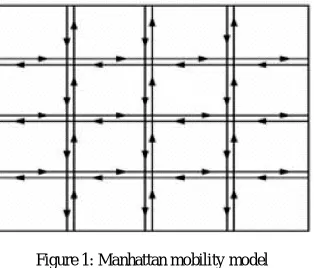
Movement of vehicle in real environment consist of restriction by the objects such as building blocks, trees. Therefore mobility model has to support the real scenario. Here Manhattan mobility model [14] is used which will generate map-based model, which contain vertical and horizontal lines for road. Figure 1 shows the Manhattan mobility model where nodes move in horizontal and vertical direction based on the probability chosen.
Figure 1: Manhattan mobility model
III.SIMULATION ENVIRONMENT
Bonn-motion [15] is a tool used for generate mobility model. The software uses is Java .The scenario generated by the Bonn-motion can be exported for network simulators such as ns2, ns3 GlomoSim/QualNet. There are different mobility model supported but we are considering Manhattan Grid model.
In this paper real time video is transmitted by using evalvid [16], the source video will be in raw YUV format which need to be compressed and transmitted. MPEG is used for compression and distributed in the network which can be decoded once it is received by the recipient. NS2 [17] is used for the simulation environment.
The following parameters are used for starting the simulation:
Mobility model : Manhattan mobility model
Connection rate : 10 packets/sec
Number of connection : 10
Simulation time : 200sec
Simulation area : 1500 X 1500 m
Maximum node speed : 10,20,30,40 and 50 m/s
Number of nodes : 50,100,150 and 200
Protocols : AODV, AOMDV, DSR
IV.EVALUATION AND RESULT
We have selected packet delivery ratio and throughput as the simulation parameter to evaluate the performance. (a) Throughput: It refers to how many number of packets successfully delivered in given amount of time.
(b) Packet delivery ratio (PDR): It’s a ratio number of successfully delivered packet to the number of packet sent by the source.
PDR = Number of packet received / Total number of packet sent
Figure 2: Throughput Vs Number of Nodes
From Figure 2, we infer that AODV and AOMDV have similar result whereas in DSR as the number of node increase packet delivered is reduced.
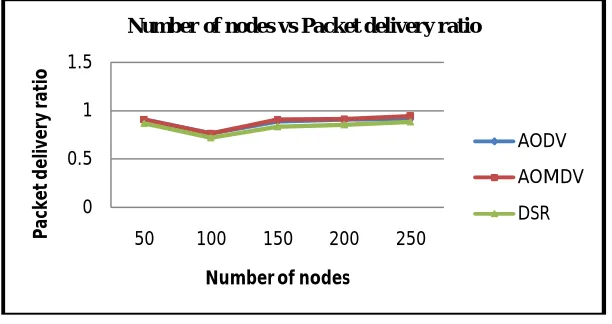
Figure 3: Number of Nodes Vs Packet delivery ratios
In Figure 3, three protocols have almost nearby value but AOMDV network delay is less compare to other two routing protocol.
B] Scenario II: In this scenario the mobility is varied by giving the speed of 10, 20, 30, 40 and 50. Based on different speed the throughput and packet delivery ratio is evaluated.
0 10 20 30 40 50
50 100 150 200 250
T
h
ro
u
gh
p
u
t
Number of nodes
Number of nodes vs Throughput
AODV
AOMDV
DSR
0 0.5 1 1.5
50 100 150 200 250
P
ac
ke
t
d
e
liv
e
ry
r
at
io
Number of nodes
Number of nodes vs Packet delivery ratio
AODV
AOMDV
Figure 4: Mobility Vs Throughput
Figure 4 gives throughput analyses of the routing protocol, where AOMDV have high packet delivery to its destination.
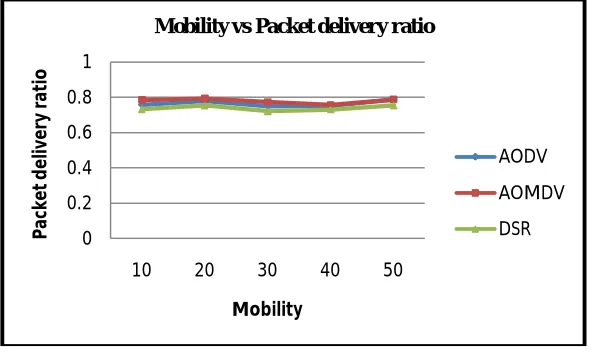
Figure 5: Mobility Vs Packet delivery ratios
In packet delivery ratio which is given in Figure 5 as the mobility increase the packet delivery ratio is increased in AOMDV.
V. CONCLUSION AND FUTURE WORK
Analysis has been done for routing protocols in Manhattan mobility model. As the speed increases, the link duration decreases and hence overhead of routing increases and throughput deceases.
It has been observed that AOMDV achieves the higher throughput and packet delivery ratio where the routing overhead is low. Manhattan mobility model will generate the scenario as road, which is mainly suited for VANET environment. Mobility model also influence in performance of routing protocol.
REFERENCES
1. Jerome Harri, Fethi Filali, and Christian Bonnet,” Mobility Models for Vehicular Ad Hoc Networks: A Survey and Taxonomy”, IEEE Communications Surveys & Tutorials, Vol. 11, No. 4, Fourth Quarter 2009
0 4 8 12 16 20
10 20 30 40 50
T
h
ro
u
gh
p
u
t
Mobility
Mobility vs Throughput
AODV
AOMDV
DSR
0 0.2 0.4 0.6 0.8 1
10 20 30 40 50
P
a
ck
e
t
d
e
liv
er
y
ra
ti
o
Mobility
Mobility vs Packet delivery ratio
AODV
AOMDV
4. Morgan, Yasser L, "Notes on DSRC & WAVE standards suite: Its architecture, design, and characteristics", Communications Surveys & Tutorials, IEEE 12, 2010.
5. Zeadally, Sherali, Ray Hunt, Yuh-Shyan Chen, Angela Irwin, and Aamir Hassan,"Vehicular ad hoc networks (VANETS): status, results, and challenges", Telecommunication Systems 50, 2012.
6. Guo, Meng, Mostafa H. Ammar, and Ellen W. Zegura, "V3: A vehicle-to-vehicle live video streaming architecture", Pervasive and Mobile Computing 1, 2005.
7. Arce, P., Guerri, J.C., Pajares, A., Lázaro, O, “ Performance Evaluation of Video Streaming Over Ad Hoc Networks Using Flat and Hierarchical Routing Protocols”, Springer Mobile Netw. Appl. 13, 324–336 (2008)
8. F. Soldo, C. Casetti, C. Chiasserini and P. Chaparro, “Streaming Media Distribution in VANETs", Global Telecommunications Conference”, IEEE GLOBECOM, IEEE, (2008)
9. J. S. Park, U. Lee, S. Y. Oh, M. Gerla and D. S. Lun, “Emergency Related Video Streaming in VANET Using Network Coding", Proceedings of the 3rd International Workshop on Vehicular Ad Hoc Networks, (2006)
10. Kayhan Zrar Ghafoor and Kamalrulnizam Abu Bakar,” Inter-Vehicle Communication Protocols for Multimedia Transmission”, Proceedings of the International Multi-Conference of Engineers and Computer Scientists 2010.
11. C. E. Perkins and E. M. Royer, “Ad hoc on-demand distance vector routing,” in Proceedings of the 2nd IEEE Workshop on Mobile Computing Systems and Applications (WMCSA ’99), pp.90–100, New Orleans, La, USA, February 1999.
12. Y. Yuan, H. Chen, and M. Jia, “An optimized ad-hoc on-demand multipath distance vector (AOMDV) routing protocol,” Proc. 11th Asia- Pacific Conference on Communications, IEEE Press, Oct. 2005, pp. 569-573, doi:10.1109/APCC.2005.1554125
13. David B. Johnson and David A. Maltz,”Dynamic source routing in ad-hoc wireless network”,In Mobile Computing, volume 353. 1996. 14. Dr. B. Ramakrishnan Ph.D, “Analysis of Manhattan mobility model without RSUs”,IOSR journal of computer engineering,2013 15. “BonnMotion-a mobility scenario generation tool”, www.cs.unibonn.de/IV/BonnMotion/.
16. Chih-Heng Ke, Ce-Kuen Shieh, Wen-Shyang Hwang and Artur Ziviani,” An Evaluation Framework for More Realistic Simulations of MPEG Video Transmission “,Journal Of Information Science And Engineering 24, 425-440 (2008)
17. NS2 simulation tool, http://www.isi.edu/nsnam/ns/.
BIOGRAPHY
Arpana Shetty is a PG Scholar in the Information Science Department, NMAM Institute of Technology. She received her B.E degree in computer science and engineering from Sahyadri College of Engineering and Management. Her research interests are sensor network and wireless network.
Ashwini B received the B.E and M.Tech degree in computer science and engineering from NMAMIT, Nitte in 2004 and 2010.She is currently pursuing her Ph.D in the area of computer vision.