University of Windsor University of Windsor
Scholarship at UWindsor
Scholarship at UWindsor
Electronic Theses and Dissertations Theses, Dissertations, and Major Papers
2010
Towards Comparative Web Content Mining using Object Oriented
Towards Comparative Web Content Mining using Object Oriented
Model
Model
Titas Mutsuddy
University of Windsor
Follow this and additional works at: https://scholar.uwindsor.ca/etd
Recommended Citation Recommended Citation
Mutsuddy, Titas, "Towards Comparative Web Content Mining using Object Oriented Model" (2010). Electronic Theses and Dissertations. 8012.
https://scholar.uwindsor.ca/etd/8012
This online database contains the full-text of PhD dissertations and Masters’ theses of University of Windsor students from 1954 forward. These documents are made available for personal study and research purposes only, in accordance with the Canadian Copyright Act and the Creative Commons license—CC BY-NC-ND (Attribution, Non-Commercial, No Derivative Works). Under this license, works must always be attributed to the copyright holder (original author), cannot be used for any commercial purposes, and may not be altered. Any other use would require the permission of the copyright holder. Students may inquire about withdrawing their dissertation and/or thesis from this database. For additional inquiries, please contact the repository administrator via email
Towards Comparative Web Content Mining using Object
Oriented Model
By
Titas Mutsuddy
A Thesis
Submitted to the Faculty of Graduate Studies through the School of Computer Science in Partial Fulfillment of the Requirements for the Degree
of Master of Science at the University of Windsor
Windsor, Ontario, Canada
2010
1*1
Library and Archives CanadaPublished Heritage Branch
395 Wellington Street OttawaONK1A0N4 Canada
Bibliotheque et Archives Canada
Direction du
Patrimoine de I'edition 395, rue Wellington Ottawa ON K1A 0N4 Canada
Your file Votre reference ISBN: 978-0-494-80235-9 Our file Notre reference ISBN: 978-0-494-80235-9
NOTICE: AVIS:
The author has granted a
non-exclusive license allowing Library and Archives Canada to reproduce, publish, archive, preserve, conserve, communicate to the public by
telecommunication or on the Internet, loan, distribute and sell theses
worldwide, for commercial or non-commercial purposes, in microform, paper, electronic and/or any other formats.
L'auteur a accorde une licence non exclusive permettant a la Bibliotheque et Archives Canada de reproduire, publier, archiver, sauvegarder, conserver, transmettre au public par telecommunication ou par I'lntemet, preter, distribuer et vendre des theses partout dans le monde, a des fins commerciales ou autres, sur support microforme, papier, electronique et/ou autres formats.
The author retains copyright ownership and moral rights in this thesis. Neither the thesis nor substantial extracts from it may be printed or otherwise reproduced without the author's permission.
L'auteur conserve la propriete du droit d'auteur et des droits moraux qui protege cette these. Ni la these ni des extraits substantiels de celle-ci ne doivent etre imprimes ou autrement
reproduits sans son autorisation.
In compliance with the Canadian Privacy Act some supporting forms may have been removed from this thesis.
Conformement a la loi canadienne sur la protection de la vie privee, quelques formulaires secondaires ont ete enleves de cette these.
While these forms may be included in the document page count, their removal does not represent any loss of content from the thesis.
Bien que ces formulaires aient inclus dans la pagination, il n'y aura aucun contenu manquant.
1+1
Author's Declaration of Originality
I hereby certify that I am the sole author of this thesis and that no part of this
thesis has been published or submitted for publication.
I certify that, to the best of my knowledge, my thesis does not infringe upon
anyone's copyright nor violate any proprietary rights and that any ideas, techniques,
quotations or any other material from the work of other people included in my thesis,
published or otherwise, are fully acknowledged in accordance with the standard
referencing practices. Furthermore, to the extent that I have included copyrighted
material that surpasses the bounds of fair dealing within the meaning of the Canada
Copyright Act, I certify that I have obtained a written permission from the copyright
owner(s) to include such material(s) in my thesis and have included copies of such
copyright clearances to my appendix.
I declare that this is a true copy of my thesis, including any final revisions, as
approved by my thesis committee and the Graduate Studies office, and that this thesis has
Abstract
Web content data are heterogeneous in nature; usually composed of different types of contents and data structure. Thus, extraction and mining of web content data is a challenging branch of data mining. Traditional web content extraction and mining techniques are classified into three categories: programming language based wrappers, wrapper (data extraction program) induction techniques, and automatic wrapper generation techniques. First category constructs data extraction system by providing some specialized pattern specification languages, second category is a supervised learning, which learns data extraction rules and third category is automatic extraction process. All these data extraction techniques rely on web document presentation structures, which need complicated matching and tree alignment algorithms, routine maintenance, hard to unify for vast variety of websites and fail to catch heterogeneous data together. To catch more diversity of web documents, a feasible implementation of an automatic data extraction technique based on object oriented data model technique, OOWeb, had been proposed in Annoni and Ezeife (2009).
This thesis implements, materializes and extends the structured automatic data extraction technique. We developed a system (called WebOMiner) for extraction and mining of structured web contents based on object-oriented data model. Thesis extends the extraction algorithms proposed by Annoni and Ezeife (2009) and develops an automata based automatic wrapper generation algorithm for extraction and mining of structured web content data. Our algorithm identifies data blocks from flat array data structure and generates Non-Deterministic Finite Automata (NFA) pattern for different types of content data for extraction. Objective of this thesis is to extract and mine heterogeneous web content and relieve the hard effort of matching, tree alignment and routine maintenance. Experimental results show that our system is highly effective and it performs the mining task with 100% precision and 96.22% recall value.
Acknowledgement
I would like to give my sincere appreciation to all of the people who have helped
me throughout my education. I express my heartfelt gratitude to my wife and daughters
for their support throughout my graduate studies.
I am very grateful to my supervisor, Dr. Christie Ezeife for her continuous
support throughout my graduate study. She always guided me and encouraged me
throughout the process of this research work, taking time to read all my thesis updates.
I would also like to thank my external reader, Dr. Gokul Bhandary, my internal
reader, Dr. Asish Mukhopadhyay, and my thesis committee chair, Dr. Xiaobu Yuan for
making time to be in my thesis committee, reading the thesis and providing valuable
input. I appreciate all your valuable suggestions and the time, which have helped improve
the quality of this thesis.
At last, I would express my appreciations to all my friends and colleagues, for
their help and support. Especially, I would like to thank Chris Drouillard and Mohammad
Table of Contents
Author's Declaration of Originality iii
Abstract iv Acknowledgement v
Table of Figures viii Table of Tables ix
1. Introduction 1
1.1 Web mining. 2
1.1.1 Web Usage mining 3 1.1.2 Web Structure mining 4 1.1.3 Web Content mining 5
1.2 Phases of Web Content Mining. 6
1.2.1 Web Page cleaning 7 1.2.2 Web data extraction 8 1.2.3 Web data classification and categorization 12
1.2.4 Web data Warehousing 15 1.2.5 Mining Web Content 17
1.3 Object-Oriented Web Data Extraction 20
1.4 Thesis contribution 23 1.5 Outline of the Thesis proposal 25
2. Previous/Related work 26
2.1 Wrapper Programming Language 26
2.1.1 DEByE: Data Extraction By Example 27 2.1.2 WICCAP : From semi-structured to structured data 27
2.2 Wrapper Induction 29 (A) String Edit Distance 30
(B) Center Star Method 31 (C) Simple Tree Matching 32 (D) DOM Tree building 34
2.2.1 STALKER: Hierarchical approach to Wrapper Induction 35 2.2.2 IEPAD: Information Extraction Based on Pattern Discovery 37
2.2.3 Instance based Wrapper Learning 39
2.3 Automatic Wrapper Generation 41
2.3.1 RoadRunner: Towards Automatic Data Extraction from Large Websites 42
2.3.2 DEPTA: Data Extraction based on Partial Tree Alignment 43 2.3.3 OWMiner: Modeling Web documents as Objects for Automatic Web
Content Extraction 44 3. Object-Oriented Web Content Mining 50
3.1 Problem Addressed 50 3.2 Web Content Objects 52
3.2.1 Text contents 53 3.2.2 Image contents 53 3.2.3 Form contents 54 3.2.4 Plug-in contents 54
3.3 Challenges and Thesis approach to solution 55
3.4 Problem Domain 59
3.4.1 Data Region and Data Block Identification 60
3.5 Proposed WebOMiner Architecture and algorithms 73
3.5.1 Crawler Module 74 3.5.2 HTML Cleaner Module 79 3.5.3 Content Extractor Module 80 3.5.4 Web Miner Module 86
3.6 Warehouse and Mining for Integration 94
4. Evaluation of WebOMiner System 96
4.1 Strength of WebOMiner 96 4.2 Empirical Evaluation 102 4.3 Experimental Results 102
5. Conclusions and Future work 103
5.1 Future work 104
References 105 Appendix A... System Manual 109
Table of Figures
Figure-01 Web structure graph 4 Figure-02 Blocks of atypical web page 7 Figure-03 Semi Structured web content data 9 Figure-04 Simple Tree matching for Wrapper Generation 12
Figure-05 Common B2C web site structure 13 Figure-06 Dataregions and data blocks 14 Figure-07 Query interface from same domain of airline ticket reservation 16
Figure-08 DOM tag tree ofCompUSA.com web document for figure 06. 22
Figure-09 Logical view of WDEL language 27 Figure-10 Edit distance matrix and back trace path 31 Figure-11 Example of center star method 32 Figure-12 Tree Matching and aligning in (X), Aligned data nodes under NI in (Y) 33
Figure-13 Boundary co-ordinates and resulting tree 35 Figure-14 (a) Training data blocks, (b) Logical presentation 36 Figure-15 Similarity measure for identifying "price" 40 Figure-16 Iterative Tree alignment with two iterations 43
Figure-17 Object Exchange GraphModel 45 Figure-18 Hierarchy of Web Object Model 47 Figure-19 OWebMiner algorithm 48 Figure-20 Example of simple static web textual data 53
Figure-21 Formatting tags within textual fragment 57 Figure-22 Difference in schema for similar information 58 Figure-23 Schema matching at object creation 58 Figure-24 Intersection ofblock level and non-block level tag 61
Figure-25 Graphical Tree representation of data block and data region... 63
Figure-26 Data block representation 64 Figure-27 Data Tuple of Product Data block 66 Figure-28 Content objects of a product list data block 67 Figure-29 Example of simple content hierarchy in a data block 67
Figure-30 NFA notation for Product tuple 69 Figure-31 NFA presentation of List tuple 70 Figure-32 NFA presentation ofForm tuple 71 Figure-33 NFA presentation of Text tuple 72 Figure-34 NFA presentation of Singleton tuple 72 Figure-35 WebOMiner Architecture for Object-Oriented web content mining 73
Figure-36 WebOMiner main algorithm 74 Figure-37 Class diagram for Crawler module 75 Figure-38 Algorithm SiteMapGenerator and MySpider 76
Figure-39 Algorithm Crowler.traverse() 76 Figure-40 PageInfo.extract() and WebPageXractor.parse() algorithm... 77
Figure-41 SimpleHTMLParser algorithm 78 Figure-42 Algorithm DOMTree.CreateTree() 79
Figure-43 OWebMiner algorithm 81 Figure-44 Modified ContentWebObjectScan algorithm 82
Figure-45 Modified ProcessContentSibling algorithm 84 Figure-46 Algorithm to insert separator object in ContentObjectArray.. 85
Figure-47 Snapshot of ContentObjectArray 85 Figure-48 Algorithm to Mine Content Object 86 Figure-49 Algorithm to Identify Object Tuple 87 Figure-50 Identification of data block 88 Figure-51 Enum set Pattern Table 88 Figure-52 Data block identification/Tuple formation 89
Figure-53 Algorithm GenerateSeedNFA to generate candidate NFA.... 90
Table of Tables
Table-01 Web Log Information 3 Table-02 Tuple types in monitor web page 94
1. Introduction
World Wide Web (WWW) is growing exponentially over the years. So, web
documents became a largest repository of information (Kosala & Blockeel, 2000).Web
content usually means to those information that a user see in a web document. It also
includes some hidden information that helps user interaction with web contents. Web
contents are heterogeneous in nature and may be in different forms like text, image,
hyperlink, metadata, audio, video and others with their combinations. A complete
classification of all these different types of web contents does not exist.
When any mechanism is used to extract relevant and important information from
web document or to discover knowledge or pattern from web document, it is then called
web content mining. Traditional mechanisms are: providing a language to extract certain
pattern from web page, discovering frequent pattern, clustering for document
classification, machine learning for wrapper (e.g., data extraction program) induction,
and automatic wrapper generation. All these traditional mechanisms are unable to catch
heterogeneous web contents together as they strictly rely on web document presentation
structure. Annoni and Ezeife (2009) present a model for representing web contents as
objects. They encapsulated web contents in object-oriented class hierarchy which enable
to catch heterogeneous contents together in unified way without strictly relying on
presentation structure.
This thesis studies the idea of modeling web contents in objects and develops a
mining process for object-oriented data model for web content integration or comparative
mining. The rest of this chapter is organized as section 1.1 introduces web mining and its
introduces the idea of object-oriented web content extraction, section 1.4 Thesis
contributions and section 1.5 outline of the Thesis Proposal.
1.1. Web Mining
Organizations that have large amount of data need to make decisions that impact
their future activities. Data mining is a process of extracting relevant and important
knowledge from that large data to facilitate decision making. According to Etzioni
(1996) web mining is a data mining technique to automatically discover and extract
information from web documents and services. Web mining became important for
knowledge discovery in business development, merchandise, personalization, and
integration of web information. Borges et al. (1999) categorized web mining into three
areas; web structure mining, web usage mining and web content mining. Kosala et al.
(2000) defined web structures as inter-document structure of web pages which is
represented by hyperlinks within the web itself. These hyperlinks are used in web pages
for navigating to other web pages for interested information. From data view of web
content mining, Kosala et al. (2000) defines web structure within the web documents
(intra-document structure), the way how web content data are represented. Web usages
are the history of user's visit to web pages generally stored in chronological order in web
log file. Web contents are all the hard data such as text, images, audio, multimedia
information in the web pages. Web contents are primary information of a web page.
There are some other information or block in the web pages such as advertisement,
page is called the noise information, and usually need to be cleaned before mining the
web content (Gupta et al., 2005; Li and Ezeife, 2006).
1.1.1. Web Usage Mining
Web usage information or the history of user's visit to different web pages are
generally stored in chronological order in web log file, server log, error log and cookie
log (Buchner and Mulvenna, 1998). General format of a web log string is as follows:
137 207 76 120-[30/Aug/2001 12 03 24-0500] "http //www crtcinfo com/bangladesh/content/current/team
/25 htm HTTP/1 0" 200 2781"
This web log string has certain set of information about user access to web as follows:
Field
Host/ip
User
Date
Request
URL
Status
Bytes
Description
Remote client IP address
Remote log user name
Date, time and time zone of request
User Request Identifier (URI) with
the Uniform Resource
Locator(URL) string
Status code returned to client
Bytes transferred
Example
137.207.76.120
' - ' for anonymous user or 'xyz' for particular user.
30/Aug/2001:12:03:24-0500
URI: http, ftp, mailto etc
URL: http •//www.cricinfo com/bangladesh/content
/current/team/25 html HTTP/1 0"
200 [series of success]
2781 bytes
Table-01: Web log information
Web usage mining finds the relationships or patterns of the user's visit to different web
pages from the access log files. The frequency of certain web page visit and the common
traversal paths by the users are important information for discovering the browsing
behavior of the web page users. If a web user visits most of the times to a certain type of
page of web site, for example: "http://. /.../products/games/hardware.html", which
hardware products. Web usage mining helps to get this information and is used by
marketing companies to sell their products to the targeted customers.
1.1.2. Web Structure Mining
A web structure defines the structure of a web site (Kosala et al., 2000). Web sites
usually consist of a set of web pages. Each page of a web site represents a set of
information. Hyperlinks (or links) are used in web pages to navigate from one web page
to other web pages of the site for navigating information. Web structure mining is the
process of discovering structure information from the web. This type of mining can be
performed either at the (intra-page) document level or at the (inter-page) hyperlink level
(Kosala et al., 2000). In case of intra-page web structure, Hyper-Text Mark-up Language
(HTML) presentation tags represent the page structure and are commonly used for web
content mining. By web structure mining, it usually means the inter-page structure
mining of web site where structure of a web site is represented as a typical web graph as
Figure-01: Web structure graph
shown in figure OLA web graph consists of web pages as nodes, and hyperlinks as edges
connecting between two related pages. Revealing web documents structure are effective
important applications of web structure mining are: discovering the topology of
hyperlinks and then categorizing the web pages, generating similarities and relationships
between different web sites, page ranking, and link-based similarity search.
1.1.3. Web Content Mining
Web contents are the core data or information of a web page. These data can be in
the form of text, image, audio, video, multimedia, hyperlinks or in combination of these
formats in a web page. Web content data can also be un-structured (e.g., bulk text),
semi-structured (e.g., HTML page content), semi-structured (e.g., XML, table, database generated
and multimedia data).
Un-structured web content data are represented by a full bag of words or texts or
phrase-based feature representations. These features can be Boolean or frequency based
and can be reduced using different feature selection techniques. Common text mining
techniques like machine learning, statistical and Natural Language Processing (NLP) can
be used for mining the unstructured web content data (Kosala et al., 2000).
Multimedia web data are the multimedia data embedded or triggered by web page
through a mouse or keyboard event or automatically generated event while browsing
through the web page. Multimedia data mining is comparatively a young sector of
research area developing in recent years with increasing demand of surfing for music,
music video, movie; online music group, large varieties of online communities for
sharing personal information, hobbies and interests especially in teenage and young age
groups. Common statistical machine learning theory or fuzzy logic theories are used for
Semi-structured and structured data are most common types of data format for
web documents. Typical HTML web page contents are semi-structured web data, which
corresponds to a collection of facts and consists of text, image, hyperlink, structured
records such as list, table, and database generated content. These types of featured data
are rich and common representation of the web document structure.
Web Content mining is the process of extracting targeted facts from web
documents. Web content corresponds to the collection of facts a web page is usually
designed to convey to the users. Web content mining aims for a target fact to be extracted
from web document or to discover patterns from web document. Common applications of
web content mining identify the topic represented by a web document, categorize web
document, find similar web pages across different servers, enhance standard query
relevance with user or role, recommendation of top relevant documents in a collection,
filter documents based on targeted facts.
1.2. Phases of Web Content Mining
Web content mining need several steps of pre-processing before mining it
efficiently. First it needs to identify targeted facts in web documents and need to exclude
noise contents (Li and Ezeife, 2006). Next step is the extraction of targeted facts from
web documents. After extraction, it then needs to classify extracted contents according to
their category. This data are then ready for mining to discover knowledge or underlying
1.2.1. Web page cleaning
A typical web page consists of a set of semantic blocks. Each block contains data
contents. There is no unified way to represent data contents and blocks. In general, most
web pages have three major blocks; header block, body block and footer block as shown
l^ffiOSS NZV/Z. TlxXS , l f e i $
sutos Entertainment (Sews Lifestyle Money Music Green Shoppitse
>/j?/.
Tedi/fraye! Vid
Header Block
•**J*~
Advertisement Block! " * - -- *' m -""re! rivkirt
J » t i , ' * •"'•«« " •>'M>s"x'y IU hii(l.'-t
' t,l w i w i i > « i,« * " M k " : J - . i 8i«'i->: = • - • 3 f l i t
E9
ftNavigation Block
i i E W i i a
Hnlti«.l. i _+1 I+ire bo.h O
hs.*,^ i . '4 5 *, ,si*i i - s t i ^ *rs?
W a
I ^ la mi
I News (IK. '••-".-.!.- liv i i -i M o n e y
• r-f,'j IN- alv.-l- S
, Explore MSN
J N v i f sired Ott«r-4
i^M'.'-.-.,V" * " " ' " l :-rr
- M ' l ] , ' , , l l I I I A «
i A ' i n d c w LI'.C I'lx- Ic
4, / " - , ; '
I i- rsd It ft i MS^
Navigation Blocks
Footer Block
Figure-02: Blocks of a typical web page
in figure 02 (Annoni and Ezeife, 2009). The body block contains the major web
document information. Other blocks like advertisement blocks, navigation block may be
contained in all these three major blocks. A header block consists of page heading,
content blocks, navigation blocks, advertisement blocks. This is the core part of the web
document including a set of noise blocks. Footer block consists of copyright notice,
advertisement and navigation bar. These heterogeneous web pages need pre-processing
like cleaning the noise contents for effective page classification/categorization and data
warehousing (Chaudhuri et al, 2003; Gupta et al., 2005). It is easy for a person to
understand the structure of a webpage by browsing them but difficult job for a machine to
do automatically. There is no easy way to differentiate the noise blocks from content
blocks (Li and Ezeife, 2005). For example, an advertisement in a page may become
important if user is interested in it and it can contain important citation links that are
valuable for PageRank (Page et al., 1998). But at the same time, an advertisement block
may be considered as noise if user is not interested in it. So, it may deteriorate the page
classification and mining quality. Many researchers just only extract data from the web
pages (Chaudhuri et al., 2003) but other researchers emphasize on removing the noise
contents from the web documents for improving quality of web content mining (Yi et al.,
2003; Li and Ezeife, 2006).
1.2.2. Web data extraction
A typical web page contains a set of data objects or records such as a list of
products, services and image or text explaining details of their products. These data may
be hard coded or generated from databases and encoded by hypertext tags of the web
page in leveled or hierarchical structure. There is no unified data model for web pages.
So, extraction of web content data is highly dependent on the presentation structure of the
web page. Wrapper (e.g., data extraction program) induction (Muslea et al., 1999) and
techniques widely used today. Former technique is a supervised learning process and the
latter is unsupervised learning process. In supervised learning, it needs a set of sample
web pages or training pages for user defined marks / labels to learn extraction rules from
these training pages first. Then, the same rule is applied to other pages of the WWW for
information discovery. Figure 03(a) shows simple personal information which can be
represented in hierarchical structure as shown in figure 03(b) and in leveled structure
Name: Dr. C. I. Ezeife Position: Professor Dept: Computer Science
Ph: (519)253-3000
Email:[email protected] Publications:
2009
Names, xxxxxxxxx 2008
Names, yyyyyyyyy
(a) (b)
• 4 -Name
Person
Position Dept Phone Email Pub: year
S s =
names
^-xxxxx, year names yyyyy
(c)
Figure- 03: Semi Structured web content data
as shown in figure 03(c). To extract the targeted information or items from nodes the
wrapper needs a rule that will extract information from the parent node. In this process,
user first marks some targeted items from a set of similar training web pages (called
positive pages), then an algorithm or the rule is developed for these training pages to Person
Name Position Department List (Publications)
Phone E-mail Year List
extract the information from the nodes and if the defined rule works as expected, then this
rule is used for other web pages in the WWW for information extraction. For example:
Problem: We are interested to extract the area code of phone numbers for all branches of
PizzaPizza store of Canada.
Training Examples: Let's take four distinctive web pages as training pages from
PizzaPizza store branch websites from different corner of the county. The address data
block of these training pages are El, E2, E3 and E4 as shown
below:-El: 2203 Wyandotte St W,<i> Windsor </i> <b> ON </b>, Phone l-<b> 519 </b>-948-5133
E2: 158 Dundas Street, <i> London </i> <b> ON </b>, Phone (519) 667-1111
E3: 7348 Kingsway <i> Burnaby </i> <b> BC </b>, Phone l-<b> 604 </b>-519-1111
E4: 5184 Avenue du Pare, <i> Montreal </i> <b> QC </b>, Phone: (514) 737-1111
Extraction rules: To extract area codes of phone numbers from above mentioned training
pages, user needs to develop an algorithm based on some extraction rules. One possible set of extraction rules are shown below:
Start Rule: End Rule:
Rl:SkipTo(() SkipTo ( ) )
R2: SkipTo (-<b> ) SkipTo( </b> )
Here, Rl and R2 are rules, each of which have a Start rule and an End rule. The wrapper
needs to identify the list of store location page from PizzaPizza web site for each
province. It then needs to identify data blocks. The wrapper then can start iteration with
its Rl Start rule, if it succeeds then it ends with Rl End rule or it iterates to R2. Here,
when wrapper program identified the data block of El training example, it will start with
</b>). Similarly, E3 will be extracted by R2 and E2 and E4 will be extracted by Rl. The
algorithm ends when all the positive examples are covered.
Problem with this kind of supervised learning is the need for heavy manual
labeling of training pages. This is labor intensive, time consuming and needs regular
wrapper maintenance effort. So, automatic wrapper generation for data extraction is
becoming more popular over the years. In this technique, a single page (positive page) or
a set of pages are given with multiple data records and then it generates the extraction
patterns from the WWW. Common technique is to identify the data regions and data
records through string matching or document tree matching (Muslea et al., 1999; Zhao et
al., 2005; Liu, 2007). The string matching technique (discussed in section 2.2.A) needs to
identify the edit distance for matching and the document tree matching technique
(discussed in section 2.2.C) is needed for matching web presentation tree and its
alignment. For example, automatic wrapper generation from a set of positive pages by
tree matching based of "Road Runner" algorithm (Crescenzi et al., 2001) is shown in
figure 04. Here, authors use multiple sample pages: each contains one or more data
records. At the beginning, a sample page is taken as the wrapper. This wrapper is then
refined by solving the mismatches between the tokens of wrapper and each sample page.
Using this set of sample pages, a wrapper as regular expression is generated. Figure 04
shows string mismatch and tag mismatch and the generated wrapper after solving
- Wt.tppt r [initially Ptiyr i !•: S<in:it!r iPi,i,t
0 1 ; <HTM> 02: Bcote o f * 05>; <B>
0 4 : John S x i t h . OS: </B> 06: <UL> HII^M^MMIUBMILJ^E^^^AI^ 1 07; «.LI> 08-10: <I>TitXe:</I> I t : DB Pr3ner.ri 12: </LI> 13: <AI>
14-16: < l > T i t l e : < / I >
17: Coop. Sys tmmm
18: </U>
i,-;»W friateitii (gPCMTA >
02-u3: r>4: Mb: yS: 07; &8: 0 9 - t l 12: 13:
Books o f -<B>
Paul Jones </B>
<I«S s r c - . . . / > <UL>
< I > T i t l « : < / I > XML a t Work
s£ra?w mt.*i> <u> [• i ^PCDATA >
T
19; <f\JL> t®$ mwmrMe-k ?+)
2 0 : </HIBL>
^ ! t s * s , i i ?fti# «*t*tHt <mrt
• Wmppf r ttfft i siJnnij il)'*T)i<il'h* .*>.'
-IT: <l>Tltl©:«-/I> : HTML S c r i p t s
</U> 2 0 : <LI>
- 2 3 : <T>Titl«:«/I> J a v a s c r i p t </LI>
</UTffl.>
<HTML>Beoks of :<B>#PCDin</B> ( <iHQ src».../> )? <UL>
( <U><I>Titla;</I>#FCBATA«/U> ) </ULx/HTHL>
Figure-04: Tree matching for Wrapper Generation (Liu, ACL Tutorial 2007).
Recently, Annoni and Ezeife (2009) modeled web documents as object oriented web data
model for automatic web content extraction. Section 1.3 discusses in details of this new
approach.
1.2.3. Web Page classification and categorization
Web page classification or categorization is the process of automatically assigning
web pages into a set of predefined categories. In general, certain types of web data are
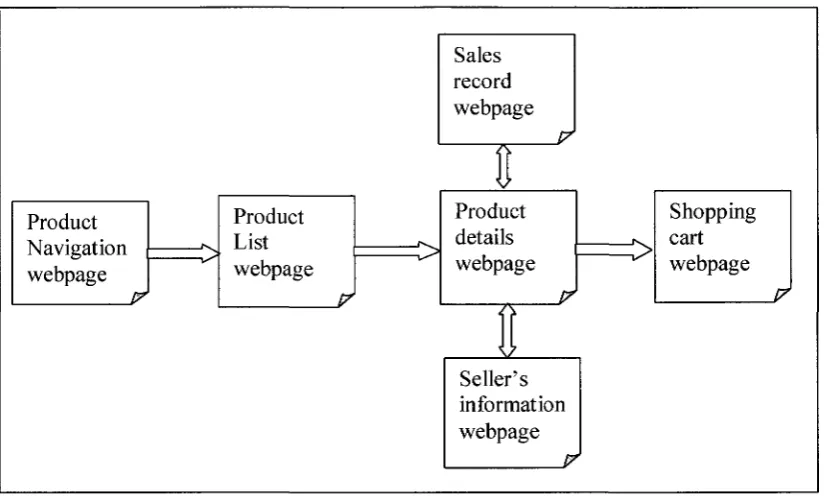
usually found in certain pages of a web site. For example, an online product sales website
or Business to Customers (B2C) website contains a set of web pages and navigation
Product Navigation webpage
sr
<"-s
\S
Product List webpage
E?
1 \ 1 ""^
Sales record webpage
Product details webpage
1/
\7
• • %
\S
Shopping cart webpage
Seller's information webpage
Figure-05: Common B2C web site structure (Ai et al., 2006)
B2C retail store website like "Future Shop" (www.futureshop.ca), one first finds an index
page or product navigation page. Clicking on a link on this page brings up product-list
page, list of all products or certain category of products including product image, product
name, product Id, short description and price of each product are listed in product-list
page. Clicking to a specific product in the list will bring up product-details page, which
gives detailed information of that product and so on until we hit the "Shopping Cart"
page. User navigation is generally restricted beyond this page after putting personal and
payment information for buying products. Figure 06 shows the monitor page of
CompUSA.com, which is an example of product-list page. We will use this page of
figure 06 and example 1.1 (page 19) as running example in subsequent sections of this
thesis. We have selected product-list page because in the entire structure of a retail store
website (shown in figure 05), product list page is the most data-rich page for comparative
Navigation block Data Region-2 Data Region-1 Data Records Advertisement
Figure-06: Data regions and data blocks
It gives brief information about different products such as product image, brand, model
or product number, short description, price and navigation to more information such as
details specification and user feedback. A set of all these information for a specific
product is called "data record". Similar category data records are in general organized in
"data region" of a product-list page. Figure 06 shows data region-1 consists of six similar
category data records. Other interesting information in a product-list page is set of
navigation blocks and advertisements. A navigation block consists of a set of pair of a
hyperlink or URL and a text Users read the text and if interested, click on that hyperlink
image is about the product or company and the related hyperlink brings user to the
related page. Advertisements in general bring the user to a new website.
1.2.4. Web Data Warehousing
Data warehouse refers to a database that is maintained separately from the
operational database. It allows heterogeneous database integration with a variety of
application systems. Web content data are scattered in different web sources and need to
integrate in a warehouse environment for analysis and discovery process. In relational
database management system (RDBMS), data warehousing is comparatively easy
because data are historical and nonvolatile. But web content data are updated frequently,
it is volatile and not historical (Bhowmick et al., 1999; Dung et al., 2007). The
maintenance of a data warehouse based on the web content data is not easy in
comparison with company based conventional data warehouse. One potential problem is
the "multiform" of web data, which needs to convert into unified format to store in
physical database. For example, an image data needs to be extracted and stored in
different physical location with unique id and its reference needs to be stored in the
database. A mapping is required between the database and the physical location to get the
image. Some researchers adopted the web data extraction system in virtual approach
without creating physical data base and warehouse (Bornhovd, and Buchmann, 1999;
Chawathe et al., 1994; Liu, 2007). In this system, the related data are integrated from the
WWW in real time on the fly as query response. This technique is called Web Query
| | V f l w f » »r*f* •*>**<* r***® Y&<a W»s>t ^ * r » v # ^
s J U 1-,-,i.~ „-|
[i.;«w; i™<;?<, --3 ff"„'7-.,;
r
Return date Time
41 -i<
DB DB
n
Preferred cabin _ _ ^ risssris-'svRiira|Economy/Coach "~~J •*•»•»* sf-mhti: [ i j 1
DB
X
DB
Figure- 07: Query interface from same domain of airline ticket reservation.
Web query interface integration provides a global query interface to the user so that user
does not need to manually query individual web source for required information. For
example, in case of airline ticket reservation of figure 07, two query attributes of
interfaces do not have matching attributes but their domain is same. To create a global
query interface for these interfaces, an efficient mapping is required for each attribute. In
this case, web content data from different web sources are not replicated and guaranteed
the consistency but there is no tight control over the quality of data that are usually
obtained from the data warehouse and sophisticated query optimization is not possible.
Other researchers adopt the data warehouse based approach (Zhu, 1999; Darmont
et al, 2002; Zhu et al., 2001; Dung et al., 2007). Most of the researchers in this area rely
on the already established Online Analytical Processing (OLAP). OLAP is a category of
warehouse approach is not very adequate to deal with multiform data (e.g., texts, images,
sounds, videos etc). OLAP is also recognized as inefficient and ill-adapted (Darmond et
al., 2002). Zhu, et al. (2001) modeled a semi-automated approach to use the relational
model based star schema for transformation task for storing web data into existing data
warehouse. Darmont, et al. (2002) modeled a logical XML schema with DTD to
transform the multiform web data into XML document and then mapped to relational
database which contents were then remodeled in multidimensional way to store in star
schema based warehouse.
1.2.5. Mining Web Content
Web content mining is the overall process of discovering potentially useful and
previously unknown information or knowledge from the web content. It has four major
tasks; Resource finding, Information selection/pre-processing, Generalization and
Analysis. Web content mining research can be broadly classified into two streams. First
stream is the Information Retrieval (IR) and the second stream is the Information
Extraction (IE) from web page. There is a common misunderstanding about Information
Retrieval and Information Extraction (Kosala et al., 2000).
Information Retrieval (IR) process tries to retrieve all the relevant documents and
at the same time retrieve as few of the non relevant documents. Modern search engines,
web document classification are examples of IR process. For example, "google" is an
example of IR process. For any "text" keyword, its engine traverses in WWW, classifies
relevant web pages of given keyword and indexes them and returns result as per their
rank. Information extraction (IE) is the process of extracting the relevant or targeted
without any targeted fact is meaningless. This process focuses on specific web sites or
contents for extraction and often used in Web Content Data Integration (Liu, 2007) by
building a virtual database or finding the schema of web documents or building web
knowledge base (Kosala et al., 2000). IE process is also used as a part of web content
mining for building the web data warehouse. Annoni and Ezeife (2009) proposed
representing web documents as Document Object Model (DOM) Tree based
object-oriented model for web content extraction. Section 1.3 discussed about this model. Our
research area is in IE process and given below a motivational example for your work.
Motivational Example:
Develop a shopping planner that is able to answer the following type queries:
1. Given a product type, output all related products on sale around Windsor area right now and advice the user about buying the product based on buyer feedback. 2. Given a flight trip plan from Windsor to Delhi, India with 2 night halt in London
and want to touch Frankfort airport on the way to Delhi, output all flight in ascending price and advice the user about the best time and airline to plan the trip.
3. List all journal and conference publications on "Sequential Pattern Mining" in 2010 by title, authors, journal/conference, place, page and date.
4. List all 17" LCD Samsung monitor selling around Windsor with price range less then $200 and show the user graphical variation about its price in last 1 year and where and when is the best time to buy.
5. List all songs by albums of singer Lionel Richie with option to play any music with user event and show user feedback or ranking of the music.
To solve these problem queries using free web data we need to extract relevant
information from web and store into any central repository, we then need to either create
a data warehouse or analyze query for mining from the repository to result the user. One
thing we need to make clear at this point to distinguish our problem with similar
Service" is a new approach used in "Semantic Web" which generally deals with Business
to Business (B2B) data integration. Web Service is a proprietary service and needs to buy
the service from the service provider. Semantic web uses XML based Web Service
Description Language (WSDL) for enterprise data integration. It does not deal with free
HTML web information. Different provider companies' offer their service or data to use
by other business or parties through semantic web and can use their service in buyer
Company's business webpage. For example, "google tool bar" is a common web service
offered by "Google" to use by other business / corporate company web sites for search
option. Similarly, "Chapters", "Burns & Nobles", "Amazon" and "e-bay" web service
can be used to integrate book domain information integration.
Both "Web Query Interface Integration" and "Web Service" gives instantaneous
information and do not hold any historical information. Our system deals with free
HTML web information and need historical events to answer these queries. In this thesis,
we are working for data extraction problem from the web toward answering the
motivational example queries above using object-oriented web data model and we state
our thesis problem as following example 1.1:
Example 1.1: Given a product list web page of a retail store shown in figure 06, extract all types of information like:
(i) Those related to data records such as product image, product brand, product id, short description, product price.
(ii) Navigation information such as link URL, link id or name,
(iii) Advertisements such as product advertised, image, URL links to related website.
1.3. Object Oriented Web Content Extraction
Annoni and Ezeife (2009) propose an object-oriented web data model for
extraction and mining of full diversified web data including contents and page
presentation structure. They modeled web data as web content objects and web
presentation objects to address a unified way of mining unstructured, loosely or strictly
structured data. They divided the web documents into three zones; header, body and foot
zone, based on value in content mining and their physical location in web browser. They
assumed that a web document should compose of at least one zone object (i.e. body zone)
and up to three zones (i.e., header zone, body zone and the foot zone). In web browser, a
header zone located at top of the web page, foot zone at bottom of the page and the body
zone is the main body of the web page between header and foot zone. The header zone
usually consists of page identification information, company logo image, company name,
advertisements. This zone is useful for extracting information about the page content,
metadata but does not have any importance for data contents and its mining. The body
zone is the basket that contains the page contents and most important for content mining.
At the same time, it is also crucial to clean effectively for extracting real valued contents.
The footer zone usually contains the copyright information, advertisement, and links that
have no value in terms of content mining. A web page usually contains a set of hypertext
presentation tags including the customs tags defined by page designer. Annoni and Ezeife
(2009) propose not to evaluate all the tags of a web document. They tried to ignore less
valuable presentation tags of the web page because this is time consuming and is not
<html><head></head><body></body></html>. This hierarchical format indicates that all
the tags of a page should be within the root tag <html> and then it has two child tags
<head> and <body>. All the information within the <head> tag is the header information
and the content data are within the <body> tag. But the real time web page presentation
format is not so simple. Lots of different pre-formatting information, styling information,
embedded client side and server side scripting programs in different languages, flash
programs, meta data are the puzzling problem for efficient page content data extraction. It
is easy to identify that the meta-data, scripting functions have become part of the header
zone information but there is not necessarily a clear boundary between the header zone
and the body zone.
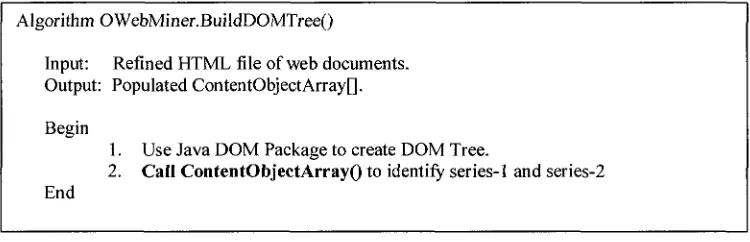
Annoni and Ezeife (2009) suggest two tag series (a set of at least five or more <a>
or <area> sibling tags) to distinguish the boundary between these zones. An <a> or
<area> tag in an HTML file represents navigation URL. They observed that, a set of first
five or more sibling <a> tags indicate the starting of body zone and called it series-1. The
last set of five or more sibling <a> tags indicate the end of body zone of a typical web
page and they called it series-2. They used two hypotheses for searching these series as
follows:
1. If the search process of series-1 goes over half of the DOM tree size, the web
document does not have header zone and series-1 is empty. The body zone's
first tag is the first region node child of the closest region node in the sub-tree
of "body" root.
2. If the search process of series-2, from half size of the DOM tree to its end
tag is the last region node child of the closest region node in the sub tree of 'body" root. 1 2 3 i i 6 3 J 11 13 15 V IS 28 21 23 25 2? 28 31 33 34 35 38 3' 33 £8 63 i W 101 102 103 "111 « 111 •12 113 Test <rft> •tvd> -Kit? %at> «tafe> <l i,-*c8frDpJBie*>
<s t-http teTStofcoT.corrsLss ij = _b)an< > <3 ">•=" appiutas campaignsfCS'npaigrtLsnplJte asp <s • *•= https< w < conpusa concgBsWaTrack as <a "{•= https' i « ¥ conpusa comsKure «dwlogin as
<i f ~ * s « t s ' s M p , « h a s p ilF^elp*>
'<Si>
-i>
0"*—Mj» '¥'••('. corrsusscor?1 >
<a * e~ tetates conpusaSforss « t e asp >
Header Zone
Region tag
Series 1 Cawpatgn!E>?3r> p* J ^ t a M / O n t e '
TC=1 rt—My Accour* >
<ars=littp ,rairpi)S'tsho|loialci:iiceT-asa!(fefeiilas'3'.acti(Ki=8ritrj > <3 i- apaicatiaiSfipfcardigirad asp*•
<s' s-'iSKtes sistilist w jdslst asp^
Q ^ seciffi'i&logiiias!""
<dr> <tt= *«328"> <Mi)C0D-€EEEEE^=15(r> •48+> <5 ? <d-<.'aHf> <'d>
<a j J1 =*ccccoo
• a ^ - . r f E E E E E « t a = 4 " <tr <l, - ,op *•
d> <afc»>
&c SiiM 'iiSDl $FL M M * few
Region tag Body Zone 119 128 121 12? 123 129 130 131 13' 138 139 M5 1 * 14? 153 154 155 156 W 131 152 193 134 20? 209 211 213 215 21? 219 225 226 22? 233 236 W 243 244 «L TH! >•<<% <Ude> 'if <t> 4a*> <M> -d> » <tefe> <,'& < ••
< a t ^ <V
<dtgc - * t k i ± t - * = ' 5 C >
<i>
ffl^ ^ ^ s ^ ^ 9 i a s & a s ^ s i GBSSSSS tssEss t « ^ ^^ ^ ^ a sggsgi!
<1 f|-f«)tjt[ip> Region tag
<4>
^s 1 N= a^teaticis tarca jissac D3iantM[rte as^CanpsfilD^t^ < a h £ «Dplijatii}isiaB'p8tgns..aira3rteT!*r3teasp''CaFp3giilD=73S >
o 1 Pt= sectors atoutos pan/ asp >
<3hf=*a:pkatcis.s,iffllieiailnanageras3 - series 2 * <a rr*#" iss index 355 c 3o*.=""N\Lnk >
<ah f='issindexss3 > <SMf > <o „= f(»Mitp2 >
-31 3'yr-let, Se= D3dding4px Opx 2sx 4p< float left -Aidth 210sx > d r * = float aft >
4i t -=*float ight J idtb T5px ^ Foot Zone
• s i *
<i <•! j= posfton assolute !i,"22flpx paddigterrayilpx ante Opx !|ipta
•ii>
Figure 08: DOM tag tree ofCompUSA.com web document for figure 06.
In case of our running example, figure 06 at page 14 shows the page what a user
sees in a web browser. The internal page tag structure of figure 06 is given in figure 08
the webpage are shown to the user. Web contents that are seen in figure 06 are embedded
between these tags in this tag tree. Figure 08 shows line number of each tag and the
symbol " © " represents embedded hidden tag in between the given tag at that line. The
symbol " 0 " represents open embedded tag. We kept some child tag structure hidden to
keep the figure 08 readable to reader and to identify easily the sibling tag structure. Any
gap in line number indicates embedded child tags. For example, in figure 08 line numbers
jumped from 58 to 69, that means there are 10 lines of hidden embedded tags at line 58
<div> tag and indicated by the symbol "©". Here, line 7 starts with a region tag that
consists of two data navigation block "<div>" starts at line 8 and 20. Line 9 to 17
indicates the first five sibling <a> tags as per Annoni and Ezeife's (2009) definition and
identifies as series-1. So, line 7 region tag clearly distinguishes between header and body
zone. Similarly, line 207 to 217 indicates the last six sibling <a> tag series which is
identified as series-2. So, the region tag at line 193 clearly distinguishes between the
body zone and foot zone.
1.4. Thesis Contributions
This thesis includes lots of pre-processing work to prepare data for mining that
are not addressed by Annoni and Ezeife (2009). We developed the architecture (we call it
WebOMiner) for extraction and mining of web contents using object-oriented model. Our
architecture has 4-modules: crawler module, cleaner module, extractor module and miner
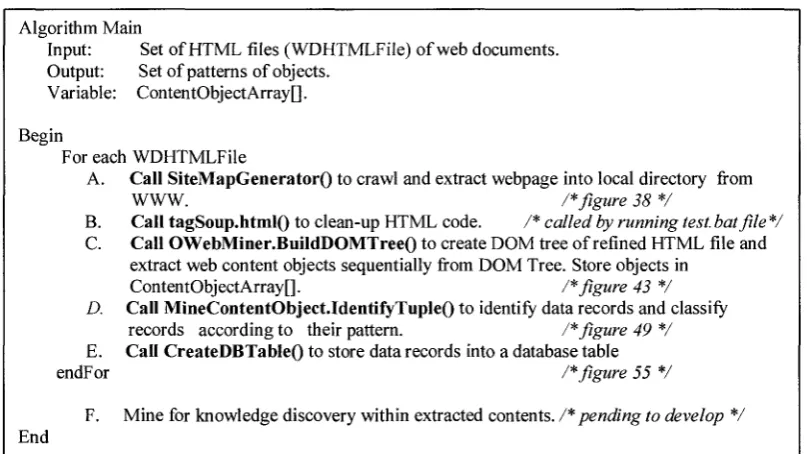
module. We developed algorithms for crawler module, modified freeware software
"tagsoup" (http://home.ccil.hangorg/~cowan/XML/tagsoup) for cleaner module, modified
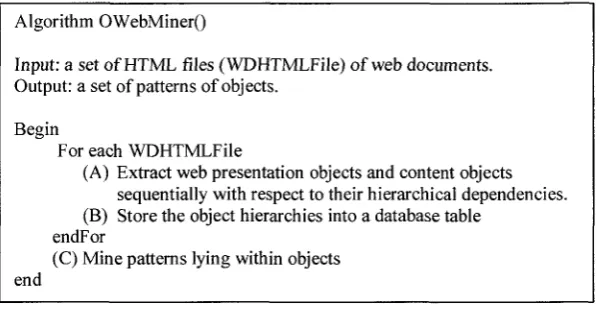
(2009) and developed algorithm for miner module. We introduced an approach of
generating and using automata for mining web content objects. The following are main
contributions of the thesis in extractor and miner module of WebOMiner system:
1. We define data block and data region to ensure consistency between related data
that is not addressed by Annoni and Ezeife's (2009). We therefore modified their
ProcessContentSibling() algorithm to identify data block and data region.
2. In web page, information about content usually reside as tag attribute. We address
to relate HTML tag attribute information with related contents to ensure
identification of content, to assign object and other information together.
3. We define object class hierarchies according to our problem domain and defined
schema matching to unify similar contents from different web sites.
4. We identify noisy contents in data block and prevent them entering into database
table.
5. We implement and materialize object-oriented data model for web content and
extract heterogeneous related web contents together.
6. We define a mining algorithm that identifies data block, generates a
Non-Deterministic Finite Automata (NFA) based wrapper for extraction of related
contents. Then classifies all data blocks of a web page according to their type and
checks minimum support to ensure data consistency before entering them into
database.
This thesis proposes a two level mining process. The first level mining (as discussed
above) extracts and classifies content data from noisy flat object array defined by Annoni
recommends data warehouse and second level mining for deep knowledge discovery.
Second level mining is similar to traditional data mining process, so excluded from the
scope of this thesis work. We also study the advantages/benefits of this new approach
over the existing approaches and conducted performance analysis. The second level
mining is beyond the scope of this thesis work.
1.5. Outline of the Thesis Proposal
The remainder of the thesis is organized as follows: Chapter 2 reviews related
work to this thesis. Chapter 3 details discussion of the problem addressed along with the
new algorithms proposed. Chapter 4 gives performance analysis and experimental results.
2. Previous/Related Work
Our research area of web content mining is in Information Extraction (IE), which
is focused on structured data extraction techniques and classified into three categories:
wrapper programming language, supervised learning like wrapper induction, and
automatic wrapper generation. Related works in this chapter are organized as wrapper
programming language in section 2.1, wrapper induction in section 2.2, and automatic
wrapper generation in section 2.3.
2.1 Wrapper Programming Language
Wrapper programming language provides some specialized pattern specification
languages to help user construct extraction programs. Most of them provide visual
interface to hide their complexities under simple graphical wizards and interactive
processes. There is a wide body of research on Wrapper Programming Language based
extraction and some examples are Lixto (Baumgartner et al., 2001), DEByE (Laender et
al., 2002), Wargo( Rapaso et al., 2002), WebOQL (Arocena et al., 1998) and
WICCAP(Zhao and Ng, 2004). All these extraction systems use Graphical User Interface
(GUI) to interact with user input and hide internal complexity from the user. Lixto system
internally uses logic-based declarative language "Elog" for extraction of content element
from targeted web page given by user in GUI. Resultant outputs are given in XML
format. Wargo system internally relies on two wrapper programming languages:
Navigation SEQuence Language (NSEQL) for specifying navigation sequence and Data
EXTraction Language (DEXTL) for specifying extraction pattern. We discussed the
2.1.1 DEByE: Data Extraction By Example
DEByE is an interactive tool that receives as input a set of example objects taken
from a sample Web page and generates extraction patterns that allow extracting new
objects from other similar pages (e.g., pages from the same Web Site). DEByE features a
GUI that allows the user to assemble nested tables (with possible variation in structure)
using pieces of data taken from the sample page. The tables assembled are examples of
objects to be identified on the target pages. From these examples, DEByE generates
object extraction patterns (OEP) that indicates the structure and the textual surrounding of
the objects to be extracted. These OEP are then fed to a bottom-up extraction algorithm
that takes a target page as input, identifies atomic values in this page, and assembles
complex objects using the structure of the OEP as a guide.
2.1.2 WICCAP : From semi-structured to structured data
Web Data Extraction System (WICCAP) uses Web Data Extraction Language
(WDEL), which is one kind of scripting language to provide features transforming web
data. Basic unit of this language is symbol, which represents the nodes of trees. A symbol
can have a set of sub-symbols. A Term is used to represent a tree. A Term in tree
language can be mapped into tree graph. For example a Book Domain tree language is
Business_Book(Bookl (Price, Author'(Most Popular_Item)) )
\ . Busmen BCH^S
" - ' " * - J B o o k ^
/
/ \
,A.
\
X .
v/
f \Pn~e /• "N \nttioy " \ Pn<.<> ?"~ Wmhm''*~~'~-- Prltu
~\ M"Sl E^pUkM Itom / -^ Must PojHl] il EkMft
given above can be represented logically as tree graph shown in figure 09. Note that,
Business Book(Bookl), BusinessJ3ook(Book2) and Business_Book(Book3) are three
different Terms, because they represent three distinctive tree under Bookl, Book.2 and
Book3 in tree graph. The authors defines the tree grammar as 4-tuple, G = {S, N, F, R}.
Where, S = Set of root symbols, N = Set of Non-terminal symbols, F = Set of symbols
and R = Set of generation rules. Where, SeN and Ne F, R is in the form A -»/?, here A is
a non-terminal node and R is a term over F. For a given Term in figure x:
Business_Book(Bookl($ 17.49,Greg)), the replacement of book title Bookl by #book,
price $17.49 by #price, and author name Grag by #name will enable to symbolize the
Term as : Business_Book(#book(#price,#name)). Therefore, the grammar for extraction
of Term can be represented as follows:
F = {Business Book, nil, #book, #price, #name, WICCAP, Book, Price, Author} S = {WICCAP} // WICCAP = root symbol of the grammar N = {WICCAP, Book, Price, Author}
R = WICCAP —* ml //Generation rule starts with root symbol WICCAP — Business_Book(Book)
Book —> #book (Price, Author) Price —* #price
Author —> #name
The absolute paths for physical structure of web contents in WWW are in general
complicated. So authors use mapping of physical structure with their logical view in tree
graphs as shown below:
[ ', Bu.MiU'is Book . , I
\ J ~ Bix>k -v,
<A HRi:r='TRr> \m\ B ^ k l tapping Bo'.-ki
Therefore rules need to redefine as (A) below and this mapping raises the need for
another grammar to describe the physical paths shown in (B) below.
WICCAP -> ml
WICCAP - » Business Book (PhyStr 1, Book) Book^> #book (PhyStr2, Price, Author) Price —> v (PhyStr3, #pnce)
Author —>v (PhyStr4, #name)
(A)
PhyStr Link — URI->
—•> mapping(Link, PhyStr)
• text (URI),
#pcdata
| loc (Pattern), Pattern —> | pathexp (Path), Path —>
\fromcode (Form), Form
(B)
#pcdata #pcdata —* #pcdata
These grammars describe the schema of original web documents to be extracted, schema
of extracted data and relationship between them. WDEL script is an instance of Terms
that can be generated corresponding to WDEL grammar. WICCAP generates the output
in portable XML data format that can easily be stored in relational database or can be
viewed as required.
Main problem for wrapper language based extraction system is their reliability on
diversified wrapper languages. None of these languages are standard, used by vast users
and therefore fail to become popular in vast user community.
2.2 Wrapper Induction
Wrapper induction is either supervised or semi-supervised learning process for
extraction and mining of web contents. It needs a set of sample web pages (called training
pages) for user to define marks / labels to learn extraction rules from these training pages
first. Then the same rule is applied to other pages of the WWW for information
discovery. We now like to discuss about three popular algorithms that most of the
Information Extraction (IE) systems use. These are String Edit Distance, Center Star
(A) String Edit Distance:
String edit distance is a popular and widely used string matching/ comparison
technique to find the same type encoded instances. The edit distance of two strings, si
and S2 is defined as the minimum number of point mutation required to change sj into s2.
The point mutation may be to change a character, insert a character and delete a
character. If c- and C2 are two last characters of sj and S2 respectively, then edit distance
between si and S2 can be denoted as d (si, S2)= d (sj.+ci, S2-+C2). Up (cj, C2) denotes the
penalty for changing, inserting or deleting a character, then
JO, if c, = c2
[1, otherwise
For example, let si = X G YX YX YX and s2 = X YX YX Y TX are two strings. The edit
distance is computed as follows:
ED (Sl, s2) = d(Sl'S2) (\si\ + \si\)/2
The edit distance matrix is given in figure 10. The final edit distance value is 2, which is
the value in the bottom right corner cell. Figure 10 also shows the trace back path. Notice
that a diagonal line means match or change, a vertical line means insertion, and a
horizontal line means deletion. Thus, the final alignment of our two strings is:
s,: X G Y X Y X Y X
s2: X - Y X Y X Y T X
s, X G Y X Y X Y X
o*
i 2 Q «_*> 4 8 7 8 1 ""cu 1 3 4 5 5 72 3
- 1 * 2 1 2 3 4 5 8 7 4 3 U ,2 2 2 3 4 trt o 5 4 ^ o 1 2 2 o 3 4 5 ' * 2 2 3 4 6 5 4 3 2 2 3 3 7 6 5 4 3 2
•t
8 7 8 4 3 22 l 2
'2
Figure-10: Edit distance matrix and back trace path (Liu, 2007).
(B) Center Star Method:
It is a classical technique for multiple string alignment. Chang et al., (2001)
introduced it for data extraction based on alignments of HTML strings. In this method a
set of strings are assumed as aligned as ' S ' . A string sc is selected as center string that
minimizes:
y dist(sc, Si) Equation (3)
Here, d (sc, s,) is the distance between two string sc and s,. The algorithm then iteratively
computes the alignment of the rest of the strings with sc. Figure 11 illustrates an example
of string alignment using center star method and latter we will illustrate how it is using
for web content extraction.
Let us have three strings, S = {ABC, XBC, XAB}. According to Center Star
method, first string selects as center string. So, ABC is selected as the center string sc and
initializes multiple sequence alignment M by string ABC. Now we need to align other
Iteration 1:
Iteration 2:
Align c* (=sc) with s = XBC:
c*' : A
s' : X Update M : A B C - »
Align c* with s = XAB: c*' :
s ' : X Update M : A B C »
-X B C X B B A I 1 A A X A C 1
c
A B CX B C
B C I 1 B -B C B C B ~
Figure-11: Example of Center Star Method
In figure 11, next string "XBC" is taken from the set S and aligned in iteration 1 by
matching character B and C. The algorithm then updates a multiple sequence alignment
M by including XBC aligning B and C with center star. Next, empty space is created to
each string in M to accommodate for next alignment. In iteration 2, it aligned XAB
matching A and B with center star and update M accordingly. There is a question of
aligning ABC and XBC in iteration 1 since we don't know which of the following
alignments is better:
(1) A
-X B B
C C
(2) -X A " B B C C
The authors did not resolve the problem in the paper. If there are k strings in S and all
strings have length n, then time complexity of pair-wise alignment is 0(kn2) and overall
time complexity is 0(Vn2). So, this algorithm runs slowly for pages containing many
data records and /or data records containing many tags.
(C) Simple Tree Matching:
(STM) algorithm to extract web data in flat and nested records. This algorithm associate
minimum set of operations needed to transform one tree to another. In this classic
formulation, the set of operations used to transform one tree into another includes, node
removal, node insertion and node replacement. Algorithm takes two inputs: root of the
tree and a threshold value, and outputs extracted data in relational table.
For a given tree root, if tree depth > 3, the algorithm recursively traverses down
the tree and performs matching operation between two child sub-trees of a node. It then
aligns and links matched data items. For figure 12 below algorithm compares root of two
(X) (Y)
Figure-12: Tree Matching and aligning in (X), Aligned data nodes under NI in (Y)
sub-trees A and B of input tree first (for example, sub-tree under node N4 and N5 of
figure 12(X)). If roots contain identical symbols, then the algorithm recursively finds the
maximum matching between first-level sub-trees of A and B and saves it in a W matrix.
Maximum matching between A and B is denoted by W (A, B) and defined as below:
,0 ifR.*R.
mi Al. ,.Al\>Bx,....B,iS)~l otherwise
'H<0 i)1 = 0 0 represents au empty siib-ti.ee list
mis \A = w(0, s t = 0 s matches any non-empty sub-tree list
wiV*- AS {B, B„}) = maxit?>((Ai A> {> \B< £„.-»-*-FUB S-)
W(A,B) is a matrix populated based on weight parameter. If root of A and B do not
contain identical symbol, the weight is zero. Otherwise, its value will be based on the
number of pair node matching of their sub-tree. The definition of m(. , ..) is similar to
string edit distance but authors compute the maximum matching rather than distance.
To find the maximum matching between sub-trees N2 and N3 of figure 15(X),
their root compared first. Since N2 and N3 contain identical symbols, M2>3[3, 2] +1 (as
per RA = RB condition in above W(A,B) equation, here 2, 3 denote Node N2 and N3) is
returned as maximum matching value between trees N2 and N3. M2> 3 matrix is computed
based on W2,3 matrix. Every entry in W2,3[i, j] is the maximum matching between ith and
jt h first level sub-trees of A and B. At level N4-N5, t2-t4 and t3-t5 are matched, so they
are aligned and linked. At matched level N2-N3, it will only align N4 sub-tree and N6
sub-tree as shown in figure 12(Y), N5 will be omitted since it has same structure as N4.
In this case, t2-t8 and t3-t9 are linked. Tl and t7 also linked as they matched. N4 is
marked with '*' in figure-12(Y) as it is turned into prototype data record of match
algorithm.
(D) DOM Tree building:
Building DOM tree from input pages is a necessary step for many data extraction
algorithms. There are two existing approaches for building DOM Tree; Using Tags Alone
and Using Tags along with Visual Cues. First approach only uses the tag pairs (e.g., start
tag < > and end tag </ >) for building the DOM Tree but HTML mark-up language also
allows non-pair tags (e.g., <br />) as well as freedom from the necessity to close some