University of Windsor University of Windsor
Scholarship at UWindsor
Scholarship at UWindsor
Electronic Theses and Dissertations Theses, Dissertations, and Major Papers
2014
Adaptive Heterogeneous Multi-Population Cultural Algorithm
Adaptive Heterogeneous Multi-Population Cultural Algorithm
Mohammadrasool R. RAEESI NAFCHI University of Windsor
Follow this and additional works at: https://scholar.uwindsor.ca/etd
Recommended Citation Recommended Citation
RAEESI NAFCHI, Mohammadrasool R., "Adaptive Heterogeneous Multi-Population Cultural Algorithm" (2014). Electronic Theses and Dissertations. 5091.
https://scholar.uwindsor.ca/etd/5091
This online database contains the full-text of PhD dissertations and Masters’ theses of University of Windsor students from 1954 forward. These documents are made available for personal study and research purposes only, in accordance with the Canadian Copyright Act and the Creative Commons license—CC BY-NC-ND (Attribution, Non-Commercial, No Derivative Works). Under this license, works must always be attributed to the copyright holder (original author), cannot be used for any commercial purposes, and may not be altered. Any other use would require the permission of the copyright holder. Students may inquire about withdrawing their dissertation and/or thesis from this database. For additional inquiries, please contact the repository administrator via email
Adaptive Heterogeneous
Multi-Population Cultural Algorithm
Mohammadrasool Raeesi Nafchi
A Dissertation
Submitted to the Faculty of Graduate Studies through the School of Computer Science in Partial Fulfillment of the Requirements for
the Degree of Doctor of Philosophy at the University of Windsor
Windsor, Ontario, Canada
Adaptive Heterogeneous Multi-Population Cultural Algorithm
by
Mohammadrasool Raeesi Nafchi
APPROVED BY
M. V. dos Santos, External Examiner
Ryerson University
K. Tepe
Electrical and Computer Engineering
S. Goodwin
School of Computer Science
D. Wu
School of Computer Science
Z. Kobti, Advisor
School of Computer Science
Declaration of Co-Authorship / Previous
Publication
I. Co-Authorship Declaration
I hereby declare that this dissertation incorporates material that is result of joint
research. In all cases, the key ideas, primary contributions, experimental designs,
data analysis and interpretation, were performed by the author, and the contribution
of co-authors was primarily through the proof reading of the published manuscripts.
I am aware of the University of Windsor Senate Policy on Authorship and I
cer-tify that I have properly acknowledged the contribution of other researchers to my
dissertation, and have obtained written permission from each of the co-author(s) to
include the above material(s) in my dissertation.
I certify that, with the above qualification, this dissertation, and the research to
which it refers, is the product of my own work.
II. Declaration of Previous Publication
This dissertation includes 10 original papers that have been previously
pub-lished/submitted for publication in peer reviewed journals and conferences, as
follows:
Section Full Citation
Publication
Status
3.2
M. R. Raeesi N. and Z. Kobti, “A machine operation lists
based memetic algorithm for job shop scheduling,” in IEEE
Congress on Evolutionary Computation (CEC), New
Orleans, LA, USA, June 5-8 2011, pp. 2436-2443. [166]
Published
Table 1: (continued from previous page)
Section Full Citation
Publication
Status
3.3
M. R. Raeesi N. and Z. Kobti, “A memetic algorithm for
job shop scheduling using a critical-path-based local search
heuristic,” Memetic Computing, vol. 4 (3), pp. 231-245,
2012. [169]
Published
3.4
M. R. Raeesi N. and Z. Kobti, “Incorporating a genetic
algorithm to improve the performance of variable
neighborhood search,” in The Fourth World Congress on
Nature and Biologically Inspired Computing (NaBIC),
Mexico City, Mexico, November 5-9 2012, pp. 144-149.
[167]
Published
3.5
M. R. Raeesi N. and Z. Kobti, “Incorporating highly
explorative methods to improve the performance of variable
neighborhood search,” Transactions on Computational
Science XXI, vol. 8160, pp. 315-338, 2013. [172]
Published
5.2
M. R. Raeesi N. and Z. Kobti, “A
knowledge-migration-based multi-population cultural
algorithm to solve job shop scheduling,” in The 25th
Florida Artificial Intelligence Research Society Conference
(FLAIRS-25), Marco Island, FL, USA, May 23-25 2012,
pp. 68-73. [168]
Published
Table 1: (continued from previous page)
Section Full Citation
Publication
Status
5.3
M. R. Raeesi N. and Z. Kobti, “A multiagent system to
solve jssp using a multi-population cultural algorithm,” in
The 25th Canadian Conference on Artificial Intelligence
(Canadian AI), vol. 7310, Toronto, ON, Canada, May
28-30 2012, pp. 362-367. [170]
Published
6.2
M. R. Raeesi N. and Z. Kobti, “Heterogeneous
multi-population cultural algorithm,” in IEEE Congress on
Evolutionary Computation (CEC), Cancun, Mexico, June
20-23 2013, pp. 292-299. [171]
Published
6.3
M. R. Raeesi N., J. Chittle, and Z. Kobti, “A new
dimension division scheme for heterogenous
multi-population cultural algorithm,” in The 27th Florida
Artificial Intelligence Research Society Conference
(FLAIRS-27), Pensacola Beach, FL, USA, May 21-23 2014,
pp. 75-80. [165]
Published
6.4
M. R. Raeesi N. and Z. Kobti, “Heterogeneous
multi-population cultural algorithm with a dynamic
dimension decomposition strategy,” in The 27th Canadian
Conference on Artificial Intelligence (Canadian AI), vol.
8436, Montreal, QC, Canada, May 6-9 2014, pp. 345-350.
[174]
Published
6.5
M. R. Raeesi N. and Z. Kobti, “Adaptive heterogenous
multi-population cultural algorithm for large scale global
optimization,” 2014. [173]
I certify that I have obtained a written permission from the copyright owner(s) to
include the above published material(s) in my dissertation. I certify that the above
material describes work completed during my registration as graduate student at the
University of Windsor.
I declare that, to the best of my knowledge, my dissertation does not infringe
upon anyone’s copyright nor violate any proprietary rights and that any ideas,
tech-niques, quotations, or any other material from the work of other people included in
my dissertation, published or otherwise, are fully acknowledged in accordance with
the standard referencing practices. Furthermore, to the extent that I have included
copyrighted material that surpasses the bounds of fair dealing within the meaning of
the Canada Copyright Act, I certify that I have obtained a written permission from
the copyright owner(s) to include such material(s) in my dissertation.
I declare that this is a true copy of my dissertation, including any final revisions,
as approved by my dissertation committee and the Graduate Studies office, and that
this dissertation has not been submitted for a higher degree to any other University
Abstract
Optimization problems is a class of problems where the goal is to make a system
as effective as possible. The goal of this research area is to design an algorithm to
solve optimization problems effectively and efficiently. Being effective means that the
algorithm should be able to find the optimal solution (or near optimal solutions),
while efficiency refers to the computational effort required by the algorithm to find
an optimal solution. In other words, an optimization algorithm should be able to find
the optimal solution in an acceptable time. Therefore, the aim of this dissertation
is to come up with a new algorithm which presents an effective as well as efficient
performance.
There are various kinds of algorithms proposed to deal with optimization
prob-lems. Evolutionary Algorithms (EAs) is a subset of population-based methods which
are successfully applied to solve optimization problems. In this dissertation the area
of evolutionary methods and specially Cultural Algorithms (CAs) are investigated.
The results of this investigation reveal that there are some room for improving the
existing EAs. Consequently, a number of EAs are proposed to deal with different
optimization problems. The proposed EAs offer better performance compared to the
state-of-the-art methods.
The main contribution of this dissertation is to introduce a new architecture for
optimization algorithms which is called Heterogeneous Multi-Population Cultural
Al-gorithm (HMP-CA). The new architecture first incorporates a decomposition
tech-nique to divide the given problem into a number of sub-problems, and then it assigns
the sub-problems to different local CAs to be optimized separately in parallel. In
order to evaluate the proposed architecture, it is applied on numerical optimization
problems. The evaluation results reveal that HMP-CA is fully effective such that it
outper-The proposed HMP-CA is further improved by incorporating an adaptive
de-composition technique. The improved version which is called Adaptive HMP-CA
(A-HMP-CA) is evaluated over large scale global optimization problems. The results
of this evaluation show that HMP-CA significantly outperforms the state-of-the-art
Dedication
I am deeply thankful to my parents, Fereshteh and Parviz Raeisi, who raised me
with a love of science and supported me in all my pursuits. I have to appreciate my
parents, brother and sisters for their love, support, and sacrifices, while I was far away
from home during my graduate studies.
I have saved the last word of appreciation for my loving, supportive, encouraging,
and patient wife, Mina Ahmadi, who has been with me all these years and has made
them the best years of my life. Without her, this dissertation would never have been
written.
This dissertation is lovingly dedicated to my wife and my parents for their constant
support, encouragement and unconditional love.
Acknowledgements
There is not enough space, nor time, to acknowledge everyone to the extent they
deserve. I hope people understand the brevity of this part.
First and foremost, I want to thank my doctorate supervisor Dr. Ziad Kobti.
Under his guidance, I was given the freedom to pursue my research in my own way
and I greatly appreciated that freedom. It was a great pleasure to work and discuss
with him. I appreciate all his contributions of time, ideas, and funding to make my
Ph.D. experience productive and stimulating. The joy and enthusiasm he has for
his research was contagious and motivational for me, even during tough times in the
Ph.D. pursuit.
Secondly, I would like to thank the theory faculty at the University of Windsor,
especially Dr. Richard Frost, for the substantial influence that their courses have
had on my research. I gratefully acknowledge the members of my Ph.D. committee,
Dr. Scott Goodwin, Dr. Dan Wu and Dr. Kemal Tepe, for their time, interest,
and helpful comments and I would also like to thank the external examiner of my
Ph.D. dissertation, Dr. Marcus dos Santos, for his valuable feedback on a preliminary
version of this dissertation.
I would like to thank my friends in the School of Computer Science at University of
Windsor, especially Morteza Mashayekhi and Abbad Golestani, for all the great times
that we have shared. I am particularly thankful to my roommates and friends during
these years, especially Esmaeil Navaei, Amir Hassannejadasl, Javad Samei, Saber
Fallahpour, Armin Sajadi, Mohammad Ghorbani, Abbas Ghaei and Hadi Razavipour,
Contents
Declaration of Co-Authorship / Previous Publication . . . iii
Abstract . . . vii
Dedication . . . ix
Acknowledgements . . . x
List of Tables . . . xvii
List of Figures . . . xx
Preface . . . xxiii
1 Introduction 1 1.1 Problem Statement . . . 1
1.2 Main Objectives . . . 3
1.3 Approaches . . . 4
1.4 Dissertation Organization . . . 12
2 Problem Domains 13 2.1 Introduction . . . 13
2.2 Job Shop Scheduling Problem . . . 14
2.2.1 Problem Definition . . . 16
2.2.2 Rules . . . 16
2.3 Numerical Optimization . . . 23
2.3.1 Well-Known Numerical Optimization Functions . . . 24
3 Memetic Algorithm 29 3.1 Introduction . . . 29
3.2 A Machine Operation Lists Based Memetic Algorithm for Job Shop Scheduling . . . 32
3.2.1 Introduction . . . 32
3.2.2 Related Works . . . 34
3.2.3 Problem Definitions . . . 37
3.2.4 Proposed Memetic Algorithm . . . 38
3.2.5 Results . . . 45
3.2.6 Conclusions . . . 54
3.3 A Memetic Algorithm for Job Shop Scheduling Using A Critical-Path-Based Local Search Heuristic . . . 55
3.3.1 Introduction . . . 55
3.3.2 Related Works . . . 57
3.3.3 Problem Definitions . . . 60
3.3.4 Proposed Memetic Algorithm . . . 62
3.3.5 Results . . . 73
3.3.6 Conclusions . . . 85
3.3.7 Appendix A . . . 87
3.4 Incorporating a Genetic Algorithm to improve the performance of Vari-able Neighborhood Search . . . 90
3.4.1 Introduction . . . 90
3.4.2 Variable neighborhood search (VNS) . . . 92
3.4.3 Memetic Algorithm (MA) . . . 93
3.4.5 Proposed Memetic Algorithm . . . 96
3.4.6 Results . . . 101
3.4.7 Conclusions . . . 103
3.4.8 Complete Results . . . 104
3.5 Incorporating highly explorative methods to improve the performance of Variable Neighborhood Search . . . 109
3.5.1 Introduction . . . 110
3.5.2 Variable Neighborhood Search . . . 113
3.5.3 Differential Evolution . . . 114
3.5.4 Multi-Population Differential Evolution . . . 118
3.5.5 Job Shop Scheduling Problem . . . 119
3.5.6 Proposed Methods . . . 123
3.5.7 Results . . . 132
3.5.8 Conclusions . . . 139
3.6 Conclusions . . . 141
4 Multi-Population Cultural Algorithm: A Survey on Architectures 143 4.1 Introduction . . . 143
4.2 Optimization Problems . . . 146
4.2.1 Master-Slave Approach . . . 146
4.2.2 Knowledge Migration Strategy . . . 148
4.2.3 Multi-population Cultural Genetic Algorithm (MCGA) . . . . 152
4.2.4 Competitive Co-evolutionary Cultural Differential Evolution (CCCDE) . . . 153
4.2.5 Multi-population Cultural Differential Evolution (MCDE) . . 155
4.3 Supply Chain Management . . . 162
4.3.1 CA-based Distributed Multi-Objective Genetic Algorithm (CA-DMOGA) . . . 162
4.3.2 Summary . . . 164
4.4 Multimodal Optimization Problems . . . 164
4.4.1 Fuzzy Clustering based Parallel Cultural Algorithm (FC-PACA) . . . 165
4.4.2 Multi-population Multi-Objective Cultural Algorithm (MMOCA)170 4.4.3 Summary . . . 171
4.5 Neurofuzzy Inference System Training . . . 171
4.5.1 Cultural Cooperative Particle Swarm Optimization (CCPSO) 172 4.5.2 Summary . . . 176
4.6 Interactive Applications . . . 176
4.6.1 Cooperative Interactive Cultural Algorithms (CICA) . . . 177
4.6.2 Summary . . . 182
4.7 Conclusions . . . 183
5 Multi-Population Cultural Algorithm 188 5.1 Introduction . . . 188
5.2 A Knowledge-Migration-Based Multi-Population Cultural Algorithm to Solve Job Shop Scheduling . . . 190
5.2.1 Introduction . . . 190
5.2.2 Related Work . . . 191
5.2.3 Problem Definition . . . 193
5.2.4 Proposed Cultural Algorithm . . . 194
5.2.5 Results . . . 199
5.2.6 Conclusions . . . 203
5.3 A Multiagent System to Solve JSSP Using a Multi-Population Cultural
Algorithm . . . 209
5.3.1 Introduction . . . 209
5.3.2 Related Work . . . 210
5.3.3 Proposed Multi-Population Cultural Algorithm . . . 210
5.3.4 Results . . . 213
5.3.5 Conclusions . . . 215
5.3.6 Complete Results . . . 216
5.4 Conclusions . . . 222
6 Heterogeneous Multi-Population Cultural Algorithm 223 6.1 Introduction . . . 223
6.2 Heterogeneous Multi-Population Cultural Algorithm . . . 227
6.2.1 Introduction . . . 227
6.2.2 Related Work . . . 230
6.2.3 Numerical Optimization . . . 234
6.2.4 Proposed Method . . . 236
6.2.5 Experiments and Results . . . 242
6.2.6 Conclusions . . . 245
6.2.7 Optimization Functions . . . 246
6.3 A New Dimension Division Scheme for Heterogeneous Multi-Population Cultural Algorithm . . . 249
6.3.1 Introduction . . . 249
6.3.2 Cultural Algorithm . . . 251
6.3.3 Heterogeneous Multi-Population Cultural Algorithm . . . 253
6.3.4 Proposed Method . . . 254
6.3.7 Conclusions . . . 264
6.4 Heterogeneous Multi-Population Cultural Algorithm with a Dynamic Dimension Decomposition Strategy . . . 266
6.4.1 Introduction . . . 266
6.4.2 Proposed Method . . . 268
6.4.3 Experiments and Results . . . 270
6.4.4 Conclusions . . . 273
6.5 Adaptive Heterogenous Multi-Population Cultural Algorithm for Large Scale Global Optimization . . . 275
6.5.1 Introduction . . . 275
6.5.2 Large Scale Global Optimization . . . 278
6.5.3 Multi-Population Cultural Algorithm . . . 279
6.5.4 Dimension Decomposition Techniques . . . 281
6.5.5 Adaptive Heterogeneous Multi-Population Cultural Algorithm 284 6.5.6 Experiments and Results . . . 289
6.5.7 Conclusions . . . 291
6.5.8 Complete Results . . . 293
6.6 Conclusions . . . 297
7 Conclusions 299
REFERENCES 302
List of Tables
2.1 4th FJSS benchmark incorporated by Xing et al. [208]. . . . 17
2.2 A sample classical job shop scheduling problem . . . 19
3.1 A sample classical job shop scheduling problem . . . 37
3.2 Parameters of proposed algorithm . . . 45
3.3 Comparing best makespan found by different chromosome representa-tions [159] and proposed MOL . . . 46
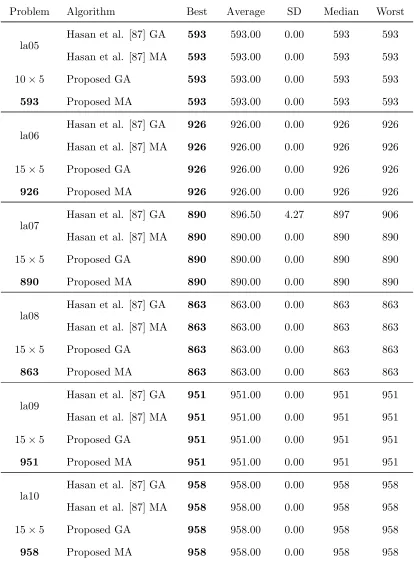
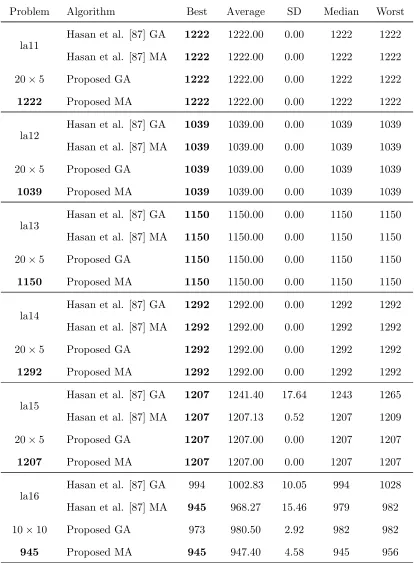
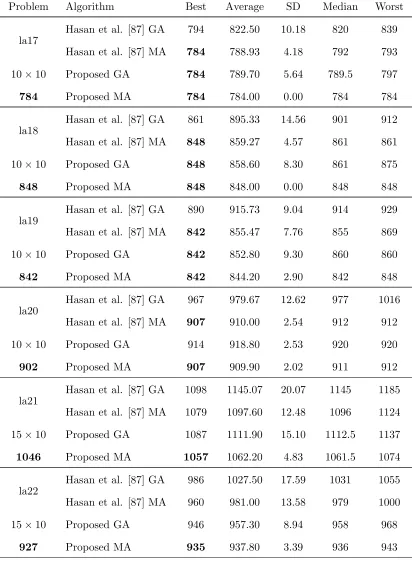
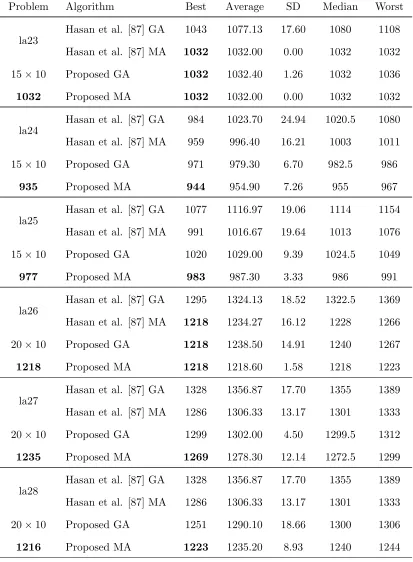
3.4 Results on Lawrence [113] test problems (la01-la40) . . . 47
3.5 4th FJSS benchmark used by Xing et al. [208]. . . . 61
3.6 A sample classical JSSP . . . 65
3.7 The average numbers of SCOs for Lawrence [113] test problems . . . 70
3.8 Results on Lawrence’s benchmark [113] (la01-la40) . . . 75
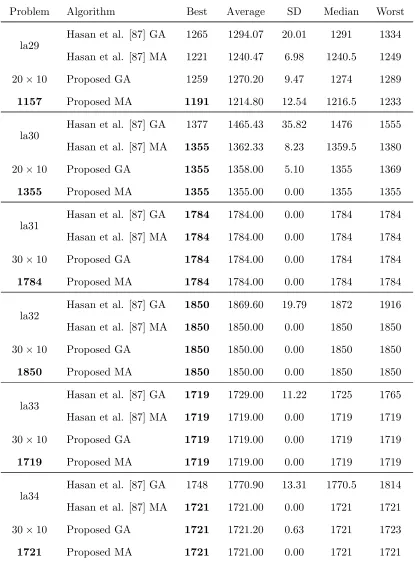
3.9 Results on Lawrence’s benchmark [113] (la01-la40) . . . 81
3.10 Comparison of different types of algorithms on BRData [22] . . . 85
3.11 Results on FJSS benchmarks used by Xing et al. [208] . . . 85
3.12 Test problem mk01 ofBRData [22] . . . 88
3.13 A sample classical JSSP . . . 95
3.14 Sample Results on LA Benchmark . . . 102
3.15 Comparison among Different EAs proposed recently to solve JSSP . . 103
3.18 Parameters of the Proposed Methods . . . 132
3.19 Results on the challenging problems of LA Benchmark . . . 133
3.20 Comparison of the best, average and worst results of the proposed methods. . . 137
3.21 Comparison with different hybrid EAs proposed recently to solve JSSP 139 4.1 Comparison of Proposed MP-CAs in Optimization Problems . . . 161
4.2 Comparison of Proposed MP-CAs in SCM . . . 164
4.3 Comparison of Proposed MP-CAs in Multimodal Optimization Problems171 4.4 Comparison of Proposed MP-CAs in NFIS Training . . . 176
4.5 Comparison of Proposed MP-CAs in Interactive Applications . . . 183
4.6 Comparison of All Proposed MP-CAs based on their Architectures . . 185
5.1 A sample classical job shop scheduling problem . . . 194
5.2 Parameters of the proposed algorithm . . . 200
5.3 Sample Results on LA Benchmark . . . 200
5.4 Comparison among Different Evolutionary Algorithms proposed re-cently to solve JSSP on LA Benchmark . . . 201
5.5 Overall Mutual Comparison . . . 203
5.6 Results on the Lawrence [113] benchmark (la01-la40) . . . 204
5.7 Sample Results on LA Benchmark . . . 214
5.8 Comparison among Different EAs proposed recently to solve JSSP . . 215
5.9 Results on the Lawrence [113] benchmark (la01-la40) . . . 216
6.1 Parameters of the proposed algorithm . . . 242
6.2 The number of generations required to find the best solution for both proposed methods with different number of sub-populations . . . 243
6.5 Dividing 30 dimension into 15 local CAs incorporating different
strate-gies. . . 258
6.6 The CR and SR values with respect to each experiments for balanced
strategies in percentile form alongside their average in the last two rows.262
6.7 The CR and SR values with respect to each experiments for imbalanced
strategies in percentile form alongside their average in the last two rows.263
6.8 The average SR and the number of experiments with the CR of 100%
obtained for each optimization function. . . 264
6.9 Well-known numerical optimization benchmarks. . . 270
6.10 The average number of FE with respect to each experiments. . . 271
6.11 The average CR values to compare dimension decomposition techniques.273
6.12 Comparing the proposed A-HMP-CA with the state-of-the-art
meth-ods over the CEC’2010 benchmark functions [193]. . . 290
6.13 The results of applying A-HMP-CA on CEC’2010 benchmark functions
List of Figures
1.1 CA Architecture . . . 8
1.2 MP-CA Architecture [171] . . . 9
1.3 HMP-CA Architecture [171] . . . 11
2.1 Sample Schedule . . . 20
2.2 Active Schedule . . . 20
3.1 A sample constructed schedule . . . 39
3.2 Constructing active schedules for chromosome{(1,2,3),(1,2,3),(2,3,1)} 42 3.3 Steps of proposed Local Search heuristic . . . 44
3.4 MA Framework . . . 45
3.5 A sample schedule for sample JSSP to show critical paths . . . 66
3.6 The sample schedule after repositioning O34 . . . 67
3.7 The sample schedule after repositioning O34, followed by repositioning O23 . . . 70
3.8 MA Framework . . . 72
3.9 The best (main bar) and the average (extended portion) values of 10 runs using the traditional fitness function versus PBFF on Lawrence’s dataset [113] . . . 74
3.10 The best (main bar) and the average (extended portion) values of 100
3.11 Comparison of different types of algorithms on Lawrence’s benchmark
[113] . . . 84
3.12 Results on 4th FJSS benchmark used by Xing et al. [208] . . . 86
3.13 Sample schedule for the sample problem. . . 95
3.14 A sample schedule for the sample problem. . . 120
3.15 The framework of the VNS+DE . . . 131
3.16 Comparison of the best, average and worst results of the proposed
methods. . . 138
4.1 CA Architecture . . . 144
4.2 MP-CA Architecture of [51] . . . 147
4.3 MP-CA Architecture of [76] . . . 150
4.4 MP-CA Architecture of [44] . . . 153
4.5 MP-CA Architecture of [209] . . . 157
4.6 MP-CA Architecture of [82] . . . 159
4.7 MP-CA Architecture of [4] . . . 163
4.8 MP-CA Architecture of [8] . . . 168
4.9 MP-CA Architecture of [7] . . . 169
4.10 MP-CA Architecture of [117, 29, 118, 120] . . . 174
4.11 MP-CA Architecture of [78] . . . 178
4.12 MP-CA Architecture of [80] . . . 180
5.1 Sample Schedule . . . 194
5.2 MP-CA Architecture . . . 195
5.3 MP-CA Framework . . . 196
5.4 The Graphical Representation of Statistical Result of Friedman’s test
5.6 MP-CA Architecture which is an extended version of the traditional CA211
6.1 CA Architecture . . . 233
6.2 HMP-CA Architecture . . . 237
6.3 A sample belief space. . . 239
6.4 The pseudo-code for local search. . . 240
6.5 The framework of proposed HMP-CA . . . 241
6.6 HMP-CA Architecture [171] . . . 280
6.7 The Graphical Representation of Statistical Analysis with Friedman’s
Preface
This dissertation presents research outcomes from my PhD studies at the School of
Computer Science, University of Windsor, between September 2010 and May 2014.
I started my PhD program by reviewing Evolutionary Algorithms (EAs) and their
problem domains specially focusing on optimization problems.
I found out that EAs work better if they are combined with local search heuristics.
This combination which is called Memetic Algorithm (MA) was introduced before by
other researchers. Afterwards, I came up with the idea of incorporating knowledge
to improve the search mechanism in EAs. Knowledge extraction within EAs was
also previously introduced in the literature as Cultural Algorithm (CA). In order to
overcome the premature convergence issue of the CAs, I decided to use the concept
of multiple populations which was also presented as Multi-Population Cultural
Al-gorithm (MP-CA) in the literature by that time. Although MAs and MP-CAs were
introduced in the literature by other researchers, I proposed a number of ideas to
improve the traditional versions. These improvement are described in details in the
following chapters.
After reaching the research area of MP-CAs, I provided a detailed survey on the
existing MP-CAs in order to define the open problems and the rooms for
improve-ment. Based on the results of this survey I came up with the idea of incorporating
Hetero-experiments, I presented that my new algorithm offers the competitive performance
compared to the state-of-the-art methods.
I improved my proposed HMP-CA by incorporating dynamic decomposition
tech-niques. The new version which is called Dynamic Heterogeneous Multi-Population
Cultural Algorithm (D-CA) presents a better performance compared to
HMP-CA such that it offers a fully effective performance to deal with numerical
optimiza-tion.
In order to improve D-HMP-CA, I proposed a new module to detect the additively
interdependency of the problem dimensions. Then I merged D-HMP-CA with the
new module which is called Variable Additively Interdependence Learning (VAIL) to
a new algorithm and I renamed it Adaptive Heterogeneous Multi-Population Cultural
Algorithm (A-HMP-CA). Since it has been shown that D-HMP-CA is fully effective
to deal with optimization problems, I moved forward and evaluated A-HMP-CA on
large scale global optimization problems. The experimental results represent that my
proposed A-HMP-CA significantly outperforms the state-of-the-art methods.
Therefore, I can say that the main contribution of my PhD studies is the new
op-timization algorithm which is called Adaptive Heterogeneous Multi-Population
Chapter 1
Introduction
1.1
Problem Statement
Optimization problem is a class of problems where the goal is to make a system as
effective as possible. Optimization problems are very well-known due to their
applica-bility in a wide range of research areas. Energy utilization in manufacturing system,
minimizing the whole cost in a supply chain management, and finding the minimum
value of a mathematical function are three samples of optimization problems.
Each optimization problem has its own input parameters. The input parameters
for a job scheduling system, for instance, is the order of jobs to be processed. An
optimization algorithm optimizes a problem by adjusting its input parameters. A
set of values with respect to all input parameters is called a solution and the set of
all feasible solutions is called solution space. For the job scheduling example, any
feasible order of jobs is a solution and the order of jobs which results in the minimum
cost is the optimal solution.
The optimization problems can be differentiated based on their goals which could
while the latter one looks for the solution with the maximum fitness value using its
evaluation function which is called fitness function. Since the strategies applied to
solve both kinds of optimization problems are the same, in the rest of this article only
minimization optimization problems are considered.
Definition 1.1.1. An optimization problem is mathematically defined as follows:
M inimize f(X)
X ={x1, x2, ..., xD}
f :RD →R
Subject to gi(X) = 0, i= 1, ..., m
hj(X)≤0, j = 1, ..., n
(1.1)
where f(X) denotes to the optimization function where its input is aD-dimensional
vector of continuous parameters denoted by X including D parameters denoted by
xi where iis the dimension index. Each optimization function is accompanied with a
number of equality and inequality constraints denoted by gi(X) and hj(X),
respec-tively.
Based on this definition, a feasible solution would be
s={v1, v2, ..., vD} s∈S
where vi is a value with respect to dimension i and should satisfy vi ∈ Di and all
other constraints. S denotes the solution space.
The solution for an optimization problem is to find out a candidate solution with
minimum objective value.
By this definition, s∗ is call the global optimal solution.
Generally optimization problems are categorized into two class based on the type
of their input parameters, which are as follows:
• Global Optimization Problems: Problems with continuous input parameters
such as real numbers. In these problems, there is no limit on the number
of solutions. Consequently, the solution space is an infinite set. The global
optimization problems with a large number of dimensions are called large scale
global optimizations.
• Combinatorial Optimization Problems: Problems with discrete input
parame-ters such as integers, permutations and graphs. In these problems, although
the solution space is a finite set, it is a very large set of solutions.
1.2
Main Objectives
In the research area of optimization problems, the main goal is to design an algorithm
to be able to find an optimal solution or near optimal solution within an acceptable
time. In other words, an optimization algorithm should be:
• Effective in terms of finding an optimal or near optimal solution.
• Efficient in terms of the computational complexity it requires to do so.
Therefore, the main goal of my research was to come with a new algorithm to
provide a better performance in terms of both effectiveness and efficiency compared
1.3
Approaches
Various kinds of algorithms are proposed to solve optimization problems. For some
specific optimization problems, a number of heuristics are designed to work on the
corresponding problem domain. Although these heuristics perform very well in these
domains, they cannot offer the same performance for other problem domains even
similar ones. Local search, for instance, is a heuristic which shows good performance
in simple optimization problems specially the ones which have only one local and
global optimal solution. Local search starts at an initial random solution and looks
for a better solution in the neighborhood of the initial solution. It selects the best
solution in that neighborhood and continues the same routine from there until it
converges to a solution which is the best one in its neighborhood.
Due to the fact that heuristics are not successful in general, metaheuristics are
introduced in the literature. A metaheuristic is formally defined as an iterative master
process to guide the operations of subordinate heuristics to efficiently produce
high-quality solutions. Metaheuristics which are so-called complex heuristics are more
general method with a wider area of applicability. Metaheuristics are approximate
algorithms and mostly they are non-deterministic.
Repeated Local Search (RLS), for instance, is an extended version of the simple
local search. Since a local search might be trapped into local optimal regions, its
execution for a number of times increases the chance of finding an acceptable
solu-tion. Iterated Local Search (ILS) is also an extended version of RLS such that it
incorporates the information of the best solutions found in the previous executions.
In fact, instead of starting from another random solution, ILS slightly perturbs the
best solution recently found and continues form there.
Generally, the search mechanism in metaheuristics consists of two phases as
• Exploration: In this phase the metaheuristics look for promising regions by
searching unexplored regions. The goal of this phase is to decrease the chance
of being trapped into local optimal solutions.
• Exploitation: In this phase the method highly investigates the promising regions
to find the local optimal solutions there. The goal of this phase is to speed up
the convergence.
It should be noted here that although exploration decreases the chance of
imma-ture convergence, too much exploration results in random search which is not going
to be converged. Similarly, although exploitation improves the convergence rate, too
much exploitation is equivalent to local search only which results in immature
conver-gence. Therefore, the main goal of a metaheuristic is to find a good balance between
exploration and exploitation which are also known as diversification and
intensifica-tion, respectively.
Metaheuristics can be divided into two groups including single point and
population-based search methods. The former approaches incorporates only one
solution to find a better solution in each iteration, while the latter ones incorporate
a population of solutions.
One of the most popular single point search methods is Variable Neighborhood
Search (VNS). VNS which is proposed by Mladenovic and Hansen [136] is one of the
most recently introduced metaheuristics. VNS can also be considered as an extended
version of ILS. The idea of VNS is to incorporate a number of neighborhood structures
and switch among them within the local search execution. VNS starts searching with
respect to the first neighborhood structure until it converges. At this point, it switch
to the next neighborhood structure and looks for a better solution. It continues this
This strategy helps VNS to decrease the chance of immature convergence
dramati-cally such that it has been successfully applied in various areas including the Traveling
Salesman Problem [55], the Open Vehicle Routing problem [57], the p-Median
prob-lem [56], and the Graph probprob-lem [24].
Evolutionary Algorithms (EAs) is a subset of population-based methods which are
successfully applied to deal with optimization problems. Although there are different
types of EAs introduced in the literature, they incorporate the same strategy which is
called evolution. The key mechanism of evolution is inspired by the natural selection
stating that the individuals which are fitter to the environment are more likely the
ones surviving for the next generations.
The framework of EAs starts with an initial population of solutions which are
usually randomly generated solutions. The solutions are getting evolved for a number
of generations by incorporating evolutionary operators including:
• Recombination or crossover.
• Modification or mutation.
• Natural Selection.
The most popular EA is Genetic Algorithm (GA) which is proposed by Holland
[93] and improved by various researchers consequently. The successful applications of
GAs are also reported in the literature such as the GAs proposed by Lawrence [112],
Chen et al. [30], Mattfeld et al. [130], Pezzella et al. [158] and Zhang et al. [221] to
solve the job shop scheduling problem.
The most recently introduced evolutionary approach in the literature is Differential
Evolution (DE). Storn and Price [191] designed DE to deal with global optimization
problems. DE has an efficient search space exploration which makes it so popular
in this area. Although DE is designed to work in continuous domains, researchers
Since the population-based search methods are more explorative and the single
point search methods are more exploitative, their combination is expected to be a
powerful method. Incorporating a local search heuristic within a population-based
approach not only improves the quality of the final results, but also helps it to
conver-gence faster. Moscato [139] defined Memetic Algorithm (MA) as a combination of a
population-based global search and a local search heuristic to deal with an
optimiza-tion problem. Although it is not possible to exactly distinguish the exploraoptimiza-tion and
exploitation with in a MA, the population-based global search is highly responsible
for search space exploration, while the local search is more likely a exploitative tool.
In other words, the global search finds the promising regions and the local search
finds the local optimal solutions in those regions.
MAs are described in Chapter 3 with more details. Additionally, this chapter
represents my proposed MAs which are published as research papers including:
• A combination of a GA with a local search heuristic to solve a class of
combi-natorial optimization problem (represented in Section 3.2).
• A GA joint with a local search heuristic to deal with a class of combinatorial
optimization problem (described in Section 3.3).
• A GA incorporating VNS to deal with a class of combinatorial optimization
problem (illustrated in Section 3.4).
• A combination of a DE and VNS to solve a class of combinatorial optimization
problem (characterized in Section 3.5).
Another subclass of EAs is Cultural Algorithms (CAs) which incorporates
knowl-edge to guide its search mechanism. CA which is developed by Reynolds [175] is
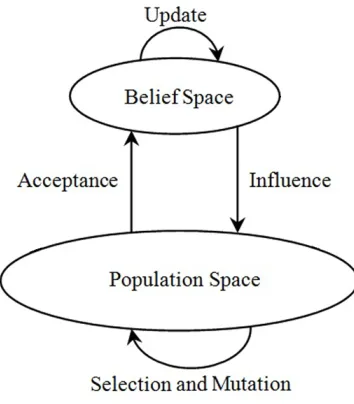
Figure 1.1: CA Architecture
presented in Figure 1.1. As illustrated in this figure, CA uses two different spaces,
namely population space and belief space. The population space includes the
solu-tions getting evolved over generasolu-tions, while the belief space is designed to extract,
update and record knowledge. In other words, in addition to the population of
so-lutions which is common in evolutionary methods, CA has another space which is
designed to manage the extracted knowledge over generations.
In addition to the spaces, CA incorporates two communication links between them
which include:
• Acceptance Function: This link is incorporated to send the best found solutions
in the population space to the belief space. The belief space extracts knowledge
from the transferred solutions.
• Influence Function: This link transfers the updated knowledge of belief space
to the population space which will be used to influence the search direction.
The circulation of information within a CA starts from the population space where
the initial solutions are getting evolved for the first time. The best found solutions
Figure 1.2: MP-CA Architecture [171]
extracts knowledge from the new solutions and updates its own knowledge. The
updated knowledge will be transferred back to the population space. From now on,
the population space incorporates knowledge-based evolutionary operators instead of
the random ones. This routine continues until it converges or the termination criteria
have been met.
Although a wide range of successful applications of CAs has been reported in the
literature, they are still suffering from their immature convergence. This is mainly
due to the fact that they are not capable to preserve the population diversity over
generations. Various strategies have been proposed in order to help CAs to overcome
this limitation such as rejecting duplicate solutions, incorporating a high mutation
rate, and removing solutions with the same objective value. One of the most common
strategy is to incorporate multiple populations with lower size instead of a big single
population. In Multi-Population Cultural Algorithm (MP-CA), the single population
is divided into a number of sub-populations and each sub-population is directed by
a local CA. Digalakis and Margaritis [51] introduced the first MP-CA which was
designed to schedule electrical generators.
The main architecture of MP-CAs is illustrated in Figure 1.2. In this architecture,
There are different architectures to implement MP-CAs such as the MP-CAs with
solution migrations between local CAs, the MP-CAs incorporating knowledge
mi-gration, and the MP-CAs with a shared belief space among local CAs. Chapter 4
represents a detailed literature survey on the existing architectures to implement
MP-CAs. These architectures are categorized based on their problem domains.
One of the best ways to benefit from the multi population concept in MP-CAs in
order to preserve the population diversity is to use knowledge migration between local
CAs. Chapter 5 represents two proposed MP-CAs incorporating knowledge migration
to solve a combinatorial optimization problem. These proposed methods which are
published as conference papers include:
• A MP-CA incorporating normative and topographic knowledge (described in
Section 5.2).
• A MP-CA with a new proposed knowledge called structured belief
(character-ized in Section 5.3).
Generally, the existing architectures to implement MP-CAs can be categorized
into two classes as follows:
• Homogeneous Local CAs: In these architectures, the local CAs work exactly
the same. Although these local CAs may use different algorithm parameters or
even different evolutionary approaches, all the local CAs contribute to the same
goal which is to solve the whole problem.
• Heterogeneous Local CAs: In these architectures, the local CAs cooperate with
each other by working on different parts of the given problem. In other words,
the goal of each local CA is to solve a sub-problem instead of dealing with the
whole problem.
The architectures in the category of heterogeneous local CAs need the problems
Figure 1.3: HMP-CA Architecture [171]
for problem decomposition which is further described in Chapter 6. This chapter
also describes the main contribution of this dissertation which is the proposed
Het-erogeneous Multi-Population Cultural Algorithm (HMP-CA) which is published as
a research paper. The proposed HMP-CA is capable to deal with both static and
dynamic dimension decomposition techniques. Figure1.3 illustrates the architecture
of the proposed HMP-CA. As presented in the figure, instead of one local belief space
for each local CA, there is only belief space which is shared among the local CAs.
The proposed HMP-CA is further improved by incorporating an adaptive
dimen-sion decomposition technique. Chapter 6 characterizes the proposed HMP-CA with
more details in four sections including:
• Proposed HMP-CA to solve a class of global optimization problems (represented
in Section 6.2).
• Investigating the performance of different static decomposition techniques to
the performance of HMP-CA (characterized in Section 6.3).
• A HMP-CA incorporating a dynamic decomposition technique to deal with a
• Incorporating an adaptive decomposition technique in HMP-CA to solve a class
of large scale global optimization problems (described in Section 6.5).
1.4
Dissertation Organization
As described before, the remainder of this dissertation is structured as follows. The
problem domains are presented precisely in Chapter 2. Chapter 3 describes the
pro-posed MAs with more details. A literature survey on the existing architectures to
im-plement MP-CAs is represented in Chapter 4 followed by characterizing the proposed
MP-CAs in Chapter 5. The proposed HMP-CA with different dimension
decomposi-tion techniques, the key contribudecomposi-tion of this dissertadecomposi-tion, is described in Chapter 6.
Finally, Chapter 7 represents the concluding remarks and future directions for this
Chapter 2
Problem Domains
2.1
Introduction
In order to evaluate the proposed methods, both combinatorial and global
optimiza-tion problems are taken into account. Job Shop Scheduling Problem (JSSP) is
consid-ered as a class of combinatorial optimization problems to evaluate the performance of
the proposed methods. JSSP is defined as the task of scheduling a number of jobs to
be processed on a number of machines. JSSP is a well-known class of combinatorial
problems in various areas specially in manufacturing systems.
Within the global optimization problems, numerical optimization is selected for
the evaluation. In numerical optimization, the goal is to find the minimum value
of a mathematical function with respect to an upper and a lower bounds for input
parameters. The optimization function is considered as a black box such that there
is no prior knowledge available about it.
The rest of this chapter is organized as follows. JSSP is precisely described in
2.2
Job Shop Scheduling Problem
Job Shop Scheduling Problem (JSSP) is an instance of combinatorial optimization
problems. JSSP is the task of scheduling various jobs to be processed on different
machines in a manufacturing system. A lot of work has been done in the last decades
to improve the output of a job shop system. In each sample JSSP problem, there are
a number of jobs and a number of machines, and each job has a fixed sequence of
operations.
In the literature, there are different types of JSSP with different specifications.
Classical Job Shop Scheduling Problem is a type of JSSP in which each operation
has to be processed only on one machine. This limitation removes machine selection
flexibility for operations in classical JSSP. In other words, classical JSSP is the process
of sequencing operations of different jobs which are to be processed on the same
machine. Flexible Job Shop Scheduling (FJSS), another instance of JSSP, provides
the flexibility for each operation to be processed on different machines. Bruker and
Schlie [25] published one of the first research considering flexibility in JSSP.
Since there is a flexibility in FJSS to select applicable machine for each operation,
FJSS includes two different tasks, machine selection and operation sequencing, while
classical JSSP has only operation sequencing task. Therefore, it is obvious that FJSS
is more complex than the classical JSSP. To solve FJSS, there are two approaches.
The first one is to consider both machine selection and operation sequencing tasks
as one problem, while in the second approach each task is solved separately. Hurink
et al. [97] published a method solving both tasks at the same time and Brandimarte
[22] proposed a method to solve them separately.
FJSS could be divided into two subcategories including Total Flexible Job Shop
Scheduling (T-FJSS) and Partial Flexible Job Shop Scheduling (P-FJSS). T-FJSS is
called to the problems where all the operations have the flexibility to be processed on
that P-FJSS is more complex than T-FJSS with respect to the computational cost
and search space.
Uncertainty is also considered for FJSS problems such as incorporating stochastic
processing time. Such problems are called Stochastic Flexible Job Shop (SFJS). A
simulation-based decision support system is proposed by Mahdavi et al. [126] to deal
with a stochastic job shop problem.
Open shop scheduling is also a scheduling problem, but it is very different from
JSSP such that the operations of a job in open shop scheduling are sequence
inde-pendent. A Memetic Algorithm (MA) is proposed by Naderi et al. to solve an open
shop scheduling problem.
The most important goal of optimizing a scheduling problem is to utilize the
manufacturing system. Since the objectives of different manufacturing system could
be different, they have their own optimization function. However in most cases, the
main objective of a scheduling problem is to minimize the total completion time of
processing all the jobs. The total completion time in the area of scheduling is so-called
makespan. An objective function could be also defined based on different parameters.
The problems with such a objective function are called Multi-Objective Job Shop
Scheduling Problem (MO-JSSP). For an instance, the objective of a system is to
minimize the maximum machine workload, to minimize the total machine workload,
as well as to maximize the machine utilization. One approach to optimize such
problems is to determine an objective function of parameters with different weights
corresponding to their importance. Another approach is to define one as the main
objective and set others as constraints. Mahdaviet al. [126] used generalized response
2.2.1
Problem Definition
In all types of JSSP, there are a number of jobs to be processed on a set of machines.
Machines are denoted by mk, where k refers to the machine’s index ranging from 1
toM, the number of machines, and jobs are denoted byJi, whereirefers to the job’s
index which is between 1 and N, the number of jobs. Each job consists of a number
of operations to be processed on a predefined sequence. The number of operations
for each job is denoted by N Oi, and Oij refers to the jth operation of the ith job. In
deterministic JSSP, the processing time of each operation on each applicable machine
is known at the beginning, which is denoted byP T(Oij, mk), meaning the processing
time of jth operation of the ith job on kth machine.
A sample T-FJSS problem is represented in Table 2.1 which is the 4th benchmark
incorporated by Xing et al. [208]. In this test problem, there are 10 jobs including 3
operations to be processed on 10 different machines.
2.2.2
Rules
In JSSP problems, there are a number of rules to be considered which are as follows:
• All the jobs and machines are available at the beginning.
• There is no due date for the jobs.
• The part movement time between machines and the machine set up time are
assumed to be negligible.
• The sequence of operation for a job is fixed. The third operation of a job, for
instance, cannot be processed until the second operation of the same job has
been done.
Table 2.1: 4th FJSS benchmark incorporated by Xing et al. [208].
Job Operation Processing Time on Different Machines
m1 m2 m3 m4 m5 m6 m7 m8 m9 m10
J1
O11 1 4 6 9 3 5 2 8 9 5
O12 4 1 1 3 4 8 10 4 11 4
O13 3 2 5 1 5 6 9 5 10 3
J2
O21 2 10 4 5 9 8 4 15 8 4
O22 4 8 7 1 9 6 1 10 7 1
O23 6 11 2 7 5 3 5 14 9 2
J3
O31 8 5 8 9 4 3 5 3 8 1
O32 9 3 6 1 2 6 4 1 7 2
O33 7 1 8 5 4 9 1 2 3 4
J4
O41 5 10 6 4 9 5 1 7 1 6
O42 4 2 3 8 7 4 6 9 8 4
O43 7 3 12 1 6 5 8 3 5 2
J5
O51 7 10 4 5 6 3 5 15 2 6
O52 5 6 3 9 8 2 8 6 1 7
O53 6 1 4 1 10 4 3 11 13 9
J6
O61 8 9 10 8 4 2 7 8 3 10
O62 7 3 12 5 4 3 6 9 2 15
O63 4 7 3 6 3 4 1 5 1 11
J7
O71 1 7 8 3 4 9 4 13 10 7
O72 3 8 1 2 3 6 11 2 13 3
O73 5 4 2 1 2 1 8 14 5 7
J8
O81 5 7 11 3 2 9 8 5 12 8
O82 8 3 10 7 5 13 4 6 8 4
O83 6 2 13 5 4 3 5 7 9 5
J9
O91 3 9 1 3 8 1 6 7 5 4
O92 4 6 2 5 7 3 1 9 6 7
O93 8 5 4 8 6 1 2 3 10 12
J10
O10,1 4 3 1 6 7 1 2 6 20 6
O10,2 3 1 8 1 9 4 1 4 17 15
• Each machine can process only one operation at a time which cannot be
inter-rupted.
• At any given time, only one operation of a job can be processed.
There are a number of concepts in JSSP which will be used later in this article.
These concepts are clarified as follows:
• Critical Path: A sequence of immediately consecutive operations starting from
time zero to the completion time is called a critical path. A critical path can be
found by tracing the schedule from its completion time back to the beginning.
• Critical Operation: An operation belongs to one or more critical path is called
a critical operation. In other words, critical operations are the ones for which
any delay in their processing increases the makespan.
• Critical Block: A set of immediately consecutive critical operations on the same
machine is called a critical block.
• Active Schedule: As defined by Croce et al. [43], if there is no operation in
a schedule that can be started earlier without delaying another operation, the
schedule is called active.
• Job’s Operation Sequence: Each job has its own fixed sequence of operations.
• Job-Predecessor Operation: This operation is the preceding operation of an
operation in a job’s operation sequence.
• Job-Successor Operation: This operation is the succeeding operation of an
op-eration in a job’s opop-eration sequence.
• Machine’s Operation Sequence: The sequence of operations to be processed on
Table 2.2: A sample classical job shop scheduling problem
Operation Index 1 2 3
J1 m2,1 m1,2 m3,3 J2 m1,2 m2,1 m3,2 J3 m1,2 m3,4 m2,1
• Machine-Predecessor Operation: This operation is the operation to be processed
exactly before an operation on the same machine.
• Machine-Successor Operation: This operation is the operation to be processed
exactly after an operation on the same machine.
The concept of an active schedule is very important in JSSP, since it can limit the
search space in order to find the optimal solution faster. Based on the definition of an
active schedule, an optimal solution is more likely to be an active schedule, and if it is
inactive, it has an equivalent active solution which is optimal too. Therefore, instead
of searching the whole solution space, just the active solutions are investigated.
If each operation is assigned to its earlier appropriate interval on its corresponding
machine, the final schedule will be active. This rule is used by Hasan et al. [87] as
Gap Reduction rule, and Becerra and Coello Coello [14] called this rule as permissible
left shift and used it as a priory knowledge in their CA.
2.2.3
A Simple Problem
In order to illustrate the concept of an active schedule, a simple classical JSSP is
considered which is represented in Table 2.2. The sample problem contains 3 jobs
including 3 operations to be processed on 3 machines. The table shows the applicable
machine with its corresponding processing time for each operation. For an instance,
the third operation of the second jobO23, should be processed for 2 time units on the
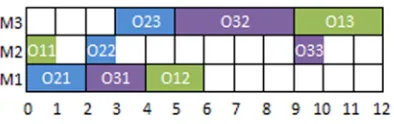
Figure 2.1: Sample Schedule
Figure 2.2: Active Schedule
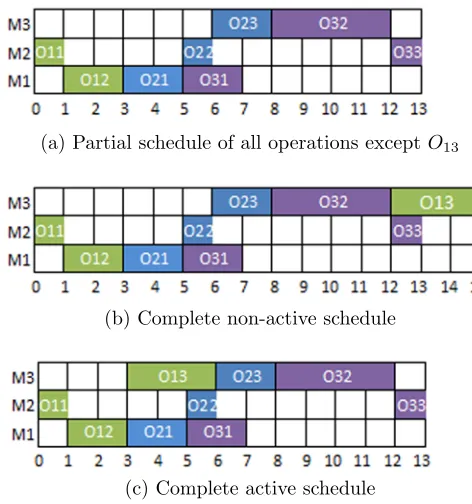
Clearly, the sample schedule represented in Figure 2.1 is not an active schedule,
since the 3rdoperation of the 1st job can be processed before other operations without
delaying them. By reassigning the operation to the earliest appropriate interval, the
new schedule will be an active one which is shown in Figure 2.2. This example also
shows that how much this rule can improve a schedule.
2.2.4
JSSP Representation
JSSP representation is more critical than the representation of other optimization
problems since JSSP cannot be normally represented as a permutation. Various
JSSP representations have been introduced in the literature. Nine different
represen-tations are introduced by Cheng et al. [32] including operation-based representation,
job-based representation, preference list-based representation, job pair relation-based
representation, priority rule-based representation, disjunctive graph-based
represen-tation, completion time-based represenrepresen-tation, machine-based represenrepresen-tation, and
ran-dom keys representation.
Overall, chromosome representations are categorized into two sections: the direct
representations and indirect ones. The representations encoding schedules are called
direct, which include operation-based representation, job-based representation, job
keys representation, while others that encode the schedule construction rules are
considered as indirect representation [32].
Ponnambalam et al. [159] conducted a comparison among four different
represen-tations including operation-based representation, job-based representation, preference
list-based representation, and priority rule-based representation. The authors claimed
that as the results of the comparison preference list-based representation offers better
results, while the operation-based representation is the fastest one.
One of the popular representation is MSOS representation which is proposed by
Zhang et al. [221]. This representation is one of the operation-based
representa-tions and it is also called modified operation-based representation. Its encoding and
decoding procedures are easy and efficient. All the possible schedules encoded by
this representation are feasible. So there is no need to any repair mechanisms. This
representation consist of two parts, namely Machine Selection (MS) and Operation
Sequence (OS).
The MS part determines a machine for each operation to be processed on. The
MS part is not applicable in classical JSSP since there is only one applicable machine
for each operation. In other words, the MS part remains the same for all possible
schedules. The MS part is a string of machines indices with the length of the total
number of operations. Each entry of MS string represents the index of one of the
applicable machines for the corresponding operation.
The OS part which is also known as permutation with repetition represents the
sequence of operations to be processed in order. The OS part is a string of job indices
with the same length as MS. Each index denotes one operation such that the job
index determines the job that operation belongs to, and the occurrence of that job
operation sequence. Consider
OS = [1,1,2,3,2,1,2,3,3]
as a sample OS for the sample problem which represents the following sequence of
operations.
O11≺O12≺O21 ≺O31 ≺O22≺O13≺O23≺O32 ≺O33
This sequence for the sample problem produces the following schedule.
m1 :O12≺O21≺O31
m2 :O11≺O22≺O33
m3 :O13≺O23≺O32
This schedule is illustrated in Figure 2.2.
However, there are different presentations introduced for JSSP. Each one has its
2.3
Numerical Optimization
Numerical optimization is a class of global optimization problems where the goal is
to find the optimal objective value of a mathematical optimization function with a
set of continuous input parameters. Equations 2.1 and 2.2 are two sample numerical
optimization functions which are called sphere model and generalized Rosenbrock’s
function, respectively. The goal of these problems is to find the minimum value while
satisfying both upper and lower bounds for each dimension.
f1(X) =
D
X
i=1
xi2 (2.1)
−100 ≤xi ≤100
min(f1) = f1(0, ...,0) = 0
f2(X) =
D−1
X
i=1
100 xi+1−xi
22
+ (xi−1)
2
(2.2)
−30≤xi ≤30
min(f2) = f2(1, ...,1) = 0
The optimization problems with a large number of dimensions are called large
scale global optimizations. The common number of dimensions in this area is 1000.
In numerical optimization, the optimization function is considered as a black box
which gets a D-dimensional vector as its input parameters and returns a real value
as the objective value corresponding to the given input vector.
separable functions, partially separable functions and non-separable functions. A
fully separable function is defined in Definition 2.3.1 [193].
Definition 2.3.1. A functionf(X) is fully separable if and only if
arg min
(x1,...,xn)
f(x1, ..., xn) =
arg min
x1 f(x1, ...), ...,arg minxn
f(..., xn)
(2.3)
The fully separable functions are the functions that can be optimized by
opti-mizing their dimensions separately since there is no interdependencies between their
dimensions. These interdependencies are also known as variable interactions. The
partially separable functions and the non-separable functions are also defined in
Def-inition 2.3.2.
Definition 2.3.2. The optimization functions where the interacting variables can be
grouped into a number of independent subsets are called partially separable
func-tions, and the functions where there is only one independent group including all the
dimensions are called non-separable functions.
Based on Definitions 2.3.1 and 2.3.2, the sphere model represented in Equation 2.1
is a fully separable function while the generalized Rosenbrock’s function illustrated in
Equation 2.2 is a non-separable function. Function fP S represented in Equation 2.4
which is a composite function of two generalized Rosenbrock’s functions is a sample
of partially separable functions.
fP S(x1, ..., x5, x6, ..., xD) =f2(x1, ..., x5) +f2(x6, ..., xD) (2.4)
2.3.1
Well-Known Numerical Optimization Functions
There are a number of numerical optimization functions which are very well-known
such that researchers in this area mostly use them to evaluated their proposed
f1 - Sphere Model:
f1(X) =
D
X
i=1
xi2 (2.5)
−100 ≤xi ≤100
min(f1) = f1(0, ...,0) = 0
f2 - Generalized Rosenbrock’s Function:
f2(X) =
D−1
X
i=1
100 xi+1−xi
22
+ (xi−1)
2
(2.6)
−30≤xi ≤30
min(f2) = f2(1, ...,1) = 0
f3 - Generalized Schwefel’s Problem 2.26:
f3(X) =
D
X
i=1
−xisin
p
|xi|
(2.7)
−500 ≤xi ≤500
min(f3) = f3(420.9687, ...,420.9687)' −12569.5
f4 - Generalized Rastrigin’s Function:
f4(X) =
D
X
i=1
xi2−10cos(2πxi) + 10
−5.12≤xi ≤5.12
min(f4) = f4(0, ...,0) = 0
f5 - Ackley’s Function:
f5(X) = −20 exp
−0.2
v u u t 1 D D X i=1 xi2
− exp
1
D
D
X
i=1
cos(2πxi)
!
+ 20 + e (2.9)
−32≤xi ≤32
min(f5) = f5(0, ...,0) = 0
f6 - Generalized Griewank’s Function:
f6(X) = 1 4000
D
X
i=1 xi2−
D Y i=1 cos xi √ i
+ 1 (2.10)
−600 ≤xi ≤600
min(f6) = f6(0, ...,0) = 0
f7 and f8 - Generalized Penalized Functions:
f7(X) = π D
10 sin2(πy1) +
D−1
X
i=1
(yi−1)2
1 + 10 sin2(πyi+1)
+ (yD−1)2
+
D
X
i=1
u(xi,10,100,4) (2.11)
−50≤xi ≤50
f8(X) = 0.1
sin2(3πx1) +
D−1
X
i=1
(xi−1)2
1 + sin2(3πxi+1)
+ (xD−1)2
1 + sin2(2πxD)
+ D X i=1
u(xi,10,100,4) (2.12)
−50≤xi ≤50
min(f8) = f8(1, ...,1) = 0
where
u(xi, a, k, m) =
k(xi−a) m
if xi > a
0 if −a≤xi ≤a
k(−xi −a) m
if xi <−a
yi = 1 +
1
4(xi+ 1)
f9 - Schwefel’s Problem 1.2:
f9(X) =
D X i=1 i X j=1 xj !2 (2.13)
−500 ≤xi ≤500
min(f9) = f9(0, ...,0) = 0
f10 - Schwefel’s Problem 2.21:
−500 ≤xi ≤500
min(f10) = f10(0, ...,0) = 0
f11 - Schwefel’s Problem 2.22:
f11(X) =
D
X
i=1 |xi|+
D
Y
i=1
|xi| (2.15)
−500 ≤xi ≤500
min(f11) = f11(0, ...,0) = 0
f12 - Step Function:
f12(X) =
D
X
i=1
bxi+ 0.5c2 (2.16)
−100 ≤xi ≤100
min(f12) = f12(0, ...,0) = 0
In addition to these functions, there are a number of benchmarks available in
the literature to provide a better platform to compare different optimization
meth-ods. The benchmark functions for the CEC’2010 competition on large scale global
optimization [193] is one of the well-known benchmarks in the literature. This
bench-mark includes twenty 1000-dimensional numerical optimization functions which can
be categorized into the three following classes based on Definitions 2.3.1 and 2.3.2:
1. Shifted Fully Separable Functions (f1−f3).
2. Shifted Partially Separable Functions (f4−f18).
Chapter 3
Memetic Algorithm
3.1
Introduction
Most of the recent work in job shop scheduling hybridized GAs with local search
algorithms to improve the final results as well as to help the convergence rate.
As defined by Moscato [139], Memetic Algorithm (MA) is a hybrid method
in-cluding a population-based global search combined with a local search heuristic to be
used to solve an optimization problem. Ong et al. [149] considered population-based
search as exploration to find the promising regions in the search space, and local
search as exploitation to find the best individual in those neighborhoods. Based on
this definition, all the hybridizations of GAs or other EAs with local search heuristics
can be considered as MAs.
For instance, the MA proposed by Yang et al. [213] is a combination of Clonal
Selection and Simulated Annealing. A combination of GA and Tabu Search was also
proposed by Ombuki [147]. Kacem et al. [103] combined an EA with a localization
approach. They also proposed a combination of EA with fuzzy logic [104]. Hassan
Recently, Hasan et al. [87] proposed three different MAs which are combinations of
GAs with three different priority rules to solve JSSP.
Incorporating a local search heuristic within a population-based global search has
two major effects on the search performance including:
• Improves the quality of the final results.
• Speeds up the convergence process.
This chapter represents my proposed MAs to deal with optimization problems
which are published as research papers including:
• M. R. Raeesi N. and Z. Kobti, “A machine operation lists based memetic
algo-rithm for job shop scheduling,” in IEEE Congress on Evolutionary Computation
(CEC), New Orleans, LA, USA, June 5-8 2011, pp. 2436-2443 [166]:
In this research paper, a MA is proposed to solve classical JSSPs. The proposed
MA is a combination of a GA with a local search heuristic. Furthermore, a new
representation for JSSP is introduced in this paper which is called Machine
Operation Lists (MOL) representation. The proposed MA is designed to deal
with the MOL representation. This research paper is represented in Section 3.2.
• M. R. Raeesi N. and Z. Kobti, “A memetic algorithm for job shop scheduling
using a critical-path-based local search heuristic,” Memetic Computing, vol. 4
(3), pp. 231-245, 2012 [169]:
This research paper also proposed a MA to deal with JSSPs. Unlike the
pre-vious paper, it is a more general method applicable on various types of JSSPs.
The results of its successful applications on three different types of JSSP have
been reported in the published paper which include classical, flexible and
![Table 2.1: 4th FJSS benchmark incorporated by Xing et al. [208].](https://thumb-us.123doks.com/thumbv2/123dok_us/1413032.1173871/42.612.142.512.182.644/table-th-fjss-benchmark-incorporated-xing-et-al.webp)
![Table 3.4: Results on Lawrence [113] test problems (la01-la40)](https://thumb-us.123doks.com/thumbv2/123dok_us/1413032.1173871/72.612.117.531.307.694/table-results-lawrence-test-problems-la-la.webp)