Abstract
LYZINSKI, REBECCA ANNE. Spatial Dynamics of Infection by Multiple Pathogens: A Case Study with Yellow Dwarf Viruses. (Under the direction of Dr. Kevin Gross.)
Mathematical models are useful tools for understanding disease dynamics, but often
assume a “well-mixed” population. In reality, populations usually violate this
assumption, exhibiting heterogeneous mixing. Spatial structure is one mechanism that
creates heterogeneous mixing by limiting the number of possible contacts. One-pathogen
models show that inclusion of spatial structure decreases the prevalence of infection. In
this paper, we extend spatial models to a two-pathogen system based on cereal and barley
yellow dwarf viruses (C/BYDVs). By comparing the spatial model to a nonspatial
model, we can determine how prevalence of coinfection and single infection changes
with localized pathogen transmission. The model predicts that when pathogens do not
interact within hosts, coinfection decreases as pathogen transmission becomes
increasingly localized. Spatial aggregation of the pathogens explains this result. We also
examine a model with decreased transmission due to cross-protection, a model with
increased transmission due to synergism, and a model with increased host mortality due
to synergism. Most notably, when hosts infected by multiple pathogens experience
greater mortality than singly infected hosts, localized pathogen transmission makes
pathogen persistence more likely. Thus, these models predict that overall pathogen
Spatial Dynamics of Infection by Multiple Pathogens: A Case Study with Yellow Dwarf Viruses
by
Rebecca Anne Lyzinski
A thesis submitted to the Graduate Faculty of North Carolina State University
in partial fulfillment of the requirements for the Degree of
Master of Science
Biomathematics
Raleigh, North Carolina
2011
APPROVED BY:
_______________________________ ______________________________
Dr. Alun Lloyd Dr. Charles Mitchell
________________________________ Dr. Kevin Gross
Biography
Rebecca was raised in northern Virginia, where she graduated from Oakton High School
in 2004. She proceeded to St. Mary’s College of Maryland where she began as a
psychology major. Quickly she learned that her true passions were mathematics and
biology. After her junior year of college, Rebecca participated in a mathematical biology
Research Experience for Undergraduates at Penn State Erie, The Behrend College. The
internship opened up to her the world of research in mathematical modeling and taught
her about graduate programs in biomathematics. After graduating from St. Mary’s
College of Maryland with a double major in mathematics and biology, Rebecca
continued to North Carolina State University where she received a Masters of Science
Acknowledgements
I would like to thank my graduate research advisor Dr. Kevin Gross for all his time,
patience, dedication, and expertise. I would also like to thank my committee members,
Dr. Alun Lloyd and Dr. Charles Mitchell, for their help and support. In addition, I want
to thank my undergraduate advisor, Dr. Samantha Elliott, for giving so much of her time
and support even after I graduated. I would also like to thank Dr. Michael Rutter and the
mathematical biology REU at Penn State Erie for introducing me to biomathematics.
I would also like to thank my family and friends for all their support. In particular, I
would like to thank my parents who have always supported me in whatever I wanted to
do and my brother who always helped me to find the fun in things. Without all their love
and support, I never would have made it this far. I would also like to thank all my friends
from North Carolina State University, St. Mary’s College of Maryland, Intervarsity
Graduate Christian Fellowship, and Edenton Street United Methodist Church for all their
Table of Contents
List of Tables...vi
List of Figures ...vii
Introduction ...1
1. Overview ... 1
2. Mathematical Tools for Analyzing Nonspatial and Spatial Models... 3
2.1 Tools for Nonspatial Models ... 4
2.2 Tools for Spatial Models ... 5
3. Spatial Structure in One-Pathogen Models... 5
4. Two-Pathogen Models ... 6
4.1 Pathogen Interactions ... 8
Methods ...10
1. Models and Their Architecture ... 10
1.1 Nonspatial ODE Model ... 10
1.2 Stochastic Models... 14
1.2.1 Stochastic Nonspatial Model... 14
1.2.2 Stochastic Spatial Model... 16
2. Biological Scenarios and Parameter Values... 18
2.1 Baseline ... 19
2.2 Variations ... 19
2.2.1 Cross Protection ... 19
2.2.2 Synergism – Increased Transmission... 20
2.2.3 Synergism – Increased Mortality ... 20
3. Simulation Details for Stochastic Models ... 20
3.1 Description of the Algorithm... 20
3.2 Implementation Details for Spatial Model ... 21
3.3 Further Details ... 22
3.4 Conditional Probabilities ... 22
Results...24
1. Nonspatial Models... 24
2. Baseline Model ... 26
2.1 Stochastic Nonspatial Model... 27
2.2 Stochastic Spatial Model ... 27
3. Cross-Protection... 33
3.1 Stochastic Nonspatial Model... 33
3.2 Stochastic Spatial Model ... 35
4. Synergism – Increased Transmission... 36
4.1 Stochastic Nonspatial Model... 36
4.2 Stochastic Spatial Model ... 38
5. Synergism – Increased Mortality ... 39
5.1 Stochastic Nonspatial Model... 39
Discussion ...46
1. Conclusions and Biological Implications ... 46
2. Future Work... 52
References ...57
List of Tables
List of Figures
Figure 1. Barley yellow dwarf virus model...13
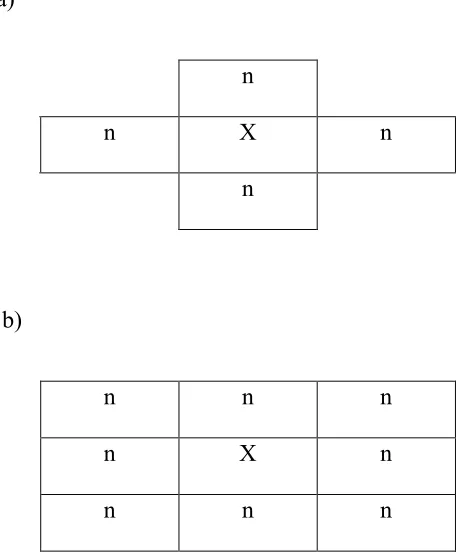
Figure 2. Spatial structure of neighbors (n) around a single host individual (X)...17
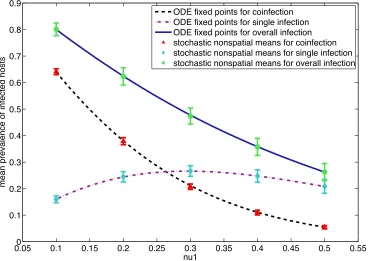
Figure 3. Deterministic ODE model fixed points and stochastic nonspatial model means for the baseline model ...25
Figure 4. The mean prevalence of infection for the baseline model ...28
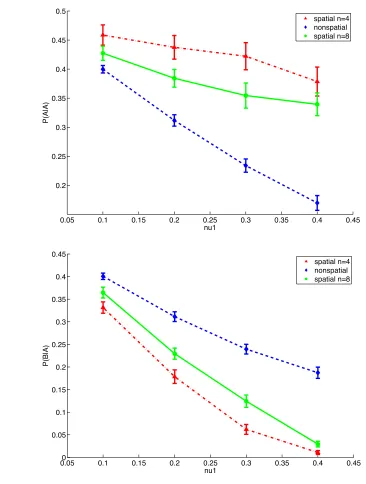
Figure 5. Aggregation of pathogen A...31
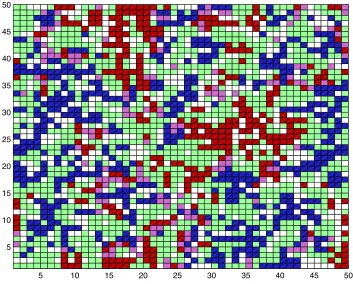
Figure 6. Map of the lattice to show aggregation in the baseline model...32
Figure 7. The mean prevalence of infection for the cross-protection model...34
Figure 8. The mean prevalence of infection for the increased transmission model...37
Figure 9. The mean prevalence of infection for the increased mortality model...40
Figure 10. Aggregation of pathogen A in the increased mortality model...42
Introduction
1. Overview
Mathematical models are useful tools for understanding disease dynamics. They
allow us to explore questions about topics such as pathogen transmission, virulence,
disease prevalence, and infectiousness. The classic epidemic models function on the
assumption of a “well-mixed” population in which all individuals are equally likely to
come into contact with each other (Bailey 1975; Boylan 1991; Brauer 2008; Brown and
Bolker 2004; Lefevre 1983). However, real populations often violate this assumption
through individual differences, such as differences in susceptibility, infectiousness,
behaviors, and number of contacts (Brauer 2008; Boylan 1991; Lefevre 1983). Here, we
will focus on the effects of spatial structure created by heterogeneous mixing.
The spatial structure of a host population affects the dynamics of diseases spread
through contact. When spatial structure is considered, the path of the disease becomes
limited. Hosts close to an infected individual are at high risk for infection whereas hosts
far away have little chance of becoming infected (Tildesley et al. 2010). This limits the
number of susceptible hosts that the disease can reach, affecting the total number of
individuals that could potentially become infected (Brown and Bolker 2004; Keeling
1999; Tildesley et al. 2010). To explore the extent to which spatial structure changes
disease dynamics, epidemic models can be used to make comparisons between a spatial
Mathematical models for one-pathogen systems have provided a good basis for
studying the differences between spatial and nonspatial structures, but multiple pathogens
are often capable of inhabiting a single host organism at the same time, creating a more
complex system (Seabloom et al. 2009). This system adds pathogen interactions as a
factor in determining disease dynamics, which brings up new questions. Can the
pathogens coexist and under what conditions? Does the presence of multiple pathogens
increase infection prevalence? Does the presence of multiple pathogens increase host
mortality? These are only some of the questions of concern for a system with multiple
pathogens.
These questions arise in many biological systems, including the system involving
cereal and barley yellow dwarf viruses (C/BYDVs) and the host plants infected by
C/BYDVs. C/BYDVs exist as at least five different species, which can coinfect grasses in
the family Poaceae including cereal crops like barley and wheat (Miller and Rasochova
1997; D’Arcy 1995). Depending on the combination, C/BYDV species exhibit cross
protection, where one pathogen prevents infection by another, and synergism, where
pathogen interaction increases transmission or virulence (Miller and Rasochova 1997).
Some symptoms of C/BYDVs include growth reduction, yellowing, and sterility, which
can lead to yield reduction and significant agricultural losses (Miller and Rasochova
1997; Jensen and D’Arcy 1995; Lister and Ranieri 1995). C/BYDVs are obligately
transmitted by both winged and wingless aphids (Halbert and Voegtlin 1995; Seabloom
limited movement of wingless aphids while a nonspatial model can describe the wider
range of movement by winged aphids (Chaussalet et al. 2000).
In this paper, we will focus on exploring the effect of spatial structure on
coinfection dynamics by using extensions of the well-known susceptible-infected (SI)
model. Specifically, we will apply a two-pathogen, one-host model to C/BYDVs to ask
the following questions. 1. Does spatial structure affect the number of coinfected hosts
relative to a well-mixed population? 2. Could pathogen clustering in the spatial model be
responsible for a change in the number of coinfected hosts? 3. How does spatial structure
affect disease dynamics when pathogens exhibit cross-protection, that is, when infection
by one pathogen reduces the possibility of infection by a second pathogen? 4. How does
spatial structure affect disease dynamics when pathogens exhibit synergism in the form of
increased transmission? 5. How does spatial structure affect disease dynamics when
pathogens exhibit synergism in the form of increased mortality? We will explore each of
these questions with mathematical models and computer simulations.
2. Mathematical Tools for Analyzing Nonspatial and Spatial Models
Many mathematical models assume a “well-mixed” population, making them
simpler and easier to analyze. However, most real populations do not follow this
assumption, so the methods for analyzing nonspatial models are being expanded to assess
more complicated spatial models. Here we discuss some of the mathematical tools used
2.1 Tools for Nonspatial Models
A deterministic ordinary differential equation (ODE) model is one of the simplest
methods for analyzing disease dynamics under the assumption of a “well-mixed”
population. The ordinary differential equations can be analyzed to give us information
about the number of individuals in each state, the stability of the infection, the possibility
of an outbreak, and more (Kermack and McKendrick 1932). However, an ODE model
always gives the same results for a given set of initial conditions, which is unrealistic for
an actual population. Real populations usually exhibit more variation than these
deterministic models account for, so these models can be expanded to include stochastic
events.
Stochastic nonspatial models for epidemics are commonly analyzed in two ways,
through simulations and analytical tools (Dangerfield et al. 2009). Simulations of
stochastic nonspatial models typically use Markov processes and the memoryless
property to create a random walk in the number of individuals in each state (Ross 2007;
Keeling and Ross 2008). These simulations are usually run using computer programs
designed for numerical analysis. More analytical approaches to exploring the behavior of
stochastic nonspatial models include exact Kolmogorov forward equations for
determining the probabilities of each state and diffusion approximations for determining
the proportion of individuals in each state and the variability of the system (Keeling and
2.2 Tools for Spatial Models
Similar to stochastic nonspatial models, stochastic spatial models can be analyzed
through either simulations or analytical methods, but these tools become more difficult to
use without the assumption of a “well-mixed” population. Computer simulations can
expand upon the methods used in stochastic nonspatial models to include spatial
structure. These simulations obtain the number of infected individuals over time as
determined by a stochastic spatial model (Chaussalet et al. 2000; Keeling 1999). The
analytical method of pairwise approximations also determines the approximate number of
infected individuals for a stochastic spatial model by taking into account the number of
pairs and type of pairs in the system (Dangerfield et al. 2009). Moment closure analysis
provides another approximation approach for exploring disease dynamics in spatial
systems through the use of differential equations (Brown and Bolker 2004). In this paper,
we will focus on the use of simulations to explore disease dynamics for both a stochastic
nonspatial model and a stochastic spatial model.
3. Spatial Structure in One-Pathogen Models
Epidemic models for a one-pathogen system set the groundwork for
understanding the difference in disease dynamics between a spatial and a nonspatial
structure. A susceptible-infected-recovered (SIR) model shows that the total number of
hosts infected during an epidemic is smaller for a spatial network model than for a
possible contacts in a spatial model. In spatial models a host can only infect its
neighbors, the number of neighbors being determined by the connectivity level. Once all
of the neighbors are infected, the original infected host no longer has susceptible hosts to
spread the pathogen to, so the epidemic is slowed (Tildesley et al. 2010, Brown and
Bolker 2004). Moment-closure analysis confirms that epidemics become slowed with the
addition of spatial structure (Brown and Bolker 2004). The slowed epidemic spread can
also be explained through susceptible-infected-susceptible (SIS) model extensions, which
have shown that the limited contact structure of a spatial model results in lower
transmission rates (Boots and Sasaki 1999). This occurs because small spatial
neighborhoods limit resource availability to only a few hosts, creating the greatest
intraspecific competition for pathogens (Keeling 1999). In addition to there being fewer
infected hosts in a spatial model, SIS models together with pairwise approximations show
that spatial structure produces a small increase in the variation of the number of infected
hosts. This increase becomes more apparent for small neighborhood sizes combined with
low levels of infection (Dangerfield et al. 2009). Understanding these results for a
one-pathogen system provides the foundation for expansion to more complex systems.
4. Two-Pathogen Models
Two-pathogen SIS models provide a good starting place for exploring the new
questions that arise with interactions among multiple pathogens. May and Nowak were
among the first to define some of these interactions and create mathematical models that
within host pathogen interactions: superinfection and coinfection (May and Nowak 1995;
Nowak and May 1994). These extremes are important to understand as they may give
insight to the more complicated scenarios that lie in between superinfection and
coinfection (May and Nowak 1995).
Superinfection occurs when competition between two pathogens drives out the
less virulent pathogen, replacing it with the more virulent pathogen. In this case, only the
more virulent pathogen is transmitted. Adding superinfection to an epidemic model
decreases the number of infected hosts, increases the average virulence level, and
decreases the rate of transmission (Nowak and May 1994). The addition of spatial
structure to a superinfection model decreases virulence and the number of infected hosts
even more while increasing the possibility of strain replacement and extinction (Nunes et
al. 2006; Caraco et al. 2006).
The other type of within host pathogen interaction is coinfection, which will be
the focus of this paper. Unlike superinfection where one pathogen drives another
pathogen out of the host, coinfection occurs when multiple pathogens are able to stably
coexist within a host (May and Nowak 1995). This definition can also be expanded to
the broader definition of multiple pathogens infecting the same host at the same time
(Seabloom et al. 2009). In this case, all pathogens within the host can be transmitted to
another host (May and Nowak 1995). The results of epidemic models incorporating
coinfection depend on how the pathogens interact. In this paper we will consider three
4.1 Pathogen Interactions
When coinfection occurs with no interaction between the pathogens, transmission
rates for each pathogen remain unchanged. The only difference assumed by a
mathematical model is that a coinfected host acquires the death rate associated with the
most virulent pathogen (May and Nowak 1995). Coinfection under the no interaction
scenario can be explored using neutral null models, which model the dynamics of
indistinguishable pathogens by allowing both pathogens to stay at their initial conditions
rather than coming together at the same stable equilibrium (Lipsitch et al. 2009).
Cross protection, another type of pathogen interaction, occurs when one pathogen
already present within the host prevents another pathogen from infecting the host (Zhang
and Holt 2001). Especially in plants, this pathogen-provided immunity often occurs
because the resident pathogen triggers resistance pathways within the host, which can
provide protection against a variety of other pathogens (Barrett et al. 2009). With
increased resistance to infection, cross protection models result in a decrease in
coinfection prevalence and transmission rates. In some cases, cross protection has also
been shown through epidemic models to decrease overall infection prevalence (Seabloom
et al. 2009).
Synergism, a third type of pathogen interaction, arises when two pathogens
infecting the same organism lead to an increase in virus replication, virulence, and/or
transmission rate (Zhang et al. 2001). In plants, synergism can occur when one pathogen
defense (Barrett et al. 2009). When synergism leads to increased host mortality,
coinfection levels decrease. With substantial increases in synergistic mortality, overall
infection prevalence decreases (Seabloom et al. 2009). All of these coinfection processes
can be modeled using SIS model extensions (Lipsitch et al. 2009; Zhang and Holt 2001;
Zhang et al. 2001). However, little research has been conducted on using these SIS
Methods
1. Models and Their Architecture
In this paper, we consider three one-host, two-pathogen models: a nonspatial
ODE model, a stochastic nonspatial model, and a stochastic spatial model. The
nonspatial ODE model allows us to achieve a basic understanding of the system. The
stochastic nonspatial model allows us to expand upon the ODE model to incorporate
variation to capture the random events of real populations. Lastly, the stochastic spatial
model allows us to explore disease dynamics without the assumption of a “well-mixed”
population.
1.1 Nonspatial ODE Model
To explore C/BYDV dynamics, we use a one-host, two-pathogen SI model that
assumes the pathogens are indistinguishable and includes the potential for coinfection
(Bailey 1975; Kermack and McKendrick 1932; Lipsitch 2009). We assume the two
pathogens, labeled here as A and B, are indistinguishable to simplify our model. This
assumption allows for transmission and virulence rates to be the same for both pathogens,
reducing the number of parameters needed. Our model envisions a landscape of N
distinct patches, each of which can either be vacant or occupied by a single host. Hosts
can be uninfected (‘susceptible’), infected by one pathogen, or infected by both
pathogens. In total, our model includes five host states: vacant, susceptible, infected by
represented by V, S, IA, IB, and IX, respectively and can be described by the following
differential equations.
€
˙
S =α(S+φ1IA +φ1IB +φ2IX)(N−S−IA −IB −IX)
N −ν0S−λAS−λBS
˙
I A =λAS−ν1IA −kλBIA ˙
I B =λBS−ν1IB −kλAIB
˙
I X =kλBIA +kλAIB −(ν1+ν2)IX
In these equations, N represents the total number of hosts and vacant patches (N =
V+S+IA+IB+IX) and is considered a constant term. This allows us to reduce the necessary
number of differential equations from five to four by rewriting the number of vacant
patches (V) as N-S-IA-IB-IX.
The transmission rates
€
λA and
€
λB quantify the rate at which susceptible hosts
become infected with pathogen A or pathogen B, respectively. These rates are the
product of a transmission rate constant,
€
β, and the number of infected hosts capable of
spreading the pathogen of interest, written as
€
λA =β(
IA
N +
qIX
N )
λB =β(IB
N +
qIX
N )
€
β is assumed to be the same for both pathogens. The transmission rates include both
singly infected and coinfected hosts, because both can spread the pathogen to a
a singly infected host, so coinfected hosts are weighted by the parameter
€
q. In the
transmission rate equations, the number of infected hosts is represented as a proportion of
the total number of hosts and vacant patches.
These transmission rates can also be used to describe the rate at which a singly
infected individual becomes infected by a second pathogen. The rate at which a singly
infected host is infected by the other pathogen to become coinfected can be determined
by multiplying
€
λA and
€
λB by the parameter
€
k. Using
€
k allows the coinfection
transmission rate to be different from the single infection transmission rate. Once
transmission occurs and a host becomes either singly infected or coinfected, the host
never recovers, just as a plant infected with C/BYDV never recovers.
Our model includes host births and deaths. Both susceptible and infected hosts
produce offspring at a rate
€
α. Offspring can only be born into a vacant patch and the
new host always starts as a susceptible individual, because C/BYDV is not transmitted
vertically.
€
φ1 and
€
φ2 allow the number of offspring contributed by singly infected hosts
and coinfected hosts, respectively, to differ from the number of offspring produced by
healthy, susceptible hosts. We assume
€
φ2≤φ1≤1 , because infection by C/BYDV can
decrease fecundity (Seabloom 2009).
In addition to a birth rate, our model also has a death rate corresponding to each
type of host. Susceptible hosts die naturally at a rate
€
ν0. When a host becomes infected
infected by A and hosts infected by B is the same, because pathogens are assumed to be
indistinguishable. A coinfected host has at least the same death rate as a singly infected
host, but can have a higher death rate by adding the parameter
€
ν2≥0 to
€
ν1. Once a host
of any kind dies, the patch occupied by that host becomes vacant. All these transmission,
birth, and death rates allow for a total of nine possible state changes (Figure 1).
Figure 1. Cereal and barley yellow dwarf viruses model. The rates given here are per capita rates. V represents vacant patches. S represents susceptible hosts. IA represents
hosts infected by pathogen A. IB represents hosts infected by B. IX represents coinfected
hosts.
€
1.2 Stochastic Models
Here we analyze two stochastic models: a nonspatial model and a spatial model.
The dynamics of C/BYDVs spread by winged aphids is well represented by a nonspatial
model while a spatial model better represents the dynamics of C/BYDVs spread by
wingless aphids. By comparing the two models, we can reach a better understanding of
how C/BYDVs are spread in real populations.
1.2.1 Stochastic Nonspatial Model
The stochastic nonspatial model is very similar to the nonspatial ODE model. For
both models, the rates are the same as given by the arrows in Figure 1. Both the ODE
and stochastic nonspatial models also multiply the rates by the total number of
individuals in the state of interest. For example, the forces of infection
€
λA and
€
λB are
multiplied by the total number of susceptible individuals. This occurs because the
stochastic nonspatial model functions under the assumption that the population is
“well-mixed.” As long as one individual in the population is infected by a pathogen, then any
susceptible individual in the population can become infected by that pathogen. For
coinfection, as long as both pathogens are present somewhere in the population, then any
singly infected individual can become coinfected.
The stochastic nonspatial model functions as a continuous-time Markov model
where the state space of the model is the number of S, IA, IB, and IX individuals present at
the transition rates as given by Table 1, where [.] denotes the “concentration” in a given
‘neighborhood’. Each concentration is defined as the number of hosts in that state
divided by the neighborhood size, such as [S] = S/N. For the nonspatial model, the ‘neighborhood’ is the entire lattice. Therefore, the overall rates depend on the total
number of individuals in each state. In this case, N is the total number of individuals and vacant patches. A more extensive description of the algorithm used for this model can be
found in Section 3 of the Methods.
Table 1. Stochastic model events and rates where [.] denotes the “concentration”.
Event Rate
V S
€€
α([S]+φ1[IA]+φ1[IB]+φ2[IX])
S V
€
ν0
S IA
€
λA=β([IA]+q[IX])
S IB
€
λB=β([IB]+q[IX])
IA V
€
ν1 IA IX
€
kλB =kβ([IB]+q[IX])
IB V
€
ν1 IB IX
€
kλA =kβ([IA]+q[IX])
IX V
€
1.2.2 Stochastic Spatial Model
Unlike the stochastic nonspatial model, the stochastic spatial model does not
assume that the population is “well-mixed”. This means that instead of using the total
number of individuals in a certain state, we only consider the individuals within a given
neighborhood size. In the spatial model, individuals are distributed on a square lattice
and each individual in the lattice has a neighborhood around it of n other individuals. Here we examine two neighborhood sizes: n=4 and n=8. For a neighborhood size of n=4, each individual has one neighbor above, one below, one to the left, and one to the right
(Figure 2a). For a neighborhood size of n=8, each individual has the same neighbors as in the n=4 model, but with the addition of the neighbors on the diagonals (Figure 2b). For both neighborhood sizes, the edges of the lattice wrap around so that each individual
has a complete neighborhood. For example, the individuals on the top row of the lattice
have a neighbor on the bottom row of the lattice and vice versa. Similarly, the
individuals in the left-most column of the lattice have a neighbor in the right-most
column and vice versa. The neighbors of an individual determine whether or not an
individual can become infected or coinfected. If the individual is susceptible then it can
only become infected if one of its neighbors is infected. If the individual is singly
infected with one pathogen, it can only become coinfected if one of its neighbors is
a)
n
n X n
n
b)
n n n
n X n
n n n
Figure 2. Spatial structure of neighbors (n) around a single host individual (X). (a) A neighborhood size of n=4. (b) A neighborhood size of n=8.
Similar to the stochastic nonspatial model, the stochastic spatial model is a
continuous-time Markov model. The state space for the spatial model is every possible
configuration of V, S, IA, IB, and IX individuals on the lattice. This model is also
event-driven with events occurring singly as determined by the transition rates given by Table
1. The overall rates only take into account the state of the neighbors of the chosen cell.
This means that where there is an S, IA, IB, or IX in the rate equations only the number of
neighbors in that state is counted not the total number of individuals in that state. With
number of individuals and vacant patches. A more extensive description of the algorithm
used for this model can be found in section 3 of the methods.
2. Biological Scenarios and Parameter Values
We start with a set of baseline conditions to represent no pathogen interaction and
then extend this case to incorporate three different variations. For the baseline model and
the three extensions, all parameters other than
€
k and
€
ν2 remain the same. To allow the
pathogen to persist, the death rate needs to be less than the transmission rate (
€
ν <β), so
we fix
€
β =1 and keep all the
€
ν parameters less than one. In exploring each type of
model, we allow
€
ν1 to vary and keep
€
ν0 constant. To determine the value of
€
ν0 we
would like to use, we look into a simpler model for insight. In a model that includes only
vacant patches and susceptible hosts, the equilibrium number of susceptibles is
€
1−ν0 α . If
we fix
€
α=1, then setting
€
ν0 =0.1 allows ninety percent of the population to be
susceptible and ten percent to be vacant patches. Based on this calculation, we use these
parameter values for
€
α and
€
ν0 in our model.
The rest of the parameters we determined based on assumptions. For simplicity,
we assume that hosts infected by one or both pathogens do not experience a change in
fecundity, so we set
€
φ1=φ2 =1. With the assumption that the pathogens are
indistinguishable, we set
€
equals the infectivity of singly infected hosts. In all these models, we set the total
number of patches equal to
€
N=2500.
2.1 Baseline
We start our exploration of spatial effects on coinfection with a baseline model
that assumes no pathogen interactions and then extend this model to incorporate pathogen
interactions. In the baseline model, the properties of the pathogens remain unchanged in
the presence of each other. To keep the transmission rate unchanged, we set
€
k=1 so that
the rate at which a singly infected host is infected by the second pathogen to become
coinfected remains the same as the rate at which a susceptible host is infected by either
pathogen A or pathogen B. We also assume
€
ν2=0 so that there is no change in the death
rate when both pathogens are present. The baseline model allows us to understand the
basic system and make comparisons to models with pathogen interaction.
2.2 Variations
2.2.1 Cross Protection
Some species of C/BYDVs exhibit cross protection, resulting in decreased
transmission (Seabloom et al. 2009). Typically this occurs between two closely related
2.2.2 Synergism – Increased Transmission
For C/BYDVs, synergism usually occurs when two dissimilar species are present
(Miller and Rasochova 1997). One result of synergism between two species of
C/BYDVs is an increase in transmission (Seabloom 2009). This type of interaction is
represented in the model by setting k >1, increasing the transmission rate from single infection to coinfection.
2.2.3 Synergism – Increased Mortality
Synergism can also increase the mortality of a coinfected host due to interactions
between the pathogens (Zhang et al. 2001). In this case, we assume that the mortality
rate of a coinfected host is the sum of the mortality rates of the two types of singly
infected hosts. For our model the pathogens inflict the same mortality rates upon their
hosts, so we set
€
ν2=ν1.
3. Simulation Details for Stochastic Models
3.1 Description of the Algorithm
Both the stochastic nonspatial and stochastic spatial models are continuous-time
Markov models. The random variables that determine the processes of the
continuous-time Markov model depend on the rates, which we will represent here by
€
ϕ1,...,ϕz where
calculated by an exponential random variable. The mean of the exponential random
variable is the inverse of the sum of all the rates given in Table 1. Alternatively, this
variable can be written as Exp(
€
1
ϕi i=1 z
∑
) At each sojourn time, one event or state changeoccurs. Which event occurs is determined by a multinomial random variable with one
trial. The number of probabilities determining the multinomial random variable depends
on the number of rates. For the nonspatial model, there are nine transition rates, so there
are nine probabilities. Each probability is one rate divided by the sum of all the rates.
For example, the first probability is
€
p1= ϕ1
ϕi
i
∑
. After each event occurs, the rates arerecalculated to account for the state change. The variables determining both sojourn
times and events are memoryless, so only the current state determines the future state
(Bartlett 1956, 1960; Kendall 1950; Ross 2007).
3.2 Implementation Details for Spatial Model
In implementing the algorithm, the stochastic spatial model is more difficult to
implement than the stochastic nonspatial model. For each cell in the spatial model, we
need to keep track of the state of the cell, the rates of the cell, and the state of the cell’s
neighbors at each sojourn time. The number of probabilities that are used by the
multinomial random variable in the spatial model is equal to the number of cells on the
uses the multinomial random variable to choose the cell to change, which simplifies the
code. Once a cell is chosen, a uniform random variable ranging from zero to one
determines which of the cell’s rates will be used to change the state of the cell. To
simplify the code, the rates are recalculated only for the chosen cell and its neighbors,
because those are the only cells affected by the state change.
3.3 Further Details
In this paper, we use MATLAB to run simulations for both the stochastic
nonspatial and stochastic spatial model. Each simulation runs from time 0 to a maximum
time of 250 with sojourn times being chosen throughout. As each simulation runs, the
program keeps track of the number of patches in each state (V, S, IA, IB, and IX) and the
amount of time in which the state variables have that number of patches. After the
simulation is done, the vector of time each state variable spends in each state, 1 to N, is used to calculate the means and standard deviations over time for each state variable.
3.4 Conditional Probabilities
In addition, the program keeps track of conditional probabilities over time,
indicating if aggregation is occurring. Each conditional probability represents the
probability that individuals in certain states are neighbors. These probabilities allow us to
examine whether pathogens are clumping together and whether the two pathogens are
spatially segregated. All together we calculate four probabilities: P(A|A), P(A|B),
probabilities include coinfected hosts as neighbors. The probabilities use the following
formulas.
P(A|A) =
€
[IA]A +q[IX]A (1)
P(A|B) =
€
[IA]B +q[IX]B (2)
P(B|B) =
€
[IB]B +q[IX]B (3)
P(B|A) =
€
[IB]A +q[IX]A (4)
In these formulas [.] denotes the concentration of individuals in the neighborhood. The
subscript next to the [.] represents the host whose neighbors we are concerned with. For
example, the subscript A outside of the brackets in [IA]A means the given host is one
infected by pathogen A and [IA] in [IA]A represents the proportion of hosts infected by
pathogen A that are neighbors of the given host. Equations 1 and 4 represent the
probability that a host infected by pathogen A will have a neighbor infected by pathogen
A or pathogen B, respectively. Similarly, equations 2 and 3 represent the probability that
a host infected by pathogen B will have a neighbor infected by pathogen A or pathogen
B, respectively. Based on these formulas, the probabilities calculate the proportion of
individuals in the neighborhood that are infected by each pathogen. At each sojourn
time, the probabilities are first calculated for each individual host and then averaged over
all A or B sites to find the mean probability. Once each simulation finishes, the means
Results
1. Nonspatial Models
First, I report the internal fixed points of the deterministic ODE model and then
compare these to the mean prevalence of infected hosts from the stochastic nonspatial
model. The fixed points we find here are informative because they appear to represent
the stable equilibrium solution to the differential equations. Thus we can expect the
prevalence of infected hosts in the population to proceed toward these fixed points at
least in a nonspatial setting when the population sizes are sufficiently large. Here, we
define the prevalence of infected hosts as the number of infected hosts divided by the
total number of patches, N. This definition is for simplicity because the number of patches, N, stays constant over time and for all simulations. When stochasticity is added
to the model, the prevalence of infected hosts should fluctuate around the fixed points
resulting in a mean approximately equal to the fixed points.
The fixed points for the deterministic ODE model are obtained using MATLAB.
I use the solver ode45 to solve the differential equations of the deterministic model. The
solver is run for a time period of 250, a sufficiently long amount of time for the state
variables to settle at the fixed points. The state variables typically reach the fixed points
before time 50, so allowing the simulation to run for 200 extra time steps assures us that
we have reached the fixed points. The fixed points are taken to be the values of IA, IB,
0.050 0.1 0.15 0.2 0.25 0.3 0.35 0.4 0.45 0.5 0.55 0.1
0.2 0.3 0.4 0.5 0.6 0.7 0.8 0.9
nu1
mean prevalence of infected hosts
ODE fixed points for coinfection ODE fixed points for single infection ODE fixed points for overall infection stochastic nonspatial means for coinfection stochastic nonspatial means for single infection stochastic nonspatial means for overall infection
To compare the fixed points and stochastic model means, I start by finding the
fixed points for the baseline model parameters. When the fixed points of the baseline
model are added together, we can see that the overall prevalence of infection
((IA+IB+IX)/N) decreases as the death rate,
€
ν1, increases (Fig. 3). Similarly, the fixed point
for the prevalence of coinfected hosts (IX/N) decreases as the death rate increases.
However, when the slopes of the coinfection and overall infection lines are compared, the
rate at which coinfection decreases is different from the rate at which the overall
prevalence of infection decreases (Fig. 3). For 0.1 <
€
ν1 < 0.3, there is a greater decrease
in the prevalence of coinfection than in the prevalence of overall infection. With the
number of coinfected hosts decreasing more than overall infected hosts, the prevalence of
singly infected hosts ((IA+IB)/N) must increase so that the number of coinfected hosts plus
the number of singly infected hosts equals the overall number of infected hosts (Fig. 3).
However, for 0.3 <
€
ν1 < 0.5, overall prevalence of infection decreases more than the
prevalence of coinfection. As the difference between coinfection and overall infection
decreases, the fixed point for the prevalence of singly infected hosts also must decrease.
To compare the ODE model to the stochastic nonspatial model, we overlay the
mean prevalence of infection from the stochastic nonspatial model on the fixed points
from the deterministic ODE model (Fig. 3). For coinfection, single infection, and overall
infection, the comparison shows that the fixed points and the mean prevalence of
infection are approximately equal. The fixed points from the ODE model and the means
from the stochastic nonspatial model are also approximately equal in all the model
variations.
2. Baseline Model
The baseline model simulates a system in which there is no interaction between
the two pathogens. We explore the simulations under this scenario to compare the mean
examine the neighboring probabilities of infection (eqs. 1-4) to determine if aggregation
is responsible for the difference in prevalence of infection between the two models.
2.1 Stochastic Nonspatial Model
Results from the stochastic nonspatial model parallel the results from the
nonspatial ODE model, but are provided again here for comparison with the stochastic
spatial model. Simulations of the baseline model were run for
€
ν1 = 0.1, 0.2, 0.3, 0.4, and
0.5. The baseline simulations result in a decrease in coinfection as the death rate
increases (Fig. 4a). For small values of
€
ν1, the prevalence of singly infected hosts
increases while the prevalence of coinfected hosts decreases. However, when the
infection-induced death rate becomes larger, both the prevalence of coinfected hosts and
the prevalence of singly infected hosts decrease (Fig. 4). The overall prevalence of
infection also decreases as the death rate increases.
2.2 Stochastic Spatial Model
The stochastic spatial model simulations result in similar trends to the stochastic
nonspatial model. As
€
ν1 increases, the prevalence of coinfected hosts decreases in both
models (Fig. 4a). Similar to the nonspatial model, the spatial model also shows an
increase in the prevalence of singly infected hosts followed by a decrease as the death
0.050 0.1 0.15 0.2 0.25 0.3 0.35 0.4 0.45 0.5 0.55 0.1 0.2 0.3 0.4 0.5 0.6 0.7 0.8 0.9 nu1
mean prevalence of infecteds
nonspatial spatial n=4 spatial n=8
0.050 0.1 0.15 0.2 0.25 0.3 0.35 0.4 0.45 0.5 0.55 0.05 0.1 0.15 0.2 0.25 0.3 0.35 0.4 nu1
mean prevalence of infecteds
nonspatial spatial n=4 spatial n=8
0.050 0.1 0.15 0.2 0.25 0.3 0.35 0.4 0.45 0.5 0.55
0.1 0.2 0.3 0.4 0.5 0.6 0.7 nu1
mean prevalence of infecteds
nonspatial spatial n=4 spatial n=8 a) b) c)
Figure 4. The mean prevalence of infection for the baseline model. Symbols represent mean prevalence of infected hosts. Vertical lines represent standard deviations. Dashed line is spatial n=4 model. Solid line is spatial n=8 model. Dashed-dotted line is
Although similar in some respects, the spatial and nonspatial models result in
some differences too. The effect of spatial structure on the mean prevalence of singly
infected hosts depends on the value of the infection death rate. For small values of
€
ν1,
the mean prevalence of singly infected hosts increases with localized transmission (Fig.
4b). This result may be a product of aggregation, which we explore through the
neighboring probabilities of infection (eqs. 1-4). However, for larger values of
€
ν1, the
mean prevalence of singly infected hosts decreases with localized transmission. Some of
this behavior can be explained by looking at the overall prevalence of infection (Fig. 4c).
At low values of the death rate, overall infection is similar for both the nonspatial and
spatial model so aggregation appears to explain the increase in singly infected hosts with
localization. However, as the death rate increases, overall infection decreases more
rapidly with localization, causing the prevalence of singly infected hosts to also decrease
with localization.
As transmission becomes more localized, the mean number of coinfected hosts
decreases for all the infection death rates analyzed (Fig. 4a). This result also reflects the
decrease in overall infection as transmission becomes more localized. Both the decrease
in coinfected hosts and the decrease in overall infection with increased localization are
similar to results from a one-pathogen model, where localization decreases overall
prevalence of infection (Keeling 1999). In the one-pathogen model, the decrease is due
to a limited number of susceptible contacts (Tildesley et al. 2010, Brown and Bolker
between hosts infected by different pathogens becomes limited with localization,
especially if aggregation occurs.
To determine the mechanism causing the decrease in coinfected hosts with
increased localization, we examine the neighboring probabilities of infection (eqs. 1-4).
By comparing P(A|A) to P(B|A), we can determine if hosts infected by pathogen A are
spatially aggregated. Pathogen A and pathogen B are indistinguishable, so the results of
the neighboring probabilities of infection for pathogen A can also be extended to
pathogen B. Probabilities from the simulations run for
€
ν1 = 0.5 are not included, because
no infected individuals remained by the end of the simulation for the spatial n=4 model.
In the nonspatial model, the conditional probabilities P(A|A) and P(B|A) are
approximately the same, meaning that hosts with pathogen A are as likely to be next to a
host with pathogen A as to be next to a host with pathogen B (Fig. 5). This occurs
because in the nonspatial model the neighboring probabilities of infection depend on the
total number of infected individuals in the population. With the total number of hosts
infected by pathogen A and pathogen B being approximately equal in the nonspatial
model, the probabilities P(A|A) and P(B|A) are approximately equal. This makes it easy
to determine the differences between P(A|A) and P(B|A) in the spatial model.
Comparing P(A|A) to P(B|A) in the spatial model shows that a host infected with
pathogen A is more likely to be next to another host infected by pathogen A than next to
a host infected by pathogen B. Because P(A|A) is greater than P(B|A), these probabilities
0.05 0.1 0.15 0.2 0.25 0.3 0.35 0.4 0.45 0.2
0.25 0.3 0.35 0.4 0.45 0.5
nu1
P(A|A)
spatial n=4 nonspatial spatial n=8
0.050 0.1 0.15 0.2 0.25 0.3 0.35 0.4 0.45 0.05
0.1 0.15 0.2 0.25 0.3 0.35 0.4 0.45
nu1
P(B|A)
spatial n=4 nonspatial spatial n=8 a)
b)
Figure 5. Aggregation of pathogen A. Symbols represent the mean prevalence of
infecteds. Vertical lines represent standard deviations. The dashed line is the nonspatial model. The solid line is the spatial n=8 model. The dashed-dotted line is the spatial n=4 model. (a) The probability of a host infected by pathogen A neighboring another host infected by pathogen A. (b) The probability of a host infected by pathogen A
5 10 15 20 25 30 35 40 45 50
5 10 15 20 25 30 35 40 45 50
and P(B|A) increases with increased localization, indicating that spatial aggregation of
pathogen A increases with localization (Fig. 5). The same results occur for the
probabilities for pathogen B indicating that hosts infected by pathogen B are also
spatially aggregated. These results indicate that spatial aggregation is keeping the two
pathogens separated, providing a possible explanation for why there is less coinfection in
the spatial model. The separation becomes apparent when examining a map of the lattice,
where we can see clumps of pathogen A and clumps of pathogen B (Fig. 6). Coinfected
Figure 6. Map of the lattice to show aggregation in the baseline model. Taken from the spatial n=4 model. Time=250, ν1=0.3. White represents vacant patches. Green
hosts can be included with either pathogen A or pathogen B to extend the clumps further.
The clumps of pathogen A and the clumps of pathogen B are usually separated by
susceptible hosts and vacant patches, creating spatial segregation.
Why does aggregation lead to a decrease in coinfection and an increase in single
infection? Aggregation causes a host infected only by pathogen A to be surrounded by
other hosts infected only by pathogen A. This means that the host has no neighbors with
pathogen B, so the host cannot become infected by pathogen B. A similar argument
holds for a host with pathogen B. Thus aggregation leads to a decrease in the number of
coinfected hosts and an increase in the number of singly infected hosts. Aggregation in
the spatial model provides a reason for why we see a decrease in coinfection and an
increase in single infection.
3. Cross-Protection
In a system with cross-protection, one pathogen prevents a second pathogen from
infecting the host. Consequently, the rate at which hosts become coinfected is reduced.
To demonstrate cross-protection in this set of simulations, we set k = 0.5 to reduce the rate of coinfection.
3.1 Stochastic Nonspatial Model
In the cross-protection model, the overall prevalence of infection is approximately
the same as in the baseline model (compare Fig. 4c & Fig. 7c). However, the
0.050 0.1 0.15 0.2 0.25 0.3 0.35 0.4 0.45 0.5 0.55 0.1 0.2 0.3 0.4 0.5 0.6 0.7 0.8 0.9 nu1
mean prevalence of infected hosts
nonspatial spatial n=4 spatial n=8
0.050 0.1 0.15 0.2 0.25 0.3 0.35 0.4 0.45 0.5 0.55 0.05 0.1 0.15 0.2 0.25 0.3 0.35 0.4 0.45 0.5 nu1
mean prevalence of infecteds
nonspatial spatial n=4 spatial n=8
0.050 0.1 0.15 0.2 0.25 0.3 0.35 0.4 0.45 0.5 0.55 0.1 0.2 0.3 0.4 0.5 0.6 nu1
mean prevalence of infecteds
nonspatial spatial n=4 spatial n=8 a) b) c)
the value of
€
ν1, because of the slowed rate at which hosts transition from single infection
to coinfection in the cross-protection model (compare Fig. 4a & Fig. 7a). In order to
keep the overall infection prevalence the same in both the cross-protection model and the
baseline model, the prevalence of singly infected hosts must compensate for the decrease
in coinfected hosts. Therefore, the cross-protection model results in an increase in the
prevalence of singly infected hosts compared to the baseline model for each
€
ν1 analyzed
(compare Fig. 4b & Fig. 7b). This result shows that as the rate at which hosts gain a
second pathogen decreases, the prevalence of coinfected hosts also decreases. The case
when this rate is zero, or in terms of the model when k=0, is a limiting case that helps build intuition. In this case, hosts do not become coinfected so we would expect only
singly infected hosts to remain.
3.2 Stochastic Spatial Model
Similar to the nonspatial model, the spatial cross-protection model results in
approximately the same overall prevalence of infection as in the spatial baseline model,
but with a decrease in coinfection and an increase in single infection (compare Fig. 4 &
Fig. 7). In addition to being the result of a lower coinfection rate, the decrease in
coinfected hosts and increase in singly infected hosts is the result of a difference in
aggregation between the spatial models. The cross-protection model produces a small
increase in aggregation compared to the baseline model. The probability of a host
infected by pathogen A having a neighbor also infected by pathogen A increases by 0.025
by pathogen B decreases by 0.02 to 0.047 in the cross-protection model, except for when
€
ν1 = 0.4 where the difference is almost equal to 0.
Similar to the baseline model, the cross-protection model maintains the same
relationship between the spatial and nonspatial model. The mean number of coinfected
hosts decreases with increased localization (Fig. 7a). At the same time, the mean number
of singly infected hosts increases with increased localization for small values of
€
ν1 and
decreases with localization for large values of
€
ν1 (Fig. 7b). This relationship between the
spatial and nonspatial models remains the same for all variations unless otherwise stated.
4. Synergism – Increased Transmission
One effect that occurs when two pathogens interact within the same organism is
an increased pathogen transmission rate. To represent increased transmission rates due to
synergism, we set k=5 to increase the rate at which a singly infected host becomes doubly infected.
4.1 Stochastic Nonspatial Model
Again, the overall prevalence of infection is the same in the increased
transmission model as in the baseline model. However, hosts are becoming coinfected at
a faster rate in the increased transmission model than in the baseline model, so the
prevalence of coinfected hosts increases in the increased transmission model (compare
Fig. 4a & Fig. 8a). While the rate at which singly infected hosts become coinfected
0.050 0.1 0.15 0.2 0.25 0.3 0.35 0.4 0.45 0.5 0.55 0.1 0.2 0.3 0.4 0.5 0.6 0.7 0.8 0.9 nu1
mean prevalence of infecteds
nonspatial spatial n=4 spatial n=8 0.050 0.1 0.15 0.2 0.25 0.3 0.35 0.4 0.45 0.5 0.55 0.1 0.2 0.3 0.4 0.5 0.6 nu1
mean prevalence of infecteds
nonspatial spatial n=4 spatial n=8
0.050 0.1 0.15 0.2 0.25 0.3 0.35 0.4 0.45 0.5 0.55 0.02 0.04 0.06 0.08 0.1 0.12 0.14 0.16 nu1
mean prevalence of infecteds
nonspatial spatial n=4 spatial n=8 a) b) c)
decrease in the prevalence of singly infected hosts (compare Fig. 4b & Fig. 8b). The
increase in coinfection and similar decrease in single infection allows the overall
prevalence of infection in the increased transmission model to remain approximately
equal to the overall prevalence of infection in the baseline model (compare Fig. 4c & Fig.
8c).
4.2 Stochastic Spatial Model
The spatial model with increased transmission results in a decrease in aggregation
compared to the baseline model. This decreased aggregation is shown through a decrease
in P(A|A) of 0.032-0.11 and an increase in P(B|A) of 0.016-0.071, depending on the
value of
€
ν1 and the degree of localization. The decreased aggregation means that the two
pathogens are not as spatially separated in the increased transmission model. With less
pathogen separation, the two pathogens are more likely to come into contact with each
other. Therefore, the increased transmission model results in an increase in the
prevalence of coinfected hosts compared to the baseline model. However, the overall
prevalence of infection is approximately the same in both the increased transmission
model and the baseline model, so the increase in coinfected hosts is reflected by a
5. Synergism – Increased Mortality
A second effect of pathogen interaction within a host is increased host mortality.
To represent increased mortality due to synergism, we set
€
ν2=ν1 to increase the rate at
which coinfected hosts die.
5.1 Stochastic Nonspatial Model
With
€
ν2 =ν1, the death rate for coinfected hosts is double the death rate for singly
infected hosts. This means that when
€
ν1=ν2 =0.25 the death rate for coinfected hosts is
0.5, which is the highest death rate we examined under the other scenarios. In addition,
the rate at which singly infected hosts become coinfected remains unchanged from the
baseline model, but coinfected hosts die faster. This produces a large decrease in the
prevalence of coinfected hosts in the increased mortality model compared to the baseline
model (compare Fig. 4a & Fig. 9a). The overall prevalence of infection also decreases in
the increased mortality model, but not as much as coinfection decreases (compare Fig. 4c
& Fig. 9c). Reflecting the difference between coinfection and overall infection, the
prevalence of singly infected hosts increases in the increased mortality model compared
to the baseline model (compare Fig. 4b & Fig. 9b).
For these simulations, we are only able to draw conclusions from
€
ν1,ν2∈[0.05,0.25], because larger values of
€
ν2 cause one of the pathogens to become
0 0.05 0.1 0.15 0.2 0.25 0.3 0.35
0.2 0.3 0.4 0.5 0.6 0.7 0.8 nu1
mean prevalence of infecteds
nonspatial spatial n=4 spatial n=8
0 0.05 0.1 0.15 0.2 0.25 0.3 0.35
0 0.1 0.2 0.3 0.4 0.5 0.6 0.7 nu1
mean prevalence of infecteds
nonspatial spatial n=4 spatial n=8
0 0.05 0.1 0.15 0.2 0.25 0.3 0.35 0.1 0.15 0.2 0.25 0.3 0.35 0.4 0.45 0.5 0.55 0.6 nu1
mean prevalence of infecteds
nonspatial spatial n=4 spatial n=8 a) b) c)
informative, because the number of infected hosts does not oscillate around an
equilibrium point. Rather the number of infected hosts decreases until there are no more
infected hosts. This result produces a very large standard deviation, making the mean
unreliable for large values of
€
ν2. Instead, we explore the cases where
€
ν2 > 0.25 by
looking at extinction probabilities in section 5.3.
5.2 Stochastic Spatial Model
Similar to the nonspatial model, the spatial model with increased mortality results
in a decrease in the prevalence of coinfected hosts and an increase in the prevalence of
singly infected hosts compared to the baseline model. The rapid decrease in coinfection
in the spatial model can be explained through aggregation. With increased mortality, the
P(A|A) increases as the death rate increases unlike in the baseline model where P(A|A)
decreases as the death rate increases (compare Fig. 5a & Fig. 10a). In addition, P(B|A)
exhibits a large decrease in the increased mortality model compared to the baseline
model, almost reaching zero by the time the death rate is 0.2 (compare Fig. 5b & Fig.
10b). Considering these conditional probabilities and comparing them to the baseline
model, the increased mortality model indicates a large amount of aggregation of pathogen
A especially at larger death rates. With the pathogens being indistinguishable, we see
0.04 0.06 0.08 0.1 0.12 0.14 0.16 0.18 0.2 0.22 0.2
0.25 0.3 0.35 0.4 0.45 0.5 0.55 0.6 0.65
nu1
P(A|A)
spatial n=4 nonspatial spatial n=8
0.040 0.06 0.08 0.1 0.12 0.14 0.16 0.18 0.2 0.22
0.05 0.1 0.15 0.2 0.25 0.3 0.35 0.4 0.45
nu1
P(B|A)
spatial n=4 nonspatial spatial n=8
a)
b)
Figure 10. Aggregation of pathogen A in the increased mortality model. Symbols
5.3 Extinction Probability
The simulations for the nonspatial model with increased mortality resulted in
extinction of one pathogen for the larger values of
€
ν1. Because of this result, we decided
to study the extinction times for the increased mortality scenario. To determine
extinction times, we ran 100 simulations of each model for a maximum time of 500 under
both
€
ν2 =ν1=0.3 and
€
ν2=ν1=0.4. The results of these simulations are studied by
comparing the probability of extinction for the nonspatial model to the spatial model.
The results of these simulations show that extinction occurs faster and more often
in the nonspatial model compared to the spatial model. For both death rates, all 100 of
the nonspatial model simulations reached extinction before reaching the maximum time
of 500 (Fig. 11). Only a few of the spatial model simulations reached extinction by time
500. Specifically, only one simulation for a neighborhood size of four and only six
simulations for a neighborhood size of eight reached extinction before time 500 when
€
ν2 =ν1=0.3 (Fig. 11a). For
€
ν2=ν1=0.4, only five simulations for a neighborhood size
of four and only nine simulations for a neighborhood size of eight reached extinction
before time 500 (Figure 11b). To understand the extinction behavior better, we can look
at the average time to extinction. For the nonspatial model, the average time to extinction
is 206.2 for
€
ν2 =ν1=0.3 and 118.0 for
€
ν2=ν1=0.4. On the other hand, the average
0 50 100 150 200 250 300 350 400 450 500
0 10 20 30 40 50 60 70 80 90 100 time
frequency of extinction of one pathogen
nonspatial spatial n=4 spatial n=8
0 50 100 150 200 250 300 350 400 450 500
0 10 20 30 40 50 60 70 80 90 100 time
frequency of extinction of one pathogen
nonspatial spatial n=4 spatial n=8
a)
b)
Figure 11. Time of extinction of one pathogen. The dashed line is the spatial n=4 model. The solid line is the spatial n=8 model. The dashed-dotted line is the nonspatial model. (a) Time of extinction of one pathogen for
€
ν2=ν1=0.3. (b) Time of extinction of one
pathogen for
€
These results imply that the probability of extinction of one pathogen increases as
localization decreases. One reason that localization increases the probability that both
pathogens persist may be that localization produces aggregation as can be seen through
the conditional probabilities for the spatial model. In the spatial n=4 model where
€
ν2 =ν1=0.3, P(A|A) is 0.4645 and P(B|A) is 0.0164. In the spatial n=4 model where
€
ν2=ν1=0.4, P(A|A) is 0.3854 and P(B|A) is 0.0028. Although these numbers are taken
from one simulation, these conditional probabilities give approximately the same values
as all other simulations run. For both death rates, the neighboring probabilities of
infection indicate that a host with pathogen A is much more likely to be next to another
host with pathogen A than next to a host with pathogen B. This large degree of
aggregation is due to coinfected hosts dying quickly and being replaced by vacant
patches. The vacant patches provide spatial separation of hosts infected by A and hosts
infected by B. With this large amount of spatial separation through aggregation, contact
between the two pathogens is limited in the spatial model, making it more difficult for
one pathogen to outcompete the other pathogen. Therefore, both pathogens are able to
Discussion
1. Conclusions and Biological Implications
Mathematical models are useful, noninvasive tools for making predictions about
disease dynamics, which can then be tested in the field. However, most of the current
models assume a “well-mixed” population (Bailey 1975; Boylan 1991; Brauer 2008;
Brown and Bolker 2004; Lefevre 1983). This assumption is unrealistic in many cases,
especially for plant communities where the hosts are incapable of moving to interact with
other hosts (Brown and Bolker 2004). In this case, spatial structure must be taken into
consideration to explore the spread of infection. Some one-pathogen models incorporate
spatial structure, providing a good foundation, but often multiple pathogens are capable
of inhabiting a single organism requiring a more complicated model (Seabloom 2009).
The addition of both multiple pathogens and spatial structure to a host-pathogen model
raises some new questions. How does spatial structure affect the prevalence of single
infection and coinfection? Is pathogen clustering responsible for the changes in
infection? How do within-host interactions among pathogens (e.g. cross-protection and
synergism) affect the prevalence of single infection and coinfection? With the use of the
two-pathogen model presented here, we can begin to answer these questions.
Through examining and comparing two-pathogen nonspatial and spatial models,
we learn that the dynamics of coinfection depend on the infection-induced death rate and
the degree of localization. When pathogens do not interact directly, increasing the

![Table 1. Stochastic model events and rates where [.] denotes the “concentration”.](https://thumb-us.123doks.com/thumbv2/123dok_us/1714367.1218116/23.612.124.489.339.553/table-stochastic-model-events-rates-denotes-concentration.webp)