
VLSI Implementation and Area Efficient
Cordic based Integer DCT Architectures for
HEVC
M.Prithivi Raj
1, G.Suresh Kumar
2,
C.Arunkumar Madhuvappan
3, S.Selvaraju
4P.G. Student, Department of ECE, VMKV Engineering College, Salem, Tamilnadu, India1
Assistant Professor, Department of ECE, VMKV Engineering College, Salem, Tamilnadu India2
Assistant Professor, Department of ECE, VMKV Engineering College, Salem, Tamilnadu, India3
Associate Professor, Department of ECE, VMKV Engineering College, Salem, Tamilnadu, India4
ABSTRACT:In signal progressing domain, recent days there is bottleneck parameter performance like area, latency. To provide area efficient integer Discrete Cosine Transform (DCT) designs for High Efficiency Video Coding (HEVC). So that invoked CORDIC architecture to produce on fly trigonometric output instead of traditional method. In integer DCT have its own style of operation and to calculate twiddle factor of DCT CORDIC architecture actively introduced and make sustainable result in area. The computational complexity has been reduced considerably half as compare to traditional operations. The Experimental result shows that the proposed Dct algorithm has not only reduces the computational complexity. Significantly, it also keeps the better transformation quality of the efficient integer DCT. Therefore, the proposed CORDIC based integer DCT can be used in area efficient and high speed HEVC systems especially in battery-based systems. The design has been verified using Modelsim 6.4se and obtain RTL schematic using Xilinx 13.1 Ise.
KEYWORDs: Discrete Cosine Transform (DCT), H.265, High Efficiency Video Coding (HEVC), Integer Discrete
Cosine Transform (IDCT), CORDIC algorithm.
I. INTRODUCTION
The critical normal for HEVC is that it chains DCT of distinctive sizes, for example, 4, 8, 16, and 32. In this way, the equipment building design ought to be sufficiently adaptable for the processing of DCT of any of these diverse lengths. The current outlines for customary DCT based on the constant matrix multiplication (CMM) and multiple constant multiplications (MCM) can give ideal answers for the processing of any of these distinctive lengths; however they are not reusable for any lengths to backing the same throughput transforming of Integer DCT of diverse change lengths. Considering this subject, this have broken down the conceivable usage of whole number DCT for HEVC in the situation of asset prerequisite and reusability and taking into account that, the proposed calculation has been inferred for equipment execution. This work has composed versatile and reusable architectures for 1-D and 2-D whole number DCTs for HEVC that could be reused for any of the endorsed lengths with the same throughput of handling regardless of change size.
II. TRADITIONAL ARCHITECTURE FOR EIGHT POINT INTERGER DCT
The Traditional architecture consists of three adder units. They are input adder unit (IAU), a shift-adder unit (SAU), and output adder unit (OAU). The calculation of t0, 64 and t1, 64 does not devour any rationale since the movement operations could be rewired in equipment. The structure of SAU is indicated given figure. Outputs of the SAU are at last added by the OAU as indicated by STAGE-3 of the calculation
A) INPUT ADDER UNIT
B) SHIFT-ADD UNIT
C) OUTPUT ADDER UNIT
III.PROPOSED METHODOLOGY
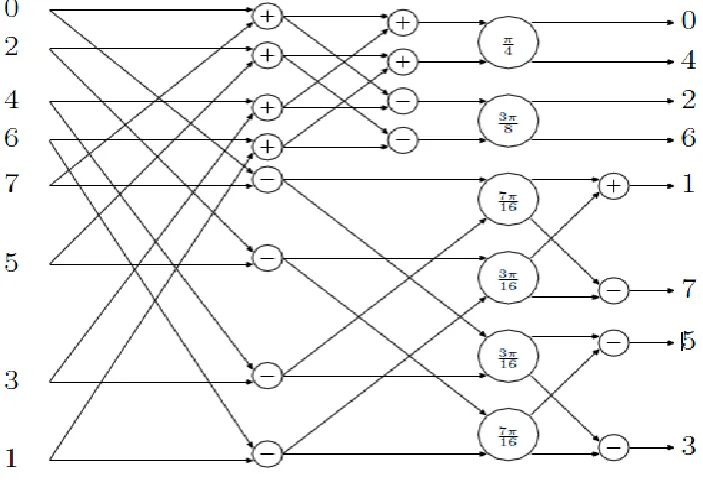
The proposed outline has been summoning CORDIC based plan in an Integer DCT. This usage requires just 38 include and 16 movement operations. We have taken the first Integer DCT as the beginning stage for our improvement, on the grounds that the hypothetical lower bound of the quantity of increases needed for the 1-D 8-point DCT. Keeping in mind the end goal to infer the proposed calculation, we first consider the butterfly toward the start of diagram as demonstrated in Figure 2.
Fig 2.SIGNAL FLOW DIAGRAM OF INTEGER DCT WITH CORDIC
The degree butterflies with scaling variables 3pi/8, 1pi/16 and 3pi/16 can likewise be supplanted by CORDIC utilizing q = 3/ 8, 1/16 and 3/16 separately. Henceforth, this can supplant all butterflies in the Integer DCT to determine the unadulterated CORDIC based Integer DCT. Next, the outline needs to decrease every turn edge and diminish the computational many-sided quality. Initial phase in this configuration is the extraordinary structure of the number DCT, toward the end of the stream chart for the edge q = pi/4. As such, the pi/4 pivot just needs two add operations to do the CORDIC turn. Second in this configuration for a point = 3/ 8 it can be diminish the quantity of emphases to three furthermore move all repayment ventures to the outline. In spite of the fact that the improved 3/ 8 revolutions will diminish the nature of the outcomes, the impacts are not clear in feature arrangement streams or picture pressure. Thirdly, when it investigate the point = /16, it can be effortlessly watched that the fancied count of the /16 turn is near to one. In this manner, it can overlook the figuring ventures of the /16 turn. Accordingly, it just wishes two emphases two iterations in the CORDIC computation.
IV.PERFORMANCE EVALUATION
A) Simulation Result of 8- point Integer DCT
Fig 3.Simulation graph of 8-point integer DCT
B) SYNTHESIS RESULT OF 8 – POINT EXISTING INTEGER DCT
The eight point integer DCT unit has been designed with CSA (Carry Select adder) and for multiplication operation left shifter has been used and it could perform multiplication operation where multiplication and addition operations are follows the algorithm, where multiplication have to perform at the same time where it have to do addition operation.Fig.4 Shows synthesis result of 8-point DCT with CSA.
C). SYNTHESIS RESULT OF 8 – POINT INTEGER DCT WITH CORDIC
The eight point integer DCT unit has been designed with CORDIC algorithm, to compute cosine terms in on fly need to compute Integer DCT, where multiplication have to perform at the same time where it have to do addition operation.Fig.5 Shows synthesis result of 8-point DCT with CORDIC.
Fig.5 8-point integer DCT with CORDIC
TABLE.1 COMPARISON BETWEEN CSA AND CLA OF 4-POINT DCT FOR SPARTAN 3E
Designs Number of slices Number of LUT’s Delay
(ns)
Existing Integer DCT 120 156 13.702
Integer DCT with
CORDIC 78 110 13.52
The comparison results of existing and proposed design of 8-point Integer DCT with CORDIC having better parameter result as compare to CSA with 8-point DCT.
V. CONCLUSION
DCT; it in like manner keeps the considerable quality change result. In this look upon, the proposed DCT figuring is amazingly suitable for low zone and fast sign changing applications, for instance, HEVC.
REFERENCES
[1] Wen Hsiung Chen, C. Smith, and S. Fralick, “A Fast Computational Algorithm for the Discrete Cosine Transform,” IEEE Trans. Commun., vol. 25, pp. 1004–1009, Sept. 1977.
[2] Zhongde Wang, “Fast Algorithms for the Discrete W Transform and for the Discrete Fourier Transform,” IEEE Trans. Acoust., Speech, Signal Processing, vol.32, pp. 803–816, Aug. 1984.
[3] Hyeonuk Jeong, Jinsang Kim, and Won Kyung Cho, “Low-Power Multiplierless DCT Architecture Using Image Correlation,” IEEE Trans. Consumer Electron.,vol. 50, pp. 262–267, Feb. 2004.
[4] N. Ahmed, T. Natarajan, and K. Rao, “Discrete cosine transform,” IEEE Trans. Comput., vol. 100, no. 1, pp. 90–93, Jan. 1974. [5] W. Cham and Y. Chan, “An order-16 integer cosine transform,” IEEE Trans. Signal Process., vol. 39, no. 5, pp. 1205–1208, May 1991. [6] Y. Chen, S. Oraintara, and T. Nguyen, “Video compression using integer DCT,” in Proc. IEEE Int. Conf. Image Process., Sep. 2000, pp. 844–845.
[7] J. Wu and Y. Li, “A new type of integer DCT transform radix and its rapid algorithm,” in Proc. Int. Conf. Electric Inform. Control Eng., Apr.2011, pp. 1063–1066.
[8] A. M. Ahmed and D. D. Day, “Comparison between the cosine and Hartley based naturalness preserving transforms for image watermarking and data hiding,” in Proc. First Canad. Conf. Comput. Robot Vision, May 2004, pp. 247–251.
![The quality of ‘egusi’ melon [(Citrullus lanatus Thunb.) Matsum and Nakai] seeds derived from fruits harvested at different growth stages and at different positions on the mother plant](data:image/gif;base64,R0lGODlhAQABAIAAAP///wAAACH5BAEAAAAALAAAAAABAAEAAAICRAEAOw==)