Recent developments in Monte-Carlo Event Generators
Marek Schönherr1,a
1Institut für Theoretische Physik, Universität Zürich, 8057 Zürich, Switzerland
Abstract. With Run II of the LHC having started, the need for high precision theory predictions whose uncertainty matches that of the data to be taken necessitated a range of new developments in Monte-Carlo Event Generators. This talk will give an overview of the progress in recent years in the field and what can and cannot be expected from these newly written tools.
1 Introduction
Modern Monte-Carlo Event Generators like PYTHIA8 [1], HERWIG++[2, 3] and SHERPA[4] are instru-mental in most physics analyses and measurements at the LHC. The current state-of-the art in usage at the experiments are either next-to-leading order to parton shower matched calculations (NLOPS) or multijet merged ones at leading order accuracy. Examples for their widespread use are shown
in Fig. 1. In many instances the PYTHIA8 and HERWIG++generators (or their older predecessors)
receive input from parton level tools computing the hard core production matrix elements either at NLO for processes with few final state particles (e.g. MADGRAPH5_AMC@NLO[5] or POWHEGBOX [6]), or at LO for multileg processes (e.g. ALPGEN[7] or MADGRAPH5_AMC@NLO). The following contribution highlights a few important improvements thereupon effected in recent years.
2 Parton shower developments
The first avenue improvements in event generators have been accomplished in recent years are parton showers. Being instrumental for the description of many relevant observables parton showers are a main ingredient of all event generator frameworks and thus their continuing advancement is crucial to a better description of collider observables.
On the one hand side subleading colour information has been propagated into the algorithms otherwise operating in the leading colour limit. In the first such advancement it was a pure necessity to achieve a process independent NLO matching and was consequently only introduced in the first emission [10]. Later implementations trace subleading colour information in different limits through multiple, if not all, emissions of the parton shower evolution [11, 12]. Generally, the impact of such improvements is small, as shown in Fig. 2 (left), although also highly sensitive observables exist [13]. Other works build around gaining a higher degree of analytical control over the parton showers’ resummation properties [14]. Through the accompanying scrutiny also their predictive power and
[GeV]
Z T
p
1 10 102
Prediction / Data
0.4 0.6 0.8 1 1.2 1.4 Data uncertainty PYTHIA6-AMBT1 POWHEG+PYTHIA6 MC@NLO+HERWIG ALPGEN+HERWIG SHERPA -1
L dt = 4.7 fb
∫
= 7 TeV; s | < 1.0
Z |y ≤ 0.0 ATLAS [GeV] Z T p
1 10 102
Prediction / Data
0.4 0.6 0.8 1 1.2 1.4 Data uncertainty PYTHIA6-AMBT1 POWHEG+PYTHIA6 MC@NLO+HERWIG ALPGEN+HERWIG SHERPA -1
L dt = 4.7 fb
∫
= 7 TeV; s | < 2.4
Z |y ≤ 2.0 ATLAS [1/GeV] jet T /dp σ ) d
-+l l
→ *γ Z/ σ (1/ -7 10 -6 10 -5 10 -4 10 -3 10 -2 10 -1 10
= 7 TeV) s Data 2011 ( ALPGEN SHERPA MC@NLO + SHERPA AT H LACK B
ATLAS -)+≥ 1 jet (l=e,μ)
l + l → *( γ Z/ -1
L dt = 4.6 fb
∫
jets, R = 0.4 t anti-k
| < 4.4 jet > 30 GeV, |y jet T p
NLO / Data 0.60.8
1 1.2
1.4 BLACKHAT + SHERPA
MC / Data
0.6 0.8 1 1.2 1.4 ALPGEN
(leading jet) [GeV]
jet T
p
100 200 300 400 500 600 700
MC / Data 0.60.8
1 1.2 1.4 SHERPA
Figure 1. Left: Transverse momentum of the reconstructedZboson in the central and the forward region, as measured by the ATLAS detector. Figure taken from [8]. Right: Transverse momentum of the leading jet inZ boson production in association with jets, as measured by the ATLAS detector. Figure taken from [9].
0.0001 0.001 0.01 0.1 1 10 100
Thrust,τ= 1−T
DipoleShower + ColorFull
0.8 0.91 1.1 1.2
0 0.05 0.1 0.15 0.2 0.25 0.3 0.35 0.4
τ
full shower strict large-Nc
N − 1d N/ d τ x/full S he rp a MC ALEPH data Eur.Phys.J. C35(2004)457
Dire
10−3
10−2
10−1
1
101
Thrust (ECMS=91.2 GeV)
1/ σ d σ /d T
0.6 0.65 0.7 0.75 0.8 0.85 0.9 0.95
0.6 0.8 1 1.2 1.4
T
MC/
D
at
a
Figure 2.Left: Subleading colour effects in parton shower evolution in thrust ine+e−-collisions at LEP. Figure taken from [11]. Right: Thrust ine+e−-collisions at LEP as calculated by a new dipole shower implementation DIRE. Figure taken from [14].
ATLAS data Weak path QCD path Combined
10−3 10−2 10−1 1 101 102σ
(≥Njet),Z→e+e−,p⊥(jet)>30 GeV,|yjet<4.4|
σ
(
Z
→
e
+e
−+
≥
Nje
t
)
[pb]
1 2 3 4 5 6 7
0 0.5 1 1.5 2
Njet
MC/
D
at
a
f= 2.0
f= 1.1
f= 1.0
f= 0.0
pTJ>750 GeV
m
23[GeV]
d
σ/
d
m23
[pb
/
2G
eV
]
100 90
80 70 60 50 0.36 0.34 0.32 0.3 0.28 0.26 0.24 0.22 0.2
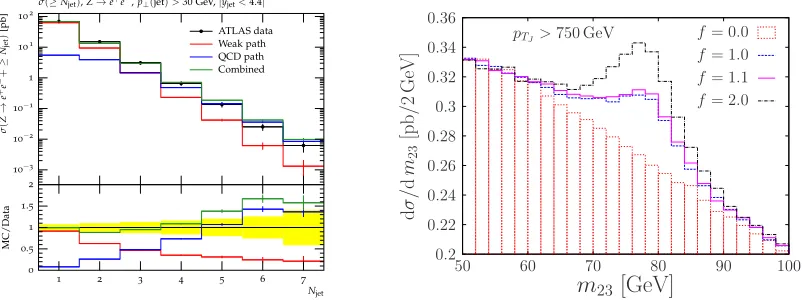
Figure 3.Left: Interplay of QCD evolution on top ofWproduction and EW evolution on top of jet production in describingWplus mulitjet production. Figure taken from [15]. Right: Effects of adding EW evolution on subjet invariant masses. Figure taken from [16].
The third stream of development centres around incorporating electroweak effects into parton
showers [15–17]. The emission of W andZ bosons, although rare, can be an important
ingredi-ent, especially in the highly boosted regime. Fig. 3 such effects for various observables. Such soft-collinear approximations to higher-order electroweak corrections complement the approximate NLO electroweak corrections of [18] and the recently achieved automation of NLO electroweak corrections [19–21].
3 N
LOP
Smatching
Known under the names of MC@NLO[22] and POWHEG[23, 24], methods for matching NLO
compu-tations to parton showers are around for over ten years now. Recent years have seen small theoretical improvements on both schemes that lead to their application to a wider range of processes [10, 25–27] with a more complicated internal structure. The range of showers the respective matching schemes are available for has increased likewise [2, 3, 28, 29]. An systematically different matching method, UNLOPS, was developed in [30].
Similarly, CKKW [33] method of scale setting and Sudakov factor inclusion has been elevated
to be applicable to NLO QCD computations in [34], leading to an improvement of NLOPSmatched
computations incorporating jets in the final state already at Born level. In colour singlet production in association with one additional jet the inclusion of a proper process dependent finite term can restore NLO accuracy for inclusive singlet production as well [35]. This formed the basis for the development of a NNLOPSmatching method for colour singlet production [31, 36]. An exemplary result is shown in
Fig. 4 (left). Another NNLOPSmatching scheme basing basing on MC@NLOand UNLOPSmatching
was developed for the same process class in [32, 37]. Fig. 4 (right) details the results for this scheme named UN2LOPS.
4 Multijet merging
10−3 10−2 10−1 100
d
σ/
dp
H T[pb/GeV]
Ratio
pH T[GeV]
d
σ/
dp
H T[pb/GeV]
Ratio
NNLOPS
HQT
0.6 1.0 1.4
0 50 100 150 200 250 300
Sherpa MC
LOPS 2 UN HqT NNLO MC@NLO = 14 TeV
s
H <2m R/F μ /2< H m
H <m Q μ /4< H m
HqT H <m Q μ /4< H m
[pb/GeV]
T,
H
/dp
σ
d
-2
10
-1
10 1
Ratio to HqT
0.8 1 1.2
[GeV]
T,H
p
0 20 40 60 80 100 120 140 160 180 200
Figure 4. Left: Transverse momentum of the Higgs boson described at NNLOPSin the MiNLOapproach. Fig-ure taken from [31]. Right: Transverse momentum of the Higgs boson described at NNLOPSin the UN2LOPS approach. Figure taken from [32].
of jets. As many observables do not clearly separate between different jet multiplicities but instead receive substantial contributions by e.g. one, two and three jet final states, such multijet merging schemes are the best way to calculate these observables with the highest accuracies.
At the NLO, this was pioneered in [40]. Modern implementations for hadron colliders first ap-peared as MEPS@NLO[41–43] and were applied to a wide range of processes [13, 39, 44–47]. Other implementations using other methods to calculated the matched processes for each jet multiplicity have been established in [38] and [30]. Fig. 5 details results of all three mentioned methods.
5 Conclusions
Monte-Carlo Event Generators are in good shape for Run II of the LHC. Tremendous progress in terms of the achieved accuracy in calculating the hard scattering process has been achieved. They can thus be used as for precise theoretical predictions including an evaluation of the theoretical uncertainty. Developments for the non-perturbative component of high-energy collisions, however, remain sparse. In that regime, playing a role in every hadron collider event, still phenomenologically motivated models with a large number of to-be-tuned parameters are instrumental in all generators. Thus, for precision calculations one should still try to minimise the influence of that regime on the considered observables.
MS acknowledges funding by the Swiss National Science Foundation (SNF) under contract PP00P2-128552.
References
[1] T. Sjöstrand, S. Ask, J.R. Christiansen, R. Corke, N. Desai, P. Ilten, S. Mrenna, S. Prestel, C.O.
Rasmussen, P.Z. Skands, Comput. Phys. Commun.191, 159 (2015),1410.3012
-60 -40 -20 0 20 40 60
20 40 60 80 100 120 140 160 180 200
Deviation [%]
p 1 [GeV] POWHEG H+jet tMS=15...45 GeV, ll tMS=15...45 GeV, cc tMS=15...45 GeV, hh 1.0 10-12
1.0 10-11 1.0 10-10
d
/
d
p
1
[mb/GeV]
Pythia8 UNLOPS (no K-factor) tMS=15 GeV, cc UNLOPS (no K-factor) tMS=30 GeV, cc UNLOPS (no K-factor) tMS=45 GeV, cc
Sherpa+OpenLoops
1st jet
2nd jet
3rd jet
MEPS@NLO
1.65×MEPS@LO S-MC@NLO
10−7
10−6
10−5
10−4
10−3
Light jet transverse momenta
d
σ
/d
pT
[pb/
G
eV]
1st jet
0.5 1 1.5
Ra
tio
to
MEP
S
@
N
LO
2nd jet
0.5 1 1.5
Ra
tio
to
MEP
S
@
N
LO
3rd jet
40 50 100 200 500
0.5 1 1.5
pT(light jet) [GeV]
Ra
tio
to
MEP
S
@
N
LO
Figure 5. Left top: Transverse momentum of the leading jet in top pair production in association with jets described through a FXFXcombination. Figure taken from [38]. Left bottom: Transverse momentum of the leading jet in Higgs production in association with jets described through UNLOPSmerging. Figure taken from [30]. Right: Transverse momentum of the three leading jets in top pair production in association with jets described through MEPS@NLOmerging. Figure taken from [39].
[3] J. Bellm et al. (2015),1512.01178
[4] T. Gleisberg, S. Höche, F. Krauss, M. Schönherr, S. Schumann, F. Siegert, J. Winter, JHEP02,
007 (2009),0811.4622
[5] J. Alwall, R. Frederix, S. Frixione, V. Hirschi, F. Maltoni, O. Mattelaer, H.S. Shao, T. Stelzer, P. Torrielli, M. Zaro, JHEP07, 079 (2014),1405.0301
[6] S. Alioli, P. Nason, C. Oleari, E. Re, JHEP06, 043 (2010),1002.2581
[7] M.L. Mangano, M. Moretti, F. Piccinini, R. Pittau, A.D. Polosa, JHEP 07, 001 (2003),
hep-ph/0206293
[8] G. Aad et al. (ATLAS), JHEP09, 145 (2014),1406.3660
[9] G. Aad et al. (ATLAS), JHEP07, 032 (2013),1304.7098
[10] S. Höche, F. Krauss, M. Schönherr, F. Siegert, JHEP09, 049 (2012),1111.1220
[11] S. Plätzer, M. Sjödahl, JHEP07, 042 (2012),1201.0260
[13] S. Höche, J. Huang, G. Luisoni, M. Schönherr, J. Winter, Phys. Rev. D88, 014040 (2013), 1306.2703
[14] S. Höche, S. Prestel, Eur. Phys. J.C75, 461 (2015),1506.05057
[15] J.R. Christiansen, T. Sjöstrand, JHEP04, 115 (2014),1401.5238
[16] F. Krauss, P. Petrov, M. Schönherr, M. Spannowsky, Phys. Rev.D89, 114006 (2014),1403.4788
[17] J.R. Christiansen, S. Prestel (2015),1510.01517
[18] S. Gieseke, T. Kasprzik, J.H. Kühn, Eur. Phys. J.C74, 2988 (2014),1401.3964
[19] S. Kallweit, J.M. Lindert, P. Maierhöfer, S. Pozzorini, M. Schönherr, JHEP04, 012 (2015),
1412.5157
[20] S. Frixione, V. Hirschi, D. Pagani, H.S. Shao, M. Zaro, JHEP06, 184 (2015),1504.03446
[21] S. Kallweit, J.M. Lindert, S. Pozzorini, M. Schönherr, P. Maierhöfer (2015),1511.08692
[22] S. Frixione, B.R. Webber, JHEP06, 029 (2002),hep-ph/0204244
[23] P. Nason, JHEP11, 040 (2004),hep-ph/0409146
[24] S. Frixione, P. Nason, G. Ridolfi, JHEP09, 126 (2007),0707.3088
[25] S. Höche, F. Krauss, M. Schönherr, F. Siegert, Phys. Rev. Lett.110, 052001 (2013),1201.5882
[26] S. Höche, M. Schönherr, Phys. Rev.D86, 094042 (2012),1208.2815
[27] F. Cascioli, P. Maierhöfer, N. Moretti, S. Pozzorini, F. Siegert, Phys. Lett.B734, 210 (2014), 1309.5912
[28] S. Höche, F. Krauss, M. Schönherr, F. Siegert, JHEP04, 024 (2011),1008.5399
[29] M. Czakon, H.B. Hartanto, M. Kraus, M. Worek, JHEP06, 033 (2015),1502.00925
[30] L. Lönnblad, S. Prestel, JHEP03, 166 (2013),1211.7278
[31] K. Hamilton, P. Nason, E. Re, G. Zanderighi, JHEP10, 222 (2013),1309.0017
[32] S. Höche, Y. Li, S. Prestel, Phys. Rev.D90, 054011 (2014),1407.3773
[33] S. Catani, F. Krauss, R. Kuhn, B.R. Webber, JHEP11, 063 (2001),hep-ph/0109231
[34] K. Hamilton, P. Nason, G. Zanderighi, JHEP10, 155 (2012),1206.3572
[35] K. Hamilton, P. Nason, C. Oleari, G. Zanderighi, JHEP05, 082 (2013),1212.4504
[36] A. Karlberg, E. Re, G. Zanderighi, JHEP09, 134 (2014),1407.2940
[37] S. Höche, Y. Li, S. Prestel, Phys. Rev.D91, 074015 (2015),1405.3607
[38] R. Frederix, S. Frixione, JHEP12, 061 (2012),1209.6215
[39] S. Höche, F. Krauss, P. Maierhöfer, S. Pozzorini, M. Schönherr, F. Siegert, Phys. Lett.B748, 74
(2015),1402.6293
[40] N. Lavesson, L. Lonnblad, JHEP12, 070 (2008),0811.2912
[41] S. Höche, F. Krauss, M. Schönherr, F. Siegert, JHEP04, 027 (2013),1207.5030
[42] T. Gehrmann, S. Höche, F. Krauss, M. Schönherr, F. Siegert, JHEP01, 144 (2013),1207.5031
[43] S. Höche, F. Krauss, M. Schönherr, F. Siegert, JHEP08, 123 (2011),1009.1127
[44] F. Cascioli, S. Höche, F. Krauss, P. Maierhöfer, S. Pozzorini, F. Siegert, JHEP01, 046 (2014), 1309.0500
[45] S. Höche, F. Krauss, M. Schönherr, Phys. Rev.D90, 014012 (2014),1401.7971
[46] S. Höche, F. Krauss, S. Pozzorini, M. Schönherr, J.M. Thompson, K.C. Zapp, Phys. Rev.D89,
093015 (2014),1403.7516
[47] M. Buschmann, D. Goncalves, S. Kuttimalai, M. Schönherr, F. Krauss, T. Plehn, JHEP02, 038
![Figure 2. Left: Subleading colour etaken from [11]. Right: Thrust inffects in parton shower evolution in thrust in e+e−-collisions at LEP](https://thumb-us.123doks.com/thumbv2/123dok_us/8158945.1361113/2.482.61.423.83.309/figure-subleading-colour-etaken-thrust-inects-evolution-collisions.webp)