ONE-POT SYNTHESIS OF PYRANO[2,3-c]PYRAZOLES USING
LEMON PEEL POWDER AS A GREEN AND NATURAL CATALYST
Swati S. Ghodke
[a], Sunil U. Tekale
[a], Rashmi D. Pathrikar
[b], Priya M.
Khandare
[a], László Kótai
[c]and Rajendra P. Pawar
[a]*Keywords: Pyranopyrazoles; lemon peel powder; one-pot synthesis; natural catalyst
A simple one-pot four-component synthesis of pyrano[2,3-c]pyrazoles has been achieved by the condensation of aldehydes, malononitrile, ethyl acetoacetate and hydrazine hydrate using lemon peel powder as a natural catalyst in ethanol under reflux condition. The advantages of this reaction are less reaction time, high yield, easy availability of the catalyst and green nature of the protocol.
* Corresponding Author’s
E-mail: [email protected]
[a] Department of Chemistry, Deogiri College, Station Road, Aurangabad-431005, Maharashtra, India
[b] Department of Chemistry, Rajeshree Shau Arts Commerce and Science College, Pathri, Maharashtra, India
[c] Research Centre for Natural Sciences, Budapest, Hungary
INTRODUCTION
Pyranopyrazole derivatives are an interesting class of nitrogen and oxygen-containing heterocyclic compounds.1
Multi-component reactions are known to be selective, effective, atom-economical, time-saving and easy to perform.2 Pyranopyrazole based heterocyclic compounds
have attracted a significant attention due to their pharmaceutical and biological activities.3 Pyranopyrazoles
are the fused heterocyclic compounds which show various biological activities such as fungicidal,4 anti-inflammatory, 5
anticancer, 6 antimicrobial,7 antioxidant8 and bactericidal.9
Considering the importance of pyranopyrazoles, researchers have reported several methods for their synthesis by using different catalysts such as nano-ZnO,10 triethanolamine,11
sodium benzoate,12L-tyrosine,13 NMPyTs,14 phenylboronic
acid,15 etc.
In continuation of our efforts to the clean synthetic protocol for the synthesis of heterocyclic compounds; herein we wish to report one-pot four-component synthesis of pyranopyrazoles by the reaction of aromatic aldehydes, malononitrile, hydrazine hydrate and ethyl acetoacetate using lemon peel powder as a catalyst under reflux condition.
EXPERIMENTAL
All the reagents and chemicals were used without further purification. Melting points were recorded in open capillaries and were uncorrected. Progress of the reaction was monitored by TLC plates using ethyl acetate:n-hexane (7:3). FTIR spectra were recorded on a Shimadzu IR Affinity-1S spectrophotometer. 1H NMR spectra were recorded on a 400
MHz spectrophotometer and chemical shifts were expressed
in δ ppm relative to Me4Si as the internal standard.
General procedure for the synthesis of substituted pyranopyrazoles
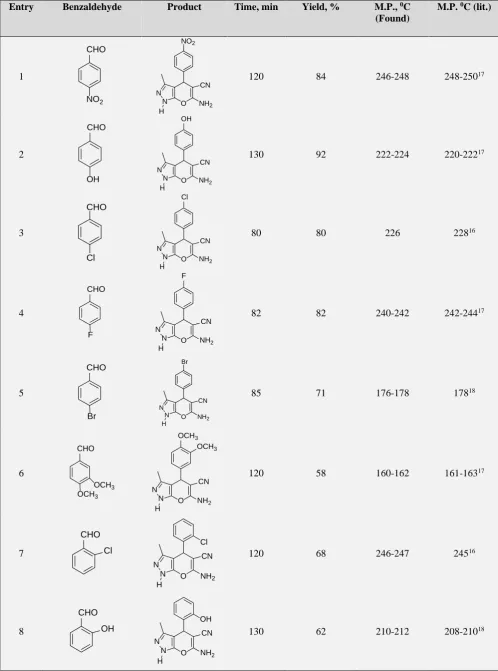
In a 25 mL round bottom flask aldehyde (1 mmol), malononitrile (1 mmol), hydrazine hydrate (1 mmol), ethyl acetoacetate (1 mmol) and lemon peel powder (10 wt%) was taken in 5 mL ethanol solvent. The resulting reaction mixture was refluxed for a period as indicated in Table 1. The progress of reaction was monitored by using TLC plates in ethyl acetate / n-hexane (7:3). After completion of reaction, the reaction mass was diluted with hot ethanol and filtered off to separate lemon peel powder catalyst as the residue. The residue was washed with hot ethanol (3 x 5 mL), the combined filtrates were concentrated and recrystallized from ethanol to afford the corresponding pure product. All the products were confirmed by comparison of their melting points with the literature values and analysis of IR, 1H NMR
and mass spectral data.
6-Amino-3-methyl-4-(4-nitro-phenyl)-1,4-dihydropyrano[2,3-c]pyrazole-5-carbonitrile (1)
1H NMR (400 MHz, CDCl
3): δ ppm 2.74 (s, 3H, CH3), 4.75
(s, 1H, CH), 7.30 (d, 1H, Ar-H), 7.31 (d, 1H, Ar-H), 7.65 (s, 2H, NH2), 7.79 (d, 2H, Ar-H), 11.04 (s, 1H, NH); ESI-MS:
298.06 (M+1) +.
6-Amino-3-methyl-4-(4-hydroxyphenyl)-1,4-dihydropyra-no[2,3-c]pyrazole-5-carbonitrile (2)
1H NMR (400 MHz, CDCl
3): δ ppm 2.75 (s, 3H, CH3), 4.45
(s, 1H, CH), 6.52 (d, 1H, Ar-H), 6.53 (dd, 1H, Ar-H), 6.54 (dd, 1H, Ar-H), 6.62 (d, 1H, Ar-H), 7.50 (s, 2H, NH2), 13.4
(s, 1H, NH); ESI-MS: 269 (M+1) +.
6-Amino-3-methyl-4-(4-chlorophenyl)-1,4-dihydropyrano[2,3-c]pyrazole-5-carbonitrile (3)
1H NMR (400 MHz, CDCl
3): δ ppm 2.31 (s, 2H, NH2) 2.89
(s, 3H, CH3), 4.76 (s, 1H, CH), 7.01 (d, 2H, Ar-H), 7.15 (d,
6-Amino-3-methyl-4-(4-flurophenyl)-1, 4-dihydropyrano[2,3-c]pyrazole-5-carbonitrile (4)
1H NMR (400 MHz, CDCl
3): δ ppm 2.10 (s, 2H, NH2), 2.73
(s, 3H, CH3), 4.74 (s, 1H, CH), 6.75 (d, 2H, Ar-H), 7.01 (d,
2H, Ar-H), 11.07 (s, 1H, NH); ESI-MS: 271.09 (M+1)+ .
6-Amino-3-methyl-4-(4-bromophenyl)-1,4-dihydropyrano[2,3-c]pyrazole-5-carbonitrile (5)
1H NMR (400 MHz, CDCl
3): δ ppm 2.50 (s, 2H, NH2), 2.69
(s, 3H, CH3), 4.71 (s, 1H, CH), 6.92 (d, 2H, Ar-H), 7.21 (d,
2H, Ar-H), 10.21 (s, 1H, NH); ESI-MS: 331.02 (M+1)+ .
6-Amino-4-(3,4-dimethoxyphenyl)-3-methyl-1,4-dihydro-pyrano[2, 3-c] pyrazole-5-carbonitrile (6)
1H NMR (400 MHz, CDCl
3): δ ppm 1.80 (s, 3H, CH3), 3.85
(s, 6H, CH3), 4.55 (s, 1H, CH), 6.56 (s, 1H, CH), 6.61 (d, 1H,
CH), 6.65 (d, 1H, CH), 7.60 (s, 2H, NH2), 13.2(s, 1H, NH);
ESI-MS: 313 (M+1)+ .
6-Amino-4-(2-chlorophenyl)-3-methyl-1,4-dihydropyrano[2,3-c]pyrazole-5-carbonitrile (7)
1H NMR (400 MHz, CDCl
3): δ ppm 2.00 (s, 2H, NH2), 2.70
(s, 3H, CH3), 4.54 (s, 1H, CH), 6.65 (d, 1H, Ar-H), 6.66 (dd,
1H, Ar-H), 6.67(dd, 1H, Ar-H), 6.75 (d, 1H, Ar-H), 13.7 (s, 1H, NH); ESI-MS: 287 (M+1) +.
6-Amino-4-(2-hydroxyphenyl)-3-methyl-1,4-dihydropyrano[2,3-c]pyrazole-5-carbonitrile (8)
1H NMR (400 MHz, CDCl
3): δ ppm 2.75 (s, 3H, CH3), 4.45
(s, 1H, CH), 6.52 (d, 1H, Ar-H), 6.53 (dd, 1H, Ar-H), 6.54 (dd, 1H, Ar-H), 6.62(d, 1H, Ar-H), 7.50 (s, 2H, NH2), 12.04
(s, 1H, NH); ESI-MS: 269 (M+1) +.
6-Amino-4-furan-2-yl-3-methyl-1,4-dihydropyrano[2,3-c]pyrazole-5-carbonitrile (9)
1H NMR (400 MHz, CDCl
3): δ ppm 2.40 (s, 2H, NH2), 2.67
(s, 3H, CH3), 4.94 (s, 1H, CH), 5.77 (d, 1H, Ar-H), 6.01 (dd,
1H, CH), 7.10 (d, 1H, Ar-H), 13.01 (s, 1H, NH); ESI-MS: 243.05 (M+1) +.
6-Amino-3-methyl-4-(3-nitrophenyl)-1,4-dihydropyrano[2,3-c]pyrazole-5-carbonitrile (10)
1H NMR (400 MHz, CDCl
3): δ ppm 0.97 (s, 3H, CH3),
4.05 (s, 1H, NH), 6.23 (s, 2H, NH2), 6.67-6.87 (m, 2H,
Ar-H), 7.19 (t, 1H, CAr-H), 7.30 (d, 1H, Ar-Ar-H), 11.38 (s, 1H, NH); ESI-MS: 299.23 (M+2) +.
6-Amino-4-(4-dimethylaminophenyl)-3-methyl-1,4-dihydro-pyrano[2,3-c]pyrazole-5-carbonitrile (11)
1H NMR (400 MHz, CDCl): δ ppm 2.50 (s, 2H, NH), 2.74
2H, Ar-H), 6.84 (d, 2H, Ar-H), 12.40 (s, 1H, NH); ESI-MS: 296.12 (M+1) +.
RESULT AND DISCUSSION
In the present work, we have synthesized pyranopyrazole derivatives using variously substituted aromatic aldehydes. A model four component condensation reaction was performed on 4-hydroxybenzaldehyde, malononitrile, ethyl acetoacetate and hydrazine hydrate using lemon peel powder as a catalyst in water solvent or without water or ethanol solvents at room temperature, reflux condition and by using ultrasound irradiation.
To follow the principles of green chemistry, initially a model reaction was carried on 4-hydroxybenzaldehyde in the absence of solvent or without solvent at room temperature, reflux condition and ultrasonic irradiation. But the corresponding product was obtained in a less amount (52 %, 45 %). Then we carried out the same reaction in the presence of water, ethanol solvent under room temperature, reflux condition and ultrasonic irradiation. We observed that the reaction required a long reaction time in water with lesser yield as compared to ethanol. Excellent yield was obtained in ethanol solvent under reflux conditions as compared to room temperature and ultrasonic irradiation. The results obtained are presented in Table 2.
Next, we optimized the amount of catalyst concentration on the same reaction by using 5, 10, 20 and 30 wt.% of the catalyst and observed 50, 90, 90, and 91 % of the product, respectively, in case of the model condensation reaction.
We also carried out the same reaction under solvent-free condition, but the product was obtained in a very less amount (10%). In conclusion, the best result was obtained with 10 wt % of lemon peel powder in ethanol under reflux condition (Table 3). Further increasing the amount of catalyst does not affect yield of the product to a greater extent.
CHO
R O O
O
CN
CN NH2NH2.H2O
O CN
NH2
N N H
R
Lemon peel powder (10 wt%) EtOH, reflux
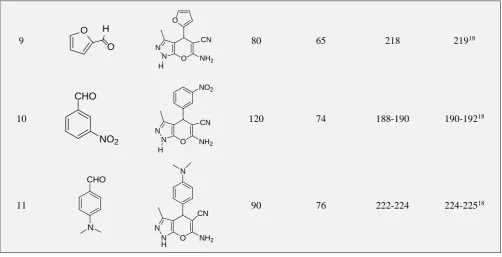
Table 1. Synthesis of pyranopyrazols derivative
Entry Benzaldehyde Product Time, min Yield, % M.P., 0C (Found)
M.P. 0C (lit.)
1
CHO
NO2
O CN
NH2
N N H
NO2
120 84 246-248 248-25017
2
CHO
OH O
CN
NH2
N N H
OH
130 92 222-224 220-22217
3
CHO
Cl O
CN
NH2
N N H
Cl
80 80 226 22816
4
CHO
F
O CN
NH2 N
N H
F
82 82 240-242 242-24417
5
CHO
Br O
CN
NH2 N
N H
Br
85 71 176-178 17818
6
OCH3
OCH3
CHO
O CN
NH2 N
N H
OCH3 OCH3
120 58 160-162 161-16317
7
CHO
Cl
O CN
NH2 N
N H
Cl
120 68 246-247 24516
8
CHO
OH
O CN
NH2
N N H
OH
9
O
O H
O CN
NH2 N
N H
O
80 65 218 21918
10
CHO
NO2 O
CN
NH2
N N H
NO2
120 74 188-190 190-19218
11
CHO
N
O CN
NH2
N N H
N
90 76 222-224 224-22518
Table 2. Effect of various solvent on the model reaction
Entry Solvent Temperature Time, min Yield, %
1 H2O Reflux 180 52
2 Solvent-free Reflux 300 45
3 Ethanol Reflux 120 91
Table 3. Effect of catalyst on the synthesis of pyranopyrazoles under reflux condition
Entry Amount of catalyst, wt% Yield, %
1 No catalyst 10
2 5 50
3 10 90
4 20 90
CONCLUSION
In conclusion, we report the synthesis of pyranopyrazoles by using one pot four-component procedure with excellent yield. Easy handling, clean method and atom economical transformation are some of the important advantages of the present method.
ACKNOWLEDGMENT
The authors are thankful to the Principal, Deogiri College, Aurangabad, for providing necessary laboratory facilities.
REFERENCES
1Suryavanshi, A. W., Copper ferrite super magnetic nano- catalyzed synthesis of 6-amino-3-methyl-4-(substituted-phenyl)-2,4-dihydropyrano[2,3-c]pyrazole-5-carbonitrile. Int. Res. J. Sci.
2Patil, R. M., and Rajput, A. P, Synthesis of 6-amino-2,4-dihydropyrano-[2,3-c]pyrazol-5-carbonitriles catalyzed by cerium(IV)carboxymethylcellulose under solvent-free conditions. J. Applic. Chem.,2018, 7(3), 553-558.
3Patil, D. C., Balaskar, R. S., Thakare, M. S., Dipke, S. S., Solvent-free synthesis of 1,4-dihydropyrano[2,3-c]pyrazole derivatives. Int. J. Innov. Res. Sci., Eng. Technol., 2016, 4(5), 18268-18272. https://doi:10.15680/IJIRSET.2016.0510144. 4Zolfigol, M. A., Tavasoli, M., Moosavi-Zare, A. R., Moosavi, P.,
Kruger, H. G., Shiri, M. and Khakyzadeh, V., Synthesis of pyranopyrazols using isonicotinic acid as a dual and biological organocatalyst. RSC Adv., 2013, 3, 25681-25685. https://doi:10.1039/c3ra45289a.
5Al-Amiery, A. A., Al-Bayati, R. I., Saed, F. M., Ali, W. B., Kadhum, A. A. H., Mohamad, A. B., Novel pyranopyrazols : Synthesis and theoretical studies. Molecules, 2012, 17, 10377-10389. https://doi:10.3390/molecules170910377.
6Chavan, H. V., Babar, S. B., Hoval, R. U., and Bandgar, B. P., Rapid one-pot four-component synthesis of pyranopyrazols using heteropolyacid under solvent-free condition. Bull. Korean Chem. Soc., 2011, 32(11), 3963-3666. https://dx.doi.org/10.5012/bkcs.2011.32.11.3963.
7Ardiansah, B., Current progress on the synthesis methods of pyranopyrazols. Int. J. Chem. Tech. Res.,2019, 12(5), 273-280. http://dx.dx.doi.org/10.20902/IJCTR.2019.120531. 8Kaur, M. and Sohal, H. S., Synthesis of new pyranopyrazols based
benzoxazole derivatives, Int. J. Curr. Res., 2017, 9(10), 59725-59728.
9Davarpanah, J., Khoram, R., Synthesis of pyranopyrazols compound using heterogeneous base catalyst based on 1, 3, 5-triazine-2, 4, 6-triamine modified. J. Nanoanalysis, 2017, 4(1), 20-30.
component synthesis of pyranopyrazols. J. Chem., 2013, 8. https://dx.doi.org/10.1155/2013/840954.
11Sonar, J. P., Pardeshi, S. D., Dokhe, S. A., Zine, A. M., Pawar, R. P. and Thore, S. N, An efficient protocol for the one-pot synthesis of pyranopyrazols in aqueous medium using triethanolamine as a catalyst. Arch. Org. Inorg. Chem. Sci.,
2018, 3(1), 314-317,
https://doi:10.32474/AOICS.2018.03.000155.
12Kiyania, H., Samimib, H. A., Ghorbania, F. and Esmaielia, S., One-pot four-component synthesis of pyrano[2,3-c]pyrazoles catalyzed by sodium benzoate in aqueous medium. Curr. Chem. Lett., 2013, 2, 197-206. https://doi:10.52 67/jcc12013.07.002.
13Rupnar, B. D., Pagore, V. P., Tekale, S. U., Shisodia, S. U., and Pawar, R. P., L-tyrosine catalyzed mild and efficient synthesis of dihydropyrano[2,3-c]pyrazole under microwave irradiation. Der Chem. Sin.,2017, 8(2), 229-234.
14Kamble, V. T., Bondle, G. M., Atkore, S. T., N-methyl pyridinium p-toluene sulfonate (NMPyTs) catalyzed synthesis of pyrano[2,3-c]pyrazoles. Iranian Chem. Comm., 2017, 5, 268-277.
15Imene, A. K., Wassima, G., Raouf, B., Taous, B. and Abdelmadjid, D., Phenylboronic acid-catalyzed a four-component synthesis of pyrano[2,3-c]pyrazole derivatives in aqueous media: an eco-friendly method, Der Pharma Chemica, 2015, 7(8), 175-180.
16Chine, S. S., Patil, S. S., Laterite catalyzed ultrasound-assisted greener protocol for the synthesis of pyranopyrazols. Int. J. Res. Anal. Rev. 2018, 5, 1786-1789.
17Pagore, V. P., Rupnar, B. D., Tekale, S. U and Pawar, R. P., Green and efficient synthesis of pyranopyrazols catalyzed by ammonium chloride in water. Der Pharma Chemica, 2015, 7(6), 312-317.
18Khandare, P. M., Ingle, R. D., Taware, A. S., Shisodia, S. U., Pawar, S. S., Kotai, L., Pawar, R. P., One-pot synthesis and biological evaluation of pyranopyrazols in aqueous medium. Eur. Chem. Bull., 2017, 6(9), 410-414. https://doi:10.17628/ecb.2017.6.410-414.