Strange Light Nuclei
Satoshi N. Nakamura1,a
1Graduate School of Science, Tohoku University, Sendai, Miyagi, JAPAN 980-8578
Abstract.“Strange” means 1) unusual or surprising, especially in a way that is difficult to explain or understand or 2) havingstrangenessdegree of freedom. Light nuclear systems with strangeness, light hypernuclei, are perfect playground to study baryon force which would be a bridge between well established nuclear force in low energy region and QCD, the first principle of the strong interaction. Overview of study of light hypernuclei is given and recent experimental findings are reviewed.
1 Introduction
Nuclear physics aims to understand many-body system interacting by the nuclear force. Based on rich nucleon-nucleon scattering data, nuclear force is well modeled and the nuclear structure can be discussed with the established nuclear force. QCD is the first principle of the strong interaction but direct deduction of nuclear force from it is not yet achieved though recent development of lattice QCD calculation would hopefully bridge between QCD and nuclear force in near future. Extension of the nuclear force to the baryon force by introducing quark degree of freedom other than up and down quarks will help to fill the gap between QCD and the nuclear force. However due to limited data on hyperon-nucleon scattering data, understanding of the YN interaction is much less satisfactory when compared to the NN interaction. Contrary to the NN interaction, the YN interaction has been studied mainly through the investigation of hypernuclear structure. Hypernuclear structure is calculated with the assumed YN interaction models and the results are compared with the experimental data to feed back the information to the YN interaction models. Data of hypernuclei measured with the state-of-art experimental techniques and modern theoretical techniques well tested for normal nuclei, have been serving to develop the YN interaction models. Especially light hypernuclei are important to extract information about the YN interaction while heavier hypernuclear system provides ideal test ground for baryon behavior in nuclear matter.
2 The s-shell hypernuclei in the 20th century
The established lightest hypernucleus is3
ΛH and Lambda’s binding energies (BΛ) of s-shell hyper-nuclei (3
ΛH,4ΛH and5ΛHe) were measured by emulsion [1, 2] in 1960s. At that time, it was already recognized that a simpleΛN potential model cannot explain the experimental data consistently. The measuredBΛ’s of s-shell hypernuclei with the limited YN scattering data were analyzed in terms of a
ae-mail: [email protected]
C
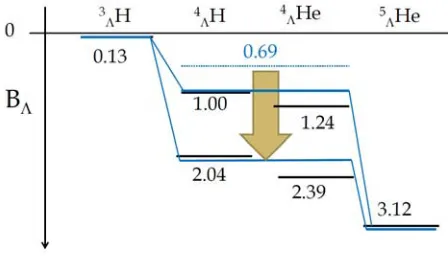
model which employed phenomenologicalΛN andΛNN potentials [3] but it resulted in over-bound of5ΛHe (Fig. 1). The importance ofΣcomponent mixing was pointed out by Refs. [4, 5] to solve the over-bound problem of5ΛHe. The wavefunction of4ΛHe could be written with an explicit inclusion of Σas:
|4
ΛHe>=φΛ(r)|3He>+
2 3φΣ+(r)|
3H>−
1 3φΣ0(r)|
3He> . (1)
The explicit inclusion ofΣcomponent in wavefunctions ofΛhypernuclei (ΛN−ΣN coupling) solved the5
ΛHe over-bound problem, but caused under-bound ofA=4 systems (4ΛH and4ΛHe) in turn. Akaishi et al. introduced an idea of coherentΛ−Σcoupling (effectiveΛNNthree-body force) which is dominant for systems with unbalanced isospin [6] and successfully explainedBΛforA = 3−5 hypernuclear systems including first excited states of4
ΛH and4ΛHe (Fig. 2).
In the 20th century, it was believed that s-shell hypernuclei were reasonably understood.
Figure 1.Lambda binding energies of s-shell hypernuclei,3
ΛH,4ΛH and5ΛHe.
Figure 2.BΛof s-shell hypernuclei with coherentΛ−Σcoupling [6]. Unit of numbers is MeV.
3 Charge symmetry breaking effect of the
Λ
N
interaction
ThoughBΛ’s of s-shell hypernuclei were reasonably understood, there exist small energy differences between4
should be the same. Figure 3 shows closer look of the ground and the first excited states of4ΛH and 4
ΛHe. There exist 350 keV and 240 keV energy differences for 0+and 1+states of4ΛH and4ΛHe. The Coulomb correction due to core nucleus compression by the existence ofΛis expected to be less than 50 keV [7] and thus the difference is not negligible. Binding energy difference between3H and3He after the Coulomb correction is 764−693=71 keV [8] and thus the charge symmetry breaking effect (CSB) of theΛNinteraction is much larger than it of theNNinteraction.
Modern calculation techniques were used to understand the CSB forA=4 hypernuclei, such as the Faddeev-Yakubovsky calculation with explicit admixture ofΣand chiral perturbation theory up to NLO, but comprehensive understanding of 0+, 1+states ofA=4 hypernuclear iso-doublet has not been obtained [9]. TheBΛdifferences between4ΛH and4ΛHe were represented by phenomenologically introduced CSB terms in theΛN potential [7]. Recent progress of cluster calculation enabled to calculateA=7 hypernuclear iso-triplet (7
ΛHe,7ΛLi∗and7ΛBe) [10]. Since theA=7 hypernuclear iso-triplet was calculated with the same calculation technique used forA =4 hypernuclear iso-doublet therefore consistency betweenA=4 andA=7 systems can be studied by switching the CSB effect on and offin the calculation.
Figure 3.Energy levels for the ground and first excited states of4
ΛH and4ΛHe.
The ground state energies of7
ΛLi and7ΛBe were already measured by emulsion [1] andγ-ray data gives the excitation energy of7
ΛLi∗(T = 1) [11]. However,BΛof7ΛHe was not yet reported due to limited statistics and scattered data of emulsion [1, 2]. Since7He target is unavailable,7
ΛHe cannot be produced by the conventional (K−, π−) and (π+,K+) reactions which convert neutron toΛ. The (e,eK+) reaction which converts proton toΛproduces7
ΛHe using7Li target.
Figure 4. Binding energy spectrum of7
ΛHe [15]. Ground state peak was clearly observed. There is structure
which might correspond to excited states, but statistical significance is not enough to be discussed. Data with more statistics were obtained by the E05-115 experiment and the analysis is in progress.
The last missing BΛ information of A = 7 hypernuclear iso-triplet (7
ΛHe, 7ΛLi∗ and 7ΛBe) was obtained by the7He (e,eK+)7
ΛHe reaction in JLab E01-011 experiment [15]. As shown in Fig. 4, a clear peak corresponding to7
ΛHe ground state was observed andBΛwas measured as:
BΛ=5.68±0.03(stat)±0.25(sys) MeV. (2)
Figure 5 shows energy levels ofA = 7 hypernuclear iso-triplet measured by experiments and theoretical calculations with and without the CSB effect. Though the phenomenological CSB potential is necessary to explain energy levels of 0+ and 1+ states of the A = 4 hypernuclear iso-doublet, inclusion of CSB term makes agreement of experimental results and calculated results worse for theA = 7 hypernuclear iso-triplet. It indicates that the assumed CSB potential is too naive or re-measurement ofA=4 hypernuclear doublet,4
ΛH and4ΛHe, with modern experimental techniques is necessary.
Using the4He(e,eK+)4
ΛH reaction, the energy levels of 0+, 1+of4ΛH can be measured and such experiment is now planned at JLab. By using the decay pion spectroscopy technique of electrons-produced hyper-fragments which will be explained later in this article, the ground state energy of4
Figure 5.Energy levels for the ground states ofA=7 hypernuclear iso-triplet obtained by experiments (red) and theoretical calculations with (blue) and without CSB (black). Unit of numbers is MeV.
4 Two loosely bound neutrons with s-shell hypernucleus core
We have discussed s-shell hypernuclei (A ≤ 5) which have been considered as already understood well andA=7 iso-triplet which is important for the discussion of the CSB effect. ForA=6 system, recent study of6ΛH by FINUDA [21] activates discussion again about light hypernuclei, a system with s-shell hypernucleus core plus two loosely bound neutrons.
FINUDA used 6Li(K−, π+)6
ΛH double charge exchange reaction with stopped K− fromφdecay and measured three events which were assigned as6
ΛH. FINUDA obtained6ΛH mass for the events by two means. One is missing mass withπ+from the6Li(K−, π+)6ΛH and the other is invariant mass with π−from the weak-decay of6
ΛH →6 He+π−. As we discussed in section 2, the coherentΛN−ΣN coupling is important to explain masses of s-shell hypernuclei, additional 1.4 MeV binding energy is expected to be gained from it for6
ΛH since the coherentΛN−ΣN coupling is significant for neutron rich hypernuclei [23]. Though energies of three6
ΛH events measured by FINUDA are scattered and there exist systematic differences between massed obtained from production and decay, the averaged binding energy of6
ΛH is obtained asBΛ=4.0±1.1 MeV while Ref. [23, 24] predictedBΛ=5.8 MeV (Fig. 6). Reference [22] concluded the6
ΛH data disagree the coherentΛN −ΣN coupling model’s prediction. Recently, similarity between6
ΛH and7ΛHe were discussed treating6ΛH as4ΛH plus 2nand 7
ΛHe as5ΛHe plus 2n; those neutrons are in p-shell and loosely bound [25, 26]. Naively adding such 2n to4
ΛH and to5ΛHe would give similarBΛchanges:
BΛ(6ΛH)BΛ(Λ7He)−BΛ(5ΛHe)+BΛ(4ΛH)=5.68−3.12+2.04=4.60 MeV. (3)
It is deeper than FINUDA’s result of 4.0 MeV, but still consistent within the large error (±1.1 MeV). However, this kind of phenomenological discussion is very rough and there exists a four body cluster calculation which gives no bound6
ΛH [27]. Therefore, we need more experimental data as well as detailed theoretical discussions to draw conclusion about coherentΛN−ΣNcoupling effects for the system of s-shell hypernucleus core+loosely bound p-shell neutrons. Recently a new experiment [28] with6Li(π−,K+)6ΛH double charge exchange reaction was performed at J-PARC. The result did not confirm the FINUDA’s result [29] and thus we need further study on6
Figure 6.Energy levels forA=3−7 hypernuclei including6
ΛH by FINUDA experiment at DAΦNE and7ΛHe by
HKS-HES (E01-011) experiment at JLab. FINUDA obtained the6
ΛH mass by averaging of masses measured by
production (red crosses) and decay (blue crosses). Unit of numbers is MeV.
p n
Λ
π−
Λ
Figure 7.Concept of the decayπ−spectroscopy of electro-produced hypernuclei.
5 Decay
π
−spectroscopy of electron-produced hypernuclei
We have discussed mainly on reaction spectroscopy which measures incoming beam and outgoing particles from hypernuclear production to deduce the missing mass of the hypernucleus. However, we can measure decay products from produced hypernuclei. For example,γ-ray spectroscopy of hyper-nuclei was successfully developed by measuringγ-rays from de-excitation of hypernuclei produced by meson beams [30].
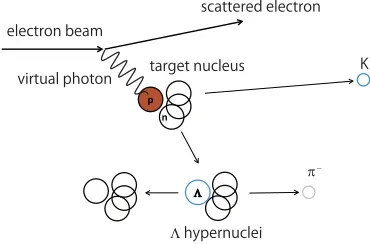
Decayπ−spectroscopy of hypernuclei is a new experimental technique which measuresπ−from weak-decay ofΛ[31]. Some fraction of produced hypernuclei by any means stops in the target, and then decays by the weak interaction in two-body toπ−and a normal nucleus like:
A
used, it is a good strategy to establish the decayπ−spectroscopy combined with electro-production of hypernuclei (Fig. 7). Important point of this method is that the produced hypernucleus stopped in the target and decay in two-body, so it is not necessary to be directly produced. Electro-produced hypernuclei can make fragmentation and lighter hyper-fragments stop in the target and decay in two-body, then this technique works.
Single monochromaticπ−measurement from weak-decay of hypernuclei would suffer from back-ground associating with decay of normal nuclei, so K+will be tagged to guarantee that strangeness is produced. Therefore, this experiment is a coincidence measurement of K+andπ−, however, final mass resolution is only determined by the momentum resolution ofπ−.
The pilot experiment started already at MAMI-C which can deliver 1.5 GeV high-quality electron beams after recent upgrade. We have quite promising results of decayπ−spectrum with K−tag from 9Be target and analysis is in progress. We believe that the ground state peak of4
ΛH which is important experimental input for theΛNCSB discussion will be observed in near future.
6 Summary
The s-shell hypernuclei were studied by emulsion and theirBΛ’s show importance of theΛN−ΣN coupling. Introduction of coherentΛ−Σcoupling (effectiveΛNNforce) solved long-standing over-bound/under-bound problems of s-shell hypernuclei. However recent experimental result on6
ΛH at DAΦNE indicates that coherentΛ−Σcoupling might not be simply applied to a system of s-shell hypernuclear core with two loosely bound neutrons though the observed three6
ΛH events with large errors cannot draw definite conclusion. New experimental result from J-PARC is eagerly awaited.
The charge symmetry breaking effect of theΛNpotential was phenomenologically introduced to explainBΛdifferences of4ΛH andΛ4He. With a decade of efforts at JLab, the (e,eK+) hypernuclear spectroscopy was established and the binding energy of7ΛHe was measured. TheBΛ(7ΛHe) is the last missing part ofA = 7,T = 1 hypernuclear iso-triplet of which binding energies can be calculated by recent four-body cluster calculation. Careful comparison of experimental results and theoretical calculation indicates that inclusion of naive CSB term which is necessary for4
ΛH and4ΛHe, deteriorates the agreements between experiments and calculation forA =7,T =1 hypernuclei. Further studies on CSB ofΛN interaction are necessary experimentally as well as theoretically. Study of4
ΛH has started at MAMI-C with a new experimental technique, the decayπ−spectroscopy of electro-produced hypernuclei.
At JLab, a new comprehensive program of hypernuclear study from elementary to heavy hyper-nuclei with the (e,eK+) reaction is planned [32]. At J-PARC, a new experiment on6
ΛH was carried out andγ-ray spectroscopy of4
ΛHe is ready to run. Many experimental and theoretical works are on going since light hypernuclei are still strange.
Acknowledgments
supports from JSPS core-to-core program (21002) and the strategic young researcher overseas visits program for accelerating brain circulation (R2201) are acknowledged.
Last but not least, I would like to thank late Osamu Hashimoto who initiated the (e,eK+) hyper-nuclear study.
References
[1] M. Juric et al., Nucl. Phys. B52, 1 (1973). [2] D.H. Davis, Nucl. Phys. A754, 3 (2005).
[3] R.H. Dalitz, R.C. Herndon and Y.C. Tang, Nucl. Phys. B47, 109 (1972). [4] B.F. Gibson, A. Goldberg and M.S. Weiss, Phys. Rev. C6, 741 (1972). [5] J. Dabrowski, Phys. Rev. C8, 835 (1973).
[6] Y. Akaishi et al., Phys. Rev. Lett.84, 3539 (2000).
[7] A.R. Bodmer and Q.N. Usmani, Phys. Rev. C31, 1400 (1985). [8] G.A. Miller and W.T.H. van Oers, arXiv:nucl-th/9409013
[9] A. Nogga, H. Kamada, W.Glöckle, Phys. Rev. Lett.88172501 (2002); A. Nogga, Nucl. Phys. A (2013) http://dx.doi.org/10.1016/j.nuclphysa.2013.02.053.
[10] E. Hiyama et al., Phys. Rev. C80054321 (2009). [11] H. Tamura et al., Phys. Rev. Lett.845963 (2000). [12] T. Miyoshi et al., Phys. Rev. Lett.90232502 (2003). [13] L. Yuan et al., Phys. Rev. C73044607 (2006). [14] O. Hashimoto et al., Nucl. Phys. C73044607 (2006). [15] S.N. Nakamura et al., Phys. Rev. Lett.110012502 (2013). [16] M. Iodice et al., Phys. Rev. Lett.99052501 (2007). [17] F. Cusanno et al., Phys. Rev. Lett.103202501 (2009).
[18] H. Tamura et al., Gamma-ray spectroscopy of light hypernuclei, J-PARC E13 proposal (2007). [19] E. Hiyama and Y. Yamamoto, Prog. Theor. Phys.128105 (2012).
[20] Y. Zhang, E. Hiyama and Y. Yamamoto, Nucl. Phys. A881187 (2012). [21] M. Agnello et al., Phys. Rev. Lett.108042501 (2012).
[22] M. Agnello et al., Nucl. Phys. A881269 (2012).
[23] Y. Akaishi and K.S. Myint, AIP Conf. Proc.1011277 (2008).
[24] Theingi, Khin Swe Myint and Y. Akaishi, Genshikaku-kenkyu57supplement 3 (2013). [25] B.F. Gibson and I.R. Afnan, Nucl. Phys. A914(2013) 179.
[26] A. Gal and D.J. Millener, arXiv:1305.6716 (2013). [27] E. Hiyama et al., Nucl. Phys. A908(2013) 29.
[28] A. Sakaguchi et al., Production of Neutron-Rich Λ-Hypernuclei with the Double Charge-Exchange Reaction, J-PARC 50 GeV PS Proposal (2007).
[29] H. Sugimura et al. (J-PARC E10 Collaboration), Phys. Lett. B729(2014) 39. [30] O. Hashimoto and H. Tamura, Prog. in Part. and Nucl. Phys.57(2006) 564.
[31] A. Margaryan, L. Tang, L. Yuan, S.N. Nakamura, J. Reinhold et al., Jefferson Lab. Proposal E08-012 (2007).

![Figure 4. Binding energy spectrum of 7ΛHe [15]. Ground state peak was clearly observed](https://thumb-us.123doks.com/thumbv2/123dok_us/8209131.1371560/4.482.159.324.80.291/figure-binding-energy-spectrum-lhe-ground-clearly-observed.webp)