† Corresponding author
DOI: 10.18488/journal.1/2015.5.8/1.8.478.502 ISSN(e): 2224-4441/ISSN(p): 2226-5139
© 2015 AESS Publications. All Rights Reserved. 478
A
MIXED
METHOD
RESEARCH
FOR
FINDING
A
MODEL
OF
ADMINISTRATIVE DECENTRALIZATION
Tahereh Feizy
1--- Alireza Moghali
2--- Masuod Gramipour
3--- Reza Zare
4†1Associate Professor of Public Management, Payam Noor University, Tehran, Iran
2Professor of Public Management, Payam Noor University, Tehran, Iran
3Assistant professor, Kharazmi University, Faculty of Psychology and Education, Tehran, Iran
4Ph.D. student of Public Management, Payam Noor University, Tehran, Iran
ABSTRACT
One of the critical issues of administrative decentralization in translating theory into practice is understanding its meaning. An important method to identify administrative decentralization is to address how it can be planned and implemented, and what are its implications, and how it would overcome challenges. The purpose of this study is finding a model for analyzing and evaluating administrative decentralization, so a mixed method research was used to explore and confirm the model of Administrative decentralization. In the first phase, in order to explore dimensions and indicators of administrative decentralization model, Grounded Theory method was used. According to the results of Grounded Theory analysis, 38 interviewees pointed to 6 dimensions of Planning, Service delivery and programs/projects implementation, financial management, Human resources management, Information management and Operation maintenance in administrative decentralization. In the second phase, the answers of 300 participants to administrative decentralization questionnaire were studied in a quantitative survey by using confirmatory factor analysis test and the validity of the above dimensions was confirmed. AMOUS 18, ATLAS.ti 6 and SPSS 18 softwares were used in the analysis of qualitative and quantitative data.
© 2015 AESS Publications. All Rights Reserved.
Keywords:
Decentralization, Administrative decentralization, Mixed method research, Grounded theory, Structural equation modeling, Public organizations.Contribution/ Originality
An important feature of this study is using mixed method research. This research uses two qualitative and quantitative methods for collecting and analyzing data. In qualitative phase, grounded theory method was used for exploring dimensions of administrative decentralization and
International Journal of Asian Social Science
ISSN(e): 2224-4441/ISSN(p): 2226-5139© 2015 AESS Publications. All Rights Reserved. 479
in quantitative phase, structural equation modeling was used for the validity of administrative decentralization dimensions.
1. INTRODUCTION
Governments are opening exciting and innovative opportunities for reaching Standards for Public Services delivery by decentralizing authority and responsibility for resource management in many parts of the world (Mitchinson, 2003). Participation, transparency, accountability, access, subsidiarity, representation, separation of powers, and an independent judiciary are characterized as fundamental principles of democratic governance. these principles are achieved via decentralization conducted (Cheema Shabbir and Rondinelli Dennis, 2007).
Decentralization is the incentive for searching innovative programs and policies. First of all, this innovative action is from the government and secondly, by performing decentralization processes, the governments need to access new and wider responsibilities to provide goods and public services for people. New responsibilities in decentralization require an improvement in programming, budgeting, management techniques and working methods, accepting new tools and improvement and also improving human resources to make operational sources (United Nations Development Program, 2004).Generally, the following three factors are the cause of tendency to change the form of administrative and political systems of the countries in the world: 1) The uncertainty about the efficiency of programming thought and central controlling as a suitable tool in sustainable development process, 2) Increased attention of specialists to novel ways of managing macro-development plans with the priority of harmonious growth strategy, 3) Increased necessities resulting from the more complex societies and therefore the necessity to change management and programming methods of growth and development (Blunt and Turner, 2005). Decentralization is a complex, multi-dimensional issue that affects all facets of government. It not only involves the political institutions, but also administrative structures and service delivery arrangements and, most importantly, some degree of local fiscal autonomy. Successful decentralization depends on how well reforms along each of these dimensions interact to support improved local governance (United Nations Development Program, 2004). The definition of decentralization is dependent on its condition and fields. Countries have social cultures, traditions, goals and destinations, forms and fields of decentralization, different geographical levels and also pending improvements (Ibid., 9).
© 2015 AESS Publications. All Rights Reserved. 480
education and healthcare, it has an advantage over purely sector-based interventions in that it explicitly invests new actors with public responsibilities (Ibid., 2). The newly involved actors that it empowers include appointed officials in subnational administrations, elected officials in subnational governments, and increasingly engaged citizens themselves. By strengthening the subnational units with which citizens are most likely to interact, decentralization differs from democratization and economic liberalization, both of which have involved mostly national-level changes. For all of these reasons, decentralization holds great promise for enhancing a number of desirable political and socioeconomic outcomes (United Nations Capital Development Fund, 2006). If decentralization is one of the most important and promising trends in governance, it is also one of the most surprising. In country after country, national politicians have decided to transfer various resources and responsibilities to subnational actors, demonstrating an apparent willingness to cede power that is rarely seen in politicians of any stripe. The cumulative result of these multiple decisions is that subnational officials around the developing world now have a much greater impact on how people live and how well they live (Bardhan and Dilip, 2006).
In a study, Treisman showed that in the field of decentralization and its role in increasing country‘s quality and efficiency and also studying the separation of 160 countries in the field of decentralization and authority delegation, the most important consequences of accurate implementation of decentralization is decreasing the government‘s costs, facilitating organizations‘ management and also increasing their quality and as the most important part, enhancing innovation in performance methods. Also, it was defined that a unique model or the best way of decentralization must be implemented based on the conditions, necessities and the available capacities in organizations and many other factors like meta-section foundations, performance mechanisms, policies, programs and training in acting units have to be considered(Treisman, 2002). This paper focuses specifically on the issue of administrative decentralization. Administrative decentralization involves delegating managerial control to the local level of government. The main purpose of the current paper is to propose an analytical framework or tool able to be used to unpack the managerial control function, understand the different components, and identify areas where specific action may be warranted. This framework has been developed from a field review of Islamic Republic of Iran.
2. LITERATURE REVIEW
2.1. Decentralization— General Overview
© 2015 AESS Publications. All Rights Reserved. 481
Recently, Spain has a good experience with decentralization and democratization. Despite having no formal framework, after the 1970s ―decentralization has proven to be the most innovative institutional feature in democratic Spain‖(Colomer, 1998).The rationale for decentralization is manifold. One type of reasoning uses normative and inherent arguments to defend decentralization, the most important being the idea of citizen participation. In a decentralized political system citizens have more opportunities to participate in political decision-making since the whole process of policy making is broken down to smaller units. Elazar points out that in a federalist system the political distance between the governed and those who govern is relatively small (Peteri, 2002). A decentralized state apparatus therefore provides more access and control over the bureaucracy for its citizens than a centralized one. Thus, it makes democracy and participation a reality. Another normative-inherent benefit of decentralization in public administration is that ,instead of forcing a unified way of life, it recognizes the autonomy of the grass roots. The grass roots level of politics, that is the view and interest of the local people, is not regarded as a less important factor in decentralized systems. Rather, it is crucial to convince them to voluntarily accept central decision and also to incorporate micro-level interests at the macro-level of politics (United Nations Development Program, 2002). In addition to the normative-inherent ideas behind administrative decentralization, there exist an instrumental line of argumentation that concerns the organizational outcome of decentralization. These ideas claim that ―decentralization facilitates the performance of specialized functional tasks by utilizing local resources and services (thus relieving the pressure on the central government) and by enlisting the cooperation and support of local authorities.‖ Fully centralized administrative systems are prone to system breakdowns (Ibid., 22). Crozier and Dahl (1982), proved that centralized public administration requires the transmission of such an amount of information that no communication system is able to handle. Speed and cost increases while quality of information decreases if decisions must go through the center all the time. In addition to this, a strong system of subnational governments can prevent the abuse of power on behalf of the central government. Thomas Jefferson saw local governments as the bulwark against tyranny and corruption coming from the top (Wampler and Avritzer, 2004).
Box-1.Arguments in Favor of Decentralization (Wampler and Avritzer, 2004)
Normative/Inherent Arguments Instrumental Arguments
Greater efficiency and effectivity of the management of public affairs
Greater efficiency and effectivity of the management of public affairs
Protection of minority rights against majority rule System overload and breakdowns prevention Acceptance of grass roots diversity as local customs
and traditions increasing
Abuse of central government, ―bulwark against tyranny prevention ‖
© 2015 AESS Publications. All Rights Reserved. 482
administrations but also their very own unitary systems: The main principle is that organization should be as decentralized as possible. It has been demonstrated that the effectiveness of large complex organizations improves when authority is delegated down into the organization along with responsibility to satisfy most students of management , (Ibid., 295).
2.2. Forms of Decentralization
According to the UNDP interpretation, decentralization takes a number of different forms, or combinations of forms, depending on the country, the reason and objectives. Much depends on what it is that is being decentralized (United Nations Department for Economic and Social Affairs, 2005). Box (2) contains a list of the key forms of decentralization defined by UNDP.
Box-2.List of the key forms of Decentralization (United Nations Development Program, 2000)
2.3. Administrative Decentralization
Political Decentralization: This normally refers to situations where political power and authority have been
decentralized to sub-national levels. The most obvious manifestations of this type of decentralization are elected and
empowered sub-national forms of government ranging from village councils to state level bodies. Devolution is
considered a form of political decentralization.
Devolution: Devolution refers to a full transfer of responsibility, decision making, resources and revenue
generation to a local level of public authority that is autonomous and fully independent from the devolving
authority. Units that are devolved are usually recognized as independent legal entities (such as municipal
corporations) and are ideally elected (although not necessarily).
Administrative Decentralization: aims at transferring decision making authority, resources and responsibilities for the
delivery of a select number of public services from the central government to other lower levels of government,
agencies, field offices of central government line agencies. It is the accountability factor that differentiates the major
types of administrative decentralization.
Deconcentration: transfers authority and responsibility from one level of the central government to another
while maintaining the same hierarchical level of accountability from the local units to the central government
ministry or agency which has been decentralised. Deconcentration can be seen as a first step in newly
decentralizing governments to improve service delivery.
Delegation: redistributes authority and responsibility to local units of government or agencies that are not
always necessarily branches or local offices of the delegating authority. While some transfer of
accountability to the sub-national units to which power is being delegated takes place, the bulk of
accountability is still vertical and to the delegating central unit.
Fiscal Decentralization: Cutting across all forms of decentralization, some level of resource reallocation is made to
allow local government to function properly. Arrangements for resource allocation are usually negotiated between local
and central authorities and they are dependent on several factors including concerns for interregional equity, availability
of central and local resources and local fiscal management capacity. Divestment or Market Decentralization: This form
is done in favor of non-public entities where planning and administrative responsibility or other public functions are
transferred from government to voluntary, private, or non-governmental institutions with clear benefits to and
involvement of the public. This often involves contracting out partial service provision or administration functions,
© 2015 AESS Publications. All Rights Reserved. 483
Administrative decentralization is the transfer of responsibility for the planning and management of one or more public functions from the national government and its centralized agencies to subnational governments and/or subnational administrative units. Administrative decentralization refers to the institutional architecture—structure, systems, and procedures—that supports the implementation and management of those responsibilities under the formal control of subnational actors. It encompasses, among others things, subnational departmental structures and responsibilities; human resource requirements and management systems; and planning, monitoring and evaluation of service arrangements (United Nations Capital Development Fund, 2006). Administrative decentralization may or may not include improving capacities for budgeting, financial management and financial control, depending on the degree of fiscal decentralization in the country in question. Administrative decentralization also includes mechanisms for working with higher, peer, and lower levels of government or administration, as well as mechanisms for working with key local nongovernmental actors, such as traditional authority structures and private sector partners (United Nations Department for Economic and Social Affairs, 2005). Administrative decentralization alters each of the four critical elements (Accountability, Authority, Autonomy, Capacity) of decentralization. The impact on accountability is particularly important: under de-concentration, subnational bureaucrats remain accountable to national officials, whereas under devolution it is desirable that they become accountable to subnational elected officials for the quality of their performance. With respect to authority and autonomy, when control over personnel decisions is transferred from national to subnational officials, not only do the latter gain additional authority over government employees, but their autonomy from the national government is also enhanced. Administrative decentralization also directly influences the capacity of subnational governments and administrations by strengthening the systems and procedures that allow these units to perform their assigned tasks (United State Agency For International Development, 2009). Given the great scope of administrative decentralization, it is difficult to cover the range of activities involved, but a few basic principles illustrate how to think conceptually and pragmatically about it:
Structures and procedures should be as simple as possible without sacrificing the ability of subnational governments to meet their basic mandates.
Structures and procedures should be rule-based and transparent, but with adequate discretion in implementation given to accountable managers.
Subnational governments and administrations should have an appropriate degree of control over subnational employees; generally this means at least the basic autonomy to hire and fire staff (within the bounds of established procedures defining a merit system), although autonomy can be more restricted in de-concentrated systems and greater in more fully devolved systems.
Managers and staff should be subject to incentives and performance review that encourage them to meet their responsibilities effectively.
© 2015 AESS Publications. All Rights Reserved. 484
authorities or other subnational governments, or procure goods and services from the private sector).
Relations between appointed and elected subnational officials should be structured in a way that balances the technical role of staff with the political roles of executives and councilors (Mitchinson, 2003).
2.4. What are the Key Ingredients of AdministrativeDecentralization?
Administrative decentralization refers to the institutionalarchitecture on which decentralization is built. Advocatesof de-concentration emphasis the ‗institutional poverty‘ oflocal governments and their reliance on central skills andresources to function. They also stress the need to provideeffective guidance for local administrators. The potentialbenefits of de-concentration are largely managerial butnonetheless potentially crucial for improved developmentimpac. (Europe Aid Cooperation Office, 2009).Figure (1), sets out the main ‗ingredients‘ of administrative decentralization. Ideally, these should complement the reforms listed under political decentralization. Each of these ingredients entails major strategic and operational challenges. Particularly in the poorest countries, the physical existence of the basic infrastructure that municipalities need to function is the first major hurdle. The challenge of local-level capacity building is obvious, and a wide range of actors can contribute to this (including European municipalities involved in twinning programs). Other elements are of a ‗softer‘ nature yet no less challenging. The effective functioning of decentralization processes depends to a large extent on the negotiation of and adherence to a clear set of rules regulating intergovernmental relations (Ibid.,16).
Figure-1. Effective key factors in administrative decentralization (Europe Aid Cooperation Office, 2009)
2.5. Purpose and the Reason of Selecting this Subject
In contrary to principle 48 of Islamic Republic of Iran‘s constitutional law, the process of provinces‘ development is not reasonable and fair and most of investments and big development plans are in a number of special provinces and most of the other provinces are deprived. The provinces which don‘t have suitable economical foundations or don‘t have powerful relation actors
Existence of lower levels of
government, agencies, field
offices Delivery of public services
&activities at lower levels
Ensuring
effectivelocal-intergovernmentalrelations
hips
Execution ‗on behalf
of‘central government
Building
institutionalcapacities at
lowerlevels Clarifying accountability lines
between local and central
government (control) Delegating decision making
© 2015 AESS Publications. All Rights Reserved. 485
are in poverty and deprivation. The unbalanced condition of growth and economic development among different regions of the country, official system inefficiency and the inconsistency of programs with environmental and cultural characteristics and also incongruity with the process of 5 years plans of development had become a barrier for development. These days, most organizations suffer from the problems of inefficiency, slow actions with low quality services and at this time, the most important impact of decentralization and authority delegation and participation in decision making is the internal development in all social, political and economic aspects. Decentralization to competent parts would decrease the resistance against revolutions and transformations and would internalize the changes. In a communicative society, oppositions and conflicts would change to cooperation. Removing focused controls would increase flexibility and the rapid performance of actions. In the 4th plan of Islamic Republic of Iran‘s economic, social and cultural development and in the section of executive policies of management and in administrative and management structure reform chapter, article 1 is focused on separating administrative responsibilities of ministerial districts and restricting their activities to sovereignty execution and strategic issues (policy-making, programming and supervision) and transferring administrative responsibilities to provincial and municipal divisions as one of the substantial actions in the reform of administrative structure of the government. So, studying administrative decentralization as an important issue in the government and its organizations and providing the required services for people and being responsive was selected as the subject of this study to illustrate its importance to people and decision-maker officials. This research is trying to study and find a model of administrative decentralization using specialists‘ and executive managers‘ of public organizations and also university professors‘ ideas in public administration major regarding the conditions of Iran‘s administrative organizations. This study has to classify the dimensions and indicators of administrative decentralization and also providing and testing the questionnaire of administrative decentralization. Accordingly, the qualitative data of executive managers of public organizations and university elites have been collected. In quantitative stage, using the questionnaire by author, the comments of five public organizations employees in Fars province of Islamic Republic of Iran were used to confirm administrative decentralization dimensions and also to assess the validity of the questionnaire.
3. MIXED METHODS RESEARCH METHODOLOGY
Mixed methods research comprises a research design with philosophical assumptions and methods of inquiry. The method focuses on collecting, analyzing, and mixing both quantitative and qualitative data in a single study or series of studies. The four major types of mixed methods designs are the Triangulation Design, the Embedded Design, the Explanatory Design, and the Exploratory Design (Creswell and Plano Clark, 2006).
3.1. Exploratory Design
© 2015 AESS Publications. All Rights Reserved. 486
design begins qualitatively, so , it is best suited for exploring a phenomenon. When a researcher needs to develop and test an instrument this design is particularly useful because one is not available or identify important variables to study quantitatively when the variables are unknown. It is also suitable when a researcher wants to generalize results to different groups, to test aspects of an emergent theory or classification, or to explore a phenomenon in depth and then measure its prevalence (Creswell and Plano Clark, 2006).
Figure-2. Exploratory Design (Creswell and Plano Clark, 2006)
3.2. Phase 1: Qualitative Research
Qualitative Research comprises collecting, analyzing, and interpreting data by observing what people do and say. Whereas, quantitative research refers to counts and measures of things, qualitative research refers to the meanings, concepts, definitions, characteristics, metaphors, symbols, and descriptions of things (Denzin Norman and Lincoln Yvonna, 2005).
4. GROUNDED THEORY
The first phase of this study is a qualitative one based on theoretical foundation (Glaser Barney and Strauss Anselm, 1967) and purposeful and theoretical sampling was used to collect data from the participants of this research. The collected data was analyzed using Atlas 6.0 software.
4.1. Participants
Our participants or the population of this study were 38 individuals. 24 of them were top managers of Fars Province public organizations and choosing these managers for interviews was due to at least 8 years of their executing and managing experience in public organizations and they were students of Doctorate of Business Administration at the time of interview. Considering this fact that different experiences and ideas are required for conceptualization method based on demand theoretical foundation (Strauss and Corbin, 1998), university elites group was used to collect data and to participate in this study and also to classify correctly the resulting codes of this group of managers and comparing stated codes form university elites and executing managers in public organizations , such that codes are stated somehow to have theoretical and scientific support in public administration major. Therefore, the 14 interviewers are university professors of National University, Islamic Azad University and Payam Noor University of Fars Province and they have at least 10 years of experience of teaching in public administration major.
This study is based on theoretical foundation method and we tried to participate individuals who had practical, executing and managing experiences in public organizations and they had
Qual
Quan
Interpretation based on
QUAL quan
© 2015 AESS Publications. All Rights Reserved. 487
understood the problems of decentralization in their activities in public organizations and also had experiences and knowledge in the field of activities which could be decentralized in public organizations and had the power of decision making and performing these activities which are under the influence of provincial and local managers.
4.2. Data Collection
The data includes interviews of the 2 participating groups of public organization managers of Fars Province and university professors in public administration major. In order to attract interviewees‘ attention for cooperation with the researcher and collecting suitable data, the purpose of interview and the methods of data analysis was clarified and they were told that their cooperation is helpful for making a native model to analyze and study administrative decentralization. First, the data of both groups of managers and university elites was collected and after coding and code categorization, their ideas were asked again to ensure their accuracy and validity.
4.3. Managers’ Sub-Study
According to the experiences and activities of executing managers in public organization, the following questions were proposed:
-Based on your executing and managerial experiences in your respective organization, which activities and performances could be decentralized from central ministry to provincial organizations and how a decision could be made and performed in a decentralized form? State them.
-Based on your experiences, which method of administrative decentralization (Delegation, De-concentration) is consistent with the condition of Iran‘s public organizations?
-What are the barriers in executing administrative decentralization process in your organization?
4.4. University Professors’ Sub-Study
-Based on your studies and information, which activities and performances of Iran‘s public organizations could be executed and make a decision about them locally and provincially? State them.
-Do you confirm the resulting codes of managers‘ interviews? -Is the codes‘ classification accurate?
4.5. Data Analysis
The interviews were recorded and analyzed using constant comparative method (Dey, 2004). In order to follow guideline, the first phase of data analysis includes open coding (Charmaz, 2008). The data were studied to recognize intellectual patterns and the related feelings and activities with the mentioned teams in interview protocol in detail. The resulting codes of similar words used by participants of this study were formulized and set to maintain the meanings of data.
© 2015 AESS Publications. All Rights Reserved. 488
and interview protocols. For example, in the first phase, using open coding, the codes of programming for staff employment, staff temporary employment and staff permanent employment would constitute the subordinate level of staffing and the second phase includes axial coding
(Charmaz, 2008) and making a relationship between staffing level, staff performance assessment, career management and salary, benefits and training which are the constituents of the main category of decentralization in managing human resources. The third phase is using selective coding (Charmaz, 2008) and includes the coupling of main and subordinate categories which was done by using constant comparison method. This led to the formation of administrative decentralization method. The collected data was used in the next stages to add codes and new classifications, detailed description and filling codes and categories. Practically, analysis phases are not completely consecutive, so we moved codes, classifications and the whole model in this research and studied and tested them again. In the following, the whole model is represented according to its different parts, because each part of the model would understand its meanings at the time of its relation with the whole model.
© 2015 AESS Publications. All Rights Reserved. 489
5. FINDINGS
5.1. Decentralization in Planning
Using open coding, 2 important factors were recognized in the responses of managers and university elites which were classified as decentralization in planning. These 2 factors are macro-policy formulation and formulating provincial plans and projects. Interviewees believe that having local and provincial priorities and authority delegation in programming to prepare for future activities is necessary. Programming would present that which goods, services and projects could be provided and executed by public sector.
5.1.1.Policy Formulation
Most respondents stated that the participation of local and provincial public organizations in formulating developmental and macro policies of each province which is executed in central ministries is one of the best ways of transferring local level requests to organizational and municipal programmers and managers, such that participation in macro programming is one of the important factors in sustainable development and have favorable results for social efficiency. Local participation is one of the important capacities of human associations and is assessed as one of the favorable results of social assets. Participating in macro programming would facilitate the access to favorable goals of local societies. Local organizations‘ participation in macro programs would increase the chance of achieving goals and the sustainable results of local projects. Authority delegation and the participation of provincial and local organizations would enable them to take more responsibilities and facilitate citizen entry to decision making cycle in local affairs.
5.1.2. Designing Provincial Projects
The respondents of subordinate level of designing provincial projects stated that authority delegation in designing plans and programs of local projects is the main factor of the development of each region and according to its geographical, cultural and strengths and weaknesses of each region, it can define, design and perform the required projects for its development. In this subordinate category, the most important stated issue is the complete familiarity of people and local organizations with the special status of their province which guarantees the success of designing and the implementation of plans and projects. In this part, using axial coding, a relationship between 2 subordinate categories of formulating macro policies and designing and programming designs and provincial projects of the main level of decentralization was made in programming.
5.2. Decentralization in Service Delivery and Project and Program Implementation
Using open coding and the resulting data of the interviews, 6 subordinate categories were made and using axial coding, the main category of decentralization in service delivery and project implementation was made. In the following, we would explain about the 6 subordinate categories.
5.2.1. Setting Norms, Standards and Regulations
© 2015 AESS Publications. All Rights Reserved. 490
important. In each province, according to their ethnic and religious conditions, people and organizations have to cooperate in setting norms and regulations, so that the norms of every region would be considered in determining norms and regulations for providing services and implementing projects. Interviewees stated that setting rules and norms have to be consistent with the country‘s general rules and norms, so that the country‘s order and unity would be maintained.
5.2.2. Defining Services and Projects
The participants stated that services and projects have to be provided and performed in accordance with province development and citizens‘ welfare, so that every province could recognize its shortcomings and the factors of non-development and it would try to overcome those problems. Interviewees stated that in decentralization and participation in recognizing and defining services, this subordinate category is the most important part for service delivery and implementing projects, because implementing plans and projects and the provided services from public organizations must lead to local and provincial developments and they have to resolve local weaknesses and lags.
5.2.3. Targeting
The characteristics of this subordinate category were recognizing poor groups of society who are more in need of receiving goods and services and the priority is implementing developmental plans in underdeveloped regions, because it‘s the responsibility of public sector organizations to provide goods and services for needy people and local organizations can recognize the priority of services, goods and the receivers of these services and also the priority of instructional projects.
5.2.4. Monitoring and Oversight of Service Delivery Projects Implementation
One of the actions in service delivery and project implementation is supervising and controlling service delivery and implementing projects. The participation of organizations and delegating authority to them in supervising and controlling their activities in providing services and public sector goods for people is the factor which the participants of this study emphasized, because local organizations have to supervise the activity of their staff in providing services for people.
5.2.5. Users Participation
The final goal in decentralization is people participation in their own decision makings. The interviewees stated that people participation in decisions, implementing projects and service delivery by public organizations is the most important method for people‘s access to public services and goods. People participation would facilitate service delivery and implementing local projects in each region.
5.2.6. Managing of Contracts
© 2015 AESS Publications. All Rights Reserved. 491
organizations are more familiar with individuals‘ abilities and private sector companies and authority delegation would facilitate service delivery for citizens and implementing projects.
5.3. Decentralization Category of Financial Management
4 subordinate categories could be observed in interviewees‘ responses in decentralizing financial management including: Revenue generation, budgeting, expenditure management and financial audit
5.3.1. Revenue Generation
Most respondents stated that in some public service organizations, people have to pay for some services and this revenue would be allocated to qualitative and quantitative development of services and that organization‘s projects in public and local sector.
5.3.2. Budgeting
Budgeting is executed in a focused form in Iran‘s public organizations, and approximately all the participants pointed to this issue. Provincial organizations‘ participation is in establishing budget and the amount of received budget from central ministries and the national government. Because allocating budget to provinces according to the amount of revenue generation of each province in generating GDP had led to some injustices in the growth and development of provinces and it‘s the reason of more developed provinces than other regions. Accordingly, the organizations have to participate in budgeting and their received budget, so they can receive their share based on the number of plans and projects.
5.3.3. Expenditure Management
In the level of expenditure management, all the interviewees agree with delegating the required authorities to local and provincial organizationsand the budget must allocate to plans and projects with higher priorities.
5.3.4. Financial Audit
Interviewees believe that financial audit is one of the most important factors in financial management decentralization. They stated that if provincial organizations do financial audit, there would be more precision in expenditure management and the costs and because there‘s a permanent provision on the way of using public budgets of organizations, corruption and embezzlement would be prevented.
5.4. Decentralizing Human Resources Management
© 2015 AESS Publications. All Rights Reserved. 492 5.4.1. Staffing
Interviewees confirmed staffing highly, because the main factor in every organization is its staffs. They proposed that delegating staffing authority and hiring the required staff of organizations is the main way of hiring the required staff of local organizations and by using gifted native and local staff, local projects and plans could be implemented better and they would have enough obligation for providing goods and public services for local people.
Formal and temporary staff hiring and planning staff employment are the factors which were stated by interviewees in relation to staffing for decentralization.
5.4.2. Job Performance Management
In staff performance management, the interviewees mentioned the codes of staff performance assay, implementing disciplinary policies and staffs performance supervision and control. Supervising and controlling staff performance in decentralized activities are the influential and important factors in staff performance management, so they would perform their responsibilities correctly. Interviewees proposed that staff performance assay is the amount of achieving defined goals in providing goods and services of public organizations to beneficiaries and if local organizations implement disciplinary policies, they can recognize sluggish or corrupt staff and encourage energetic employees at the right time.
5.4.3. Training
In relation to staff training, interviewees mentioned 2 subjects including programming for training and implementing training programs and in the case of training decentralization in organizations, activities of programming for training and implementing staff training programs would be based on local and provincial needs.
5.4.4. Pay Policy
The subordinate category of pay policy includes salary amount, hardship and remoteness from center that interviewees pointed to them in their responses. The participants stated that local organizations are aware of working hardships and their staff deprivation of life benefits, so that they can meet their needs.
5.4.5. Job Career Management
© 2015 AESS Publications. All Rights Reserved. 493 5.5. Information Management Decentralization
The open coding of the resulting data of interviews represented 5 subordinate categories including: designing information systems, data collection, processing and analyzing, storing and updating and providing information for beneficiaries.
5.5.1. Designing Information Systems, Collection, Processing and Analyzing, Storing and Updating Information and Disseminating Information to Various Stakeholders
Interviewees stated that designing information systems is the local and state organizations‘ responsibility, because these systems have to be consistent with the region‘s local and native conditions and local employees must have the ability of using the designed systems which would empower local employees. Interviewees stated that collecting, processing, analyzing, storing and updating information are the main responsibilities of the employees of local organizations, because it‘s the local employees who are aware of the required information in relation to providing services and implementing projects in the region. They have to collect, process and analyze them and update the information according to variable needs of stakeholders and the changeable condition of organizations.
5.5.2. Dissemination of Information to Various Stakeholders
Providing information for organization stakeholders is one of the responsibilities in decentralizing information management, but the important point is that central organization supervision is providing information for stakeholders and most interviewees believed that the central organization should supervise how the information systems are designed and how the information is provided for stakeholders.
5.6. Decentralization in Operation and Maintenance
Interviewees mentioned 2 subordinate categories in relation to decentralization in operation and maintenance including using, repairing and maintaining vehicles, facilities, equipment and using, repairing and maintaining the implemented projects in provincial and local levels. According to interviewees‘ statements, public organizations should have the required authorities in the fields of using, repairing and maintaining vehicles and equipment like buildings and the required tools for better public service providing for people. They also stated that if the implemented projects are left uncared and the organizations don‘t accept the responsibility of their repair and maintenance, they would be destroyed and unusable.
5.7. Managers’ Answers to Questions
5.7.1. Which Method of Administrative Decentralization (De-Concentration, Delegation) Is Consistent with Iran’s Public Organizations Condition?
© 2015 AESS Publications. All Rights Reserved. 494
responsive to the delegated authorities. Authority delegation would quicken decision making, rapid implementation of plans and projects. It would facilitate achieving long term goals and the empowerment of local organizations‘ employees and also the development of staff capacities, regional economic development and democracy.
5.8. Phase 2: Quantitative Method Research
In this stage, the model of administrative decentralization was founded in qualitative phase (phase 1) and was studied by using confirmatory factor analysis to determine whether the empirical data can justify the model of administrative decentralization or not.
Quantitative Research options have been predetermined with a large number of respondents involved. By definition, measurement requires to be objective, quantitative and statistically valid. Simply put, it‘s about numbers, objective hard data. statisticians calculated the sample size for a survey using formulas to determine how large a sample size will be needed from a given population to achieve findings with an acceptable degree of accuracy (Creswell and Plano Clark, 2006).
6. CONFIRMATORY FACTOR ANALYSIS
Confirmatory factor analysis (CFA) is a special form of factor analysis, most commonly used in social research (Kline, 2010). It is used to test whether measures of a constructer are consistent with a researcher's understanding of the nature of that construct (or factor). Intrinsically, the objective of confirmatory factor analysis is to test if the data fit a hypothesized measurement model. This hypothesized model is based on theory and/or previous analytic research (Preedy and Watson, 2009).
6.1. Question of Quantitative Research
1. Do the quantitative data confirm the explored dimension for administrative decentralization in qualitative phase?
6.2. Methodology of Quantitative Step
In this stage, using space cluster sampling, five public organizations in Fars province of I.R.IRAN were selected as the population, including: Tax and Asset Organization, Jihad Agriculture Organization, Agency of Natural Resources, Educational Organization and the County, then using Optimum Nyman formula (formula 1), 300 employees of these organizations were selected as the sample and they answered to administrative decentralization questionnaire. Table (1), shows the statistical samples of this study.
© 2015 AESS Publications. All Rights Reserved. 495 Table-1. Statistical samples of each organization
Frequency Percent Valid Percent
Cumulative Percent
Valid Jihad Agriculture 61 18.7 20.3 20.3
Tax and Asset Organization 52 15.9 17.3 37.7
County 59 18.0 19.7 57.3
Agency of Natural Resources 60 18.3 20.0 77.3
Educational Organization 68 20.8 22.7 100.0
Total 300 91.7 100.0
Missing System 27 8.3
Total 327 100.0
In order to collect data, administrative decentralization questionnaire by author was used. In this questionnaire, six dimensions of planning, implementing programs and projects, financial management, human resources management, information management and operation maintenance were assessed. This questionnaire had 38 questions and followed five-option Likert spectrum. The reliability of the questionnaire was confirmed by Cronbach Alpha Test. Table (2) represents the coefficient of Cronbach Alpha for the questions of each dimension, separately.
Table-2.Coefficient of Cronbach Alpha for the questions of each dimension
Scale Mean if Item Deleted
Scale Variance if Item Deleted
Corrected Item-Total Correlation
Cronbach' s Alpha if Item Deleted
planning 102.5033 314.799 .654 .858
Service Delivery, Program and
Project Implementation
96.2367 281.104 .699 .853
Financial Management 105.7733 315.540 .773 .856
Human Resource Management 74.7500 147.238 .799 .863
Information Management 97.8600 273.191 .782 .867
Operation Maintenance 98.8933 273.754 .714 .887
The validity of the questionnaire was confirmed by the experts in public administration major and the results of confirmatory factor analysis test represent the favorable validity of the administrative decentralization questionnaire. In order to analyze data, confirmatory factor analysis test was used with Structural Equation Modeling. In order to test the goodness of fit of the suggested pattern with data, sets of fitness indicators were used. The analysis of data was performed using AMOS18 and SPSS18 software.
6.3. Quantitative Data Analysis
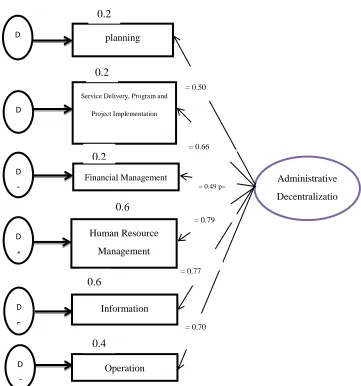
The results of confirmatory factor analysis test are represented using structural equation model in figure (4).
© 2015 AESS Publications. All Rights Reserved. 496 Administrative Decentralizatio n planning D 1 Operation Maintenance D 6 Information Management D 5 = 0.50 p=0.021 λ Service Delivery, Program and
Project Implementation D 2
0.2
4
= 0.66 p=.009 λ = 0.77 p=.002 λ = 0.70 p=.005 λ0.2
5
Financial Management D3 = 0.49 p=
.034 λ
0.2
4
Human Resource Management D 4 = 0.79 p=.003 λ0.6
3
0.6
0
0.4
8
Figure-4. Result of confirmatory factor analysis test
6.4. Goodness of Fit Indices of Administrative Decentralization Model 6.4.1. The Analysis of CMIN Index
Table-3. CMIN Index
Model NPAR CMIN DF P CMIN/DF
Default model 48 28.097 183 1.000 .154
Saturated model 231 .000 0
Independence model 21 262.311 210 .008 1.249
Table (3) represents absolute fit Index of Chi-square. Considering meaningful P value for the given model in this indicator which has to be more than 0.05 (sig>0.05) and based on table (3) and P=1.000, we conclude that the structure of matrix covariance of the model is not meaningfully
different with the observed matrix. Confirming (H0) hypothecs, , the model of qualitative
© 2015 AESS Publications. All Rights Reserved. 497 6.5. Analyzing the Results of Comparative Fit Indices
Table-4. Comparative fit Indices
Model NFI
Delta1 RFI rho1
IFI Delta2
TLI
rho2 CFI
Default model .993 .977 2.953 4.398 1.000
Saturated model 1.000 1.000 1.000
Independence model .000 .000 .000 .000 .000
According to table (4), because the amount of NFI Delta 1, RFI rho1, IFI Delta 2, TLI rho2 and CFI Indices are more than 0.9, they represent the goodness of fit of the model.
6.6. Analyzing Parsimonious Fit Indices
Table-5. Parsimonious fit Indices
Model PRATIO PNFI PCFI
Default model .871 .778 .871
Saturated model .000 .000 .000
Independence model 1.000 .000 .000
When PNFI and PCFI amounts are more than 0.6, they represent the acceptability of the model. According to table (5), these numbers for the given model are more than 0.6, which represents the acceptability of the given model.
6.7. Analyzing RMSEA Index
Table-6. RMSEA Index
Model RMSEA LO 90 HI 90 PCLOSE
Default model .000 .000 .000 1.000
Saturated model .112 .060 .153 .031
According to this index, acceptable models are 0.05 or lower for this indicator. The fit of some models with higher amounts than 0.1 is weak. If the amount of PCLOSE is more than 0.05, it is concluded that the prepared model is more closed to an acceptable model. So, according to table (6) and the numbers of the given model, our model is acceptable in this study.
7. DISCUSSION
© 2015 AESS Publications. All Rights Reserved. 498
were confirmed by other researchers in the previous studies in relation to administrative decentralization.
7.1. Planning
Decentralization in Planning can, thus, be defined as a type of planning where localorganizations and institutions formulate, adopt, execute actions and supervise theplan without interference by the central body (Mohapatra, 2003). Findings of this study to detect indicators of decentralization in planning are consistent with Silverman Jerry (1992), Bossert and Beauvais (2002) and Mohapatra (2003) findings in qualitative phase. They mentioned two indicators of policy formulation and program and project design for decentralization in planning in public organizations. The results of quantitative phase are represented in figure (4) and they show that the factor loading of decentralization in planning equals 0.52 and squared multiple correlation equals 0.27. Because factor loading (λ=0.52) is more than 0.4, it represents the accuracy of exploring indicators of this dimension and the consistency of planning with administrative decentralization.
7.2. Service Delivery, Programs/Projects Implementation
Decentralization in service delivery programs and projects implementation includes delegating authority to local organizations, service delivery and determining the policy of programs and projects implementation in local level (Mitchinson, 2003). The findings of this study in qualitative phase to explore indicators of programs and projects implementation dimension and in the cases of defining service and project, targeting service delivery and user participation are consistent with
Cohen and Peterson (1999)findings and in the cases of monitoring and oversight of service delivery, project implementation, setting norms and regulation and managing contracts are consistent with Bossert and Beauvais (2002), findings. The results of quantitative phase are represented in figure (4) and they show that factor loading of decentralization dimension in programs and projects implementation and service delivery equals 0.68 and squared multiple correlations equals 0.47. According to this fact that factor loading (λ=0.66) is more than 0.4, it represents the accuracy of exploration and the consistency of indicators of this dimension.
7.3. Financial Management
© 2015 AESS Publications. All Rights Reserved. 499 7.4. Human Resources Management
Decentralization in human resources management includes delegating authority to implement organizational directed activities for staffing, keeping and improving the effective workforce Evans and Manning (2004). The findings of this qualitative phase are consistent with the findings of
Evans and Manning (2004)and Hutchinson (1998). The findings of this study are represented in figure (4) and they show that factor loading of decentralization dimension in human resources management to make administrative decentralization equals 0.79 and squared multiple correlations equals 0.59. According to this fact that factor loading (λ=0.79) is more than 0.4, it shows the accuracy and consistency of the indicators of this dimension with administrative decentralization.
7.5. Information Management
Decentralization in information management includes delegating authority to local organizations to provide and analyze scientific, technical, local, time and situational information
(Cohen and Peterson, 1999). The findings of this study in qualitative phase to detect indicators of this dimension are consistent with Bossert and Beauvais (2002) and Cohen and Peterson (1999)findings. The findings of quantitative phase of this study are represented in figure (4) and they show that factor loading of decentralization dimension in information management to make administrative decentralization equals 0.79 and squared multiple correlations equals 0.62. According to this fact that factor loading (λ=0.77) is more than 0.4, it shows the accuracy and consistency in exploring indicators of this dimension.
7.6. Operation and Maintenance
Decentralization in operation maintenance includes delegating authority to local organizations in the final assessment, the success of project implementation and projects‘ efficiency and effectivity in the long term (Silverman Jerry, 1992). The findings of this study in qualitative phase to explore indicators of decentralization dimension in operation maintenance are consistent with
Silverman Jerry (1992) and Litvack and Bird (1998) findings. The results of quantitative phase are represented in figure (4) and it shows that factor loading of decentralization in operation maintenance equals 0.69 and squared multiple correlations equals 0.48. According to this fact that factor loading (λ=0.70) of this dimension is more than 0.4, it shows the accuracy and consistency of the indicators of this dimension.
In this study, a questionnaire by author was used to collect data. In order to determine the reliability of this questionnaire, Alpha Cronbach test was used. According to the results of table (2), the Cronbach Alpha of the proposed questions for each dimension of administrative decentralization which is more than 0.7 represents the suitable reliability of the questionnaire by author. In order to study the validity of the questionnaire, comparative fit indicators of decentralization model were examined. According to table (4), in which GFI and CFI is more than 0.9, it shows the suitable validity of the questionnaire by author.
© 2015 AESS Publications. All Rights Reserved. 500
codes and categories of administrative decentralization were formed. Another advantage of this study is that it could be a chance for making a theoretical model of administrative decentralization. Another characteristic of this study is the participation of university elites and managers whose ideas were a confirmation for the made codes and categories, such that there would be a scientific definition for the stated categories in administrative decentralization and in the literature of public management. In relation to proposed questions for managers in the field of decentralization constraints in public organizations, they enumerated the following factors as the main constraints: 1. Top managers‘ reluctance to delegate power
2. Legal limitations
3. Ignoring staff abilities within provincial level 4. Non-development of decentralization culture
5. Weak organizational foundations in regions for decentralization 6. Inadequate social maturity of managers
7. Top managers‘ inability to implement decentralization process 8. Managers‘ personal ideas about decentralization
9. Serious administrative bureaucracy in public organizations
10. The absence of specialist staff in subordinate units of local organizations 11. Legal problems in the fields of budgeting and expenditures
12. The governments‘ propensity to maintain its power on resources and decision makings 13. Negative attitude of policy makers toward decentralization
The limitations of this study were the limited access to executing and top managers of public organizations to interview and a large amount of time devoted to their interviews and we had to hold a number of interview sessions with these managers. Perhaps the resulting model couldn‘t be generalized highly and this issue is not the main goal of this study.
8. ASSESSING FUTURE RESEARCH NEEDS
© 2015 AESS Publications. All Rights Reserved. 501
REFERENCES
Bardhan, P. and M. Dilip, 2006. Decentralization and local governance in developing countries. Cambridge,
MA: MIT Press.
Blunt, P. and M. Turner, 2005. Decentralisation, democracy and development in a post-conflict society:
Commune councils in Cambodia. Public Administration and Development, 25(1): 75-87.
Bossert, T. and J. Beauvais, 2002. Decentralization of health systems in Ghana, Zambia, Uganda and the
Philippines: A comparative analysis of decision space. Health Policy and Planning, 17(1): 14-31.
Charmaz, K., 2008. Constructionism and the grounded theory method. In J. A. Holestein & J. F. Gubrium
(Eds). Constructionism and the grounded theory. Handbook of constructionist research. New York:
The Guilford Press. pp: 397-412.
Cheema Shabbir, G. and A. Rondinelli Dennis, 2007. Decentralizing governance emerging concepts and
practices. Washington, D.C.: Harvard University Press.
Cohen, J.M. and S.B. Peterson, 1999. Administrative decentralization: Strategies for developing countries.
New York: Kumarian Press.
Colomer, J.M., 1998. The Spanish State of autonomies: Non-institutional federalism., West European Politics,
21(4): 577-579.
Creswell, J.W. and V.L. Plano Clark, 2006. Designing and conducting mixed methods research. Thousand
Oaks, CA: Sage.
Crozier, M. and R.A. Dahl, 1982. Dilemmas of pluralist democracy. New Haven: Yale University Press.
De Vos, A.S., H. Strydom, C.B. Fouche and C.S.L. Delport, 2002. Research at grass roots: For the social
sciences and human services professions. Pretoria: Published by Van Schaik Publishers.
Denzin Norman, K. and S. Lincoln Yvonna, 2005. The Sage handbook of qualitative research. 3rd Edn.,
Thousand Oaks, CA: Sage. ISBN 0-7619-2757-3.
Dey, I., 2004. Grounded theory. In C. Seale, G. Gobo,J. F.Gubrium, & D. Silverman (Eds.), Qualitative
research practice. London: Sage. pp: 80–93.
Europe Aid Cooperation Office, 2009. Supporting decentralization and local governance in third countries.
Available from
http://www.eeas.europa.eu/delegations/swaziland/documents/eu_swaziland/supporting_decentralisat
ion_and_local_governance_in_third_countries_january_2007.pdf.
Evans, A. and N. Manning, 2004. Administrative decentralization: A review of staffing practices during
decentralization in eight countries. Prepared for the World Bank. Available from http://
www.gsdrc.org/go/display&type=Document&id=3380.
Glaser Barney, G. and L. Strauss Anselm, 1967. The discovery of grounded theory: Strategies for qualitative
research. New York: Aldinede Gruyter.
Herbest, J., 1993. The politics of reform in Ghana, 1982-1991. Berkeley, CA: University of California Press.
utchinson, P., 1998. Decentralization in Uganda s health sector. April 1998, draft. Uganda: orld Bank.
Kline, R.B., 2010. Principles and practice of structural equation modeling. 3rd Edn., New York: Guilford
Press.
Litvack, J. and R. Bird, 1998. Rethinking decentralization in developing countries. Washington, DC: The
© 2015 AESS Publications. All Rights Reserved. 502 Mitchinson, R., 2003. Devolution in Uganda: An experiment in local service delivery. Public Administration
and Development, 23(3): 241–248.
Mohapatra, P.K., 2003. Decentralized planning: A training module (DLM) for group E & F functionaries.
New York: UNDP Press.
Peteri, G., 2002. Mastering decentralization and public administration reforms in central and Eastern Europe.
Local government and public service reform initiative. Budapest: Open Society Institute.
Preedy, V.R. and R.R. Watson, 2009. Handbook of disease burdens and quality of life measures. New York:
Springer.
Silverman Jerry, M., 1992. Public sector decentralization: Economic policy and sector investment programs.
Technical Paper No.188. Africa technical department series. Washington, DC: World Bank.
Stillman Richard, J., 1991. Preface to public administration: A search for themes and direction. New York: St.
Martin‘s Press. pp: 19.
Strauss, A. and J. Corbin, 1998. Basics of qualitative research: Grounded theory procedures and techniques.
2nd Edn., Thousand Oaks, CA: Sage.
Treisman, D., 2002. Decentralization and the quality of government. Available from
http://www.sscnet.ucla.edu/polisci/faculty/treisman/Papers/DecandGovt.pdf.
United Nations Capital Development Fund, 2006. Delivering the goods: Building local government capacity
to achieve the millennium development goals. New York: UNCDF.
United Nations Department for Economic and Social Affairs, 2005. Participatory planning and budgeting at
the subnational level. New York: UNDESA.
United Nations Development Program, 2000. The undp role in decentralization and local governance. A Joint
Undp–Government of Germany Evaluation. Available from
http://web.undp.org/evaluation/documents/decentralization_final_Report.PDF.
United Nations Development Program, 2002. The role of participation and partnership in decentralised
governance: A brief synthesis of policy lessons and recommendations of nine country case stuides
on service delivery for the poor. New York: UNDP.
United Nations Development Program, 2004. Decentralized governance for development: A combined
practice note on decentralization, local governance and urban/rural development. Available from
http://www.undp.org/content/dam/aplaws/publication/en/publications/democratic-governance/dg-publications-for-website/DLGUD_PN_English.pdf.
United State Agency For International Development, 2009. Democratic decentralization programming
handbook. Available from
http://capacity4dev.ec.europa.eu/system/files/file/19/07/2011_-_0957/8usaid_decentralisation_programming_handbook.pdf.
Wampler, B. and L. Avritzer, 2004. Participatory publics: Civil society and vew institutions in democratic
Brazil. Comparative Politics, 36(3): 291-312.