Reactive Garbling:
Foundation, Instantiation, Application
Jesper Buus Nielsen? and Samuel Ranellucci
Aarhus University
Abstract. Garbled circuits is a cryptographic technique, which has been used among other things for the construction of two and three-party secure computation, private function evaluation and secure out-sourcing. Garbling schemes is a primitive which formalizes the syntax and security properties of garbled circuits. We define a generalization of garbling schemes calledreactive garbling schemes. We consider functions and garbled functions taking multiple inputs and giving multiple out-puts. Two garbled functions can be linked together: an encoded output of one garbled function can be transformed into an encoded input of the other garbled function without communication between the parties. Re-active garbling schemes also allow partial evaluation of garbled functions even when only some of the encoded inputs are provided. It is possible to further evaluate the linked garbled functions when more garbled in-puts become available. It is also possible to later garble more functions and link them to the ongoing garbled evaluation. We provide rigorous definitions for reactive garbling schemes. We define a new notion of secu-rity for reactive garbling schemes called confidentiality. We provide both simulation based and indistinguishability based notions of security. We also show that the simulation based notion of security implies the indis-tinguishability based notion of security. We present an instantiation of reactive garbling schemes. We present an application of reactive garbling schemes to reactive two-party computation secure against a malicious, static adversary. We demonstrate how garbling schemes can be used to give abstract black-box descriptions and proof of several advanced ap-plications of garbled circuits in the literature, including Minilego and Lindell’s forge-and-lose technique.
1
Introduction
Garbled circuits is a technique originating in the work of Yao and later for-malised by Bellare, Hoang and Rogaway [3], who introduced the notion of a garbling scheme along with an instantiation. Garbling schemes have found a wide range of applications. However, many of these applications are using spe-cific constructions of garbled circuits instead of the abstract notion of a garbling scheme. One possible explanation is that the notion of a garbling scheme falls short of capturing many of the current uses. In the notion of a garbling scheme,
?
the constructed garbled function can only be used for a single evaluation and the garbled function has no further use. In contrast, many of the most interesting current applications of garbled circuits have a more granular look at garbling, where several components are garbled, dynamically glued together and possibly evaluated at different points in time. We now give a few examples of this.
In the standard cut-and-choose paradigm for two-party computation, Alice sendsscopies of a garbled function to Bob. Half of the garblings (chosen by Bob) are opened to check that they were correctly constructed. This guarantees that the majority of the remaining instances were correctly constructed. Alice and Bob then use the remaining garblings for evaluation. Bob takes the majority output of these evaluations as his output. Although conceptually simple, this introduces a number of problems: Bob must ensure that Alice uses consistent inputs. It is also required that the probability that Bob aborts does not depend on his choice of input. Previous protocols solve these problems by doing white-box modifications of the underlying garbling scheme. We will show how to solve these problems by using reactive garbling schemes in a black-box manner.
In [20], Lindell presents a very efficient protocol for achieving active secure two-party computation from garbled circuits. In the scheme of Lindell, first s circuits are sent. Then a random subset of them are opened up to test that they were correctly constructed and the rest, the so-called evaluation circuits, are then evaluated in parallel. If the evaluations don’t all give the same output, then the evaluator can construct a certificate of cheating which can be fed into a small corrective garbled circuit. Another example is a technique introduced simultane-ously by Krater, shelat and Shen [18] and Frederiksen, Jakobsen and Nielsen [7], where a part of the circuit which checks the so-called input consistency of one of the parties is constructedafter the main garbled circuit has been constructed andafter Alice has given her input. We use a similar technique in our example application, showing that this trick can be applied to (reactive) garbling schemes in general. Another example is the work of Huang, Katz, Kolesnikov, Kumaresan and Malozemoff [16] on amortising garbled circuits, where one of the analytic challenges is a setting where many circuits are garbled prior to inputs being given. Our security notion allows this behaviour and this part of their protocol could therefore be cast as using a general (reactive) garbling scheme. Another example is the work of Huang, Evans, Katz and Malka [15] on fast secure two-party computation using garbled circuits, where they use pipelining: the circuit is garbled and evaluated in blocks for efficiency. Finally, we remark that some-times the issue of garbling many circuits and gluing them together and having them interact with other security components can also lead to subtle insecurity problems, as demonstrated by the notion of a garbled RAM as introduced by Lu and Ostrovsky in [22], where the construction was later proven to be insecure by Gentry, Halevi, Lu, Ostrovsky, Raykova and Wichs [12]. We believe that having well founded abstract notions of partial garbling and gluing will make it harder to overlook security problems.
appli-cations and which will hopefully form a foundation for many future appliappli-cations of garbling schemes. Reactive garbling schemes generalize garbling schemes in several ways. First of all, we allow a garbled evaluation to save a state and use it in further computations. Specifically, when garbling a functionf one can link it to a previous garbling of some function g and as a result get a garbling of f ◦g. Even more, given two independent garblings off and g, it is possible to do a linking which will produce a garbling off◦gorg◦f. The linking depends only on the output encoding and input encoding of the linked garblings. We also allow garbling of a single function which allows partial evaluation and which al-lows dynamic input selection based on partial outputs. This can be mixed with linking, so that the choice of which functions to garble and link can be based on partial outputs. This can be important inreactive secure computation which allows inputs to arrive gradually and allows branching based on public partial outputs. We introduce the syntax and security definitions for this notion. We give an instantiation of reactive garbling schemes in the random oracle model. We also demonstrate the usefulness of reactive garbling schemes by giving various applications. We construct a reactive, maliciously UC secure two-party compu-tation protocol. We also describe Lindell’s reduced circuit optimization by using reactive garbling schemes. These two constructions use reactive garbling schemes in a black-box manner. We also describe the minilego garbling procedure as a reactive garbling scheme.
1.1 Discussion and Motivation
In this section, we describe the purpose of our framework and why certain design choices were made for the framework in this paper.
One of the main goals of garbling schemes was to define a primitive that would be used in constructions without relying on the underlying instantiation. Unfortunately, most secure two-party computation protocols still rely on garbled circuits to provide security. In some sense, the notion of garbling schemes is not able to achieve this goal for the given task. One way of thinking of our result is to note that many techniques that previously only worked for garbled circuits, now work for reactive garbling schemes.
More precisely, to achieve reactive secure computation, the protocol for re-active computation shows how three issues which typically are solved using the underlying instantiation of garbled circuits in cut-and-choose protocols can be solved using reactive garbling schemes. These issues are Alice’s input consistency, selective failure attacks and how to run the simulator against a corrupted Bob. We solve these three issues by using the notion of reactive garbling schemes. This means that many protocols in the literature can easily be modified to achieve security by only relying on the properties of reactive garbling schemes.
Output encodings are important for many reasons. First, it provides a method for defining linking. Roughly because of this notion, it is easy to define a linking as information which allows an encoded output to be converted into an encoded input. Secondly, in certain cases, constructions based on garbling schemes require a special property of the encoded output which otherwise cannot be described. This is the case of [13] where the encoded input has to be the same size as the encoded output. It is also useful for output reuse, covers pipelining and has applications to protocols where the receiver can use a proof of cheating to extract the sender’s input.
We included partial evaluation for two main reasons, first we consider that it can be an important feature for reactive computation, secure outsourcing and secure computation where a partial output would be valuable. A partial output could be used to determine what future computation to run on data. In addition, we could garble blocks of functions and decide to link certain blocks together based on partial outputs.
In addition, many schemes in the literature inherently allow partial evalu-ation and not allowing partial evaluevalu-ation imposes artificial restrictions on the constructions. For example, fine-grained privacy in [2] cannot be realized by standard schemes precisely because those schemes give out partial outputs.
1.2 Recasting Previous Constructions
The concept of using output encoding and linking has been implicitly used in many previous works. In particular, in cut-and-choose protocols, it has been used in [6,7,19,25] to enforce sender input consistency (ensure that the sender uses the same input in each instance) and to prevent selective failure attacks (an attack that works by having the probability that the receiver aborts depend on his choice of input). These concepts have also been used for different optimizations. Pipelining [15,18] and output reuse [13,23] are examples of direct optimizations. Linking has also been employed to reduce the number of circuits that need to be sent in protocols that apply cut-and-choose at the circuit level [5,20]. This is done by adding a phase where a receiver can extract the input of a cheating sender. Another example is gate soldering [8,24]. This technique works by employing cut-and-choose at the gate level. The gates are then randomly split among different buckets and soldered together. This optimization reduces the replication factor for a security (s) to ( s
log(n)) wheren is the number of non-xor gates. There are many applications that benefit from output encoding and linking in garbling schemes. In addition, if we allow sequences where the input is chosen as a function of the garbling, reactive garbling schemes are also adaptive. The constructions of [14,11] require adaptive garbling.
1.3 Structure of the paper
of a reactive garbling scheme. In Section 4.1, we give a full description of the reactive garbling scheme. In Section 5, we give an intuitive description of the reactive two-party computation protocol based on reactive garbling schemes. In Section 5.1, we provide a full description of the reactive two-party computation protocol. We note that the techniques that we introduce in section 5 can be applied to previous secure two-party computation protocol to convert them into constructions that only use reactive garbling schemes in a black-box manner.
In Appendix A, we prove that our reactive computation protocol is secure. In Appendix B, we prove security of our reactive garbling scheme using the in-distinguishability based notion of security. In Appendix C, we recast Lindell’s construction using reactive garbling schemes. In Appendix D, we describe Mini-lego’s garbling and soldering as a reactive garbling scheme. In Appendix F, we prove security of our garbling scheme using the simulation based definition of confidentiality. We also show that simulation based definition implies the indis-tinguishability based definition of security.
2
Preliminaries
LetN be the set of natural numbers. Forn∈N, let{0,1}n be the set of n-bit strings. Let{0,1}∗= ∪
n∈N
{0,1}n. We use>and⊥as the syntax fortrueandfalse and we assume that >,⊥ 6∈ {0,1}∗. We use () to denote the empty sequence.
For a sequenceσ, we use x∈ σto denote that x is in the sequence. When we iterate overx∈σin a for-loop, we do it from left to right. For a sequenceσand an elementxwe useσkxto denote that we appendxtoσ. We usek to denote concatenation of sequences. When unambiguous, we also use juxtaposition for concatenating and appending. We use x←$ X to denote sampling a uniformly random xfrom a finite set X. We use [A] to denote the possible legal outputs of an algorithmA. This is just the set of possible outputs, with⊥removed.
ruleExample
on(7, x1)fromA
onx2 fromB
x←() x←xkx1kx2
z←0
fory∈(1,2,4)do if z≥ythen abort z←z+y
sendxtoA
Fig. 1.A rule We prove security of protocols in the UC
framework and we assume that the reader is familiar with the framework. When we spec-ify entities for the UC framework, ideal func-tionalities, parties in protocol, adversaries and simulators we give them by a set of rules of the form Example (which sends (x1, x2) to the adversary in its last line). In Figure 1, we give an an example of a rule. A line of the form “sendmto F.R”, whereF is another entity and R the name of a rule, the entity will send (R, id, m) toF, whereidis a unique identifier of the rule that is sending, including the session and sub-session identifier, in case many copies of the same rule are currently in
that the real input has been removed. When a message of the form (R, id, m) arrives from an entity A, the receiver stores (R,A, id, m) in a pool of pending messages and turns the activation over to the adversary. A line of the form “onP
fromA” executed in a rule namedRrunning with identifieridand whereP is a pattern, is executed as follows. The entity executing the rule stores (R,A, id, P) in a pool of pending receives and turns over the activation to the adversary. We say that a pending message (R,A, id, m) matches pending receive (R,A, id, P) ifmcan be parsed on the formP. Whenever an entity turns over the activation to the adversary it sends along (R,A, id,?) for all matched (R,A, id, P), where ? is just a special reserved bit-string. There is a special procedure Initialize which is executed once, when the entity is created. All other rules begin with an on-command. The rule is considered ready for id if the first line is of the form “on P from A” and (R,A, id, P) is matched and the rule was never exe-cuted with identifierid. In that case (R,A, id, P) is considered to be in the set of pending receives. If the adversary sends (R,A, id,?) to an entity that has some pending receive (R,A, id, P) matched by some pending message (R,A, id, m), then the entity parses m using P and starts executing right after the line “on
P from A” which added (R,A, id, P) to the list of pending receives. A line of the form “awaitP” whereP is a predicate on the state of the entity works like the on-command. The line turns activation over to the adversary along with an identifier, and the entity will report to the adversary which predicates have become true. The adversary can instruct the entity to resume execution right after any “awaitP” whereP is true on the state of the entity. If an entity exe-cutes a rule which terminates, it turns the activation over to the adversary. The keywordabortmakes an entity terminate and ignore all future inputs. A line of the form “verifyP” makes the entity abort ifP is not true on the state of the entity. We useA to denote the adversary andZ to denote the environment. A line of the form “onP” is equivalent to “onP fromZ”. When specifying ideal functionalities we useCorruptto denote the set of corrupted parties.
We define security of cryptographic schemes via code-based games [4]. The game is given by a set of procedures. There is a special procedure Initialize which is called once, as the first call. There is another special procedureFinalize which may be called by the adversary. The output is true or false, > or ⊥, where > indicates that the adversary won the game. In between Initialize
andFinalize, the adversary might call the other procedures at will. The other procedures might also output ⊥or > at which point the game ends with that output. Other outputs go back to the adversary.
3
Syntax and Security of Reactive Garbling Schemes
Next, we will define the syntax of a reactive garbling scheme in the same way that a garbling scheme was described before. We will describe tags, a way of as-signing identities to garbled functions, so that we can refer to them later. We will then describe different algorithms: how to encode inputs, decode outputs, link garblings together and other algorithms. Next, we will define correctness. The work of [3] defined the notion of correctness by comparing it to a plaintext evaluation. We define the notion of garbling sequences which is the equivalent of plaintext evaluation but for reactive garbling. Some garbling sequences don’t make sense, for example producing an encoded input for a function that has not been defined. As a result, we will define the concept of legal garbling sequences to avoid sequences that are nonsensical. Finally, we can define correctness by comparing the plaintext evaluation of a garbling sequence with the evaluation of a garbling sequence by applying the algorithms define before. We then use the notion of garbling sequence to define the side-information function for reac-tive garbling. This is necessary to describe our notion of security which we call confidentiality.
Gradual Functions We first define the notion of a gradual function. A gradual function is an extension of the usual notion of a function f :A1× · · · ×An → B1× · · · ×Bm, where we allow to partially evaluate the function on a subset of the input components. Some output components might become available before all input components have arrived. We require that when an output component has become available, it cannot become unavailable or change as more input components arrive. We also require that the set of available outputs depends only on which inputs are ready, not on the exact value of the inputs. In our framework, we only allow garblings of gradual functions. This allows us to define partial evaluation and to avoid issues such as circular evaluation and determining when outputs are defined. These issues would make our framework more complex. The access function will be the function describing which outputs are available when a given set of inputs is ready. We will use⊥to denote that an input is not yet specified and that an output is not yet available. We therefore require that ⊥ is not a usual input or output of the function. We now formalize these notions. For a functionf :A1× · · · ×An→B1× · · · ×Bmwe use the following notation. f.n := n and f.m := m, f.A := A1× · · · ×An, f.B := B1× · · · ×Bm, and f.Ai:=Ai andf.Bi :=Bi.
Definition 1. We use component to denote a setC ={0,1}`∪ {⊥} for some ` ∈N, where ⊥ 6∈ {0,1}∗. We call ` the length of C and we write len(C) =`.
Let C1, . . . , Cn be components and letx0, x∈C1× · · · ×Cn.
– We say thatx0 is an extension of x, written x@x0 if xi 6=⊥implies that xi=x0i fori= 1, . . . , n.
– We say thatxand x0 are equivalently undefined, written x ./ x0, if for all
i= 1, . . . , n it holds thatxi=⊥iffx0i=⊥.
Definition 2 (Gradual Function).LetA1, . . . , An, B1, . . . , Bmbe components
and let f :A1× · · · ×An→B1× · · · ×Bm. We say thatf is a gradual function
– It is monotoneif for all x, x0 ∈A1× · · · ×Am it holds that x@x0 implies
thatf(x)@f(x0).
– It is variable definedifx ./ x0 thenf(x)./ f(x0).
We say that an algorithm computes a gradual function f : A1× · · · ×An → B1× · · · ×Bm if on all inputs x∈A1× · · · ×Am it accepts with output f(x) and on all other inputs it rejects. We define a notion of access function which specifies which outputs components will be available given that a given subset of input components are available.
Definition 3 (Access Function). The access function of a gradual function
f :A1× · · · ×An→B1× · · · ×Bmis a functionaccess(f) :{⊥,>}n → {⊥,>}m
defined as follows. For j = 1, . . . , m, let qj : Bj → {⊥,>} be the function
where qj(⊥) =⊥ and qj(y) => otherwise. Let q: B1× · · · ×Bm→ {⊥,>}m
be the function (y1, . . . , ym) 7→ (q1(y1), . . . , qm(ym)). For i = 1, . . . , n, let pi : {⊥,>} → Ai be the function with pi(⊥) = ⊥ and pi(>) = 0len(Ai). Let p : {⊥,>}n → A
1× · · · ×An be the function (x1, . . . , xn)7→(p1(x1), . . . , pn(xn)).
Thenaccess(f) =q◦f ◦p.
Definition 4 (Gradual functional similarity).Letf,gbe gradual functions. We say that f is similar to g (f ∼ g) if f.n = g.n, f.m = g.m, f.A = g.A,
f.B=g.B andaccess(f) =access(g).
In the following, if we use a function at a place where a gradual function is expected and nothing else is explicitly mentioned, we extend it to be a gradual function by adding⊥to all input and output components and letting all outputs be undefined until all inputs are defined.
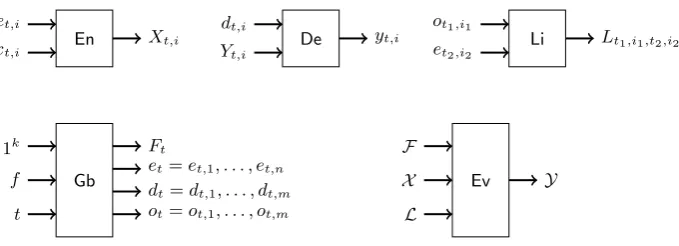
Syntax of Algorithms A reactive garbling scheme consists of seven algorithms G = (St,Gb,En,li,Ev,ev,De). The algorithms St, Gb and Li are randomized and the other algorithms are deterministic. Gradual functions are described by stringsf. We callf theoriginal gradual function. For each such description, we require thatev(f,·) computes some gradual functionev(f,·) :A1× · · · ×An → B1× · · · ×Bm. This is the function that f describes. We often use f also to denote the gradual function ev(f,·).
– On input of a security parameterk∈N, thesetup algorithmoutputs a pair of parameters (sps,pps)←St(1k), wheresps∈ {0,1}∗ is thesecret parameters
and pps ∈ {0,1}∗ is the public parameters. All other algorithms will also
receive 1k as their first input, but we will stop writing that explicitly.
– On input f, a tag1 t ∈ {0,1}∗ and the secret parameters sps the garbling algorithmGbproduces as output a quadruple of strings (F, e, o, d), whereFis thegarbled function,eis theinput encoding function,dis theoutput decoding function, which is of the formd= (d1, . . . , dm), andois theoutput encoding
function. When (F, e, o, d)←Gb(sps, f, t) we useFtto denoteF, we usedt,i
1 Some of the algorithms will take as input values output by other algorithms. To
to denote the ith entry of d, and similarly for the other components. This naming is unique by thefunction-tag uniqueness andgarble-tag uniqueness
conditions described later.
– Theencoding algorithmEntakes input (e, t, i, x) and producesencoded input
Xt,i.
– Thelinking algorithm li takes input of the form (t1, i1, t2, i2, o, e) and pro-duces an outputLt1,i1,t2,i2 called theencoded linking information. Think of
this as information which allows to take an encoded output Yt1,i1 for Ft1
and turn it into an encoded inputXt2,i2 forFt2. In other words, we link the
output wire with indexi1of the garbling with tagt1to the input wire with indexi2 of the garbling with tagt2.
– Thegarbled evaluation algorithm Ev takes as input a set F of pairs (t, Ft) wheretis a tag andFta garbled function (letT be the set of tagstoccurring inF), a setX of triples (t, i, Xt,i) wheret∈T,i∈[Ft.n] andXi,j6=⊥is an encoded input, and a setL of tuples (t1, i1, t2, i2, Lt1,i1,t2,i2) witht1, t2 ∈T
and i1 ∈ [Ft1.m] and i2 ∈ [Ft2.n] and Lt1,i1,t2,i2 6= ⊥ an encoded linking
information. It outputs a setY ={(t, i, Yt,i)}t∈T ,i∈[Ft.m], where eachYt,i is
anencoded output. It might be thatYt,i =⊥if the corresponding output is not ready.
– Thedecoding algorithmtakes input (t, i, dt,i, Yt,i), and produces afinal output
yt,i. We require thatDe(·,·,·,⊥) =⊥. The reason for this is thatYt,i =⊥ is used to signal that the encoded output cannot be computed yet, and we want this to decode to yt,i =⊥. We extend the decoding algorithm to work on sets of decoding functions and sets of encoded outputs, by simply decoding each encoded output for which the corresponding output decoding function is given, as follows. For a setδ, called theoverall decoding function, consisting of triples of the form (t, i, dt,i), and a setY of triples of the form (t, i, Yt,i), we let De(δ,Y) output the set of (t, i,De(t, i, dt,i, Yt,i)) for which (t, i, dt,i)∈δand (t, i, Yt,i)∈ Y.
En De Li
Gb Ev
et,i
xt,i
Xt,i
dt,i
Yt,i
yt,i
ot1,i1
et2,i2
Lt1,i1,t2,i2
1k
f
t
Ft
et=et,1, . . . , et,n
dt=dt,1, . . . , dt,m
ot=ot,1, . . . , ot,m
F
X
L
Y
Fig. 2.Input-output behaviour of the central algorithms of a reactive garbling scheme.
Basic requirements We require that f.n and f.m can be computed in linear
be computed in linear time for i = 1, . . . , n andj = 1, . . . , m. We require that the same numbers can be computed in linear time from any garbling F of f. We finally require that one can compute access(f) in polynomial time given a garblingF off. We do not impose the length condition and the non-degeneracy condition from [3], i.e., e and d might depend on f. Our security definitions ensure that the dependency does not leak unwarranted information.
Projective Schemes Following [3], we call a scheme projective (on input compo-nent i) if all X ∈ {En(e, t, i, x)|x∈ {0,1}n } are of the form {X
1,0, X1,1} × . . .× {Xc,0, Xc,1}, wherec = len(f.Xi), andEn(e, t, i, x) = (X1,x[1], ..., Xc,x[c]). This should hold for all k, f, t, `, x ∈ {0,1}c and (sps,pps) ∈ [St(1k)] and (F, e, o, d) ∈ [Gb(sps, f, t, `)]. As in [3] being projective is defined only relative to the input encodings. One can define a similar notion for output decodings. Having projective output decodings is needed for capturing some applications using reactive garbling scheme, for instance [20].
Correctness To define correctness, we need a notion of calling the algorithms of a garbling scheme in a meaningful order. For this purpose, we define a notion of
garbling sequence σ. A garbling sequence is a sequence of garbling commands, each command has one of the following forms: (Func, f, t), (Link, t1, i1, t2, i2), (Input, t, i, x),
(Output, t, i), (Garble, t). In the rest of the paper, we will useσto refer to a garbling
sequence. A garbling sequence is calledlegal if the following conditions hold.
Function uniqueness σ does not contain distinct commands (Func, f1, t) and (Func, f2, t).
Garble uniqueness Each command (Garble, t) occurs at most once in σ. Garble legality If (Garble, t) occurs inσ, it is preceded by (Func,·, t).
Linkage legality If the command (Link, t1, i1, t2, i2) occurs inσ, then the com-mand is preceded by comcom-mands of the forms (Func, f1, t1), (Garble, t1), (Func, f2, t2) and (Garble, t2), and 1≤i1≤f1.m, 1≤i2≤f2.nandf1.Bi1 =f2.Ai2.
Input legality If (Input, t, i, x) occurs in σ it is preceded by (Func, f, t) and
(Garble, f) andx∈f.Ai\ {⊥}.
Output legality If (Output, t, i) occurs in a sequence it is preceded by (Func, f, t)
and (Garble, t) and 1≤i≤f.m.
Note that if a sequence is legal, then so is any prefix of the sequence. We call a garbling sequence illegal if it is not legal. Since we allow to link several output components onto the same input component we have to deal with the case where they carry different values. We consider this an error, and to catch it, we use the following safe assignment operator.
(u←- v) :=
u←Error ifv=Error
u←u ifv=⊥
u←v ifu=⊥ ∨u=v
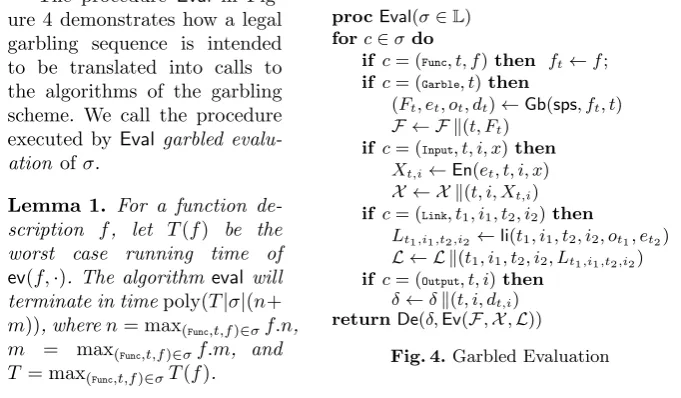
proceval(σ∈L)
for(Func, t, f)∈σ,do
ft←f
fori= 1, . . . , ft.ndoxt,i← ⊥
forj= 1, . . . , ft.mdoyt,j← ⊥
for(Input, t, i, x)∈σdo xt,i←- x
T ← ∅
repeat U←T
for(Func, t, f)∈σdo
(yt,1, . . . , yt,ft.m)←ft(xt,1, . . . , xt,ft.n)
for(Link, t, i1, t2, i2)∈σdoxt2,i2 ←- yt,i1
T← {(t, i, yt,i)|t∈Tags(σ), i= 1, . . . , ft.m}
untilT =U∨(·,·,Error)∈T
returnT
Fig. 3.Plaintext evaluation We now define an
al-gorithmeval, which takes as input a legal garbling sequence σ and outputs a set of tuples (t, i, yt,i), one for each command (Output, t, i), where
possi-bly yt,i = ⊥. The val-ues are computed by tak-ing the least fix point of the evaluation of all the gradual functions, see Figure 3. We call this the
plain evaluation ofσ. We extend the definition of a legal sequence to include the requirement that
Input uniqueness (·,·,Error)6∈eval(σ).
Therefore the use of the safe assignment in eval is only to conveniently define the notion of legal sequence. In the rest of the paper we assume that all inputs toeval are legal. The valuesyt,i6=⊥are by definition the values that areready
in σ, i.e.,ready(σ) ={(t, i)|∃(t, i, yt,i)∈eval(σ)(yt,i 6=⊥)}. Note that since the gradual functions are variable defined, which outputs are ready does not depend on the values of the inputs, except via whether they are⊥or not.
procEval(σ∈L)
forc∈σdo
if c= (Func, t, f)then ft←f;
if c= (Garble, t)then
(Ft, et, ot, dt)←Gb(sps, ft, t) F ← F k(t, Ft)
if c= (Input, t, i, x)then
Xt,i←En(et, t, i, x) X ← X k(t, i, Xt,i)
if c= (Link, t1, i1, t2, i2)then
Lt1,i1,t2,i2 ←li(t1, i1, t2, i2, ot1, et2)
L ← L k(t1, i1, t2, i2, Lt1,i1,t2,i2)
if c= (Output, t, i)then
δ←δk(t, i, dt,i)
returnDe(δ,Ev(F,X,L)) Fig. 4.Garbled Evaluation The procedure Eval in
Fig-ure 4 demonstrates how a legal garbling sequence is intended to be translated into calls to the algorithms of the garbling scheme. We call the procedure executed by Evalgarbled evalu-ation ofσ.
Lemma 1. For a function
de-scription f, let T(f) be the worst case running time of ev(f,·). The algorithm eval will terminate in timepoly(T|σ|(n+ m)), wheren= max(Func,t,f)∈σf.n,
m = max(Func,t,f)∈σf.m, and T = max(Func,t,f)∈σT(f).
Side-Information Functions We use the same notion of side-information func-tions as in [3]. A side information functionΦmaps function descriptions f into the side information Φ=Φ(f)∈ {0,1}∗. Intuitively, a garbling off should not
leak more thanΦ(f). The exact meaning of the side information functions are given by our security definition. We extend a side information functionΦto the set of garbling sequences. For the empty sequenceσ= () we letΦ(σ) = ().
For a sequenceσ, we define the side-information asΦ(σ) :=Φσ(σ) where for a sequence ¯σand a commandc:Φσ(¯σkc) =Φσ(¯σ)kΦσ(c), whereΦσ(Func, t, f) =
(Func, t, Φ(f)),Φσ(Link, t1, i1, t2, i2) = (Link, t1, i1, t2, i2),Φσ(Input, t, i, x) = (Input, t, i,|x|),
Φσ(Garble, t) = (Garble, t) andΦσ(Output, t, i) = (Output, t, i, yt,i), whereyt,iis defined byeval(σ).
Legal Sequence Classes We define the notion of a legal sequence class L (rela-tive to a given side-information function Φ). It is a subset of the legal garbling sequences which additionally has these five properties:
Monotone Ifσ0kσ00∈L, thenσ0 ∈L.
Input independent Ifσ0k(Input, t, i, x)kσ00 ∈L, then σ0k(Input, t, i, x0)kσ00 ∈
Lfor allx0∈ {0,1}|x|.
Function independent Ifσ0k(Func, t, f)kσ00∈L, thenσ0k(Func, t, f0)kσ00∈L for allf withΦ(f0) =Φ(f).
Name invariant Ifσ∈L andσ0 isσwith all tags t replaced byt0 =π(t) for an injectionπ, then σ0∈L.
Efficient Finally, the languageLshould be in P, i.e., in polynomial time.
It is easy to see that the set of all legal garbling sequences is a legal sequence class.
Definition 5 (Correctness). For a legal sequence classL and a reactive gar-bling schemeGwe say thatGisL-correctif for allσ∈L, it holds thatDe(Eval(σ))⊆
eval(σ)for all choices of randomness by the randomized algorithms.
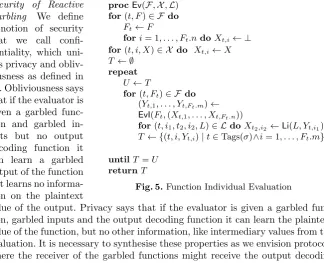
Function Individual Garbled Evaluation The garbled evaluation functionEvjust takes as input sets of garbled functions, inputs and linking information and then somehow produces a set of garbled outputs. It is often convenient to have more structure to the garbled evaluation than this.
We say that garbled evaluation isfunction individual if each garbled func-tion F is evaluated on its own. Specifically there exist deterministic poly-time algorithmsEvIandLicalled theindividual garbled evaluation algorithm and the
garbled linking algorithm. The input toEvIis a garbled function and some gar-bled inputs. For each fixed gargar-bled function F withn=F.nand m=F.mthe algorithm computes a gradual function EvI(F) : A1× · · · ×An → B1× · · · × Bm and (X1, . . . , Xn) 7→ EvI(F, X1, . . . , Xn), with access(EvI(F)) = access(f), where f is the function garbled byF. We denote the output by (Y1, . . . , Ym) =
EvI(F, X1, . . . , Xn). The intention is that the Yj are garbled outputs (or⊥). To say that Evhas individual garbling we then require that it is defined from EvI
procEv(F,X,L) for(t, F)∈ F do
Ft←F
fori= 1, . . . , Ft.ndoXt,i← ⊥
for(t, i, X)∈ X do Xt,i←X
T ← ∅
repeat U ←T
for(t, Ft)∈ F do
(Yt,1, . . . , Yt,Ft.m)←
EvI(Ft,(Xt,1, . . . , Xt,Ft.n))
for(t, i1, t2, i2, L)∈ LdoXt2,i2←Li(L, Yt,i1)
T ← {(t, i, Yt,i)|t∈Tags(σ)∧i= 1, . . . , Ft.m}
untilT =U returnT
Fig. 5.Function Individual Evaluation
Security of Reactive
Garbling We define
a notion of security that we call confi-dentiality, which uni-fies privacy and obliv-iousness as defined in [3]. Obliviousness says that if the evaluator is given a garbled func-tion and garbled in-puts but no output decoding function it can learn a garbled output of the function but learns no informa-tion on the plaintext
value of the output. Privacy says that if the evaluator is given a garbled func-tion, garbled inputs and the output decoding function it can learn the plaintext value of the function, but no other information, like intermediary values from the evaluation. It is necessary to synthesise these properties as we envision protocols where the receiver of the garbled functions might receive the output decoding function for some of the output components butnot all of them. Obliviousness does not cover this case, since the adversary has some of the decoding keys. It is not covered by privacy either, as the receiver should not gain any information about outputs for which he does not have a decoding function.
In the confidentiality (indistinguishability) game, the adversary feeds two se-quences σ0 and σ1 to the game, which produces a garbling of one of the two sequences, σb for a uniform bit b. The adversary wins if it can guess which sequence was garbled. It is required that the two sequences are not trivially distinguishable. For instance, the two commands at position i in the two se-quences should have the same type, the side information of functions at the same positions in the sequences should be the same, and all outputs produced by the sequences should be the same. This is formalized by requiring that the side information of the sequences are the same. This is done by checking that Φ(σ0) = Φ(σ1) in the rule Finalize. If one considers garbling sequences with only one function command, one garbling command, one input command per input component, no linking and where no output command is given, then con-fidentiality implies obliviousness. If in addition an output command is given for each output component, then confidentiality implies privacy.
the simulator and forwards any response to the adversary. We list this notion of security in appendix E.
In appendix F, we show that the simulation-based notion of confidentiality implies the indistinguishability-based notion of indistinguishability.
Definition 6 (Confidentiality). For a legal sequence classLrelative to side-information functionΦand a reactive garbling schemeG, we say thatGis(L, Φ)
-confidentialif for all PPTAit holds that AdvadpG, .ind.con
L0,Φ,A (1
k)is negligible, where
AdvadpG, .ind.con
L0,Φ,A (1k) = Pr[Game
adp.ind.con
G,L0,Φ,A (1k) = >]−12 and Game
adp.ind.con
G,L0,Φ is
given in Figure 6.
Notice that this security definition is indistinguishability based, which is known to be very weak in some cases for garbling (cf. [3]). Consider for instance garbling a functionf where the inputxis secret andy=f(x) is made a public output. The security definition then only makes a requirement on the garbling scheme in the case where the adversary inputs two sequences where in sequence one the input isx1and in sequence two the input isx2and wheref(x1) =f(x2). Consider then what happens if f is collision resistant. Since no adversary can compute such x1 and x2 where x1 6= x2, it follows that x1 = x2 in all pairs of sequences that the adversary can submit to the game. It can then be seen that it would be secure to “garble” collision resistant functions f by simply sending f in plaintext. Despite this weak definition, we later manage to prove that it is sufficient for building secure two-party computation. Looking ahead, when we need to securely compute f, we will garble a function f0 which takes an additional input pwhich is the same length as the output of f and where f0(x, p) =p⊕f(x) and ask the party that suppliespto always letpbe the all-zero string. Our techniques for ensuring active security in general is used to enforce that even a corrupted party does this. Correctness is thus preserved. Clearlyf0 is not collision resistant even if f is collision resistant. This prevents a secure garbling scheme from making insecure garblings of f0. In fact, note that this trick ensures thatf0 has the efficient invertibility property defined by [3], which means that the indistinguishability and simulation based security coincide.
4
Instantiating a Confidential Reactive Garbling Scheme
procInitialize() b←{$ 0,1}
σ0← ∅
σ1← ∅
procFunc(f0, f1, t)
forc∈ {0,1}do σc←σck(Func, fc, t)
if f06∼f1 then return⊥
procOutput(t, i) forc∈ {0,1}do σc←σck(Output, t, i)
returndt,i
procInput(t, i, x0, x1)
forc∈ {0,1}do σc←σck(Input, t, i, xc)
returnEn(et, t, i, xb)
procLink(t1, i1, t2, i2)
forc∈ {0,1}do
σc←σck(Link, t1, i1, t2, i2)
returnli(t1, i1, t2, i2, ot1,i1, et2,i2)
procFinalize(b0)
if b=b0∧Φ(σ0) =Φ(σ1)∧σ0∈L
then return>
else return⊥
procGarble(t)
forc∈ {0,1}doσc←σck(Garble, t)
(Ft, et, ot, dt)←Gb(sps, ft, t)
returnFt
Fig. 6.The gameGameadpG,L,Φ.ind.con(1 k
) definingadaptive indistinguishability confiden-tiality. InFinalizewe check thatσ0∈Land the adversary loses if this is not the case.
It is easy to see that whenLis a legal sequence class andΦ(σ0) =Φ(σ1), thenσ0∈Liff
σ1∈L. We can therefore by monotonicity assume that the game returns⊥as soon as
it happens thatσc6∈L. We use a number of notational conventions from above. Tags
are used to name objects relative toσc, which is assumed to be legal. As an example, in Garble(t), the functionft refers to the functionfc occurring in the command (Func, fc, t)
which was added toσcinFuncbyGarble Legality. For another example, thedt,iin
Output(t, i) refers to theithcomponent of thedtcomponent output byGb(sps, ft, t) in
the execution ofGarble(t, π) which must have been executed byOutput Legality.
in Section 4.1 and its proof of security in Appendix B. We use the RO because reactive garbling schemes run into many of the same subtle security problems as adaptive garbling schemes [2], which are conveniently handled by being able to program the RO. We leave as an open problem the construction of (efficient) reactive garbling schemes in the standard model.
4.1 A reactive garbling scheme
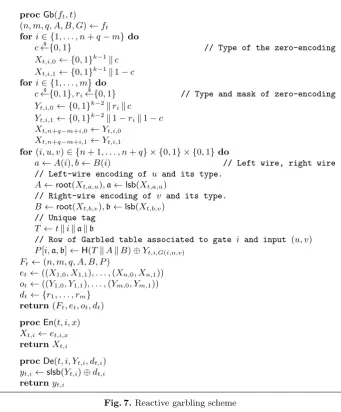
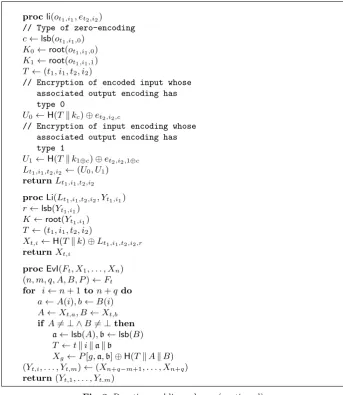
We will now give the details of the construction of a confidential reactive garbling scheme based on a random oracle. The protocol is inspired by the construction of garbling schemes from dual-key ciphers presented in [3]. The pseudocode for our reactive garbling scheme is shown in Figure 7 and Figure 8.
To simplify notation, we define lsb as the least significant bit, slsb as the second least significant bit. The operation Root removes the last two bits of a string. The symbolHdenotes the random oracle.
procGb(ft, t)
(n, m, q, A, B, G)←ft
fori∈ {1, . . . , n+q−m}do
c←{$ 0,1} // Type of the zero-encoding
Xt,i,0← {0,1}k−1kc
Xt,i,1← {0,1}k−1k1−c
fori∈ {1, . . . , m}do
c←{$ 0,1}, ri←{$ 0,1} // Type and mask of zero-encoding
Yt,i,0 ← {0,1}k−2krikc
Yt,i,1 ← {0,1}k−2k1−rik1−c
Xt,n+q−m+i,0←Yt,i,0
Xt,n+q−m+i,1←Yt,i,1
for(i, u, v)∈ {n+ 1, . . . , n+q} × {0,1} × {0,1}do
a←A(i), b←B(i) // Left wire, right wire
// Left-wire encoding of u and its type.
A←root(Xt,a,u),a←lsb(Xt,a,u)
// Right-wire encoding of v and its type.
B←root(Xt,b,v),b←lsb(Xt,b,v) // Unique tag
T ←tkikakb
// Row of Garbled table associated to gate i and input (u, v)
P[i,a,b]←H(TkAkB)⊕Yt,i,G(i,u,v)
Ft←(n, m, q, A, B, P)
et←((X1,0, X1,1), . . . ,(Xn,0, Xn,1))
ot←((Y1,0, Y1,1), . . . ,(Ym,0, Ym,1))
dt← {r1, . . . , rm}
return(Ft, et, ot, dt)
procEn(t, i, x) Xt,i←et,i,x
returnXt,i
procDe(t, i, Yt,i, dt,i)
yt,i←slsb(Yt,i)⊕dt,i
returnyt,i
Fig. 7.Reactive garbling scheme
of outputs and q≥1 is the number of gates. We let r=n+q be the number of wires. We let Inputs = {1, . . . , n}, Wire = {1, . . . , n+q}, OutputWires = {n+q−m+ 1, . . . , n+q} and Gates = {n, . . . , n+q}. Then A : Gates → Wires\OutputWires is a function to identify each gate’s first incoming wire and B : Gates → Wires\OutputWires is a function to identify each gate’s second incoming wire. Finally,G: Gates×{0,1}2→ {0,1}is a function that determines the functionality of each gate. We require thatA(g)< B(g)< gfor allg∈Gates.
procli(ot1,i1, et2,i2)
// Type of zero-encoding
c←lsb(ot1,i1,0)
K0←root(ot1,i1,0)
K1←root(ot1,i1,1)
T ←(t1, i1, t2, i2)
// Encryption of encoded input whose associated output encoding has type 0
U0←H(Tkkc)⊕et2,i2,c
// Encryption of input encoding whose associated output encoding has type 1
U1←H(Tkk1⊕c)⊕et2,i2,1⊕c
Lt1,i1,t2,i2←(U0, U1)
returnLt1,i1,t2,i2
procLi(Lt1,i1,t2,i2, Yt1,i1)
r←lsb(Yt1,i1)
K←root(Yt1,i1)
T ←(t1, i1, t2, i2)
Xt,i←H(Tkk)⊕Lt1,i1,t2,i2,r
returnXt,i
procEvI(Ft, X1, . . . , Xn)
(n, m, q, A, B, P)←Ft
for i←n+ 1ton+qdo a←A(i), b←B(i) A←Xt,a, B←Xt,b
if A6=⊥ ∧B6=⊥then a←lsb(A),b←lsb(B) T ←tkikakb
Xg ←P[g,a,b]⊕H(TkAkB)
(Yt,i, . . . , Yt,m)←(Xn+q−m+1, . . . , Xn+q)
return(Yt,1, . . . , Yt.m)
Fig. 8.Reactive garbling scheme (continued)
value 0 and the other denoted byXt,i,1 which will encode the value 1, we refer to this mapping as the semantic of a token.
The encoding of an input for a value x is simply the token of the given wire with semantic x. The decoding of an output is the mask for that wire. We decouple the decoding from the linking to simplify the proof of security. The simulator will be able to produce linking without having to worry about the semantics of the output encoding.
output tokens. We useroot(X) to denote the part of a token that is not the type bit or the mask bit.
Each gategwill be garbled by producing a garbled table. A garbled table will consist of four ciphertexts p[g, a, b] wherea, b∈ {0,1}, The ciphertext P[g, a, b] will be produced in the following way: first find the token associated to the left input wire (i1) with typea, denote the semantic of this token asx. Secondly, find the token associated to the right input wire (i2) with typeb, denote the semantic of this token as y. The ciphertext will be an encryption of the token of z ← G(g, x, y). We will denote T ← tkgkakb. The encryption will beP[g, a, b] ←
H(Tkroot(Xt,i1,x)kroot(Xt,i2,y))⊕(Xt,i,z)
For each non-output wire, the token with semantic 0 will be chosen randomly and the token with semantic 1 will be chosen uniformly at random except for the last bit which will be chosen to be the negation of the least significant bit of the token with semantic 0 for the same wire.
For each output wire, the first token will also be chosen uniformly at random. The token with semantic 0 will be chosen randomly and the token with semantic 1 will be chosen uniformly at random except for the least significant bit and the second least significant bit. For both of these positions, the second token will be chosen so that they differ from the value in the 0-token for the same position. We refer to the second least significant bit of the 0-token of an output token as the mask of an output wire.
A linking between output (t1, i1) and input (t2, i2) consists of two ciphertexts: let c be the type of the 0-token for the output wire. In this case, we set T = t1ki1kt2ki2. The linking is simply
L←(ErootT (Y
t1,i1,c)(Xt2,i2,c), Eroot(Yt1,i1,1−c)(Xt2,i2,1−c))
where EkT(z) = H(T||k)⊕z. Converting an encoded output into an encoded input follows naturally.
In Appendix B we prove the following theorem.
Theorem 1. Let L be the set of all legal garbling sequence, let Φ denote the
circuit topology of a function. Then RGS is (L, Φ)-confidential in the random
oracle model.
5
Application to Secure Reactive Two-Party
Computation
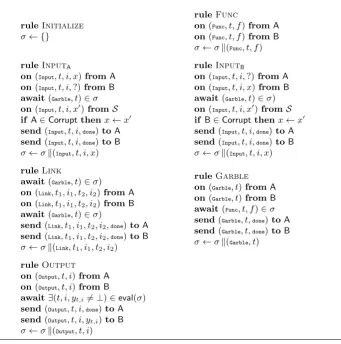
ruleInitialize σ← {}
ruleFunc
on(Func, t, f)fromA
on(Func, t, f)fromB
σ←σk(Func, t, f)
ruleInputA
on(Input, t, i, x)fromA
on(Input, t, i,?)fromB
await(Garble, t)∈σ
on(Input, t, i, x0)fromS
if A∈Corruptthenx←x0 send(Input, t, i,done)toA
send(Input, t, i,done)toB
σ←σk(Input, t, i, x)
ruleInputB
on(Input, t, i,?)fromA
on(Input, t, i, x)fromB
await(Garble, t)∈σ)
on(Input, t, i, x0)fromS
if B∈Corruptthenx←x0 send(Input, t, i,done)toA
send(Input, t, i,done)toB
σ←σk(Input, t, i, x)
ruleLink
await(Garble, t)∈σ)
on(Link, t1, i1, t2, i2)fromA
on(Link, t1, i1, t2, i2)fromB
await(Garble, t)∈σ)
send(Link, t1, i1, t2, i2,done)toA
send(Link, t1, i1, t2, i2,done)toB
σ←σk(Link, t1, i1, t2, i2)
ruleGarble
on(Garble, t)fromA
on(Garble, t)fromB
await(Func, t, f)∈σ
send(Garble, t,done)toA
send(Garble, t,done)toB
σ←σk(Garble, t)
ruleOutput
on(Output, t, i)fromA
on(Output, t, i)fromB
await∃(t, i, yt,i6=⊥)∈eval(σ)
send(Output, t, i,done)toA
send(Output, t, i, yt,i)toB
σ←σk(Output, t, i)
Fig. 9.Ideal FunctionalityFL,Φ
R2PC (only suitable for static security). For each line of the
form, “oncfromP” for a commandcand a partyP, when the activation is given to the adversary the ideal functionality sends along (Φ(c),P).
We implement the ideal functionality in Figure 9. The inputs to the parties will be a garbling sequence. The commands are received one-by-one, to have a well defined sequence, but can be executed in parallel. We assume that at any point in time the input sequence received by a party is a prefix or suffix of the input sequence of the other parties, except that when a party receives a secret input by receiving input (Input, t, i, x), then the other party receives
(Input, t, i,?), to not leak the secretx, where we use ? to denote a special reserved
The implementation will be based on the idea of a watchlist [17]. Alice and Bob will run many instances of a base protocol where Alice is the garbler and Bob is the evaluator. Alice will in each instance provide Bob with garbled functions, linking information, encoded inputs for Alice’s inputs and encoded inputs for Bob’s inputs, and decoding information. For all Bob’s input bits, Alice computes encodings of both 0 and 1, and Bob uses an oblivious transfer to pick the encoding he wants. For a given input bit, the same oblivious transfer instance is used to choose the appropriate encodings in all the instances. This forces Bob to use the same input in all instances. Bob then does a garbled evaluation and decodes to get a plaintext output. Bob therefore gets one possible value of the output from each instance. If Alice cheats by sending incorrect garblings or using different inputs in different instances, the outputs might be different. We combat this by using a watchlist. For a random subset of the instances, Bob will learn all the randomness used by Alice to run the algorithms of the garbling scheme and Bob can therefore check whether Alice is sending the expected values in these instances. The instances inspected by Bob are called the watchlist instances. The other instances are called theevaluation instances. The watchlist is random and unknown to Alice. The number of instances and the size of the watchlist is set up such that except with negligible probability, either a majority of the evaluation instances are correct or Bob will detect that Alice cheated without leaking information about his input. Bob can therefore take the output value that appears the most often among the evaluation instances as his output. There are several issues with this general approach that must be handled.
1. We cannot allow Bob to learn the encoded inputs of Alice in watchlist in-stances, as Bob also knows the input encoding functions for the watchlist instances. This is handled by letting Alice send her random taperi for each instanceito Bob in an oblivious transfer, where the other message is a key that will be used by Alice to encrypt the encodings of her input. That way Bob can choose toeither make instanceia watchlist instance, by choosing ri, or learn the encoded inputs of Alice, but not both.
2. Alice might not send correct input encodings of her own inputs, in which case correctness is not guaranteed. This is not caught by the watchlist mechanism as Bob does not learn Alice’s input encodings for the watchlist instances. To combat this attack, Alice must for all input bits of Alice, in all instances, commit to both the encoding of 0 and 1, in a random order, and send along with her input encodings an opening of one of the commitments. The ran-domness used to commit is picked from the random tape that Bob knows in the watchlist instances. That way Bob can check in the watchlist instances that the commitments were computed correctly, and hence the check in the evaluation position that the encoding sent by Alice opens one of the com-mitments will ensure that most evaluation instances were run with correct input encodings, except with negligible probability.
message digest of Alice’s input. Bob can then check that this digest is the same in all instances. For efficiency, the digest is computed using a two-universal hash function. This is a common trick by now, see [9,25,7]. How-ever, all previous work used garbled circuits in a white box manner to make this trick work. We can do it by a black box use of reactive garbling, as follows. First Alice garbles the function f to be evaluated producing the garblingF where Alice is to provide some input componentx. Then Alice garbles the functiongwhich takes as input a maskm, an indexc for a fam-ily hof two-universal hash functions and an input xfor the hash function and which outputs x and y = hc(x)⊕m. Alice then randomly samples a maskmand then sends encodings ofm andxto Bob as well as the output decoding function fory. Bob then samples an indexc at random and makes it public. Then Alice sends the encoding of c to Bob. Alice then links the output componentxof Ginto the input component xof F. This lets Bob computey and an encodingX of the inputxoff.
4. As usual Alice can mount a selective attack by for example offering Bob a correct encoding of 0 and an incorrect encoding of 1 in one of the OTs used for picking Bob’s input. This will not be caught by the watchlist mechanism if Bob’s input is 0. As usual this is combated by encoding Bob’s input and instead using the encoding as input. The encoding is such that anyspositions are uniformly random and independent of the input of Bob. Hence if Alice learns up tosbits of the encoding, it gives her no information on the input of Bob, and if she mounts more thansselective attacks, she will get caught except with probability 2−s. This is again a known trick used in a white box manner in previous works, and again we use linking to generalize this technique to (reactive) garbling schemes. First, Alice will garble an identity function for which Bob will get an encoding of a randomly chosen inputx0 via OT. Then Bob selects a random hash functionh from a two-universal family of hash functions such thath(x0) =xwherexis Bob’s real input. Bob sendshto Alice. Alice then garbles the hash function and links the output of the identity function to the input of the hash function and she links the output of the hash function to the encoded function which Bob is providing an input for.
With the above augmentations which solves obvious security problems, along with an augmentation described below, addressing a problem with simulation, the protocol is UC secure against a static adversary. We briefly sketch how to achieve simulation security.
evaluation instances would give the same outputzconsistent withx. Hence the simulator can use xas the input of Alice in the simulation.
As usual simulating corrupted Bob is more challenging. To get a feeling for the problem, assume that Alice has to send a garbled circuit F of the function f to be computed before Bob gives inputs. When Bob then gives input, the inputy of Bob can be extracted in the simulation by cheating in the OTs and inspecting the choice bits used by Bob. The simulator then inputs y to the ideal functionality and gets back the output z =f(x, y) that Bob is to learn. However, the simulator then in addition has to makeF outputzin the simulated execution of the protocol. This in general would require finding an inputx0 of Alice such that z = f(x0, y), which could be computationally hard. Previous
papers have used white-box modifications of the garbled circuit or the output decoding function to facilitate enough cheating to makeF hitzwithout having to computex0. We show how to do it in a very simple and elegant way in a black-box manner from any reactive garbling scheme which can garble the exclusive-or function. In our protocol Alice will not send to Bob the decoding key for the encoded output Z. Instead, she garbles a masking function (ψ(z, m) =z⊕m) and links the output of the function f to the first argument of the masking function. Then she produces an encoding M of the all-zero string for m and sends M to Bob along with the output decoding function for ψ. Bob can then compute and decode fromZ andM the valuez⊕0 =z. In the simulation, the simulator of corrupted Bob knows the watchlist and can hence behave honestly in the watchlist instances and use the freedom of mto make the output z⊕m hit the desired output from the ideal functionality in the evaluation positions. This will be indistinguishable from the real world because of the confidentiality property. Since this trick does not require modifying the garbled function, our protocol will only require a projective garbling scheme which is confidential. It will work for any side-information function. Earlier protocols required that the side-information be the topology of the circuit to hide the modification of the functionf needed for simulation, or they needed to do white box modifications of the output decoding function to make the needed cheating occur as part of the output decoding.
5.1 Details of the Reactive 2PC Protocol
ruleA.Initialize
// Sample watchlist key and an evaluation key
wk,ek←{$ 0,1}k OT.send(ek,wk) σ←()
ruleB.Initialize
// Learn either the watchlist key or the evaluation key
w←{$ 0,1}
k←OT.choose(w) σ←()
ruleA.Func
on(Func, t, f)
σ←σk(Func, t, f)
ruleB.Func
on(Func, t, f)
σ←σk(Func, t, f)
ruleA.Garble
on(Garble, t)
await∃f: (Func, t, f)∈σ
(Ft, et, ot, dt)←Gb(f, t;r)
E←Ewk(r) sendFt, EtoB
σ←σk(Garble, t)
ruleB.Garble
on(Garble, t)
await∃f: (Func, t, f)∈σ
onF0, E fromA
if w= 1then r←Dwk(E)
(Ft, et, ot, dt)←Gb(f, t;r)
verifyF0=Ft
Ft←F0
σ←σk(Garble, t)
ruleA.Link
on(Link, t1, i1, t, i2)
await(Garble, t)∈σ
await(Garble, t1)∈σ
sendli(ot1,i1, et,i2)toB
σ←σk(Link, t1, i1, t, i2)
ruleB.Link
on(Link, t1, i1, t, i2)
await(Garble, t)∈σ
await(Garble, t1)∈σ
onL¯ fromA
L ← L k(t1, i1, t, i2,L¯)
if w= 1then verify ¯
L=li(ot1,i1, et,i2)
σ←σk(Link, t1, i1, t, i2)
Fig. 10.Protocol (Initialize,Garble,Link)
We will use commitments and oblivious transfer within the protocol. We work in the OT hybrid model. We use OT.send(m0, m1) to mean that Alice sends two messages via the oblivious-transfer functionality and we use the notation
OT.choose(b) to say that Bob chooses to receivemb. We use a perfect binding and computationally hiding commitment scheme. If a public key is needed, it could be generated by Alice and sent to Bob in initialization. A commitment to a messagem produced with randomnessris denoted by com(m;r), sending (m, r) constitutes an opening of the commitment.
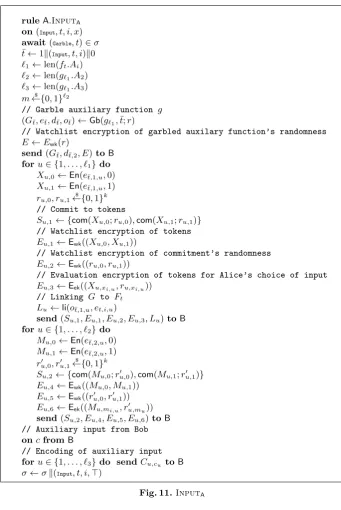
ruleA.InputA
on(Input, t, i, x)
await(Garble, t)∈σ
¯
t←1k(Input, t, i)k0
`1←len(ft.Ai)
`2←len(g`1.A2)
`3←len(g`1.A3)
m←{$ 0,1}`2
// Garble auxiliary function g
(G¯t, e¯t, d¯t, o¯t)←Gb(g`1,¯t;r)
// Watchlist encryption of garbled auxilary function’s randomness
E←Ewk(r)
send(G¯t, dt,¯2, E)toB
foru∈ {1, . . . , `1}do Xu,0←En(e¯t,1,u,0)
Xu,1←En(e¯t,1,u,1)
ru,0, ru,1←{$ 0,1}k // Commit to tokens
Su,1← {com(Xu,0;ru,0),com(Xu,1;ru,1)} // Watchlist encryption of tokens
Eu,1←Ewk((Xu,0, Xu,1))
// Watchlist encryption of commitment’s randomness
Eu,2←Ewk((ru,0, ru,1))
// Evaluation encryption of tokens for Alice’s choice of input
Eu,3←Eek((Xu,xi,u, ru,xi,u))
// Linking G to Ft
Lu←li(ot,¯1,u, et,i,u)
send(Su,1, Eu,1, Eu,2, Eu,3, Lu)toB
foru∈ {1, . . . , `2}do Mu,0←En(e¯t,2,u,0)
Mu,1←En(e¯t,2,u,1)
r0u,0, r
0
u,1
$
←{0,1}k
Su,2← {com(Mu,0;r0u,0),com(Mu,1;r0u,1)}
Eu,4←Ewk((Mu,0, Mu,1))
Eu,5←Ewk((ru,0 0, r
0
u,1))
Eu,6←Eek((Mu,mi,u, r
0
u,mu))
send(Su,2, Eu,4, Eu,5, Eu,6)toB // Auxiliary input from Bob
oncfromB
// Encoding of auxiliary input
foru∈ {1, . . . , `3}do sendCu,cu toB
σ←σk(Input, t, i,>)
Fig. 11.InputA
that these tags are unique, except when referring to a legal previous occurrence. We further assume that all tags provided as inputs are of the form 0k{0,1}∗,
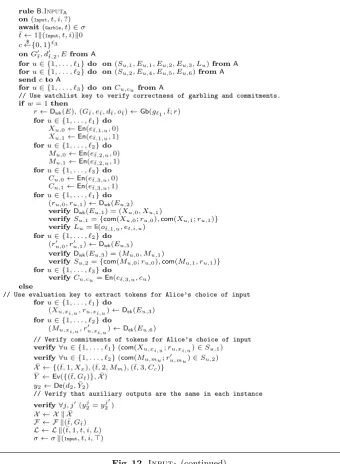
ruleB.InputA
on(Input, t, i,?) await(Garble, t)∈σ ¯
t←1k(Input, t, i)k0 c←{$ 0,1}`3
onG0¯t, d
0
¯
t,2, EfromA
foru∈ {1, . . . , `1}do on(Su,1, Eu,1, Eu,2, Eu,3, Lu)fromA
foru∈ {1, . . . , `2}do on(Su,2, Eu,4, Eu,5, Eu,6)fromA
sendctoA
foru∈ {1, . . . , `3}do onCu,cufromA
// Use watchlist key to verify correctness of garbling and commitments.
ifw= 1then
r←Dwk(E), (G¯t, et¯, d¯t, o¯t)←Gb(g`1,¯t;r)
foru∈ {1, . . . , `1}do
Xu,0←En(e¯t,1,u,0)
Xu,1←En(e¯t,1,u,1)
foru∈ {1, . . . , `2}do
Mu,0←En(et,¯2,u,0)
Mu,1←En(et,¯2,u,1)
foru∈ {1, . . . , `3}do
Cu,0←En(et,¯3,u,0)
Cu,1←En(et,¯3,u,1)
foru∈ {1, . . . , `1}do
(ru,0, ru,1)←Dwk(Eu,2)
verifyDwk(Eu,1) = (Xu,0, Xu,1)
verifySu,1={com(Xu,0;ru,0),com(Xu,1;ru,1)}
verifyLu=li(o¯t,1,u, et,i,u)
foru∈ {1, . . . , `2}do
(r0u,0, r0u,1)←Dwk(Eu,5)
verifyDwk(Eu,3) = (Mu,0, Mu,1)
verifySu,2={com(Mu,0;ru,0),com(Mu,1, ru,1)}
foru∈ {1, . . . , `3}do
verifyCu,cu=En(et,¯3,u, cu)
else
// Use evaluation key to extract tokens for Alice’s choice of input
foru∈ {1, . . . , `1}do
(Xu,xi,u, ru,xi,u)←Dek(Eu,3)
foru∈ {1, . . . , `2}do
(Mu,xi,u, r0
u,xi,u)←Dek(Eu,6)
// Verify commitments of tokens for Alice’s choice of input
verify∀u∈ {1, . . . , `1}(com(Xu,xi,u;ru,xi,u)∈Su,1)
verify∀u∈ {1, . . . , `2}(com(Mu,mu;r0u,mu)∈Su,2)
¯
X ← {(¯t,1, Xx),(¯t,2, Mm),(¯t,3, Cc)}
¯
Y ←Ev({(¯t, Gt¯)},X¯)
y2←De(d2,Y¯2)
// Verify that auxiliary outputs are the same in each instance
verify∀j, j0(y2j=y2j0)
X ← X kX¯
F ← F k(¯t, G¯t)
L ← L k(¯t,1, t, i, L) σ←σk(Input, t, i,>)
Fig. 12.InputA (continued)
for internal use will be derived from the tags given as input and the name of the rule creating the new tag. For a garbling schemeG, a commitment schemecom
and an encryption schemeE, we useπG,com,E to denote protocol given by the set
ruleA.InputB
on(Input, t, i,?)
await(Garble, t)∈σ
`←len(ft.Ai)
`1←`+ 2s+ 1
¯
t←1k(Input, t, i)k0
t0←1k(Input, t, i)k1
// Garble the identity function
(Idt¯, e¯t, o¯t, dt¯)←Gb(id`1,¯t;r)
// Send to Bob the garbled identity function and the watchlist encryption of its randomness to Bob
sendE←Ewk(r),Id¯t toB
foru∈ {1, . . . , `1}do Xu,0←En(e¯t,u,0)
Xu,1←En(e¯t,u,1)
// Oblivious Transfer of Bob’s input tokens
OT.send({Xu,j0}j∈{1,...,s},{Xu,j1}j∈{1,...,s})
// Await universal hash function
onhfromB
// Garble universal hash function
(Ht0, et0, ot0, dt0)←Gb(h, t0;r0)
// Send garbled hash function and the watchlist encryption of its randomness to Bob
sendHt0,Ewk(r0)toB
foru∈ {1, . . . , `1}do
// Link Id¯t to Ht0
sendL¯u←li(ot,u¯ , et0,u)toB // Link Ht0 to Ft
sendLu←li(ot0,u, et,i,u)toB
σ←σk(Input, t, i,>)
Fig. 13.InputB
In theInitialize-rules Alice and Bob setup the watchlist. They use a (sym-metric) encryption schemeE = (E,D) withk-bit keys. For each instancej, Alice sends two keys via the oblivious transfer functionality, the watchlist key wkj
and the evaluation key ekj. Alice will later encrypt and send the information Bob is to learn for watchlist (evaluation) instances with the keywk(ek). In the
Func-rules they simply associate a function to a tag. In theGarble-rules Alice
rule. She produces a garbling ofψ. She will link the output toψand produce an encoding of the zero-string for the second component, she also sends an encryp-tion of the randomness used to produce the garbling of ψ to Bob. Bob awaits that he has received the garbling, linking and encoding to produce the encoded output in question. For each instance of the watchlist, he uses the randomness to check that the linking was done correctly, thatψwas garbled correctly and that an encoding of an all zero-string was sent for the second component of ψ. He then evaluates each instance in the evaluation set and takes the majority value as his output.
In theInputA-rules Alice commits to both her input encodings and encrypts
the openings of the commitments using the watchlist key. The opening of Alice’s input encoding will be encrypted using the evaluation key. To verify Alice’s input, we first pass Alice’s input through an auxiliary function which combines the identity function with an additional verification function which forces Alice to use the same input in different instances. We then link the output of the identity function to the appropriate input. We denoted the auxiliary function by gl:A1×A2×A3→B1×B2 andg`(x, m, c) = (x, v`(x, m, c)) whereA1=A2= B1 ={0,1}`∪ {⊥}and v` :A1×A2×A3 →B2. Efficient such functions with the properties needed for the security of the protocol can be based on universal hash functions, see for instance [25,7].
In theInputB-rules Alice first garbles the identity function. Bob then randomly
samples a value x0 and gets an encoding of that value via oblivious transfer for
the garbled identity function. Then Bob samples uniformly at random a function hfrom a two-universal family of hash functions such thath(x0) =xwherexis the input of Bob. Alice will then garble the hash function. She will link the garbling of the identity function to the garbling of the hash function. She will then link the garbled hash function to the garbled function. We will denote by H` a two-universal family of hash functionsh:{0,1}`+2s+1 → {0,1}`. We use
id:A→A to denote the identify function onA. In Appendix A, we prove the following theorem.
Theorem 2. LetLbe the set of all legal sequences and letΦbe a side-information
function. Let Gbe a reactive garbling scheme. Letcombe a commitment scheme and E an encryption scheme. IfG is L-correct and (L, Φ)-confidential and com
is computationally hiding and perfect binding and E is IND-CPA secure, then
πG,com,E UC securely realizesFR2PCL,Φin theFOT-hybrid model against a static, ma-licious adversary.
References
1. M. Abdalla and R. D. Prisco, editors. Security and Cryptography for Networks - 9th International Conference, SCN 2014, Amalfi, Italy, September 3-5, 2014. Proceedings, volume 8642 ofLecture Notes in Computer Science. Springer, 2014. 2. M. Bellare, V. T. Hoang, and P. Rogaway. Adaptively secure garbling with
ruleB.InputB
on(Input, t, i, x)
await(Garble, t)∈σ
¯
t←1k(Input, t, i)k0
t0←1k(Input, t, i)k1
// sample a random string x¯ ¯
x $
←{0,1}`1
// Sample a random universal hash function h such that h(¯x) =x h←{$ ¯h∈ H`|¯h(¯x) =x}
// Await a garbled identity function from Alice
onE,Id0t¯fromA
// Obliviously learn tokens for x¯
foru∈ {1, . . . , `1}do
{X¯u,j¯xu}j∈{1,...,s}←OT.choose(¯xu)
¯
Xt,¯x¯←( ¯X1,x¯1, . . . ,X¯`1,x¯`1)
if w= 1 then
/* Verify garbled identity function and the correctness of received tokens using the watchlist encryption of the
randomness */
r←Dwk(E)
(Id¯t, et¯, o¯t, dt¯)←Gb(id`1,¯t;r)
verifyId¯t=Id
0
¯ t
verify∀u∈ {1, . . . , `1} : ¯Xt,u¯ =En(e¯t,u,x¯u)
else
X ← X k(¯t,X¯¯t,x¯)
sendhtoA
onH0, E0 fromA
foru∈ {1, . . . , `1}do onL¯ufromA
onLufromA
if w= 1then
/* Verify garbled hash function using the watchlist encryption
of the randomness */
r0←Dwk(E0)
(Ht0, et0, ot0, dt0)←Gb(h, t0;r0)
verifyHt0 =H0
// Verify linking information
foru∈ {1, . . . , `1}do
verifyL¯u=li(o¯t,u, et0,u)
verifyLu=li(ot0,u, et,i,u)
else
F ← F k(¯t, Id)
F ← F k(t0, H)
X ← X k(¯t,X¯¯t,x¯) L ← L k(t0,1, t, i, L) foru∈ {1, . . . , `1}do
L ← L k(¯t, u, t0, u,L¯u)
σ←σk(Input, t, i,>)
ruleA.Output on(Output, t, i)
await(t, i)∈ready(σ) ¯
t←1k(Output, t, i)
// Garble ψ
(Ψ, e¯t, dt¯, ot¯)←Gb(ψ,¯t;r)
L←li(ot,i, e¯t,1)
E←Ewk(r)
// Encode all zero-string
Xt,¯0←En(e¯t,2,0)
send(L, E, Ψ, X¯t,0, d¯t)toB
ruleB.Output
on(Output, t, i)
await(t, i,>)∈ready(σ) ¯
t←1k(Output, t, i)
on( ¯L,E,¯ Ψ ,¯ X¯t,¯0,d¯¯t)fromA
if w= 1 then r←Dwk( ¯E)
(Ψ, e¯t, d¯t, o¯t)←Gb(ψ,¯t;r)
L←li(ot,i, e¯t,1) /* Verify:
1) Ψ¯ is the garbling of ψ
2) Linking is correct
3) Encoding of the all zero-string was sent
4) Correct output decoding was sent */
verifyL¯=L∧Ψ¯=Ψ
verifyX¯¯t,0=En(e¯t,2,0)∧d¯¯t,1=d¯t,1
else
F ← F k(¯t, Ψ)
X ← X k(¯t,2,X¯¯t,0) L ← L k(t, i,¯t,1,L¯) δ←δk(¯t,1,d¯¯t,1)
await∃(¯t,1, Yt,1)∈Ev(F,X,L)
yt,ij ←De( ¯d¯t,1, Y¯t,1)
// Apply majority decoding
yt,i←maj(y1t,i, . . . , y 1 t,i)