A High-Security Searchable Encryption Framework for
Privacy-Critical Cloud Storage Services
Thang Hoang∗ Attila A. Yavuz∗ Jorge Guajardo†
Abstract
Searchable encryption has received a significant attention from the research community with various constructions being proposed, each achieving asymptotically optimal complexity for spe-cific metrics (e.g., search, update). Despite their elegancy, the recent attacks and deployment efforts have shown that the optimal asymptotic complexity might not always imply practical performance, especially if the application demands a high privacy. Hence, there is a significant need for search-able encryption frameworks that capture the recent attacks with actual deployments on cloud in-frastructures to assess the practicality under realistic settings.
In this article, we introduce a new Dynamic Searchable Symmetric Encryption (DSSE) frame-work calledIncidence Matrix (IM)-DSSE, which achieves a high level of privacy, efficient search/update, and low client storage with actual deployments on real cloud settings. We harness an incidence matrix along with two hash tables to create an encrypted index, on whichbothsearch and up-date operations can be performed effectively with minimal information leakage. This simple set of data structures surprisingly offers a high level of DSSE security while at the same time achiev-ing practical performance. Specifically,IM-DSSEachieves forward privacy, backward privacy and size-obliviousness properties simultaneously. We also create several DSSE variants, each offering different trade-offs (e.g., security, computation) that are suitable for different cloud applications and infrastructures. Our framework was fully-implemented and its performance was rigorously evalu-ated on a real cloud system (Amazon EC2). Our experimental results confirm thatIM-DSSEis highly practical even when deployed on mobile phones with a large outsourced dataset. Finally, we have released ourIM-DSSEframework as an open-source library for a wide development and adaptation. Keywords—Privacy-enhancing technologies; private cloud services; dynamic searchable symmet-ric encryption
1
Introduction
The rise of cloud storage and computing services provides vast benefits to society and IT industry. One of the most important cloud services is data Storage-as-a-Service (SaaS), which can significantly reduce the cost of data management via continuous service, expertise and maintenance for resource-limited clients such as individuals or small/medium businesses. Despite its benefits, SaaS also brings significant security and privacy concerns to the user. That is, once a client outsources her data to the cloud, sensitive information (e.g., email) might be exploited by a malicious party (e.g., malware). Although standard encryption schemes (e.g., AES) can provide confidentiality, they also prevent the
∗Oregon State University, {hoangmin, attila.yavuz}@oregonstate.edu
†Robert Bosch Research and Technology Center, [email protected]
client from querying encrypted data from the cloud. This privacy versus data utilization dilemma may significantly degrade the benefits and usability of cloud-based systems. Therefore, it is vital to develop privacy-enhancing technologies that can address this problem while retaining the practicality of the underlying cloud service.
Searchable Symmetric Encryption (SSE) [9] enables a client to encrypt data in such a way that she can later perform keyword searches on it. These encrypted queries are performed via “search to-kens" [27] over an encrypted index which represents the relationship between search token (keywords) and encrypted files. A prominent application of SSE is to enable privacy-preserving keyword search on the cloud (e.g., Amazon S3), where a data owner can outsource a collection of encrypted files and perform keyword searches on it without revealing the file and query contents [18]. Preliminary SSE schemes (e.g.,[26, 9]) only provide search-only functionality on static data (i.e., no dynamism), which strictly limits their applicability due to the lack of update capacity. Later, several Dynamic Searchable Symmetric Encryption (DSSE) schemes (e.g., [18, 5]) were proposed that permit the user to add and delete files after the system is set up. To the best of our knowledge, there isnosingle DSSE scheme that outperformsallthe other alternatives in terms of allthe aforementioned metrics: privacy (e.g., information leakage), performance (e.g., search, update delay), storage efficiency and functionality.
Research Gap and Objectives: Despite a number of DSSE schemes have been introduced in the
litera-ture, most of them only provide a theoretical asymptotic analysis1and in some cases, merely a prototype
implementation. The lack of a rigorous actual experimental performance evaluation on real platforms poses a significant difficulty in assessing the application and practicality of proposed DSSE schemes, as the impacts of security vulnerability, hidden computation costs, multi-round communication delay and storage blowup might be overlooked. For instance, most efficient DSSE schemes (e.g., [5, 12]) are vul-nerable to file-injection attacks, which have been showed to be easily conducted even by semi-honest adversary in practice, especially in the personal email scenario. Although several forward-secure DSSE schemes with an optimal asymptotic complexity have been proposed, they incur either very high delay due to public-key operations (e.g., [3]), or significant storage blowup at both client and server-side (e.g., [27]), and therefore, their ability to meet actual need of real systems in practice is still unclear.
There is a significant need for a DSSE scheme that can achieve a high level of security with a well-quantified information leakage, while maintaining a performance and functionality balance between the search and update operations. More importantly, it is critical that the performance of proposed DSSE should be experimentally evaluated in a realistic cloud environment with various parameter settings, rather than merely relying on asymptotic results. The investigation of alternative data structures and their optimized implementations on commodity hardware seem to be key factors towards achieving these objectives.
1.1 Our Contributions
In this article, towards filling the gaps between theory and practice in DSSE research community, we introduceIM-DSSE, a fully-implemented DSSE framework which favors desirable properties for
realis-tic privacy-crirealis-tical cloud systems including high security against pracrealis-tical attacks and low end-to-end delay. In this framework, we provide the full-fledged implementations of our preliminary DSSE scheme proposed in [31], as well as extended schemes, which are specially designed to fit with various appli-cation requirements and cloud data storage-as-a-service infrastructures in practice.
Improvements over Preliminary Version: This article is the extended version of [31] which includes
the following improvements: (i) We propose extended DSSE schemes which are more compatible with the cloud SaaS infrastructure and offer backward-privacy at the cost of bandwidth overhead. (ii) As a significant improvement over the preliminary version, we provide a comprehensive DSSE framework, where our preliminary DSSE scheme in [31] as well as all of its variants are fully implemented. We fully deployed our framework on Amazon EC2 cloud and provided a much more comprehensive performance analysis of each scheme with different hardware and network settings. (iii) Finally, we have released our framework for public use and improvement.
Desirable properties:IM-DSSEoffers ideal features for privacy-critical cloud systems as follows.
• Highly secure against File-Injection Attacks:IM-DSSEoffersforward privacy(see [27] or Section 4 for definition) which is an imperative security feature to mitigate the impact of practical file-injection attacks [3, 32]. Only few DSSE schemes offer this property (i.e., [27, 3]), some of which incur high client storage with costly update (e.g., [27]), or high delay due to public-key operations (e.g., [3]). Additionally,IM-DSSEofferssize-obliviousnessproperty, where it hides all size information involved with the encrypted index and update query including (i) update query size (i.e., number of keywords in the updated file); (iii) and the number of keyword-file pairs in the database. More importantly, one of theIM-DSSEvariants achievesbackward privacydefined in [27]. To the best of our knowledge, none of the state-of-the-art DSSE schemes offer all these security properties simultaneously.
• Updates with Improved Features: (i)IM-DSSEallows todirectly update keywords of an existing file without invoking the file delete-then-add operation sequence. The update in IM-DSSEalso leaks
minimal information and it is type-oblivious, meaning that it does not leak timing information (i.e., all updates take the same amount of time) and whether the operation is add, delete, or update. (ii) The encrypted index of our schemes does not grow with update operations and, therefore, it does not require re-encryption due to frequent updates. This is more efficient than some alternatives (e.g., [27]) in which the encrypted index can grow linearly with the number of deletions.
• Fully Parallelizable: IM-DSSE supports parallelization for both update and search operations and,
therefore, it takes full advantages of modern computing architecture to minimize the delay of cryp-tographic operations. Experiments on Amazon cloud indicates that the search latency of our frame-work is highly practical and mostly dominated by the netframe-work communication between the client and server (see Section 5).
• Detailed experimental evaluation and open-source framework: We deployed IM-DSSEin a realistic
cloud environment (Amazon EC2) to assess the practicality of our framework. We experimented with different database sizes and investigated the impacts of network condition and storage unit on the overall performance. We also evaluated the performance ofIM-DSSEon a resource-limited mobile
client. We give a comprehensive cost breakdown analysis to highlight the main factors contributing the overall cost in all these settings. Finally, we released the implementation of our framework to public to provide opportunities for broad adaptation and testing (see Section 5).
2
IM-DSSE Framework
IM-DSSEframework comprises various DSSE schemes based on the incidence matrix data structure. In
asIM-DSSE𝗆𝖺𝗂𝗇, which is preliminarily presented in [31]. Several extension derived fromIM-DSSE𝗆𝖺𝗂𝗇
scheme that IM-DSSE also fully supports will be described in the next section. We first start with
notation, and then present typical data structures being used in IM-DSSE. We give the algorithmic
details ofIM-DSSE𝗆𝖺𝗂𝗇scheme afterwards.
2.1 Notation and Data Structure
Notation. Operators||and|𝑥|denote the concatenation and the bit length of variable𝑥, respectively.
𝑥 ←$ denotes variable𝑥 is randomly and uniformly selected from set. (𝑥1, … , 𝑥𝑛) $
← denotes
(𝑥1 $
←, … , 𝑥𝑛 $
← ).|𝑥|denotes the size of𝑥. We denote{0, 1}∗as a set of binary strings of any finite length. ⌊𝑥⌋and⌈𝑥⌉denote the floor and the ceiling of𝑥, respectively. Given a matrix𝐈,𝐈[𝑖, 𝑗]denotes the cell indexing at row𝑖and column𝑗.𝐈[∗, 𝑗]and𝐈[𝑖, ∗]denote accessing column𝑗 and row𝑖of matrix 𝐈, respectively. 𝐈[∗, 𝑎, … , 𝑏]denotes accessing columns from𝑎to𝑏of matrix𝐈. 𝐮[𝑖]denotes accessing the𝑖’th component of vector𝐮.
We denote an IND-CPA encryption scheme as a triplet = (𝖦𝖾𝗇, 𝖤𝗇𝖼, 𝖣𝖾𝖼):𝑘 ←.𝖦𝖾𝗇(1𝜅), where 𝜅 is a security parameter and𝑘is a key; 𝑐 ←.𝖤𝗇𝖼𝑘(𝑀, 𝑢)takes as input a secret key𝑘, a counter𝑢
and a message𝑀 and returns a ciphertext𝑐;𝑀 ←.𝖣𝖾𝖼𝑘(𝑐, 𝑢)takes as input a key𝑘, a counter𝑢and
ciphertext𝑐, and returns𝑀if𝑘and𝑢were the key and the counter under which𝑐 was produced. The function𝐺is a keyed Pseudo Random Function (PRF), denoted by𝜏 ← 𝐺𝑘(𝑥), which takes as input a
secret key𝑘 ← {0, 1}$ 𝜅 and a string𝑥, and returns a token/key𝑟. We denote𝐻 ∶ {0, 1}|𝑥| → {0, 1}as a Random Oracle (RO) [1], which takes an input𝑥and returns a bit.
IM-DSSE Data Structures. Our encrypted index is an incidence matrix𝐈, in which𝐈[𝑖, 𝑗].𝑣 ∈ {0, 1} stores the (encrypted) relationship between keyword indexing at row𝑖and file indexing at column𝑗, and𝐈[𝑖, 𝑗].𝗌𝗍 ∈ {0, 1} stores a bit indicating the state of𝐈[𝑖, 𝑗].𝑣. Particularly,𝐈[𝑖, 𝑗].𝗌𝗍is set to 1 or 0 if 𝐈[𝑖, 𝑗].𝑣is accessed by update or search, respectively. For simplicity, we will often write𝐈[𝑖, 𝑗]to denote 𝐈[𝑖, 𝑗].𝑣, and be explicit about the state bit as𝐈[𝑖, 𝑗].𝗌𝗍.
The encrypted index𝐈is augmented by two static hash tables𝑇𝑤 and𝑇𝑓 that associate a keyword
and file to a unique row and a column, respectively. Specifically,𝑇𝑓 is a file static hash table whose
key-value pair is(𝑠𝑖𝑑𝑗, ⟨𝑦𝑗, 𝑢𝑗⟩), where𝑠𝑖𝑑𝑗 ← 𝐺𝑘2(𝑖𝑑𝑗)for file with identifier𝑖𝑑𝑗, column index𝑦𝑗 ∈ {1, … , 𝑛}
equivalent to the index of𝑠𝑖𝑑𝑗 in𝑇𝑓 and𝑢𝑗 is a counter value. We denote access operations by 𝑦𝑗 ←
𝑇𝑓(𝑠𝑖𝑑𝑗)and𝑢𝑗 ← 𝑇𝑓[𝑦𝑗].𝖼𝗍. 𝑇𝑤 is a keyword static hash table whose key-value pair is{𝑠𝑤𝑖, ⟨𝑥𝑖, 𝑢𝑖⟩},
where token𝑠𝑤𝑖 ← 𝐺𝑘2(𝑤𝑖)for keyword𝑤𝑖, row index𝑥𝑖 ∈ {1, … , 𝑚}equivalent to the index of𝑠𝑤𝑖 in
𝑇𝑤 and𝑢𝑖 is a counter value. We denote access operations by𝑥𝑖 ← 𝑇𝑤(𝑠𝑤𝑖)and𝑢𝑖 ← 𝑇𝑤[𝑥𝑖].𝖼𝗍. All
counter values are incremental and initially set to 1. So, the client state information is in the form of 𝑇𝑤 and𝑇𝑓, that offers (on average)(1)look-up time.
2.2 IM-DSSE𝗆𝖺𝗂𝗇Algorithms
We present the detailed algorithmic construction of the main scheme inIM-DSSEframework in Scheme
1, which consists of nine algorithms with the following highlights.
∙Setup: Given a file collection = {𝑓𝑖𝑑1, … , 𝑓𝑖𝑑𝑛}(with unique IDs𝑖𝑑1, … , 𝑖𝑑𝑛) to be outsourced, the client
in encrypted index𝛾 and encrypted files= {𝑐𝑖𝑑1, … , 𝑐𝑖𝑑𝑛}, respectively. Finally, the client sends𝛾 and
to the cloud server along with the file hash table𝑇𝑓.
∙ Search: To search keyword 𝑤, the client generates a token 𝜏𝑤 (IM-DSSE.𝖲𝖾𝖺𝗋𝖼𝗁𝖳𝗈𝗄𝖾𝗇 algorithm)
containing a row index𝑖and row key(s). Upon receiving𝜏𝑤, the server decrypts row𝑖and determines
column indexes𝑗 where𝐈[𝑖, 𝑗] = 1, and returns the corresponding𝑗-labeled ciphertexts to the client. Finally, the client invokesIM-DSSE.𝖣𝖾𝖼algorithm on each ciphertext to obtain the search result. ∙Update: To add (or delete) a file, the client generates a token containing column𝑗and the encrypted file (if the file is added) viaIM-DSSE.𝖠𝖽𝖽𝖳𝗈𝗄𝖾𝗇(IM-DSSE.𝖣𝖾𝗅𝖾𝗍𝖾𝖳𝗈𝗄𝖾𝗇resp.) algorithm. The server invokesIM-DSSE.𝖠𝖽𝖽((IM-DSSE.𝖣𝖾𝗅𝖾𝗍𝖾resp.) ) algorithm to update column𝑗 of𝐈, and adds (deletes resp.) the file in.
Scheme 1IM-DSSE𝗆𝖺𝗂𝗇Scheme
←IM-DSSE.𝖦𝖾𝗇(1𝜅): Given security parameter𝜅, generate secret key
1: 𝑘1←.𝖦𝖾𝗇(1𝜅)and(𝑘2, 𝑘3) $
← {0, 1}𝜅
2: return, where← {𝑘1, 𝑘2, 𝑘3}
𝑓 ←IM-DSSE.𝖣𝖾𝖼(𝑐): Decrypt encrypted file𝑐with key𝜅
1: 𝑓 ←.𝖣𝖾𝖼𝑘1(𝑐′, 𝑦||𝑢)where𝑢 ← 𝑇𝑓[𝑦].𝖼𝗍,(𝑐′, 𝑦) ← 𝑐 2: return𝑓
(𝛾 ,) ←IM-DSSE.𝖤𝗇𝖼(𝛿,): Given index𝛿and plaintext files, generate encrypted index𝛾 and encrypted
files
1: 𝑇𝑤[𝑖].𝖼𝗍 ← 1,𝑇𝑓[𝑗].𝖼𝗍 ← 1, for0 ≤ 𝑖 ≤ 𝑚, 0 ≤ 𝑗 ≤ 𝑛
2: 𝐈[∗, ∗].𝗌𝗍 ← 0and𝛿[∗, ∗] ← 0
3: Extract(𝑤1, … , 𝑤𝑚′)from = {𝑓𝑖𝑑
1, … , 𝑓𝑖𝑑𝑛′}
4: for𝑖 = 1, … , 𝑚′do
5: 𝑠𝑤𝑖 ← 𝐺𝑘2(𝑤𝑖),𝑥𝑖 ← 𝑇𝑤(𝑠𝑤𝑖)
6: for𝑗 = 1, … , 𝑛′do
7: if𝑤𝑖appears in𝑓𝑖𝑑𝑗 then
8: 𝑠𝑖𝑑𝑗 ← 𝐺𝑘2(𝑖𝑑𝑗)and𝑦𝑗 ← 𝑇𝑓(𝑠𝑖𝑑𝑗)
9: 𝛿[𝑥𝑖, 𝑦𝑗] ← 1
10: for𝑖 = 1, … , 𝑚do
11: 𝑟𝑖 ← 𝐺𝑘3(𝑖||𝑢𝑖), where𝑢𝑖← 𝑇𝑤[𝑖].𝖼𝗍
12: for𝑗 = 1, … , 𝑛do
13: 𝐈[𝑖, 𝑗] ← 𝛿[𝑖, 𝑗] ⊕ 𝐻(𝑟𝑖||𝑗||𝑢𝑗), where𝑢𝑗 ← 𝑇𝑓[𝑗].𝖼𝗍
14: for𝑗 = 1, … , 𝑛′do
15: 𝑐𝑗← (𝑐𝑗′, 𝑦𝑗), where𝑐𝑗′←.𝖤𝗇𝖼𝑘1(𝑓𝑖𝑑𝑗, 𝑦𝑗||𝑢𝑦𝑗) 16: return(𝛾 ,), where𝛾 ← (𝐈, 𝑇𝑓)and← {𝑐1, … , 𝑐𝑛′}
𝜏𝑤 ←IM-DSSE.𝖲𝖾𝖺𝗋𝖼𝗁𝖳𝗈𝗄𝖾𝗇(, 𝑤): Generate search token𝜏𝑤from keyword𝑤and key
1: 𝑠𝑤 ← 𝐺𝑘2(𝑤),𝑖 ← 𝑇𝑤(𝑠𝑤) 2: 𝑢 ← 𝑇𝑤[𝑖].𝖼𝗍,𝑟𝑖← 𝐺𝑘3(𝑖||𝑢)
3: if𝑢 = 1then
4: 𝜏𝑤 ← (𝑖, 𝑟𝑖)
5: else
6: 𝑟𝑖 ← 𝐺𝑘3(𝑖||𝑢 − 1)and𝜏𝑤 ← (𝑖, 𝑟𝑖, 𝑟𝑖)
7: 𝑇𝑤[𝑖].𝖼𝗍 ← 𝑢 + 1
Scheme 1IM-DSSE𝗆𝖺𝗂𝗇Scheme (continued)
(𝑤,𝑤) ←IM-DSSE.𝖲𝖾𝖺𝗋𝖼𝗁(𝜏𝑤, 𝛾 ): Given search token𝜏𝑤and encrypted index𝛾, return sets of file identifiers 𝑤 and encrypted files𝑤 ⊆matching with𝜏𝑤
1: for𝑗 = 1, … , 𝑛do
2: 𝑢𝑗← 𝑇𝑓[𝑗].𝖼𝗍
3: if(𝜏𝑤 = (𝑖, 𝑟𝑖) ∨ 𝐈[𝑖, 𝑗].𝗌𝗍 = 1)then
4: 𝐈′[𝑖, 𝑗] ← 𝐈[𝑖, 𝑗] ⊕ 𝐻 (𝑟𝑖||𝑗||𝑢𝑗)and set𝐈[𝑖, 𝑗].𝗌𝗍 ← 0
5: else
6: 𝐈′[𝑖, 𝑗] ← 𝐈[𝑖, 𝑗] ⊕ 𝐻 (𝑟𝑖||𝑗||𝑢𝑗)and set𝐈[𝑖, 𝑗] ← 𝐈′[𝑖, 𝑗] ⊕ 𝐻 (𝑟𝑖||𝑗||𝑢𝑗)
7: 𝑙 ← 0
8: foreach𝑗 ∈ {1, … , 𝑛}satisfying𝐈′[𝑖, 𝑗] = 1do
9: 𝑙 ← 𝑙 + 1and𝑦𝑙 ← 𝑗
10: 𝑤 ← {𝑦1, … , 𝑦𝑙}
11: 𝛾 ← (𝐈, 𝑇𝑓),𝑤 ← {(𝑐𝑦1, 𝑦1), … , (𝑐𝑦𝑙, 𝑦𝑙)} 12: return(𝑤,𝑤)
(𝜏𝑓, 𝑐) ←IM-DSSE.𝖠𝖽𝖽𝖳𝗈𝗄𝖾𝗇(, 𝑓𝑖𝑑): Given keyand a file𝑓𝑖𝑑, generate add token𝜏𝑓 and ciphertext𝑐of𝑓𝑖𝑑
1: 𝑠𝑖𝑑← 𝐺𝑘2(𝑖𝑑),𝑗 ← 𝑇𝑓(𝑠𝑖𝑑),𝑇𝑓[𝑗].𝖼𝗍 ← 𝑇𝑓[𝑗].𝖼𝗍 + 1and𝑢𝑗 ← 𝑇𝑓[𝑗].𝖼𝗍
2: for𝑖 = 1, … , 𝑚do
3: 𝑟𝑖 ← 𝐺𝑘3(𝑖||𝑢𝑖), where𝑢𝑖← 𝑇𝑤[𝑖].𝖼𝗍 4: Extract(𝑤1, … , 𝑤𝑡)from𝑓𝑖𝑑and set𝐈[∗, 𝑗] ← 0
5: for𝑖 = 1, … , 𝑡do
6: 𝑠𝑤𝑖 ← 𝐺𝑘2(𝑤𝑖),𝑥𝑖 ← 𝑇𝑤(𝑠𝑤𝑖),𝐈[𝑥𝑖, 𝑗] ← 1
7: for𝑖 = 1, … , 𝑚do
8: 𝐈′[𝑖, 𝑗] ← 𝐈[𝑖, 𝑗] ⊕ 𝐻(𝑟𝑖||𝑗||𝑢𝑗)
9: 𝑐 ← (𝑐′, 𝑗), where𝑐′←.𝖤𝗇𝖼𝑘1(𝑓𝑖𝑑, 𝑗||𝑢𝑗)
10: return(𝜏𝑓, 𝑐)where𝜏𝑓 ← (𝐈′, 𝑗)
(𝛾′,′) ←IM-DSSE.𝖠𝖽𝖽(𝛾 ,, 𝑐, 𝜏𝑓): Add token𝜏𝑓 and ciphertext𝑐to encrypted index𝛾and set, resp.
1: Set𝐈[𝑖, 𝑗] ← 𝐈′[𝑖, 𝑗]and𝐈[𝑖, 𝑗].𝗌𝗍 ← 1, for1 ≤ 𝑖 ≤ 𝑚 2: 𝑇𝑓[𝑗].𝖼𝗍 ← 𝑇𝑓[𝑗].𝖼𝗍 + 1
3: return(𝛾′,′), where𝛾′← (𝐈, 𝑇𝑓)and′←∪ {(𝑐, 𝑗)}
𝜏𝑓′←IM-DSSE.𝖣𝖾𝗅𝖾𝗍𝖾𝖳𝗈𝗄𝖾𝗇(, 𝑓 ): Given keyand deleted file𝑓𝑖𝑑, generate deletion token𝜏𝑓′
1: Execute steps (1-3) of𝖠𝖽𝖽𝖳𝗈𝗄𝖾𝗇Algorithm that produces(𝑗, 𝑢𝑗, ⟨𝑟1, … , 𝑟𝑚⟩)and increases𝑇𝑓[𝑗].𝖼𝗍to 1
2: for𝑖 = 1, … , 𝑚do
3: 𝐈′[𝑖] ← 𝐻(𝑟𝑖||𝑗|𝑢𝑗)
4: return𝜏𝑓′, where𝜏𝑓′← (𝐈′, 𝑗)
(𝛾′,′) ←IM-DSSE.𝖣𝖾𝗅𝖾𝗍𝖾(𝛾 ,, 𝜏𝑓′): Update token𝜏𝑓′in encrypted index𝛾′and delete a file from set′
1: Set𝐈[𝑖, 𝑗] ← 𝐈′[𝑖, 𝑗]and𝐈[𝑖, 𝑗].𝗌𝗍 ← 1, for1 ≤ 𝑖 ≤ 𝑚 2: 𝑇𝑓[𝑗].𝖼𝗍 ← 𝑇𝑓[𝑗].𝖼𝗍 + 1
3: return(𝛾′,′), where𝛾′← (𝐈, 𝑇𝑓),′←⧵ {(𝑐, 𝑗)}
she will prepare a new column𝐈′[𝑖, 𝑗] ← 𝑏
𝑖 for1 ≤ 𝑖 ≤ 𝑚, where𝑏𝑖 = 1if𝑤𝑖 is added and𝑏𝑖 = 0if
otherwise and𝑗 ← 𝑇𝑓(𝑠𝑖𝑑)with𝑠𝑖𝑑 ← 𝐺𝑘2(𝑖𝑑)as inIM-DSSE.𝖠𝖽𝖽𝖳𝗈𝗄𝖾𝗇algorithm (steps 4-6). The rest
of the algorithm remains the same.
Analytical analysis.For keyword search,IM-DSSE𝗆𝖺𝗂𝗇incurs𝑛invocations of hash function𝐻and𝑛 XOR operations. Despites the fact thatIM-DSSE𝗆𝖺𝗂𝗇has linear search complexity which is
asymptoti-cally less efficient than other DSSE schemes (e.g., [5, 3]), we show in the experiment that, this impact is insignificantin practice for personal cloud usage with moderate database size where all optimizations are taken into account. Specifically, sinceIM-DSSE𝗆𝖺𝗂𝗇 is fully parallelizable, the search and update
computation times can be reduced to𝑛/𝑝and𝑚/𝑝, respectively, where𝑝is the number of processors in the system. Therefore, cryptographic operations inIM-DSSE𝗆𝖺𝗂𝗇only contribute a small portion to the
overall end-to-end search delay which is dominated by the network communication latency between client and server. Moreover, notice that all sub-linear DSSE schemes [27, 5] are less secure and some-times incur more costly updates thanIM-DSSE𝗆𝖺𝗂𝗇. For file update operation,IM-DSSE𝗆𝖺𝗂𝗇incurs𝑚 invocations of𝐻 and𝑚XOR operations along with𝑚bits of transmission.
Regarding to storage overhead, IM-DSSE𝗆𝖺𝗂𝗇 costs(2𝑚 ⋅ 𝑛 + 𝑛 ⋅ (𝜅 + |𝑢|))bits at the server for
encrypted index𝐈and file hash table𝑇𝑓. At the client side,IM-DSSE𝗆𝖺𝗂𝗇requires(𝑛 + 𝑚)(𝜅 + |𝑢|)+3𝜅
bits for two hash tables𝑇𝑤,𝑇𝑓 and secret key.
3
Extended IM-DSSE Schemes
We now present efficient extended schemes derived fromIM-DSSE𝗆𝖺𝗂𝗇 scheme in Section 2 that our IM-DSSEframework also supports.
3.1 IM-DSSEI: Minimized search latency
InIM-DSSE𝗆𝖺𝗂𝗇, we encrypt each cell of𝐈with a unique key-counter pair, which requires𝑛invocations of 𝐻 during keyword search. This might not be ideal for some applications that require extremely prompt search delay. Hence, we introduce an extended scheme calledIM-DSSEI, which aims at
achiev-ing a very low search latency with the cost of increasachiev-ing update delay. Specifically, instead of encrypt-ing the index bit-by-bit as inIM-DSSE𝗆𝖺𝗂𝗇 scheme,IM-DSSEIleverages𝑏-bit block cipher encryption to encrypt𝑏successive cells with the same key-counter pair. This is achieved by interpreting columns
of𝐈as𝐷 = ⌈𝑛𝑏⌉ blocks, each being IND-CPA encrypted using counter (CTR) mode with block cipher
size 𝑏. The counter will be stored via a block counter array (denoted𝐮) instead of 𝑇𝑓[⋅].𝑢 as in the
main scheme. The update state is maintained for each block rather than each cell of𝐈[𝑖, 𝑗]. Hence,𝐈is decomposed into two matrices with different sizes:𝐈.𝑣 ∈ {0, 1}𝑚×𝑛and𝐈.𝗌𝗍 ∈ {0, 1}𝑚×𝐷.
IM-DSSEIrequires some straightforward algorithmic modifications from the main scheme.
Specifi-cally, we substitute encryption and decryption using𝐻 (𝑟𝑖||𝑗||𝑢𝑗)with.𝖤𝗇𝖼𝑟𝑖(⋅, 𝑙||𝑢
′
𝑙)and.𝖣𝖾𝖼𝑟𝑖(⋅, 𝑙||𝑢
′ 𝑙),
respectively, where𝑢𝑙 is a block counter stored in𝐮. Since𝐈is encrypted by blocks, the client needs to
retrieve a whole block and the states first before being able to update a column residing in the block during file update. Therefore, the reduction of search cost increases the cost of communication over-head for the update as a trade-off. We present modified algorithms for file addition in Scheme 2. The modifications for file deletion follow the same principle. The𝖦𝖾𝗇and𝖣𝖾𝖼algorithms ofIM-DSSEIare
Scheme 2IM-DSSEIScheme
(𝜏𝑓, 𝑐) ← 𝖠𝖽𝖽𝖳𝗈𝗄𝖾𝗇(, 𝑓𝑖𝑑): Given keyand a file𝑓𝑖𝑑, generate addition token𝜏𝑓 and ciphertext𝑐of𝑓𝑖𝑑
1: 𝑠𝑖𝑑← 𝐺𝑘2(𝑖𝑑),𝑗 ← 𝑇𝑓(𝑠𝑖𝑑),𝑙 ← ⌊𝑗−1𝑏 ⌋,𝑢𝑙← 𝐮[𝑙] 2: 𝑎 ← (𝑙 ⋅ 𝑏) + 1,𝑎′← 𝑏 ⋅ (𝑙 + 1)
3: Extract(𝑤1, … , 𝑤𝑡)from𝑓𝑖𝑑
4: for𝑖 = 1, … , 𝑡do
5: 𝑠𝑤𝑖 ← 𝐺𝑘2(𝑤𝑖),𝑥𝑖 ← 𝑇𝑤(𝑠𝑤𝑖) 6: Get from server(𝐈[∗, 𝑎 … 𝑎′])and𝐈[∗, 𝑙].𝗌𝗍
7: for𝑖 = 1, … , 𝑚do
8: 𝑢𝑖 ← 𝑇𝑤[𝑖].𝖼𝗍
9: if(𝑢𝑖 > 1 ∧ 𝐈[𝑖, 𝑙].𝗌𝗍 = 0)then
10: 𝑢𝑖← 𝑢𝑖− 1
11: 𝑟𝑖 ← 𝐺𝑘3(𝑖||𝑢𝑖)
†
12: 𝐈′[𝑖, 𝑎 … , 𝑎′] ←.𝖣𝖾𝖼𝑟𝑖(𝐈[𝑖, 𝑎 … 𝑎′], 𝑙||𝑢𝑙)
13: 𝐈′[𝑖, 𝑗] ← 0for1 ≤ 𝑖 ≤ 𝑚and𝐈′[𝑥𝑖, 𝑗] ← 1for1 ≤ 𝑖 ≤ 𝑡
14: 𝐮[𝑙] ← 𝐮[𝑙] + 1,𝑢𝑙← 𝐮[𝑙]
15: for𝑖 = 1, … , 𝑚do
16: if(𝑢𝑖 > 1 ∧ 𝐈[𝑖, 𝑙].𝗌𝗍 = 0)then
17: 𝑟𝑖← 𝐺𝑘3(𝑖||𝑢𝑖+ 1)
18: 𝐈[𝑖, 𝑎 … 𝑎′] ←.𝖤𝗇𝖼𝑟𝑖(𝐈′[𝑖, 𝑎 … 𝑎′], 𝑙||𝑢𝑙) 19: 𝑇𝑓[𝑗].𝖼𝗍 ← 𝑇𝑓[𝑗].𝖼𝗍 + 1and𝑢′𝑗 ← 𝑇𝑓[𝑗].𝖼𝗍
20: 𝑐 ← (𝑐′, 𝑗)where𝑐′←.𝖤𝗇𝖼𝑘1(𝑓𝑖𝑑, 𝑗||𝑢
′ 𝑗)
21: return(𝜏𝑓, 𝑐)where𝜏𝑓 ← (𝐈, 𝑗)
(𝛾′,′) ← 𝖠𝖽𝖽(𝛾 ,, 𝑐, 𝜏𝑓): Add token𝜏𝑓 and ciphertextto encrypted index𝛾and ciphertext set, resp.
1: 𝑙 ← ⌊𝑗−1
𝑏 ⌋,𝑎 ← (𝑙 ⋅ 𝑏) + 1,𝑎′← 𝑏(𝑙 + 1) 2: 𝐈[𝑖, 𝑗′] ← 𝐈[𝑖, 𝑗′], for1 ≤ 𝑖 ≤ 𝑚and𝑎 ≤ 𝑗′≤ 𝑎′
3: 𝐮[𝑙] ← 𝐮[𝑙] + 1and𝐈[∗, 𝑙].𝗌𝗍 ← 1
4: return(𝛾′,′), where𝛾′← (𝐈, 𝑇𝑓)and′←∪ {𝑐} † 𝐺should generate a suitable key for(e.g.,128-bit key for AES-CTR)
Analytical analysis.For keyword search,IM-DSSEIrequires𝑛/𝑏invocations of, which is theoret-ically𝑏times faster than the main scheme. Given the CTR mode, the search time can be reduced to
𝑛/(𝑏 ⋅ 𝑝), where𝑝is the number of processors in the system. For update,IM-DSSEIrequires
transmis-sion of(2𝑏 + 1) ⋅ 𝑚bits along with decryption and encryption operations at the client side, compared with𝑚non-interactive transmission and encryption-only in the main scheme. Thus,IM-DSSEIoffers a
trade-off where the search speed is increased by a factor of𝑏(e.g.,𝑏 = 128) with the cost of transmitting (2𝑏 + 1) ⋅ 𝑚bits in update operation.IM-DSSEIreduces the server storage overhead to(𝑛⋅|𝑢|+𝑚⋅𝑛⋅(𝑏+1)𝑏 )
bits, while the client storage remains the same as inIM-DSSE𝗆𝖺𝗂𝗇.
3.2 IM-DSSEII: Achieving cloud SaaS infrastructure with backward privacy
Scheme 3IM-DSSEIIScheme
(𝑤,𝑤) ← 𝖲𝖾𝖺𝗋𝖼𝗁(, 𝑤): Given keyword𝑤 and key , return sets of file identifiers𝑤 and encrypted files
𝑤 ⊆matching with𝑤
1: 𝑠𝑤𝑖 ← 𝐺𝑘2(𝑤),𝑖 ← 𝑇𝑤(𝑠𝑤𝑖),𝑟𝑖 ← 𝐺𝑘3(𝑖),𝑙 ← 0 2: Fetch the𝑖’th row data𝐈[𝑖, ∗]from server
3: for𝑗 = 1, … , 𝑛do
4: 𝑢𝑗← 𝑇𝑓[𝑗].𝖼𝗍
5: 𝐈′[𝑖, 𝑗] ← 𝐈[𝑖, 𝑗] ⊕ 𝐻 (𝑟𝑖||𝑗||𝑢𝑗)
6: foreach𝑗 ∈ {1, … , 𝑛}satisfying𝐈′[𝑖, 𝑗] = 1do
7: 𝑙 ← 𝑙 + 1and𝑦𝑙 ← 𝑗
8: 𝑤 ← {𝑦1, … , 𝑦𝑙}
9: Send𝑤 to server and receive𝑤 = {(𝑐𝑦1, 𝑦1), … , (𝑐𝑦𝑙, 𝑦𝑙)} 10: 𝑓𝑖 ← 𝖣𝖾𝖼(𝑐𝑦𝑖)for1 ≤ 𝑖 ≤ 𝑙
11: return(𝑤,𝑤), where𝑤 ← {𝑓1, … , 𝑓𝑙}
we propose another extended scheme derived fromIM-DSSE𝗆𝖺𝗂𝗇scheme calledIM-DSSEII, where all
computations during keyword search are performed at the client side while the server does nothing rather than serving as a storage service. This simple trick makesIM-DSSEIInot only compatible with
the current infrastructure of SaaS clouds, but also more importantly, achieve the backward-privacy property. This is because the server is no longer able to decrypt any part of encrypted index to keep track of historical update operations. Additionally, IM-DSSEII also reduces the storage overhead at
both client and server sides by eliminating the need of state matrix and keywords counters, which is used inIM-DSSE𝗆𝖺𝗂𝗇andIM-DSSEIschemes to perform correct decryption during keyword search and
forward-privacy during update. The detail is as follows.
To search a keyword𝑤, the client sends to the server the𝑤’s row index𝑖and receives the corre-sponding row. The client decrypts row𝑖, obtains the column indexes𝑗, where𝐈[𝑖, 𝑗] = 1. The client then fetches and decrypts encrypted files indexed at𝑗to obtain the search result. We present the key-word search ofIM-DSSEIIin Scheme 3, which is a protocol combined fromIM-DSSE.𝖲𝖾𝖺𝗋𝖼𝗁𝖳𝗈𝗄𝖾𝗇and
IM-DSSE.𝖲𝖾𝖺𝗋𝖼𝗁algorithms inIM-DSSE𝗆𝖺𝗂𝗇scheme. Since everything is computed by the client, it is
not required to derive new keys for forward-privacy and therefore, state matrix𝐈[∗, ∗].𝗌𝗍as well as file hash table 𝑇𝑓 at the server and keyword counters 𝑇𝑤.𝖼𝗍 at the client are not needed in IM-DSSEII.
Therefore, the modifications of IM-DSSE.𝖤𝗇𝖼, IM-DSSE.𝖠𝖽𝖽, IM-DSSE.𝖠𝖽𝖽𝖳𝗈𝗄𝖾𝗇, IM-DSSE.𝖣𝖾𝗅𝖾𝗍𝖾,
IM-DSSE.𝖣𝖾𝗅𝖾𝗍𝖾𝖳𝗈𝗄𝖾𝗇 algorithms are straightforward by (i) substituting row key generation 𝑟𝑖 ←
𝐺𝑘3(𝑖, 𝑢𝑖) by𝑟𝑖 ← 𝐺𝑘3(𝑖), (ii) omitting all keyword counters𝑢𝑖, block states𝐈[∗, ∗].𝗌𝗍,𝑇𝑓 at the server
(e.g., step 2,IM-DSSE.𝖠𝖽𝖽algorithm) and all operations involved.
Analytical analysis. The computation cost ofIM-DSSEIIis identical to the main scheme (i.e.,𝑛 and 𝑚invocations of𝐻 for search and update resp.), except that the decryption is performed at the client, instead of the server during keyword search. However,IM-DSSEIIrequires𝑚bits of transmission and a two-round communication.IM-DSSEIIreduces the client and sever storage costs to𝑛(𝜅 +|𝑢|)+𝑚⋅𝜅 +3𝜅
and𝑚 ⋅ 𝑛bits, respectively.
3.3 IM-DSSEI+II: Low search latency, backward-privacy and compatible with cloud
SaaS infrastructure
IM-DSSEI+IIinherits all properties ofIM-DSSEIandIM-DSSEIIschemes,IM-DSSEI+IIis highly desirable
for cloud SaaS infrastructure that requires a very low search latency and backward-privacy with the costs of more delayed update and an extra communication round during search.
4
Security Analysis
In this section, we analyze the security and update privacy of all DSSE schemes provided in ourIM-DSSE
framework.
4.1 Security Model
Most known efficient SSE schemes (e.g., [27, 5, 24]) reveal thesearch and file-access patternsdefined as follows:
• Given search query𝑤at time𝑡,the search pattern(𝛿,Query, 𝑡)is a binary vector of length𝑡with a 1 at location𝑖if the search time𝑖 ≤ 𝑡was for𝑤, and 0 otherwise. The search pattern indicates whether the same keyword has been searched in the past or not.
• Given search query𝑤𝑖at time𝑡,the file-access patternΔ(𝛿,, 𝑤, 𝑡)is identifiers𝑤of files having𝑤𝑖.
We consider the following leakage functions, in the line of [16] that captures dynamic file addi-tion/deletion in its security model as we do, but we leak much less information compared to [16].
Definition 1. We define leakage functions(1,2)as follows:
1. (𝑚, 𝑛,, ⟨|𝑓𝑖𝑑1|, … , |𝑓𝑖𝑑𝑛|⟩) ← 1(𝛿,): Given the index 𝛿 and the set of files (including their
identifiers),1outputs the maximum number of keywords𝑚, the maximum number of files𝑛, the
identifiers = {𝑖𝑑1, … , 𝑖𝑑𝑛}of and the size of file|𝑓𝑖𝑑𝑗|for1 ≤ 𝑗 ≤ 𝑛(which also implies the size
of its corresponding ciphertext|𝑐𝑖𝑑𝑗|).
2. ((𝛿,Query, 𝑡), Δ(𝛿,, 𝑤, 𝑡)) ←2(𝛿,, 𝑤, 𝑡): Given the index𝛿, the set of files and a keyword
𝑤for a search operation at time𝑡, it outputs the search patternand file-access patternΔ.
Definition 2(IND-CKA2 Security [9, 18]). Letbe a stateful adversary and be a stateful simulator. Consider the following probabilistic experiments:
𝐑𝐞𝐚𝐥(𝜅): The challenger executes← 𝖦𝖾𝗇(1𝜅).produces(𝛿,)and receives(𝛾 ,) ← 𝖤𝗇𝖼(𝛿,) from the challenger.makes a polynomial number of adaptive queries𝖰𝗎𝖾𝗋𝗒 ∈ (𝑤, 𝑓𝑖𝑑, 𝑓𝑖𝑑′)to the
chal-lenger. If𝖰𝗎𝖾𝗋𝗒 = 𝑤is a keyword search query thenreceives a search token𝜏𝑤 ← 𝖲𝖾𝖺𝗋𝖼𝗁𝖳𝗈𝗄𝖾𝗇(, 𝑤)
from the challenger. If𝖰𝗎𝖾𝗋𝗒 = 𝑓𝑖𝑑 is a file addition query thenreceives an addition token(𝜏𝑓, 𝑐) ←
𝖠𝖽𝖽𝖳𝗈𝗄𝖾𝗇(, 𝑓𝑖𝑑)from the challenger. If𝖰𝗎𝖾𝗋𝗒 = 𝑓𝑖𝑑′ is a file deletion query thenreceives a deletion
token𝜏𝑓′ ← 𝖣𝖾𝗅𝖾𝗍𝖾𝖳𝗈𝗄𝖾𝗇(, 𝑓𝑖𝑑′)from the challenger. Eventually,returns a bit𝑏that is output by the
experiment.
𝐈𝐝𝐞𝐚𝐥,(𝜅):produces(𝛿,). Given1(𝛿,), generates and sends(𝛾 ,)to. makes a
poly-nomial number of adaptive queries𝖰𝗎𝖾𝗋𝗒 ∈ (𝑤, 𝑓𝑖𝑑, 𝑓𝑖𝑑′)to. For each query,is given2(𝛿,, 𝑤, 𝑡).
If𝖰𝗎𝖾𝗋𝗒 = 𝑤then returns a simulated search token𝜏𝑤. If𝖰𝗎𝖾𝗋𝗒 = 𝑓𝑖𝑑 or𝖰𝗎𝖾𝗋𝗒 = 𝑓𝑖𝑑′, returns a
simulated addition token𝜏𝑓 or deletion token𝜏𝑓′,respectively. Eventually,returns a bit𝑏that is output
A𝖣𝖲𝖲𝖤is said to be(1,2)-secure against adaptive chosen-keyword attacks (CKA2-security) if for
allPPTadversaries, there exists aPPTsimulator such that
| Pr[𝐑𝐞𝐚𝐥(𝜅) = 1] − Pr[𝐈𝐝𝐞𝐚𝐥,(𝜅) = 1]| ≤ 𝗇𝖾𝗀(𝜅)
Remark 1. In Definition 2, we adopt the notion ofdynamic CKA2-securityfrom [16], which captures the file addition and deletion operations by simulating tokens𝜏𝑓 and𝜏𝑓′, respectively.
The security ofIM-DSSEcan be stated as follows.
Theorem 1. If𝖤𝗇𝖼is IND-CPA secure,𝐺is PRF and𝐻is a Random Oracle (RO) thenIM-DSSEis(1,2
)-secure in ROM by Definition 2 (CKA-2 security with update capacity).
Proof. We present the detailed IND-CKA2 security proof forIM-DSSE𝗆𝖺𝗂𝗇 scheme in Section 2. The
proof for extended schemes in Section 3 can be easily derived from this proof and therefore, we will not repeat it.
To begin with, we construct a simulatorthat interacts with an adversaryin an execution of an 𝐈𝐝𝐞𝐚𝐥,(𝜅)experiment as described in Definition 2. In this experiment, maintains lists,and
to keep track of query results, states and history information, respectively. Initially, all lists are set to empty. is a list of key-value pairs and is used to keep track of𝑅𝑂(⋅)queries. We denote
𝗏𝖺𝗅𝗎𝖾 ← (𝗄𝖾𝗒)and⊥ ← (𝗄𝖾𝗒)if𝗄𝖾𝗒does not exist in. is to keep track of random
values generated during the simulation and it follows the same as. is to keep track of search and update queries,’s replies to those queries and their leakage output from(1,2). executes the
simulation as follows:
I. Handle𝑅𝑂(⋅)Queries:𝑏 ← 𝑅𝑂 (𝑥)takes an input𝑥and returns a bit𝑏as output. Given𝑥, if⊥ =(𝑥)
set𝑏← {0, 1}$ , insert(𝑥, 𝑏)intoand return𝑏as the output. Else, return𝑏 ←(𝑥)as the output. II. Simulate(𝛾 ,): Given(𝑚, 𝑛, ⟨𝑖𝑑1, … , 𝑖𝑑𝑛′⟩, ⟨|𝑐1|, … , |𝑐𝑛′|⟩) ←1(𝛿,),simulates(𝛾 ,)as follows:
1. (𝑠𝑖𝑑𝑗, 𝑘)
$
← {0, 1}𝜅,𝑦𝑗 ← 𝑇𝑓(𝑠𝑖𝑑𝑗), insert(𝑖𝑑𝑗, 𝑠𝑖𝑑𝑗, 𝑦𝑗)into and𝑐𝑦𝑗 ←.𝖤𝗇𝖼𝑘({0}
|𝑐𝑖𝑑𝑗|
)for1 ≤ 𝑗 ≤ 𝑛′. 2. For𝑗 = 1, … , 𝑛and𝑖 = 1, … , 𝑚
(a) 𝑇𝑤[𝑖].𝖼𝗍 ← 1and𝑇𝑓[𝑗].𝖼𝗍 ← 1.
(b) 𝑧𝑖,𝑗 $
← {0, 1}𝜅,𝐈[𝑖, 𝑗] ← 𝑅𝑂 (𝑧𝑖,𝑗)and𝐈[𝑖, 𝑗].𝗌𝗍 ← 0.
3. Output(𝛾 ,), where𝛾 ← (𝐈, 𝑇𝑓)and ← {⟨𝑐𝑖, 𝑦𝑖⟩}𝑛
′
𝑖=1
Correctness and Indistinguishability of the Simulation: has the correct size and distribution, since 1leaks⟨|𝑐𝑖𝑑1|, … , |𝑐𝑖𝑑𝑛′|⟩and𝖤𝗇𝖼is a IND-CPA secure scheme, respectively.𝐈and𝑇𝑓 have the correct
size since1leaks(𝑚, 𝑛). Each𝐈[𝑖, 𝑗]for1 ≤ 𝑗 ≤ 𝑛and1 ≤ 𝑖 ≤ 𝑚has random uniform distribution, since
𝑅𝑂(⋅)is invoked with random value 𝑧𝑖,𝑗. 𝑇𝑓 has the correct distribution, since each 𝑠𝑖𝑑𝑗 has random
uniform distribution, for1 ≤ 𝑗 ≤ 𝑛′. Hence, does not abort due to’s simulation of(𝛾 ,). The probability thatqueries𝑅𝑂(⋅)on any𝑧𝑖,𝑗beforeprovides𝐈tois negligible (i.e.,21𝜅). Hence,also
does not abort.
III. Simulate𝜏𝑤: Simulator receives a search query for an arbitrary keyword𝑤 on time𝑡.is given
((𝛿,Query, 𝑡),Δ(𝛿,, 𝑤, 𝑡)) ←2(𝛿,, 𝑤, 𝑡). adds these to.then simulates𝜏𝑤 and updates
1. If𝑤is in, then fetch𝑠𝑤. Else,𝑠𝑤 $
← {0, 1}𝜅,𝑖 ← 𝑇𝑤(𝑠𝑤𝑖),𝑢𝑖 ← 𝑇𝑤[𝑖].𝖼𝗍, insert(𝑤,1(𝛿,), 𝑠𝑤)
into.
2. If⊥ =(𝑖||𝑢𝑖), then𝑟𝑖 $
← {0, 1}𝜅 and insert(𝑟𝑖, 𝑖, 𝑢𝑖)into. Else,𝑟𝑖 ←(𝑖||𝑢𝑖).
3. If𝑢𝑖 > 1, then𝑟𝑖 ←(𝑖||𝑢𝑖− 1),𝜏𝑤 ← (𝑖, 𝑟𝑖, 𝑟𝑖). Else,𝜏𝑤 ← (𝑖, 𝑟𝑖).
4. 𝑇𝑤[𝑖].𝖼𝗍 ← 𝑢𝑖+ 1.
5. Given2(𝛿,, 𝑤, 𝑡),knows identifiers𝑤 = {𝑦1, … , 𝑦𝑙}. Set𝐈′[𝑖, 𝑦] ← 1for each𝑦 ∈𝑤 and rest
of the elements as𝐈′[𝑖, 𝑗] ← 0for each𝑗 ∈{{1, … , 𝑛} ⧵𝑤
} .
6. If((𝜏𝑤 = (𝑖, 𝑟𝑖) ∨ 𝐈[𝑖, 𝑗].𝗌𝗍) = 1), then𝐕[𝑖, 𝑗] ← 𝐈[𝑖, 𝑗]′⊕ 𝐈[𝑖, 𝑗]and insert tuple(𝑟𝑖||𝑗||𝑢𝑗, 𝐕[𝑖, 𝑗])into,
where𝑢𝑗 ← 𝑇𝑓[𝑗].𝖼𝗍for1 ≤ 𝑗 ≤ 𝑛.
7. 𝐈[𝑖, 𝑗].𝗌𝗍 ← 0for1 ≤ 𝑗 ≤ 𝑛.
8. 𝐈[𝑖, 𝑗] ← 𝐈′[𝑖, 𝑗] ⊕ 𝑅𝑂 (𝑟𝑖||𝑗||𝑢𝑗), where𝑢𝑗 ← 𝑇𝑓[𝑗].𝖼𝗍for1 ≤ 𝑗 ≤ 𝑛.
9. Output𝜏𝑤 and insert(𝑤, 𝜏𝑤)into.
Correctness and Indistinguishability of the Simulation: Given anyΔ(𝛿,, 𝑤, 𝑡), simulates the output of 𝑅𝑂(⋅)such that𝜏𝑤always produces the correct search result for𝑤 ← 𝖲𝖾𝖺𝗋𝖼𝗁𝜏𝑤, 𝛾.needs to simulate
the output of𝑅𝑂(⋅)for two conditions (as inIII-step 6): (i) The first search of𝑤 (i.e.,𝜏𝑤 = (𝑖, 𝑟? 𝑖)), since did not know𝛿 during the simulation of (𝛾 ,). (ii) If any file𝑓𝑖𝑑 containing𝑤 has been updated
after the last search on 𝑤 (i.e., 𝐈[𝑖, 𝑗].𝗌𝗍 = 1? ), since does not know the update content. sets the output of 𝑅𝑂(⋅)for those cases by inserting tuple (𝑟𝑖||𝑗||𝑢𝑗, 𝐕[𝑖, 𝑗])into (as in III-step 6). In other
cases, just invokes𝑅𝑂(⋅)with(𝑟𝑖||𝑗||𝑢𝑗), which consistently returns the previously inserted bit from (as inIII-step 8).
During the first search on𝑤, each𝑅𝑂(⋅)outputs𝐕[𝑖, 𝑗] = 𝑅𝑂 (𝑟𝑖||𝑗|𝑢𝑗)that has the correct distribution,
since𝐈[𝑖, ∗]of𝛾 has random uniform distribution (seeII-Correctness and Indistinguishabilityargument). Let = {𝑗1, … , 𝑗𝑙}be the set of indexes of files containing𝑤, which are updated after the last search
on 𝑤. If 𝑤 is searched again after being updated, then each 𝑅𝑂(⋅)’s output 𝐕[𝑖, 𝑗] = 𝑅𝑂 (𝑟𝑖||𝑗|𝑢𝑗) has
the correct distribution, since𝜏𝑓 ← (𝐈′, 𝑗)for indexes𝑗 ∈ has random uniform distribution (see
IV-Correctness and Indistinguishabilityargument). Given that’s𝜏𝑤always produces correct𝑤 for given
Δ(𝛿,, 𝑤, 𝑡), and relevant values and 𝑅𝑂(⋅)outputs have the correct distribution, does not abort
during the simulation due to’s search token. The probability thatqueries𝑅𝑂(⋅)on any(𝑟𝑖||𝑗|𝑢𝑗)
before queryingon𝜏𝑤is negligible (i.e., 21𝜅) and, therefore,does not abort due to’s search query.
IV. Simulate (𝜏𝑓,𝜏𝑓′): receives an update request 𝖰𝗎𝖾𝗋𝗒 = (⟨𝖠𝖽𝖽, |𝑐|⟩, 𝖣𝖾𝗅𝖾𝗍𝖾) for an arbitrary file
having𝑖𝑑 at time𝑡.simulates update tokens(𝜏𝑓, 𝜏𝑓′)as follows:
1. If𝑖𝑑is in, then fetch(𝑖𝑑, 𝑠𝑖𝑑, 𝑗). Else set𝑠𝑖𝑑 $
← {0, 1}𝜅,𝑗 ← 𝑇𝑓(𝑠𝑖𝑑)and insert(𝑖𝑑, 𝑠𝑖𝑑𝑗, 𝑗)into.
2. 𝑇𝑓[𝑗].𝖼𝗍 ← 𝑇𝑓[𝑗].𝖼𝗍 + 1,𝑢𝑗 ← 𝑇𝑓[𝑗].𝖼𝗍.
3. If⊥ =(𝑖||𝑢𝑖), then𝑟𝑖 $
← {0, 1}𝜅 and insert(𝑟𝑖, 𝑖, 𝑢𝑖)into, where𝑢𝑖 ← 𝑇𝑤[𝑖].𝖼𝗍for1 ≤ 𝑖 ≤ 𝑚.
4. 𝐈′[𝑖, 𝑗] ← 𝑅𝑂 (𝑧𝑖), where𝑧𝑖 $
← {0, 1}2𝜅for1 ≤ 𝑖 ≤ 𝑚. 5. Set𝐈[𝑖, 𝑗] ← 𝐈′[𝑖, 𝑗]and𝐈[𝑖, 𝑗].𝗌𝗍 ← 1for1 ≤ 𝑖 ≤ 𝑚.
6. If𝖰𝗎𝖾𝗋𝗒 = ⟨𝖠𝖽𝖽, |𝑐|⟩, then simulate𝑐𝑗 ←.𝖤𝗇𝖼𝑘({0}|𝑐|)add𝑐𝑗 into, set𝜏𝑓 ← (𝐈′, 𝑗)and output𝜏𝑓.
Correctness and Indistinguishability of the Simulation: Given access pattern(𝜏𝑓, 𝜏𝑓′)for a file𝑓𝑖𝑑,checks
the correctness of update by searching all keywords = {𝑤𝑖1, … , 𝑤𝑖𝑙}in𝑓𝑖𝑑. Since is given access
patternΔ(𝛿,, 𝑤, 𝑡)for a search query (which captures the last update before the search), the search operation always produces a correct result after an update (seeIII-Correctness and Indistinguishability argument). Hence,’s update tokens are correct and consistent.
It remains to show that(𝜏𝑓, 𝜏𝑓′)have the correct probability distribution. In the real algorithm, the
counter 𝑢𝑗 is increased for each update as simulated inIV-step 2. If𝑓𝑖𝑑 is updated after the keyword
𝑤 at row𝑖is searched, a new𝑟𝑖 is generated for𝑤 as simulated inIV-step 3(𝑟𝑖 remains the same for
consecutive updates but𝑢𝑗 increases). Hence, the real algorithm invokes𝐻 (.)with a different(𝑟𝑖||𝑗||𝑢𝑗)
for1 ≤ 𝑖 ≤ 𝑚.simulates this step by invoking𝑅𝑂(⋅)with𝑧𝑖and𝐈′[𝑖, 𝑗] ← 𝑅𝑂 (𝑧𝑖), for1 ≤ 𝑖 ≤ 𝑚.(𝜏𝑓, 𝜏𝑓′)
have random uniform distribution since𝐈′has random uniform distribution and update operations are correct and consistent as shown above. 𝑐𝑗 also has the correct distribution since𝖤𝗇𝖼is an IND-CPA
encryption. Hence,does not abort during the simulation due to’s update tokens. The probability thatqueries𝑅𝑂(⋅)on any𝑧𝑖 prior queryingon(𝜏𝑓, 𝜏𝑓′)is negligible (i.e., 212⋅𝜅) and, therefore,does
not abort due to’s update query.
V. Final Indistinguishability Argument: (𝑠𝑤𝑖, 𝑠𝑖𝑑𝑗, 𝑟𝑖)for 1 ≤ 𝑖 ≤ 𝑚and1 ≤ 𝑗 ≤ 𝑛are indistinguishable
from real tokens and keys since they are generated by PRFs that are indistinguishable from random functions. 𝖤𝗇𝖼is a IND-CPA scheme, the answers returned by tofor𝑅𝑂(⋅)queries are consistent and appropriately distributed, and all query replies of to during the simulation are correct and indistinguishable as discussed in I-IV Correctness and Indistinguishability arguments. Hence, for all PPT adversaries, the outputs of𝐑𝐞𝐚𝐥(𝜅)and𝐈𝐝𝐞𝐚𝐥,(𝜅)experiment are:
|𝖯𝗋[𝐑𝐞𝐚𝐥(𝜅) = 1] − 𝖯𝗋[𝐈𝐝𝐞𝐚𝐥,(𝜅) = 1]| ≤ 𝗇𝖾𝗀(𝜅)
4.2 Privacy Levels
The leakage definition and formal security model imply various levels of privacy for different DSSE schemes. We summarize important privacy notions based on the various leakage characteristics dis-cussed in [16, 27, 5, 24] with different levels of privacy as follows:
∙ Size pattern: The number of actual keyword-file pairs.
∙ Forward privacy: A search on a keyword𝑤does not leak the identifiers of files matching this keyword for future files.
∙ Backward privacy: A search on a keyword 𝑤 does not leak all historical update operations (e.g., addition /deletion) on the identifiers of files having this keyword.
∙ Update privacy: Update operation may leak different levels of information depending on the con-struction of the scheme. Specifically, we define five levels of update privacy, in which the level-1 leaks least information while the level-5 leaks the most, as follows:
– Level-1 (L1) leaks only the time𝑡of the update.
– Level-2 (L2) leaksL1plus the identifier of the file being updated, the number of keywords in it and update type (i.e., add/delete/modify) (e.g., [27]).
– Level-3 (L3) leaksL2plus if that identifier has same keywords added or deleted previously, and also when/if the same keywords were searched before (e.g., [5]).
– Level-5 (L5) leaks the pattern of all intersections of everything is added/deleted and whether the keywords were searched for (e.g., [18]).
Corollary 1. IM-DSSEframework offers forward-privacy.
Proof (sketch). InIM-DSSEframework, the update involves reconstructing a new column/block of
en-crypted index𝐈. The column/block is always encrypted with row keys that have never been revealed to the server (steps 2–4 in Simulate (𝜏𝑓,𝜏𝑓′))). This is achieved inIM-DSSE𝗆𝖺𝗂𝗇andIM-DSSEIschemes
by increasing the row counter after each keyword search operation (e.g., step 4 in Simulate (𝜏𝑤)) so
that fresh row keys will always be used for subsequent update operations. InIM-DSSEIIscheme, since
all cryptographic operations are performed at the client side where no keys are revealed to the server, it is unable for the server to infer any information in the update, given that the encryption scheme is IND-CPA secure. These properties enable ourIM-DSSEframework to achieve forward privacy.
Corollary 2. IM-DSSEIIandIM-DSSEI+IIachieve backward-privacy.
Proof (sketch). In most DSSE schemes, the client sends a key that allows the server to decrypt a small part of the encrypted index during keyword search. The server can use this key to backtrack historical update operations on this part and therefore, compromise the backward-privacy. In IM-DSSEII and IM-DSSEI+IIschemes, instead of sending the key to the server, the client requests this part and decrypts
it locally. This prevents the server from learning information about historical update operations on the encrypted index and therefore, allows both schemes to achieve backward-privacy.
One might observe that all developed DSSE schemes inIM-DSSEframework do not leak the update
type (add/delete) on encrypted index𝐈 since it has the same access pattern on𝐈. However, it can be distinguishable due to access pattern on encrypted files. This leakage can be sealed by sending a dummy file to the server during deletion. This strategy enables both add and delete operations to have the same procedure on both𝐈and encrypted files and, therefore, achieves Level-1 of update privacy, where only the update time and a column index are leaked. Finally, since keyword-file relationships are represented by an encrypted incidence matrix,IM-DSSEframework also hides thesize pattern(i.e., number of ‘1’ entities in𝐈), and therefore, achieve the size-obliviousness.
5
Performance Analysis and Evaluation
We evaluate the performance of ourIM-DSSEframework in real-life networking and system settings.
We provide a detailed cost breakdown analysis to fully assess criteria that constitute the performance overhead of our constructions. Given that such analysis is generally missing in the literature, this is the main focus of our performance evaluation. Finally, we give a brief asymptotic comparison of our framework with several DSSE schemes in the literature.
Implementation Details. We implemented our framework using C/C++. For cryptographic
random oracles truncated to 80 bits. We implemented the IND-CPA encryptionusing AES with CTR mode.
IM-DSSEframework contains the full implementation of all schemes presented in this article
in-cludingIM-DSSE𝗆𝖺𝗂𝗇,IM-DSSEI,IM-DSSEII andIM-DSSEI+II, which can be freely accessible via our
Github repository:
https://github.com/thanghoang/IM-DSSE/
Our implementation supports the encrypted index stored on either memory or local disk. Therefore, our schemes can be directly deployed in either storage-as-a-service (e.g., Amazon S3) or infrastructure-as-a-service clouds (e.g., Amazon EC2). For this experimental evaluation, we selected block cipher size
𝑏 = 128forIM-DSSEIandIM-DSSEI+IIschemes.
Dataset. We used the Enron email dataset and select its subsets, ranging from 50,000 to 250,000 files
with 240,000–940,000 unique keywords to evaluate the performance of our schemes with different en-crypted index sizes. These selected sizes surpass the experiments in [18] by three orders of magnitude and are comparable to the experiments in [27].
Hardware.We conducted the experiment with two settings:
(i) We used HP Z230 Desktop as the client and built the server using Amazon EC2 withm4.4xlarge instance type. The desktop was equipped with Intel Xeon CPU E3-1231v3 @ 3.40GHz, 16 GB RAM, 256 GB SSD and CentOS 7.2 installed. The server was installed with Ubuntu 14.04 and equipped with 16 vCPUs @2.4 GHz Intel Xeon E5-2676v3, 64 GB RAM and 500 GB SSD hard drive.
(ii) We selected LG G4 mobile phone to be the client machine, which runs Android OS, v5.1.1 (Lollipop) and is equipped with Qualcomm Snapdragon 808 64-bit Hexa-core CPU @1.8 GHz, 3GB RAM and 32 GB internal storage. Notice thatAES-NIlibrary cannot be used to accelerate cryptographic
op-erations on this mobile device since its incompatible CPU, which affects the performance of our schemes in the mobile environment as will be shown in the following section.
We disabled the slow-start TCP algorithm and maximized initial congestion window parameters in Linux (i.e., 65535 bytes) (see [10] for more insights) to reduce the network impact during the initial phase in case the scheme requires low amount of data to be transmitted.
Performance Results.Figure 1 presents the overall performance in terms of end-to-end cryptographic
delay of all schemes inIM-DSSEframework. In this experiment, we located client and server in the same
geographical region, resulting in the network latency of 11.2 ms and throughput of 264 Mbps. We refer to this configuration as afast networksetting. Notice that we only measured the delay due to accessing the encrypted index𝐈, and omitted the time to access encrypted files (i.e., set) as it is identical for all (D)SSE and non-SSE schemes. For instance, in keyword search, we measured the delay ofIM-DSSE𝗆𝖺𝗂𝗇
scheme andIM-DSSEIscheme by the time the client sends the request and the server finishes decrypting
an entire row of the encrypted index and gets cells whose value is 1. TheIM-DSSE𝗆𝖺𝗂𝗇scheme and its
extended versions took less than 100 ms to perform a keyword search, while it took less than 2 seconds to update a file. The cost per keyword search depends linearly on the maximum number of files in the database (i.e.,(𝑛)) and yet it is highly practical even for very large numbers of keyword-file pairs (i.e., more than1011pairs). Indeed, we confirm that the search operation inIM-DSSEis very fast and
1010 1011 40
60 80 100
# keyword-file pairs (log)
Delay
(ms)
IM-DSSE𝗆𝖺𝗂𝗇
IM-DSSEI
IM-DSSEII IM-DSSEI+II
(a) Keyword search
100 10 1011
0.5 1 1.5
# keyword-file pairs (log)
Delay
(s)
IM-DSSE𝗆𝖺𝗂𝗇
IM-DSSEI
IM-DSSEII IM-DSSEI+II
(b) File update
Figure 1: The latency of our schemes with fast network.
of extended schemes and it increases as the size of the encrypted index increases due to two reasons: First, the encrypted index𝐈inIM-DSSE𝗆𝖺𝗂𝗇scheme is bit-by-bit encrypted compared with 128-bit block
encryption inIM-DSSEI. Hence, the server needs to derive more AES keys than inIM-DSSEIto decrypt
a whole row. Thus, the gap betweenIM-DSSE𝗆𝖺𝗂𝗇 andIM-DSSEIrepresents the server computation
cost required for this key derivation and encryption. Second, processes in IM-DSSE𝗆𝖺𝗂𝗇 scheme are
performed subsequently, in which the server needs to receive some information sent from the client first before being able to derive keys to decrypt a row. Such processes inIM-DSSEIandIM-DSSEIIcan
be parallelized, where the client generates the AES-CTR keys while receiving a row of data transmitted from the server. We can see that the delay is not so different betweenIM-DSSEI andIM-DSSEII and IM-DSSEI+II. This indicates that using 128-bit encryption significantly reduces the server computation
cost to be negligible as it will be later shown.
Considering the file update operation, ourIM-DSSE𝗆𝖺𝗂𝗇andIM-DSSEIIschemes leverage 1-bit
en-cryption and, therefore, it does not require to transfer a 128-bit block to the client first prior to up-dating the column as inIM-DSSEIandIM-DSSEI+IIschemes. Hence, they are faster and less affected
by the network latency thanIM-DSSEI andIM-DSSEI+II. So, the gap between such schemes reflects
the data download delays, which will be significantly higher on slower networks as shown in the next experiment. Update inIM-DSSEI+IIis considerably faster than inIM-DSSEIbecause it allows for
par-allelization, in which the client can pre-compute AES-CTR keys while receiving data from the server. InIM-DSSEI, such keys cannot be computed as they need some information being sent from the server
beforehand (i.e., state data𝐈[∗, 𝑗].𝗌𝗍).
The impact of network quality.The previous experiments were conducted on a high-speed network,
which might not be widely available in practice. Hence, we additionally investigated how our schemes perform when the network quality is degraded. To do that, we setup the server to be geographically located distant from the client machine, resulting in the network latency and throughput to be 67.5 ms and 46 Mbps, respectively . Figure 2 shows the end-to-end crypto delay of our schemes in thismoderate networksetting. Due to the high network latency, search operation of each scheme is slower than that of fast network by 230ms. The impact of the network latency is clearly shown in the update operation as reflected in Figure 2b. The delays ofIM-DSSEI,IM-DSSEI+II are significantly higher than those of IM-DSSE𝗆𝖺𝗂𝗇 andIM-DSSEII. As explained previously, this gap actually reflects the download delay
1010 1011 280
300 320
# keyword-file pairs (log)
Delay (ms) IM-DSSE𝗆𝖺𝗂𝗇 IM-DSSEI IM-DSSEII IM-DSSEI+II
(a) Keyword search
1010 1011
0 2 4 6
# keyword-file pairs (log)
Delay (s) IM-DSSE𝗆𝖺𝗂𝗇 IM-DSSEI IM-DSSEII IM-DSSEI+II
(b) File update
Figure 2: The latency of our schemes with moderate network.
10410 1011
6 8 10
⋅101
# kw-f pairs (log) ms
IM-DSSE𝗆𝖺𝗂𝗇
IM-DSSEI IM-DSSEII
IM-DSSEI+II
(a) Keyword search
10010 1011
2 4 6 ⋅10
3
# kw-f pairs (log) ms
IM-DSSE𝗆𝖺𝗂𝗇
IM-DSSEI IM-DSSEII
IM-DSSEI+II
(b) File update
1010 1011
28 30 32
⋅101
# kw-f pairs (log) ms
IM-DSSE𝗆𝖺𝗂𝗇
IM-DSSEI IM-DSSEII
IM-DSSEI+II
(c) Keyword search
10010 1011
5 10
⋅103
# kw-f pairs (log) ms
IM-DSSE𝗆𝖺𝗂𝗇
IM-DSSEI IM-DSSEII
IM-DSSEI+II
(d) File update
Figure 3: The latency ofIM-DSSEframework with SSD server-storage and (a,b) fast and (c,d) moderate
networks.
Storage location of encrypted index: RAM vs. disk. Another important performance factor for
DSSE is the encrypted index storage access delay. Hence, we investigated the impact of the encrypted index storage location on the performance of our schemes. Clearly, the ideal case is to store all server-side data on RAM to minimize the delay introduced by storage media access as shown in previous experiments. However, deploying a cloud server with a very large amount of RAM capacity can be very costly. Thus, in addition to the RAM-stored results shown previously, we stored the encrypted index on the secondary storage unit (i.e., SSD drive), and then measured how overall delays of our scheme were impacted by this setting. Figure 3 presents results with two aforementioned network quality environments (i.e., fast and moderate speeds). InIM-DSSE𝗆𝖺𝗂𝗇andIM-DSSEIschemes, the disk
I/O access is incurred by loading a part of the encrypted index including value𝐈.𝑣 and state 𝐈.𝗌𝗍. It is clear that the disk I/O access time incurred an insignificant latency to the overall delay in terms of keyword search operation as shown in Figures 3a and 3d since our schemes achieve perfect locality as defined by Cash et al. [7]. However, in the file update operation, the delay inIM-DSSEframework was
0% 20% 40% 60% 80% 100%
IM-DSSE
𝗆𝖺𝗂𝗇
IM-DSSE
I
IM-DSSE
II
IM-DSSE
I+II
Disk I/O access Server computation (a) Keyword search
0% 20% 40% 60% 80% 100%
IM-DSSE
𝗆𝖺𝗂𝗇
IM-DSSE
I
IM-DSSE
II
IM-DSSE
I+II
Data transmission Client computation (b) File update
Figure 4: Detailed costs ofIM-DSSEframework with moderate network and SSD server-storage.
Cost breakdown. We dissected the overall cost of our schemes previously presented in Figures 1, 2
and 3 to investigate which factors contribute a significant amount to the total delay of each scheme. For analysis, we selected the cost of our schemes when performing on the largest encrypted index size being experimented (i.e.,2.36×1011) with moderate network speed, where the encrypted index is stored on a SSD drive. Figure 4 presents the major factors that contribute to the total delay of our schemes during keyword search and file update operations.
Considering the search operation, it is clearly data transmission what occupied the largest amount of delay of all schemes. In ourIM-DSSE𝗆𝖺𝗂𝗇andIM-DSSEIschemes, most of the computations were
per-formed by the server wherein cryptographic operations were accelerated by AES-NI so that they only took a small number of the total, especially inIM-DSSEIscheme. Meanwhile, the client only performed
simple computations such as search token generation so that its cost was negligible. InIM-DSSEIIand IM-DSSEI+IIschemes, encrypted data were decrypted at the client side, while the server did nothing
but transmission. Therefore, the client computation cost took a small portion of the total delay and the server’s cost was negligible. However, as indicated in Section 3, the client computation and data transmission inIM-DSSEIIandIM-DSSEI+IIare fully parallelizable where their partially parallel costs
are indicated by their overlapped area in Figure 4a. Hence, we can infer that client computation was actually dominated by data transmission and, therefore, the computation cost did not affect the total delay of the schemes. As explained above, we stored the encrypted matrix on disk with row-friendly strategy so that the disk I/O access time due to keyword search was insignificant, which contributed less than 3% to the total delay.
In contrast, it is clear that disk I/O access time occupied a considerable proportion of the over-all delay of the update operation, especiover-ally in theIM-DSSE𝗆𝖺𝗂𝗇 andIM-DSSEIIschemes due to
non-contiguous memory access. Data transmission was the second major factor contributing to the total delay. As the server did not perform any expensive computations, its cost was negligible in all schemes. The client performed cryptographic operations which were accelerated byAES-NIlibrary so that it only
contributed less than 7% of the overall cost. Additionally, the client computation was mostly parallelized with the data transmission and the server’s operations inIM-DSSEIIandIM-DSSEI+IIschemes so that
it can be considered not to significantly impact the total delay.
Realization on mobile environments. Finally, we evaluated our schemes’ performance when
net-10010 1011
2 4 6
⋅102
# keyword-file pairs (log) ms
IM-DSSE𝗆𝖺𝗂𝗇
IM-DSSEI IM-DSSEII
IM-DSSEI+II
(a) Keyword search
10010 1011
5 10 15
⋅103
# keyword-file pairs (log) ms
IM-DSSE𝗆𝖺𝗂𝗇
IM-DSSEI IM-DSSEII
IM-DSSEI+II
(b) File update
1010 1011
3 4 5 6
⋅102
# keyword-file pairs (log) ms
IM-DSSE𝗆𝖺𝗂𝗇
IM-DSSEI IM-DSSEII
IM-DSSEI+II
(c) Keyword search
10010 1011
5 10 15 20
⋅103
# keyword-file pairs (log) ms
IM-DSSE𝗆𝖺𝗂𝗇
IM-DSSEI IM-DSSEII
IM-DSSEI+II
(d) File update
Figure 5: The latency ofIM-DSSEframework on mobile and RAM server-storage with (a,b) fast and
(c,d) moderate networks.
10010 1011
2 4 6
⋅102
# keyword-file pairs (log) ms
IM-DSSE𝗆𝖺𝗂𝗇
IM-DSSEI
IM-DSSEII IM-DSSEI+II
(a) Keyword search
10010 1011
5 10 15 20 ⋅10
3
# keyword-file pairs (log) ms
IM-DSSE𝗆𝖺𝗂𝗇
IM-DSSEI
IM-DSSEII IM-DSSEI+II
(b) File update
1010 1011
3 4 5 6
⋅102
# keyword-file pairs (log) ms
IM-DSSE𝗆𝖺𝗂𝗇
IM-DSSEI
IM-DSSEII IM-DSSEI+II
(c) Keyword search
10010 1011
10 20
⋅103
# keyword-file pairs (log) ms
IM-DSSE𝗆𝖺𝗂𝗇
IM-DSSEI
IM-DSSEII IM-DSSEI+II
(d) File update
Figure 6: The latency ofIM-DSSEframework on mobile and SSD server-storage with (a,b) fast and (c,d)
moderate networks.
0% 20% 40% 60% 80% 100%
IM-DSSE 𝗆𝖺𝗂𝗇 IM-DSSE I IM-DSSE II IM-DSSE I+II
Disk I/O access Server computation (a) Keyword search
0% 20% 40% 60% 80% 100%
IM-DSSE 𝗆𝖺𝗂𝗇 IM-DSSE I IM-DSSE II IM-DSSE I+II
Data transmission Client computation (b) File update
Figure 7: Detailed costs ofIM-DSSEframework on mobile with moderate network and SSD
server-storage.
work settings when the data in the server were stored on primary (i.e., RAM) and secondary (i.e., SSD) storage units, respectively. In the mobile environment, theIM-DSSEIIscheme performed considerably
slower than others in terms of keyword search. That is because, in this scheme, a number of crypto-graphic operations (i.e.,(𝑛)) were performed by the mobile device. Moreover, these operations were not accelerated byAES-NIlibrary as in our Desktop machine because the mobile CPU did not have
spe-cial crypto accelerated instructions. Considering the keyword search performance ofIM-DSSEIIin the
moderate network setting (i.e., Figures 5c and 6c), we can see that its delay significantly increased when the size of encrypted index exceeded1011keyword-file pairs. This is because starting from this size of the encrypted index, the client computation began to dominate the data transmission cost. The update delays of our schemes, especially theIM-DSSE𝗆𝖺𝗂𝗇 andIM-DSSEII schemes, were substantial in the
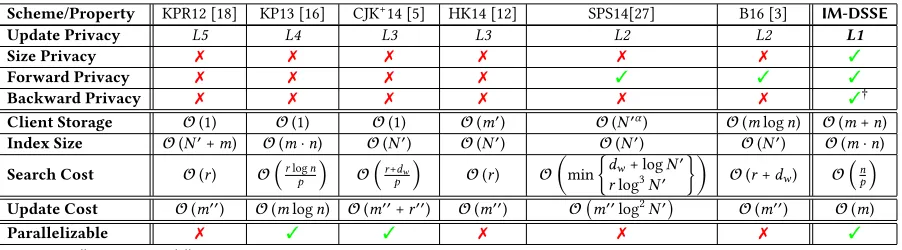
Table 1: Security and asymptotic complexity of some state-of-the-art DSSE schemes.
Scheme/Property KPR12 [18] KP13 [16] CJK+14 [5] HK14 [12] SPS14[27] B16 [3] IM-DSSE
Update Privacy L5 L4 L3 L3 L2 L2 L1
Size Privacy 7 7 7 7 7 7 3
Forward Privacy 7 7 7 7 3 3 3
Backward Privacy 7 7 7 7 7 7 3†
Client Storage (1) (1) (1) (𝑚′) (𝑁′𝛼) (𝑚 log 𝑛) (𝑚 + 𝑛)
Index Size (𝑁′+ 𝑚) (𝑚 ⋅ 𝑛) (𝑁′) (𝑁′) (𝑁′) (𝑁′) (𝑚 ⋅ 𝑛)
Search Cost (𝑟) (𝑟 log 𝑛𝑝 ) (𝑟+𝑑𝑝𝑤) (𝑟) (min {
𝑑𝑤+ log 𝑁′
𝑟 log3𝑁′
}
) (𝑟 + 𝑑𝑤) (𝑛𝑝) Update Cost (𝑚′′) (𝑚 log 𝑛) (𝑚′′+ 𝑟′′) (𝑚′′)
(𝑚′′log2𝑁′
) (𝑚′′) (𝑚)
Parallelizable 7 3 3 7 7 7 3
†IM-DSSEIIandIM-DSSEI+IIschemes in ourIM-DSSEframework offer backward-privacy (see Section 4).
∙ 𝑚and𝑛denote the maximum number of keywords and files, respectively.𝑚′< 𝑚and𝑛′< 𝑛denote the actual number of keywords and files, respectively.𝑁′≤ 𝑚′⋅ 𝑛′is # keyword-file pairs.𝑚′′=# unique keywords included in an updated file,𝑟 =# files matching search query,𝑝 =#
processors,0 < 𝛼 < 1,𝑑𝑤=# historical update (add/delete) operations on keyword𝑤,𝑟′′=(accumulated) # unique keywords being newly added.
∙We omitted the security parameter𝜅for analyzed complexity cost. Update privacy levels{𝐿1, … , 𝐿5}are described in Section 4.
network setting when the server data were stored on a SSD hard drive. For the search operation, the detailed costs ofIM-DSSE𝗆𝖺𝗂𝗇andIM-DSSEIschemes are the same as those of the desktop setting
be-cause computations were performed by the server while the client only did lightweight computation to generate the search token. In theIM-DSSEIIscheme, the client computation contributed almost 100%
to the total delay due to(𝑛)number of AES-CTR decryptions, compared with that of(𝑛) /128in
IM-DSSEI+IIwhich was all dominated by the data transmission delay. The limitation of computational
capability of the mobile device is reflected clearly in Figure 7b, wherein the client computation cost ac-counted for a considerable amount of the overall delay of most schemes except forIM-DSSEI+IIscheme. Asymptotic performance comparison.Compared to Kamara et al. in [18], which achieves optimal
sublinear search time but leaks significant information for update, ourIM-DSSEframework has linear