Accepted Manuscript
Extending the framework for Mobile Health Information Systems
Research: A Content Analysis
Shah Jahan Miah , John Gammack , Najmul Hasan
PII:
S0306-4379(17)30163-1
DOI:
10.1016/j.is.2017.04.001
Reference:
IS 1213
To appear in:
Information Systems
Received date:
15 March 2017
Revised date:
12 April 2017
Accepted date:
12 April 2017
Please cite this article as: Shah Jahan Miah , John Gammack , Najmul Hasan , Extending the
frame-work for Mobile Health Information Systems Research: A Content Analysis,
Information Systems
(2017),
doi:
10.1016/j.is.2017.04.001
ACCEPTED MANUSCRIPT
Highlights
•
This paper describes findings of a comprehensive content analysis on the
current state of m-health research for IS researchers and professionals.
•
The paper identifies eight application categories (themes), ten design issues
(security, privacy, literacy, accessibility, acceptability, reliability, usability,
confidentiality, integrity, knowledge-sharing and system flexibility) as well as
the stakeholders and development techniques involved.
ACCEPTED MANUSCRIPT
Extending the framework for Mobile Health Information Systems
Research: A Content Analysis
Shah Jahan Miah
Information Systems Discipline, College of Business, Victoria University,
Footscray Park Campus, Melbourne, Australia
John Gammack
College of Technological Innovation, Zayed University, Abu Dhabi, United
Arab Emirates
Najmul Hasan
MRC Bangladesh Ltd, Dhaka, Bangladesh
Abstract
Whilst researchers and professionals recognize that mobile health (m-health) systems offer unprecedented opportunities, most existing work has comprised individual project-based developments in specialised areas. Existing review articles generally utilise medical literature and categories: none investigates m-health from an information systems (IS) design point of view. Identifying application areas, design issues and IS research techniques will demonstrate models, issues, approaches and gaps to inform future research. A comprehensive analysis of the literature from this viewpoint is thus valuable, both for theoretical progression and for guiding real-world innovative system developments.
Drawing from key IS and healthcare multidisciplinary journals we analyse recent (2010-2016) articles concerning m-health application developments and their associated design or development issues, with particular focus on the use of contemporary research methods. Our analysis suggests that m-health is an emerging field to which, although underused, contemporary approaches such as design science research are particularly appropriate. We identify eight application categories, eleven design issues (security, privacy, literacy, accessibility, acceptability, reliability, usability, confidentiality, integrity, knowledge sharing and flexibility) as well as the stakeholders and development techniques involved. This goes beyond previous frameworks, and theoretically integrates the central role of IS design within the sub-field.
Keywords: m-health, design science, mobile-based innovations, content analysis, information systems design
methodologies.
ACCEPTED MANUSCRIPT
1
Introduction
Research on healthcare applications design for mobile devices (M-health) has gained increasing attention over the past decade. M-health broadly refers to a service or mobile application for providing healthcare support to anyone, anytime, and anywhere [10]. M-health aims to provide health professionals, patients, clinicians and other relevant users with information support services to manage, disseminate, collect, administer, control and monitor healthcare information and improve health service delivery and quality of care support. The service provided by various m-health information systems (IS), eliminates geographical and temporal constraints while enhancing the coverage, quality, cost savings and other user provisions of healthcare [15, 51, 76].
M-health IS provide information services that facilitate, inter alia, onsite patient care, community wellbeing and self-care, clinician decision making, administrative mobility and personalization support provision both for service receivers and service providers. Various innovative M-health IS have been proposed and many forms of m-health applications have thus been developed as fully functional system solutions. Currently M-health IS offers not only personalized access to applications through mobile devices, but also provides associated data from various sensors, automatic trackers and relevant stakeholders, for real-time actions. Through Internet enabled wireless networks, and/or other forms of connectivity such as Bluetooth, m-health innovations allow acquisition, monitoring, forecasting, sharing and control of various health conditions. Such provisions are designed for healthcare personnel and patients with disparate needs to make decisions regarding treatments and care support, and serves administration requirements for developing anytime-anywhere service support. Illustrative examples include: M-health systems for remote patient monitoring [4], disease prevention and wellbeing [78], knowledge exchange [59] and medication management [39]. To date many such initiatives have been developer-driven and theoretically piecemeal, and inconsistent or lacking in their generalisabilty either to knowledge or theory. The continuing flow of such M-health studies indicates a need for a contemporary research framework that may help better to formalize this sub-field within IS research.
Within the IS literature Varshney [76] analysed 129 selected articles from IS, biomedical informatics and health informatics outlets up to 2012 and identified four major areas of M-health with associated research challenges. The areas are: expanding healthcare coverage, improving decision making, managing chronic conditions and providing suitable healthcare in emergencies. The defined challenges are grouped as being related to (a) patients, (b) healthcare professionals, (c) IT and (d) applications. The aim of this effort was to suggest further research directions within the four categories but also acknowledged that other categories would be required for this proposed M-health framework to become comprehensive. Hussein et al. [27] reviewed 133 articles on smartphone medical apps across medical and technical repositories and found most articles described apps for specific diseases or subfields, or were general reviews. Only 5 addressed general frameworks and only one addressed the developer’s perspective, a classification of 200 IOS apps, by Liu et al. [41]. Both Zein et al. [82] and Sahinoglu et al. [63] note the absence of systematic reviews on testing and verification of mobile apps, including M-health apps. Zein at al’s observation that “there are currently no available comprehensive systematic review studies in the area of mobile and smartphone application testing” [82, p.334] motivated their own study
in this area.
ACCEPTED MANUSCRIPT
selected these are often ad hoc properties of a sample chosen purposively. When a field is still emerging at a rapid rate, it is unlikely that any categorisation induced from its earliest articles will have general utility beyond the classification purpose or provide enactment and long-term stability. The paper by Kallander et al. [36], for example, cited various numbers of thematic categories that had been suggested in the M-health literature, from which they chose a 6 items typology (see [82]).
Naturally, all systematic literature reviews are limited by the articles available at the time of sampling, as Fiordelli et al. [20] note with regard to their own review. Fiordelli et al. [20] actually split the decade to 2012 into two halves, noting a sudden exponential growth with the advent of smartphones around 2008, with distinctive patterns in each half.
In the various existing review articles on M-health , other than Varshney [76], who identifies IT and application areas of research challenge, IS considerations are far removed from their primary focus. Although there are several conference papers represented, IS journals provide only 16 M-health articles in his sample and his analysis shows that only about 11% of all M-health articles address application design, development and testing: well behind the other three areas. However, understanding what types of application development methodologies are used for M-health and their design issues is imperative to offer better understanding to M-health designers, IS researchers and industry practitioners in their further innovative developments of M-health applications. Whilst the reviews to date find no shortage of developed apps and pilot studies towards medical outcomes [75] these provide little contribution to research knowledge and there remains little specific contribution that can guide IS development in this field. As a contemporary IS method, Design Science Research (DSR) [25] provides explicit approaches by reinforcing - not only IS design innovation (e.g. product and process perspectives) but also methodological innovation [24]. DSR requires both a rigorous contribution to knowledge, and a development of knowledge relevant to stakeholders’ practices. Nevertheless, to date very few studies seemed explicitly to apply the DSR approach in M-health. We therefore wished to explore in more systematic detail how M-health innovations are being developed, and the role of design science approaches within that.
To formalize the M-health design sub-field and extend the current frameworks and understanding, we used a bottom-up approach to conduct an IS focused literature review and analysis through the use of a qualitative content analysis method [12]. We aim to identify the scope and prospect for potential use of DSR in M-health design. Prior to conducting the analysis we chose an IS design lens that both encompasses identifying the range of human user roles, and also the design issues and methods used for developing and evaluating M-health artefacts: areas lacking in the previous M-health studies reviewed. This responds to the more recent calls for design collaboration and IS focus in M-health app development that are now becoming evident [9, 35].
Under this approach, we set two main objectives for our literature analysis. The first objective was to attain better understanding on M-health research emerging themes, stakeholders and key design issues and solution technologies (hardware, software and networking). The second objective was to find the forms of replicable methodology used, if any, to design M-health applications. In particular, we aimed to identify aspects of DSR in the existing research of M-health app development. This assessment will indicate the extent to which DSR methodologies both are used, and have further potential to apply, in M-health app design.
ACCEPTED MANUSCRIPT
an application of DSR in M-health app design. The section after that provides methodological details followed by the findings of the study. The discussion section describes the overall contributions of the research followed by a conclusion section in which we summarise and discuss limitations and further directions of the research.
2
STUDY BACKGROUND
2.1
M-health innovations
Although today’s M-health studies effectively began with the invention of the smart cell phone, in 1949, AT&T invented a program called “Mobile Telephone Service”, for providing health services to 100 towns and 5,000
customers in the US. However, the service experienced major technological issues as they used only three radio channels to provide only three customers at a particular time [60]. Laxminarayan and Istepanian [29] described M-health for the first time as “unwired e-med” and in 2003, as mobile communications technologies were further developed for healthcare systems, the term ‘M-health’ was redefined as ‘emerging mobile communications and network technologies for healthcare’ [29]. Mobile technologies are now rapidly growing due to popular uptake
along with emerging capacity in hardware and software as well as powerful cellular technologies, and companies such as Apple and Samsung have developed features in their mobile devices (e.g. tablets, i-pads, portable computers, mobile phones and personal digital assistants-PDAs), for health services which offer potential general provision of mobile health apps. This has engendered innovations in the ways healthy lifestyles and well-being can be supported, while linking technologies for health, health professional and individuals in social care systems [28].
An increasing number of apps, especially among the most used, are being linked to social media [31]. Social media allows people to be active participants in their health maintenance: virtually connected communities are enabling people to become more educated, supported, and more knowledgably to control and self-regulate their wellness in health- and lifestyle-related decision making [72]. Emerging technologies, responsive to individual profiles combined with Internet-based analytics, realise opportunities for new types of consumer-oriented innovations and enable new forms of community-based provision. A recent count found over 165,000 mobile healthcare apps, but cautioned on the lack of evidence for the safety and efficacy of many, as well as the non-adoption and the confusion entailed by the sheer amount of apps available [72]. Many healthcare providers are now “prescribing” apps, implying a need for objective quality vetting, regulation and perhaps certification, along with future integration into electronic health records and monitoring systems, all currently under-researched areas.
2.2
Previous reviews of the M-health literature
ACCEPTED MANUSCRIPT
Although new research designs and app rating or certifying mechanisms have begun to emerge, much of the literature describes individual, project-based application developments which do not offer generalised knowledge contributions, mostly being clinical trials or pilot studies [20]. Previous reviews of the M-health literature have also typically used top-down categorisations from the medical literature to identify research directions for specific areas of health, and their focus is largely that of medical journals’ interests. From the viewpoint of IS, understanding related to the solution themes, the development methods of M-health application and the associated design issues are poorly developed and lacking a theoretical framework. Although emerging as an “autonomous field of study” [20], studies in the area of M-health are rarely discussed in terms of the
ACCEPTED MANUSCRIPT
Existing studies Literature review methodologies Outcomes of the analysis
Conserve et al. [13] 7 articles; Narrative analysis M-health interventions for increasing HIV testing
Jennings and Gagliardi, [32]
173 articles; iterative thematic analysis
M-health to find influence of gender relations
Free et al [19] Three-part search strategy was implemented on several databases; narrative synthesis
Provided evidence of effectiveness of mobile computing and communication technologies to improve healthcare and health service
Payne et al. [56] 24 articles; qualitative synthesis M-health studies that are informed by behavioral theories or strategies
Nhavoto and Grönlund [51]
271 articles; 220 M-health technologies, 51 GIS, Narrative analysis
Captured existing understanding on how mobile technologies and GIS applications have been used for improving health care Mobasheri et al. [35] 185 mobile apps; Narrative analysis Identified the current barrier and potential
use of M-health apps related in the field of breast disease
Betjeman et al. [7] 109 articles; Thematic analysis Identified major issues and challenges of M-health for future research.
Kallander et al. [36] Several project documents, Two stage process, a thematic overview, the study only focused on 6 major thematic areas
The potential challenges and opportunities for integration of community M-health applications
Martinez-Pérez et al. [44]
371 papers and 557 apps related to the leading causes of death; comparison study
Identified top 10 causes by comparing the amount of M-health research and the number of mobile apps dedicated to the diseases and conditions that led to human death.
Catalani et al. [8] 62 articles; qualitative data synthesis Relevance of M-health interventions for HIV treatment and its prevention
Silva et al. [69] 35 articles; content survey M-health technologies growth, its regulation, and legislation issues
Varshney [76] 129 articles; structured survey out of 16 IS journals
Findings major themes, research issues, and a framework to describe M-health
Table 1: Previous M-health literature review studies
The typical emphasis of these reviews is instrumental: focusing on emerging directions in M-health associated with medical or social categories. The review by Jennings and Gagliani [32] for example selected only articles related to developing countries, and whose findings concerned gender dynamics. Kallander et al. [36] used predefined M-health themes from the literature to assess how low-middle income countries were approaching the intersection of mobile technology and public health and identified the key challenge of moving from “pilot projects to national scalable programs”.
Although IT and apps are centrally involved, the reviews rarely consider IS issues. Indeed this is an explicitly acknowledged delimitation of the otherwise comprehensive review by Fiordelli et al. [20] who excluded technology-oriented databases in favour of medical and socially focused sources of articles. Fiordelli et al. [20] reviewed the decade of M-health research from 2002-12 to assess the impact of mobile phones, describing the field’s monotonic and at times exponential growth and categorising articles by medical conditions, usually
ACCEPTED MANUSCRIPT
cited evidence that the US store alone had more than 40000 healthcare apps as of 2013, whilst Varshney [76] claimed there were over 100000 M-health apps available across various devices at the time his research was
done. The research based 165,000 figure of IMS [31] and the 259 000 figure of research2guidance (2016)1 indicates the current trajectory and scale of development of healthcare related apps. Payne et al.’s [56] literature review identified 24 articles on mobile apps for M-health behaviour interventions, but these were found to be mainly pilot or feasibility studies. Although review articles of M-health apps are beginning to emerge, (e.g. [64]; [50]) these also tend to have outcomes relevant to specialised medical practitioner audiences. Despite several apps being available, both of these recent articles conclude that functionality is lacking and that there is a need for more relevant app development for the areas reviewed (iatrogenic infection and gout respectively). Like others (e.g. [35]), Schnall and Iribarren [64] specifically call for collaboration between medical specialists and IS developers.
2.3
Major methodologies for M-health innovations
The proliferation of apps indicated earlier, with wearable or implantable monitors indicates the demand potential, but development is generally not research-led, and untested or ill-informed apps can be actively dangerous. Diagnostic inaccuracy, unreliable, (or reliable but invalid) measures, inappropriate treatment recommendations and data breaches or misrepresentation are just some of the recognized outcomes from improperly designed solutions [28].
Many current M-health innovations are, however, designed through the use of traditional development system methodologies that encompass steps or iterations for identifying and analysing requirements, designing or implementing a system solution and testing the system within the problem domain. For instance, Radzuweit and Lechner [61] utilised prototyping for designing a consultation service that supported effective interaction between individuals and health professionals. Milošević et al. [47] used a basic software engineering
methodology for designing an M-health application for community well-being by monitoring individuals’ health conditions such as physical activity, weight and heart activity. The methodology consisted of common phases such as problem definition, architecture (mobile computing) design and implementation. Chatzipavlou et al [9] stressed the “executive role of developers” and their specific need to understand legal and financial aspects to
gain user confidence with the apps they develop: embodying a traditional developer-centric perspective.
Many of the M-health innovations designs, however, do not evaluate the solution directly or indirectly with the target user groups. For instance, Oluwafemi et al. [53] proposed a patient communication solution through messaging but, although the study used phases such as design, development and evaluation, the authors did not evaluate the solution with the target user patient group. Moreover, Zein et al [82] have identified a lack of systematic testing in mobile app developments and specify several areas where gaps exist. Although the later phases are neglected, many M-health developments display a traditional methodology of system design starting with requirement identification and analysis then software design and development continuing through to testing, implementation and maintenance. The Scandinavian, socio-technical and user-centred traditions have all variously argued for the continuing participation of stakeholders in this process, and designing for relevance to
1
ACCEPTED MANUSCRIPT
the realities of the operational environment, which itself may require redesign and change management, values recognized within the newer development models and methods of DSR.
2.4
Design Science Researchmethodologies
Design Science Research (DSR) represents development, implementation, evaluation, and adaptation of artefacts for contextually relevant problem solving [25] and its traditional focus on the design and construction of solution artefacts suggest its utility for M-health applications. Because badly designed health applications can be dangerous, it is therefore important to emphasise the use of an appropriate design methodology for quality innovation design in the M-health sector.
DSR offers improvements over traditional methodologies in designing IS artefacts, so understanding DSR is of significance for M-health design. DSR provides methodologies that have roots in engineering and the artificial sciences [71]. DSR “seeks to create innovations that define the ideas, practices, technical capabilities, and products through which the analysis, design, implementation, management, and use of information systems can be effectively and efficiently accomplished” [25, p. 76]. DSR is particularly relevant for innovative solution
designs for M-health applications because it better supports designers/researchers in establishing grounded knowledge and in embedding behavioral or human aspects into the design of artifacts to solve real world problems [65].
Hevner et al’s [25] guidelines are intended to be supportive to designing IS artefacts in form of constructs, models, methods, and instantiations [42]. M-health solutions are composed of mutable and adaptable hardware, software, and human interfaces and presents unique and challenging design problems that call for new and creative methodological ideas, to which DSR is relevant. However, although the design steps commonly used for developing and evaluating M-health innovations in many IS solutions may be similar to design guidance of DSR methodologies, none of the M-health design studies reviewed previously explicitly utilised DSR. Previous literature reviews have not inventorised the design methodologies nor assessed their current status in the literature.
2.4.1 An illustrative case of Design Science Research in M-heath app design
Before beginning our content analysis we describe a case study to illustrate the development of an M-health solution app developed using Design Science Research to show how the various constructs and guidelines used apply in the context of a representative M-health study.
ACCEPTED MANUSCRIPT
Using DSR methodological guidelines the M-health application was designed through engaging medical professionals and citizen groups – outlining the basic user demand for general practice services. Cognizant of the increasing pervasiveness of mobile phones and social media usage, the solution targets the demand of Bangladeshi rural citizens, who do not have adequate access to healthcare support in general practice, but who do have mobile phones and capable telecommunication infrastructure. In the adopted approach, Hevner et al’s [25] seven guidelines were grouped into three broad activities (identifying target problems and solution types; artifact creation and evaluation and finally research contribution and communication of research). The three project phases represent design and development guidance for M-health apps as illustrated below.
Prior to producing the artifact (Hevner et al’s guideline one) we used guideline two to identify the specific problem of relevance. Our project identified a target population within the problem domain of general practice healthcare and produced a mobile decision support artefact designed to support healthcare decisions for rural patients in Bangladesh.
Second, for artifact evaluation (guideline three), the utility of the initial artifact was demonstrated to obtain feedback from target users (representative stakeholders). Evolutionary prototyping development in consultation with doctors (representative knowledge sources) ensured ongoing evaluation of quality and relevance during development. Following guideline five for ensuring research and artifact construction rigor, iterative prototyping is standard practice, and a social media based doctor rating technique was used to validate the artefact following generally accepted research procedures (observational and descriptive methods). Using guideline six (design as a search process), valid healthcare knowledge was established through iterative development and evaluation in order to cope with much of the uncertainty inherent in the problem space (e.g. patients’ concerns relevant to general practices and emergencies were separated from the primary medical and healthcare requirements) to allow progressive and incremental solution development at a level that would fit the usage context.
Finally, the third activity phase identifies the research contribution and communicates the outcome to a professional community in order to express its value within the relevant body of knowledge. Using guideline four the study used experimental and focus group methods and analysis showed clear benefits to the target populations in rural areas of Bangladesh. The approach connects citizens to doctors based on the queries and information provided by the patients. Available doctors evaluate a patient's condition and provide answers for diagnosis or treatment. Using guideline seven, the study presented detail relevant to academic, management and industry professionals, and was verbally presented to such audiences in workshops and presentations during its development and evaluation.
Following Gregor and Hevner [24], the study further ensured the principles of form and functions incorporating underlying constructs were described, including scope of artifact design, mutability of artifact, testable properties, new knowledge justification, kernel theories, principles of implementation and the expository instantiation.
ACCEPTED MANUSCRIPT
recent work in M-health, their contributions, and the methods used by the developers, with particular focus on design approaches.
2.5
Research Questions
Nunamaker et al. [52] stated that a body of knowledge comprises of research domains and research methodologies, and that, “A research process involves both understanding the research domains, asking
meaningful research questions, and applying valid research methodologies to address these questions. Results from a good research project contribute to the body of knowledge by expanding knowledge in a given domain”
(p. 91). IS design is a broad, varied and evolving research domain with many sub-fields and application areas. An objective of this study is to conceptualise M-health research as a distinct sub-field of IS research, through analysis of prior literature and design approaches taken. Very few previous M-health studies have attempted to reflect on their chosen methods, or on the relation of their work in the context of a body of knowledge. Our work therefore addresses the following research questions (RQs):
RQ1: What are the themes and associated design issues in published M-health literature?
RQ2: What are the design details of M-health applications reported in previous M-health designs? RQ3: How do these studies relate to design science research knowledge?
The answers to RQ1 and RQ2 are generated through a systematic content analysis, RQ3 is then considered separately against this background to extend our understanding of M-health research in IS.
3
Method
3.1
Target area of interest
The main aim of the study is to identify and analyse recent M-health studies, to classify emerging themes and to explore solution designs and methodologies used in M-health applications design. This extends and updates Varshney’s work [76] where the aim, based on literature prior to 2012, was to develop knowledge around M-health IS design themes to inform future research agendas. Secondly, to detail the use of IS methodologies in existing M-health app design which had not been a focus of previous reviews. In the Design Science Research (DSR) literature, Hevner et al. [25] defined four types of IS solutions (artifacts), namely constructs, models, methods, and instantiations. Gregor and Hevner [24] extended this by adding design theory as a fifth type of IS artifact, marking an essential difference from traditional reporting of a specific development by an explicit consideration of its relationship to a body of knowledge. We accordingly aim to investigate the recent M-health design literature using this typology, identifying both literature analyses, and specifically relevant M-health conference and journal articles. We distinguish these by primary concern, whether focusing on design or development issues, application developments, or design theories (figure 1), selected as described below.
ACCEPTED MANUSCRIPT
3.2
Sample articles and their sources
We used a bottom-up approach for collecting our sample articles. That is, we didn’t initially select the specific outlets for selecting the sample articles but rather conducted an independent search using keywords across various databases such as Sciencedirect, NCBI, and Google scholar. Keywords both represent the essence of articles and indicates new literature to examine, and their choice is critical. Although we were most interested in recent literature, we filtered from 2004, since this was a landmark date in DSR conceptualisation. Using the terms “design science (research)” and “{mobile,m} health” as initial filters on the ACM digital library,
Sciencedirect and Proquest databases we however identified only a handful of peer reviewed articles since 2004, with only 4 articles (conferences or journals) before 2011. We therefore expanded the terms used (e-health and apps or applications) and the databases used to ensure better coverage of relevant articles.
Following the proposal of Dieste et al. [14] for developing an optimum search strategy, “mobile health” was initially searched in Google scholar to find relevant multidisciplinary journals in various databases yielding around 100 results related to “mobile health”. Then we used specific terms (e.g. “applications”, “applications design”, “design research”), in Boolean searches [58]. Depending on the search syntax for each database, the full
text of the journal articles and conference proceedings published in English were also searched using the following search strings:
(mobile health OR mHealth) AND (apps OR apps design OR design research OR design issues) Telemedicine AND (apps OR apps design OR design research OR design issues)
(Healthcare OR mhealth) AND (mobile OR decision framework OR applications OR technology OR information systems)
This also expanded the journal base beyond IS journals to relevant multidisciplinary journals. The databases searched were as follows: Springer Link, Science Direct, ProQuest Central, EBSCO online database, Wiley Online Library, NCBI database, IEEE Xplore and the ACM Digital library.
ACCEPTED MANUSCRIPT
Figure 1: M-health areas of focus in existing studies
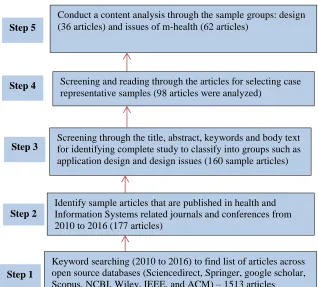
We classified the journals into two groups: top high-impact journals (such as DSS, EJIS, JAIS, MISQ, JIT, ISR, ISJ and JMIS, (ranked as top eight IS journals by ACPHIS) and lower impact or domain-specific journals (e.g. the multidisciplinary journals publishing M-health papers, such as Journal of Medical Internet Research, (JMIR), mHealth and uHealth, Diabetes technology & therapeutics etc). The process used to identify and select articles is shown in figure 2. Tables 2 and 3 show the pattern of results from our search and with a modal number of articles of 1, shows there is a wide range but no dominant or central outlets. It also indicates there is no particular upward trend in the number of publications. With small numbers, this is not significant, but is consistent with a nascent field of study. Note that the “Journal of mHealth” has operated since 2014 but is a professional, rather than an academic journal. For further sample details please see Appendix A: we now look more specifically at the content of the identified articles.
Other Relevant Studies
m-Health Research
M-health Applications Design M-health Design
Issues
Literature Review
Design Theories
Journal Articles [30] Conference Articles [06]
Research in 2010 to 2016
Journal Articles [45] Conference Articles [13]
Journal Articles [03] Conference Articles [01]
Journal Articles [12] Conference Articles [00]
Journal Articles [41] Conference Articles [12]
ACCEPTED MANUSCRIPT
Figure 2: Five-step methodology for sample collection
3.3
Content analysis
Content analysis is an analysis method that can variously use qualitative and quantitative research techniques. The method can be applied for exploring and analyzing data or content directly obtained from written documents, as well as from human interaction processes [21]. Using qualitative methods, the method is useful to enhance the ability of researchers to exploit documents as important sources of information to identify new phenomena. Many IS researchers have applied the content analysis method both for qualitative and quantitative analysis in different IS research domains. For example, Al-Debei and Avison [1] used content analysis in their analysis of business model concepts using IS literature while Arnott and Pervan [2] explored previous articles of DSR in relation to decision support systems (DSS) design research. Indulska and Recker [30] also conducted qualitative content analysis on DSR articles to establish the claims of these articles’ usage of DSR methods in IS
research. In our research, we followed the approach of Arnott and Pervan [2] to analyse both types of articles, as the approach guided to produce useful insights and current state of the DSS research.
The result of a qualitative content analysis provides a summary of the original information and can be presented in the form of concepts and/or categories that express the investigated phenomenon. For conducting effective content analysis inductive analysis is appropriate when “there are no previous studies dealing with the phenomenon or when it is fragmented” [17, p.107]. We analyzed both types of articles using the inductive method, for classification and categorisation of the attributes. The articles were collected to gain insights on their
Keyword searching (2010 to 2016) to find list of articles across open source databases (Sciencedirect, Springer, google scholar, Scopus, NCBI, Wiley, IEEE, and ACM) – 1513 articles
Screening through the title, abstract, keywords and body text for identifying complete study to classify into groups such as application design and design issues (160 sample articles)
Identify sample articles that are published in health and Information Systems related journals and conferences from 2010 to 2016 (177 articles)
Screening and reading through the articles for selecting case representative samples (98 articles were analyzed)
Conduct a content analysis through the sample groups: design (36 articles) and issues of m-health (62 articles)
Step 1 Step 2
ACCEPTED MANUSCRIPT
issues, themes and methodologies utilised in designing M-health, and also to reveal the extent of use of methods related to DSR.
We were guided by the three phases of preparing, organising and reporting described by Elo and Kyngäs [17]. The preparing phase aims to form a categorization based on related and common characteristics from a collection of grouped codings or headings. This includes an interpretation process that helps identify categories that describe the phenomenon that has been analysed [17]. The first concern is to determine what to analyse: in this case we prepared 98 articles retrieved from databases using research-relevant terms.In the organising phase we manually went through each article to identify the issues, key themes and how the design was conducted. Although a small total, we believe it is sufficient to represent the issues. We separated issues focused papers from M-health design focused articles where we identified their design process description, evaluation methodologies and rigorous processes employed. These enact existing IS design methodologies and can be loosly mapped to the explicit DSR guidelines of Hevner et al. [25]. Finally, for reporting purposes (to summarize the outcome of the content analysis) we have represented our findings using the structures of Varshney [76] for issues and of Hevner et al. [25] for design. The next section will describe the findings of our analysis.
4
Findings
The section describes the findings revealed in two separate analyses. First we briefly describe the issues emerging, and indicate some areas from recent papers not identified in the earlier studies reviewed, which had been based on an earlier sampling period. We then focus in more detail on the techniques and technologies used.
4.1
Issues of M-health IS design
Our content analysis of the articles identified as having a primary focus on M-health issues per se identified 20 areas of innovative M-health apps for stakeholders including patients, healthcare givers, doctors and healthcare professionals. The areas are patient monitoring, self-management, disease prevention, adherence improvement dietary control, evidence based practices, early intervention in childhood, medication compliance for elderly populations, therapeutic support, treatment support, interaction support between doctor and patients, home monitoring, healthcare data collection, clinical decision making, and public healthcare service etc. We found the majority of apps were designed for patient support (such as self-care and remote monitoring) with fewer apps for healthcare professional and care-givers. The most common target audience for the apps developer was those with chronic diseases or older adults. It was evident that majority of the app developers came from technological backgrounds rather than having domain specific or medical knowledge.
ACCEPTED MANUSCRIPT
Figure 3: Eight emerging themes (innovation areas) of M-health IS research
The themes are defined as follows:
Theme 1: Expanding healthcare coverage
M-health allows provision across the different locations of patients and healthcare professionals. Service to remote or otherwise underserved regions is enabled. Real time support via low-cost short message service (SMS) based remote monitoring is gaining popularity (e.g. [67]). Likewise sensor based monitoring applications can be linked and transmissions recorded as usability and feasibility of collected sensor data expands [18, 26, 37]. Through networks of sensor nodes, and network cameras with image processing, P/T/Z operation, TCP/IP management for mobile healthcare service remote monitoring, diagnostics and treatment interventions become enabled. Involving healthcare professionals in app design augments the technological potential. In the weight loss program of Shaw et al. [67] for example, Rothman’s Behaviour Change Process [62] was considered during application development. In areas where patients are underserved, such as the developing nations, remote or rural areas, or where there is a shortage of physicians or long waiting times, further research using such technologies within effective information systems is needed.
Theme 2: Improving decision making
Due to increased mobility in support services decision making in healthcare industries has been improved in relation to prevention, diagnosis, data collection, treatment, adherence monitoring and surveillance using mobile networks [5]. Appropriate decision-making depends on the validity and reliability of the data collection, error
m-Health
Application
Expanding healthcare coverage
(e.g [34, 53])
Improving decision
making
(e.g. [61, 76])
Managing chronic conditions
(e.g. [74, 76])
Providing suitable healthcare in emergencies
(e.g. [23, 76])
Improving training support
(e.g. [45,69])
Motivation or self support
services
(e.g. [67, 74])
Improving hospital management
(e.g. [11, 26])
Supervision support services
ACCEPTED MANUSCRIPT
checking and observation. Through remote and timeous data collection over wireless networks appropriate and necessary actions can be taken promptly. Using M-health protocols like color coding, symbolic presentations and use of alternate screens it is easy to develop clinical strategy and improve usability [76] in diverse aspects of clinical decision making, at both healthcare professional and patient level.
Various strategies have been developed to provide decision support to healthcare industries both for disease assessment and treatment provision. Radzuweit and Lechner [61] developed a hybrid IT-artefact using common Web technologies like HTML, CSS and JavaScript, from which healthcare management improved their reasoning strategy and changed their knowledge and skill to develop their decision making. Wireless based systems using GSM/GPRS can provide real time disease diagnostics and give quick decisions, which are also cost effective. For example, ECG signals through Bluetooth devices can be transmitted using AliveECG software [38]. Banos et al. [5] described a sensor-based application named Shimmer2 supported by the M-health Droid Communication Manager that successfully provided an open framework for taking instant decisions in healthcare management. Many chronic patients like diabetics or asthma patients are also now used to M-health applications and are able to improve self-efficacy. Researchers have found that patient healthcare behaviour has changed using self-reported electronic diaries. Wolf et al. [80] for example found significant benefits from patients using a mobile/web e-health diary and symptom tracking tool compared to traditional care. Clinical DSS are likely to remain an important area of M-health IS research.
Theme 3: Managing chronic conditions
M-health technologies can foster greater commitment for better managing chronic disease. A design research approach by Radzuweit and Lechner [61] suggested shared tablet computers could enhance the relationship between patients and healthcare providers for managing chronic conditions. If web apps are not available, researcher(s) have readily found mobile alternatives, e.g. Android supported apps using java script. In Wolf et al’s [80] study the mobile app was preferred to the equivalent web app. In the development phase many
developers have used PHP due to its logical approach and created the supporting databases using MySql. But HTML technology combined with JavaScript is very well-suited to developing apps that helps elderly people or chronic patients self-manage and report in a user friendly environment. Wearable sensor and portable biomedical systems also improve the condition of chronic diseases. Tools like mobile adapters, smart watch adapters, bracelet adapters and belt adapters help to improve care of chronic conditions in self-care management. For example M-healthDroid, an open framework for building M-health apps [5] can be used to build apps that investigate and visualise human behaviour or make knowledge-based inferences and give quick feedback. Wireless technologies like WiFi, 3G connection, Bluetooth, geo-positioning technologies (GPS), are configured to mobile apps means (e.g. elderly) people’s activities can send feedback to the professional enabling alert generating, providing notifications and self-guidelines and likewise for controlling eating disorders as patients self-monitor meals, emotions, behaviours, and their thoughts. Reliability and acceptability of wearables, adoption and usability are all areas to which IS research can contribute.
Theme 4: Providing suitable healthcare in emergencies
ACCEPTED MANUSCRIPT
patient e.g. elderly people who may not get proper care at specific periods. In this situation, M-health applications can provide better emergency service like reminders to take medicine [23]. With telemedicine systems emergency services are easier to provide as well as enabling remote monitoring. Accordingly, self-management procedures at emergency times are increasing. For example, even the electrocardiogram (ECG) can be cost-effectively done from the patient’s home during an emergency period. Transmitting ECG signals and lab reports can be done using a wireless telemedicine system with mobile network technologies like GSM/GPRS as an alternative to cabled network, and PHP and MySql were used for developing the apps where standard bandwidth in the control system is sufficient to record the ECG [38].
Expert involvement however, both technical and psychological, is critical to such system design and development. Apart from accurate detail measurement, there is emphasis on security issues of the application especially on data transmission [40]. Goyal et al. [23] considered social cognitive theory (SCT) in designing and developing apps for remote and emergency services. Both socially and technically focussed IS/IT are applicable research lines in emergency healthcare.
Theme 5: Improving training support
A healthcare provider is an individual, group or organization who provides observation facilities, preventive attitude, curative advice as well as rehabilitation in healthcare service in a systematic way to the patients. With M-health technology a patient’s roles begin to overlap those of a healthcare provider. Provider strategy nowadays is changing towards patient training using (effectively ubiquitous) portable and mobile devices. On the other hand physicians are becoming used to mobile technology for supplying training to patients and also for collecting medical data using self-trained mobile apps.
Some mobile games with learning activities can also help patients share the healthcare provider burden. For example a mobile phone “dice/chess” game helps rehabilitate neuro-damaged hand movements [81]. Barbosa et al’s [6] interdisciplinary team used mobile games to support a “normalized” schooling experience for young
oncological patients. Some mobile app development environments e.g. “iBuildApp” has led to apps developed by medical students, who are non-professional in apps development [45]. Education and training to replace or supplement professional care is available for mental health issues such as general anxiety disorder and post-traumatic stress disorder. Without the help of psychiatrists, apps developers have developed many such mobile apps for mental health but these have often proved ineffective or even risky [3], and a Collaboratory for Psychiatric App Development, stressing clinician involvement has be formed in response [79]. Especially when science, policy and regulation are lagging, such examples simultaneously reinforce the need for informed medical input, and for ensuring effective IS design for patient-relevant contexts. Evaluating end-user or participatory app development methods, and game-based or other protocols for effective training, education and rehabilitation as IS aspects relevant in this sector.
Theme 6: Motivation support services
ACCEPTED MANUSCRIPT
opportunities in this regard, including motivating “forgetful” patients through SMS. Shaw et al.’s [67] study indicated a increased acceptance of the SMS in delivering health service, and led to development of a web based SMS provider protocol.
Mobile apps can focus on target behaviours that benefit a patient’s health. For example one M-health
application, SapoFitness [66], helps to keep a personal health record, enables an auto alarm service and can share information in social networks. Mobile apps, linked to wireless medical peripheral devices can assist self-control for various types of chronic disease patients. The Bent II mobile app for example was integrated with TELUS Health Space (Microsoft HealthVault) for self-monitoring for diabetics [23]. Social-cognitive theories provide models widely used in applied health for behavioural change [66], and encompass control of psychological determinants, observational learning, and self-regulation; all supportable by mobile apps, often free on app stores. Motivation is managed in the Mobile RehApp™ game, developed for ankle sprain rehabilitation using augmented reality technology [22], since traditional rehabilitation exercises are “boring”.
On the other hand, there are medical conditions which patients are embarrassed to disclose face to face with a doctor. Oluwafemi and Olanrewaju [53] discussed this situation where patients use mobile health apps to describe problems and receive diagnosis within a secure and confidential network environment. The data are secured through biometric verification of the patient and at the other end, the software verifies authorized login. Security, usability, gamification and the role of social media are all relevant research areas relevant to this segment.
Theme 7:Improving hospital management
Hospitals are organizations providing medical services, increasingly based on technology. Hospital management can be defined as the process, technical functions and activities, organized towards the goal of effective service provision. With mobile and wireless technology professional services can be provided both accurately and efficiently, and with proper design, securely and confidentially. Developing apps for portable devices can also enhance hospital management. For example, Jeong et al. [33] suggested personalized chronic disease care linked to mobile Electronic Medical Record (EMR) applications can provide significant change in healthcare service. As well as EMR linked apps, Choi et al. [11] also considered laboratory information systems (LIS), picture archiving and communication systems (PACS), and nurse information systems (NIS) all of which can improve hospital management. Typically, Android, java, C, C++, PHP and MySql are used to develop such apps for hospital use [47]. As well as continuing app development and testing, integration of systems and medical records suggests further lines of research.
Theme 8: Supervision support services
Administrative case management provides ongoing, real time support to patients. This acts primarily as the bridge between patients and healthcare provider and is known as supervision in healthcare management.
ACCEPTED MANUSCRIPT
enhances case management through capturing e-records or providing e-prescriptions [53]. Similarly cancer pain management and emergency healthcare service in remote area are supported through apps related to maintaining daily lives of patients [34, 54].
In the design phase of such types of apps attention must be paid to user validation, registration of the patients, doctors and laboratory scientists for security and confidentiality. On the other hand, usability issues are critical. This includes touch screen interfaces, which can improve interactive logging system accuracy and speed. Correspondingly, evaluation of the designed apps should be tested from the user perspective. Panou et al. [54] tested their Guardian Angel app for the elderly with 30 users and five experts after design and development to identify usability issues and future redesign proposals. Usability in general is a relevant line for further IS research into this aspect.
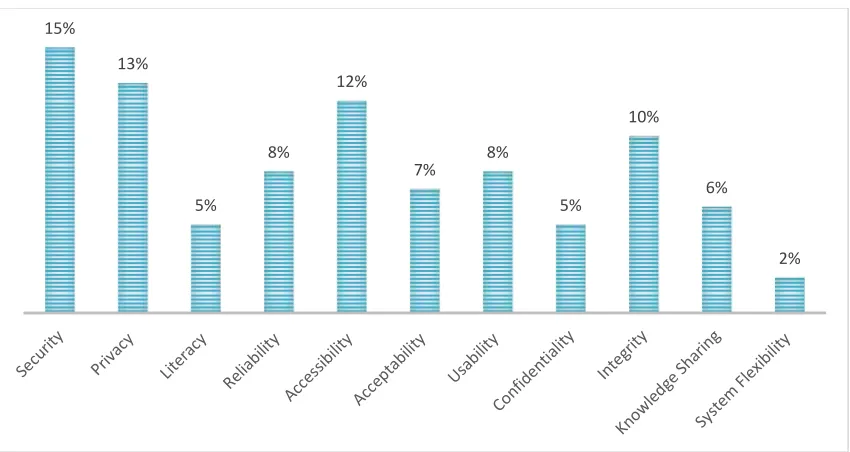
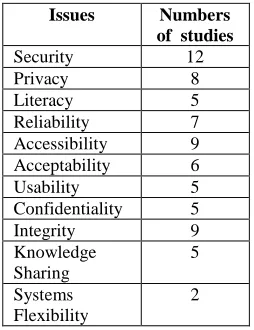
Our analysis of the sample found 11 IS issues that are regularly discussed in M-health studies, ranging from security to system flexibility. Figure 4 illustrates the number of studies that are related to each of these issues, though this analysis must meantime remain descriptive due to small numbers.
Figure 4: IS Issues identified in different M-health innovation studies
We then looked at the specific IT involved in the various studies, summarised in table 2.
15%
13%
5%
8%
12%
7% 8%
5%
10%
6%
ACCEPTED MANUSCRIPT
Table 2: Key IT choices used in M-health application designKey software technique (service providers and service receivers side)
Network technologies Special Hardware details
PHP and MYSQL database, Java
[11, 53, 61]
SQLite
[61]
Unity 3D engine
[6, 22]
C, C++, Microsoft Visual C++ 2010 compiler, HTTPS
[11, 67]
HTML code (investigated various mobile apps)
[45, and many others]
Autodesk Maya for 3D modelling, 3D Studio Max
[59 and many others]
Android SDK (Software Development Kit)
[22, 70 and many others]
Signal quality index (SQI) algorithm, Blowfish
algorithm [16]
Triple Data Encryption Standard (3DES)
[40, 70]
Froyo (Android 2.2 operating system) and
Gambit Scheme programming Language[57]
Wireless and GPS technology
[5, 11, 38 and many others]
wireless sensor network (WSN)
[26, 37, 81 and many others]
Mobile Augmented Reality (MAR) Technology
[22, 79]
Near-field communication
(NFC) technology [49]
Mobile Node
[70]
IEEE 802.15.4/ZigBee, Bluetooth Low Energy, IEEE 802.15.6, ANT/ANT+, Sensium, Z-Wave, RuBee, Zarlink
[43, 81 and many others]
Bluetooth wireless
communication [77]
Touch sensitive monitor
[11]
Jawbone UP24
[23]
7-lead ECG device
[10, 26 and many others]
Bluetooth
[5, 23 and many others]
Blood pressure
meterUA-767 [49]
Electronic pen and PIC24microcontroller
[68, 77]
Whilst particular technologies are not of primary interest in the present study, mainstream network technologies, including Bluetooth, along with standard programming languages, form the platform for most of the applications described in the articles, with relatively few individual cases using specialized hardware or software techniques. Further details are given in Appendix B.
4.2
Findings for M-health studies focussed on application design
ACCEPTED MANUSCRIPT
or a prototype), with relatively little contribution to conceptualization of the M-health research field. Very few studies indicated requirements for developing new design theories so they can be reusable as new knowledge (as shown in figure 5).
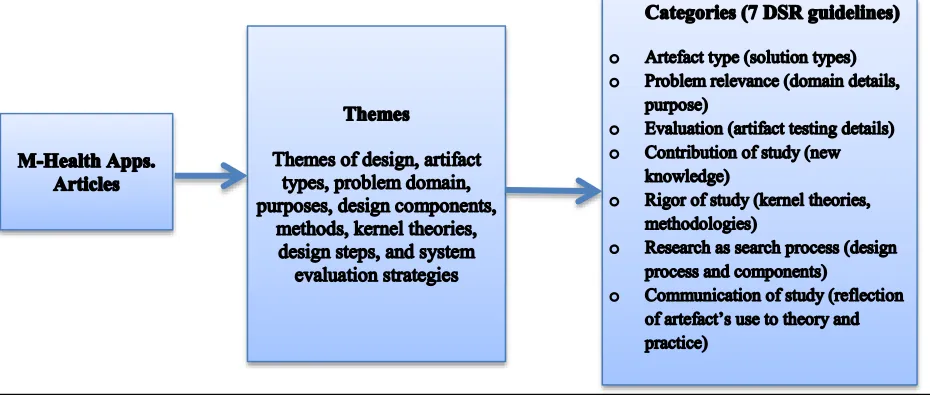
We also analysed this set of M-health articles using the thematic components of DSR. Appendix C summarizes the detailed analysis in a table showing the contribution type and relating each study to design science features. Although most papers were not expressed using DSR terms the categories could be approximately mapped to the list in figure 6. The papers described respectively: artefact types and purposes; problem relevance; problem definitions and design themes; design steps and components; methods and approaches used, (which indicated the rigour of the process and its replicability) and finally details related to evaluation, as is common with system development projects. The M-health contribution is communicated to its target audience through the research report itself, and as applicable to its professional audiences and users. As a norm of peer reviewed papers, the contribution of a study is a standard requirement. However, as most papers were conducted as projects, usually developing an app and describing that, few conformed fully to the requirements for design science as outlined by Gregor and Hevner [24].
Figure 5: M-health artefact types
50%
15% 16%
3%
16%
ACCEPTED MANUSCRIPT
Figure 6: Design science categories and themes
5
Discussion and conclusions
Our analysis of the recent literature on M-health information systems has highlighted several issues not evident from previous reviews of this emerging field, which has often been undertaken from a primarily healthcare or medical perspective. Like Varshney [76], who surveyed the literature up to 2012, we emphasize categories relevant to IS research neglected in previous reviews.
Our first finding shows that M-health has grown to encompass new issues and application categories beyond those identified in earlier reviews. The initial M-health categories that Varshney [76] identified, namely
expanding healthcare coverage, improving decision making, managing chronic conditions and providing suitable healthcare in emergencies have been both validated and extended to include supporting training, patient motivation, supervision support and improving hospital management.
As well as finding more areas of M-health per se, we identified eleven specific IS/IT areas represented in the recent literature (Security, Privacy, Literacy, Reliability, Accessibility, Acceptability, Usability, Confidentiality, Integrity, Knowledge Sharing and System Flexibility), which follows Varshney’s [76] hope that his framework
ACCEPTED MANUSCRIPT
Although the field is expanding rapidly, this is not, however, reflected proportionally in academic studies, with relatively few journal and conference papers (154) compared to the number of apps available (259 000). This comports with Thibaut’s [73] observation that despite thousands of psychiatry apps, a search using the keywords “mobile technology” and “psychiatry,” retrieved only 35 articles from the PubMed database, and
indicates the huge potential for research as the field emerges. While there is a continuing stream of research papers, this is fragmented across multidisciplinary as well as IS journals, with no dominant or central outlets. The dedicated Journal of mhealth is a practitioner, not an academic, journal, and most academic journals and conferences typically had only one M-health paper in the seven-year sampling period. Figure 7 illustrates the growth of M-health conference and journal articles published from 2010 to 2016 Figure 8 summarises the conference and journals articles in five different aspects of M-health research.
Figure 7: Recent growth of articles in M-health design field
Our review of the IS developments in M-health echoes views expressed in the more medically focused literature, which is primarily concerned with relevance to healthcare practice. They find a disconnect between the numerous apps that have been developed and the realities of medical practitioners, a familiar outcome when apps are developed without ongoing understanding of user requirements. Usability is not a proxy for relevance and applications developed outwith a research framework do not generally specify a knowledge contribution: in particular, those not using DSR as their approach may not cover the guidelines of Hevner et al [25] and Gregor and Hevner [24].
Secondly, there are very few M-health studies which explicitly use design science as their approach. Most use traditional systems development, but the evaluation phase is often lacking, and informed participation throughout development is infrequent. This reinforces earlier findings that there was a lack of testing, and that often developers lacked the medical knowledge to be relevant to their target audience. Most papers described instantiations, with very few more theoretically focused artefacts being developed. Although numerous M-health applications had been developed, without a design science framework being used, the theoretical contribution or
3 5
8
17
32
45
52
2010 2011 2012 2013 2014 2015 2016
ACCEPTED MANUSCRIPT
specification of the design is not always clear, limiting their use as design artefacts for later adaptation, or a generalizable knowledge. On the other hand, most M-health articles followed the general practices of reporting developments to an academic audience, with most of the components being approximately mappable to Design Science Research constructs, and broadly replicable. Those adopting user-centred approaches conform to the design principles of ensuring relevance to practical context, although evaluation of many systems by usability alone is inadequate if the application is not evaluated for relevance too.
Figure 8: Recent M-health research areas profile (from 2010 to 2016)
Our analysis was also the first to focus on an IS development view of the research in M-health, which had been a limitation of previous studies, and to analyse the design and developments displayed in recent work. Our content analysis explored the emerging themes, potential design issues, key stakeholders and technologies and aimed to assess the applicability of DSR for M-health solution design. Although many studies have involved systems development, this has generally been done outwith a design science framework, and some gaps, particularly with respect to evaluation, kernel theories, and, as noted earlier, testing and user involvement in design are evident.
The limitations of the study are, firstly, that the sample of papers, despite our search efforts, was relatively small, and the categorisations must, as with Varshney’s [76] proposal, remain less than comprehensive. The four areas identified by Varshney [76] were, however, validated by our up-to-date sample, and as other categories are likely to emerge as the field evolves we do not stress this formulation as definitive or final.
A second limitation is common to other systematic reviews of literature, and concerns the databases chosen and the search terms used, as well as the general limit of any data collection that is restricted by the research purposes. As inductive categorisation is appropriate in nascent fields, we avoided the top down searches available from established medical categories used in previous studies with a more medically-focused audience
0 5 10 15 20 25 30 35 40 45 50
M-health Design
Issues
M-health App. Design
Design Theories
Literature Reviews
Other research
papers
Journal articles
ACCEPTED MANUSCRIPT
in mind. By including both the top IS journals and relevant multidisciplinary outlets across major library databases we believe the sample chosen is, if not comprehensive, at least largely representative of the field.
A third limitation was that only one of us did the coding of the articles into IS categories based on DSR constructs. Some interpretation to fit these categories was required, and perhaps some cells might be described differently. Although these are not considered to be radically at variance with the constructs in question, cross checking by independent coders might add greater confidence in the interpretation of the source articles.
ACCEPTED MANUSCRIPT
References
[1] M.M. Al-Debei, D. Avison, Developing a unified framework of the business model concept, Eur. J. Inf. Syst. 19
(2010) 359–376.
[2] D. Arnott, G. Pervan, Design science in decision support systems research: An assessment using the Hevner, March,
Park, and Ram Guidelines, J. Assoc. Inf. Syst. 13 (2012) 923.
[3] E. Anthes, Mobile Mental-Health Apps Have Exploded Onto The Market, But Few Have Been Thoroughly Tested,
NATURE, 532 (2016), 20-23
[4] M.M. Baig, H. GholamHosseini, M.J. Connolly, Mobile healthcare applications: system design review, critical
issues and challenges, Australas. Phys. Eng. Sci. Med. 38 (2015) 23–38.
[5] O. Banos, C. Villalonga, R. Garcia, A. Saez, M. Damas, J.A. Holgado-Terriza, S. Lee, H. Pomares, I. Rojas, Design,
Implementation and Validation of a novel open framework for agile development of mobile health applications,
Biomed. Eng. Online. 14 (2015) S6.
[6] D.N.F. Barbosa, P.B.S. Bassani, J.B. Mossmann, G.T. Schneider, E. Reategui, M. Branco, L. Meyrer, M. Nunes,
Mobile learning and games: experiences with mobile games development for children and teenagers undergoing
oncological treatment, in: Int. Conf. Serious Games, Springer, 2014: pp. 153–164.
[7] T.J. Betjeman, S.E. Soghoian, M.P. Foran, mHealth in Sub-Saharan Africa, International Journal of Telemedicine
and Applications, 2013, (2013), 482324, 7.
[8] C. Catalani, W. Philbrick, H. Fraser, P. Mechael, D. M. Israelski, mHealth for HIV Treatment & Prevention: A
Systematic Review of the Literature, The Open AIDS Journal, 7, (2013),17-41
[9] I.A. Chatzipavlou, S.A. Christoforidou, M. Vlachopoulou, A recommended guideline for the development of
mHealth Apps, mHealth, (2016), 2.
[10] H.-S. Chen, M.-J. Su, F.-M. Shyu, J.-J. Luh, S.-L. Hwang, S. Su, S.-J. Chen, J.-S. Lai, Mobile hospital: healthcare
for anybody in anytime and anywhere, in: Enterp. Netw. Comput. Healthc. Ind. 2005. Heal. 2005. Proc. 7th Int.
Work., IEEE, 2005: pp. 144–149.
[11] W.Choi, M. A. Park, E. Hong, S. Kim, R. Ahn, J. Hong,. . . S.Yeo, Development of mobile electronic health records
application in a secondary general hospital in Korea. Healthcare informatics research, 19(4), (2013), 307-313.
[12] J. W. Creswell, Educational Research: Planning, Conducting, And Evaluating Quantitative, 2012, Pearson.
[13] D.F. Conserve, L. Jennings, C. Aguiar, G. Shin, L. Handler, S. Maman, Systematic review of mobile health
behavioural interventions to improve uptake of HIV testing for vulnerable and key populations, J. Telemed.
Telecare. 23(2) (2016),347-359.
[14] O. Dieste, A. Griman, N. Juristo, Developing search strategies for detecting relevant experiments, Empirical
Software Engineering, 14(5), (2009), 513-539
[15] J.M.G. Duarte, R.S. Yokoyama, L.A. Villas, A Low Cost Mhealth Non-Intrusive Method for Monitoring Patient
Indoor Localization, IEEE Latin America Transactions, 13(8), (2015), 2668-2673.
[16] D.T. Dunsmuir, B.A. Payne, G. Cloete, C.L. Petersen, M. Gorges, J. Lim, et al., Development of mHealth
applications for pre-eclampsia triage. IEEE Journal of Biomedical and Health Informatics, 18(6), (2014),
1857-1864.