Neural Networks
Sanjay Yadav, Ritika Manchanda, Stela Sarkar
1Computer Science, Dronacharya College Of Engineering, Gurgaon, India 2Computer Science, Dronacharya College Of Engineering, Gurgaon, India 3Computer Science, Dronacharya College Of Engineering, Gurgaon, India
________________________________________________________________________________________________
Abstract :
A neural network is data processing system which consists of large number of simple & highly interconnected elements which are used for processing in a framework which is inspired by the archi. of cerebral cortex portion of brain. On other hand, neural networks are generally capable of doing tasks which humans or animals do very well but which are not done by the conventional computers. Neural networks emerged in the past few years as area of unusual opportunity for research, application & development to variety of real world issues which arise.
Even, neural networks display characteristics which not shown by any other technology. This paper gives a brief intro on neural
networks & describes briefly several
applications
Keywords : and - &, intro – introduction, archi. – architecture,
____________________________________ INTRODUCTION
Artificial Neural Network (ANN) is an instruction processing model which is inspired by the technique biological nervous systems, like the brain, processes information. The vital element of this model is the novel formation of the instruction processing system. It is structured of a large number of hugely interconnected processing elements functioning in unison to solve
certain problems. Artificial Neural Networks, like people, learn by cases. An Artificial Neural Network is configured for a certain application, like data classification or pattern recognition by a learning process. In biological systems learning includes adjustments to the synaptic relation which exist between the neurons. It is true for Artificial Neural Networks also.
PROPOSED METHODLOGY AND DISCUSSION
Neural networks, with their exceptional ability to derive definition from imprecise or complicated data, and can be used to separate patterns and detect fashion which is too complex to be observed by either humans or any computer technique. A prepared neural network can be considered as an "expert" in the classification of information which has been given to it to analyze.
Advantages :
Adaptive learning - It is an ability to understand how to perform certain task based on the information which has been provided for training or the initial experience.
Real Time Operation - Artificial Neural Network computations may be fetched out in parallel and a special hardware device is being designed and manufactured which would take advantage of this potential.
Fault Tolerance through Redundant Information Coding: In this, Partial demolition of a network leading to the corresponding deterioration of performance. However, some of the network capabilities may be maintained even with great network damage.
Neural networks And conventional computers
Neural networks take a dissimilar approach in solving a problem as compared to conventional computers. Conventional computers utilize an algorithmic approach i.e. the computer observes a set of instructions in order to find the solution of the problem. Unless we know the specific steps that computer needs to follow the computer could not solve the problem. And this restricts the problem solving ability of the conventional computers to problems that we understand and know how it will be solved. But the computers would be much more useful if they could do things which we don't know how to do exactly.
Neural networks process instruction in a homogeneous way the human brain does. The network is made of a large number of hugely interconnected processing components (neurons) working in parallel to find the solution of a specific issue. Neural
The cases must be specified carefully else the useful time is wasted or even the worse could happen that the network might be operating incorrectly. The drawback is that because the network finds out the way to solve the problem by itself, its operation could be unpredictable.
On the other side, the conventional computers utilize a cognitive approach to find the solution of the problem; the way the solution is found must be known and expressed in small explicit instructions. All these instructions are then converted to high level language program and then to machine code that computer can understand. These machines are absolutely predictable; if something goes wrong it is due to the software or hardware fault.
How the Human Brain Learns?
Components of a neuron
The synapse
Artificial Neurons From Human Neurons We organize these neural networks by trying to infer the essential characteristics of neurons and their interconnections. We then program a computer to replicate these
features. Although our knowledge regarding neurons is incomplete and computing power is also limited, our models are certainly gross idealizations of real networks of neurons.
A simple neuron
An artificial neuron is single device with multiple inputs and single output. The neuron has two ways of operation; the training method and the using method. In the
A simple neuron
Firing rules
The firing rule is important notion in neural networks and narrates for high flexibility. The firing rule determines how a person calculates in case a neuron should fire for any of the input pattern. It connects to all the input criteria, not only those on which the node was instructed.
A simple firing rule could be executed by using Hamming distance method. The rule states that:
RULE : ‘Take a collection of training patterns for a node, some of which cause it
to fire (the 1-taught set of patterns) and others which prevent it from doing so. Then the patterns not in the collection cause the node to fire if, on comparison , they have more input elements in common with the 'nearest' pattern in the 1-taught set than with the 'nearest' pattern in the so called 0-taught set. If tie occurs there, then the pattern remains in the undefined state.’
Like, 3-input neuron is instructed to output 1 when the inputs (X1,X2 and X3) are 111 or 101 and for output 0 when the inputs are 000 or 001. Then, the truth table:
X1: 0 0 0 0 1 1 1 1
X2: 0 0 1 1 0 0 1 1
X3: 0 1 0 1 0 1 0 1
As a case of the kind the firing rule is implemented, consider the pattern 010. This pattern is different from 000 in 1 element, and from 001 in 2 elements, and from 101 in 3 elements and and from 111 in 2 elements. So, the 'nearest' pattern is 000 which lies in the 0-taught set. And so, the firing rule needs that the neuron should not fire when
input is 001. On the other hand, 011 are equally faraway from the two trained patterns which have different outputs and hence, the output stays undefined (0/1). By exercising the firing in every column the truth table is obtained as follows :
X1: 0 0 0 0 1 1 1 1
X2: 0 0 1 1 0 0 1 1
X3: 0 1 0 1 0 1 0 1
OUT: 0 0 0 0/1 0/1 1 1 1
Architectures
Any of the learning rule is confidentially tied with the network topology or framework, in such a way that the make the two almost inseparable. A key disadvantage would be to distinct the parameters and functions of a given framework from that of a learning rule.
Feed forward Neural Networks
A multilayer perceptron framework (a fully connected feed forward with partiality) is
Feed forward networks have the convenience that they are very easy and usually very quick. Also, conventional numerical methods could be applied to feedforward network training furthermore algorithms invented particularly for neural networks, so there are wide range of algorithms which could be used.
Recurrent Network Architecture
Recurrent networks tends to be more strenuous to train than a feedforward network, due to cycles, although there are still a good number of algorithms which are occasionally used, including Jordan,time delay networks or Elman. Some difficulties are especially suited for the use of recurrent networks in the favor of feedforward networks, like time series prediction.
Self Organizing Maps (SOM)
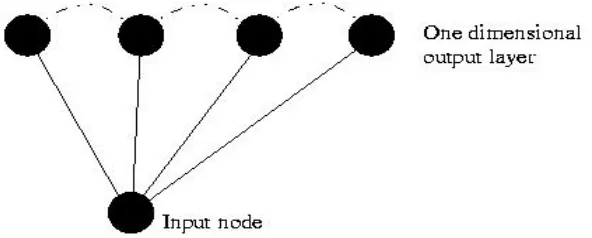
The Self Organizing Map neural network explains mapping from an input signal of inconsistent dimension to one or two dimensional array. This array of nodes explains corresponding to a discrete map.
In figure 1, the Self Organizing Map is a two layer neural network with full connections, and only now with the connectivity between the neurons in the output layer. The methods
for learning such an architecture are present.
Self Organizing Maps represent a unique topology due to the connections present between the neurons in output layer. Connections that do not exist in such a way for the other network type. Though recurrent networks might have connections between the neurons in the same layer.
CONCLUSION:
Neural networks are relevant for concluding time series mostly because of learning alone from examples, without any demand to add additional instruction that can bring further confusion than prediction outcome. These are able to postulate and are resistant to noise. And, On the other hand, it is not possible to exactly
determine what a neural network learned and it is even hard to find possible prediction error.
In spite of this, neural networks were successfully used for concluding time series. They are ideal specially when we don’t have any description of observed series.
REFERENCE :