Leakage-Resilient Cryptography from Puncturable Primitives
and Obfuscation
Yu Chen ∗ Yuyu Wang † Hong-Sheng Zhou ‡
Abstract
In this work, we develop a framework for building leakage-resilient cryptosystems in the bounded leakage model from puncturable primitives and indistinguishability obfuscation (iO). The major insight of our work is that various types of puncturable pseudorandom functions (PRFs) can achieve leakage resilience on an obfuscated street.
First, we build leakage-resilient weak PRFs from weak puncturable PRFs andiO, which readily imply leakage-resilient secret-key encryption. Second, we build leakage-resilient pub-licly evaluable PRFs (PEPRFs) from puncturable PEPRFs and iO, which readily imply leakage-resilient key encapsulation mechanism and thus public-key encryption. As a build-ing block of independent interest, we realize puncturable PEPRFs from either newly in-troduced puncturable objects such as puncturable trapdoor functions and puncturable ex-tractable hash proof systems or existing puncturable PRFs withiO. Finally, we construct the first resilient public-coin signature from selective puncturable PRFs, leakage-resilient one-way functions and iO. This settles the open problem posed by Boyle, Segev, and Wichs (Eurocrypt 2011).
By further assuming the existence of lossy functions, all the above constructions achieve optimal leakage rate of 1−o(1). Such a leakage rate is not known to be achievable for weak PRFs, PEPRFs and public-coin signatures before. This also resolves the open problem posed by Dachman-Soled, Gordon, Liu, O’Neill, and Zhou (PKC 2016, JOC 2018).
∗Institute of Information Engineering, Chinese Academy of Sciences. Email: [email protected] †Tokyo Institute of Technology, IOHK, and AIST. Email: [email protected]
Contents
1 Introduction 1
1.1 Motivation . . . 2
1.2 Our Contributions . . . 3
1.3 Overview of Our Techniques . . . 4
1.4 Related Work . . . 8
2 Preliminaries 9 2.1 Entropy and Randomness Extraction . . . 9
2.2 Leakage Types . . . 10
2.3 Cryptographic Primitives . . . 10
3 Leakage-Resilient SKE 14 3.1 Leakage-Resilient Weak PRFs . . . 14
3.2 Weak Puncturable PRFs . . . 15
3.3 Leakage-Resilient wPRFs from wPPRFs and iO . . . 16
4 Leakage-Resilient KEM 18 4.1 Leakage-Resilient PEPRFs. . . 19
4.2 Puncturable PEPRFs . . . 20
4.3 Leakage-Resilient PEPRFs from PPEPRFs and iO . . . 20
4.4 Construction with Improved Leakage Rate . . . 22
5 Leakage-Resilient Signature 24 5.1 Selective Construction from sPPRFs, Leakage-Resilient OWFs and iO . . . 24
5.2 Construction with Improved Leakage Rate . . . 27
A Puncturable TDFs 34 A.1 Construction from Correlate-Product TDFs . . . 34
B Puncturable Extractable Hash Proof System 35 B.1 Construction from DEHPS . . . 38
C Constructions of PPEPRFs 38 C.1 Construction from PTDFs . . . 38
C.2 Construction from PEHPS. . . 40
C.3 Construction from wPPRFs andiO . . . 41
1
Introduction
A main line in cryptography is to design cryptosystems in security models that capture a wide range of possible attacks. Based on the idealized assumption that software/hardware implementations of cryptosystems perfectly hide the internal secrets, traditional security models (following the seminal work of Goldwasser and Micali [GM84]) only give an adversary “black-box” access to cryptosystems. However, advancements of cryptanalysis indicate that such an idealized assumption is false in real world: an adversary can launch a variety of key leakage attacks (such as [Koc96,BDL97,BS97,KJJ99,HSH+08]) to get some partial information about secret keys.
To thwart key leakage attacks in a systematic manner, the research community has paid extensive efforts on the design of provably secure leakage-resilient cryptosystems in the last decade, spreading from basic primitives (including one-way functions, pseudorandom functions, message authentication codes, encryptions, and signatures) to advanced protocols (including identifications, authenticated key agreements, and zero-knowledge proof systems).
Leakage models. Briefly speaking, leakage models are defined by strengthening standard models with a leakage oracleOleak(·), from which an adversary can (adaptively) specify a series ofleakage functions fi :{0,1}∗ → {0,1}ℓi and learn the result offiapplied to the internal secret state. Over the years, several leakage models have been proposed in the literature, differing in the specifications of fi. In this work we focus on a simple yet general model called bounded leakage model, introduced by Akavia et al. [AGV09]. In the bounded leakage model, all secrets in memory are subject to leakage, i.e., the input of fi could be entire secret key sk, while fi could be arbitrary subjected to the natural restriction that∑iℓi is bounded by some parameter
ℓ, called the leakage bound. The leakage rate is defined as the ratio ofℓ to the secret key size |sk|, i.e., ℓ/|sk|. Obviously, the optimal leakage rate is 1−o(1) since otherwise the adversary can trivially learn the entire secret via querying Oleak(·).
To date, the bounded leakage model has been widely adopted in many works [NS09,KV09,
CDRW10,BG10,GKPV10,HL11,BK12,BCH12]. The results from the bounded leakage model are usually used as building blocks for leakage-resilient schemes in more complex leakage models.
Approach towards leakage resilience. From the perspective of provable security, the main technical hurdle to achieve leakage-resilience is that the reduction must be able to handle leakage queries w.r.t. arbitrary functions chosen from L, where L is the ensemble of admissible leak-age functions. This seemingly stipulates that the reduction should know the secret key while typically this is not the case because the underlying intractable problems is usually embedded in the secret key. This intuition has been formalized as “useless attacker paradox” in [Wic13]. Prior works overcome this paradox by taking the following two approaches.
One approach is directly resorting to leakage-resilient assumptions (which might be well packed as advanced assumptions). Following this approach, the reduction can easily handle leak-age queries by simply forwarding them to its own challenger. Goldwasser et al. [GKPV10] proved that the LWE assumption itself is leakage-resilient and then built a leakage-resilient secret-key encryption from it. Akavia et al. [AGV09] proved that meaningful and meaningless public keys are computationally indistinguishable even in the presence of secret key leakage based on the LWE assumption, and then utilized this leakage-resilient “assumption” to show that Regev’s PKE [Reg05] is actually leakage-resilient. Katz and Vaikuntanathan [KV09] built a leakage-resilient signature from universal one-way hash functions (UOWHFs)1 together with PKE and simulation-sound non-interactive zero knowledge (NIZK) proof system, where the UOWHFs
1
are actually used as leakage-resilient one-way functions. Similar strategy is also adopted for constructing other leakage-resilient signature schemes [DHLW10,BSW11,MTVY11].
Another approach is combiningkey detachedstrategy andleakage-resilientfacts/assumptions, which is mainly used in the constructions of leakage-resilient PKE. Informally, the key detached strategy means the underlying intractable problems are not embedded to the secret keys, but to the ciphertexts. Following this approach, the reduction can easily handle key leakage queries by either owning the secret key or relying on leakage-resilient assumptions. Naor and Segev [NS09] utilized hash proof system (HPS) as a powerful tool to construct leakage-resilient PKE. In the security proof, valid ciphertexts are first switched to invalid ones (such switching is com-putationally indistinguishable even given the whole secret key because the underlying subset membership problem and secret keys are detached) to ensure that the hash proof π has high min-entropy, then the leftover hash lemma is used to prove the session key of the formext(π, s) is random even in the presence of bounded key leakage.2 Subsequently, Alwen et al. [ADN+10] and Hazay et al. [HLWW13] extended HPS to the identity-based and symmetric-key setting respectively, and used them to construct leakage-resilient identity-based encryption and secret-key encryption. Dodis et al. [DGK+10] constructed leakage-resilient PKE in the auxiliary input model via a similar method. In the security proof, valid ciphertexts are also first switched to invalid ones, then the generalized Goldreich-Levin theorem is used to argue that the session key of the form hc(sk) is pseudorandom even given auxiliary-input of the secret key sk.3
1.1 Motivation
So far, a broad range of leakage-resilient cryptographic schemes under various leakage models have been proposed in the literature. Nevertheless, several interesting problems are still left open around lower-level, “workhorse” primitives like SKE, PKE, and signature under the basic bounded leakage model.
For leakage-resilient SKE, the task can be reduced to constructing leakage-resilient weak PRFs (wPRFs) in the bounded leakage model. However, the literature on this topic is sparse. [Pie09,DY13] showed that any wPRF is already leakage-resilient for a logarithmic leakage bound
ℓ=O(logλ). Hazay et al. [HLWW13] built leakage-resilient wPRF from any one-way functions. Their construction only requires minimal assumption, but its leakage rate is O(log(λ)/|sk|), which is rather poor. To date, essentially nothing better was known for generic construction of leakage-resilient SKE with optimal leakage rate, beyond simply using leakage-resilient PKE in the symmetric-key setting.
For leakage-resilient PKE, existing constructions [AGV09,BG10,DGK+10,NS09,ADN+10] are based on either specific assumptions such as LWE, DDH, DCR, QR, or somewhat more gen-erally the hash proof systems4. It is intriguing to know if there is a generic construction. In par-ticular, whether the generic constructions of PKE based on trapdoor functions/relations [PW08,
RS09, KMO10, Wee10] can be made leakage-resilient is still unclear. On the other hand, se-mantic security against chosen-ciphertext attacks (CCA) is the strongest notion for PKE in the traditional security model [GM84]. Several previous works [NS09,LWZ13,QL13,QL14,CQX18] studied how to achieve leakage-resilience and CCA security simultaneously via dedicated com-position of separate techniques. Nevertheless, no prior work considered the orthogonal problem:
2
Leftover hash lemma could be interpreted as a leakage-resilient fact, which stipulatesext(x, s) is close to uniform even given a correlated valuez, as long assis a random seed chosen independently andxstill has high min-entropy given leakagez.
3
Goldreich-Levin theorem can be interpreted as a leakage-resilient assumption, which states that ifhis one-way thenhc(x) is pseudorandom even in the presence ofh(x). Herehc serves as a computational randomness extractor andh(x) could be viewed as leakage onx.
whether we can acquire leakage-resilience from CCA security. We observe that in the CCA secu-rity experiment, responses to decryption queries can be viewed as a certain form of key leakage (the leakage function f is tied to decryption algorithm but with unbounded output length). It is interesting to know whether there is a general connection between the two important security notions for PKE.
For leakage-resilient signature, achievingfully leakage-resilienceis of particular interest since it better captures real attacks [KV09]. This notion requires a signature to remain existentially unforgeable under chosen-message attacks even when an adversary obtains bounded leakage information on all intermediate states, including the secret keys and internal random coins. Clearly, if the signing procedure is deterministic or public-coin5, standard leakage resilience automatically implies fully leakage resilience. To date, all the known fully leakage-resilient signature schemes [BSW11,MTVY11,LLW11,GJS11] in the standard model are randomized and secret-coin. The existence of leakage-resilient deterministic or public-coin signature is un-clear and was left as an open problem by Boyle et al. [BSW11]. Earlier, the leakage-resilient signature scheme by Katz and Vaikuntanathan [KV09] is deterministic but only “one-time” secure. Recently, Wang et al. [WMHT16] proposed a leakage-resilient public-coin signature scheme. However, their construction is only secure against selective leakage attacks, i.e., an adversary has to declare the leakage function before seeing the verification key. Besides, their construction requires differing-input obfuscation [BGI+12], whose existence is seriously cast in doubt [GGHW14,BSW16]. From this perspective, the problem posed by Boyle et al. [BSW11] is still largely open.
1.2 Our Contributions
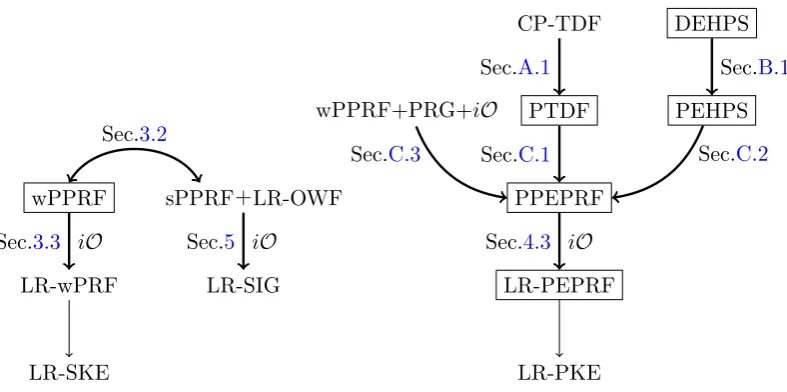
With the preceding discussion in mind, in this work we focus on generic constructions of leakage-resilient encryption and signature in the bounded leakage model. The major insight of our work is that various kinds of puncturable PRFs can achieve leakage-resilience on an obfuscated street. We summarize our main results (depicted in Figure 1) as below.
Leakage-resilient SKE. As shown in [HLWW13], the classic construction of CPA-secure SKE from wPRF is leakage-resilience-preserving. So, we restrict our attention to construct-ing leakage-resilient wPRFs. Towards this goal, in Section3.2we first put forward a new notion called weak puncturable PRFs (wPPRFs), which could be thought of as the puncturable version of wPRFs. We then show wPPRFs and selective puncturable PRFs (sPPRFs) [SW14] imply each other, while the latter is implied by the GGM-tree based PRFs [GGM86]. Finally, in Section3.3 we build leakage-resilient wPRFs from wPPRFs andiO.
Leakage-resilient KEM.The KEM-DEM paradigm (here KEM stands for key encapsulation mechanism, DEM stands for data encapsulation mechanism) is a modular and efficient approach for building PKE. In the leakage setting, one can build a leakage-resilient PKE by combining a leakage-resilient KEM with a standard DEM. In the rest of this work, we only focus on the construction of leakage-resilient KEM. Chen and Zhang [CZ14] put forward the notion of publicly evaluable PRFs (PEPRFs), which encompasses almost all the known constructions of KEM. We observe that leakage-resilient PEPRFs naturally imply leakage-resilient KEM. So, the task is reduced to acquiring leakage resilience for PEPRFs.
5
To this end, in Section 4.2 we first put forward the notion of puncturable PEPRFs, then build leakage-resilient PEPRFs from puncturable PEPRFs andiOin Section4.3. Moreover, we instantiate puncturable PEPRFs from either newly introduced primitives such as puncturable trapdoor functions and puncturable extractable hash proof systems, or existing puncturable PRFs withiO.
This result provides a unified framework for constructing leakage-resilient KEM, which not only clarifies and encompasses the construction by Dachman-Soled et al. [DGL+16, Section 5.1], but also indicates that the PKE constructions based on “puncturable” trapdoor func-tions/relations (which in turn implied by correlated-product trapdoor functions [RS09] or ex-tractable hash proof systems [Wee10] with puncturable property) can be made leakage resilient! Recently, Matsuda and Hanaoka [MH15] introduced a new primitive called puncturable KEM (PKEM), which captures a common pattern towards CCA security underlying many construc-tions of CCA-secure PKE. We remark that PPEPRFs imply PKEM with perfect strong punc-tured decapsulation soundness. This result establishes a somewhat surprising connection be-tween CCA security and leakage resilience, that is, CCA security obtained along the puncturable road can be converted to leakage-resilience in a non-black-box manner via obfuscation.
Leakage-resilient signature. In Section5, we show how to build leakage-resilient signature from selective puncturable PRFs,iO, and leakage-resilient one-way functions. Our basic scheme is deterministic but only achieves selective security6. To attain adaptive security, several boot-strapping techniques can be used without compromising leakage resilience. More precisely, as we elaborate in Section D, one can either use the magic method enabled by extremely lossy function [Zha16], obtaining the first deterministic leakage-resilient signature scheme, or apply the “prefix-guessing technique” [HW09, RW14], yielding the first public-coin leakage-resilient signature scheme.
We highlight that in our construction the signature size is exactly the output size of a puncturable PRF7, which is very close to the leakage bound. Clearly, signature size cannot be shorter than leakage bound, since otherwise an adversary can directly obtain a forged signature from leakage. In this sense, our constructions also enjoy the almost optimal signature size.
All the basic constructions described above can tolerateLbits of leakage for any polynomial
L of security parameter λ. However, the leakage rate is low due to the fact that secret keys are obfuscated programs, which could be very huge. By further assuming the existence of lossy functions [PW08], we can remarkably shrink the size of secret keys and achieve optimal leakage rate 1−o(1), as we demonstrate in Section4.4and Section5.2. Such a leakage rate is not known to be achievable for weak PRFs, PEPRFs and deterministic/public-coin signatures before.
1.3 Overview of Our Techniques
As we summarized before, a common theme of the two main approaches towards leakage re-silience in the literature is that the reduction always try to simulate leakage oracle perfectly, i.e., answering leakage queries with real leakage. To do so, we have to either rely on leakage-resilient assumptions or resort to sophisticated design with specific structure. It is interesting to investigate the possibility of simulating leakage oracle computationally, namely answering leakage queries with simulated leakage, as long as it is computationally indistinguishable from
6
In selective security model, the adversary must declare the messagem∗on which it will make a forgery before seeing the verification key, but then can adaptively make signing queries on messages distinct fromm∗.
7In the case of our adaptively secure construction, a signature additionally contains a public coin of sizeλc
wPPRF
LR-wPRF
LR-SKE Sec.3.3 iO
sPPRF+LR-OWF
LR-SIG Sec.5 iO
Sec.3.2
PPEPRF
LR-PEPRF
LR-PKE Sec.4.3 iO
PTDF CP-TDF
Sec.C.1
Sec.A.1
PEHPS
Sec.C.2
DEHPS
Sec.B.1
wPPRF+PRG+iO
Sec.C.3
Figure 1: The bold lines and rectangles denote our contributions (the thin lines denote those that are straightforward or follow readily from previous work).
real leakage. This would possibly lend new techniques to address the unsolved problems in leakage-resilient cryptography.
Very recently, Dachman-Soled et al. [DGL+16] discovered powerful applications of iO to leakage-resilient cryptography. In the continual leakage model, they presented an iO-based compiler that transforms any public-key encryption or signature scheme with consecutive con-tinual leakage-resilience to concon-tinual leakage resilience allowing leakage on key updates. In the bounded leakage model, they showed how to modify the Sahai-Waters PKE to be leakage-resilient. We observe that their work essentially embodies the idea of simulating leakage oracle computationally.
Simulate leakage via obfuscation. At the heart of our leakage-resilient encryptions and signatures is a general approach of simulating leakages enabled by puncturable primitives and obfuscation, which is largely inspired by the leakage-resilient variant of Sahai-Waters PKE due to Dachman-Soled et al. [DGL+16]. Next, we first distill and extend the idea underlying the work of [DGL+16], then carry out a systematic study of its applicability to leakage-resilient cryptography.
Recall that the common technical hurdle towards leakage resilience is to handle leakage queries. As opposed to the naive strategy of answering leakage queries with real secret keys, another promising strategy is simulating leakage with “faked” secret keys. By the composition lemma, as long as the faked secret keys are indistinguishable from the real ones, the simu-lated leakages are also indistinguishable from the real leakages because all leakage functions are efficiently computable.
Obfuscate key and extract randomness. Our leakage-resilient encryptions exactly follow this approach. In a nutshell, we useiOto compile weak (resp. publicly evaluable) puncturable PRFs into leakage-resilient weak (resp. publicly evaluable) PRFs, which immediately yield leakage-resilient secret-key (resp. public-key) encryption.
To best illustrate our approach, we focus here on the secret-key setting, as it already em-phasizes the main ideas underlying our approach. Starting from a weak puncturable PRF
F :K×X → {0,1}n, we use iO to compile it into a leakage-resilient weak PRF with a ran-domness extractorext:{0,1}n×S→Z. The construction is instructive: (1) generate a secret key k for F, then create a program Eval with k hardwired, which on input x and s outputs
ext(Fk(x), s); (2) set the secret key asiO(Eval). This defines a weak PRF ˆF :{0,1}n×S→Z. To establish security, the hybrid argument starts with the real game for leakage-resilient wPRF, where leakage and evaluation queries are handled with real secret key iO(Eval). In the next game, the challenger picks the challenge inputx∗ands∗at the very beginning, create a program Eval′ with the same input-output behavior as Eval, wherekx∗ is the punctured key fork w.r.t.
x∗ and y∗ =Fk(x∗). The leakage and evaluation queries are thus handled with iO(Eval′). Such modifications are undetectable by the security ofiO. In the final game, the challenger switches
y∗ fromFk(x∗) to a random value. This transition is undetectable by the weak pseudorandom-ness of the starting puncturable PRF. An important fact is that the responses to evaluation queries are determined bykx∗, and thus do not leak any information abouty∗. Now, we can ar-gue the desired security in purely information-theoretic way. By appropriate parameter choice,
y∗ still retains high min-entropy in the presence of leakage, and thus the value ext(y∗, s∗) is statistically close to uniform distribution.
In the public-key setting, our construction essentially follows the same approach. We use
iO to compile puncturable PEPRF into resilient PEPRF, which readily yield leakage-resilient CPA-secure KEM. The main technical novelty lies in realizing puncturable PEPRFs from a variety of puncturable primitives. More precisely, we build puncturable PEPRFs from: (1) newly introduced notion of puncturable TDFs, which is in turn implied by correlated-product TDFs [RS09]; (2) newly introduced notion of puncturable EHPS, which is implied by EHPS [Wee10] satisfying derivable property; (3) selective puncturable PRFs, pseudorandom generator, and iO (adapted from the Sahai-Waters PKE [SW14]). This provides us a unified method to build leakage-resilient KEM from various puncturable primitives andiO.
Obfuscate key and translate leakage. Along our approach towards leakage resilience, we investigate the possibility of building leakage-resilient signature from puncturable primitives and iO. We choose the short “hash-and-sign” selectively secure signature by Sahai and Wa-ters [SW14] as our starting point, since it inherits the puncturable property from its underlying selective puncturable PRFs. To best illustrate the idea of our adaption, we first briefly review the Sahai-Waters signature scheme.
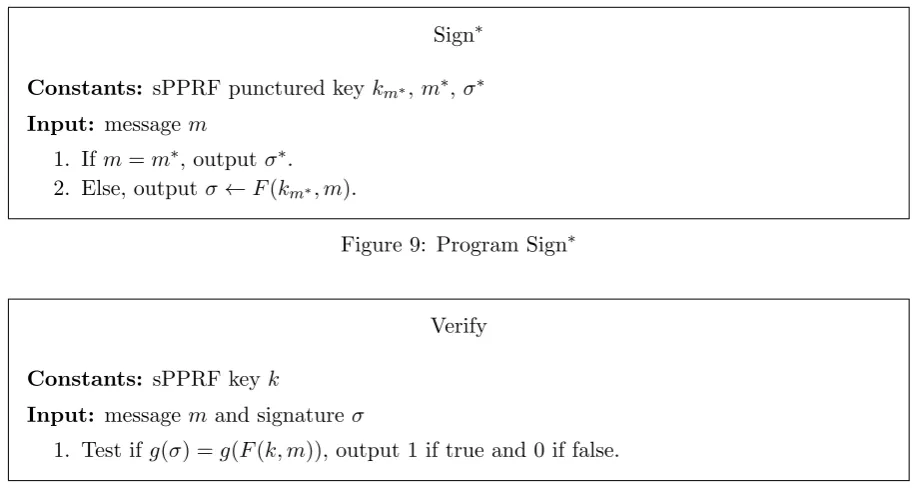
The Sahai-Waters signature is essentially a PRF-based MAC with public verifiability. The signing key sk is simply a secret key of selective puncturable PRF (sPPRF), and the signature on m is σ ← Fk(m). The verification key vk is set as iO(Vefy) where Vefy is a program that can check the MAC publicly. To excise out the information about Fk(m∗) (here m∗ denotes the target message), Vefy computes g(Fk(m)) and compares the result for equality to g(σ), where g is a one-way function and σ is the claimed signature on m. To establish security, the hybrid argument starts with the real game for selective signature. The intermediate hybrid game builds an equivalent verification program using a punctured key km∗ and y∗ ←
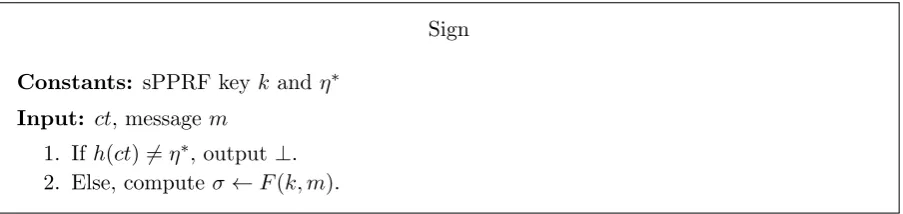
Following the new approach of simulating leakage, a tempting idea to make the Sahai-Waters signature leakage-resilient is setting the signing key asiO(Sign), where Sign is a program that on inputmoutputsFk(m). Among the transitions of hybrid games, Sign is replaced by Sign′ (with
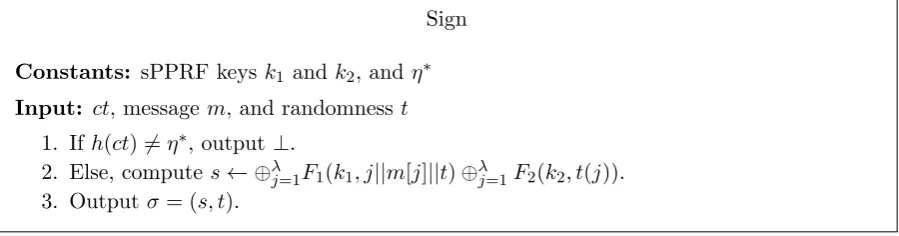
km∗ and σ∗ hardwired). In this way, leakage and signing queries can be handled with “faked” signing key. However, we are unable to reduce the leakage-resilient unforgeability to the one-wayness ofg. This is because in addition toy∗=g(σ∗) revealed invk, the information ofσ∗may also be leaked via leakage queries on signing keyiO(Sign′). Therefore, the security proof breaks down in the final game, i.e., the reduction has to build Sign′whileσ∗ is unknown.8 We overcome this obstacle by usingleakage-resilient OWF to replace standard OWF. Briefly, OWF is leakage-resilient if one-wayness remains in the presence of certain leakage on the preimage. Also observe that a leakage functionf about the signing keyiO(Sign′) can be efficiently translated to leakage about σ∗, since bothf andiO are efficiently computable. With such enhancement, in the final game the reduction can handle signing queries usingkm∗ and handle leakage queries on signing keyiO(Sign′) by translating them to leakage queries on preimageσ∗ to the underlying leakage-resilient OWF. See Section 5for technical details.
Improving leakage rate via lossy functions. Applying the above approach in a straight-forward manner will incur poor leakage rate, because the secret keys are obfuscated programs, which could be very large.
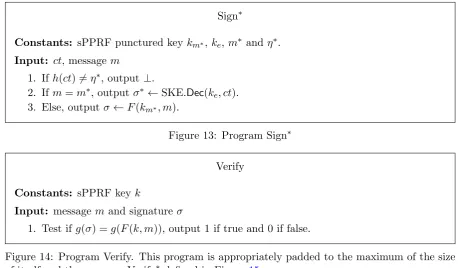
In [DGL+16], the authors showed how to modify their basic leakage-resilient PKE construc-tion to achieve optimal leakage rate. Next, we briefly revisit their technique in the context of our construction of leakage-resilient wPRF. Now, the key generation algorithm works as follows: (1) pick a random key ke for a SKE scheme and generate a dummy ciphertextct←Enc(ke,0n) as the secret key sk; (2) pick a collision-resistant hash h and compute η∗ ← h(ct); (3) pick a random keykfor the underlying weak PRF, obfuscate a program Eval and store the obfuscated result Ceval into public parameters. Here, the program Eval is hardwired with kand t∗, which
on input sk and (x, s) outputs ext(Fk(x), s) if and only if h(sk) = η∗. Intuitively, ct acts as a trigger of Ceval, which only works when h(ct) matchesη∗. In this way, the size of secret key is
greatly reduced.
In the security proof, the first game is the real game. In the next game, ctis switched to an encryption of the PRF value y∗ ←Fk(x∗). This modification is undetectable by the semantic security of SKE. Then, Ceval is switched to Ceval′ , which is an obfuscation of program Eval′. With ke and a punctured PRF key kx∗ hardwired, Eval′ works if and only if the hash value of its inputctmatchesη∗. Whenh(ct) =t∗, it evaluates withkx∗ ifx̸=x∗, otherwise it evaluates after decryptingcttoy∗. In the final game,y∗is switched to a uniformly random value. The rest security analysis is routine. A subtle problem arised is that now Eval and Eval′ have differing inputs, becausehis compressing and thus a collision ct′ (i.e.,h(ct′) =η∗ =h(ct)) that encrypts a value y′ ̸= y∗ is likely to exist. Therefore, they have to rely on public-coin differing-input obfuscation [IPS15], which is stronger than indistinguishability obfuscation. They left how to get rid of differing-input obfuscation as an open question.
As analyzed above, the usage of CRHF leads to the reliance on differing-input obfuscation, while the choice of CRHF seems necessary to ensure that η∗ only leaks partial information abouty∗ (encrypted inct), which is crucial to achieve high leakage rate. Can we achieve higher leakage rate without resorting to differing-input obfuscation? The answer is affirmative. Our idea is to replace CRHFs with lossy functions [PW08]. In the real construction,h is generated as an injective function. By this choice, η∗ uniquely fixes its preimage ctand thus the valuey∗, With this setting, Eval and Eval′ agree on all inputs, andiOsuffices to guarantee the switching
8Note that this dilemma does not occur in the case of encryption, since the argument in the final game is
from Eval to Eval′ is undetectable. To argue the high leakage rate we can attain, in the last game we switches h to a lossy function that significantly lose the information about y∗. By the security of lossy functions, this change is undetectable. Clearly, in the last game y∗ still maintains sufficiently large min-entropy even in the presence ofη∗ and leakage. By appropriate choice of parameter, optimal leakage rate is achievable. The above technique carries over to the constructions of leakage-resilient PEPRF and signature as well, except some subtle issues need to be carefully dealt with for the case of signature. See the discussion at the end of Section5.2
for details.
We believe that the our technique of improving leakage rate by interplaying iO with lossy functions will also be instructive for avoiding using differing-input obfuscation in other places.
1.4 Related Work
Leakage models. Several leakage models have been proposed in the literature. In the seminal work, Micali and Reyzin [MR04] initiated the formal study of side-channel attacks by introduc-ing the “only computation leaks information” model. Unfortunately, it fails to capture many practical leakage attacks, such as the cold-boot attack of [HSH+08].
To capture more general side-channel attacks known as memory attacks, Akavia et al. [AGV09] introduced the bounded leakage model, in which the adversary can obtain arbitrary length-bounded leakage. The follow-up works considered various strengthens to accommodate more complex and general leakage scenarios. Naor and Segev [NS09] generalized the bounded leakage model to noisy leakage model (also known as entropy leakage model), where length-bounded leakage is relaxed to entropy-bounded leakage. Alwen et al. [ADW09a,ADN+10] suggested the bounded-retrieval model, which imposes an additional requirement that the tolerated leakage amount can grow by proportionally expanding the secret key without increasing the size of public key, or computation/bandwidth efficiency. Dodis et al. [DHLAW10] and Brakerski et al. [BKKV10] introduced the continual leakage model for public-key schemes, where the secret key can be periodically self-refreshed while the public key remains the same. This model allows bounded leakage between any two successive refreshes without a-priori bound on the overall amount of leakage throughout the lifetime of the system.
The bottomline of the bounded leakage model and its variants interpret the following re-striction on the leakage: it is information-theoretically impossible to recover the secret key from the leakage. Dodis et al. [DKL09,DGK+10] introduced the auxiliary input model (AIM), in which the total amount of leakage could be unbounded, as long as the secret key remains hard-to-invert given the leakage (but even if the secret key is fully determined in an information-theoretic sense). As noted in [KV09], a drawback of this model is that given some collection of leakage functions {fi} there is no way to tell, in general, whether they satisfy the stated requirement or not. Furthermore, existing constructions in this model require super-polynomial hardness assumptions.
Leakage-resilient cryptosystems. There is a large body of constructions of leakage-resilient cryptosystems in various models. In the bounded leakage model, there are OWF [KV09,
2
Preliminaries
Notation. For a distribution or random variableX, we writex←−R X to denote the operation of sampling a random x according to X. For a setX, we use x←−R X to denote the operation of sampling x uniformly at random from X, and use |X| to denote its size. We use UX to denote the uniform distribution over X. For a positive integer n, we use [n] to denote the set {1, . . . , n}. Unless described otherwise, all quantities are implicitly functions of a security parameter denoted λ. We say that a quantity is negligible, written negl(λ), if it vanishes faster than the inverse of any polynomial in λ. A probabilistic polynomial time (PPT) algorithm is a randomized algorithm that runs in time poly(λ). If A is a randomized algorithm, we write
z ← A(x1, . . . , xn;r) to indicate that A outputs z on inputs (x1, . . . , xn) and random coins r. For notational clarity we usually omit r and write z← A(x1, . . . , xn).
2.1 Entropy and Randomness Extraction
We use capital letters (e.g. X) for random variables, standard letters (e.g. x) for values, and calligraphic letters (e.g. X) for sets. The min-entropy of a random variable X overX is the negative (base-2) logarithm of the unpredictability ofX: H∞(X) =−log (maxx∈XPr[X =x]).
In many natural settings, the variable X is correlated with another variableY whose value is known to an adversary. In such scenarios, it is most convenient to use the notion of average min-entropy as defined by Dodis et al. [DORS08], which captures the average unpredictability of X conditioned on Y:
˜
H∞(X|Y) =−log
(
Ey←Y
[
max
x∈X Pr[X=x|Y =y]
])
The following bound of average min-entropy was proved in [DORS08].
Lemma 2.1 ([DORS08]). Let X, Y, Z be arbitrarily correlated random variables where the support of Y has at most 2r elements. Then H˜∞(X|(Y, Z)) ≥ H∞(X|Z)−r. In particular,
˜
H∞(X|Y)≥H∞(X)−r.
In cryptographic applications, we usually need to derive nearly uniform bits from a weakly random source X that has some average min-entropy. This is accomplished via an appropri-ate type of randomness extractor. We recall the definition of average-case strong extractor from [DORS08].
Definition 2.1 (Randomness Extractor). An efficient functionext:X × S → Y is an average-case (n, ϵ)-strong extractor if for all (correlated) random variables (X, Z) s.t. ˜H∞(X|Z)≥n, it holds that:
∆((ext(X, S), S, Z),(Y, S, Z))≤ϵ,
whereS is uniform over S and Y is uniform over Y, respectively.
Dodis et al. [DORS08] proved that any strong extractor is in fact an average-case strong extractor for appropriate setting of the parameters. As a specific example, they proved that any family of universal hash functions is an average-case strong extractor.
2.2 Leakage Types
In the standard bounded leakage model [AGV09], the amount of leakage that the adversary learns is measured by the output length of leakage function f, which is refereed to as length-bounded leakage [BSW11]. However, this is not the most general way of measuring leakage. As an alternative suggested by Naor and Segev [NS09], Dodis et al. [DHLAW10], and Boyle et al. [BSW11], we could measure the amount of leakage via the entropy loss to the input of f, given the output off. By relaxing the requirement on leakage functions from length-bounded to entropy-bounded, the standardbounded leakage model strengthens toentropy leakage model. Next, we formally recall the notion of entropy-bounded function from [BSW11] as below.
Definition 2.2(ℓ-entropy-bounded functions). A (possibly randomized) efficiently computable function f : {0,1}∗ → {0,1}∗ is ℓ-entropy-bounded if there exists some (possibly inefficiently computable) function f′ such that:
• For allx∈ {0,1}∗,f(x)≈sf′(x) (over the randomness of f and f′).
• For all integersn≥1, ˜H∞(Un|f′(Un))≥n−ℓ, whereUn is the uniform distribution over {0,1}n.
Notice that any functionf :{0,1}∗→ {0,1}ℓ isℓ-entropy-bounded. Clearly, there are func-tions which areℓ-entropy-bounded but whose output lengths can be arbitrarily long. Therefore, resilience toℓ-bit of entropy leakage is a seemingly stronger notion of security than resilience to
ℓ-bit of length-bounded leakage.
2.3 Cryptographic Primitives
2.3.1 Lossy Functions
Lossy functions are the trapdoor-free version of lossy trapdoor functions introduced by Peikert and Waters [PW08].
Definition 2.3 (Lossy Functions). A family of (n, τ)-lossy functionsGfrom X={0,1}n toY
is given by three polynomial time algorithms satisfying the following properties:
• GenInj(λ): on input a security parameter λ, output a function index isuch thatG(i,·) is an injective function fromX toY.
• GenLossy(λ): on input a security parameterλ, output a function indexisuch thatG(i,·) is a lossy function fromX toY whose image has size at most 2τ. Thelossiness is defined asn−τ.
• Eval(i, x): on input a function indexiand an element x, outputs G(i, x).9
Hard to distinguish injective from lossy. The outputs of GenInj(λ) and GenLossy(λ) are computationally indistinguishable.
2.3.2 One-way Functions
Roughly, a one-way functiong:{0,1}n→ {0,1}m is leakage-resilient if it remains one-way even in the presence of some leakage about preimage. Boyle et al. [BSW11] formalized the notion of leakage-resilient one-wayness w.r.t. either length-bounded leakage or entropy-bounded leakage (which is more general), which we recall as below.
9
Leakage-resilient one-wayness. Let A be an adversary against g and define its advantage in the following experiment:
AdvA(λ) = Pr
[
g(x) =y∗ : x∗ R
←− {0,1}n, y∗ ←g(x∗);
x← AOleak(·)(y∗);
]
.
Here Oleak(·) is a leakage oracle that on input f :{0,1}n→ {0,1}∗ returnsf(x∗), subjected to the restriction that its total output lengths is at most ℓ. We say g is ℓ-leakage-resilient one-way if for any PPT adversaryAits advantage defined as above is negligible in λ.
Constructions of LR-OWFs. As implicitly or explicitly shown in [KV09,ADW09b,DHLW10,
BSW11,Kom16], a universal one-way hash function withn-bit inputs andm-bit outputs auto-matically constitutes anℓ-leakage-resilient OWF as long asn−m−ℓ≥ω(logλ). The leakage amount ℓis roughly the number of bits by which the UOWHF shrinks its input.
Chen et al. [CQX18] realized that any lossy (non-trapdoor) functions [PW08] yield a family of leakage-resilient injective OWFs. Let LF be a collection of (n, τ)-lossy functions and ℓ be the amount of leakage. They proved that forn−τ−ℓ≥ω(logλ), the functions in the injective mode readily constitute a family of ℓ-leakage-resilient injective OWFs. The leakage amount ℓ
is roughly the lossiness (n−τ) and the leakage rate could be 1−o(1) by settingτ =o(n). The above leakage-resilient results also hold in the entropy leakage model.
2.3.3 Signatures
Definition 2.4 (Signatures). A signature scheme with message spaceM and signature space Σ consists of three polynomial time algorithms as follows.
• Gen(λ): on input a security parameter λ, output a verification key vk and a signing key
sk.
• Sign(sk, m): on input sk and a messagem∈M, output a signature σ∈Σ.
• Verify(vk, m, σ): on input vk, a messagem, and a purported signature σ, output 1 indi-cating acceptance or 0 indiindi-cating rejection.
Correctness. For all (vk, sk)←Gen(λ) and allm∈M, we haveVerify(vk, m,Sign(sk, m)) = 1.
The definition of leakage resilience for signature is the standard notion of existential un-forgeability under adaptive chosen-message attacks (EUF-CMA), except that the adversary is additionally given access to a leakage oracle.
Leakage-resilient EUF-CMA. Let A = (A1,A2) be an adversary against signature and
define its advantage in the following experiment:
AdvA(λ) = Pr
[
Verify(vk, m∗, σ∗) = 1 ∧ m∗ ∈ Q/ :
(vk, sk)←Gen(λ);
(m∗, σ∗)← AOsign(·),Oleak(·)(vk);
]
.
2.3.4 Secret-Key Encryption
Definition 2.5 (Secret-Key Encryption). An SKE scheme with message space M, ciphertext space C and secret key space K consists of three polynomial time algorithms as follows.
• Gen(λ): on input a security parameter λ, output a random secret keyk←R−K.
• Enc(k, m): on input a secret key kand a message m∈M, output a ciphertextc∈C. • Dec(k, c): on input a secret keyk and a ciphertextc∈C, output a messagem∈M.
Correctness. For allk←Gen(λ) and all m∈M, we have Dec(k,Enc(k, m)) =m.
We recall leakage-resilient chosen-plaintext security (LR-CPA) for SKE as follows.
Leakage-resilient CPA. Let A = (A1,A2) be an adversary against SKE and define its
ad-vantage in the following experiment:
AdvA(λ) = Pr
β =β′ :
k←Gen(λ);
(state, m0, m1)← AOleak(·),Oenc
1 (λ);
β ←− {R 0,1};
c∗←Enc(k, mβ);
β′← A2(state, c∗);
− 1 2.
Here Oleak(·) is a leakage oracle that on inputf :SK→ {0,1}∗ returnsf(sk), subjected to the restriction that the sum of its output lengths is at mostℓ. Oencis an encryption oracle that on input m ∈ M outputs Enc(k, m). (When Enc is randomized, Oenc uses fresh randomness each time it answers a query.) A SKE is ℓ-leakage-resilient CPA-secure if no PPT adversary has non-negligible advantage in the above security experiment.
2.3.5 Key Encapsulation Mechanism
Definition 2.6 (Key Encapsulation Mechanism). A KEM with message space M, ciphertext space C and encapsulated key space K consists of three polynomial time algorithms as below.
• Gen(λ): on input a security parameter λ, output a public keypk and a secret key sk. • Encaps(pk): on input a public keypk, output a ciphertextc∈C and an encapsulated key
k∈K.
• Decaps(sk, c): on input a secret key sk and a ciphertext c ∈ C, output an encapsulated keyk∈K or a distinguished symbol ⊥indicating that c is invalid.
Correctness. For all (pk, sk)←Gen(λ) and all (c, k)←Encaps(pk), we haveDecaps(sk, c) =k.
We recall leakage-resilient chosen-plaintext security (LR-CPA) for KEM as follows.
Leakage-resilient CPA. Let A = (A1,A2) be an adversary against KEM and define its
advantage in the following experiment:
AdvA(λ) = Pr
β =β′ :
(pk, sk)←Gen(λ);
state← AOleak(·)
1 (pk);
(c∗, k∗0)←Encaps(pk), k1∗←−R K;
β ←− {R 0,1};
β′← A2(state, c∗, k∗β);
−1 2.
Remark 2.1. The KEM-DEM approach also works in the leakage setting, i.e., one can build leakage-resilient PKE by combining a leakage-resilient KEM and a standard DEM. The resulting PKE inherits the same leakage-resilience from the underlying KEM.
2.3.6 Puncturable Pseudorandom Functions
Puncturable PRFs (PPRFs) [SW14] is the simplest type of constrained PRFs [KPTZ13,BW13,
BGI14]. In a PPRF, the constrained key is associated with an element x∗ ∈X, which allows evaluation on all elements x̸=x∗. Next, we recall the definition and security notion of PPRFs as below.
Definition 2.7(PPRFs). A PPRFF :K×X→Y consists of four polynomial time algorithms:
• Gen(λ): on inputλ, output public parameterpp and a secret keyk←−R K. ppwill be used as an implicit input ofPrivEval,Punctureand PuncEval.
• PrivEval(k, x): on input a secret keykand x∈X, output F(k, x).
• Puncture(k, x∗): on input a secret keyk andx∗∈X, output a punctured keyk({x∗}).10 • PuncEval(kx∗, x): on input a punctured keykx∗ and an element x∈X, output F(k, x) if
x̸=x∗ and a special reject symbol ⊥otherwise.
For ease of notation, we writekx∗ to representk({x∗}), writeFk(x) andF(k, x) interchangeably and write Fkx∗(x) or F(kx∗, x) to represent PuncEval(kx∗, x).
Sahai and Waters [SW14] defined selective pseudorandomness for PPRFs, which is weaker than full pseudorandomness in that the adversary must commit to the target input x∗ even before seeing the public parameter.
Selective pseudorandomness. LetA= (A1,A2) be an adversary against PPRFs and define
its advantage in the following experiment:
AdvA(λ) = Pr
β =β′ :
(state, x∗)← A1(λ);
(pp, k)←Gen(λ);
kx∗ ←Puncture(k, x∗);
y∗0 ←Fk(x∗), y1∗
R
←−Y;
β←− {R 0,1};
β′← A2(state, pp, kx∗, y∗β);
−1 2.
A PPRF is said to be selectively pseudorandom if for any PPT adversary A its advantage defined as above is negligible in λ. For simplicity, we refer to selectively pseudorandom PPRFs as sPPRFs. sPPRFs with fixed-length domain are easily obtained from the GGM tree-based PRFs [GGM86], as observed in [BW13, BGI14,KPTZ13]. Ramchen and Waters [RW14] also showed the existence of sPPRFs with variable-length domain.
2.3.7 Indistinguishability Obfuscation for Circuits
We recall the definition and security notion of indistinguishability obfuscator from [GGH+13] as below.
Definition 2.8 (Indistinguishability Obfuscator (iO)). A uniform PPT machine iO is called an indistinguishability obfuscator for a circuit class{Cλ}if the following conditions are satisfied:
10
• (Preserving Functionality) For all security parameter λ∈ N, for all C ∈ Cλ, and for all inputsx∈ {0,1}∗, we have:
Pr[C′(x) =C(x) :C′ ←iO(λ, C)] = 1
• (Indistinguishability of Obfuscation) For any PPT adversaries (S,D), there exists a neg-ligible functionα such that the following holds: if Pr[∀x, C0(x) =C1(x) : (C0, C1, aux)← S(λ)]≥1−α(λ), then we have:
|Pr[D(aux, iO(λ, C0)) = 1]−Pr[D(aux, iO(λ, C1)) = 1]| ≤α(λ)
3
Leakage-Resilient SKE
We begin this section by recalling the notion of leakage-resilient wPRFs and their application in building leakage-resilient CPA-secure SKE from [HLWW13]. We then introduce a new notion called weak puncturable PRFs (weak PPRFs), and show how to compile weak PPRFs to leakage-resilient wPRFs via iO.
3.1 Leakage-Resilient Weak PRFs
Standard PRFs require full pseudorandomness: given polynomially many arbitrarily inputs
x1, . . . , xq, the outputs Fk(x1), . . . , Fk(xq) look pseudorandom. Sometimes, the full power of PRFs is not needed and it is sufficient to have weak PRFs which only claim weak pseudo-randomness, where pseudorandomness holds for uniformly random choice of inputs {xi}. The corresponding leakage-resilient notion requires that weak pseudorandomness holds even if the adversary can learn some leakage about the secret key k. Now, we recall the formal definition of leakage-resilient weak pseudorandomness from [HLWW13].
Leakage-resilient weak pseudorandomness. LetA= (A1,A2) be a PPT adversary against
PRFs and define its advantage in the following experiment.
AdvA(λ) = Pr
β =β′ :
(pp, k)←Gen(λ);
state← AOleak(·),Oeval($)
1 (pp);
x∗ ←−R X;
y∗0 ←Fk(x∗), y1∗
R
←−Y;
β←− {R 0,1};
β′← AOeval($)
2 (state, x∗, y∗β);
−1 2.
Here Oleak(·) is a leakage oracle that on input leakage function f : K → {0,1}∗ returns
f(k), subjected to the restriction that the sum of its output lengths is at most ℓ. Oeval($) is an evaluation oracle that does not take any input and on each invocation, chooses a freshly randomx∈X and outputs (x, Fk(x)). A PRF is ℓ-leakage-resilient weakly pseudorandom if no PPT adversary has non-negligible advantage in the above experiment.
Remark 3.1. As pointed out in [HLWW13], since the adversary can always learn a few bits of
Fk(x) for some x of its choice (via leakage query), we cannot hope to achieve full pseudoran-domness in the presence of leakage, and hence setting for weak pseudoranpseudoran-domness is a natural choice.
a leakage-resilient wPRF, whose range Y is an additive group (e.g., bit-strings under XOR). The secret key is exactly the key of the underlying wPRF. To encrypt a message m ∈ Y, one samplesx←−R X and outputs the ciphertext (x, Fk(x) +m). The decryption process is obvious. The desired LR CPA security of SKE follows readily from the LR weak pseudorandomness of the wPRF.
3.2 Weak Puncturable PRFs
Towards the construction of leakage-resilient wPRFs, we put forward a new notion called weak PPRFs by introducing weak pseudorandomness for PPRFs. We show that weak PPRFs and selective PPRFs imply each other, while the latter is directly implied by the GGM-tree based PRFs [GGM86].
Next, we formally introduce weak pseudorandomness for PPRFs, which differs from selective pseudorandomness (cf. definition in Section2.3.6) in that the target inputx∗is uniformly chosen by the challenger, rather than being arbitrarily chosen by the adversary before seeing the public parameter.
Weak pseudorandomness. LetA= (A1,A2) be an adversary against PPRFs and define its
advantage in the following experiment:
AdvA(λ) = Pr
β =β′:
(pp, k)←Gen(λ);
x∗ ←−R X;
kx∗ ←Puncture(k, x∗);
y∗0 ←Fk(x∗), y∗1
R
←−Y;
β←R− {0,1};
β′ ← A(pp, x∗, kx∗, y∗β);
−1 2.
A PPRF is weakly pseudorandom if no PPT adversary has non-negligible advantage in the above experiment. For simplicity, we refer to weakly pseudorandom PPRFs as wPPRFs.
Interestingly, we show that wPPRFs and sPPRFs imply each other.
Theorem 3.1. wPPRFs and sPPRFs imply each other.
Proof. We first show that “wPPRFs imply sPPRFs” by building sPPRFs from wPPRFs. Let
F :K×X→Y be a wPPRF, we build a sPPRF ˆF :K×X→Y from F as below.
• Gen(λ): run (pp, k)←F.Gen(λ), pick r∗ ←−R X, set ˆpp= (pp, r∗) and kas the secret key. • PrivEval(k, x): on inputkandx, output ˆy←Fk(x+r∗) via computingF.PrivEval(k, x+r∗).
This algorithm defines ˆFk(x) :=Fk(x+r∗).
• Puncture(k, x∗): computekx∗+r∗←F.Puncture(k, x∗+r∗), output ˆkx∗ =kx∗+r∗.
• PuncEval(ˆkx∗, x): parse ˆkx∗ askx∗+r∗, ifx̸=x∗outputy←Fkx∗+r∗(x+r∗) via computing
F.PuncEval(kx∗+r∗, x+r∗), else output⊥.
We now reduce the selective pseudorandomness of the above construction to the weak pseu-dorandomness of the underlying wPPRF. LetAbe an adversary against sPPRF with advantage
AdvA(λ), we build an adversary B that breaks wPPRF with the same advantage. B interacts withA in the selective pseudorandomness experiment of sPPRF as below:
2. Setup and Challenge: B invokes its wPPRF challenger and receives back the wPPRF challenge instance (pp, kx∗, x∗, yβ∗) wherex∗is randomly chosen fromX,y∗βis eitherFk(x∗) if β = 0 or randomly chosen from Y if β = 1. B then sets r∗ = x∗−xˆ∗, ˆpp = (pp, r∗), ˆ
kxˆ∗=kx∗, sends ( ˆpp,kˆxˆ∗, y∗β) to Aas the sPPRF challenge.
3. Guess:A outputs its guessβ′ forβ and Bforwards β′ to its own challenger.
Note that x∗ is distributed uniformly at random over X, thereby so is r∗. According to the construction, the punctured key ˆkxˆ∗ at point ˆx∗ in sPPRF ˆF equals the punctured key kxˆ∗+r∗ =kx∗ at point x∗ in wPPRF F. Therefore, B’s simulation is perfect and has the same advantage asA. This proves the forward implication.
The reverse direction that “sPPRFs imply wPPRFs” follows by a simple reduction of weak pseudorandomness to selective pseudorandomness. LetAbe an adversary against wPPRF with advantage AdvA(λ), we build an adversary B that breaks sPPRF with the same advantage. B interacts withA in the weak pseudorandomness experiment of wPPRF as below:
1. Setup and Challenge:Bpicksx∗ ←−R Xand submitsx∗to its own sPPRF challenger. Upon receiving back (pp, kx∗, y∗β) where yβ is eitherFk(x∗) if β= 0 or randomly chosen from Y ifβ = 1,B sends (pp, x∗, kx∗, y∗β) to Aas the wPPRF challenge.
2. Guess:A outputs its guessβ′ forβ and Bforwards β′ to its own challenger.
Note that x∗ is distributed uniformly over X. Therefore, B’s simulation is perfect and has the same advantage as A. This proves the inverse implication.
The theorem immediately follows.
3.3 Leakage-Resilient wPRFs from wPPRFs and iO
Now, we show how to construct leakage-resilient wPRFs from wPPRFs andiO. LetF :K×X → Y be a wPPRF,iO be an indistinguishability obfuscator, and ext:Y ×S →Z be an average-case (n, ϵ)-strong extractor. In what follows, we build a LR wPRF ˆF : ˆK×Xˆ → Z, where
ˆ
X=X×S.
• Gen(λ): run (pp, k)←F.Gen(λ), output ppand ˆk←iO(PrivEval), where PrivEval is the program defined in Figure 2.
• PrivEval(ˆk,xˆ): on input ˆk and ˆx = (x, s) ∈ X×S, output y ← ˆk(x, s). This algorithm implicitly defines ˆFkˆ(ˆx) :=ext(Fk(x), s).
PrivEval
Constants: wPPRF keyk
Input: xˆ= (x, s)
1. Outputz←ext(Fk(x), s).
Figure 2: Program PrivEval. This program is appropriately padded to the maximum of the size of itself and program PrivEval∗ defined in Figure3.
Theorem 3.2. If F is a secure wPPRF,iO is indistinguishably secure, ext is an average-case (n, ϵ)-strong extractor, the above construction is a ℓ-LR wPRF as long as ℓ≤log|Y| −n.
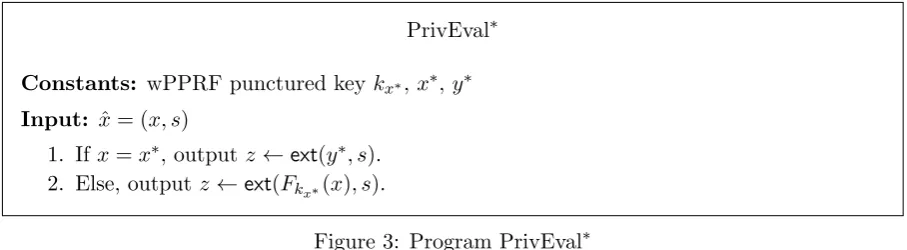
PrivEval∗
Constants: wPPRF punctured keykx∗,x∗,y∗
Input: xˆ= (x, s)
1. Ifx=x∗, output z←ext(y∗, s). 2. Else, output z←ext(Fkx∗(x), s).
Figure 3: Program PrivEval∗
Game 0. This game is the standard leakage-resilient weak pseudorandomness game for wPRFs. CH interacts withA as below:
Setup: CH runs (pp, k)←F.Gen(λ), creates ˆk←iO(PrivEval), where the program PrivEval is defined in Figure2. CH then sendspp toA.
Phase 1: A can make evaluation queries and leakage queries. For each evaluation query, CH choosesx←−R X and s←−R S and returns (x, s,kˆ(x, s)). For each leakage query⟨f⟩,CHresponds withf(ˆk).
Challenge: CH chooses x∗ ←R− X, s∗ ←−R S and computes y∗ ← Fk(x∗), then computes z∗0 ←
ext(y∗, s∗), picksz1∗←−R Z and β ←− {R 0,1}, sends z∗β toA.
Phase 2: Acontinues to make evaluation queries. CH responds the same way as in Phase 1. Guess:A outputs its guessβ′ forβ and wins ifβ′ =β.
According to the definition, we have:
AdvA(λ) =|Pr[S0]−1/2|
Game 1. Same as Game 0 except thatCHchoosesx∗ ←−R X,s∗ ←−R Sand computesy∗ ←Fk(x∗) in the Setup stage. This change is only conceptual and thus we have:
Pr[S1] = Pr[S0]
Game 2. Same as Game 1 except that CH directly aborts when handling evaluation queries forx=x∗.
LetE be the event that there exists one random samplexthat equalsx∗whenCH emulates evaluation oracle. Clearly, ifEnever happens, then Game 1 and Game 2 are identical. Suppose A makes at most qe evaluation queries. Since A is a PPT adversary, qe is bounded by a polynomial in λ. Therefore, Pr[E]≤qe/|X| ≤negl(λ), we have:
|Pr[S2]−Pr[S1]| ≤Pr[E]≤negl(λ)
Game 3. Same as Game 2 except that CH computes kx∗ ← F.Puncture(k, x∗), y∗ ← Fk(x∗),
and creates ˆk ← iO(PrivEval∗) in the Setup stage. Here, the program PrivEval∗ (defined in Figure 3) is built from constantskx∗,x∗,y∗.
By the correctness of wPPRFs, the two programs PrivEval and PrivEval∗agree on all inputs. By the security of iO, we have:
|Pr[S3]−Pr[S2]| ≤AdviAO
By a simple reduction to the weak pseudorandomness of wPPRFs, this modification is undetectable for all PPT adversaries. Thus, we have:
|Pr[S4]−Pr[S3]| ≤AdvwPPRFA
Game 5. Same as Game 4 except that CH picksz∗0 ←−R Z rather than setting z∗0 ← ext(y∗, s∗) in the Challenge stage.
We denote by V the set of public parameter pp, (x∗, s∗), the responses to all evaluation queries (determined by kx∗), z1∗ and β. In both Game 4 and Game 5, y∗ is uniformly chosen
from Y (independent of V), thus H∞(y∗|V) = log|Y|. Observe that A also obtains at most
ℓ bits leakage on ˆk (denote by leak) which is correlated to y∗, it follows by Lemma 2.1 that ˜
H∞(y∗|(V, leak)) ≥ H∞(y∗|V) −ℓ = log|Y| −ℓ. Since ext is an average-case (n, ϵ)-strong extractor, we conclude that ext(y∗, s∗) is ϵ-close to a uniformly random z∗0 ←−R Z, even given
V and leakage. Note that A’s view in Game 4 and Game 5 is fully determined by z0∗, V and
leak, whileV and leak are distributed identically in Game 4 and Game 5. Thereby, A’s view in Game 4 and Game 5 areϵ/2-close. Thus, we have:
|Pr[S5]−Pr[S4]| ≤ϵ/2≤negl(λ)
In Game 5, both z0∗ andz1∗ are randomly chosen from Z. Therefore, we have:
Pr[S5] = 1/2
Putting all the above together, the theorem immediately follows.
We have sketched how to achieve optimal leakage rate in Section 1.3. To avoid repetition, we omit the details here.
Comparison with prior constructions. [Pie09, DY13] showed that any wPRF is already leakage-resilient for a logarithmic leakage boundℓ=O(logλ). Hazay et al. [HLWW13] showed a black-box construction of LR wPRF from any wPRF F :K ×X → Y. Their construction is somewhat involved: they first constructed symmetric-key weak HPS from wPRF, then built LR wPRF from parallel repetition of symmetric-key weak HPS. The consequence is that it is not flexible and efficient. To make the output size larger than nlog|Y|, they have to invoke n
independent copies of the basic wPRF, and the domain size must be larger thann(|X|+log|Y|). Besides, its leakage rate is rather poor, say,O(log(λ)/|k|). In contrast, our construction enjoys flexible parameter choice and optimal leakage rate, which is benefited from the non-black-box use of underlying wPPRF viaiO.
We also mention a few conceptually different approaches to leakage-resilient symmetric-key cryptosystems such as leakage-resilient SKE based on the minimal use of leak-free compo-nents [PSV15] or leakage-resilient PRF in the random oracle or generic group model [BMOS17], which are incomparable to ours.
4
Leakage-Resilient KEM
4.1 Leakage-Resilient PEPRFs
Chen and Zhang [CZ14] put forwarded the notion of PEPRFs, which is best viewed as a coun-terpart of weak PRFs in the public-key setting. In PEPRFs, each secret key is associated with a public key, and there is a collection of N P languages (indexed by public key) defined over domain. For any element in the language, in addition to evaluating its PRF value using secret key, one can also evaluate it publicly with public key and the associated witness.
PEPRFs neatly capture the essence of KEM, and they can be instantiated from either specific assumptions or more general assumptions such as (extractable) hash proof systems and trapdoor functions. In what follows, we recall the standard definition of PEPRFs from [CZ14] and proceed to introduce leakage resilience for them.
Definition 4.1 (PEPRFs). LetL={Lpk}pk∈P K be a collection ofN P languages defined over
X. A PEPRF F :SK×X → Y ∪ ⊥11 forL consists of three polynomial time algorithms as
below:
• Gen(λ): on input λ, output a public keypk and a secret key sk. • PrivEval(sk, x): on input sk and x∈X, output y←Fsk(x)∈Y ∪ ⊥.
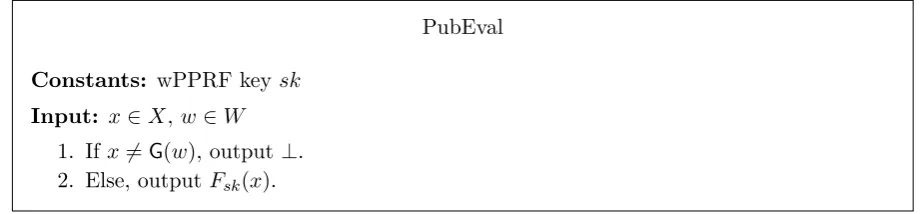
• PubEval(pk, x, w): on input pk and x ∈ Lpk together with a witness w, output y ←
Fsk(x)∈Y.
To be applicable, L is required to be efficiently samplable, i.e., for each pk∈P K, there exists an efficient sampling algorithm SampRel that on input pk outputs a random element x ∈ Lpk together with a witness w.
Leakage-resilient weak pseudorandomness. Let A be an adversary against PEPRFs and define its advantage as below:
AdvA(λ) = Pr
β′ =β:
(pk, sk)←Gen(λ);
state← AOleak(·)(pk);
(x∗, w∗)←SampRel(pk);
y0∗←Fsk(x∗), y∗1
R
←−Y;
β ←− {R 0,1};
β′ ← A(pk, x∗, yβ∗);
−1 2.
Here Oleak(·) is a leakage oracle that on input f : SK → {0,1}∗ returns f(sk), subjected to the restriction that the sum of its output lengths is at most ℓ. A PEPRF is ℓ -leakage-resilient weakly pseudorandom if no PPT adversary has non-negligible advantage in the above experiment. As pointed out in [CZ14], full pseudorandomness is impossible due to the publicly evaluable property.
Leakage-Resilient KEM.[CZ14] showed that weakly pseudorandom PEPRF naturally imply CPA-secure KEM. We observe that this implication applies in the leakage setting as well. We sketch the construction here for completeness. Assume F :SK×X → Y is a leakage-resilient PEPRF for L={Lpk}pk∈P K, where the range Y is an additive group. The key pair is exactly the key pair of the underlying PEPRF. To encrypt a messagem∈Y, one picksx←−R Lpk with a witnessw, computes k←PubEval(pk, x, w) and outputs ciphertext (x, k+m). The decryption process re-computes k via PrivEval(k, x). The LR CPA security of KEM readily follows from the LR weak pseudorandomness of the underlying PEPRF. The resulting LR CPA-secure KEM can be boosted to LR CPA-secure PKE by combining data encapsulation mechanism (DEM) with appropriate security properties [CS02].
11In a PEPRF, when the input xis not in L
pk, its PRF value Fsk(x) may not be well defined and will be