1
Physicochemical foundations of life that direct evolution
Why chance and natural selection cannot explain evolution
Didier Auboeuf
Univ Lyon, ENS de Lyon, Univ Claude Bernard, CNRS UMR 5239, INSERM U1210, Laboratory of Biology and Modelling of the Cell, 46 Allée d'Italie, Site Jacques Monod, F-69007, Lyon, France ; Mail: [email protected]
Abstract
The current framework of evolutionary theory postulates that evolution relies on random mutations generating a diversity of phenotypes on which natural selection acts. This framework was established using a top-down approach as it originated from Darwinism, which is based on observations made on complex multicellular organisms, and then modified to fit a DNA-centric view. In this article, I argue that, based on a bottom-up approach starting from the physicochemical properties of nucleic and amino acid polymers, we should reject the facts that: i) natural selection plays a dominant role in evolution, and ii) the probability of mutations is independent of the generated phenotype. I will show that the adaptation of a phenotype to an environment does not correspond to organism fitness but rather corresponds to maintaining the genome stability and integrity. In a stable environment, the phenotype maintains the stability of its originating genome, and both (genome and phenotype) are reproduced identically. In an unstable environment (i.e., corresponding to variations in physicochemical parameters above a physiological range), the phenotype no longer maintains the stability of its originating genome but instead influences its variations. Indeed, environment- and cellular-dependent physicochemical parameters define the probability of mutations in terms of frequency, nature and location in a genome. Evolution is non-deterministic because it relies on probabilistic physicochemical rules, and evolution is driven by a bidirectional interplay between genome and phenotype, the phenotype ensuring the stability of the genotype in a cellular and environment physicochemical parameter-depending manner.
2
Introduction
The current framework of evolutionary theory coming from the Modern Synthetic Theory of Evolution postulates that evolution relies on random mutations, generating a diversity of phenotypes on which natural selection acts. This concept is widely accepted in the scientific community despite the fact that some important issues have been raised about it1-3. The notion of random mutations can lead to multiple
interpretations. It can mean that the nature or location of mutations is random, and indeed, mutations are often described as “errors” during replication4,5. However, many factors influence the rate, nature
and location of mutations5-10. Thus, the appearance of a mutation is probabilistic and depends on multiple
cellular- and environment-dependent physicochemical parameters. The notion of random mutations can also mean that the probability of a mutation is independent of the phenotype it generates. One of the objectives of this article is to show that if cellular- and environment-dependent physicochemical parameters influence the frequency, nature and location of mutations, the probability of a mutation should depend on the phenotype it generates. Indeed, I will show a continuum between physiological and genetic adaptation, as already has been proposed11-13, which indicates that physiological adaptation
facilitates and guides genetic variations in an environment-depending manner (see below).
The notion of natural selection is also subject to multiple interpretations as it can be negative, positive or neutral14-17. How can evolution be explained, if chance generates a large number of
possibilities, and natural selection can be positive, negative or neutral? In addition, the notion of natural selection has a limited interest because a living organism observable over more or less long time periods is necessarily adapted to its environment, otherwise it disappears without leaving any descendants. The second objective of this article is to replace the notion of natural selection with the notion that the role of the phenotype in evolution is to maintain the integrity and stability of its originating genome.
Another issue raised by the current model of evolution relies on the fact that the combination of chance and natural selection does not provide a single conceptual framework that simultaneously explains both evolution and organism activities, since evolution but not organism activities would rely on chance and natural selection. However, life and evolution are inseparable and must depend on the same fundamental principle. Indeed, living organisms are hierarchically structured since multicellular organisms are composed of cells that are composed of molecules. The lower levels of organization have necessarily appeared before more complex living forms and fundamental principles of evolution must be applicable from molecules to complex organisms. In this setting, the current model of evolution was established using a "top-down" approach originating from Darwinism that is based on observations made on complex multicellular organisms18 and that was modified after the discovery of DNA. In this article, I
3
allow us to redefine i) the notion of chance in a precise context of physicochemical laws, and ii) the notion of adapted phenotype not in terms of organism fitness but rather in terms of impact on genome stability. Life is based on two types of polymers: nucleic acid polymers (DNA and RNAs) and amino acid polymers (proteins). Emphasis has been given over the last decades on a functional dichotomy in which nucleic acids are described as the support of the genetic information, while proteins perform the cellular activities. As a consequence, nucleic acids are often “simply” considered as the carrier (DNA) or vectors
(RNAs) of genetic information and are represented in the form of a suite of letters A, C, G, and T, corresponding to the four nucleotides that composed them. Thus, the physicochemical properties of nucleic acids are obscured in the context of the current Synthetic Theory of Evolution, in which evolution corresponds basically to the random substitutions of one letter by another one. In the first part, I will underline that the physicochemical properties of nucleic and amino acid polymers depend on their composition, which is constrained by cellular- and environment-dependent physicochemical parameters. I will next show that this principle has consequences on the way evolution proceeds.
Indeed, I will highlight in the second part that the emergence of life probably corresponds to the establishment of the interdependency between RNAs (or similar molecules) and proteins (or similar molecules). This means that, as observed in modern organisms, protein synthesis depends on RNAs as templates and RNA synthesis depends on proteins. This interdependency generates a positive feedback loop, as an RNA (the proto-genome) generates a protein (the proto-phenotype) that contributes to the synthesis of the RNA on which it depends (Fig. 1A). Moreover, RNAs are unstable and are rapidly degraded by hydrolysis. Therefore, the RNA/protein system can only self-reproduce and self-amplify if proteins (the proto-phenotypes) maintain the physical integrity of the template (the proto-genome) from which they are derived. This fundamental principle can be expressed as follows: the genome (in this case, an RNA) generates a phenotype (here, a protein) that contributes to the reproduction and stability of its originating genome by relaxing environment-dependent physicochemical constraints (Fig. 1A).
4
response to physicochemical constraints and relaxes the initial constraints. If the phenotype is adapted to a given environment (i.e., a set of physicochemical constraints), the genome is stable and will be reproduced identically (physiological adaptation, Fig. 1C). If the phenotype is unsuitable, the genome is unstable and will be modified until generating a phenotype that will ensure its stability (genetic adaptation, Fig. 1C).
If the main role of a phenotype is to maintain the stability (see Glossary) of its originating genome, the phenotype (as the sum of all cellular activities) in turn creates physicochemical constraints on the genome. For example, the metabolic activities of cells produce a diversity of molecules (e.g., reactive oxygen species) that can interact with DNA and induce mutations. This means that a genome can generate a phenotype that can in turn generate physicochemical constraints on its originating genome (Fig. 1D). I will illustrate in the fourth part this feedback loop by showing that UV-radiation triggered the emergence of photosynthesis, which then triggered the emergence of oxidative metabolism followed by eukaryogenesis. In addition, I will show that this principle explains the emergence of epigenetic modifications, multicellular organisms, and germline cells. I will finally highlight the fact that the interplay between the genome and the phenotype described above at the RNA/protein level is still operating in multicellular organisms when considering that the phenotype generated from the germline cell DNA corresponds to the production of somatic cells whose function is to protect the originating genome (i.e., the germline cell DNA) from environment-dependent physicochemical constraints.
5
Part 1. Environment-dependent physicochemical constraints on nucleic and amino acid
polymer composition
Nucleic and amino acid polymers have emergent physicochemical properties (e.g., solubility, folding, and stability) that depend on intrinsic parameters relying on their composition and extrinsic parameters (e.g., temperature). The aim of this part is to show that cellular- and environment-dependent physicochemical parameters constrain the composition of cellular nucleic and amino acid polymers. I will show in the next par that this principle has consequences on the way evolution proceeds.
1.1. Physicochemical constraints on protein composition
The amino acid composition of proteins is constrained by intrinsic parameters impacting on protein solubility, folding, and stability; for instance, proteins with too many hydrophilic amino acids tend to unfold, while proteins with too many hydrophobic amino acids tend to aggregate20,21. Extrinsic
physicochemical parameters, such as temperature or cellular and environment chemical composition, also constrain the amino acid composition of proteins, notably owing to the chemical modifications of amino acid side chains. Indeed, protein amino acids can react with and be modified by various chemical compounds (e.g., lipids, sugars, and reactive oxygen species or ROS)22. Protein chemical modifications
(see Glossary): i) are spontaneously or enzymatically generated; ii) change the physicochemical properties of the modified amino acids; and iii) contribute to cellular regulatory processes or induce protein mis-folding and aggregation22. For example, amino acid oxidation in proteins plays a role in many
cellular processes yet high rates of it induces protein damage and aggregation22. In agreement with the
fact that (bio)chemical compounds constrain the amino acid composition of proteins, organisms growing under different levels of salt or oxygen, or having different metabolic activities, produce proteins with different amino acid composition biases21,23 (see Glossary). Finally, the amino acid composition of
proteins depends on the environmental supply of key elements that are required for the biogenesis of amino acids. For example, organisms growing in nitrogen- or sulphur-poor environments produce proteins that contain low amounts of nitrogen-rich amino acids (e.g., arginine) or sulphur-containing amino acids (e.g., cysteine), respectively24,25. In summary, the amino acid composition of proteins obeys
physicochemical laws and on cellular- and environment-dependent physicochemical parameters.
1.2. Physicochemical constraints on nucleic acid polymer composition
6
stacking interactions, and GC dinucleotides form polymorphic structures26-28. As a consequence, GC- and
purine-rich polymers are thermodynamically stable, and the genome of thermophilic organisms is enriched in GC and/or purine nucleotides26,29. Nucleotide composition also determines DNA mechanical
properties (e.g., flexibility, bendability), contributing to its cellular functions and its resistance to torsional stresses (Fig. 2A and 2B, see Box 1). For example, increasing the GC content increases the B- to Z-DNA conformational transition, DNA-bendability, and DNA resistance to torsional stresses; accordingly, highly transcribed genes are GC-rich27,30-32.
Like proteins, DNA and RNA molecules undergo dozens of spontaneous or enzyme-dependent chemical modifications (including oxidation, methylation, deamination, alkylation, and glycation) that i) affect the physicochemical properties of nucleic acid polymers; and ii) contribute to regulatory processes but can also induce damages33-35(Fig. 2C). For example, DNA oxidation not only plays a role in gene
expression regulation but also increases DNA damages and mutations33,34. The reason why DNA chemical
modifications can generate mutations during replication is because a chemically modified nucleotide can
“mimic” another one; for example, an oxidized-guanine can base-pair with an adenine instead of a cytosine, which can result in mutations during replication33,34. As for proteins, environmental
physicochemical parameters (temperature, chemical composition) constrain the nucleotide composition of genomes; this can be observed in thermophilic, halophilic, acidophilic, aerobic, and radiation-exposed organisms29,36. Finally, the amount of DNA per cell (genome size and ploidy) is constrained by the
environmental availability of phosphorus, and the genomes of organisms growing in nitrogen-poor environment are enriched in A:T pairs, which require 7 nitrogen instead of 8 in G:C pairs37-39.
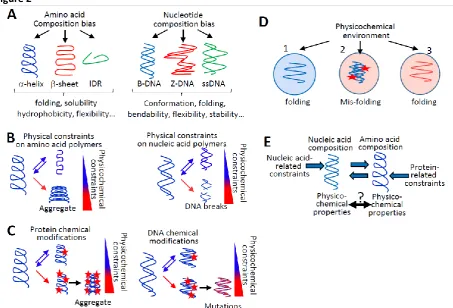
In summary, the properties of nucleic and amino acid polymers depend on intrinsic parameters and these polymers can undergo reversible structural and chemical modifications triggered by extrinsic physicochemical constraints; above a certain threshold, these modifications can challenge their integrity (Fig. 2A-D). This raises a major issue for coding sequences, which are under both nucleic acid- and protein-related constraints (Fig. 2E).
1.3. Interdependency between the physicochemical properties of nucleic acid polymers and their
cognate amino acid polymers
Coding sequences accommodate different constraints, not only by the encoded protein sequence but also by cellular processes such as chromatin organisation (e.g., nucleosome positioning), transcription (e.g., DNA flexibility), RNA folding, splicing, and RNA-RNA or RNA-protein interactions40-42. It has been
assumed until now that variations of the third nucleotide of codons (the “wobble” position, which is usually the only variable between all codons encoding an amino acid) solves nucleic acid–related constraints without affecting the encoded amino acids40. However, this assumption is challenged by the
7
the thermodynamic property of codon–anticodon interactions, with consequences on translation fidelity, speed, and co-translational protein folding40,43. Accommodation of different constraints in coding
sequences also relies on the fact that the genetic code is not randomly organized, as amino acids that share physicochemical properties (e.g., hydropathy) correspond to codons with a similar nucleotide composition bias. For example, hydrophilic or hydrophobic amino acids correspond to A- or T-rich codons, respectively, and small or large amino acids are encoded by GC-rich or GC-poor codons, respectively44,45.
Consequently, two codons with only one nucleotide difference (either at the first or third position) can encode either the same amino acid or different amino acids with similar physicochemical properties.
However, the organization of the genetic code implies that the nucleotide composition bias of a nucleic acid polymer affects the physicochemical properties of the encoded protein and, conversely, that the amino acid composition bias in a protein affects the physicochemical properties of the cognate nucleic acid polymer. For instance, compact proteins comprising small amino acids correspond to GC-rich coding sequences (as small amino acids correspond to GC-rich codons), while proteins comprising hydrophobic regions (i.e., containing stretches of hydrophobic amino acids) correspond to T-rich coding sequences (as hydrophobic amino acids correspond to T-rich codons)31,46,47. Along the same lines, the
global nucleotide composition bias of a genome (e.g., GC content) is associated with a global amino acid composition bias of the encoded proteome48,49.
Supporting the notion that constraints on the physicochemical properties of one kind of polymer affects composition biases of the cognate polymers are the following observations: i) nucleosome positioning leaves a footprint in protein sequences; ii) splicing sites and splicing factor–binding motifs constrain the amino acid composition of peptides encoded by splicing-regulated exons; iii) mRNA secondary structures depending on base complementarity have consequences on the secondary structures of the encoded protein41,50-52. Conversely, protein secondary structures leave a footprint in the
nucleotide composition bias of coding sequences, as for example amino acids that favor alpha-helices and beta-sheets correspond to codons ending with purines and pyrimidines, respectively53. Along the
same line, alternation of hydrophobic and hydrophilic amino acids in amphipathic alpha-helices that rely on a periodicity of ~3.5 amino acids corresponds to a specific detectable ~10 bp periodicity in DNA, with consequences for the helical pitch of nucleosome-wrapped DNA54. Finally, purine enrichment in coding
sequences is determined by protein-related physicochemical constraints, such as solubility and folding55.
8
Part 2: Evolution of the genetic code
Life relies on the interdependency between nucleic and amino acid polymers, since the biogenesis of proteins requires a nucleic acid polymer as a template (RNA) while biogenesis of nucleic acid polymers requires proteins. In addition, nucleic and amino acid polymers are in “competition” with each other, as their biogenesis requires the same elements (e.g., nitrogen) and required the same template— single-stranded RNA (ssRNA) before the emergence of DNA. The aim of this section is to propose that these fundamental principles (interdependency and competition) constrain the genetic code evolution to match the fundamental physicochemical properties of both polymers. In other words, specific codons correspond to specific amino acids because their presence in nucleic acids/cognate proteins allows both polymers to deal with the same fundamental physicochemical parameters.
2.1. Interdependency and competition between RNAs and proteins
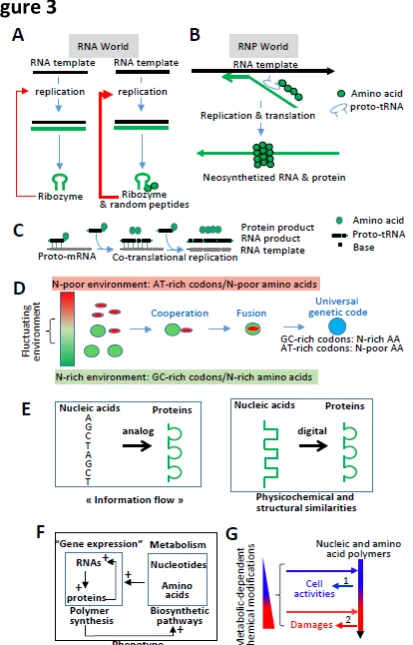
While there is an ongoing debate about whether the origin of life started with only RNAs (“RNA world”) or with RNAs and peptides (“RNP world”), there is a consensus that the activity of ribozymes (e.g., RNAs that catalyze nucleic acid polymerization) has been enhanced at some points of evolution by their interactions with amino acids or with randomly generated small peptides that may have also stabilized RNAs, which would otherwise be rapidly degraded by hydrolysis (Fig. 3A)56-58. For example, randomly
generated peptides composed of abiogenetically-produced amino acids, such as Gly and Asp, may increase the efficiency of replicating ribozymes, as these amino acids play a very important role in the AsnAlaAspPheAspGlyAsp (NADPDGD) peptides found in all polymerases. In particular, binding of these amino acids to the catalytic metal ion Mg2+ could have enhanced polymerization and protected RNA from
Mg2+-dependent hydrolysis59. Coincidentally, a primeval genetic code corresponding to GC-rich and RNY
codons (e.g., GGC, GCC, GAC, GTC) has been proposed, because these codons are the most frequent in coding sequences and correspond to the most metabolically simple amino acids (Gly, Asp, Ala, and Val) that are sufficient to produce stable, folded, and functional proteins57,60. A positive feedback loop
between nucleic and amino acid polymers could have been initiated by primeval GC-rich RNAs, by first interacting with randomly-generated peptides (e.g., made of Gly and Asp), which would then favor the production of more complex peptides through a primeval GC-rich genetic code.
However, such a cooperation would have been inefficient if RNA and protein polymerization were physically uncoupled, for two main reasons. First, ssRNA templates give rise to stable double-stranded RNAs (dsRNAs) after replication, which decreases the rate of other rounds of replication as well as of protein synthesis that requires ssRNA templates61,62. Second, freely diffusible RNAs and proteins would
limit their cooperation, as freely diffusible peptides generated from an RNA template can stabilize and enhance the replication of potential “parasitic” or mutated RNA replicators63,64. Simulation and in vitro
9
molecules freely diffuse, due to the appearance of mutated RNAs, which become smaller and therefore are more rapidly amplified while simultaneously losing their enzymatic activity63,64. Proto-cell
compartmentalization and physical coupling between replication (i.e., RNA production in an RNP world) and amino acid polymerization (i.e., protein production) could solve these two main issues65-69. First,
interactions between the nascent RNA and the nascent peptide could decrease the formation of stable dsRNAs while protecting ssRNAs from degradation. This is observed in modern prokaryotes or eukaryotes: protein binding to nascent RNAs during co-transcriptional–translation or co-RNA processing prevents RNAs from interacting with the DNA template and increases transcription70-73(Fig. 3B). Second,
the physical proximity between replication and translation would increase the probability that the neo-synthetized proteins “protect” and enhance replication of its originating RNAs, which would have facilitated the increase in replication and translation fidelity65-69.
While the physical coupling between RNA and protein polymerization may seem to be a
“sophisticated” molecular process, several authors have proposed straightforward models66-69,74. For
example, proto-tRNAs (tRNA ancestors) comprising three nucleotides (the proto-anticodons) bound by one amino acid could have been used simultaneously for replication and translation: the three anti-codon nucleotides could have been used as “building” blocks during replication, while the attached amino acids could have chemically enhanced the triplet polymerization and be used as building blocks for protein production (Fig. 3C). Of note, i) the use of tri-nucleotides rather than mono-nucleotides increases the efficiency and fidelity of replication by ribozymes75; ii) phylogeny analyses suggest that tRNAs originated
in replication76; and iii) the coupling between transcription (i.e., RNA biogenesis) and translation is still
operating in prokaryotes, and many features are shared by transcription and translation in modern cells 70-73(Box 2).
To summarize, life likely emerged from the cooperation between nucleic and amino acid polymers. This has consequences on the nature of amino acids that can be assigned to specific nucleotide sequences, as detailed below.
2.2. Co-adaptation of nucleic acid polymers and their encoded proteins to the same fundamental
physicochemical parameters
10
Along the same line, the organization of the genetic code allows nucleic and amino acid polymers to co-adapt to the bioavailability of nitrogen. Indeed, A:T pairs that require fewer nitrogen atoms than G:C pairs (7 vs. 8, respectively) correspond to amino acids that also requires fewer nitrogen atoms24,37,38.
Accordingly, plant genomes and proteomes are AT-rich and contain amino acids that requires fewer nitrogen atoms as compared to animal genomes and proteomes; this fits well with the fact that nitrogen sources are limited for plants, while animals can access organic sources of nitrogen24,37,38.
Oxygen is highly toxic, as oxygen derivatives (e.g., ROS) can damage nucleic and amino acid polymers and induce their cleavage or aggregation22,33,34. Stepwise increases of oxygen in the biosphere
over time (see Part 4 for more details) may have given the impulse for the late incorporation into the genetic code of amino acids that can act as “ROS scavengers” (including Trp, Tyr, Met, Cys and His) and thereby protect biopolymers from oxidative damages78. Interestingly, the most frequent mutations in
ROS-producing cancer cells affect Arg codons (and in particular, the CGN codons), with mutations producing codons for Cys (TGY), Trp (TGG), stop codon (TGA), and His (CAR)79-83. It has been proposed
that these mutations i) are induced by ROS-mediated deamination of (methyl)cytosine, leading to C>T mutations, or incorporation of oxidized guanine during replication, leading to G>A mutations; and ii) protect cancer cells from the high levels of ROS by increasing the global anti-oxidant capacity of the cancer proteome79-83. Interestingly, CGN codons (that encode Arg) seem to be particularly sensitive to
oxidation because of their physicochemical properties79,84. Further, (methyl)cytosine deamination
produces CG>TA mutations and may thereby increase the nitrogen availability required by proliferative cancer cells, as it reduces the nitrogen-richer C:G pairs in favor of the nitrogen-poorer T:A pairs as well as the GC-rich sequences that contain codons (e.g., CGN) corresponding to nitrogen-rich amino acids (e.g., Arg)79. Therefore, ROS-induced cytosine deamination would simultaneously save nitrogen atoms (at
both genome and proteome levels) and protect cells from ROS. Although speculative, one possibility is that the assignment of “ROS scavenger” amino acids to codons that originate from the oxidation of Arg codons generates anti-oxidant proteins from oxidized nucleic acids. Supporting such a possibility, assignment of Met to the ATA codon (in addition to the ATG codon) in most animal mitochondria lineages explains the high frequency of Met in mitochondria-encoded respiratory chain complexes, and it represents an adaption to high ROS level in mitochondria85.
If physicochemical constraints shaped the genetic code, it is very likely that the universal genetic code is the result of horizontal transfers of "code fragments", as proposed by several authors58,86. For
example, proto-cells present in extreme environments (e.g., hot or cold, nitrogen-rich or -poor, oxygen-rich or –poor) could have developed "code fragments” adapted to their specific environment. At the frontiers of these habitats where physicochemical parameters fluctuate, genetic horizontal transfers
11
To summarize, the organization of the genetic code was constrained to match general properties of the interdependent nucleic and amino acid polymers, as well as to favor their interaction and coordinate their biogenesis (Box 2). As a consequence, nucleic acids and their cognate proteins may share more physicochemical and structural properties than previously anticipated (Fig. 3E), which has consequences on evolutionary mechanisms, as discussed in Part 3. However, it must be first emphasized that the cell metabolism is another important factor in the genetic code evolution.
2.3 Feedforward and feedback loops between gene products and their products (i.e., metabolites)
Nucleic and amino acid polymers depend on the availability of molecules containing elements, such as nitrogen (see Part 1). This dependency would have favored the emergence of polymers with metabolic activities that modify environmental resources and allow elements to be incorporated into amino acids and nucleotides. In an RNP world, the proto-cell phenotype would be a positive feedback loop between bio-synthetic pathways (i.e., metabolism in modern cells) and polymerization of RNAs and proteins (i.e., the gene expression process in modern cells): polymer production depends on bio-synthetic pathways that in turn depend on polymerization products (Fig. 3F). Supporting this interplay between gene expression and biosynthetic pathways, the genetic code likely co-evolved with amino acid biosynthetic pathways, as codons starting with A, C, U, or G correspond to amino acids synthetized from oxaloacetate, -ketoglutarate, pyruvate, or from the reductive amination -keto acid, respectively57,87-89. A possibility
is that simple amino acids or metabolites covalently attached to polynucleotides (e.g., proto-tRNAs made of three nucleotides) could have been chemically transformed to give rise to more complex amino acids89.
Another possibility is that chemical modifications of simple amino acids occurred after their incorporation into proteins, and that chemically modified amino acids (i.e., complex amino acids) were thus available after protein hydrolysis. Complex amino acids would have next been incorporated into the genetic code. In this context, it must be underscored that the chemical modifications of proteins and nucleic acids establish a direct bridge between cell metabolic activities and gene expression/gene product functions (i.e., the cellular physiological adaptation). Indeed, chemical modifications of nucleic and amino acid polymers (e.g., post-translational modifications, DNA or RNA methylation) that change their physicochemical properties also affect their cellular activities, and these chemical modifications depend on the cell metabolic activities. For example, DNA, RNA, and protein oxidation depend on cellular oxidative metabolism, while DNA, RNA, and protein methylation depend on the production of S-adenosyl methionine (SAM), the universal methyl-group donor produced in the one-carbon cycle90-92. Finally, as
12
Part 3. Continuum between physiological and genetic adaptation
The aim of this section is to show that environmental fluctuations induce physical and chemical constraints on nucleic and amino acid polymers, which triggers the cellular physiological adaptation that maintains cellular homeostasis (Fig. 1B, 1). However, if the cellular response to environmental fluctuations does not allow a return to equilibrium, constraints persist and can challenge the physical integrity of DNA, leading to DNA damages, mutations, and genetic variations. This process only ends when mutated sequences allow the direct or indirect relaxation of the initial constraints (Fig. 1B, 2).
3.1. Genetic adaptation directed by transcription: transcription-replication conflicts
Several authors have already proposed that cellular stresses (i.e., environmental fluctuations above a physiological range) induce “adaptive mutations” (i.e., mutations that occur at a high rate) and/or
“directed mutations” (i.e., mutations occurring at specific genomic locations)93-95. A possible underlying
mechanism is that stress-directed transcriptional activation of specific loci (as part of the cellular physiological adaptation) increases the probability of mutations to occur within these loci because transcription induces mechanical stresses (e.g., formation of supercoiling) that challenge the physical integrity of transcribed DNA12,35,94-97. I will describe below how this straightforward principle establishes
a continuum between physiological and genetic adaption.
Highly transcribed genes are enriched in GC nucleotides that can “absorb” mechanical stresses by favoring the B- to Z-DNA transition, owing to the physical properties of both pairing and base-stacking interactions between G and C nucleotides (see Part 1). Critically, this G/C enrichment can be explained by several transcriptional-dependent mutational biases (see Glossary), which result in part from conflicts between transcription and replication97,98. Indeed, while the act of transcription increases
DNA accessibility to DNA polymerases, the simultaneous transcription and replication of a locus creates conflictual physical stresses leading to DNA breaks97-99. DNA breaks can be repaired by heteroduplex DNA
recombination, a process known to favor G:C over A:T base pairs100-103. This phenomenon may in part rely
on the fact that a T in a mismatched base-pair (T:G or T:C) within heteroduplex DNA can spontaneously flip out of the dsDNA, increasing the probability of its removal104. In addition, transcription-replication
conflicts have been shown to induce adenine deamination, giving rise to hypoxanthine, a nucleotide that mimics guanine and leads to A:T>G:C mutations during replication105. Different mutational biases also
occur in early and late replicating regions7. For example, the accumulation of free oxidized-dGTP before
replication may result in its incorporation in place of Ts (as oxidized-dGTP mimics adenine), leading to A:T>G:C mutations during the early phase of replication106. Additionally, as DNA cytosine methylation is
13
to decreases during the cell cycle of concentrations of free dGTPs and dCTPs (as producing these nucleotides requires more energy than producing dATP and dTTP), which leads to a higher incorporation rate of A or T nucleotides in late-replicating regions108. Therefore, mutational biases associated with
replication timing and replication-transcription conflicts could increase the GC- and AT-content in early and late replicating regions, respectively.
While the GC-content of loci may increase as a consequence of DNA breaks resulting from transcription-replication conflicts, this increase next exerts positive feedback loops by: i) synchronizing transcription and replication; ii) increasing local DNA stability during transcription and/or replication; and iii) increasing the transcription activity of modified loci as well as many downstream steps of the gene expression process28,32,42,109. Indeed, the mechanical properties of GC-rich DNA regions favors
transcription efficiency (but not elongation speed) and avoids nascent RNAs from interacting with the DNA template due to formation of stable secondary structures in the nascent GC-rich RNAs70,71. High
GC-rich content may also increase local rate of recombination/deletion, leading eukaryotic GC-GC-rich genes to bear smaller introns (as compared to AT-rich genes)30,31,102,110. Of note, small GC-rich introns are more
efficiently spliced, likely because of intronic RNA secondary structures111,112. In addition, high GC content
in RNAs increases the efficiency and fidelity of translation by smoothing translation elongation and favoring co-translational protein folding52,113-115. And finally, as the genetic code is not random, increasing
gene GC content leads to the biogenesis of proteins with small amino acids, which in turn leads to decreases in: i) protein volume, ii) concentration-dependent aggregate formation, and iii) the energetic cost of protein production31,116-118. Therefore, the “over-stimulation” of the transcriptional activity of
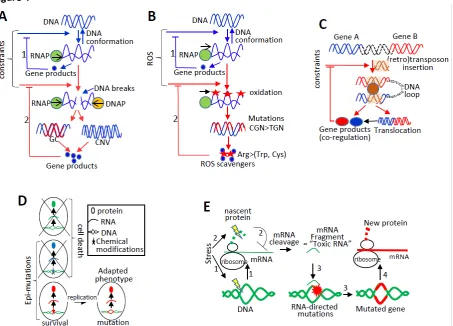
some genes under sustained stresses could result in i) replication-dependent mutational bias, ii) increases in the GC-content of stress-induced genes; and iii) decreases in the local transcription-dependent DNA instability, while improving gene product biogenesis at multiple levels (Fig. 4A). Another genetic process that increases the biogenesis of specific gene products under stress situations is gene duplication, which is also linked to transcription-replication conflicts12,119. For example, stress-induced promoter activity can
stimulate gene duplication by destabilizing stalled replication forks119.
14
3.2. Genetic adaptation directed by transcription: role of ssDNA formation and DNA folding
Transcription-dependent chromatin relaxation and ssDNA formation increase the accessibility of transcribed DNA regions to mutational agents—so-called “transcription-associated mutations” 5,12,35,95-97,120. For example, ROS-mediated oxidation of cytosines and methylcytosines is enhanced in ssDNA,
which can lead to C>T mutations during replication35. As a consequence, CGN codons (corresponding to
Arg) of transcriptionally activated genes under ROS exposure have a higher probability to be mutated into TGG, TGA, and TGY codons (corresponding to Trp, stop, and Cys codons, respectively), allowing the synthesis of proteins containing amino acids that protect cells from oxidation (see Part 2 and Fig. 4B).
Remarkably, genome-wide analysis of mutations occurring in organisms growing under different environmental constraints (e.g., different metabolic resources or temperatures) show that each challenging condition is associated with a specific mutational bias121-125 (see Glossary). This is in
agreement with the fact that each mutagenic agent i) affects sequences with specific physicochemical properties, and ii) induces nucleotide modifications toward a particular pattern, as has now been well established in cancer genetics126. Of note, in addition to ROS-associated mutational signatures in cancers
(see above), mutational bias induced by high intracellular pH has recently been shown to favor Arg (CGY) > His (CAY) mutations that confer pH-regulated protein functions127. It will be very interesting to
systematically characterize the relationship between i) the physicochemical properties of mutagenic agents as well as of their most affected sequences; and ii) the nature of the induced mutations and the resulting physicochemical consequences at the nucleotide and amino acid levels8. Each mutagenic agent
could trigger a specific mutation bias that more or less directly relaxes the initial physicochemical constraints (Fig. 1B, 2).
Of particular interest, transcription-dependent ssDNA formation increases also the probability of insertion of repeated elements, such as transposons and retrotransposons, a process known to play a major role in the genomic plasticity under sustained stresses128-132. It has been proposed that cellular
stresses leading to a global chromatin relaxation could on the one hand de-repress (retro)transposon activity and, on the other hand, increase the likelihood of their insertion in specific stress-transcriptionally activated genes128-132. Insertion of (retro)transposons in stress-activated genes can influence gene
expression at multiple levels, in particular by playing a role in the spatial genome organization. Indeed, it is now well recognized that regulation of gene transcription is based on the three-dimensional (3D) genome organization, which roughly corresponds to DNA folding (Box 1). DNA folding plays a critical role in co-regulating genes by bringing them closer together in space133-137. Factors binding to repeated
sequences dispersed in various genomic locations could facilitate 3D genome organization and promote co-regulation of repeated sequence–hosting genes138,139(Fig. 4C). Spatial clustering of co-regulated genes
15
lead to the formation of new gene products but also can facilitate the expression coordination of co-stimulated genes (Fig. 4C). The importance of gene position in genomes with respect to their regulation and cellular functions is clearly established in operons from bacteria and in the so-called topologically-associated domains (TADs) in eukaryotes144-147. An emerging theme is that the 1D and 3D locations of
genes play a major role in coordinating the expression of genes whose products are involved in the same cellular pathways (Box 1).
In sum, environment-dependent physicochemical constraints on DNA trigger cellular physiological adaptation and a continuum between physiological and genetic adaptation is established when environment-dependent physicochemical parameters above a physiological range challenge DNA physicochemical integrity.
3.3. Physiological adaptation facilitates genetic adaptation: role of RNAs
DNA chemical modifications can contribute to physiological adaptation (e.g., role of DNA methylation and oxidation in transcription regulation) and induce mutations during replication when a chemically modified nucleotide “mimics” another nucleotide (see Part 1). This mimicry process can also result in transcription “infidelity” by affecting the base-pair rules, thereby leading to biogenesis of RNAs with different sequences than encoded by the DNA template148-150. This so-called “transcriptional
mutagenesis” is more frequent than previously anticipated and could play a major role in both physiological and genetic adaptations. For example, chemical modifications in transcribed DNA may lead to the biogenesis of new RNAs and proteins, which could contribute to cell survival. As a consequence, only cells bearing the DNA chemical modifications can divide, so that having the DNA chemical modifications would increase the probability to give rise to genetically adapted daughter cells 148-153 (Fig.
4D). The same principle can be used to establish a direct link between genetic adaptation and epigenetic modifications (i.e., DNA or histone chemical modifications that impact gene expression), as environmental fluctuations induce epigenetic modifications of specific loci as part of the cell´s physiological adaptation. If transcription-dependent epigenetic modifications at specific loci increase cell survival, the surviving cells may have a higher probability to undergo mutations within these genes, as chromatin organization and epigenetic marks more or less directly impact both DNA damage and DNA repair35,154,155.
Along the same line, RNAs produced from loci as part of the cellular physiological adaptation could under certain circumstances induce mutations in the loci they originated from. For example, the spatial proximity of co-regulated genes (see above) could promote the biogenesis of chimeric RNAs via a mechanism called trans-splicing, thereby “fusing” RNAs produced from two genes156. These chimeric
16
these RNAs during the repair of loci broken by the stress-induced transcription, increasing the probability of recombination between specific loci157,158.
RNAs can increase the likelihood of genetic variations in numerous ways159,160. I have recently
described a spectra of molecular mechanisms by which physicochemical constraints on RNAs and proteins at the time of their synthesis could trigger mutations in their originating genes through the biogenesis of RNA fragments73,161,162. Briefly, environmental fluctuations can on the one hand induce the
transcriptional activity of target genes, thereby generating a greater amount of mRNAs and proteins, and on the other hand generate constraints on nascent RNAs / nascent proteins during transcription / translation (Fig. 4E, 1 & 2). Perturbation of mRNA or protein synthesis leads to the biogenesis of RNA fragments; for example, mRNA cleavage occurs when the dynamics of ribosomes (e.g., as a consequence of nascent protein misfolding) along the mRNA template is disturbed163,164. RNA
fragments generated during transcription and/or translation could then interact with their originating genomic regions and induce genomic instability and mutations in the targeted regions (Fig. 4E, 3). Therefore, RNA-directed mutations could increase the likelihood of mutations to occur in specific loci when cells experienced constraints during the biogenesis of specific RNAs or proteins (see also Part 4).
In sum, environment-dependent physicochemical parameters trigger cellular physiological adaptation through changes of the cellular activities that leave traces / footprints on nucleic and amino acid polymers (e.g., DNA breaks, chemical modifications, RNA biogenesis). If the physiological adaptation allows a return to equilibrium, polymer modifications are temporary and reversible (Fig. 1B, 1). If not, these modifications may have a more-or-less direct effect on replication, potentially leading to mutations at specific loci. This mutational process triggered by physicochemical constraints only stops when new sequences relax the initiating constraints (Fig. 1B, 2). This principle is well suited to unicellular organisms in which the same DNA molecule is used as a template during i) the physiological response to environmental fluctuations and ii) replication and transmission across generations.
Part 4: Physicochemical rules: from genes to ecosystems
The objective of this section is to illustrate, by examining the emergence over evolutionary time of photosynthesis, oxidative metabolism, eukaryogenesis, multicellularity, and gametes, that i) a phenotype is adapted to an environment if it maintains the integrity of its originating genome with respect to environment physicochemical constraints (Fig. 1D, 1); and ii) a phenotype (i.e., the sum of all cellular activities) generates physicochemical constraints on its originating genome (Fig. 1D, 2). Indeed, numerous compounds are produced by the cell in response to environment-dependent physicochemical variations, which can interact and react with nucleic and amino acid polymers with potentially deleterious effects on their stability, folding, or solubility22,165 (see Part 1). Therefore, cellular activities represent a source of
17
4.1. Feedforward and feedback loops between toxicity (“constraints”) and detoxification
(“adaptation”)
Before the emergence of the ozone layer, cells were exposed to strong solar UV radiations166-168. By
inducing genomic instability, UV favored the emergence of genomes that produce pigments absorbing UV-damaging radiations, which would give these genomes a greater probability to be “accurately”
reproduced166-168(Fig. 5B, 1). Interestingly, it has been proposed that the molecular ancestors of
photosynthetic light acceptors (e.g., chlorophyll) were pigments that protected nucleic and amino acid polymers from UV irradiation166-168. One possibility is that UV-absorbing pigments generated genomic
instability because of the free dispersion of energy (heat) released from UV-absorbing pigments, favoring the emergence of pigment-interacting proteins containing photosynthetic reaction centers that can concentrate energy into complex molecules (e.g., sugars or “energy tanks”) by fixing CO2166-168 (Fig. 5B,
2). This gave rise to photosynthesis that in turn generated new constraints, as photosynthesis produces oxygen, a highly toxic compound that damages nucleic and amino acid polymers. In this setting, the ancestors of the gene products and metabolites involved in cell respiration have been proposed to have originated from oxygen scavenger compounds or oxidases that do not conserve energy and that protected their originating genome from the rise of oxygen169-171. Therefore, the emergence of cellular
respiration could have resulted from a “detoxification” process concentrating oxygen-derived energy in biosynthetic pathways, in the same way that photosynthesis emerged from energy concentration from UV radiations169-171 (Fig. 5B, 3).
The rise of oxygen produced by photosynthetic cyanobacteria in the earth atmosphere may also have impelled anaerobic cells (e.g., archaeas) and aerobic cells (e.g., alphaproteobacteria) to cooperate, as aerobic cells could protect anaerobic cells by scavenging environmental oxygen and/or because both cell types exchanged intermediate metabolites172-174. This cooperation might have resulted in the
internalization of aerobic bacteria (the ancestors of mitochondria) by anaerobic archaea, resulting in the emergence of eukaryotes172-174. However, as mitochondria subsequently generated intracellular toxicity
by producing intracellular ROS, this detoxification would have favored the biogenesis of new cellular compounds175,176. In this setting, biogenesis of sterols that requires oxygen-dependent enzymes could
have first played a role in oxygen detoxification176-178. In addition, these molecules have specific
properties when incorporated into membranes that contributes to the development of eukaryotic intra-cellular membranes, like the nuclear membrane, which could have initially protected intraintra-cellular polymers (e.g., DNA) from ROS176-179. Indeed, intracellular bio-membranes can fold up into
three-dimensional periodic arrangements (‘cubic membranes’), representing antioxidant defense180.
18
intron-encoded reverse transcriptase to propagate within genomes181,182. It has been proposed that
retromobility of group II introns can be stimulated by oxidative stress and that the presence of introns may have contributed to “trapping” ROS in introns, thereby decreasing the probability of nucleotide oxidation in coding exons181,183-185. Supporting this model, nucleotide oxidation increases the probability
of GC>AT mutations, and the frequency of GC nucleotides is higher in exons than in introns185,186. This
implies that exons have been protected from ROS, which could have been achieved by histones. Indeed, histones are preferentially found in GC-rich sequences because of the flexibility of the G-C stacking interactions (see Part 1), and they protect DNA from a variety of mutagenic stresses by i) binding to and stabilizing dsDNA, ii) compacting DNA, and iii) providing a “shield” through their C-terminal tails that are rich in Arg and Lys, amino acids that are basic and positively-charged and can act as ROS scavenger187-191.
Therefore, binding of histones to GC-rich exons may protect them from oxidation, while intronic GC>AT mutations induced by ROS would ultimately lead to exclude histones from introns. A consequence of intron invasion was an increased DNA size, leading to the formation of linear DNA from an ancestor circular DNA, as increasing the size of a circular DNA favors the formation of linear DNA because of intramolecular recombination182. Of note, group II introns that converted to linear DNA through
expansion are also likely the ancestors of telomeres that protect linear DNA extremities182.
In summary, photosynthesis, oxidative metabolism, and eukaryogenesis may have been triggered by extracellular (e.g., UV radiation) and intracellular (e.g., ROS) physicochemical constraints that destabilize genomes (i.e., inducing genetic variations). New genomes produce molecules that relax the initiating constraints, therefore stabilize their originating genomes but simultaneously generate new constraints, constantly pushing organism evolution (Fig. 5B and Fig. 1D).
4.2. Adaptation to a diversity of environment-dependent constraints: epigenetics and multicellularity
The cell physiological adaptation to environmental fluctuations relies on the biogenesis of gene products and metabolites. Nevertheless, all possible biochemical reactions cannot take place simultaneously in a cell as i) each reaction depends on specific physicochemical conditions and ii) the diversity of the generated biochemical products would be highly toxic, due to their ability to interact and react spontaneously with each other22,165. In addition, each nucleic acid and amino acid polymer can only be
adapted to a limited number of constraints (e.g., salt or oxygen concentrations) (see Part 1). Therefore, a cell can physiologically adapt to a limited number of fluctuating physicochemical parameters that push towards the cooperation between unicellular organisms performing complementary biochemical reactions, thereby protecting each other from environmental fluctuations192 (Fig. 5C).
In this context, histones may have allowed an increase in the diversity of metabolic activities encoded by a single genome193. Eukaryotic histones evolved by compacting DNA and by acting as a
19
Histone chemical modifications (i.e., epigenetic marks) could first have been triggered as a chemical
“shields” and played a role in maintaining DNA stability against chemical DNA “attacks”194. However, by
affecting DNA accessibility, histone chemical modifications would not only have protected specific genes but also coordinated their activity depending on the intracellular chemical composition. Indeed, different epigenetic marks may protect different parts of the genome from different chemical compounds, while simultaneously adapting gene transcriptional activities with respect to these chemical compounds (Fig. 5D). Two pieces of evidence support such a possibility. First, epigenetic marks are directly dependent on the cell metabolism: for example, methylation depends on SAM produced by the one carbon cycle, and demethylation relies on oxidation of methylated residues and therefore on the cellular oxidative metabolism90-92,193. Second, histone chemical modifications either reduce or facilitate DNA access to RNA
polymerases and to potentially genotoxic molecules91,92,154,194,195. By selectively protecting and regulating
gene expression, histone chemical modifications allowed the emergence of different cell types (i.e., multicellularity) containing the same genome but performing different metabolic activities (Fig. 5D).
Multicellularity that emerged several times in the course of evolution corresponds to a
“metabolic division of labor”, with cells containing the same genome performing specific sets of chemical reactions and protecting each other’s by exchanging metabolites196-199. However, increasing the diversity
of metabolite exchanges within a group of cells would have increased the probability of DNA damage events and could have favored the emergence of sexual reproduction. Indeed, meiosis, the cellular process involved in the production of haploid gametes, likely emerged over evolutionary time as a mechanism to erase DNA oxidation resulting from cellular activities200-202. Supporting this model, meiosis
is associated in many species with homologous recombination, a process primarily involved in DNA repair. As already mentioned, homologous recombination favors GC over AT nucleotides (i.e., the so-called GC-bias gene conversion) because of physical properties of DNA; for example T (corresponding to an oxidized (met)C) flips outside the DNA molecule in T:G mismatches (see above)100-104. In so doing, homologous
recombination limits the load of GC>AT mutations triggered by C oxidation. Further supporting a role of meiosis in erasing ROS-dependent DNA damages, oxidative stresses trigger meiotic homologous recombination (even in organisms such as male Drosophila, which normally do not perform meiotic homologous recombination), and meiotic recombination and crossovers do not occur randomly but in DNA regions localized between methylated nucleosomes that are less protected from ROS200-202. In
addition, meiosis that results in the formation of haploid cells is essential to eliminate damaged alleles that can be otherwise masked in diploid cells200-203. A side effect of meiotic homologous recombination is
that different parts of different DNA molecules are mixed, so that this process increases the genetic diversity without the need of de novo mutations.
20
emergence of processes like meiosis, which “counteract” and “erase” DNA damages triggered by an increasing diversity of biochemical processes. In the model depicted above, known as the “dirty work hypothesis”204,205, somatic cells performed metabolic activities that maintain the integrity of the germline
DNA molecule, which is transmitted to the next generation and which (after fertilization) can generate the same phenotype—in other words, production of somatic cells protecting germline DNA molecules (Fig. 5E). Therefore, the principle described in Sections 2 and 3 at the molecular and cellular levels, respectively, is still operating in multicellular organisms, considering that the germline genome generates a phenotype (somatic cells) that maintain the stability of the originating genome (i.e., those of germ cells). However, what happens if somatic cellular activities do not maintain the organism homeostasis in response to environmental fluctuations?
4.3. Evolution of multicellular organisms
In Section 3, I proposed that environment-dependent physicochemical constraints on DNA trigger a cellular physiological adaptation that can leave “marks” (e.g., DNA chemical modifications or RNAs), which next potentially results in mutations during replication. As the replicated-DNA that is transmitted across generations in multicellular organisms is no longer directly involved in physiological adaptation, do physicochemical constrains exerted on somatic cell DNA induce modifications on germline cell DNA? To answer this question, it must first be stressed that germline cells depend on and are exposed to the activities of somatic cells. For example, metabolic disorders are associated with the overproduction by somatic cells of small sugars or lipids that can react with and induce damages in the germline cell DNA. Further, metabolic activity of somatic cells, for example under nutrient constraints of the parents, can induce epigenetic changes on specific loci in germline cell DNA with consequences on the development and activity of the offspring206-209. There is also a consensus regarding the fact that molecular exchanges
between somatic and germline cells are more complex than previously anticipated. For example, somatic cells produce extracellular vesicles that i) contain proteins, metabolites, and a diversity of small RNAs (e.g., microRNAs, tRNA-derived small RNAs, [tsRNAs]); and ii) are internalized by germline cells with consequences on the development and activity of offspring after fertilization208,210-214 (Fig. 5F, 1). These
processes, collectively called “transgenerational epigenetic inheritance”, establish that a somatic cell’s “experiences” in the parent organism can be transmitted at the molecular level to germline cells, with consequences on the offspring’s phenotype208,210-215. Another process, called “genomic imprinting” that
also depends on germline epigenetic marks and small RNAs leads to the selective expression of alleles transmitted from one of the two parents sometimes in an environment depending manner216. Epigenetic
marks of one allele can also be transferred to the other allele, a process called “paramutation”, which is
21
alleles by transcriptionally activating or repressing some of them in the offspring depending on the parental somatic cells’ experiences (Fig. 5F, 1 & 2); combined with meiosis, these processes could “purge”
some deleterious alleles200-203,219-221.
Indeed, the frequency of transmission of some alleles in offspring can vary depending on their parental origin. This mechanism, known as the "transmission ratio distortion", is an exception to Mendel's laws of equal segregation and seems to rely on a diversity of mechanisms, such as “selection” among
chromosomes during meiosis (e.g., non-random crossovers during meiotic recombination), allele-dependent elimination of gametes, or selective elimination during early zygote development219-221.
Although the underlying molecular mechanisms of transmission ratio distortion are not yet fully understood, such a process establishes that sexual reproduction allows the selective elimination of some alleles. One possibility is that genes targeted by somatic RNAs in germline cells have a lower probability to be transmitted in next generations depending on the parents’ experiences (Fig. 5F, 3 & 4). Therefore, sexual reproduction allows genes to be turned on/off, and/or for some alleles, to be eliminated, across generations without the need of de novo mutations in germline cells.
In this context, several studies have shown that even though the number of germline de novo mutations per generation is very low in some species, their distribution across genomes is biased9,10,222,223.
For example, an association between de novo mutation occurrence, replication timing, transcription, and chromatin organization has been observed in germline DNA9,10,222,223. Furthermore, de novo “mutational
clusters” corresponding to multiple de novo mutations in very close vicinity in a single individual, as well
as “mutational hotspots” corresponding to de novo mutations occurring at the same location in several individuals, have been reported222-224. As the distribution of de novo mutations across genomes is biased,
an important issue is to decipher whether their occurrence could depend on the somatic cell experiences? One possibility could rely on the fact that RNAs produced by somatic cells induce local and targeted epigenetic modifications in the germline DNA, which next induces more or less directly targeted de novo mutations because of the interplay between the chromatin environment and the local
mutational rate (Fig. 5G, blue arrows)35,154,155,225,226. Although very speculative, there is also the possibility
that the DNA of somatic cells challenged by environment-dependent physicochemical parameters produces “parasite-mimicking RNAs” that could form DNA-RNA hybrids in their complementary loci in the germline DNA and locally trigger mutations (Fig. 5G, red arrow). In support of this possibility, i) a convergence between RNA-containing extracellular vesicles and viral particles has been described; ii) RNAs are widely used in all living organisms to cleave or mutate parasitic nucleic acids; iii) RNA:DNA hybrids can be genotoxic, as for example RNA:DNA hybrids can induce DNA adenine deamination 73,159-162,217,218,227-232. It would be very interesting in the future to investigate whether some of the 150 chemical
22
mutations in germline cells still remaining to be determined, especially considering i) the production of extracellular vesicles containing RNAs that are produced by somatic cells; ii) the observations that germline de novo mutations are not randomly distributed across genomes; iii) the involvement of RNAs in epigenetic and genetic modifications; and iv) the diversity of RNA modifications associated in particular with the elimination and mutation of parasitic sequences.
If de novo mutations in germline cells are triggered by RNAs produced by somatic cells, how this could then lead to the emergence of complex phenotypes? Adaptation of multicellular organisms to cold stress provides some clues. Cold may lead to genetic instability by decreasing the kinetics of (bio)chemical reactions, and this cold-induced genomic instability might be relaxed by increasing the activity of genes encoding enzymes involved in cellular respiration, therefore increasing heat production233. However,
increasing cellular respiration increases the production of ROS that induces genetic instability and therefore may lead to increase the activity of genes involved in the detoxification of ROS, such as those coding for uncoupling proteins (UCPs)234,235 (Fig. 5H, 1 & 2). Indeed, uncoupling proteins, such as UCP1,
are anion carriers that mediate proton leaks across the inner mitochondrial membrane, which i) mitigate ROS production and ii) simultaneously lead to cellular heat production234,235. The UCP-dependent heat
production has been proposed to contribute to the emergence of heat-producing muscle cells, and next the emergence of mammalian brown adipose cells that i) express UCP1; ii) derive from skeletal muscle progenitor cells; and iii) play an important role in heat production in mammals 236,237(Fig. 5H, 2 & 3).
Interestingly, it has been proposed that the loss of genes like UCP1 in bird ancestors (due to yet unknown mechanisms) did not allow the emergence of brown adipose cells but instead led to hyperplasia of heat-producing muscle cells. Thermoregulation depending on muscle hyperplasia (vs. brown adipose cells) has been proposed to generate constraints during development, with consequences on the body plan organization of bird (vs. mammal)238,239 (Fig. 5H, 4). Thus, environment-dependent physicochemical
23
Conclusion
The fundamental physicochemical principles on which life and evolution rely have been established owing to the interdependence of two types of polymers (RNAs and proteins) that are complementary and share properties thanks to the evolution of the genetic code. The complexity of life organization has increased, starting from RNAs and proteins, and next evolving to unicellular (DNA, RNA, proteins, cell) and multicellular organisms (germline and somatic cell DNAs, RNAs, proteins, cell populations), accordingly to the facts that i) the physicochemical properties of each level of life organization depend on those of the lower levels and determine those of the upper levels; ii) each new level of life organization allows an increasing number and wider environment-dependent physicochemical constraints to be relaxed. For example, if muscle cells have emerged by limiting cold damages by producing heat, the energy they generate has also allowed animals to move. Mobility allows animals to be less under the yoke of physicochemical constraints in their immediate environment.
The notions of chance and natural selection are useful to highlight the fact that life has not been
“created” by or for something, and that organisms are necessarily adapted to their environment. However, these notions are useless to explain how evolution proceeds. In the framework proposed in this article, evolution is not fueled by random mutations, as mutations i) are directed by cellular- and environment-dependent physicochemical constraints on biopolymers involved in organismal physiological adaptations and ii) are passed across generations when they drive a phenotype that relaxes the initiating constraints (Fig. 1D, 1). Natural selection based on organism fitness acts only as a filter, as an adapted phenotype is a phenotype that maintains the stability of its originating genome in a given environment. Finally, each new phenotype generates physicochemical constraints on its own genome. This feedback loop feeds evolution and allows complex phenotypes to emerge (Fig. 1D, 2 and Fig. 5B).
24
Figure legends
Figure 1
A. The origin of life likely relies on simpler forms of organization than those observed in modern living organisms. The commonly accepted hypothesis postulates that the origin of life corresponds to the emergence of polymers, such as RNAs and proteins. These two polymers are interdependent as RNAs serve as templates for protein synthesis (1) and proteins are necessary for RNA synthesis (2). This interdependence, which can be represented in the form of feedforward and feedback loops between the proto-genome (RNAs) and the proto-phenotype (proteins) can only be maintained if proteins relax environment-dependent physicochemical constraints triggering for example RNA degradation (3). This interdependence is the foundation of life and evolution.
B. Variations in the extracellular environment induce constraints on cellular polymers sensitive to these variations, triggering the cellular response that results in the biogenesis of gene products, whose activity relaxes the initial constraints (1). However, if these variations exceed a certain amplitude or persist over time, they challenge the integrity of the targeted polymers, which ultimately lead to mutations. This process stops only when new sequences (directly or indirectly) relax the initial constraints (2).
25
D. A DNA molecule is subjected to environmental fluctuations of physicochemical parameters, which triggers the biogenesis of polymers (gene products) whose activities correspond to the phenotype. Cellular activities (the phenotype) allow a return to equilibrium by relaxing the initial constraints (1). Nevertheless, these activities also generate constraints directly or indirectly on their originating genome, meaning that a genome is adapted to the constraints generated by its own activities (2).
E. A genome (G) generates a phenotype (P) that maintains the stability of its originating genome in a stable environment and both (genome and phenotype) are reproduced identically (left panel). In an unstable environment (corresponding to variations in physicochemical parameters above a physiological range), the genome generates a phenotype (P*) that no longer maintains the stability of its originating genome and instead triggers mutations those rate, nature and location dependent on the initial constrains and the phenotype (right panel). This process occurs until new genetic variants (G**) generate a phenotype (P**) that maintains the stability of its originating genome.
F. According to the current framework of evolutionary theory (left panel), there is no direct relationship between physiological and genetic adaptation because physiological adaptation is based on physicochemical principles of homeostasis as a function of environmental fluctuations, while genetic adaptation would be fueled by random mutations generating a diversity of phenotypes on which natural selection acts. In contrast, in the model proposed in this article (right panel), genetic adaptation is the consequence of physiological adaptation. Indeed, physiological adaptation can take place as long as fluctuations in environment-dependent physicochemical parameters do not exceed a certain threshold. Above this physiological threshold, the integrity of nucleic and amino acid polymers, in particular DNA, is challenged which leads to targeted mutations. This mutational process stops when the mutations generate a phenotype that maintains the integrity of the DNA with regard to environmental constraints (genetic adaptation).
Figure 2
A. The amino acid or nucleotide composition of proteins (left) or DNA (right), respectively, determines the physicochemical properties of these polymers with consequences on their physical and chemical properties. IDR: Intrinsically Disordered Region; ssDNA: single-stranded DNA.