Compressive Strength of the Glare Composite Laminates after
Impact Load
P
1
P
Santhosh Kumar D, M.Tech ,
P 2P
Dr.R.Asokan,Professor,
[email protected],Hindustan university.
[email protected], Hindustan university
ABSTRACT
GLARE is a hybrid composite consisting of thin
aluminium and glass/epoxy layers. GLARE has good impact
resistance and has high resistance to fatigue loading.This paper
presents the experimental behaviour of the GLARE and
investigate its impact damage. The analysis involved for various
thickness of the aluminium fibre. The thickness of the aluminum
sheet is 0.2.After investigated the laminate in impact testing it is
tested in the compression testing.
Key words -GLARE,Impact test,Compression test
1.INTRODUCTION
The aircraft industry is very conservative in the adoption of new designs and technologies. GLARE (Glass Laminate Aluminum Reinforced Epoxy) belongs to a class of hybrid composites, called fiber metal laminates (FMLs). It is used mainly in the fuselage body and other aircraft industries.It is maily because of its low weight ,high strength,high damage resistance ,low fatigue,corrosion resistance and blast resistance. Because of its impact resistance it is used for the optimumupstage impact performance. Although GLARE is an composite material it looks like an bulk of aluminium metals sheets kept together. GLARE is invented in 1980’s and it is the most successful FML up to now among the various FML in composite field. It has the benefits of metals and
composites simultaneously. GLARE is widely used in aircraft skins. GLARE got some serious attentions in recent days due to its large amount usage in the skin of AIRBUS A-380.
In the past investigation of GLARE , some scholars like SeyedYaghoubi et al (2012) presented the experimental and numerical investigations on ballistic impact behaviours of GLARE 5 fibre-metal laminated (FML) beams of various thicknesses and also analysed using 3D finite element (FE) code, LS-DYNA and compared the results.Alderliesten et al (2012) calculated the impact loading using the combination of suitable properties of metals and fibre reinforced composites, used superior impact properties as well as considerable improvement in fatigue performance.The results for different material is studied .Hamedahmadi et al( 2011) studied the 2/1 GLARE laminates that are manufactured and impacted by cylindrical projectiles at energies up to that required to achieve complete perforation of the target using a helium gas gun. Aluminium and composite layers in these laminates have different thicknesses so the effect of changing thickness of aluminium or composite layers on the ballistic performance of GLARE
This project the GLARE is developed using aluminium sheet of 0.2mm thickness.These laminate is experimentally undergone the impact test to investigate the impact load and residual strength.After the impact test the laminate is tested for the compression loading.
2.MATERIAL SELECTION AND PROPERTIES
UNIDIRECTIONAL GLASS FIBRE WOVEN MAT(E-
GLASS)
The composites are made as woven as like cloth.Woven roving is a coarse fabric in which continuous roving woven in two mutually perpendicular directions. Woven cloth is weaved using one over the anothercontinuous strands. That continuous strand provide bidirectional properties that depend on the style
of weaving as well as relative fibre counts in the length (warp) and crosswise (fill) directions. A layer of woven roving is sometimes bonded with a layer of CSM to produce a woven roving mat. All of these forms of glass fibres are suitable for hand lay-up moulding and liquid composite moulding.
Aluminium Sheet (2024-T3)
Aluminium sheet 2024 is an aluminium alloy, with copper as a primary alloying element. It is used in application of high strength to weight ratio, as well as good failureresistance.
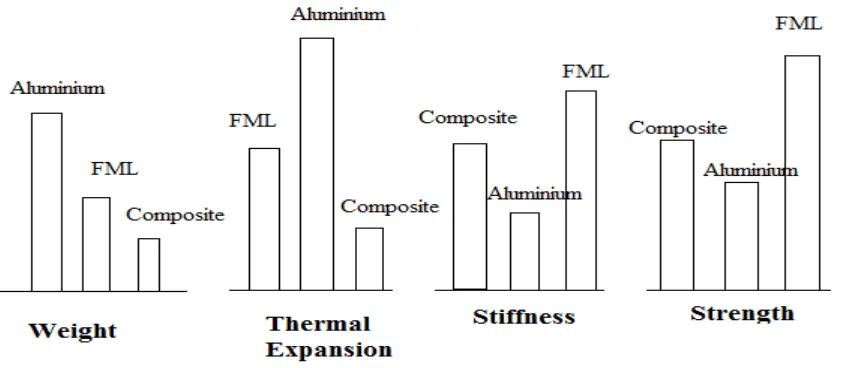
Fig. 1 Comparison of physical properties
Fig. 2 Glass fibre Fig. 3 Aluminium sheet
Table.1 Properties of glass fibre
𝛒𝛒 ER1 ER2 ER3 GR12 GR13 GR23 𝛎𝛎R12 𝛎𝛎R32 𝛎𝛎R31 XRt YRt YRc S 𝛆𝛆Rf 𝛄𝛄Rf
1540 36 5 5 2.7 2.7 1.92 0.25 0.301 0.25 465 5.6 5.6 19.2 0.013 0.12
Table.2 Properties of aluminium
𝛒𝛒 E 𝛎𝛎 SRy ERt 𝛆𝛆Rm
2700 72 0.32 350 1.3 0.18
Table. 3 Comparison of typical properties of some common fibres
Materials Density(g/cmP
3
P
) Tensile strength (Mpa) Young's modulus (Gpa)
E- glass 2.55 2000 80
S-glass 2.49 4750 89
Alumina 3.28 1950 297
Carbon 2.00 2900 525
Kevlar 29 1.44 2860 64
Kevlar 49 1.44 3750 136
3. FABRICATION
The GLARE material is modelled using hand lay up in this glass and aluminium fibre as fibre which is bonded using epoxy resin.The laminate is having 5 layers with 3
aluminium and 2 glass layer .The layer is held in room temperature for 48 hours. The specimens were carefully cut to the required dimensions of the impact test according to ASTM D7037as shown in fig 5. The bullet is made in lathe machine and its dimensions are shown in the fig 6
Fig. 4 GLARE laminate with 0.2 and 0.3 mm aluminium Fig. 5 specimen cut according to the ASTM standard D 7030
Fig.6 Dimension of bullet and fabricated model
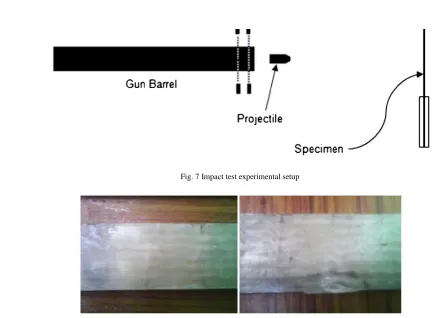
Fig. 7 Impact test experimental setup
Fig. 8 Impact damage of specimen
4. TESTING PROCEDURE
4.1 IMAPCT TESTING
The impact test equipment is as shown in the figure7.The bullet is inserted in the gun barrel and air is compressed in the compressor. The pressure is noted as 40 psi and the velocity with which the bullet hit specimen is 45m/s. The impact damage is as shown in fig 8as a result the specimen has the impact area of 0.42 mP
2
4.2 COMPRESSION TESTING
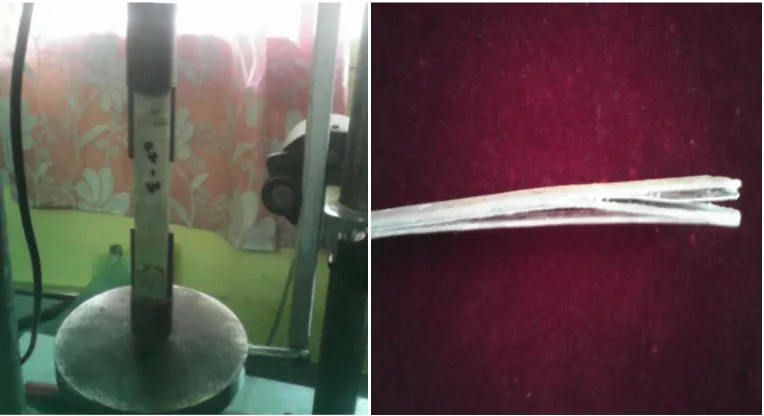
After the impact test is carried out the impacted specimen has to undergone a compression test to know the residual strength of the specimen. Compression test is carried out using UTM (universal testing machine). We can calculate load vs displacement of the impacted specimen by carried out the compression test.
Fig. 9 Specimen during compression test Fig. 10 Specimen after compression test
Graph.1 Loadvs displacement of 0.2 mm aluminium thickness laminate
5.RESULTS AND DISCUSSION
Since the invention of composites the fibre metal laminates have gained much more attention for researchers who are witnessing excellent replacement for metals as well as pure composites. The metal layer in the fibre metal laminates dominates the change in entire strength of the whole laminate. From our experimental analysis it is found that even though the metal layer thickness in the 0.2 mm aluminium sheet inserted laminate is minimal compared to the rest of the laminates but it tends to bear high impact capacity and also have better residual strength. This clearly states that the physical strength of the FML is not increasing when the metal thickness is increased, rather it purely depends upon the no of layers of interaction between the metal and glass fiber also the bonding strength.
6. REFERENCES
[1] “ Abdullah MR, Cantwell WJ” The impact resistance of polypropylene-based fiber-metallaminates. Compos Sci Tech 2006;66:1682–93.
[2 ]“Richardson MOW, Wisheart MJ” Review of low-velocity impact properties of composite materials. Composites 1996;27:1123–31.
[3] “Mittal RK, Jafri MS” Influence of fiber content and impactor parameter on transvers impact response of uniaxially reinforced composite plates. Composites 1995;26:877–86.
[4] “ Vlot A, Krull M” Impact damage resistance of various fibre metal laminates. J Phys IV 1997;7(C3):1045–50.
[5] “Laliberté JF, Poon C, Straznicky PV, Fahr A” Applications of fiber-metal laminates. Polym Compos 2004;21(4):558–67.
[6] “Karakuzua R, Erbil E, AktasM”Impact characterization of glass/ epoxy composite plates: an experimental and numerical study Composites 2010;41:388–9 0 0.5 1 1.5 2 2.5 3 3.5 4 4.5 5
0 0.5 1 1.5 2
Lo
ad
Displacement
0.2 - 1 0.2 - 2 0.3 - 3