Sri Krishna College of Engineering & Technology, Kuniamuthur, Coimbatore-641008, Tamilnadu, India
Artificial Bee Colony Optimization for Torque
Improvement of Three Phase Induction Motor
P.Sindu
1,P. Meenakshi Sundaram
2,C. Mohan Raj
3Final year PG student,Department of Electrical and Electronics Engineering, Sri Eshwar College of Engineering, Coimbatore, Tamilnadu, India1
Assistant Professor,Department of Electrical and Electronics Engineering, Sri Eshwar College of Engineering, Coimbatore, Tamilnadu, India2
Assistant Professor,Department of Electrical and Electronics Engineering, Sri Eshwar College of Engineering, Coimbatore, Tamilnadu, India3
ABSTRACT: This paper implements the torque improvement of three phase induction motor at constant speed for variable load operation. The speed of the induction motor is maintained constant for varying load operation using Artificial Bee Colony (ABC) optimization algorithm. Speed performance is improved when using ABC optimization technique instead of conventional PI controller. The torque output of ABC optimization is better comparing to the torque output of the conventional PI controller. The reference speed and actual speed is compared and that error signal is used for generating the reference torque. The ABC optimization Algorithm is implemented for finding the fitness value of reference torque. With PI controller the time to reach the set speed is more. In proposed system, ABC optimization algorithm was implemented for generating the reference torque. The time to reach the reference speed is improved by using ABC optimization algorithm. The speed performance and torque is improved by ABC optimization algorithm. The proposed method is implemented using MATLAB/SIMULINK version 2010b.
KEYWORDS: Induction Motor, ABC (Artificial Bee Colony Algorithm, PI (Proportional Integral)..
I. INTRODUCTION
Before the introduction of micro-controllers and high switching frequency semiconductor devices, variable speed actuators were dominated by DC motors. Today, using modern high switching frequency power converters controlled by micro-controllers, the frequency, phase and magnitude of the input to an AC motor can be changed and hence the motors speed and torque can be controlled. AC motors combined with their drives have replaced DC motors in industrial applications due to their lower cost, better reliability, lower weight, and reduced maintenance requirement. Squirrel cage Induction motors are more widely used than all the rest of the electric motors put together as they have all the advantages of AC motors and they are easy to build.
Sri Krishna College of Engineering & Technology, Kuniamuthur, Coimbatore-641008, Tamilnadu, India
II. MOTOR DRIVE CONTROLLERS
A. Scalar Controllers
Despite the fact that "Voltage-Frequency" (V/f) is the simplest controller, it is the most wide spread, being in the majority of the industrial applications. It is known as a scalar control and acts by imposing a constant relation between voltage and frequency. The structure is very simple and it is normally used without speed feedback. However, this controller doesn’t achieve a good accuracy in both speed and torque responses, mainly due to the fact that the stator flux and the torque are not directly controlled. Even though, as long as the parameters are identified, the accuracy in the speed can be 2% (except in a very low speed), and the dynamic response can be approximately around 50ms. [3]
B. Vector Controllers
In these types of controllers, there are control loops for controlling both the torque and the flux. The most widespread controllers of this type are the ones that use vector transform such as either Park or Ku. Its accuracy can reach values such as 0.5% regarding the speed and 2% regarding the torque, even when at stand still. The main disadvantages are the huge computational capability required and the compulsory good identification of the motor parameters. [3]
C. Field Acceleration Method
This method is based on maintaining the amplitude and the phase of the stator current constant, while avoiding electromagnetic transients. Therefore, the equations used can be simplified saving the vector transformation, which occurs in vector controllers. This technique has achieved some computational reduction, thus overcoming the main problem with vector controllers and allowing this method to become an important alternative to vector controllers. The field-oriented control methods are complex and sensitive to inaccuracy in the motors parameter values. Therefore, in this field, a considerable research effort is devoted. The aim is to find even simpler methods of speed control for induction machines. One method, which is popular at the moment, is Direct Torque Control (DTC). This method has emerged over the last decade to become one possible alternative to the well-known Vector Control of Induction Machines.
III. ARTIFICIAL BEE COLONY ALGORITHM
A. Behaviour of Real Bees
Tereshko developed a model of foraging behaviour of a honey bee colony based on reaction – diffusion equations. This model that leads to the emergence of collective intelligence of honey bee swarms consists of three essential components: food sources, employed foragers, and unemployed foragers, and defines two leading modes of the honey bee colony behaviour: recruitment to a food source and abandonment of a source. Tereshko explains the main components of the model as below:
1. FOOD SOURCES: In order to select a food source, a forager bee evaluates several properties related with the food source such as its closeness to the hive, richness of the energy, taste of its nectar, and the ease or difficulty of extracting this energy. For the simplicity, the quality of a food source can be represented by only one quantity although it depends on various parameters mentioned above.
2. EMPLOYED FORAGERS: An employed forager is employed at a specific food source which she is currently exploiting. She carries information about this specific source and shares it with other bees waiting in the hive. The information includes the distance, the direction and the profitability of the food source.
Sri Krishna College of Engineering & Technology, Kuniamuthur, Coimbatore-641008, Tamilnadu, India
The mean number of scouts is about 5–10%.The exchange of information among bees is the most important occurrence in the formation of collective knowledge.
While examining the entire hive it is possible to distinguish some parts that commonly exist in all hives. The most important part of the hive with respect to exchanging information is the dancing area. Communication among bees related to the quality of food sources occurs in the dancing area. The related dance is called waggle dance. Since information about all the current rich sources is available to an onlooker on the dance floor, probably she could watch numerous dances and chooses to employ herself at the most profitable source. There is a greater probability of onlookers choosing more profitable sources since more information is circulating about the more profitable sources. Employed foragers share their information with a probability which is proportional to the profitability of the food source, and the sharing of this information through waggle dancing is longer in duration. Hence, the recruitment is proportional to profitability of a food source. [2]
Fig 1. Behaviour of Honeybee Foraging for Nectar
Fig. 3.1 shows the basic behaviour characteristics of foragers. Assume that there are two discovered food sources: A and B. At the very beginning, a potential forager will start as unemployed forager. That forager bee will have no knowledge about the food sources around the nest. There are two possible options for such a bee:
i. It can be a scout and starts searching around the nest spontaneously for food due to some internal motivation or possible external clue.
Sri Krishna College of Engineering & Technology, Kuniamuthur, Coimbatore-641008, Tamilnadu, India
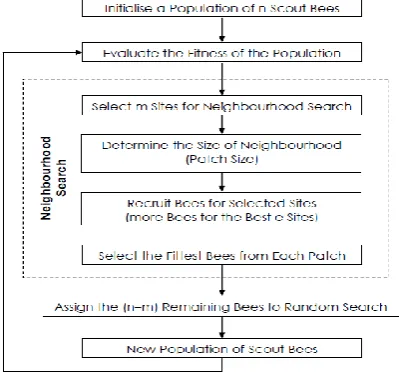
The main steps of the algorithm are as below:[4] 1. Initialize Population
2. Repeat
3. Place the employed bees on their food sources
4. Place the onlooker bees on the food sources depending on their nectar amounts 5. Send the scouts to the search area for discovering new food sources
6. Memorize the best food source found so far 7. until requirements are met
IV. UNITS RESULTS AND COMPARISON
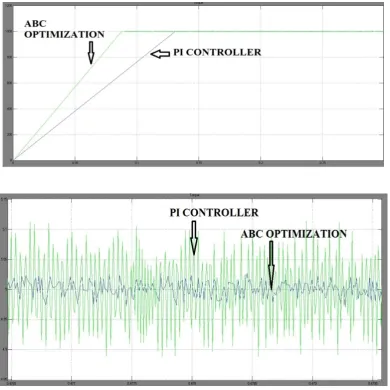
The simulink results of both PI controller based Induction Motor control and the ABC controlled Induction Motor is shown in Fig below.
Sri Krishna College of Engineering & Technology, Kuniamuthur, Coimbatore-641008, Tamilnadu, India
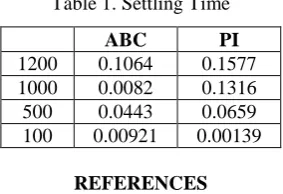
The settling time is improved using ABC Optimization when compared with the PI controller. The table 4.1 shows the settling time of Induction motor for ABC and PI. The speed performance of the motor can be improved. At 1000 RPM, the speed output of PI controller is 998.95 RPM at no load and the output of ABC Optimization technique is 1000 RPM. At any load condition the speed performance of ABC will be better when compared with the PI Controller. The torque ripples will be less in ABC than PI. The output torque of the motor is also improved using ABC Optimization. Thus the speed of the motor is maintained constant for any loading condition.
Table 1. Settling Time
ABC PI
1200 0.1064 0.1577 1000 0.0082 0.1316 500 0.0443 0.0659 100 0.00921 0.00139
REFERENCES
[1] Dervis Karaboga, Bahriye Akay (2009), “A comparative study of Artificial Bee Colony algorithm”, Elsevier Inc. Applied Mathematics and Computation 214108–132.
[2] Dervis Karaboga, Celal Ozturk (2011), “A novel clustering approach: Artificial Bee Colony (ABC) algorithm”, Elsevier Inc. Applied Soft Computing 11 652–657.
[3] N.Kamala, R.Dharmaprakash (2014), “Studies On Modeling And Direct Torque Control Of Induction Motor Using Soft Computing Technique”, Journal of Innovative Research and Solution (JIRAS)- A unit of UIIRS Volume1 – Issue No.1 – Jan – Jun, JJT-017-2014. [4] Noorazliza Sulaiman, Junita Mohamad-Saleh Abdul Ghani Abro (2013), “A Modified Artificial Bee Colony (JA-ABC) Optimization
Algorithm”, Proceedings of the 2013 International Conference on Applied Mathematics and Computational Methods in Engineering.