Functional Encryption for Quadratic Functions, and Applications
to Predicate Encryption
Romain Gay
ENS, CNRS, INRIA, and PSL, Paris, France [email protected]
Abstract. We present a functional encryption scheme based on standard assumptions where ciphertexts are associated with a tuple of values (x1, . . . , xn) ∈ Znp, secret keys are associated
with a degree-two polynomial, and the decryption of a ciphertextct(x1,...,xn)∈Znp with a secret key skP∈Zp[X1,...,Xn],deg(P)≤2 recovers P(x1, . . . , xn), where the ciphertext contains onlyO(n) group elements. Our scheme, which achieves selective security based on pairings, also yields a new predicate encryption scheme that supports degree-two polynomial evaluation, generalizing both [26] and [10].
1
Introduction
Functional Encryption [11](in short: FE) is a general paradigm that allows to generate restricted decryption keys, that let users learn specific functions of the encrypted data, and nothing else. Namely, ciphertexts ctx are associated with an attribute x, secret keys skf are associated with
a functionf, and the decryption of ctx with skf allows to recover f(x), and nothing more. In
particular, ctx does not leak its underlying attribute x. The scheme must be resistant to any
collusion of secret keysskf for different functionsf: such group of secret keys should not learn
anything more than the information leaked by each keyskf, individually. This security property
makes FE schemes both hard to build and extremely useful, provided the class of function they handle is large. In fact, combining the results of [8, 4, 5] proves that an FE for sufficiently general functions1 gives a construction for the almighty Indistinguishability Obfuscation for circuits [20]. Perhaps unsurprisingly given the versatility of these cryptographic notions, we do not know how to implement them based on standard assumptions, let alone efficient. Instead, another approach consider specific classes of functions, and give efficient constructions, based on standard assumptions. This is the case of Predicate Encryption [26](in short: PE), where ciphertexts are associated with a plaintextmand an attributex, and secret keys are associated with a functionf such thatf(m, x) =mif and only ifP(x) = 1, wherePis a boolean predicate (note that these are stronger that attribute-based encryption [33,24] since a ciphertext should not reveal its attributex). More recently, [1,3] build simple functional encryption for the inner product functionality, namely, where ciphertextsctx are associated with vectorsx, secret keys
are associated with vectors y of same dimension, and the decryption of ctx with sky recovers
the inner product ofx and y. To this date, boolean predicates and inner product are the only functionalities that we know how to build from standard assumptions.
Our contributions.
We build the first FE scheme based on a standard assumption that supports a functionality beyond inner product, or predicates. In our scheme, ciphertexts are associated with a set of values, and secret keys are associated with a degree-two polynomial. This way, the decryption of a ciphertext ct(x1,...,xn)∈Znp with a secret key skP∈Zp[X1,...,Xn],deg(P)≤2 recovers P(x1, . . . , xn). The ciphertext size is O(n) group elements, improving upon [1,3], which would require O(n2) group elements, since they build an FE scheme for inner product. This implies new PE schemes that satisfy a so-called attribute-hiding property, that is, ciphertexts are associated with a set of values and a plaintext, secret keys are associated with a degree-two polynomial, and the decryption of a ciphertext ct(x1,...,xn)∈Zn
p with a secret keyskP∈Zp[X1,...,Xn],deg(P)≤2 recovers the plaintext if, and only if, P(x1, . . . , xn) = 1. The attribute-hiding property refers to the
fact that ct(x1,...,xn)∈Znp leaks no information on its attribute (x1, . . . , xn), beyond the inherent leakage of the boolean value P(x1, . . . , xn) = 1. Again, this is done with ciphertexts of O(n)
group elements, instead of O(n2) when using [26], which build an Inner Product Encryption (where the predicate is defined by a degree-one polynomial). Both our FE scheme and PE scheme are proved selectively secure under the Matrix Diffie-Hellman assumption [19], which generalizes standard assumptions such as DLIN or k-Lin fork≥1, and the 3-pddh assumption [10].
Comparison with prior works.
Prior PE schemes based on standard assumptions exist for Identity-Based Encryption [13,2,9,
7,14,38] (in this context, the attribute-hiding property is referred to as anonymity of the IBE), Inner Product Encryption [26,31, 28, 32, 15, 17], and comparison [10, 12, 21], namely, when ciphertexts and secret keys are associated with values, and the secret-key sky∈Zp decrypts the ciphertext ctx∈Zp if, and only if,y≥x (here we only cite works that are secure in the standard model, under static assumptions). IPE is the most expressive of these three, since the other predicates can be efficiently reduced to IP. The PE we build is even more expressive, since it allows to define predicate by degree-two polynomials. Note that there also exists lattice-based attribute-hiding PE for all circuits [23], or PE for comparison withO(logn) group elements per ciphertext [35,22]. However, these PE are attribute-hiding in a weaker sense. In fact, in these so-called weakly attribute-hiding PE, ciphertexts can reveal their attribute if some secret keys that decrypt them are known (see Remark1 for more details on the difference between weakly and fully attribute-hiding PE).
Technical overview.
The difficulty is to have ciphertexts ct(x1,...,xn) of O(n) group elements, that must hide their attribute (x1, . . . , xn)∈Znp, but still contain enough informations to recover then2valuesxi·xj
fori, j∈[n]. To ensure the attribute is hidden, the ciphertext will contain an encryption of each valuexi. Since we want to multiply together these encryptions to compute productsxi·xj, and
since these encryption are composed of group elements, we require a pairinge:G1×G2 →GT,
where G1, G2, and GT are additively written, prime-order groups. Namely, decryption pairs
encrypted values inG1 with encrypted values inG2. For this reason, it makes sense to re-write
the function as: X :=Znp ×Zmp ,K :=Zpn×m, and for all (x,y)∈ X,M∈ K,
F((x,y),M) =x>
My= X
i∈[n],j∈[m]
Private-key, single-ciphertext secure FE. Our starting point is a private-key FE that is only secure for a single-ciphertext:
ctx,y :={[Ari+b⊥xi]1}i∈[n],{[Bsj+a⊥yj]2}j∈[m]and skM := [ X
i,j
mi,jr>iA>Bsj]T,
where we rely on implicit representation notation [19] for group elements : for a fixed generator Ps of Gs and for a matrix A ∈ Znp×t, we define [A]s := APs ∈ Gns×t where multiplication is
done component-wise, with s∈ {1,2, T}. Here (A|b⊥) and (B|a⊥) are bases ofZk+1p such that A>a⊥ = B>b⊥ = 0, `a la [16]. The vectors [Ari]
1 and [Bsj]2 for i∈ [n], j ∈ [m], a⊥ and b⊥
are part of a master secret key, used to (deterministically) generatectx,y andskM. Correctness
follows from the orthogonal property: decryption computes P
i,jmi,je([Ari +b⊥xi]>1,[Bsj + a⊥yj]2) =skM+(b⊥)>a⊥·[F((x,y),M)]T which is equal toskMif, and only if,F((x,y),M) = 0.
Security relies on the Dk-mddh Assumption [19], which stipulates that given [A]1 drawn from
a matrix distributionDk overZ(k+1)p ×k,
[Ar]1 ≈c[Ar+b⊥]1 and [Bs]1≈c[Bs+a⊥]1,
where r,s ←r Zk
p. This allows to change ctx0,y0 into ctx1,y1, but creates an extra term h
P
i,jmi,jx1iyj1− P
i,jmi,jx0iy0j i
T in the secret keys skM. We conclude the proof using the
fact that for all M queried to KeyGen, F((x0,y0),M) = F((x1,y1),M), as required by the
security definition for FE (see Section 2.4.2 for the definition of FE), which cancels out the extra term in all secret keys.
Public-key FE. Going from one to many challenge ciphertexts poses three problems.
Problem 1. Generating [Ari+b⊥xji]1 for a fixed i∈[n] but different j requires to know a⊥,
which prevent using MDDH on [A]1. The same problem holds relative to [B]2 and b⊥.
In fact, this is even more stringent in the public-key setting, since [a⊥]2 and [b⊥]1 would
need to be part of the public key.
Problem 2. There are mix and match attacks, where some part of a challenge ciphertext is used with a part of another ciphertext to break the scheme. For instance in the case n=m= 1, pairing the part [Ar1+b⊥x0]1of ciphertextctx0,y0 with the part [Bs1+a⊥y1]1
of ciphertext ctx1,y1, together with the secret key skM := [r>1A>Bs1]T forM = 1, yields
the value [x0·y1]T where only the values [x0·y0]T and [x1·y1]T should leak.
Problem 3. In the public-key setting, the secret keysskMfor allMare computable efficiently
from the public key that contains the vectors [Ari]1, [Bsj]2.
Solution to problem 1. We add an extra dimension, namely, we use bases
A|b⊥ 0
0 1
and
B|a⊥ 0
0 1
where the extra dimension will be used for correctness, while (A|b⊥)
and (B|a⊥) will be used for security (using the mddh assumption, since a⊥ and b⊥ are not part of the public key anymore).
Solution to problem 2. The encryption randomizes the bases
A|b⊥ 0
0 1
and
B|a⊥ 0
0 1
into
W−1
A|b⊥ 0
0 1
and W>
B|a⊥ 0
0 1
forW←r GLk+2 a random invertible matrix. This “glues” the components of a ciphertext
that are in G1 to those that are in G2.
Solution to problem 3. we generate secret keys inG2 instead ofGT, namely
skM:= [ X
i,j
mi,jr>
iA
>
Bsj]2.
We also randomize the ciphertexts, which contain [Ari·γ]1and [Bsj·σ]2, whereγ, σ←r Zp
are the same for all i∈ [n], and j ∈ [m], but fresh for each ciphertext. The ciphertexts also contain [γ ·σ]1, for correctness. This way, decryption gets [F((x,y),M)]T + [γσ· P
i,jmi,jr
>
iA
>
Bsj]T, where the second term of the sum is e([γσ]1,skM). Including this
“quadratic information” [γ ·σ]2 inside the ciphertexts is similar to the techniques used
originally in [10], and in follow up [12,21]. The similarity with these schemes ends here: we need significantly new techniques to achieve general quadratic functions (they focus on a particular case of quadratic function). A more detailed comparison between our work and these papers is provided in the Discussion paragraph.
New problem 4. Computing secret keys in the groupG2instead of the target groupGT, poses
a new problem when using a type 3 pairing (where there are no efficient isomorphism betweenG1 and G2), namely, how can we compute [A]2 and use the MDDH assumption
on [A]1, inG1? Note that this problem does not arises in type 1 pairing (when G1 =G2),
but this is a less efficient setting that type 3 pairing, as demonstrated in [25].
Solution to problem 4. We secret share the secret keys in both G1 and G2, allowing to
generate them only ([A]1,[B]1) or ([A]2,[B]2), but not both. Namely, KeyGen(msk,M)
computesK := [P
i,jmi,jr
>
iA
>
Bsj]1−[u]1andKb := [u]2, foru←r Zpthat is freshly picked
for each secret key. This way, there is essentially two to compute secret keys: by computing a meaningful value inG1, and a random value inG2, or vice versa. Finally, for correctness,
the ciphertexts include the values [γ·σ]1 and [γ·σ]2 for γ, σ←r Zp, and the decryption
can cancel out the second term of the sum [F((x,y),M)]T + [γσ· P
i,jmi,jr
>
iA
>Bsj]
T by
computing e([γσ]1,K) +b e(K,[γσ]2).
Combining the solutions to problems 1 to 4, we obtain:
ctx,y:=
("
Ari·γ
xi >
W−1 #
1 )
i∈[n]
,
W
Bsj ·σ
yj
2
j∈[m]
,[γ·σ]1,[γ·σ]2
whereW ←rGLk+2 andγ, σ ←rZp are freshly picked for each ciphertext, and
skM:= (K,K) whereb K:= [ X
i,j
mi,jr>iA
>
Bsj]1−[u]1 and Kb := [u]2.
whereu←rZp is freshly picked for each secret key.
Then, to get back the value F((x,y),M) in Zp (and not only in GT), we need to solve
discrete log inGT, for instance using a look-up table when the output ofF is small, as done in
Discussion.
The scheme described above is identically distributed to:
ctx,y:=
("
ri·γ
xi >
W−1 #
1 )
i∈[n]
,
W
sj·σ
yj
2
j∈[m]
,[γ·σ]1,[γ·σ]2
whereri,sj ←r Zkp,
skM:= (K,K) whereb K := [ X
i,j
mi,jr>
isj]1−[u]1 and Kb := [u]2.
This is reminiscent from constructions based on Dual Pairing Vector Space, originally introduced in [30], and later used in [31, 27, 17] in the context of attribute-based encryption, and in [18,36] in the context of FE for inner product, with the crucial difference the all these previous constructions do not include quadratic terms of the form [r>
isj]2. The technical difficulty is to
achieve security even when these terms are leaked in the secret keys. More specifically, these previous approaches use a security paradigm called Dual System Encryption, introduced by [37], where the security proof uses a hybrid argument over all secret keys, leaving the distribution of the public key identical. This is different from our proof, which changes the distribution of the public and secret keys, and whose security loss does not depend on the number of queried secret keys.
Finally, our approach differs from [10] and follow-up works [12, 21] in that these previous works focus an a particular case of quadratic function, namely, the predicate comparison (see Section4), for which it is enough to consider vectors of the form: [Ari+xib⊥]1,[Bsj+yja⊥]2,
where xi and yj are either 0, either some random value (fixed at setup time, and identical for
all ciphertexts and secret keys), or the vectors are just some “trash” random vector, i.e that do not contain any useful information.In this case, the problem 2. pointed out previously does not arise. We introduce new techniques to solve problem 2., thereby generalizing the aforementioned works to any quadratic functions.
Concurrent and Independent work.
In concurrent and independent work, Lin [29], and Ananth and Sahai [6] present constructions ofprivate-keyfunctional encryption schemes for degree-Dpolynomials based on D-linear maps. As a special case for D= 2, these schemes support quadratic polynomials from bilinear maps, as ours. Also, in terms of security, the construction of Lin is proven selectively secure based on the SXDH assumption, while the scheme of Ananth and Sahai is selectively secure based on ad-hoc assumptions that are justified in the multilinear group model. In comparison to these works, our schemes have the advantage of working in the (arguably more challenging) public keysetting.
Road map.
2
Preliminaries
2.1 Notations
For a finite setS,|S|denotes its cardinality, and we denote bys←rS the fact thatsis picked uniformly at random from S. By PPT, we denote a probabilistic polynomial-time algorithm. We denote byλthe security parameter, and bynegl(·) any negligible function ofλ. We denote vectors ~x= (xi) and matrices A = (ai,j) in bold. For any prime p and any matrix A∈Znp×m
with n ≥ m, we denote by orth(A) := {a⊥ ∈ Zn
p : A>a⊥ = 0}. For all square matrices A∈Znp×n, we denote by det(A) the determinant ofA. For anyn∈N∗, we denote byGLn the
general linear group of degree n, that is, the set of alln×ninvertible matrices overZp.
2.2 Pairing groups
LetGGenbe a probabilistic polynomial time (PPT) algorithm that on input the security param-eter 1λ, returns a description PG = (p,G1,G2, P1, P2,GT, e) of pairing groups where G1, G2, GT are cyclic group of order pfor aλ-bit primep,P1,P2 are generators ofG1,G2, respectively,
and e : G1 ×G2 → GT is an efficiently computable (non-degenerate) bilinear map. Define
PT :=e(P1, P2), which is a generator of GT. We use implicit representation of group elements:
for a∈ Zp, define [a]s =aPs ∈ Gs as the implicit representation of a inGs, for s ∈ {1,2, T}.
Given [a]1 and [b]2, one can efficiently compute [ab]T using the pairing e. For two matrices A, B with matching dimensions define e([A]1,[B]2) := [AB]T.
2.3 Complexity assumptions
We recall the definitions of the Matrix Decision Diffie-Hellman (mddh) Assumption [19].
Definition 1 (Matrix Distribution)
Letk∈N∗. We callDk a matrix distribution if it outputs, in polynomial time, matrices in
Z(k+1)p ×k of full rankk, and satisfying the following property:
Property 1
Pr[orth(A)⊆span(B)] = 1 Ω(p),
whereA,B←rDk.
Without loss of generality, we assume the first k rows of A←r Dk form an invertible matrix.
Note that the basis property is not explicit in [19], but, as noted in [16, Lemma 1 (basis lemma)], all examples of matrix distribution presented in [19, Section 3.4], namely Uk,Lk, SCk,Ck and
ILk, satisfy this property.
The Dk-Matrix Diffie-Hellman problem in Gs for s ∈ {1,2, T} is to distinguish the two
distributions ([A]s,[Aw]s) and ([A]s,[u]s) where A←rDk,w←r Zkp and u←rZk+1p .
Definition 2 (Dk-Matrix Diffie-Hellman Assumption Dk-mddh)
Let Dk be a matrix distribution. We say that the Dk-Matrix Diffie-Hellman (Dk-mddh)
Assumption holds relative to GGeninGs, fors∈ {1,2, T}, if for all PPT adversaries A,
AdvDk-mddh
GGen,Gs,A(λ) :=|Pr[A(PG,[A]s,[Aw]s) = 1]−Pr[A(PG,[A]s,[u]s) = 1]|=negl(λ),
where the probability is taken over PG ←rGGen(1λ),A←
For eachk≥1, [19] specifies distributions (Uk,Lk,SCk,CkandILk) overZ(k+1)p ×ksuch that
the corresponding Dk-mddh assumptions are generically secure in bilinear groups and form a
hierarchy of increasingly weaker assumptions. Lk-mddhis the well knownk-Linear Assumption k-Lin with 1-Lin =DDH.
LetQ≥1. ForW ←r Zqk×Q,U←rZ
(k+1)×Q
q , we consider theQ-foldDk-mddh Assumption
which consists in distinguishing the distributions ([A],[AW]) from ([A],[U]). That is, a chal-lenge for theQ-fold Dk-mddh Assumption consists ofQindependent challenges of the Dk-mddh Assumption (with the same A but different randomness w). In [19] it is shown that the two problems are equivalent.
Lemma 1 (Random self-reducibility of U`,k-mddh, [19])
Let k, Q∈ N, and s∈ {1,2, T}. For any PPT adversary A, there exists a PPT adversary
B such that
AdvQ-Dk-mddh
GGen,Gs,A (λ)≤Adv
Dk-mddh
GGen,Gs,B(λ) + 1 p−1
where AdvQ-Dk-mddh
GGen,Gs,A (λ) := |Pr[B(PG,[A]s,[AW]s) = 1]−Pr[B(PG,[A]s,[U]s) = 1]| and
the probability is taken over PG ←rGGen(1λ),A←rUk,W←r Zkq×Q,U←rZ
(k+1)×Q
q .
We also recall the definition of 3-party Decision Diffie-Hellman (3-pddh) Assumption intro-duced in [10]. We give a variant in the asymmetric-pairing setting.
Definition 3 (3-party Decision Diffie-Hellman Assumption 3-pddh)
We say that the 3-party Decision Diffie-Hellman Assumption (3-pddh) Assumption holds relative to GGenif for all PPT adversariesA,
Adv3GGen,−pddhA(λ) :=|Pr[A(PG,[a]1,[b]2,[c]1,[c]2,[abc]1) = 1]
−Pr[A(PG,[a]1,[b]2,[c]1,[c]2,[d]1) = 1]|
=negl(λ)
where the probability is taken over PG ←rGGen(1λ),a, b, c, d←r Zp.
2.4 Functional Encryption
A functional encryption scheme for a function F : K × X → Y consists of four algorithms (Setup,Enc,KeyGen,Dec):
• Setup(1λ,X,K,Y) → (pk,msk,ek). The setup algorithm gets as input the security pa-rameterλ, the key spaceK, the plaintext space X, the output spaceY, and outputs the public key pk, the master key msk and the encryption key ek. In a private-key scheme, ek:=msk, whereas ek:=∅ in a public-key scheme.
• Enc(pk,ek, x) → ctx. The encryption algorithm gets as input the public key pk, the
encryption key ek, and a plaintext x∈ X. It outputs a ciphertextctx.
• KeyGen(pk,msk, k) → skk. The key generation algorithm gets as input msk and a key
k∈ K. It outputs a secret keyskk.
• Dec(pk,skk, k,ctx) → y. The decryption algorithm gets as input skk, the associated key
2.4.1 Correctness.
We require that for all (k, x)∈ K × X,
Pr[Dec(pk,skk, k,Enc(pk,ek, x)) =F(k, x)] = 1,
where the probability is taken over (pk,msk,ek)←Setup(1λ,X,K,Y),sk
k←KeyGen(pk,msk, k),
and the coins of Enc.
2.4.2 Security definition.
For a stateful adversary A and a functional encryption scheme FE, we define the advantage function
AdvFEA(λ) := Pr
b=b0 : state← A
SetupO(·,·);
b0 ← AKeyGenO(·)(state)
−1
2
where SetupO, on input (x(0) ∈ X, x(1) ∈ X), computes (pk,msk,ek) ← Setup(1λ,X,K), picks b←r{0,1}, and returns (pk,Enc(ek,pk, x(b));KeyGenO, on inputk∈ K, returnsKeyGen(msk, k); with the requirement that SetupO is called only once at the beginning of the game, and that all queries k∈ Kthat A makes to KeyGenO(·) satisfy F(k, x(0)) = F(k, x(1)). FE is said to be selectively secure, if for all PPT adversariesA, the advantageAdvFEA(λ) =negl(λ). Note that in the private-key setting, this corresponds to single-ciphertext security, since the adversary only gets to see one challenge ciphertext (and contrary to the public-key setting, it cannot generate ciphertext by itself withoutek).
2.5 Predicate Encryption
An predicate encryption (PE) scheme for a predicate P : X × Y → {0,1} consists of four algorithms (Setup,Enc,KeyGen,Dec):
• Setup(1λ,X,Y,M)→(pk,msk). The setup algorithm gets as input the security parameter λ, the attribute universeX, the predicate universeY, the message spaceMand outputs the public parameterpk, and the master keymsk.
• Enc(pk, x, M)→ctx. The encryption algorithm gets as inputpk, an attribute x∈ X and
a messageM ∈ M. It outputs a ciphertextctx. Note that x is public givenctx.
• KeyGen(pk,msk, y) → sky. The key generation algorithm gets as input msk and a value
y∈ Y. It outputs a secret keysky.
• Dec(pk,sky, y,ctx) → M. The decryption algorithm gets as input sky, the associated
attributey, andctx such thatP(x, y) = 1. It outputs a message M.
2.5.1 Correctness.
We require that for all (x, y)∈ X × Y such that P(x, y) = 1 and allM ∈ M,
Pr[Dec(pk,sky, y,Enc(pk, x, M)) =M] = 1,
where the probability is taken over (pk,msk)←Setup(1λ,X,Y,M),sky ←KeyGen(pk,msk, y),
2.5.2 Security definition.
For a stateful adversaryA, we define the advantage function
AdvPEA (λ) := Pr
b=b0 : state← A
SetupO(·,·,·,·);
b0← AKeyGenO(·)(state)
−1
2
where SetupO, on input (x(0) ∈ X, x(1) ∈ X, M0 ∈ M, M1 ∈ M), computes (pk,msk) ←
Setup(1λ,X,Y,M), picksb←r{0,1}, and returns (pk,Enc(pk, x(b), Mb); KeyGenO, on input y,
returnsKeyGen(msk, y); with the requirement thatSetupOis called only once at the beginning of the game, and that all queriesy thatAmakes to KeyGenO(·) satisfies P(x(0), y) =P(x(1), y). Moreover, if P(x(0), y) = 1, for the queries y to KeyGenO, then M0 = M1. A PE scheme is
selectively secure,fully attribute hiding, if for all PPT adversariesA, the advantageAdvPEA (λ) is a negligible function in λ.
Remark 1 (Fully vs weakly attribute hiding)
The fully attribute hiding property refers to the fact that an adversary cannot distinguish a ciphertext for attribute x(0) from a ciphertext forx(1), as long as it only queries keyssky
whereP(x(0), y) =P(x(1), y). This is stronger that a so-called weakly attribute hiding prop-erty, which requires that the adversary only queries keys sky whereP(x(0), y) =P(x(1), y) =
0.
3
Functional Encryption for Quadratic Functions
In this section we give a functional encryption scheme for quadratic functions, that is, for n, m∈N,PG = (p,G1,G2, P1, P2,GT, e)←rGGen(1λ),X ⊆Znp ×Zmp ,K ⊆Znp×m,Y ⊆Zp, and
for all (x,y)∈ X,M∈ K:
F((x,y),M) =x>
My∈Zp
Following the technical overview of Section 1, we first give in Section 3.1 a private-key functional encryption scheme that is only single-ciphertext secure, and we build up from the latter a public-key functional encryption in Section3.2.
3.1 Private-key, Single-ciphertext secure FE
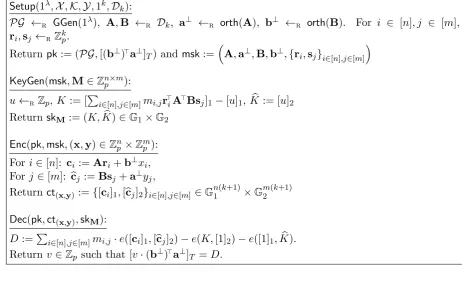
In Figure 1, we present a family of private-key, single-ciphertext secure functional encryption schemes for quadratic functions, parametrized by an integer k ≥ 1 and a matrix distribution
Dk (see Definition 1). That is, for each k ∈ N, and each matrix distribution Dk, the scheme FEone(k,Dk) presented in Figure 1 is single-ciphertext, selectively secure under the Dk-mddh
assumption, on asymmetric pairings.
Theorem 1
For anyk∈N∗and any matrix distributionD
k, the functional encryption schemeFEone(k,Dk)
defined in Fig. 1 has perfect correctness.
Proof Theorem 1: Correctness follows from the fact that for alli∈[n], j∈[m],
e([ci]1,[bcj]2) = [r
>
iA
>
Bsj+ (b⊥)>
a⊥xiyj]T,
sinceA>
a⊥=B>
b⊥=0. Therefore, the decryption computes
D:= [X
i,j
mi,jr>iA
>
Bsj +x>My·(b⊥)>a⊥]T −e(K,[1]2)−e([1]1,K) =b x
>
My·[(b⊥)>
Setup(1λ,X,K,Y,1k,Dk):
PG ←r GGen(1λ), A,B ←
r Dk, a⊥ ←r orth(A), b⊥ ←r orth(B). For i ∈ [n], j ∈ [m], ri,sj ←r Zk
p.
Return pk:= (PG,[(b⊥)>a⊥]
T) andmsk:=
A,a⊥,B,b⊥,{ri,sj}i∈[n],j∈[m]
KeyGen(msk,M∈Zn×m p ):
u←r Zp,K := [P
i∈[n],j∈[m]mi,jr>iA
>Bs
j]1−[u]1,Kb := [u]2
Return skM:= (K,K)b ∈G1×G2
Enc(pk,msk,(x,y)∈Zn
p ×Zmp ):
Fori∈[n]: ci :=Ari+b⊥xi,
Forj ∈[m]: bcj :=Bsj+a⊥yj,
Return ct(x,y):={[ci]1,[bcj]2}i∈[n],j∈[m]∈G n(k+1) 1 ×G
m(k+1) 2
Dec(pk,ct(x,y),skM):
D:=P
i∈[n],j∈[m]mi,j·e([ci]1,[cjb ]2)−e(K,[1]2)−e([1]1,K).b
Return v∈Zp such that [v·(b⊥)>a⊥]
T =D.
Figure 1: FEone(k,Dk), a family of private-key, functional encryption schemes parametrized by
k ∈ N∗ and a matrix distribution D
k, single-ciphertext, selectively secure under the Dk-mddh
assumption on asymmetric pairings.
Property1 in Definition1 implies that (b⊥)>a⊥ 6= 0 with probability 1− 1
Ω(p) over the choices
ofA,B←rDk, anda⊥←r orth(A),b⊥ ←rorth(B). Therefore, one can enumerate all possible
v∈ Y and check ifv·[(b⊥)>a⊥]
T =D. This can be done in time |Y|, thus, we need to setY to
be of size poly(λ).
Theorem 2 (Security)
For any k ∈ N∗ and any matrix distribution Dk, if the Dk-mddh assumption holds in G1
and G2, then, the private-key functional encryption scheme FEone(k,Dk), defined in Fig.1,
is selectively secure, in a single-ciphertext setting (see the security definition in Section2.4). Namely, for any PPT adversary A, there exist PPT adversariesB and B0 such that
AdvFEoneA (λ)≤AdvDk-mddh
GGen,G1,B(λ) +Adv
Dk-mddh
GGen,G2,B0(λ) + 2−Ω(λ).
Proof Theorem 2: We prove the security of FEone(k,Dk) via a series of games described in
Fig.2 and we useAdvi to denote the advantage of Ain game Gi.
Lemma 2 (G0)
Adv0 =AdvFEoneA (λ).
Proof Lemma2: We show that G0corresponds to the game for selective security of the
SetupO (x(0),y(0)),(x(1),y(1)): G0, G1, G2
PG ←r GGen(1λ), A,B ←r Dk, b ←r {0,1}, a⊥ ←r orth(A),b⊥ ←r orth(B). For i∈[n], j ∈[m]: ri ←r Zkp,sj ←r Zkp
[ci]1 := [Ari+x(b)i b⊥]1; [ci]1 ←rGk+11
[bcj]2:= [Bsj +y (b) i a
⊥]
2; [bcj]2 ←r G k+1 2
Returnpk:= (PG,[(b⊥)>a⊥]
T) and ct(x,y):={[ci]1,[bcj]2}i∈[n],j∈[m]
KeyGenO(M∈Zn×m p ):
u←rZp,K :=P
i,jmi,j[c>icbj]1−[u]1−x
(b)>My(b)·[(b⊥)>a⊥]
1,Kb := [u]2
ReturnskM:= (K,K)b
Figure 2: Games G0, G1, G2 for the proof of selective security ofFEone(k,Dk) in Fig.1. In each
procedure, the components inside a solid (dotted) frame are only present in the games marked by a solid (dotted) frame.
It is clear that the oracle SetupO is identically distributed in both of these games. We show that this is also the case ofKeyGenO. Indeed, for alli∈[n], j∈[m], we have:
c>ibcj =r
>
iA
>
Bsj+x(b)i yj(b)(b⊥)>a⊥.
Thus, in game G0, for all M∈Znp×m,KeyGenO(M) computes:
K :=X
i,j
mi,j[c>ibcj]1−[u]1−x (b)>
My(b)[(b⊥)>
a⊥]1
=X
i,j
mi,j[r>iA
>
Bsj]1+x(b)>My(b)[(b⊥)>a⊥]1−[u]1−x(b)>My(b)[(b⊥)>a⊥]1
=X
i,j
mi,j[r>iA
>
Bsj]1−[u]1
which is exactly as in the security game for selective security.
Lemma 3 (G0 to G1)
There exists a PPT adversaryB0 such that
|Adv0−Adv1| ≤AdvDGGen,k-mddhB0 (λ) + 2
−Ω(λ).
Proof Lemma 3: Here, we use the mddh assumption on [A]1 to change the distribution of
the challenge ciphertext, after arguing that one can simulate the game without knowing a⊥ or [A]2.
Namely, we build a PPT adversary B00 against the n-fold mddh assumption inG1 such that
|Adv0−Adv1| ≤AdvGGen,n-Dk-Gmddh1,B0
0(λ) + 2
−Ω(λ). Then, by Lemma1, this implies the existence of a
PPT adversary B0 such that|Adv0−Adv1| ≤AdvDGGen,k-mddhG1,B0(λ) + 2
−Ω(λ).
Adversary B0
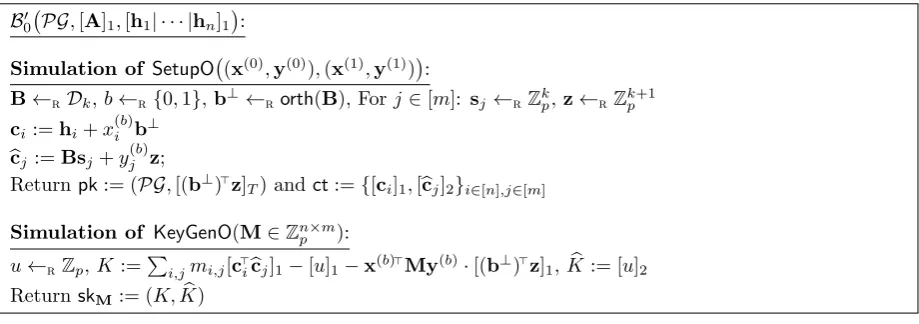
0 simulates the oracles SetupO andKeyGenO as described in Figure3. Finally,
B0
0 PG,[A]1,[h1| · · · |hn]1:
Simulation of SetupO (x(0),y(0)),(x(1),y(1)) :
B←rDk,b←r{0,1},b⊥←rorth(B), Forj ∈[m]: sj←rZkp,z←r Zkp+1
ci:=hi+x
(b)
i b⊥
bcj :=Bsj+y
(b)
j z;
Returnpk:= (PG,[(b⊥)>z]T) andct:={[ci]
1,[bcj]2}i∈[n],j∈[m]
Simulation of KeyGenO(M∈Zn×mp ):
u←rZp,K:=Pi,jmi,j[c>ibcj]1−[u]1−x
(b)>My(b)·[(b⊥)>z]
1,Kb := [u]2
ReturnskM:= (K,K)b
Figure 3: AdversaryB00 against the n-foldDk-mddh assumption, for the proof of Lemma3.
when B00 is given a real mddh challenge, that is, [h1| · · · |hn]1 := AR forR ←r Zkp×n, then it
simulates the oracles as in game G0, whereas it simulates them as in game G1 when given a
fully random challenge, i.e. when [h1| · · · |hn]1 ←r G
(k+1)×n
1 , which implies the lemma.
We use the following facts.
1. For alls∈Zk
p,B∈Z (k+1)×k
p ,b⊥ ∈orth(B), and a⊥∈Zk+1p , we have:
(b⊥)>
a⊥ = (b⊥)>
(Bs+a⊥).
2. For allyj(b)∈Zp,s∈Zkp:
{sj}j∈[m]
sj←rZkp
≡{sj+y(b)j s}j∈[m]
sj←rZkp .
3.
Bs+a⊥
A,B←rDk,a⊥←rorth(A),s←rZkp
≈ 1
Ω(p) (z)z←rZ
k+1
p ,
since (B|a⊥) is a basis ofZk+1p , with probability 1−Ω(p)1 over the choices ofA,B, anda
⊥
(this is implied by Property 1).
Therefore, we have for ally(b)∈Zm p :
b⊥,{Bsj+yj(b)a
⊥}
j∈[m],(b⊥)
>
a⊥
A,B,a⊥←
rorth(A),b⊥←rorth(B),sj←rZkp
≡b⊥,{Bsj+y(b)j a
⊥}
j∈[m],(b⊥)
>
(Bs+a⊥)
A,B,a⊥←
rorth(A),b⊥←rorth(B),s←r Zkp ,sj←rZkp
(by 1.)
≡b⊥,{Bsj+y(b)j (Bs+a⊥)}j∈[m],(b⊥)>(Bs+a⊥)
A,B,a⊥←
rorth(A),b⊥←rorth(B),s,sj←rZkp
(by 2.)
≈ 1
Ω(p)
b⊥,{Bsj +y (b)
j z}j∈[m],(b⊥)>z
A,B,a⊥←
rorth(A),b⊥←rorth(B),z←r Zk+1p ,sj←rZkp
(by 3.)
Note that the first distribution corresponds to pk, {bcj}j∈[m], and KeyGenO distributed as in
games G0or G1(these are identically in these two games), while the last distribution corresponds
B0
0 PG,[B]2,[h1| · · · |hm]2:
Simulation of SetupO (x(0),y(0)),(x(1),y(1)) :
A←rDk,b←r {0,1},a⊥←rorth(A),v←rZp ci←rZkp+1
bcj :=hj+y
(b)
j a⊥;
Returnpk:= (PG,[v]T) andct:={[ci]1,[bcj]2}i∈[n],j∈[m]
Simulation of KeyGenO(M∈Zn×mp ):
u←rZp,Kb := P
i,jmi,j[c
>
ibcj]2−[u]2−x
(b)>My(b)·[v]
1,K:= [u]1
ReturnskM:= (K,K)b
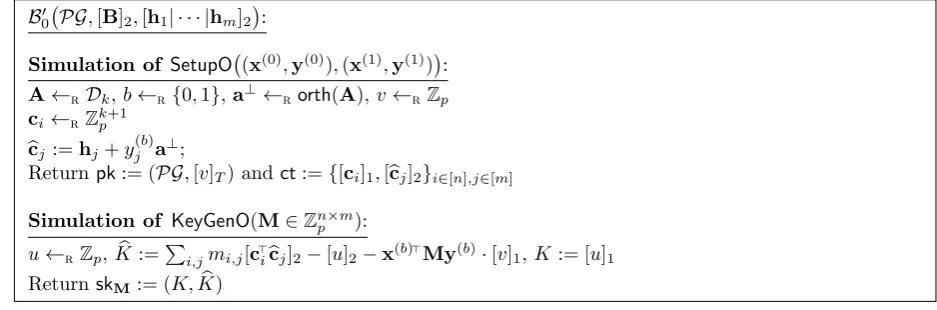
Figure 4: AdversaryB01against them-foldDk-mddhassumption inG2, for the proof of Lemma4.
Finally, when B00 is given a real mddh challenge, i.e when for all i ∈ [n], hi := Ari, for
ri ←r Zkp, we haveci:=Ari+x(b)i b⊥, exactly as in game G0, whereasci is uniformly random
over Zk+1p when B00 is given a random challenge, i.e. when for all i ∈ [n], hi ←r Zk+1p , as in
game G1.
Lemma 4 (G1 to G2)
There exists a PPT adversaryB1 such that
|Adv1−Adv2| ≤AdvGGen,Dk-mddhG2,B1(λ) + 2
−Ω(λ).
Proof Lemma 4: Here, we use the mddh assumption on [B]2 to change the distribution of
the challenge ciphertext, after arguing that one can simulate the game without knowing b⊥ or [B]1.
Namely, we build a PPT adversaryB10 against them-fold mddhassumption inG2 such that
|Adv1−Adv2| ≤ AdvmGGen,-Dk-mddh
G2,B01(λ). Then, by Lemma 1, this implies the existence of a PPT
adversaryB1 such that|Adv1−Adv2| ≤AdvDGGen,k-mddhG2,B1(λ) + 1 p−1.
Adversary B0
1 simulates the oracles SetupO andKeyGenO as described in Figure4. Finally,
it outputs 1 if the bit b0 output by the adversary A is equal to b, 0 otherwise. We show that when B10 is given a real mddh challenge, that is, [h1| · · · |hm]2 := [BS]2 for S ←r Zkp×m, then
it simulates the oracles as in game G1, whereas it simulates them as in game G2 when given a
fully random challenge, i.e. when [h1| · · · |hm]2 ←rG
(k+1)×m
2 , which implies the lemma.
We use the fact that for all A,B∈Z(k+1)p ×k,
(a⊥,(b⊥)>
a⊥)a⊥←
rorth(A),b⊥←rorth(B)≡(a
⊥, v)
v←rZp).
Note that the leftmost distribution corresponds topk,{ci}i∈[n], and KeyGenOdistributed as in
games G1or G2(these are identically distributed in these two games), while the last distribution
corresponds to pk,{ci}i∈[n], and KeyGenO simulated byB10.
Finally, when B01 is given a real mddh challenge, i.e when for all j ∈ [m], hj := Bsj, for
sj ←rZkp, we havebcj :=Bsj+y (b)
j a⊥, exactly as in game G1, whereas bcj is uniformly random
over Zk+1p when B10 is given a random challenge, i.e. when for all j ∈[m], hj ←r Zk+1p , as in
Lemma 5 (G2)
Adv2 = 0.
Proof Lemma5: By definition of the security game, for allMqueried toKeyGenO, we have:
x(b)>My(b)=x(0)>My(0). Therefore, the view of the adversary in G
2is completely independent
from the random bitb←r {0,1}.
Combining Lemma 3,4, and 5 gives Theorem2.
3.2 Public-key FE
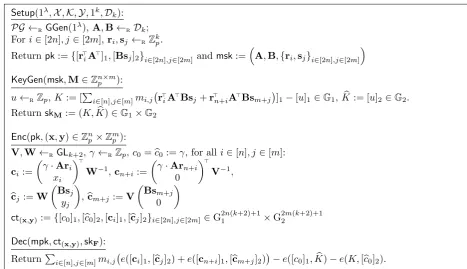
In Figure 3, we present a family of public-key functional encryption schemes for quadratic functions, parametrized by an integer k ≥ 1 and a matrix distribution Dk (see Definition 1). That is, for each k ∈N, and each matrix distribution Dk, the scheme FE(k,Dk) presented in Figure 5 is selectively secure under the Dk-mddh and the 3-pddh assumptions, on asymmetric
pairings.
Setup(1λ,X,K,Y,1k,D k):
PG ←rGGen(1λ),A,B←
rDk; Fori∈[2n], j∈[2m],ri,sj←r Z
k p. Returnpk:={[r>
iA
>]
1,[Bsj]2}i∈[2n],j∈[2m] andmsk:=
A,B,{ri,sj}i∈[2n],j∈[2m]
KeyGen(msk,M∈Zn×mp ):
u←rZp,K:= [Pi∈[n],j∈[m]mi,j r>iA>Bsj+r>n+iA>Bsm+j
]1−[u]1∈G1,Kb := [u]2∈G2.
ReturnskM:= (K,K)b ∈G1×G2
Enc(pk,(x,y)∈Znp ×Zmp):
V,W←rGLk+2,γ←rZp,c0=bc0:=γ, for alli∈[n], j∈[m]:
ci:=
γ·Ari xi
>
W−1,cn+i:=
γ·Arn+i 0
>
V−1,
bcj :=W
Bsj yj
,bcm+j:=V
Bsm+j 0
ct(x,y):={[c0]1,[bc0]2,[ci]1,[bcj]2}i∈[2n],j∈[2m]∈G
2n(k+2)+1
1 ×G
2m(k+2)+1 2
Dec(mpk,ct(x,y),skF):
ReturnP
i∈[n],j∈[m]mi,j e([ci]1,[bcj]2) +e([cn+i]1,[bcm+j]2)
−e([c0]1,K)b −e(K,[bc0]2).
Figure 5: FE(k,Dk), a family of functional encryption schemes parametrized by k∈ N∗ and a matrix distributionDk, selectively secure under theDk-mddh and 3-pddh assumptions.
Theorem 3 (Correctness)
For anyk∈N∗and any matrix distributionDk, the functional encryption schemeFE(k,Dk)
defined in Figure5 has perfect correctness.
Proof Theorem 3: Correctness follows from the facts that for alli∈[n],j ∈[m]:
e([ci]1,[bcj]2) = [γr
>
iA
>
Bsj +xiyj]T and e([cn+i]1,[bcm+j]2) = [γr
>
n+iA
>
SetupO (x(0),y(0)),(x(1),y(1))
: G0, G1, G2, G3 , G4 , G5
PG ←rGGen(1λ);A,B←
rDk;b←r{0,1}; a
⊥←
rorth(A),b
⊥←
rorth(B)
Fori∈[2n], j∈[2m]: ri←rZ
k
p,sj←rZ
k p
pk :=
Ari+ x
(b)
i b ⊥ 1 ,
Arn+i− x
(0) i b ⊥ 1 ,
Bsj+ y
(b)
j a ⊥ 2 ,
Bsm+j+ y
(0) j a ⊥ 2
i∈[n],j∈[m]
,
V,W←rGLk+2,γ←rZp; v←rZp ;c0=bc0:=γ
ci:=
γ·Ari+ γx
(b)
i b
⊥ + vx(b)
i b⊥
x(ib)− x(ib)
>
W−1,cn+i:=
γ·Arn+i− γx
(0)
i b
⊥ − vx(0)
i b⊥
0 + x(0)i
>
V−1,
bcj :=W
Bsj+ y
(b)
j a ⊥
yj− yj(b)
,bcm+j :=V
Bsm+j+ y
(0)
j a ⊥
0 + yj(0)
Returnpkandct(x,y):={[ci]1,[bcj]2}i∈[2n],j∈[2m]
KeyGenO(M∈Zn×mp ):
u←rZp,K:= [Pi∈[n],j∈[m]mi,j r>iA>Bsj+r>n+iA>Bsm+j
]1−[u]1∈G1;Kb := [u]2∈G2.
ReturnskM:= (K,K)b ∈G1×G2
Figure 6: Games Gi,i= 0, . . . ,5 for the proof of selective security ofFE(k,Dk) in Fig.5. In each
procedure, the components inside a solid (dotted, gray) frame are only present in the games marked by a solid (dotted, gray) frame.
Therefore, the decryption gets
[ X
i∈[n],j∈[m]
mi,jγ r>iA
>
Bsj+r>n+iA
>
Bsm+j
]T
+ [ X
i∈[n],j∈[m]
mi,jxiyj]T −e([c0]1,K)b −e(K,[ b
c0]2)
= [ X
i∈[n],j∈[m]
mi,jxiyj]T.
Then, the decryption solves the discrete log to recoverx>My∈
Zp, which can be done efficiently
as long as the setY is of sizepoly(λ).
Theorem 4 (Security)
For anyk∈N∗and any matrix distributionDk, if theDk-mddhand the3-pddhassumptions hold inPG, then the functional encryption schemeFE(k,Dk)defined in Figure5is selectively secure. Namely, for any PPT adversary A, there exists PPT adversariesB,B0 and B00 such that
AdvFEA (λ)≤4·Adv
Dk-mddh
GGen,G1,B(λ) + 4·Adv
Dk-mddh
GGen,G2,B0(λ) + 2·Adv
3−pddh
GGen,B0(λ) + 2−Ω(λ).
game for selective security of the functional encryption scheme, as defined in Section 2.4.2
Lemma 6 (G0 to G1)
There exists PPT adversaries B0 and B1 such that
|Adv0−Adv1| ≤2·AdvGGen,Dk-mddhG1,B0(λ) + 2·Adv
Dk-mddh
GGen,G2,B1(λ) + 2
−Ω(λ).
Proof Lemma6: Using the selective, single-ciphertext security of the underlying private-key scheme (which is exactly the scheme in Figure 1), we can change the distribution of the public key elements from{[Ari]1,[Bsj]2}i∈[2n],j∈[2m] to
n
[Ari+rx(b)i b⊥]1,[Arn+i−rx(0)i b⊥]1,[Bsj+syj(b)a⊥]2,[Bsm+j+syj(0)a⊥]2 o
i∈[n],j∈[m].
In order to apply Theorem2we rely on the fact that theFEpublic key can be seen as an FEone
encryption of longer vectors
e
x(0) =0∈Z2np and ey
(0)=0∈
Z2mp inG0,
e
x(1)= (x(b)|| −x(0))∈Z2np andye
(1)= (y(b)||y(0))∈
Z2mp inG1.
Also, secret keys inFE can be seen as FEonesecret keys corresponding to matrices
f M=
M 0
0 M
∈Z2np ×2m
With this observation in mind, it can be seen that the restriction
x(1)>M y(1)=x(0)>M y(0)
in the queries made byAtranslates into legitimate queries byB0sincex(b)>M y(b)−x(0)>M y(0) =
0 and xe(0)>
f Mey(0) =
e x(1)>
f
Mey(1) = 0. Thus, by Theorem 2 (security of the single-ciphertext
secure scheme), we obtain the lemma.
Lemma 7 (G1 to G2)
There exists a PPT adversaryB2
|Adv1−Adv2| ≤Adv3GGen,−pddhB2(λ) + 2
−Ω(λ)
Here, we change the distribution of the challenge ciphertexts, using the 3-pddhassumption.
Proof Lemma 7: Upon receiving a 3-pddh challenge (PG,[a]1,[b]2,[c]1,[c]2,[z]1) (see
Defini-tion 3),B2 simulatesSetupO(x(0),y(0)),(x(1),y(1) by pickingA,B←r Dk;b←r {0,1};a⊥ ←r
orth(A),b⊥ ←rorth(B), and setting[γ]1 := [c]1 and [γ]2 := [c]2. Then, fori∈[2n], j∈[2m],B2
picksri←rZk
p,sj ←rZkp and computes
pk:=
nh
Ari+ax(b)i b⊥ i
1, h
Arn+i−ax(0)i b⊥ i
1, h
Bsj+by(b)j a⊥ i
2, h
Bsm+j+byj(0)a⊥ i
2 o
i∈[n],j∈[m].
It picks Wf,Ve ←r GLk+2 and implicitly sets
W :=Wf
B|b·a⊥ 0
0 1
−1
and V:=Ve
B|b·a⊥ 0
0 1
−1
Here we use the fact that (B|ba⊥) is full rank with probability 1− 1
Ω(p) over A,B ←r Dk, a⊥orth(A), andb←r Zp (this is implied by Property 1).
Then, for i∈[n], j ∈[m], it computes
[ci]1 :=
γri
z·x(b)i x(b)i
>
A>B 0 0
0 (b⊥)>a⊥ 0
0 0 1
fW−1
1
and [bcj]2 :=
Wf
sj
yj(b)
yj(b)
2
[cn+i]1 :=
γrn+i
−z·x(0)i
0
>
A>B 0 0
0 (b⊥)>a⊥ 0
0 0 1
eV−1
1
and [bcm+j]2 :=
Ve
sm+j
yj(0) 0 2 .
B2 computes [c0]1 := [γ]1, [bc0]2 := [γ]2, and simulates KeyGenO as in G2 (see Figure 3.2).
Finally, if Aoutputsb0,B2 outputs 1 if b0=b, and 0 otherwise.
It can be seen that when [z]1 is a real 3-pddh challenge, i.e., [z]1 = [abc]1, thenB2 simulates
game G1; whereas it simulates game G2 when [z]1 ←r G1. In particular, while this is easy to see
for the elements of the public key and for ciphertexts [bcj]2, [bcm+j]2, for the ciphertext elements
[ci]1, [cn+i]1 we observe that they can be written as
ci :=
γB>
Ari
z·x(b)i ·(b⊥)>a⊥ x(b)i
>
B|b·a⊥ 0
0 1
−1
W−1 = γAri+zb
−1·x(b) i
x(b)i
!>
W−1
cn+i :=
γB>
Arn+i
−z·x(0)i ·(b⊥)>a⊥
0
>
B|b·a⊥ 0
0 1
−1
V−1 = γArn+i+zb
−1·x(0) i
0
!>
V−1.
So, if z = abc, then zb−1 = aγ and the ciphertexts are distributed as in G
1; otherwise if z
is random zb−1 is identically distributed to (aγ+v) as in G2. This proves |Adv1−Adv2| ≤ Adv3GGen,−pddhB
2(λ) + 2
−Ω(λ).
Lemma 8 (G2 to G3)
|Adv2−Adv3| ≤2−Ω(λ).
Here, we change the distribution of the challenge ciphertexts, using a statistical argument.
Proof Lemma 8: First, we use the fact that for allγ ∈Zp:
(γ, v+γ)v←rZp ≡(γ, v)v←rZp.
Therefore, we can write the challenge ciphertexts as follows. For all i∈[n], j∈[m]:
ci:= γAri+vx
(b) i b
⊥
x(b)i
!>
W−1,cn+i := γArn+i−vx
(0) i b⊥
0
!>
V−1.
Then, we use the facts that:
• (v←rZp)≈1
p (v
←r Zp) such thatv+ 16= 0 modp.
• (A,B,a⊥)A,B←rDk,a⊥←rorth(A) ≈Ω(1p) (A,B,a
⊥)
• For any v ∈ Zp such that v+ 1 6= 0 mod p, W ←r GLk+2 is identically distributed
thanWf ·
B|a⊥ 0
0 1
·
Idk×k 0 0
0 v+1v v+11
0 −1 1
·
B|a⊥ 0
0 1
−1
, whereWf ←r GLk+2,
A,B←rDk, and a⊥ ←rorth(A)\span(B).
Therefore, we can change the distribution of {ci,bcj}i∈[n],j∈[m]as follows:
bcj =Wf ·
B|a⊥ 0
0 1
·
Idk×k 0 0
0 v+1v v+11
0 −1 1
sj
yj(b)
yj(b)
=Wf ·
B|a⊥ 0
0 1 · sj
y(b)j 0
=Wf ·
Bsj+yj(b)a⊥
0 ! and ci=
γri
vx(b)i x(b)i
>
A>B 0 0
0 (b⊥)>a⊥ 0
0 0 1
·
Idk×k 0 0
0 v+1v v+11
0 −1 1
−1
·
B|a⊥ 0
0 1
−1
·Wf−1
=
γri
v·x(b)i x(b)i
>
A>B 0 0
0 (b⊥)>a⊥ −1 v+1
0 (b⊥)>a⊥ v v+1
·
B|a⊥ 0
0 1
−1
·Wf−1
=
γri
(v+ 1)·x(b)i 0 > ·
A>B 0 0
0 (b⊥)>a⊥ 0
0 0 1
·
B|a⊥ 0
0 1
−1
·Wf−1
= γAri+ (v+ 1)·x
(b) i b
⊥
0
!>
·Wf−1
Then, we use the facts that:
• v←r Zp such that v+ 16= 0 mod p≈1
p v
←rZp such that v+ 16= 0 mod p and v6= 0
mod p.
• For anyv∈Zp such that v+ 16= 0 modp andv6= 0 mod p,V←r GLk+2 is identically
distributed thanVe·
B|a⊥ 0
0 1
·
Idk×k 0 0
0 1 1v
0 1 1 +1v
·
B|a⊥ 0
0 1
−1
, whereVe ←r
Therefore, we can change the distribution of {cn+i,bcm+j}i∈[n],j∈[m] as follows:
b
cm+j =Ve ·
B|a⊥ 0
0 1
·
Idk×k 0 0
0 1 1v
0 1 1 +v1
sj
y(0)j 0
=Ve ·
B|a⊥ 0
0 1 · sj
yj(0)
yj(0)
=Ve ·
Bsj +yj(0)a⊥
yj(0)
! and cn+i = γrn+i
−vx(0)i
0
>
A>B 0 0
0 (b⊥)>a⊥ 0
0 0 1
·
Idk×k 0 0
0 1 1v
0 1 1 +1v
−1
·
B|a⊥ 0
0 1
−1
·Ve−1
=
γrn+i
−vx(0)i
0 > A>
B 0 0
0 (b⊥)>
a⊥·(1 +1v) −v1 0 −(b⊥)>
a⊥ 1
·
B|a⊥ 0
0 1
−1
·Ve−1
=
γrn+i
−(v+ 1)x(0)i x(0)i
> A>
B 0 0
0 (b⊥)>
a⊥ 0
0 0 1
·
B|a⊥ 0
0 1
−1
·Ve−1
= γArn+i−(v+ 1)x
(0) i b
⊥
x(0)i
!>
·Ve−1
Finally, we use the fact that for any γ ∈ Zp: (v+ 1) where v ←r Zp such that v+ 1 6= 0
mod p and v 6= 0 mod p ≈2
p (v+γ), where v
←r Zp. Thus, we obtain, for all i ∈ [n] and j∈[m]:
ci:= γAri+ (v+γ)x (b) i b ⊥ 0 !> f
W−1,cn+i :=
γArn+i−(v+γ)x(0)i b⊥
x(0)i
!>
e V−1,
b
cj :=Wf γBsj+y (b) j a
⊥
0
!
,bcm+j :=Ve
γBsj+yj(0)a⊥
y(0)j
!
, as in game G3.
This proves|Adv2−Adv3| ≤2−Ω(λ).
Lemma 9 (G3 to G4)
There exists an adversaryB3 such that
|Adv3−Adv4| ≤Adv3GGen,−pddhB3(λ) + 2
−Ω(λ).
Proof Lemma 9: Upon receiving a 3-pddh challenge (PG,[a]1,[b]2,[c]1,[c]2,[z]1) (see
Defi-nition 3), B3 simulates SetupO((x(0),y(0)),(x(1),y(1))) by picking A,B ←
r Dk; b ←r {0,1}; a⊥←rorth(A),b⊥←r orth(B), and setting: [γ]1:= [c]1 and [γ]2 := [c]2. Then, fori∈[2n], j∈
[2m], B3 picksri←rZpk,sj ←rZkp and computes
pk:=n hAri+ax(b)i b
⊥i
1, h
Arn+i−ax(0)i b
⊥i
1, h
Bsj+by(b)j a
⊥i
2, h
Bsm+j+byj(0)a
⊥i
2 o
i∈[n],j∈[m].
It picks Wf,Ve ←r GLk+2 and implicitly sets
W :=Wf
B|b·a⊥ 0
0 1
−1
and V:=Ve
B|b·a⊥ 0
0 1
−1
.
Here we use the fact that (B|ba⊥) is full rank with probability 1−Ω(p)1 over overA,B←rDk,
a⊥orth(A), andb←r Zp (this is implied by Property 1). Then, for i∈[n], j ∈[m], it computes
[ci]1 :=
γri
z·x(b)i 0
>
A>B 0 0
0 (b⊥)>a⊥ 0
0 0 1
fW
−1
1
and [bcj]2 :=
Wf
sj
yj(b) 0 2
[cn+i]1 := γrn+i
−z·x(0)i
x(0)i
>
A>B 0 0
0 (b⊥)>a⊥ 0
0 0 1
eV
−1
1
and [bcm+j]2 :=
Ve
sm+j
yj(0)
yj(0)
2 .
Finally, B3 computes [c0]1 := [γ]1, [bc0]2 := [γ]2, and simulates KeyGenO as in G3 (see
Figure 3.2). Note that when [z]1 is a real 3-pddh challenge, i.e [z]1 = [abc]1, thenB3 simulates
game G3; whereas it simulates game G4 when [z]1 ←r G1. This proves |Adv3 − Adv4| ≤ Adv3GGen,−pddhB
3(λ) + 2
−Ω(λ).
Lemma 10 (G4 to G5)
There exist PPT adversariesB4 andB5 such that
|Adv4−Adv5| ≤2·AdvGGen,Dk-mddhG1,B4(λ) + 2·Adv
Dk-mddh
GGen,G2,B5(λ) + 2
−Ω(λ).
Proof Lemma 10: This transition is symmetric to that between game G0 and G1: we use
the selective, single-ciphertext security of the underlying private-key scheme (in Figure 1), to switch: {[Ari +x(b)i b⊥]1,[Arn+i −x(0)i b⊥]1,[Bsj +yj(b)a⊥]2,[Bsm+j +y(0)j a⊥]2}i∈[n],j∈[m] to
{[Ari]1,[Bsj]2}i∈[2n],j∈[2m], since x (b)>
i My (b) j −x
(0)>
i My (0)
j = 0, by definition of the security
game. Thus, by Theorem 2 (security of the single-ciphertext secure scheme), we obtain the
lemma.
Theorem 4 follows from Lemmas 6-10, and the fact that game G5 is independent from the
bitb←r {0,1}.
4
Application to PE Supporting Degree-Two Polynomial
Eval-uation.
for the predicate P :X × Y → {0,1} where X ⊂Zn
p ×Zmp , Y ⊂Zpn×m, and for all (x,y)∈ X
and M∈ Y:
x>
My∈ {0,1}and P((x,y),M) = 1 iff x>
My= 1.
In Figure7, we present a generic construction of PE forPfrom any functional encryption scheme FE for the bilinear maps functionality F :K × M0 → Y0, where M0 := Zpn×Zmp ,K := Znp×m,
Y0 :=Zp and for all (x,y)∈ M0,M∈ K
F(M,(x,y)) =x>
My.
The PE scheme can be instantiated by using one of our FE constructions presented in Sections3.
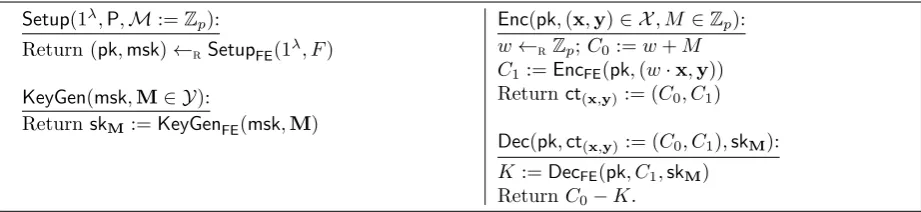
Setup(1λ,P,M:=
Zp):
Return (pk,msk)←rSetupFE(1λ, F)
KeyGen(msk,M∈ Y):
ReturnskM:=KeyGenFE(msk,M)
Enc(pk,(x,y)∈ X, M ∈Zp): w←rZp;C0:=w+M
C1:=EncFE(pk,(w·x,y))
Returnct(x,y):= (C0, C1)
Dec(pk,ct(x,y):= (C0, C1),skM):
K:=DecFE(pk, C1,skM)
ReturnC0−K.
Figure 7: PE, a predicate encryption scheme, selectively secure if the underlying FE scheme (SetupFE,KeyGenFE,EncFE,DecFE) is selectively secure.
Theorem 5 (Correctness)
If FE := (SetupFE,KeyGenFE,EncFE,DecFE) is a perfectly correct functional encryption
scheme for functionalityF, then so is the predicate encryption schemePEdefined in Figure7.
Proof Lemma 5: By correctness ofFE, we have for all (x,y)∈ X,w∈Zp,M∈ Y:
F(M,(w·x,y)) =w·x>
My=w·P((x,y),M).
Thus, when P((x,y),M) = 1, decryption recovers the encapsulation key w.
Theorem 6 (Security)
IfFE:= (SetupFE,KeyGenFE,EncFE,DecFE)is a selectively secure encryption scheme for F,
then so is the predicate encryption scheme PE defined in Figure 7. Namely, for any PPT adversary A, there exists a PPT adversaryB such that:
AdvPEA (λ)≤4·AdvFEB (λ).
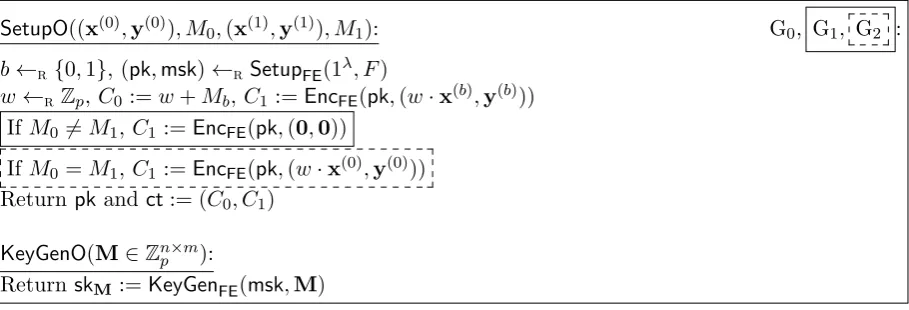
Proof Lemma 6: We prove the selective security of PE via a series of games described in Figure 8and we useAdvi to denote the advantage of Ain game Gi.
Lemma 11 (G0 to G1)
There exists a PPT adversaryB0:
SetupO((x(0),y(0)), M0,(x(1),y(1)), M1): G0, G1, G2 :
b←r {0,1}, (pk,msk)←rSetupFE(1λ, F)
w←rZp,C0:=w+Mb,C1 :=EncFE(pk,(w·x(b),y(b)))
IfM06=M1,C1 :=EncFE(pk,(0,0))
IfM0=M1,C1 :=EncFE(pk,(w·x(0),y(0)))
Returnpk and ct:= (C0, C1)
KeyGenO(M∈Zn×m p ):
ReturnskM:=KeyGenFE(msk,M)
Figure 8: Games Gi, for i= 0,1,2 for the proof of adaptive security ofPE in Figure7. In each
procedure, the components inside a solid (dotted) frame are only present in the games marked by a solid (dotted) frame.
Proof Lemma11: By definition of the security game, we know that ifM0 6=M1, then it must
be that for all queries Mto KeyGenO(·), x(b)>My(b) = 0 (i.e., the predicate over the challenge
attributes is false). Therefore, using the security of the underlying FE scheme, we can switch: Enc(pk,(w·x(b),y(b))), computed by SetupO when M06=M1, toEnc(pk,(0,0)).
Lemma 12 (G1 to G2)
There exists a PPT adversaryB1:
|Adv1−Adv2| ≤2·AdvFEB1(λ).
Proof Lemma 12: By definition of the security game, we know that for all queries M to KeyGenO(·),P (x(0),y(0)),M
=P (x(1),y(1)),M
. Together with the fact that for all (x,y)∈ X and M ∈ Y: x>My ∈ {0,1}, we obtain that: x(0)>My(0) = x(1)>My(1). Therefore, using
the security of the underlying FE scheme, we can switch: Enc(pk,(w·x(b),y(b))), computed by SetupO whenM0 =M1, toEnc(pk,(w·x(0),y(0))).
Lemma 13 (G2)
Adv2= 0.
Proof Lemma 13: We show that theA’s view is independent ofb←r {0,1}in this game. If M0 6=M1, the challenge ciphertext is of the form (C0, C1) whereC0 := [w]T +Mb forw←rZp,
and C1 is independent ofw andb. Thus, the messageMb is completely hidden by the one-time
pad [w]T, and the ciphertext is independent of b.
If M0 = M1, the challenge ciphertext is of the form (C0, C1) where C0 := [w]T +Mb for
w←r Zp, which is independent of b since M0 =M1; and C1 :=Enc(pk,(w·x(0),y(0))), which
is also independent of b.
4.1 Applications of PE for Bilinear Maps Evaluation
In this section, we discuss two applications of our fully attribute-hiding PE scheme supporting bilinear maps evaluation.
PE for constant depth boolean formulas.
As a first application, we can use the PE scheme in Figure 7 to handle boolean functions of constant degree d in n variables. This yields a solution where ciphertexts comprise O(nd/2) group elements, in contrast to O(nd) group elements in [26] (the asymptotic is taken for large n, constantd).
The idea is to encode a predicate for boolean formulas into a predicate for bilinear maps evaluation. This can be done as follows. Consider the following predicateP :X × Y → {0,1}, with X := Zn2 and Y := {T ∈ Z2[X1, . . . , Xn],deg(T) ≤ d}, such that for all x ∈ X, T ∈ X,
P(x, T) = 1 iffT(x) = 1. Below we describe how to encode x∈ X and T ∈ Y into a vector ex
and a matrix Te such that P(x, T) = 1 iff ex>Texe= 1.
To see this, assume for simplicity thatdis even, and let us consider the setting wheren≥ d 2.
First, we map every x∈ X toxe:= (M1(x), . . . , Mde(x))∈Z e
d
2, where de:= Pd2
i=0 n
i
, and for all
j∈h nd
2 i
,Mj is thej-th monomial of degree at most d2 onnvariables (there are exactlydesuch
monomials, which we order arbitrarily). Second, we write every T ∈ Y as P
i,j∈[d]eTi,jMiMj, where for all i, j ∈[d],e Ti,j ∈Z2, and we map T ∈ Y toTe ∈ Z
e
d×de
2 such that for all i, j ∈ [d],e e
Ti,j :=Ti,j. This way, for all x∈ X and T ∈ Y, we have P(x, T) = 1 iffxe
>
e
Txe=T(x) = 1. Therefore, using the PE which supports bilinear maps evaluation presented in Section 4, we obtain a PE for boolean formulas with ciphertexts of size O(d). Using a similar encodinge
to the PE from [26] that support linear maps evaluation yields a solution with ciphertexts of dimensionO(d) whereb db:=
Pd i=0
n i
. When considering asymptotic for largen, constantd, our ciphertext size isO(nd/2), against O(nd) for [26].
Finally, we note that boolean formulas can be arithmetized into a polynomial overZ2, `a la
[34]. Namely, for boolean variablesx, y∈Z2,AND(x, y) is encoded asx·y,OR(x, y) is encoded
asx+y−xy, and NOT(x) = 1−x.
PE for comparison.
Let us consider the comparison predicate P≤ : [N]×[N] → {0,1} that for all x, y ∈ [N] is defined by
P≤(x, y) = 1 iffx≤y.
We can reduce this predicate to a polynomial of degree two, as done (implicitly) in [10], as follows. First, any integerx ∈[N] is canonically mapped to the lexicographically ordered pair (x1, x2) ∈ [
√
N]×[√N] (we assume √N is an integer for simplicity). Then x1 is mapped to
vectors xe :=
0x1 1
√
N−x1
∈ {0,1}
√
N where 1`, 0` denote the all-one and all-zero vectors in
{0,1}`, respectively; and b
x:=ex1 ∈ {0,1} √
N, where for alli∈[√N],ei denotes the i’th vector
of the canonical basis of Z
√
N
p . Finally, x2 ∈ [
√
N] is mapped to ¯x :=
0x2−1 1
√
N−x2+1
. For all
(x1, x2),(y1, y2)∈[
√
N]×[√N]:
where for any vectorz ∈Z √
N
p , and any i∈[
√
N], we denote byzi ∈Zp the i-th coordinate of z.
This means that by using the above encoding, for an integer attribute x ∈[N] one can use a PE for bilinear maps evaluation to encrypt the pair of vectors
e x
b x
,
1 ¯
x
∈Z2√N
p ×Z1+
√
N p
This gives a PE for comparison with ciphertexts of O(√N) group elements, as in [10,21]. More precisely, by instantiating our PE scheme with the FE of Section 3.2, we obtain a PE for comparison with ciphertext size (12√N + 1)· |G1|+ (6
√
N + 7)· |G2|, and secret-key size
|G1|+|G2|, compared to ciphertext size 5
√
N· |G1|+ 4
√
N· |G2|+|GT|and secret-key size|G2|
for [21], where both schemes are selectively-secure based on SXDH.
Acknowledgments.
We would like to thank Florian Bourse, Alain Passel`egue, and Hoeteck Wee for insightful dis-cussions.
References
[1] M. Abdalla, F. Bourse, A. De Caro, and D. Pointcheval. Simple functional encryption schemes for inner products. In J. Katz, editor, PKC 2015, volume 9020 of LNCS, pages 733–751. Springer, Mar. / Apr. 2015. 1,2,4
[2] S. Agrawal, D. Boneh, and X. Boyen. Efficient lattice (H)IBE in the standard model. In H. Gilbert, editor, EUROCRYPT 2010, volume 6110 of LNCS, pages 553–572. Springer, May 2010. 2
[3] S. Agrawal, B. Libert, and D. Stehl´e. Fully secure functional encryption for inner products, from standard assumptions. LNCS, pages 333–362. Springer, Aug. 2016. 1,2,4
[4] P. Ananth and A. Jain. Indistinguishability obfuscation from compact functional encryp-tion. In R. Gennaro and M. J. B. Robshaw, editors,CRYPTO 2015, Part I, LNCS, pages 308–326. Springer, Aug. 2015. 1
[5] P. Ananth, A. Jain, and A. Sahai. Indistinguishability obfuscation from functional encryption for simple functions. Cryptology ePrint Archive, Report 2015/730, 2015.
http://eprint.iacr.org/2015/730. 1
[6] P. Ananth and A. Sahai. Projective arithmetic functional encryption and indistinguisha-bility obfuscation from degree-5 multilinear maps. InEUROCRYPT, 2017. 5
[7] N. Attrapadung, G. Hanaoka, and S. Yamada. A framework for identity-based encryption with almost tight security. LNCS, pages 521–549. Springer, Dec. 2015. 2
[8] N. Bitansky and V. Vaikuntanathan. Indistinguishability obfuscation from functional en-cryption. In56th FOCS, pages 171–190. IEEE Computer Society Press, 2015. 1
[10] D. Boneh, A. Sahai, and B. Waters. Fully collusion resistant traitor tracing with short ciphertexts and private keys. In S. Vaudenay, editor,EUROCRYPT 2006, volume 4004 of LNCS, pages 573–592. Springer, May / June 2006. 1,2,4,5,7,23,24
[11] D. Boneh, A. Sahai, and B. Waters. Functional encryption: Definitions and challenges. In Y. Ishai, editor,TCC 2011, volume 6597 ofLNCS, pages 253–273. Springer, Mar. 2011. 1
[12] D. Boneh and B. Waters. A fully collusion resistant broadcast, trace, and revoke system. In A. Juels, R. N. Wright, and S. Vimercati, editors,ACM CCS 06, pages 211–220. ACM Press, Oct. / Nov. 2006. 2,4,5
[13] X. Boyen and B. Waters. Anonymous hierarchical identity-based encryption (without random oracles). In C. Dwork, editor, CRYPTO 2006, volume 4117 of LNCS, pages 290– 307. Springer, Aug. 2006. 2
[14] D. Cash, D. Hofheinz, E. Kiltz, and C. Peikert. Bonsai trees, or how to delegate a lattice basis. In H. Gilbert, editor, EUROCRYPT 2010, volume 6110 of LNCS, pages 523–552. Springer, May 2010. 2
[15] D. Cash, D. Hofheinz, E. Kiltz, and C. Peikert. Bonsai trees, or how to delegate a lattice basis. Journal of Cryptology, 25(4):601–639, Oct. 2012. 2
[16] J. Chen, R. Gay, and H. Wee. Improved dual system ABE in prime-order groups via predicate encodings. In E. Oswald and M. Fischlin, editors,EUROCRYPT 2015, Part II, volume 9057 ofLNCS, pages 595–624. Springer, Apr. 2015. 3,6
[17] J. Chen, H. W. Lim, S. Ling, H. Wang, and H. Wee. Shorter IBE and signatures via asymmetric pairings. In M. Abdalla and T. Lange, editors, PAIRING 2012, volume 7708 ofLNCS, pages 122–140. Springer, May 2013. 2,5
[18] P. Datta, R. Dutta, and S. Mukhopadhyay. Functional encryption for inner product with full function privacy. LNCS, pages 164–195. Springer, 2016. 5
[19] A. Escala, G. Herold, E. Kiltz, C. R`afols, and J. Villar. An algebraic framework for Diffie-Hellman assumptions. In R. Canetti and J. A. Garay, editors, CRYPTO 2013, Part II, volume 8043 ofLNCS, pages 129–147. Springer, Aug. 2013. 2,3,6,7
[20] S. Garg, C. Gentry, S. Halevi, M. Raykova, A. Sahai, and B. Waters. Candidate indistin-guishability obfuscation and functional encryption for all circuits. In 54th FOCS, pages 40–49. IEEE Computer Society Press, Oct. 2013. 1
[21] S. Garg, A. Kumarasubramanian, A. Sahai, and B. Waters. Building efficient fully collusion-resilient traitor tracing and revocation schemes. In E. Al-Shaer, A. D. Keromytis, and V. Shmatikov, editors,ACM CCS 10, pages 121–130. ACM Press, Oct. 2010. 2,4,5,24
[22] R. Gay, P. M´eaux, and H. Wee. Predicate encryption for multi-dimensional range queries from lattices. In J. Katz, editor,PKC 2015, volume 9020 ofLNCS, pages 752–776. Springer, Mar. / Apr. 2015. 2