Volume 2006, Article ID 73950, Pages1–13 DOI 10.1155/ASP/2006/73950
Stereo Image Coder Based on the MRF Model for
Disparity Compensation
J. N. Ellinas and M. S. Sangriotis
Department of Informatics and Telecommunications, National & Kapodistrian University of Athens, Panepistimiopolis, Ilissia, 15784 Athens, Greece
Received 4 November 2004; Revised 23 May 2005; Accepted 25 July 2005
Recommended for Publication by King Ngan
This paper presents a stereoscopic image coder based on the MRF model and MAP estimation of the disparity field. The MRF model minimizes the noise of disparity compensation, because it takes into account the residual energy, smoothness constraints on the disparity field, and the occlusion field. Disparity compensation is formulated as an MAP-MRF problem in the spatial domain, where the MRF field consists of the disparity vector and occlusion fields. The occlusion field is partitioned into three regions by an initial double-threshold setting. The MAP search is conducted in a block-based sense on one or two of the three regions, providing faster execution. The reference and residual images are decomposed by a discrete wavelet transform and the transform coefficients are encoded by employing the morphological representation of wavelet coefficients algorithm. As a result of the morphological encoding, the reference and residual images together with the disparity vector field are transmitted in parti-tions, lowering total entropy. The experimental evaluation of the proposed scheme on synthetic and real images shows beneficial performance over other stereoscopic coders in the literature.
Copyright © 2006 J. N. Ellinas and M. S. Sangriotis. This is an open access article distributed under the Creative Commons Attribution License, which permits unrestricted use, distribution, and reproduction in any medium, provided the original work is properly cited.
1. INTRODUCTION
The perception of a scene with 3D realism may be accom-plished by a stereo image pair which consists of two images of the same scene recorded from two slightly different per-spectives. The two images are distinguished as Left and Right images that present binocular redundancy, and for that rea-son can be encoded more efficiently as a pair than indepen-dently. The stereoscopic vision has a very wide field of ap-plications in robot vision, virtual machines, medical surgery, and so forth. Typically, the transmission or the storage of a stereo image requires twice the bandwidth or the capacity of a single image. The objective on a bandwidth-limited trans-mission system is to develop an efficient coding scheme that will exploit the redundancies of the two images, that is, in-traimage and cross-image correlation or similarities.
A typical compression scenario is the encoding of one image, which is called reference and the disparity compen-sation of the other, which is called target. In this work, the Left image is assigned as reference and the Right image as tar-get. Transform coding is a method used to remove intraspa-tial redundancy both from reference and target images. The
cross-image redundant information is evaluated by consider-ing the disparity between the two images. Disparity compen-sation procedure estimates the best prediction of the target image from the reference and results in an error image, which is called residual, together with a disparity vector field. The encoded reference and residual images together with the dis-parity vectors are entropy coded and transmitted. Therefore, the effectiveness of the encoding algorithm, the energy of the residual image, and the smoothness of the disparity vector field affect the overall performance of the stereo coder.
fail to estimate disparity satisfactorily because the dispar-ity field inherits a nonsmooth variation due to noise and the existence of occlusions. This may be improved by esti-mating disparity field with the Markov random field (MRF) model, which provides smoothness constraints and takes into account the occlusions [6]. Some other methods code the residual part of the predicted target image using effi -cient coders for “still” images, as EZW, or mixed coding [7–10]. Another method predicts the blocks transform of one image from the matching blocks transform of the other [11]. The subspace projection technique is another method that combines disparity compensation and residual coding by applying a transform to each block of the target image [12].
MRF model takes into account the contextual con-straints by considering that the disparity field is smooth except near object boundaries. Hence, the value of a random variable, which may be a block of pixels, is influenced by the local neighbourhood system. The probabilistic aspect of the MRF analysis is converted to energy distribution through its equivalence to Gibbs distribution (GRF) with Hammersley-Clifford theorem. The usual statistical crite-rion for optimality is the maximum a posteriori probability (MAP) that provides the MAP-MRF framework. Since Gemans’ classical work [13], many methods have been presented in motion estimation of a monoscopic video which is very similar to the disparity estimation case. Some works use either global or local methods for the MAP esti-mation problem [6,14]. The global methods, like simulated annealing (SA), converge to a global minimum with high computational cost, whereas the local methods, like iterated conditional mode (ICM), converge quickly but they are trapped to local minima. Some other methods, based on the mean field theory (MFT), provide a compromise between efficiency and computational cost [15,16].
A robust “still” image encoder and a disparity compen-sation process, which is based on the MRF/GRF model [17], are the novelties of the proposed coder. According to this model, occlusion field is initially separated into three regions by setting two threshold levels. The blocks of the intermedi-ate region, which is called uncertain, are finally characterized as occluded or nonoccluded. This reduces the number of regions needed for the MAP search procedure, which is normally implemented in the entire occlusion field, making the algorithm simpler and faster. Also, mean absolute error (MAE) is selected instead of mean square error (MSE), in order to render our algorithm less sensitive to noise. The reference image and the resulting disparity compensated difference (DCD) or residual are decomposed by a discrete wavelet transform (DWT) and encoded by employing the morphological representation of wavelet data (MRWD) encoding algorithm [18]. The disparity vectors are DPCM entropy encoded and are embedded in the formed partitions of the morphological algorithm. The outstanding features of the proposed stereoscopic coder are the inherent advantages of the wavelet transform, the efficiency and simplicity of the employed morphological compression algorithm, and the effectiveness of the disparity compensation process.
This paper is organized as follows. InSection 2, there are overviews of the disparity compensation process, the MRF model, and the employed morphological encoder. In Section 3, the proposed algorithm is discussed and in Section 4, the experimental results are presented. Finally, conclusions are summarized inSection 5.
2. OVERVIEW
2.1. Disparity in stereoscopic vision
The problem of finding the points of a stereo pair that cor-respond to the same 3D object point is called correspon-dence. The correspondence problem is simplified into one-dimensional problem if the cameras are coplanar. The dis-tance between two points of the stereo pair images that cor-respond to the same scene point is called disparity. The esti-mation of this distance (disparity vector orDV) is very portant in stereo image compression because the target im-age (Right) can be predicted from the reference (Left) along with the disparity vectors. Then, the difference of the predic-tion from the original image (disparity compensated diff er-ence or DCD) is evaluated so that redundant information is not encoded and transmitted [19,20]. Disparity compensa-tion usually employs BMA for the estimacompensa-tion of a residual or DCD block:
DCDbi,j
=
(x,y)∈bi,j bR
i,j(x,y)−b˜iL,j
x+dvx,y+dvy,
(1)
wherebR
i,j, ˜biL,jare the corresponding blocks of the Right and
the reconstructed Left images, respectively anddvx,dvyare
the disparity vector components for the best match, which is defined as
DVbi,j
= argmin (dvx,dvy)∈A
DCDbi,j
, (2)
(a) (b) (c)
Figure 1: (a) First-order neighbourhood system; (b) single-site clique; (c) double-site cliques.
process, since they contribute to high distortion in the resid-ual image. MRF model penalizes the existence of an occluded block and encourages the connectivity of neighbouring oc-cluded blocks, as they usually appear at the boundaries of objects where large intensity gradients prevail.
2.2. The MRF/GRF model
In this section, the basic concepts of the MRF model are re-viewed [21,22]. Let
S=(i,j)|1≤i, j≤N (3)
be a rectangular lattice of sizeN×N, which in this case is the disparity compensated image and
D=Di,j, (i,j)∈S
(4)
a family of random variables defined onSrepresenting the random disparity field. Obviously, each disparity compen-sated image may be viewed as a discrete sample realization ofD, with a configurationd, which is a set of each random variable. Each disparity compensated block of pixels may be viewed as a random variable in the spatial domain:
d=di,j, (i,j)∈S
. (5)
The MRF model considers a neighbourhood systemNonS, which is defined as
N=Ni,j, (i,j)∈S
, (6)
whereNi,jis the set of sites on the neighbourhood of the (i,j)
block. The definition of the neighbourhood is as follows:
Ni,j=
(i,j)|(i,j)∈S, (i,j)=(i,j),
(i−i)2+ (j−j)2≤k,
(7)
wherek is a positive integer defining the order of a neigh-bourhood system. The first-order neighneigh-bourhood (k = 1), which is used in the present work, is a four-connected struc-turing element as shown inFigure 1.
The cliques are a subset of sites inS, where each site is a neighbour of the other sites in the defined neighbourhood
system. A family of random variablesDis an MRF model on
Swith respect toNif the following properties are satisfied:
PDi,j=di,j
>0, ∀di,j∈D, (8)
PDi,j=di,j|Dm,n=dm,n, (m,n)∈S, (m,n)=(i,j))=
PDi,j=di,j|Dm,n=dm,n, (m,n)∈Ni,j
.
(9)
Equation (9) is called Markovianity and indicates that dis-parity field on site (i,j) has local characteristics, that is, it depends only on neighbouring sites Ni,j. According to
Hammersley-Clifford theorem [23],Dis an MRF onSwith respect toNifP(D=d) for all configurationsdis a Gibbs distribution with respect toN. Gibbs distribution has the fol-lowing form:
P(d)=Z−1×e−(1/T)U(d), (10) where
U(d)=
c∈C
Vc(d)=
(i,j)∈C1
V1
di,j
+
(i,j)∈C2
V2
di,j
(11)
is the energy function ford.Vc(d) represents the clique
po-tential of all possible first-order clique sets, which are single-siteC1and double-siteC2. Normalization factorZis called partition function and has the following form:
Z=
d
e−(1/T)U(d). (12)
The practical value of the above is that the probability of a configurationdmay be specified in terms of prior potentials
Vc(d) for all the cliques. Let us assume that the observation
modelr, the configurationd, the a priori probability P(d), and the likelihood densityp(r|d) are known. Normally, the best value ofdis given by an MAP estimation, which can be expressed with Bayes formula as
Pd|r= p
r|dP(d)
p(r) , (13) wherep(r) is the probability density function of the observa-tion model, which does not affect the solution of (13). There-fore, an MAP solution is given by
d=argmax
d∈S
Pd|r=argmax
d∈S
pr|dP(d). (14)
According to Gibbs distribution equation (10), the MAP so-lution may be converted as follows:
d=argmax
d∈S
pr |dP(d)
=argmax
d∈S
Z−1
r ×e−U(r|d) Z−1×e−U(d)
(15)
or
d=argmin
d∈S
HL2
LH2 HH2
HL1
LH1 HH1
(a) (b)
Figure2: (a) Spatial dependency of significant coefficients among the subbands of a three-level wavelet decomposition; (b) partitions of significance and insignificance.
whereU(d) is the prior andUr|dthe likelihood energies. Finally, configurationdmay be estimated by the minimiza-tion of energy equaminimiza-tion (16) knowing the prior and likeli-hood energies for a given neighbourlikeli-hood system.
2.3. The morphological encoder
The conventional wavelet image coders decompose a “still” image into multiresolution bands providing better compres-sion quality than the so far existing DCT transform [24]. The statistical properties of the wavelet coefficients led to the development of some very efficient encoding algorithms such as the embedded zero-tree wavelet coder (EZW) [25], the coder based on set partitioning in hierarchical trees (SPIHT) [26], the coder based on the morphological repre-sentation of wavelet data (MRWD) [18], and its enhanced version called significance-linked connected component analysis for wavelet image coding (SLCCA) [27].
MRWD algorithm, which is used in the present work, exploits the intraband clustering and interband directional spatial dependency of the wavelet coefficients. This spatial dependency is shown inFigure 2(a)for a three-level wavelet transform. Hence, a prediction of the significant coefficients in a hierarchical manner is feasible starting from the coarsest scale. This may be accomplished using the morphological dilation operation with a structuring element. A dead-zone uniform step-size quantizer quantizes all the subbands and the coefficients of the coarsest detail subbands constitute either the map of significance or insignificance, that is, a binary image with two partitions in every subband. The intraband dependency of wavelet coefficients or the tendency to form clusters suggests that significant neighbours may be captured applying a morphological dilation operator. The finer-scale significant coefficients, in the children subbands, may be predicted from the significant ones of the coarser scale, parent subbands, by applying the same morphological operator to an enlarged neighbourhood, because children
subbands have double size than their parents. However, the significant partitions comprise insignificant coefficients that were captured as significant, and correspondingly the insignificant partitions comprise significant coefficients that were isolated. So, each of these two partitions may be further partitioned into two groups, so that the elements of each group have the same properties.
Figure 2(b)shows binary images of the detail subbands with the formed clusters after the aforementioned mor-phological operation. The black areas denote significant coefficients, the white areas denote insignificant ones, while the grey areas illustrate insignificant coefficients that are cap-tured as significant by dilation operation with a 3×3 struc-turing element. The approximation subband, which contains the low-frequency components, is not subjected to this oper-ation and all of its coefficients are considered as significant.
Consequently, the coefficients of the wavelet transform are partitioned into groups with the same characteristics and total composite entropy is lowered. The transmitted se-quence of these partitions has a certain order of transmission including side information, which consists of the headers that define each partition, needed at the decoder’s stage. The performance of this algorithm for “still” images is quite good with respect to other state-of-the-art compression techniques. It provides PSNR values of about 1 dB better than EZW and has about the same performance as SPIHT [18]. The morphological encoder has also the capability, by assigning a set of embedded quantizers, to produce an embedded coding which insures resolution scalability at the decoder’s side.
3. THE PROPOSED ALGORITHM
configurations d ando, for disparity and occlusion fields, respectively, may be estimated by (16):
d,o=argmin (d,o)∈S
USR|SL,d,o+Ud|o+U(o),
(17)
where SL, SR are the observations and represent the Left
and Right images, respectively. The first term represents the likelihood energy, the second term represents the prior disparity field when occlusion field is given, and the third term represents the prior occlusion constraint.
3.1. The likelihood energy
The likelihood energy, which is also called similarity con-straint, indicates how similar two corresponding images are when disparity and occlusion fields are known. Typically, this may be expressed as
USR|SL,d,o=
(i,j)∈S
1−oi,j
(k,l)∈bi,j
c(Rk,l)−c˜L(k,l)⊕di,j 2
,
(18)
whereoi,j is a binary indication for the presence of an
oc-cluded block,cR
(k,l)are the pixels of the processed blockbi,j,
and ˜cL(k,l)⊕di,j are the predicted pixels of the reconstructed Left block that are translated bydi,jin order to have a best match
to the corresponding ones of the processed block. The best matching between two corresponding blocks is decided by the minimum value of their MAE.
3.2. The smoothness constraint
The prior disparity field, when occlusion field is given, is also called smoothness constraint. Minimization of the respective term in the general equation (17) provides a smooth dispar-ity field except on the occluded points. This is expressed as follows:
Ud|o=
Ni,j
1−oNi,j
di,j−dNi,j 2
, (19)
wheredNi,jis the disparity field of the first-order neighbour-hood system. As it is clear from the above equation, the oc-cluded neighbours are not taken into account, since they rep-resent local discontinuities. The effect of this procedure is to result in a more uniform disparity field, which provides bet-ter encoding. In this work, MAE is selected instead of MSE as a measure of the energy terms in (18) and (19), because it is simpler and less sensitive to outliers.
3.3. The occlusion constraint
The prior occlusion field, which is called occlusion con-straint, is a binary field that defines local discontinuities. The occluded blocks are not compensated and their disparity vec-tor is set to zero. The energy equation of the occlusion field
has the following form:
U(o)=
c∈C
Vc
oi,j,oNi,j
=
(i,j)∈C1
oi,jVc
oi,j,oNi,j
+
(i,j)∈C2
Vc
oi,j,oNi,j
,
(20)
whereoNi,jare the occluded neighbours of the processedoi,j,
C1andC2are the single and double clique sites, respectively. First term provides the energy cost if a block becomes oc-cluded and second term encourages occlusion connectivity.
3.4. The final equation for disparity estimation
The general equation (17) of the MRF/GRF model, taking into account (18), (19), and (20), may be expressed as
d,o
=argmin (d,o)∈S
1−λd
(i,j)∈S
1−oi,j
(k,l)∈bi,j cR
(k,l)−c˜(Lk,l)⊕di,j
+λd
Ni,j
1−oNi,jdi,j−dNi,j
+
(i,j)∈C1
oi,jVc
oi,j,oNi,j
+λo
(i,j)∈C2
Vc
oi,j,oNi,j
,
(21)
whereλd andλo are weighting constants that control each
of the participating fields. Each term of the above equation depicts the energy cost of likelihood, smoothness constraint, and occlusion functions, respectively.
3.5. The proposed disparity compensation
The disparity field, which is estimated by (1) and (2), con-sists of the residual image and the vector field. The initial occlusion field is formed by employing a double-threshold procedure as in [16]:
nonoccluded block at (i,j)∈S
ifCR
i,j−CL(i,j)⊕di,j< T1, occluded block at (i,j)∈S
ifCR
i,j−CL(i,j)⊕di,j≥T2, uncertain block at (i,j)∈S
ifT1≤CRi,j−C(Li,j)⊕di,j< T2.
(22)
Hence, the occlusion field is separated into three regions:
(i) the nonoccluded region, where the blocks are always predictable;
(iii) the uncertain region, where the blocks are subjected into an MAP search, in order to enrol them as occluded or nonoccluded.
Disparity and occlusion fields are iteratively updated ac-cording to the nonoptimal deterministic method proposed in [28], in order to reduce complexity.
(i) Given the best initial estimate of the occlusion field, update disparity field by minimizing the first two terms of the final equation (21). This phase refers to blocks that belong to the nonoccluded and uncertain regions, because occluded blocks are not compensated. (ii) Given the best estimate of the disparity field, update occlusion field by minimizing the last two terms of the final equation. This phase is applied on blocks that be-long to the uncertain region, in order to enrol them in one of the other two regions. First term penalizes the conversion of an uncertain block to an occluded or nonoccluded block and second term favours the con-nectivity of the processed block.
(iii) The whole process is repeated until no further energy minimization takes place. The proposed MRF method converges in three or four iterations.
The last two terms of (21) represent the potential costs for the occlusion phase and are defined as follows:
Uoi,j
=oi,j C0−λpmeanbiR,j−b˜Li,j
+λo
(i,j)∈Ni,j
hoi,j,oi,j, (23)
whereC0,λp,λo are weighting constants. The first term of
the above equation is the energy cost if an uncertain block is assigned as occluded and is expressed in terms of the mean residual block. The second term penalizes the connectivity of an uncertain block to its neighbours. The functionh(·) is defined as
hoi,j,oi,j
= ⎧ ⎪ ⎪ ⎪ ⎪ ⎨ ⎪ ⎪ ⎪ ⎪ ⎩
oi,j−oi,j if (i,j)∈/ uncertain,
1−signdi,j−di,j−λq
× 1−2δoi,j−oi,j if (i,j)∈uncertain,
(24)
whereδ(·) is the Kronecker delta function and sign is the signum function.
If the neighbours of an uncertain block are occluded or nonoccluded blocks, the cost increases with the number of neighbours that are of different kind. This term favours the connectivity of an uncertain block to its neighbourhood. If a neighbour of an uncertain block is also uncertain, the cost depends on their disparity vectors difference. If this is greater than a thresholdλq, there is no energy cost. If the difference is
less than the prespecified threshold, the energy cost increases if the two uncertain blocks are of different kind. The thresh-oldλq becomes smaller over the iterations, as the disparity
vector field becomes more uniform and in this work is de-fined asλq=max(2e−i/8, 1).
3.6. The computational complexity of the proposed algorithm
It is well known that the computational complexity of a dis-parity estimation algorithm is defined by the search algo-rithm, the cost function, and the search range. Assume the macroblock size of 8×8 pixels and that the search range pa-rameter is p. Let us also assume that a disparity estimation algorithm employs the MSE cost function and that the image size isM×Npixels. The computational complexity of BMA is given by
OBMA=
MN
64 −nocc
(2p+ 1)2O
MSE+OOCC, (25) where OMSE is the complexity of the cost function requir-ing 259 operations. The exhaustive search technique requires (2p+ 1)2searches per macroblock. Ifp=16, as proposed in this paper, the number of searches is 1089. The disparity field, unlike motion field, depends on the distance from the cam-era and thus is less uniform, as different parts of the back-ground show different disparity. The occlusion field is de-fined by comparing the magnitude of the MAE of a matching block with a preselected threshold and is assumed consist-ing ofnoccoccluded macroblocks. The disparity compensa-tion procedure is performed for macroblocks that are not oc-cluded. Thus, the complexity of defining the occlusion field is given by the termOOCCthat is about the complexity of the MAE cost function.
The computational complexity given by (25) is consid-ered as the initial step of a typical MRF algorithm, [6]. To this complexity, the required operations for updating the dispar-ity field and the operations for updating the occlusion field have to be added, as mentioned in the previous subsection. The update of the disparity field is performed by the first two terms of (21), whereas the update of the occlusion field is performed by the last two terms of the same equation or (23) and (24). This may be expressed as
OMRF=OBMA+
ODCD+OO
k, (26) whereODCDandOOrepresent the computational complexity
for updating the disparity and occlusion fields, respectively, andkis the number of required iterations. The update of the disparity field concerns only the nonoccluded macroblocks, whereas the update of the occlusion field concerns all the macroblocks.
Table1: Values assigned to weighting constants.
Parameter Value Parameter Value
T1 2×mean (|DCD|) λo 10
T2 mean (|DCD|) λp 1
C0 50 λq max(2e−i/8, 1)
λd 0.5 — —
the number of searches is reduced to 165. This is reasonable because the natural images used for experimental evaluation have been captured by fixed and aligned cameras. The com-plexity may be further improved if a fast searching algorithm is employed for disparity estimation, as for motion estima-tion. For example, the three-step search algorithm presents a complexityO(logp) compared toO(p2) that the exhaus-tive search presents. Also, the complexity of the hierarchical block-matching algorithm is 50 times lower compared to the exhaustive search.
4. EXPERIMENTAL RESULTS
In this section, the experimental evaluation of the proposed coder is reported. Three grey-scale stereo image pairs were employed for the experimental evaluation, from which two images are synthetic: “Room” (256×256) and “SYN.256” (256×256); and two images are real: “Fruit” (256×256) and “Aqua” (360×288) [29–31]. The proposed stereoscopic coder employs four-level DWT with symmetric extension, based on the 9/7 biorthogonal Daubechies filters [32]. The parameter values are obtained by trial and error and are listed inTable 1.
(i) T1,T2 are thresholds that define an initial occlusion field. They are defined in terms of the average value of the initial disparity compensated field. The initial DCD or the initial residual image is attained after dis-parity estimation for all the macroblocks employing BMA.
(ii)λd controls the smoothness of the disparity vector
field. Large values of this parameter may lead to blur-ring across object boundaries.
(iii)C0,λpcontrol the energy cost of an uncertain block to
be assigned as occluded. In the final energy equation, they represent the single-site cliques.
(iv)λo controls the double-site cliques and enforces the
connectivity of neighbours.
(v)λq is a variable threshold value in each iteration that
penalizes the disparity vector difference between un-certain neighbouring blocks.
Except for the thresholdsT1andT2, which define the three regions of the occlusion field, minor alterations to the other parameters will not change considerably the experimental re-sults. It is very difficult to estimate automatically their values or to correlate their estimation with the source stereoscopic image pair. For this reason, the parameters listed inTable 1 were kept constant throughout the experiments and for all the tested images.
The experimental evaluation of the proposed method is performed with the following criteria.
(i) The subjective quality measure, which is the optical quality of the reproduced target image. The smooth-ness of the residual image and the disparity vector field are indicative of the final target image quality. The abnormalities that appear in the residual image due to occlusions make the bit cost larger. Also, the detection of the occlusion field by using thresholds is simple but contributes to a larger bit cost.
(ii) The objective quality measure of the reproduced im-ages, which is expressed by the PSNR value in terms of the total bit rate:
PSNR=10 log10 255 2
MSEL+ MSER
/2, (27) where MSELand MSER are the mean square errors of Left
and Right images, respectively. The total bit rate is the en-tropy of the DWT subband coefficients of reference and residual images, after their morphological representation and partitioning by the morphological encoder and the disparity vectors, which are DPCM encoded, since their transmission must be lossless.
(i) The entropy of the disparity vector field, which is de-fined as
HDV= −
dvx
Pdvx
log2Pdvx
−
dvy
Pdvy
log2Pdvy
,
(28)
whereP(dvx) andP(dvy) denote the probability of the
hor-izontal and vertical disparity vector components. This mea-sure indicates the randomness of the disparity field and it is intended to be as low as possible. This is normal in most im-ages which consist of smooth intensity objects, except around object boundaries. The MRF method, in contradiction to the classical BMA, takes care of that vector smoothness.
(ii) The normalized average energy or MSE of the residual image, which is defined as
EDCD=
(i,j)∈S DCD(i,j)
2
N×N , (29)
(a) (b)
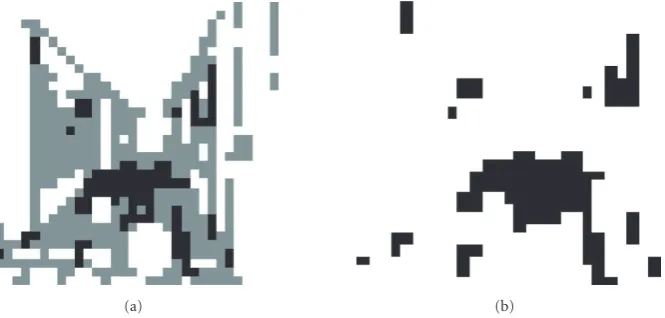
Figure3: (a) The initial occlusion field as it has been formed after a two-threshold-level classification. The grey colour indicates the un-certain blocks, whereas the black colour indicates the occluded blocks. (b) The final occlusion field after the occlusion phase of the energy minimization process. The occluded region has been augmented because the employed algorithm favours occlusion connectivity.
Table2: Comparative results between BMA and MRF.
Image Method
Total bit rate (bpp)
EDCD H(bpp)DV
Room BMA 0.20 (bpp) 0.0308 0.1275
MRF 0.0198 0.0975
SYN.256 BMA 0.21 (bpp) 0.0186 0.1381
MRF 0.0186 0.1284
Table 2shows the normalized average energy of the resid-ual image and the entropy of the disparity vector field for BMA and MRF processes at a specific total bit rate. As ex-pected, the MRF residual images present lower energy and the disparity vector field is smoother than that of BMA pro-cessing. This lower energy and the smoothness of the vector field insure lower total entropy values. The occluded regions are usually tracked and excluded from the disparity compen-sation process, since they contribute to distortions increasing excessively the bit rate. The occlusion indicators are trans-mitted because their residual coding results in a total bit-rate benefit. Also, their main role is to avoid mismatching blocks containing object boundaries and preventing disparity over-smoothing across discontinuities. The MRF model penalizes the existence of an occluded block and encourages the con-nectivity of neighbouring occluded blocks, which usually ap-pear at objects boundaries where large intensity gradients prevail.
Figure3(a)and3(b)show the initial and final occlusion fields for the “Room” stereo pair, respectively. In (a), grey re-gions represent the uncertain field, black areas represent the occluded field, and white areas represent the nonoccluded field. The isolated occluded blocks are initially assigned as uncertain blocks, because it is desirable to exclude them as they increase entropy cost. It is also apparent in (b) that oc-clusion connectivity is favoured, as black areas have been en-larged.
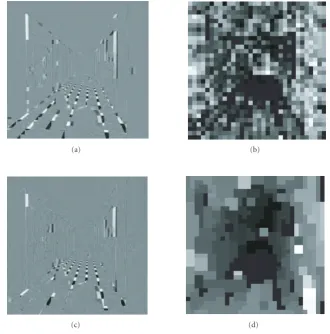
Figures4(a)–4(d)show the residual image and the dis-parity vector of a BMA- and an MRF-based disdis-parity com-pensation process for the “Room” stereo pair, at a bit rate of 0.20 bpp. Figures5(a)–5(d)show the residual image and the disparity vector field of a BMA- and an MRF-based dispar-ity compensation process for the “SYN.256” stereo pair, at a bit rate of 0.21 bpp. In both stereo pairs, the performance of the MRF disparity compensation process is better than the corresponding BMA. Apparently, the MRF model residual images present lower energy and their corresponding dispar-ity vector fields are smoother than their BMA counterparts validating the results ofTable 2.
Figures6(a)and6(b)show the reconstructed target im-age of stereo pair “Room,” for BMA and MRF, respectively. The objective quality of BMA and MRF processes is 26.02 dB and 28.24 dB, respectively, for a bit rate of 0.2 bpp. Figures 7(a)and7(b)show the reconstructed target image of stereo pair “SYN.256,” for BMA and MRF, respectively. The perfor-mance of BMA and MRF processes is 29.08 dB and 29.92 dB, respectively, for a bit rate of 0.21 bpp.
Table 3demonstrates the performance of the proposed coder for all the tested stereo pairs at discrete bit rates.
(a) (b)
(c) (d)
Figure4: Residual image and disparity vector field: (a), (b) BMA method; (c), (d) MRF method.
procedure that is performed with fixed-size block BMA. Fi-nally, our proposed coder presents inferior quality compared to Woo et al. hierarchical MRF stereo coder at medium bit rates [35].
At the lower bound, the two algorithms converge, where-as at bit rates greater than 0.5 bpp, our proposed scheme outperforms Woo et al.’s coder. The hierarchical MRF stereo coder incorporates the typical MRF model and a variable-size block-matching scheme for disparity estimation. Conse-quently, we believe that a variable-size block disparity esti-mation scheme, adapted to our MRF model, would improve the performance of our coder.
Figure 9shows the experimental evaluation of various stereoscopic coders for the “Fruit” stereo image pair. The dis-parity compensated EZW coder is based on EZW encoding for both the reference and residual images employing fixed-size block BMA for disparity estimation. The proposed MRF stereo coder presents beneficial PSNR values in comparison with the other coders. This proves that our coder behaves equally well not only with synthetic stereo images but with camera-acquired images, which present a more difficult dis-parity field as this field depends on cameras distances and their alignment. It should be observed that the quality dif-ference mitigates at lower bit rates, which may be ascribed to
the fixed-size block matching. BMA disparity compensation with fixed-size blocks does not exploit the constant disparity areas that exist in a scene and assigns more bits than actually required. Figure 10 illustrates the performance of the pro-posed coder in comparison with other state-of-the-art coders for the “Aqua” stereo image pair. Again, our proposed coder outperforms in the middle and high bit rates of at least 0.8 dB the other stereo coders and its performance converges to the others at lower bit rates. It is worth to note that hierarchical MRF stereo coder presents inferior quality to the specific nat-ural image, whereas our proposed scheme has a stable perfor-mance both in synthetic and natural images.
Apart from the MRF model, which treats disparity com-pensation very effectively, the wavelet-based morphological encoder contributes to the good performance of our pro-posed scheme because it is more efficient than other coders. It presents, for “still” images, about 1 dB better performance over EZW and also outperforms DCT because of its wavelet nature. Apart from its simple implementation, fast execu-tion, and efficiency, MRWD encoder may provide embedded bit streams and spatial scalability that are prerequisites of a modern coding scheme.
(a) (b)
(c) (d)
Figure5: Residual image and disparity vector field: (a), (b) BMA method; (c), (d) MRF method.
(a) (b)
Figure6: Reconstructed target image at a bit rate of 0.2 bpp: (a) BMA; (b) MRF.
disparity field will imply better temporal prediction. Of course, this will imply a more complicated framework be-cause motion and disparity fields along with their unpre-dictable fields must be integrated. The motion-disparity es-timation procedure for compensating the auxiliary channel with techniques like the joint motion-disparity estimation,
(a) (b)
Figure7: Reconstructed target image at a bit rate of 0.2 bpp: (a) BMA; (b) MRF.
Table3: PSNR versus bit rate of the proposed coder.
Image PSNR (dB)
0.25 (bpp) 0.5 (bpp) 0.75 (bpp) 1 (bpp)
Room 30.67 36.98 41.85 45.06
SYN.256 30.76 35.60 38.63 41.20
Fruit — 37.00 38.65 39.86
Aqua 26.35 28.87 30.81 32.57
Therefore, as a plan for future work, the application of the proposed scheme in a variable-size block framework should be considered.
5. CONCLUSIONS
In this work, an algorithm employing the MRF model is pro-posed for the disparity estimation of a stereo image pair. The MRF model is a popular method in video community for a consistent evaluation of motion fields. It provides the means to accomplish smooth disparity field without increasing the residual energy, and thus to devote fewer bits to encode them. The proposed coder consists of a disparity compensation unit and an encoding unit. The disparity compensation unit constructs initially the disparity and occlusion fields using BMA. The occlusion field is separated into three regions by employing a two-level threshold and the MAP search is per-formed on the uncertain region, which consists of blocks that have to enrol in the occlusion or nonocclusion regions. This approach permits faster execution times, as the MAP search is conducted in a fraction of the whole image. In addition, the choice of MAE provides more reliable disparity estimation than MSE because it is more robust and simpler. The encod-ing unit decomposes the reference and residual images with DWT and employs the morphological algorithm MRWD for compression. This algorithm partitions the coefficients of the wavelet transform and lowers their entropy. The obtained re-sults show that the proposed method improves the quality
1.6 1.5 1.4 1.3 1.2 1.1 1 0.9 0.8 0.7 0.6 0.5 0.4 0.3 0.2
Bit rate (bpp) 30
31 32 33 34 35 36 37 38 39 40 41 42 43 44 45 46
PSNR
(dB)
Optimal blockwise dependent quantization Disparity-compensated JPEG
Disparity-compensated JPEG2000 Boulgouris and Strintzis EZW coder Frajka and Zeger coder
Woo et al. hierarchical MRF coder Proposed MRF coder
Figure8: Quality performance evaluation of various stereoscopic coders for “Room” stereo pair.
of the reconstructed target images compared with the re-sults which a plain BMA method may provide. Also, the pro-posed stereo coder outperforms some known state-of-the-art coders.
1.8 1.7 1.6 1.5 1.4 1.3 1.2 1.1 1 0.9 0.8 0.7 0.6 0.5 0.4
Bit rate (bpp) 34
35 36 37 38 39 40 41 42
PSNR
(dB)
Disparity-compensated JPEG Disparity-compensated JPEG2000 Disparity-compensated EZW coder Proposed MRF coder
Figure9: Quality performance evaluation of various stereoscopic coders for “Fruit” stereo pair.
1.2 1.1 1 0.9 0.8 0.7 0.6 0.5 0.4 0.3 0.2
Bit rate (bpp) 22
23 24 25 26 27 28 29 30 31 32 33 34
PSNR
(dB)
Optimal blockwise-dependent quantization Disparity-compensated JPEG
Disparity-compensated JPEG2000 Frajka and Zeger coder
Woo et al. hierarchical MRF coder Proposed MRF coder
Figure10: Quality performance evaluation of various stereoscopic coders for “Aqua” stereo pair.
ACKNOWLEDGMENT
This work was supported in part by the Research Committee of the National & Kapodistrian University of Athens under the Project Kapodistrias and the EU, and the Greek Ministry of Education under the Project of Archimedes-II.
REFERENCES
[1] H. Yamaguchi, Y. Tatehira, K. Akiyama, and Y. Kobayashi, “Stereoscopic images disparity for predictive coding,” in Pro-ceedings of IEEE International Conference on Acoustics Speech and Signal Processing (ICASSP ’89), vol. 3, pp. 1976–1979, Glasgow, Scotland, UK, May 1989.
[2] B. D. Lucas and T. Kanade, “An iterative image registration technique with an application to stereo vision,” in Proceed-ings of 7th International Joint Conference on Artificial Intelli-gence (IJCAI ’81), pp. 674–679, Vancouver, BC, Canada, Au-gust 1981.
[3] W. Woo and A. Ortega, “Overlapped block disparity com-pensation with adaptive windows for stereo image coding,” IEEE Transactions on Circuits and Systems for Video Technol-ogy, vol. 10, no. 2, pp. 194–200, 2000.
[4] J. Jiang and E. A. Edirisinghe, “A hybrid scheme for low bit-rate coding of stereo images,”IEEE Transactions on Image Pro-cessing, vol. 11, no. 2, pp. 123–134, 2002.
[5] S. Sethuraman, A. Jordan, and M. Siegel, “Multiresolution based hierarchical disparity estimation for stereo image pair compression,” inProceedings of Symposium on Applications of Subbands and Wavelets, Newark, NJ, USA, March 1994. [6] W. Woo and A. Ortega, “Stereo image compression with
dis-parity compensation using the MRF model,” inVisual Com-munications and Image Processing (VCIP ’96), vol. 2727 of Pro-ceedings of SPIE, pp. 28–41, Orlando, Fla, USA, March 1996. [7] H. Yamaguchi, Y. Tatehira, K. Akiyama, and Y. Kobayashi,
“Data compression and depth shape reproduction of stereo-scopic images,” Systems and Computers in Japan, vol. 22, no. 12, pp. 53–64, 1991.
[8] N. V. Boulgouris and M. G. Strintzis, “A family of wavelet-based stereo image coders,”IEEE Transactions on Circuits and Systems for Video Technology, vol. 12, no. 10, pp. 898–903, 2002.
[9] T. Frajka and K. Zeger, “Residual image coding for stereo im-age compression,”Optical Engineering, vol. 42, no. 1, pp. 182– 189, 2003.
[10] J. N. Ellinas and M. S. Sangriotis, “Stereo image compres-sion using wavelet coefficients morphology,”Image and Vision Computing, vol. 22, no. 4, pp. 281–290, 2004.
[11] M. G. Perkins, “Data compression of stereopairs,”IEEE Trans-actions on Communications, vol. 40, no. 4, pp. 684–696, 1992. [12] H. Aydinoglu and M. H. Hayes, “Stereo image coding: a
projection approach,”IEEE Transactions on Image Processing, vol. 7, no. 4, pp. 506–516, 1998.
[13] S. Geman and D. Geman, “Stochastic relaxation, Gibbs distri-butions, and the Bayesian restoration of images,”IEEE Trans-actions on Pattern Analysis and Machine Intelligence, vol. 6, no. 6, pp. 721–741, 1984.
[14] J. Konrad and E. Dubois, “Bayesian estimation of motion vec-tor fields,”IEEE Transactions on Pattern Analysis and Machine Intelligence, vol. 14, no. 9, pp. 910–927, 1992.
[15] J. Zhang and G. G. Hanauer, “The application of mean field theory to image motion estimation,”IEEE Transactions on Im-age Processing, vol. 4, no. 1, pp. 19–33, 1995.
[16] J. Wei and Z.-N. Li, “An efficient two-pass MAP-MRF algo-rithm for motion estimation based on mean field theory,” IEEE Transactions on Circuits and Systems for Video Technol-ogy, vol. 9, no. 6, pp. 960–972, 1999.
encoding,” in Proceedings of 2nd IEEE International Sympo-sium on 3D Data Processing, Visualization and Transmission (3DPVT ’04), pp. 852–859, Thessaloniki, Greece, September 2004.
[18] S. D. Servetto, K. Ramchandran, and M. T. Orchard, “Image coding based on a morphological representation of wavelet data,”IEEE Transactions on Image Processing, vol. 8, no. 9, pp. 1161–1174, 1999.
[19] M. Lukacs, “Predictive coding of multi-view point image sets,” inProceedings of IEEE International Conference on Acoustics, Speech, and Signal Processing (ICASSP ’86), vol. 11, pp. 521– 524, Tokyo, Japan, April 1986.
[20] J.-L. Starck, F. D. Murtagh, and A. Bijaoui,Image Processing and Data Analysis: The Multiscale Approach, Cambridge Uni-versity Press, Cambridge, UK, 1998.
[21] S. Z. Li,Markov Random Field Modeling in Computer Vision, Springer, Tokyo, Japan, 1995.
[22] S. Z. Li, “Markov random field models in computer vision,” inProceedings of 3rd European Conference on Computer Vi-sion (ECCV ’94), vol. 2, pp. 361–370, Stockholm, Sweden, May 1994.
[23] J. Besag, “Spatial interaction and the statistical analysis of lat-tice systems,”Journal of the Royal Statistical Society B, vol. 36, pp. 192–225, 1974.
[24] M. Antonini, M. Barlaud, P. Mathieu, and I. Daubechies, “Im-age coding using wavelet transform,”IEEE Transactions on Im-age Processing, vol. 1, no. 2, pp. 205–220, 1992.
[25] J. M. Shapiro, “Embedded image coding using zero trees of wavelet coefficients,”IEEE Transactions on Signal Processing, vol. 41, no. 12, pp. 3445–3462, 1993.
[26] A. Said and W. A. Pearlman, “A new, fast, and efficient im-age codec based on set partitioning in hierarchical trees,” IEEE Transactions on Circuits and Systems for Video Technol-ogy, vol. 6, no. 3, pp. 243–250, 1996.
[27] B.-B. Chai, J. Vass, and X. Zhuang, “Significance-linked con-nected component analysis for wavelet image coding,”IEEE Transactions on Image Processing, vol. 8, no. 6, pp. 774–784, 1999.
[28] E. Dubois and J. Konrad, “Estimation of 2-D motion fields from image sequences with application to motion-compensated processing,” inMotion Analysis and Image Se-quence Processing, M. I. Sezan and R. L. Lagendijk, Eds., pp. 53–87, Kluwer Academic, Boston, Mass, USA, 1993.
[29] Stereo images from Bonn University, available from:http:// www-dbv.cs.uni-bonn.de.
[30] Stereo images from Carnegie Mellon University, Pittsburgh, Pa, USA, available from:http://www-2.cs.cmu.edu/afs/cs.cmu. edu/project/sensor-9/ftp/.
[31] http://www.code.ucsd.edu/∼frajka/images/stereo/stereo ima-ges.html.
[32] B. E. Usevitch, “A tutorial on modern lossy wavelet image compression: foundations of JPEG 2000,”IEEE Signal Process-ing Magazine, vol. 18, no. 5, pp. 22–35, 2001.
[33] M. D. Adams, H. Man, F. Kossentini, and T. Ebrahimi, “JPEG 2000: The next generation still image compression standard,” ISO/IEC JTC 1/SC 29/WG 1 N 1734, 2000.
[34] W. Woo and A. Ortega, “Optimal blockwise dependent quan-tization for stereo image coding,”IEEE Transactions on Circuits and Systems for Video Technology, vol. 9, no. 6, pp. 861–867, 1999.
[35] W. Woo, A. Ortega, and Y. Iwadate, “Stereo image coding us-ing hierarchical MRF model and selective overlapped block
disparity compensation,” inProceedings of IEEE International Conference on Image Processing (ICIP ’99), vol. 2, pp. 467–471, Kobe, Japan, October 1999.
J. N. Ellinasreceived his B.S. degree in elec-trical and electronic engineering from the University of Sheffield, England, in 1977, and his M.S. degree in telecommunications from Universities of Sheffield and Leeds, in 1978. He received his Ph.D. degree from the Department of Informatics and Telecom-munications at the National & Kapodistrian University of Athens in June 2005. Since 1983, he has been with Technological
Edu-cational Institute of Piraeus, Department of Computer Engineer-ing, Greece, where he is currently an Associate Professor. His re-search interests include image processing, image and video com-pression.