
Volume 2007, Article ID 57286,13pages doi:10.1155/2007/57286
Research Article
Hardware Implementation of a Modified Delay-Coordinate
Mapping-Based QRS Complex Detection Algorithm
Matej Cvikl,1Franc Jager,2and Andrej Zemva3
1Iskra Sistemi, d.d., Stegne 21, 1000 Ljubljana, Slovenia
2Laboratory of Biomedical Computer Systems and Imaging, Faculty of Computer and Information Science, University of Ljubljana, Trzaska 25, 1000 Ljubljana, Slovenia
3Laboratory for Integrated Circuit Design, Faculty of Electrical Engineering, University of Ljubljana, Trzaska 25, 1000 Ljubljana, Slovenia
Received 30 April 2006; Revised 23 January 2007; Accepted 23 January 2007 Recommended by David Hamilton
We present a modified delay-coordinate mapping-based QRS complex detection algorithm, suitable for hardware implementation. In the original algorithm, the phase-space portrait of an electrocardiogram signal is reconstructed in a two-dimensional plane us-ing the method of delays. Geometrical properties of the obtained phase-space portrait are exploited for QRS complex detection. In our solution, a bandpass filter is used for ECG signal prefiltering and an improved method for detection threshold-level calculation is utilized. We developed the algorithm on the MIT-BIH Arrhythmia Database (sensitivity of 99.82% and positive predictivity of 99.82%) and tested it on the long-term ST database (sensitivity of 99.72% and positive predictivity of 99.37%). Our algorithm outperforms several well-known QRS complex detection algorithms, including the original algorithm.
Copyright © 2007 Matej Cvikl et al. This is an open access article distributed under the Creative Commons Attribution License, which permits unrestricted use, distribution, and reproduction in any medium, provided the original work is properly cited.
1. INTRODUCTION
Detecting QRS complexes is the most important task in elec-trocardiogram (ECG) signal analysis. Physiological variabil-ity of QRS complexes and various types of artifacts like mus-cle noise, power line interference, baseline wander, motion artifacts, and electrode contact noise added to the ECG sig-nal make QRS complex detection a difficult task.
In the literature, various types of QRS complex detec-tion algorithms can be found. K¨ohler et al. [1] divided QRS complex detection algorithms into algorithms based on sig-nal derivatives and digital filters, wavelet-based QRS complex detection, neural network approaches, and additional ap-proaches. The algorithms from the first two groups are most widely used for QRS complex detection and can be found in software (SW) or hardware (HW) implementations.
The first group encompasses algorithms based on sig-nal derivatives and digital filters. Such approach divides the search process into two stages: the preprocessing stage and the decision stage. The preprocessing stage usually consists of a band-pass linear filter to reduce noise and enhance the QRS complex [2,3], and a nonlinear filter, which by signal differentiation, squaring, and integration differentiates the
QRS complex from the artifacts. The decision stage applies QRS complex search rules where the detection function is compared to a certain detection threshold level to find signal peaks and then the decision is made whether the peak is a QRS complex or not. One of the best performing algorithms in this group is an open source ECG analysis SW (OSEA) [4]; OSEA achieves QRS complex detection sensitivity (Se) of 99.80% and positive predictivity (+P) of 99.80% on the MIT-BIH Arrhythmia Database [5]. Further examples of al-gorithms with lower performance that can be classified into this group can be found in [6–10].
ECG signal
Lowpass filter
Time delay
y
x
Area calculation
Peak detection
and decision
Detection threshold
level calculation Figure1: QRS complex detection using delay-coordinate mapping [11].
containing low-frequency signal information and continues to the lowest scale (W21) containing high-frequency signal information. A positive-negative pair of local maxima that occurs at all the scales at the same time and meets other de-tection rules is declared as the QRS complex. One of the first WT-based QRS complex detection algorithms with very high Se of 99.89% and +P of 99.94% tested on the MIT-BIH Ar-rhythmia Database was published by Li et al. [12]. This al-gorithm serves as a starting point for other alal-gorithms which usually only differ in the usage of different wavelet functions [13], number of processed scales [14], or modifications to the original algorithm [15,16]. These algorithms also have lower performance than [12].
While algorithms from the first group are usually less computationally intensive and suitable for microcontroller implementations in embedded systems, other types of algo-rithms usually utilize a greater number of filters and decision rules, making them unsuitable for systems with low-signal processing power. Most of such algorithms run on personal computers (PCs) where data is processed further. Regardless of the type of the algorithm, when a lot of ECG signals need to be processed on a single PC in a relatively short time, it is essential to have enough processing power. All the signals need to be processed without degrading the performance of other applications running on the PC. One solution to the problem is upgrading the PC, while the second solution is in an application-specific HW. Such HW can be based on a dig-ital signal processor (DSP) or field programmable gate array (FPGA) added to the PC, so the processor in the PC can be relieved from most of the computation.
The goal of our research work was development and HW implementation of a QRS complex detection algorithm in or-der to set the groundwork for further ECG signal processing stages in HW. Because of expected high-speed data process-ing, the HW is aimed to be used as a QRS complex detection engine in systems where a larger number of ECG signals have to be processed. In this paper, a HW implementation of the QRS complex detection algorithm based on phase-space por-trait of the ECG signal is described. In contrast to the original algorithm [11], our algorithm processes blocks of ECG data, has a different input filter, and uses a different method for detection threshold level calculation. The algorithm was de-veloped on the MIT-BIH Arrhythmia Database and a com-parison with some of the well-known QRS complex detec-tion algorithms in terms of QRS detecdetec-tion performance on
this database was made. Finally, the algorithm was tested on the long-term ST database (LTST DB) [17].
2. MATERIALS AND METHODS
A real-time QRS complex detection algorithm for microcon-troller implementation was adapted for block data process-ing in HW. The developed algorithm was first modeled and tested in SW (Matlab). The SW model served as an optimiza-tion and testing tool for the HW implementaoptimiza-tion of the al-gorithm, which was entirely written in very high-speed inte-grated circuit hardware description language (VHDL) [18].
The QRS complex detection algorithm proposed by Lee et al. [11] uses time delay to map the input ECG signal. A sin-gle ECG signal and its time delayed duplicate create a phase-space portrait, whose geometrical properties are exploited for QRS complex detection. Based on the size of the poly-gon bounded by a number of consecutive data points, a QRS event can be found. Each time a new polygon size (area) ex-ceeding the current detection threshold level is found, a de-cision is made whether the peak is indeed a QRS complex or not, and the detection threshold level is updated. A block diagram of the algorithm is shown inFigure 1.
Although this scheme requires several multiplications for area calculation, the algorithm is relatively simple and has satisfactory performance: Se of 99.69% and +P of 99.88%, tested on the MIT-BIH Arrhythmia Database. In order to simplify the preprocessing stage, authors deliberately used only a lowpass filter, which resulted in more dynamic changes of the polygon sizes since P and T waves and motion artifacts were not filtered out.
We modified the algorithm in order to make it more suit-able for postprocessing, where the ECG signal is processed block-by-block. It is designed and optimized for QRS com-plex detection in the ECG signal sampled at 250 Hz. How-ever, other sampling rates can be used with appropriate ad-justments to the input filter, correct block length, and detec-tion threshold level calculadetec-tion. The algorithm we propose is shown inFigure 2.
ECG signal
Bandpass filter
Time delay
y
x
Area calculation
Threshold calculation
Peak detection
and decision Figure2: Modified delay-coordinate mapping algorithm.
1.5 1 0.5 0
−0.5
−1
−1.5
ECG
(
t
)(
m
V
)
0 0.5 1 1.5 2
t(s) (a)
1.5 1 0.5 0
−0.5
−1
−1.5
ECG
(
t
+d
el
ay
)(
m
V
)
−2 −1 0 1 2
ECG (t) (mV) (b)
1.5 1 0.5 0
−0.5
−1
−1.5
ECG
(
t
+d
el
ay
)(
m
V
)
−2 −1 0 1 2
ECG (t) (mV) (c)
1.5 1 0.5 0
−0.5
−1
−1.5
ECG
(
t
+d
el
ay
)(
m
V
)
−2 −1 0 1 2
ECG (t) (mV) (d)
Figure3: Phase-space portraits of the ECG signal: (a) input ECG signal, (b) phase-space portrait of the ECG signal with the time delay of 4 milliseconds, (c) phase-space portrait of the ECG signal with the time delay of 12 milliseconds, (d) phase-space portrait of the ECG signal with the time delay 28 milliseconds.
2.1. Phase-space portrait
The phase-space portrait (also phase portrait) of a sig-nal is constructed in a 2D plane (x-y) from the origi-nal sigorigi-nal and its time delayed duplicate, so that coordi-nates of each data point are written asx[nT] = ECG[nT] and y[nT] = ECG[(n− τ)T], where τ is the time de-lay. Figure 3shows exemplary phase-space portraits of two
1 0
−1
−2
ECG
(
t
)(
m
V
)
0 0.5 1 1.5 2 2.5 3 3.5 4 4.5 5
t(s) (a) 2
0
−2
ECG
(
t
)(
m
V
)
0 1 2 3 4 5
t(s) (b)
0.5 0
−0.5
ECG
(
t
)(
m
V
)
0 1 2 3 4 5
t(s) (c) 2
0
−2
ECG
(
t
+d
el
ay
)(
m
V
)
−2 −1.5 −1 −0.5 0 0.5
ECG (t) (mV) (d)
0.5 0
−0.5
ECG
(
t
+d
el
ay
)(
m
V
)
−0.4 −0.2 0 0.2 0.4 0.6
ECG (t) (mV) (e) 2
1
0
0 1 2 3 4 5
t(s) (f)
0.4 0.2
0
0 1 2 3 4 5
t(s) (g)
Figure4: Phase-space portraits and the calculated area of the ECG signal: (a) input ECG signal, (b) lowpass filtered ECG signal, (c) band-pass filtered ECG signal, (d) phase-space portrait of the lowband-pass filtered ECG signal, (e) phase-space portrait of the bandband-pass filtered ECG signal, (f) calculated area of the lowpass filtered ECG signal, (g) calculated area of the bandpass filtered ECG signal.
It is very important that an appropriate signal time de-lay is chosen in order to get useful phase-space portraits and to sustain proportions between the sizes of areas created by different waves. If the time delay is too short (Figure 3(b)), the resulting trajectory creates rather “flat” areas around the y = xline, that can potentially be disordered, but on the other hand, if the time delay is too great (Figure 3(d)), the contour can create several smaller areas instead of one larger area. Based on their QRS detection algorithm performance, Lee et al. [11] determined that the optimal time delay is 20 milliseconds.
Some phase-space portrait examples of ECG signals con-taminated with high-frequency noise and baseline drifts are shown in [11]. While baseline drifts cause the phase-space
portrait to move along the diagonal axis of the plane, along they=xline, and do not influence the size of the area itself, the high-frequency noise can distort the phase-space portrait to a point where the distinctive area created by the QRS com-plex cannot be found anymore. To avoid this, the ECG signal is to be prefiltered, so the phase-space portrait is constructed from the filtered ECG signal and its time delayed duplicate.
Figure 4shows the input ECG signal, lowpass, and bandpass filtered signals, their phase-space portraits, and sizes of the areas the trajectories created. The input signal is deliberately selected to emphasize the difference between the phase-space portraits created by the two filters.
by time delaying the signal moves along the y = x line (Figure 4(d)), while no influence can be seen on the calcu-lated area (Figure 4(f)). It can also be noted that the low-pass filter allows waves like P and T to create small areas (Figure 4(f)), which add to more dynamical area behavior. If the ECG signal is filtered with a bandpass filter, the trajectory does not move along the y=xline (Figure 4(e)) and there are hardly any areas present that would be created by the P and T waves, as these waves are attenuated (Figure 4(g)). It can also be noticed that the different frequency characteris-tics of the bandpass filter result in a different shape and posi-tion of the shape the trajectory tends to form in the 2D plane (Figures4(d),4(e)).
2.2. Area calculation
As mentioned in the previous subsection, each data point in thex-yplane has coordinates (x[nT],y[nT]). The size of an area formed byndata points (n-point data vector) is used as the detection function for locating QRS complexes. The area is obtained using plane geometry equation for a planar non-self-intersecting polygon area calculation:
Area= 1
2
xy11 xy22
+
xy22 xy33
+· · ·+
xynn−1−1 xynn
. (1)
Polygon orientation is not important, so the absolute value of the calculated area (determinant) has to be considered. Lee et al. [11] calculated the sizes of areas comprised of ten data points. Their decision was based on the fact that if the average QRS complex duration is less than 100 milliseconds (25 data points at 250 samples per second), all polygons comprised of ten data points are nonintersecting. The experiment for obtaining the optimum number of data points for our algo-rithm is described inSection 3.
2.3. Filtering
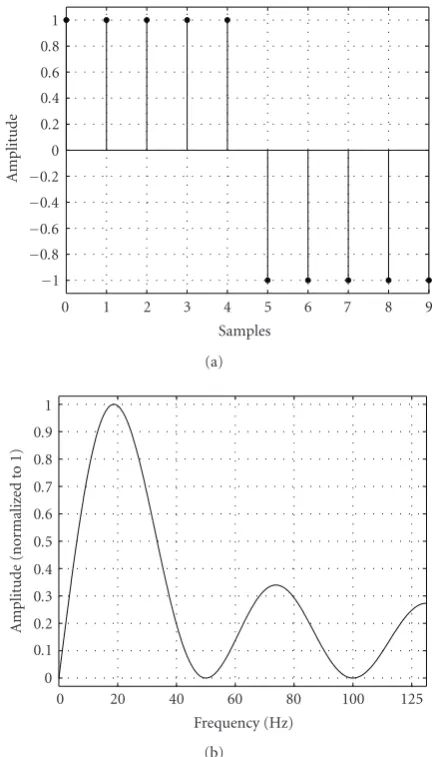
Targeted for HW implementation in FPGA, the chosen filter belongs to a family of simple nonrecursive filters with inte-ger multipliers [19,20]. Impulse response of the filter used in this work is shown inFigure 5(a). The filter comprises two sections, where each section of lengthLcalculates the aver-age value ofLneighboring data samples; thus each section represents a moving average filter. By averaging consecutive data samples, the high-frequency components of the input signal are attenuated. To attenuate power-line interference, the lengthLof the two sections is calculated so that the fil-ter has zero gain at 50 Hz (f50) and multiples of 50 Hz. For 250 Hz sampling rate (f s), the section lengthLis five:
L= ff s
50.
(2)
The filter can be redesigned for other sampling rates accord-ingly, again attenuating 50 Hz. Furthermore, the impulse response of the filter was chosen in such a way that there is a step between coefficient values. This results in empha-sis on high-speed transitions in the input ECG signal, that
1 0.8 0.6 0.4 0.2 0
−0.2
−0.4
−0.6
−0.8
−1
A
m
plitude
0 1 2 3 4 5 6 7 8 9
Samples (a) 1
0.9 0.8 0.7 0.6 0.5 0.4 0.3 0.2 0.1 0
A
m
plitude
(nor
m
aliz
ed
to
1)
0 20 40 60 80 100 125
Frequency (Hz) (b)
Figure5: Filter characteristics: (a) impulse response, (b) frequency response.
is, slopes of the QRS complex, and attenuation of the low-frequency components. Frequency response of the filter is shown inFigure 5(b). The difference equation of the filter is the following:
y[n]=x[n] +x[n−1] +x[n−2] +x[n−3] +x[n−4]−x[n−5]−x[n−6]
−x[n−7]−x[n−8]−x[n−9].
(3)
Frequency response of the filter shows attenuation of low-and high-frequency components.
We can also see approximately linear characteristic below the center frequency yielding sensitivity of the bandpass filter to slopes in original signal and cancelation of the 50 Hz com-ponent and its multiples. The center frequency of the filter designed is at 18.7 Hz and its cutofffrequencies are at 9.2 Hz and 29.3 Hz.
1050 1000 950 900 850 800 750
ECG
(
t
)
(AD
C
value)
0 0.2 0.4 0.6 0.8 1 1.2 t(s)
(a)
500 0
−500
Filt
er
ed
ECG
(
t
)(
va
lu
e)
0 0.2 0.4 0.6 0.8 1 1.2 t(s)
(b)
Figure6: Original ECG signal and filtered ECG signal.
slowly varying waves like P wave, ST segment, and T wave composed from low frequencies were attenuated.
2.4. Detection threshold level calculation
The bandpass filter significantly reduces the influence of lower- and higher-frequency components on the calculated area, which can be seen when Figures4(f)and4(g)are com-pared. InFigure 4(g), representing the areas created by the bandpass filtered signal, the peaks produced by the QRS complexes can clearly be distinguished from other peaks. This is true even when the signal is noisy, like it is between the third and the fourth heartbeats inFigure 4. The reduc-tion of areas created by non-QRS artifacts enables a different approach to the QRS complex detection threshold level cal-culation than what was originally used in [11]. Our detection threshold level evaluation is based on the average value of the detection function in the current data block. As the average value of the calculated areas in the block was not high enough to filter out the peaks that were not due to QRS complexes, multiplied average values were tested. After extensive testing, the optimal value to be used as a detection threshold level was determined to be four times the average area value in the data block.
Two additional safety mechanisms for error prevention were incorporated in our algorithm and are depicted in
Figure 7.
The first mechanism assures that blocks, where the cal-culated detection threshold level is too low, are treated as blocks with no QRS. Without this fail-safe, in blocks with no QRS complexes, a peak of any height would be recog-nized as a QRS complex and the number of false positive (FP) detections would increase. A search was conducted to find the optimum lower limiting value that can be represented
Calculate thr new
thr new>thr old/8
Detect peaks, apply QRS rules at the end of the block
Yes No
thr=thr new thr=thr old
Yes
QRS found No thr old=thr thr old=thr old/2
Stop detection?
Figure7: Scheme of QRS complex detection threshold level adap-tation.
with a combination of numbers of power of two. This lim-itation was set to avoid divisions in HW. Testing results indi-cated that the detection threshold level in the current block (thr new) has to be greater than 1/8th of the threshold level in the previous block (thr old). If this is not the case, the old value is kept as a valid detection threshold level for the cur-rent block, otherwise the new value is used and the old one is updated. The second mechanism serves for recovery from false negative (FN) detections, as each time no QRS com-plex is found, the old detection threshold level (thr old) is decreased by 50%. This proves to be useful in cases when nondetected weak QRS complexes are present; each time no QRS is detected, the detection threshold level (thr old) is lowered, and eventually becomes sufficiently low to start de-tecting the QRS complexes. However, there is a limit to the number of the detection threshold level decreases. The al-gorithm only allows three consecutive detection threshold level decreases, meaning that the detection threshold level can drop to 1/8th of its initial value. The detection thresh-old level remains unchanged for all subsequent consecutive blocks with no QRS complexes.
2.5. Peak search and QRS complex detection rules
1200 1000 800 600 400 200 0 FN + F P (beats)
4 8 12 16 20 24 28 32
Time delay (ms) Error at 600 samples, 8 points
FN=147 FP=426
FN=147 FP=412
FN=153 FP=371
FN=138 FP=299
FN=154 FP=276
FN=220 FP=423
FN=295 FP=837
FN=256 FP=670
(a) 1200 1000 800 600 400 200 0 FN + F P (beats)
400 500 600 650 700 750 800 900 Block length (samples)
Error at 20 ms delay, 8 points FN=103
FP=954
FN=152 FP=562
FN=154 FP=276
FN=176 FP=262
FN=217 FP=199
FN=262 FP=184
FN=299 FP=168
FN=467 FP=136
(b) 500 475 450 425 400 FN + F P (beats)
6 7 8 9 10 11
Number of points for area calculation Error at 600 samples, 20 ms delay
FN=151 FP=337
FN=148 FP=307
FN=154 FP=276
FN=175 FP=280
FN=185 FP=288
FN=212 FP=273
(c)
Figure 8: Influence of detection parameters ((a) time delay, (b) block length, (c) number of polygon points) on the number of missed and falsely detected beats.
QRS candidates, while the peaks between thr/2 and thr are stored to a separate list (half peaks). Every time a new QRS candidate is found, the half peaks list is cleared. If no QRS candidates are found within 150% of the last RR interval, the peaks from the half peaks list are added to QRS candi-dates, and the half peaks list is cleared. This procedure cor-responds to the “search-back” procedure. After the complete block of the area values is swept and the QRS candidate list is obtained, QRS decision rules are applied to the list.
QRS complex decision is based on the peak mutual dis-tance and amplitude criteria. A sweep through the peaks in the detection function is performed. The position and height of every peak in the QRS candidate list are compared to the position and height of the last known peak in the list that
was recognized to originate from the QRS complex. The first peak in the candidate list is automatically recognized as the QRS complex. If the distance between the first and the second peaks is less than the refractory period (200 milliseconds), the higher of the two peaks is recognized as a QRS complex. In case the second peak is higher, the first peak is discharged and the second one is recognized as the first QRS complex. If the distance is greater than the refractory period, the second peak is automatically recognized as a new QRS complex. The third peak would then be compared to the first or the second peak, depending on which peak was recognized as the QRS complex.
After all QRS complexes in the block have been located, the difference between the last two QRS complexes is consid-ered to be the RR interval. If none or only one QRS complex is detected in a block, the RR interval remains unchanged. It is also possible to calculate the RR interval as the mean value of all RR intervals within one block. The performance testing showed that the latter method performed worse, for which its error persistence is to be blamed. If one FP beat is detected, it takes several true positive (TP) detections to nul-lify its influence. Since such errors can persist through sev-eral blocks, the error can increase even further. Every FP de-tection causes the search-back to be performed sooner than it should, which can lead to additional FP detections. The opposite situation is also possible in cases when a few QRS complexes are missed (FN); the search-back interval can be increased and the search-back seldom performed. This way, even more FN detections can occur when the QRS complexes have their amplitude below the detection threshold level.
An additional feature of the QRS complex detection part of the algorithm is the mechanism for block overlapping. While in [13] consecutive blocks of data are overlapped by 75%, our algorithm uses the last detected QRS complex in a block as a starting point for its subsequent block. The method in [13] thus produces a constant 25% processing overhead as 25% of the data is always processed twice. The overhead in our method is variable and spans between 6.7% (record 234) and 46.8% (record 231), but is with its average value of 19.1% lower than in [13]. The same mechanism also sets the starting point when no QRS is found in the processed block. In such cases, the new starting point of the following block is set at 450 samples of the currently processed block. This means that the new block comprises 250 samples of the old data (one second of the ECG signal) and 450 samples of the new data. In cases where low-amplitude QRS complexes are present but not detected, such block composition reduces the number of FN detections, as some portions of blocks are always processed twice and each time with a lower detection threshold level.
Start
Read ECG data Filtering, area calculation
Threshold calculation, start search
QRS detection threshold exceeded
No
Yes Add to QRS
candidates Clear half peaks, reset searchback cnt. No
End of data block Yes
Apply QRS detection rules to QRS candidates, update RR interval, update old threshold No Stop detection
Yes Stop
Reduced QRS detection threshold
exceeded
No
Yes Add candidate to
half peaks
Time exceeds RR interval
No
Yes Write half peaks
(a)
Read data
Filtering, area and threshold calculation
Else
Compare sample to thresholds End of
block Apply QRS rules to QRS
candidates
Update RR interval, transmit QRS
locations
Add candidate to
half peaks
Write QRS candidate
Clear half peaks,
reset search-back
cnt. Else
thr/2 exceeded thr exceeded
1.5∗RR interval exceeded
(b)
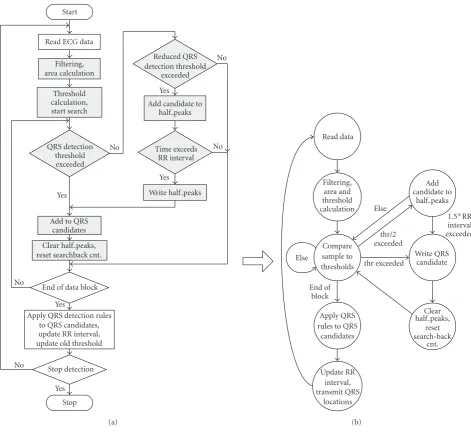
Figure9: QRS complex detection algorithm: (a) flow chart of the SW implementation, (b) simplified state diagram of the HW implemen-tation.
to calculate the QRS detection threshold level on the basis of the average value of the detection function in the current data block.
3. IMPLEMENTATION
The algorithm performance is highly dependant on the time delay parameterτ, data block length settings, and the cho-sen number of polygon points. For testing purposes, the al-gorithm was first implemented in Matlab, where individual detection parameters were set to give optimal QRS complex detection performance in terms of the minimum number of missed and falsely detected (FN and FP) QRS complexes.
For each of the three parameters, the algorithm perfor-mance was tested on the complete database. Each test had two parameters fixed and the third parameter was
chang-ing (Figure 8). First, the time delay parameter selection was made based on QRS complex detection performance with blocks of 600 data samples and 8 data points for area cal-culation (Figure 8(a)). In the next step, the block length was modified using the selected time delay and the same number of polygon data points (Figure 8(b)). Finally, the optimum number of data points used for area calculation was determined using 20 milliseconds delay and block length of 600 data samples (Figure 8(c)). Parameter settings with the least detection error rate were chosen for the imple-mentation and algorithm performance was evaluated on the MIT-BIH Arrhythmia Database. The time delay was set to 20 milliseconds, the block length was set to 700 samples, and the number of points was set to eight.
was developed in VHDL. The main difference between the HW implementation and the SW implementation is true parallel execution that the HW implementation offers.
All grayed parts of the code inFigure 9(a)are in the HW implementation executed independent of each other. The SW implementation needs to wait for the outcome of the de-tection threshold level comparison, while in the HW imple-mentation both detection threshold level comparisons (thr and thr/2) are performed at the same time. Such schedul-ing significantly reduces the number of clock cycles needed for data processing and improves data processing speed. Fur-thermore, the average value can be calculated in parallel with area calculation, which also speeds up block processing.
Another difference in the HW implementation is that in the entire design only integer arithmetic is used. The deci-sion to represent the variables with 32 bits or less was made to reach a compromise between the entered calculation error and resource utilization. Any variable that requires a greater number of bits is appropriately modified. Such modification is only needed at average value calculation, when 700 30-bit area size variables are to be summed. The HW divider used for average value calculation can only accept dividends of up to 32 bits; therefore, before addition, each area value is di-vided by 256 to achieve a 32-bit sum (dividend). Because of the high area values, such division has no influence on the detection accuracy, and does not also influence the process-ing speed, since divisions with the power of two are in HW only bit-shifts and zero padding.
The HW implementation of the algorithm is designed to accept the input data of a single ECG signal as a nonrepeating stream, meaning that the input logic only accepts as much data as needed to fill up the input buffer; if 200 samples of a block need to get overlapped with the next data block, only 500 additional input samples are added to construct the next data block. The resulting QRS complex detection algorithm inFigure 9(b)was implemented and tested with the Xilinx XC2VP7 [24] development board. To prove the concept, an addition of a soft-core microcontroller and a serial port in-terface were chosen for data transfer handling between the development board and a PC.
4. RESULTS AND DISCUSSION
The algorithm was developed on resampled data from the MIT-BIH Arrhythmia Database. The database contains 48 half-hour ambulatory records. These records include com-plex ventricular, junctional, and supraventricular arrhyth-mias and conduction abnormalities. Several of these records have interesting rhythm features, QRS morphology varia-tions, and variety of changes in signal quality, thus repre-senting “real-world” clinical conditions that may present dif-ficulty to Arrhythmia detectors.
We tested standard performance measures such as the sensitivity (Se) and the positive predictivity (+P). The Se re-ports the percentage of true beats that were correctly detected by the algorithm, while the +P reports the percentage of beat detections which were in reality true beats. The test results presented in Tables1and2reflect the QRS complex detection
Table1: Performance of the algorithm on the MIT-BIH Arrhyth-mia Database.
Table2: QRS complex detection performance compared to several algorithms (based on [15, Table II]).
QRS detector ANN TP FN FP Error [%] Se [%] +P [%] Li et al. [12] 104182 104070 112 65 0.17 99.89 99.94 Saxena et al. [14] 103763 103664 99 102 0.19 99.9 99.9 Bahoura et al. [16] 109809 109635 184 135 0.29 99.83 99.88 Mart´ınez et al. [15] 109428 109208 220 153 0.34 99.80 99.86
This work 109494 109294 200 200 0.37 99.82 99.82
OSEA [4] 91284∗ 91105 179 180 0.39 99.80 99.80 Lee et al. [11] 109486∗ 109151∗ 335 137 0.43 99.69 99.88 Hamilton and Tompkins [6] 109267 108927 340 248 0.54 99.69 99.77 Zong et al. [7] NA NA NA NA 0.58 99.65 99.77 Pan and Tompkins [2] 109809 109532 277 507 0.71 99.75 99.54 Afonso et al. [21] 90909 90535 374 406 0.86 99.59 99.56 Poli et al. [22] 109963 109522 441 545 0.90 99.60 99.50 Kunzmann et al. [10] 91283 NA NA NA 1.41 98.86 99.73 Aristotle SW [23] 109428 107567 1861 94 1.79 98.30 99.91
∗The numbers are recalculated.
performance obtained utilizing data blocks of 700 samples, time delay of 20 milliseconds and eight data points for area calculation. Because of initial data resampling to 250 sam-ples per second, the obtained QRS complex locations were recalculated to match the 360 samples per second data rate of the original data and the attribute file. Then the performance was tested applying a 40 milliseconds delay to the MIT-BIH Arrhythmia Database. The first channel of all 48 two-channel records throughout their entire length was used for testing the performance of the algorithm.
The columns in Table 1 represent the record number (REC), the number of heartbeats in the record (AHBs), the number of correctly (true positive) (TP) detected heartbeats, the number of missed (not detected) (FN) heartbeats, the number of false positive (FP) detections, the sum of falsely detected and missed heartbeats (FN + FP), the sensitivity (Se [%]), and the positive predictivity (+P [%]), respectively.
The results in Table 1 were obtained by the algorithm modified for nonrepeating data reception through a serial link. The area calculation was performed on the data stream and then partitioned to data blocks. In order to enable block processing through the complete record, 1000 replicates of the last data sample were added to the end of all records. The algorithm was based on assumption that every block starts at the last detected QRS complex, therefore data processing starts 200 milliseconds after the block starts. This is also the case for the first data block where the first 200 milliseconds of data are not scanned for peaks, which leads to FN detec-tions at the start of some records (207, 208, 210, 214, 220, and 233).
The algorithm performs well and stable on all tested records (Table 1); however, performance on two records is far worse than on other records. The record 108 is problem-atic for many detection algorithms because of the first-degree AV block and high and sharp P waves. The combination of these two properties allows the P waves to qualify as the QRS complexes and produce FP detections in several places in the
record. Detection performance on the record 203 mainly suf-fers from nondetected (FN) beats, mostly premature ventric-ular contractions (PVCs). The nondetected PVCs have low amplitude and occur between two normal high-amplitude beats. In such conditions, these beats either do not exceed any of the detection threshold levels or exceed the lower de-tection threshold level, but there is no search-back.
To gain the sense of the algorithm performance on the MIT-BIH Arrhythmia Database, a comparison of detection results to a set of other well-known published algorithms is reported in Table 2. The columns in Table 2 represent the QRS detector (QRS detector), the number of tested (anno-tated) (ANN) heartbeats, the number of correctly (true pos-itive) (TP) detected heartbeats, the number of missed (not detected) (FN) heartbeats, the number of false positive (FP) detections, percentage of falsely detected and missed heart-beats among all tested heartheart-beats (Error %), the sensitiv-ity (Se [%]), and the positive predictivsensitiv-ity (+P [%]), respec-tively.
Table3: Performance of the algorithm on 43 records of the LTST DB.
REC AHB THB TP FN FP FN + FP Se [%] +P [%] s20011 100053 99674 99670 4 0 4 100.00 100.00 s20021 88963 88598 88597 1 5 6 100.00 99.99 s20031 109501 109109 109095 14 25 39 99.99 99.98 s20041 109304 108993 108977 16 0 16 99.99 100.00 s20061 117925 117454 117451 3 1 4 100.00 100.00 s20081 112979 112553 112553 0 1 1 100.00 100.00 s20101 78017 77649 77649 0 21 21 100.00 99.97 s20121 85526 85220 85210 10 6 16 99.99 99.99 s20141 116674 116206 116206 0 0 0 100.00 100.00 s20161 83698 83355 83337 18 226 244 99.98 99.73 s20181 106978 106555 106498 57 150 207 99.95 99.86 s20201 91477 91058 91057 1 1 2 100.00 100.00 s20221 119182 118715 118714 1 0 1 100.00 100.00 s20241 92439 91997 91997 0 0 0 100.00 100.00 s20261 102311 101955 101953 2 0 2 100.00 100.00 s20281 73076 72808 72807 1 1 2 100.00 100.00 s20301 106779 106379 106378 1 3 4 100.00 100.00 s20321 91929 91586 91542 44 18 62 99.95 99.98 s20341 100255 99816 99814 2 7 9 100.00 99.99 s20361 105688 105380 105377 3 37 40 100.00 99.96 s20381 102972 102884 102883 1 10 11 100.00 99.99 s20401 77333 77048 77046 2 30 32 100.00 99.96 s20421 92966 92582 92578 4 2 6 100.00 100.00 s20441 93127 92737 92735 2 54 56 100.00 99.94 s20461 98872 98489 98487 2 0 2 100.00 100.00 s20481 91455 91117 91027 90 288 378 99.90 99.68 s20501 142725 142207 142175 32 26 58 99.98 99.98 s20521 75336 74957 74918 39 723 762 99.95 99.04 s20541 115151 114375 114354 21 84 105 99.98 99.93 s20561 100816 100391 100370 21 21 42 99.98 99.98 s20581 84935 84601 84596 5 5 10 99.99 99.99 s20601 116943 116488 116365 123 149 272 99.89 99.87 s20621 112369 111933 111829 104 2320 2424 99.91 97.97 s20641 84854 84426 84423 3 44 47 100.00 99.95 s30661 144447 143932 143925 7 26 33 100.00 99.98 s30681 126651 126101 126097 4 145 149 100.00 99.89 s30701 107078 106719 106715 4 4 8 100.00 100.00 s30721 106636 106234 105818 416 7212 7628 99.61 93.62 s30741 123461 123064 122984 80 2 82 99.93 100.00 s30742 113767 113317 113311 6 0 6 99.99 100.00 s30761 117044 116677 115883 794 313 1107 99.32 99.73 s30781 110087 109635 109231 404 5359 5763 99.63 95.32 s30801 94373 94055 84133 9922 10559 20481 89.45 88.85 Total 4426152 4409029 4396765 12264 27878 40142 99.72 99.37
We then additionally tested the developed algorithm on the 43 publicly accessible records [25] of the LTST DB. The complete database contains 86 two- and three-channel 24-hour annotated ambulatory records, where some records present great difficulties for accurate QRS complex detec-tion. The LTST DB contains records contaminated with lots
detection Se and +P were 99.72% and 99.37%, respectively, as shown in Table 3. The performance of the OSEA algo-rithm on the same data set is 99.79% for Se and 99.37% for +P. The columns inTable 3represent the record number (REC), the number of all heartbeats in the record (AHBs), the number of tested heartbeats (THBs), the number of cor-rectly (true positive) (TP) detected heartbeats, the ber of missed (not detected) (FN) heartbeats, the num-ber of false positive detections (FP), the sum of falsely detected and missed heartbeats (FN + FP), the sensitivity (Se [%]), and the positive predictivity (+P [%]), respec-tively.
We tried to compare our work with other works in this field, but there is lack of papers that describe detection results of modified QRS complex detection algorithms and their HW implementations. Therefore, our work can only be par-alleled to [26,27]. Two HW implementations of a QRS com-plex detector are described in [26]. One implementation is a modification of the well-known Hamilton-Tompkins [6] de-tector and the other is a single-scale (W24) WT-based QRS complex detector. Only modest performance results were given and only descriptive comparisons of the results were made to [13]. As both [13, 26] were tested on the AHA database [28], we could not compare the performance of those two algorithms with the performance of our algorithm. When the size and speed of the design are compared to the design in [26], large differences can be seen. The QRS com-plex detection algorithm in [26] uses less than 1% of the Xilinx XC2V3000-6 [24] device resources and can operate at 34 MHz. Our QRS complex detection algorithm together with all communication logic uses approximately 17% of the XC2V3000 device resources, but the estimated operat-ing speed of the device is 82 MHz. In [27], a lifting WT-based FPGA implementation of a QRS complex detection al-gorithm is presented, but no accurate performance results are supplied. While these two works present pure HW solutions to QRS complex detection (except coefficient prelearning in [27]), the HW/SW solution in [29] uses the FPGA as a copro-cessor engine for cross-correlation coefficient calculation.
An important feature of the HW implementation of the algorithm is data processing speed. To obtain the most parable results of both HW and SW implementations, a com-parison of block processing speed in the HW and SW imple-mentations was made. The time needed to find all peaks in one block and determine QRS complex locations was mea-sured. In average, approximately 132μs were required by the HW implementation to perform these operations, while for the SW implementation in average it took approximately 120μs to perform the same operations. It needs to be singled out that the operating frequency of the HW implementation was only 5 MHz, while the SW implementation ran on an AMD Athlon 2500+ processor with the operating frequency of 1.8 GHz. Taking into consideration that the HW imple-mentation can operate at 80 MHz, we can conclude that the HW implementation can process data up to 14 times faster than SW implementation. This means that in the same time the HW device can process up to 14 times more data than a PC.
5. CONCLUSION
An ECG beat detection algorithm based on delay-coordinate mapping was presented in this paper. Heartbeat detection was based on the size of the area created in a 2D geometrical plane by the ECG signal and its time delayed copy. The al-gorithm processes blocks of data and is applicable in systems where true real-time beat detection is not needed, but the data can rather be grouped into blocks and then processed. Outperforming the founding algorithm, the QRS complex detection performance of the proposed algorithm is compa-rable to other detection algorithms. With Se of 99.82% and +P of 99.82% on the MIT-BIH Arrhythmia Database the al-gorithm is superior to a large number of well-known algo-rithms. The performance was additionally tested on the LTST DB, where Se of 99.72% and +P of 99.37% were achieved. The algorithm was implemented in both SW and HW, where with all communication logic and without any code opti-mization it fits into the Xilinx XC3S400 device. Besides good detection results, the HW implementation of the algorithm excels itself with high data processing speed and the possibil-ity of multiplying data processing cores in a single FPGA de-vice. Being 14 times faster than the SW solution, the HW so-lution represents a valuable contribution to ECG signal pro-cessing, either as an easily upgradeable stand-alone beat de-tector or as a very powerful coprocessing engine.
REFERENCES
[1] B.-U. K¨ohler, C. Hennig, and R. Orglmeister, “The principles of software QRS detection,”IEEE Engineering in Medicine and Biology Magazine, vol. 21, no. 1, pp. 42–57, 2002.
[2] J. Pan and W. J. Tompkins, “A real-time QRS detection algo-rithm,”IEEE Transactions on Biomedical Engineering, vol. 32, no. 3, pp. 230–236, 1985.
[3] N. V. Thakor, J. G. Webster, and W. J. Tompkins, “Estimation of QRS complex power spectra for design of a QRS filter,”
IEEE Transactions on Biomedical Engineering, vol. 31, no. 11, pp. 702–706, 1984.
[4] P. S. Hamilton,Open Source ECG Analysis Software Documen-tation, E. P. Limited, Somerville, Mass, USA, 2002.
[5] R. G. Mark, P. S. Schluter, G. B. Moody, P. Devlin, and D. Cher-noff, “An annotated ECG database for evaluating arrhythmia detectors,” inProceedings of the 4th Annual Conference of IEEE Engineering in Medicine and Biology Society on Frontiers of En-gineering in Health Care, pp. 205–210, IEEE Computer Society Press, Philadelphia, Pa, USA, 1982.
[6] P. S. Hamilton and W. J. Tompkins, “Quantitative investi-gation of QRS detection rules using the MIT/BIH arrhyth-mia database,”IEEE Transactions on Biomedical Engineering, vol. 33, no. 12, pp. 1157–1165, 1986.
[7] W. Zong, G. B. Moody, and D. Jiang, “A robust open-source algorithm to detect onset and duration of QRS complexes,” in
Computers in Cardiology, vol. 30, pp. 737–740, Thessaloniki, Chalkidiki, Greece, September 2003.
[8] I. I. Christov and T. V. Stoyanov, “Steep slope method for real time QRS detection,”Electrotechnics & Electronics E+E, vol. 1-2, pp. 13–17, 2002.
[10] U. Kunzmann, G. von Wagner, J. Sch¨ochlin, and A. Bolz, “Pa-rameter extraction of ECG signals in real-time,” Biomedizinis-che Technik, vol. 47, supplement 1 part 2, pp. 875–878, 2002. [11] J.-W. Lee, K.-S. Kim, B. Lee, B. Lee, and M.-H. Lee, “A real time
QRS detection using delay-coordinate mapping for the micro-controller implementation,”Annals of Biomedical Engineering, vol. 30, no. 9, pp. 1140–1151, 2002.
[12] C. Li, C. Zheng, and C. Tai, “Detection of ECG character-istic points using wavelet transforms,”IEEE Transactions on Biomedical Engineering, vol. 42, no. 1, pp. 21–28, 1995. [13] S. Kadambe, R. Murray, and G. F. Boudreaux-Bartels, “Wavelet
transform-based QRS complex detector,”IEEE Transactions on Biomedical Engineering, vol. 46, no. 7, pp. 838–848, 1999. [14] S. C. Saxena, V. Kumar, and S. T. Hamde, “Feature
extrac-tion from ECG signals using wavelet transforms for disease diagnostics,”International Journal of Systems Science, vol. 33, no. 13, pp. 1073–1085, 2002.
[15] J. P. Mart´ınez, R. Almeida, S. Olmos, A. P. Rocha, and P. La-guna, “A wavelet-based ECG delineator: evaluation on stan-dard databases,”IEEE Transactions on Biomedical Engineering, vol. 51, no. 4, pp. 570–581, 2004.
[16] M. Bahoura, M. Hassani, and M. Hubin, “DSP implementa-tion of wavelet transform for real time ECG wave forms detec-tion and heart rate analysis,”Computer Methods and Programs in Biomedicine, vol. 52, no. 1, pp. 35–44, 1997.
[17] F. Jager, A. Taddei, G. B. Moody, et al., “Long-term ST database: a reference for the development and evaluation of automated ischaemia detectors and for the study of the dy-namics of myocardial ischaemia,”Medical and Biological Engi-neering and Computing, vol. 41, no. 2, pp. 172–182, 2003. [18] D. L. Perry,VHDL: Programming by Example, McGraw-Hill,
New York, NY, USA, 2002.
[19] P. A. Lynn, “Online digital filters for biological signals: some fast designs for a small computer,”Medical and Biological En-gineering and Computing, vol. 15, no. 5, pp. 534–540, 1977. [20] F. Jager, “QRS complex detection in electrocardiogram,” M.S.
thesis, University of Ljubljana, Ljubljana, Slovenia, 1984. [21] V. X. Afonso, W. J. Tompkins, T. Q. Nguyen, and S. Luo,
“ECG beat detection using filter banks,”IEEE Transactions on Biomedical Engineering, vol. 46, no. 2, pp. 192–202, 1999. [22] R. Poli, S. Cagnoni, and G. Valli, “Genetic design of optimum
linear and nonlinear QRS detectors,” IEEE Transactions on Biomedical Engineering, vol. 42, no. 11, pp. 1137–1141, 1995. [23] G. B. Moody and R. G. Mark, “Development and evaluation of
a 2-lead ECG analysis program,” inComputers in Cardiology, pp. 39–44, Seattle, Wash, USA, 1983.
[24] Xilinx,http://www.xilinx.com/.
[25] “Long-Term ST Database at Physionet,”http://physionet.org/ physiobank/database/ltstdb/.
[26] M. M. Peir ´o, F. Ballester, G. Paya, J. Belenguer, R. Colom, and R. Gadea, “FPGA custom DSP for ECG signal analysis and compression,” inProceedings of the 14th International Confer-ence on Field Programmable Logic and Application (FPL ’04), vol. 3203 ofLecture Notes in Computer Science, pp. 954–958, Leuven, Belgium, August-September 2004.
[27] K. Kuzume, K. Niijima, and S. Takano, “FPGA-based lifting wavelet processor for real-time signal detection,”Signal Pro-cessing, vol. 84, no. 10, pp. 1931–1940, 2004.
[28] R. E. Hermes, D. B. Geselowitz, and G. C. Oliver, “Develop-ment, distribution, and use of the American heart associa-tion database for ventricular arrhythmia detector evaluaassocia-tion,” inComputers in Cardiology, pp. 263–266, Williamsburg, Va, USA, October 1980.
[29] A. Rosado, M. Bataller, J. F. Guerrero, J. Calpe, J. V. Franc´es, and J. R. Magdalena, “High performance hardware correlation coefficient assessment using programmable logic for ECG sig-nals,”Microprocessors and Microsystems, vol. 27, no. 1, pp. 33– 39, 2003.
Matej Cviklreceived his B.S. degree in elec-trical engineering from the Faculty of Elec-trical Engineering, University of Ljubljana, in 2002. Since then, he has been work-ing as HW and System Design Engineer. In October 2004, he started working towards the Ph.D. degree at the Faculty of Elec-trical Engineering, supported by Ministry of Higher Education, Science and Technol-ogy. His current research includes HW/SW
codesign in the area of ECG signal processing on FPGAs.
Franc Jagerreceived a Ph.D. degree in com-puter and information science from the University of Ljubljana, in 1994. Currently, he is a Full Professor in the Faculty of Com-puter and Information Science at the Uni-versity of Ljubljana, and a Research Affi li-ate at the Massachusetts Institute of Tech-nology, Cambridge. His research interests include biomedical signal processing and medical imaging, and biomedical computer systems.


![Table 2: QRS complex detection performance compared to several algorithms (based on [15, Table II]).](https://thumb-us.123doks.com/thumbv2/123dok_us/1156122.1145330/10.600.54.552.86.279/table-complex-detection-performance-compared-algorithms-based-table.webp)
