doi:10.1155/2010/892120
Research Article
A Near-ML Complex
K
-Best Decoder with Efficient Search
Design for MIMO Systems
Chung-Jung Huang, Chih-Sheng Sung, and Ta-Sung Lee
Department of Electrical Engineering, National Chiao Tung University, 1001, Ta-Hsueh Road, Hsinchu 300, Taiwan
Correspondence should be addressed to Chung-Jung Huang,[email protected] Received 21 May 2010; Revised 20 October 2010; Accepted 16 December 2010
Academic Editor: Athanasios Rontogiannis
Copyright © 2010 Chung-Jung Huang et al. This is an open access article distributed under the Creative Commons Attribution License, which permits unrestricted use, distribution, and reproduction in any medium, provided the original work is properly cited.
A low-complexity near-ML K-Best sphere decoder is proposed. The development of the proposed K-Best sphere decoding algorithm (SDA) involves two stages. First, a new candidate sequence generator (CSG) is proposed. The CSG directly operates in the complex plane and efficiently generates sorted candidate sequences with precise path weights. Using the CSG and an associated parallel comparator, the proposedK-Best SDA can avoid performing a large amount of path weight evaluations and sorting. Next, a new search strategy based on a derived cumulative distribution function (cdf), and an associated efficient procedure is proposed. This search procedure can be directly manipulated in the complex plane and performs ML search in a few preceding layers. It is shown that incorporating detection ordering into the proposed SDA offers a systematic method for determining the numbers of required ML search layers. With the above features, the proposed SDA is shown to provide near ML performance with a lower complexity requirement than conventionalK-Best SDAs.
1. Introduction
Next-generation wireless communication systems are expected to provide users with higher data rate services for video, audio, data, and voice signals. Many innovative techniques have recently been proposed to improve the spectral efficiency and reliability of wireless communication links. Some popular examples include coded multicarrier modulation, smart antennas, in particular multiple-input multiple-output (MIMO) technology [1–4], and adaptive modulation [5,6].
Various signal detection schemes can be adopted in MIMO systems, such as linear detection, successive inter-ference cancellation (SIC) [7,8], and maximum-likelihood (ML) detection. Linear detection and SIC scheme are both easy to implement, but their detection performance is not optimal. ML detection is the optimal detection scheme, but its complexity grows exponentially with the size of the transmitted symbol alphabet and number of transmit antennas. To reduce the complexity of ML detection, the sphere decoding algorithm (SDA) has been introduced to achieve the same performance as ML detection with reduced
to improve the decoding throughput. These designs exhibit excellent performance in the higher SNR regime.
To overcome the drawbacks of the conventional SDA, the K-Best SDA has been introduced in [17–19]. The K -Best SDA uses a breadth-first search and keeps the K-Best candidates of each layer for the search of the next layer. Briefly, the main idea of the K-Best SDA is to keep only K candidates which have the smallest path weights as the most promising solutions. Hence, the decoding throughput of the K-Best SDA is stable. Unfortunately, applying a sorting algorithm to find the K-Best candidates in each layer requires many computational operations and a long decoding latency. Moreover, the value of K must be large enough to achieve near-ML performance, and this would increase the computational complexity, decoding latency, and implementation cost.
Sorting is a critical factor in reducing the complexity of aK-Best SDA. In [17], the bubble sort algorithm is applied to conduct sorting. More efficient sorting algorithms [18,19] have also been adopted to reduce computational complexity. Recently, a high-efficiency sorting architecture has been proposed, which can sort K values of partial Euclidean distances inK/2 clock cycles [20]. It is found that the quick-sort algorithm [18] is not always more suitable than the bubble sort algorithm for a small value ofK. Some efficient early-pruning schemes have been proposed in [18,21], which eliminate the survival candidates that are unlikely to become ML solutions in the early search layers. The approach in [22] reduces the number of candidate nodes by adopting dynamic K values according to the index of search layers. The above approaches can effectively reduce decoding complexity but also introduce performance degradation due to that the ML solution will inevitably be dropped.
To solve the above performance problem, the method presented in [23] always conducts the ML search in several preceding search layers, where ML search refers to an exhaustive search in a certain layer. In this case, the operation in the remaining layers is the same as the conventionalK -Best SDA. This approach is a special case of the dynamic-K method, and increases complexity and power consumption significantly. In general, it is not necessary to perform the ML search especially when the channel condition is good. The method proposed in [24] chooses the optimal K dynamically according to the channel condition. An approximated algorithm [25] has been proposed to estimate channel conditions in an efficient way. Nevertheless, these methods require complicated procedures and some extra circuits. To the best of our knowledge, there are no efficient mechanisms for deciding the number of layers in which the ML search is conducted, or whether to perform the ML search under differentKvalues and antenna numbers.
Most of the SDAs developed so far work in the real domain using the real-valued decomposition (RVD) [17,26, 27]. Although the real-domain approaches lead to better performance and lower complexity, they require more search layers than the complex domain approaches [28, 29]. To reduce the number of search layers, some novel search methods which operate in the complex plane have been proposed [30, 31]. These methods introduce errors when
evaluating path weights, achieving the goal of reducing complexity but sacrificing performance significantly. On the other hand, some communication systems require rotating the constellation by a predefined angle before transmitting symbols to achieve a higher diversity gain. In this case, conventional real-domain SDAs cannot be adopted directly, and some extra and complicated techniques are needed. To tackle these issues, a new SDA directly performing in the complex domain is desired.
In this paper, we first propose a simple and efficient complex-domain candidate sequence generator (CSG). The CSG is developed based on the fact that neighboring points share the same candidate sequence in the complex plane, rendering the relevant rule invariant to constellation rotation. With a minor modification, the proposed decoder can be easily applied to wireless communication systems with constellation prerotation to obtain a larger diversity gain. By combining the proposed CSG with an efficient sorting architecture, the proposed decoder can significantly reduce path weight calculations and comparison operations without sacrificing detection performance. Moreover, to address the performance issue, a new search strategy that incorporates the ML search in the preceding layers under poor channel conditions (i.e., channel matrix is ill conditioned) improves the performance of the proposed K-Best SDA even when the value of K is small. A judicious criterion is proposed that helps determine fewer ML search layers than previous works [23,27]. An efficient search procedure is also proposed that fully utilizes existing hardware elements. The proce-dure increases hardware utilization and significantly reduces implementation cost. Combining the above features, the proposed K-Best SDA exhibits lower complexity, excellent performance, and is well suited to real-time applications.
The remainder of this paper is organized as follows. Sec-tion2describes the signal model andK-Best SDA. Section3 introduces the proposed candidate generator in the complex plane and its associated sorting algorithm and hardware architecture. Section 4 examines the preprocessing unit, proposes a new search strategy, and presents a comprehensive complexity analysis. Section5gives the simulation results to demonstrate the advantages of the proposed SDA. Finally, Section6concludes the paper.
Throughout this paper, vectors and matrices are denoted using lower-case and upper-case boldface letters, respectively, withIN representing theN×Nidentity matrix. [·]Tdenotes
the transpose operation, and [·]H denotes the conjugate transpose operation. The expectation operator is denoted as E[·], and∼ means distributed as. mod (·) denotes the modulus operation. Re(·) and Im(·) are the real and imaginary parts of its argument. · and · denote the ceiling and floor operations, respectively.Z,R, and Crefer to the field of integer numbers, the field of real numbers, and the field of complex numbers, respectively.
2. Signal Model and
K
-Best SDA
y =[y1 y2 · · · yM]T ∈ CM×1, where ymis the received
signal at themth receive antenna. Similarly, the transmitted signal vector is denoted asx=[x1 x2 · · · xN]T ∈ZN[j],
whereZ[j] := {a+ jb | a,b ∈ Z}is the set of Gaussian integers andxnis the transmitted signal at thenth transmit
antenna. The transmitted signal constellation is assumed to be either 16-QAM or 64-QAM. Assume thatM≥Nand that the channel responses are frequency-flat fading and remain constant during a frame transmission. The channel matrix can be expressed as
H=
⎡ ⎢ ⎢ ⎢ ⎢ ⎢ ⎢ ⎢ ⎣
h1,1 h1,2 · · · h1,N
h2,1 h2,2 · · · h2,N
..
. ... . .. ... hM,1 hM,2 · · · hM,N
⎤ ⎥ ⎥ ⎥ ⎥ ⎥ ⎥ ⎥ ⎦
, (1)
wherehi,jis the channel gain from the jth transmit antenna
to theith receive antenna. Assuming that there is sufficient antenna separation at the transmit and receive sites, the entries of the channel matrix H can be regarded as i.i.d. complex Gaussian random variables with zero-mean and unit variance. The relationship between the received signal vector and the transmitted signal vector can be expressed as
y=Hx+n, (2)
wheren=[n1 n2 · · · nM]T ∈CM×1is the i.i.d. complex
additive white Gaussian noise (AWGN) vector with zero-mean and covariance matrixσ2I
M.
The optimal detector for MIMO systems is the ML detec-tor, which searches all possible combinations of transmitted symbols via the following criterion [10]:
x=arg min
x∈S
y−Hx 2, (3)
where S = ON denotes the set of all possible transmitted
symbol vectors and O is the modulation symbol alphabet set with a size of Mc. The computational complexity of
ML detection grows exponentially with N. Therefore, it is difficult to be implemented at the receiver in practice.
The basic idea of the SDA is to restrict the search region of the optimal solution to a smaller subset. Typically, the search region is constrained to the interior of a hypersphere of radiusdcentered around the received signalyas described by [10]
d2≥ y−Hx 2
. (4)
First, performing complex QR-decomposition to the channel matrix produces
H=Q1 Q2
⎡ ⎣R
0 ⎤
⎦, (5)
whereQ1∈CM×NandQ2∈CM×(M−N)are unitary matrices, Ris anN×Nupper triangular matrix, and0is an (M−N)×N zero matrix. Substituting (5) into (4), we have
(d)2≥ y −Rx 2, (6)
wherey =QH1yand (d)2=d2− QH2y 2
. The right-hand side of (6) can be expanded as
(d)2≥ y −Rx 2= N
i=1 yi−
N
j=i
ri,jxj 2
= yN−rN,NxN 2
+ yN−1−rN−1,NxN−rN−1,N−1xN−1 2+· · ·
=rN,N2 yN −xN 2+rN2−1,N−1 y N−1−xN−1 2+· · ·,
(7)
wherey i =(yi− N
j=i+1ri,jxj)/ri,i. Define the path weightPk
and branch weightBkof thekth layer as
Pk=0, fork=N+ 1
Pk=Pk+1+Bk, for 1≤k≤N,
Bk=rk,k2 yk −xk 2
.
(8)
The path weightPkis the partial Euclidean distance (PED)
which is a positive and nondecreasing function of k. The iterative search for the candidates xN,xN−1,. . .,x2,x1 can
be easily transformed into a tree search problem [10]. The decoding process of theK-Best SDA can then be regarded as descending a tree in which each parent node has Mc
branches.
The main idea of the K-Best SDA is to keep only the K candidates with the smallest path weights as the most promising solutions. The procedure of the complexK-Best SDA is summarized as Algorithm1.
In (8), path weights are defined for a given candidate symbol x. When performing the decoding procedure of Step 2, multiple candidate symbols need to be evaluated concurrently for finding the optimal solution. Therefore, a multi-index notation is needed, and Step 2 can be further elaborated as follows.
LetP1
i,Pi2,. . .,PKi denote theK smallest PEDs in theith
layer, where P1
i ≤ Pi2 ≤ · · · ≤ PiK. In performing search
in the (i −1)th layer, first conduct full path expansion from the K parent nodes to obtain KMc branch weights
B1,1i−1,Bi1,2−2,. . .,B1,Mi−1c,. . .,BiK,1−1,BK,2i−2,. . .,BiK,M−1c and PEDsP1,1i−1,
Pi1,2−2,. . .,Pi1,M−1c,. . .,PiK,1−1,PiK,2−2,. . .,PiK,M−1c, respectively, where
Bm,ni andPim,n−1are the branch weight and PED of thenth path
expanded from themth parent node. The associated PED of each designated node can be evaluated according toPim,n−1 =
Pim+Bm,ni−1. Next, sort the KMc PEDs, and select K partial
Step 1.
(a) Setk=N. For each symbol in the complex-plane constellation, calculate
PN=BN.
(b) Choose those symbols having theKsmallest paths. Step 2.
(a)k←k−1.
(b)Path Evaluation:For each partial symbol vector that survives the previous layer; for each symbol in the complex-plane constellation, calculate:Pk=Pk+1+Bk.
(c)Sorting and candidate selection: Sort theKMcPEDs, and selectKpartial
nodes having the smallest PEDs among the entire candidate set. Step 3.
Ifk=1
Output the vector with the smallest path weight as the estimated solution. Else
Go back to Step 2.
Algorithm1
A popular alternative to the complexK-Best SDA works in the real domain by performing RVD on the complex signal model
y=
⎡ ⎣Re
y
Imy ⎤ ⎦, x=
⎡ ⎣Re(x)
Im(x)
⎤ ⎦,
n=
⎡ ⎣Re(n)
Im(n)
⎤ ⎦, H =
⎡
⎣Re(H) −Im(H)
Im(H) Re(H)
⎤ ⎦,
(9)
which yield
y=Hx+n, (10)
where H ∈ R2M×2N, y ∈ R2M×1, n ∈ R2M×1, and x ∈ Λ2N×1 ⊂ Z2N×1. Note that Λ = {−3,−1, 1, 3} for
16-QAM and Λ = {−7,−5,−3,−1, 1, 3, 5, 7} for 64-QAM. After RVD, each component xi of x is chosen from a set Λ of integer numbers with Mc elements. Since (10) has
the same algebraic structure as (2), the complex detection problem can be solved in the real domain using the same K-Best algorithm. This is denoted as the conventional K -Best SDA. In [28,29], it is shown that the conventionalK -Best SDA slightly outperforms the complexK-Best SDA and requires lower complexity. However, the conventionalK-Best SDA may not always be applicable in some communications systems with special diversity features. ModifiedK-Best SDA aims to reduce decoding complexity but usually introduces performance degradation, which is more significant in the complex domain [30, 31]. These prompt the development of a low-complexity and high-performance K-Best SDA directly operating in the complex domain.
3. Proposed Sorting Algorithm
and Hardware Architecture
This section proposes a complexK-Best sphere decoder that achieves the same performance as the conventionalK-Best SDA with lower complexity. As described in the previous procedural summary, theK-Best SDA involves three major operations: path evaluation, sorting, and candidate selection. In the following, new algorithms for sorting and candidate selection will be developed to achieve the reduction in computations. The path evaluation part remains unchanged so that the decoding performance of theK-Best SDA can be maintained.
3.1. Candidate Sequence Generator in Complex Plane. To search the symbols efficiently in the complex plane, it is useful to construct a table of candidate symbol sequences within a given region [14]. First, a primitive block is defined to be a square block bounded by{1 +j, 1−j,−1 +j,−1−j}. The complex plane can be regarded as consisting of a lot of primitive blocks placed at equal distances. In Figure2, a received symbol is located atyi surrounded by four nearest
candidate symbols 41, 42, 49, and 50 in the constellation diagram. A candidate symbol sequence, 49-50-41-42, can then be formed according to their distance from y i in
ascending order. Consider then the square area centered at the origin and surrounded by the candidate symbols 27, 28, 35, and 36. Shifting the symbols 41, 42, 49, and 50 to the symbols 27, 28, 35, and 36, respectively, a location y i,M
corresponding to yi can be identified. A new candidate
symbol sequence, 35-36-27-28, can be identified likewise according to their distance from yi,M in ascending order.
Apparently the relation in terms of the distance from yi
i-th layer P 1
i P2i · · · Pik
· · · · · · · · ·
· · ·
Bi1−.11 Bi1,−M1 B2,1i−1 Bi2,−M1c Bik−,11 Bik−,M1
Pi1−.11 Pi1−.M1c P2,1i−1 Pi2,−M1c Pik−,11 Pik−,M1c
Sort algorithm (i-1)-th layer
Pi1−1 P2i−1 PPikki−−11
Pim−,1n=Pim−1+Bmi−,1n
Figure1: Illustration of the multi-index operation.
25
26
27
28
33
34
35
36
41
42
43
44
49
50
51
52 1. Modulo 2. Add offset
−1 1 3 5
Quadr
atur
e
−1 1 3 5
QAM constellation
y i,M
yi
In-phase
Figure2: Modulo operation of the search center.
symbols are placed symmetrically in the complex plane, once the relation between a received symbol and the associated candidate symbol sequence in one of the four quadrants is obtained, those in the other three quadrants can be readily derived. Next, Figure 3 shows quadrant I of the solid-line square area in Figure 2. The area is divided into 30 segments (we will explain how to partition the specified square area later). It can be verified that all symbols inside any given segment share the same candidate symbol sequence of k symbols, where k = 11 in Figure 3. For example, consider two symbols “c” and “d” inside segment 01 and evaluate the distances between all valid candidate symbols and the two points. It is straightforward to verify that the resulting two candidate sequences are identical, that is,{1 + j,−1 + j, 1− j,−1− j, 1 + j3,−1 + j3, 3 + j,−3 + j, 3− j,−3 − j, 1 − j3}. For other segments, the same result applies.
01 02
03
04 05 06
07
08
09 10
11
12 13 14
15
16 17 18
19 20
21
22 23
24 25
26
27 28
29
30
0 0.1 0.2 0.3 0.4 0.5 0.6 0.7 0.8 0.9 1
Quadr
atur
e
0 1 0.2 0.3 0.4 0.5 0.6 0.7 0.8 0.9 1
∗c ∗d
In-phase
Figure3: Partition of the search segments.
Using the above properties, we can construct a table of candidate symbol sequences of theK nearest constellation symbols for all symbols bounded by{1 +j, 1−j,−1 +j,−1− j}instead of generating approximated path weights [30,31]. Due to the symmetry of 16-QAM and 64-QAM, a simple transformation allows symbols in the region bounded by {1 + j, 1− j,−1 + j,−1− j} in quadrants II, III, and IV to use the same table as quadrant I. Any symbol located within the bounded region is first mapped to quadrant I by a simple transformation. The transformed result acts as the search center for finding theknearest candidate symbols by looking up the table of the symbol sequences, wherek is a specified number. When the candidate symbol sequence{xi}
Table1: List of candidate sequences. Segment
ID Candidate sequence
01 1 +j,−1 +j, 1−j,−1−j, 1 +j3,−1 +j3, 3 +j,−3 +
j, 3−j,−3−j, 1−j3
02 1 +j,−1 +j, 1−j,−1−j, 1 +j3,−1 +j3, 3 +j,−3 +
j, 3−j,−3−j, 3 +j3 ..
. ...
29 1 +j, 1−j,−1 +j j, 3 +j,−1−j, 3−j, 1 +j3,−1 + 3, 3 +j3, 1−j3,−1−j3
30 1 +j, 1−j,−1 +j, 3 +j,−1−j, 3−j, 1 +j3, 1−
j3,−1 +j3, 3 +j3,−1−j3
table can be constructed in advance by the following offline procedure:
First, the bounded square area by{1 +j, 1,j, 0}is divided intou2grids, by (u−1) equally space horizontal and (u−1)
equally space vertical lines, whereuis chosen according to the required resolution. The corresponding distances between all valid candidate symbols and the center of each grid, which represents all possible received symbols within, are then evaluated. Next, by using some sorting procedure, the associated candidate sequence of any possible received symbol can be determined. Finally, all these possible symbols are rearranged into several search segments such that each segment has the same candidate sequence. By this approach, it is easy to tackle any predefined constellation rotation during run-time processing. The following describes the run-time operation in detail.
For any given search centeryi in the complex plane, the
CSG first rounds it to the relative position y i,M which lies
inside the region bounded by{1+j, 1−j,−1−j,−1+j}. This modulo operation is depicted in Figure2, and the associated relationship is described as follows:
for Re(yi )
X offset=Rey i
+ modRey i
, 2
Reyi,M
=Reyi
−X offest
(11)
for Im(y i )
Y offset=Imyi
+ modImyi
, 2
Imyi,M
=Imyi
−Yoffest.
(12)
Figure4(a)shows the modulo unit of Re(y i) based on the
2’s complement property, which is efficiently implemented by a single adder and a few bit manipulations.Sis the sign bit (i.e., MSB) of Re(y i ) andb0 is the LSB of the integer
part of Re(y i). Since the modulo operation of Im(y i ) is the
same as Re(y i), the modulo circuits of Im(y i ) and Re(yi )
are identical.
In the next step, if y i,M lies in quadrant II, III, or IV,
the CSG unit maps yi,M into quadrant I by rotatingπ/2,π
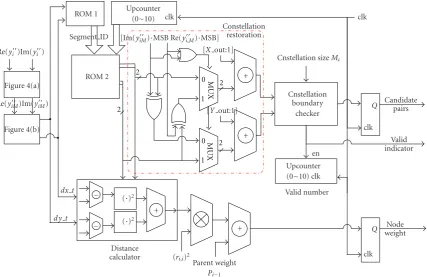
and 3π/2, respectively. Figure4(b)shows this transformation circuit. The multiplexers chooses a right data path based
on the sign bits of Re(yi,M ) and Im(yi,M ). The coordinates dx tanddy tdenote the transformed values of Re(y i,M) and
Im(yi,M ), respectively.
The set (dx t, dy t) is sent to the candidate generator unit to generate the desired candidate sequence{xi}ki=1using
a table lookup operation. The contents of the segment identification (ID) and its corresponding candidate sequence are stored in ROM 1 and ROM 2, respectively, as shown in Figure5, where the hardware architecture of the candidate generator is depicted. The found candidate symbol is first rotated into its original quadrant, and then the offset pair (X offset, Y offset) is added to the coordinates of the found candidate symbol. After the constellation restoration, the constellation boundary checker checks whether or not the found symbol lies inside the constellation boundary. If the found restored symbol is a legal one, the distance calculator calculates the value ofy i −xi2. Multiplying the value of
y i −xi2 by ri,i2 and adding the parent weightPi+1 to the
multiplied result, we obtain the path weightPiof the found
symbol. The CSG can efficiently generate the coordination pairs of valid candidates and the associated path weights according to their path weights in an ascending order for each given received symbol. From Figure5, the major hardware cost of the CSG involves 3 multipliers, 12 adders, and 2 ROMs. The ROM sizes (number of logic gates) are 2116 (ROM 1, with u = 32) and 731 (ROM 2), respectively, according to the Synposys synthesis tools.
For any given symbol and its neighbors, which share the same candidate sequence, the candidate sequence is generated from theknearest constellation symbols by sorting their relative distance to the search center though these distance values are different for each different search center. The proposed CSG utilizes this property to generate a candidate sequence in ascending order and calculates the associated path weights so as to avoid a heavy load of path weight evaluations and sorting. Based on this concept, we can choose the appropriatekto fit the system requirement. The ROM size expands quickly when a large value ofkis chosen. To remedy this, we can divide k into a set {ki}pi=1, where p
i=1ki = k such that the ROM can be kept at a realizable
size.
3.2. Architecture of Highly Parallel Comparison Circuit (HPCC). The sorting operations in the K-Best decoder dominate the major complexity at each search layer. Hence, sorting is a critical factor in reducing the complexity of theK-Best SDA. The previously proposed CSG module can be applied to the K-Best SDA by exploiting the inherent partial orders coming with the property of CSG. This can be efficiently accommodated by applying the K-merge algorithm [30,32]. For a more practical implementation, an efficient architecture that can effectively reduce the sorting complexity is needed.
Recall the definitions of branch weights and PED in Section2. LetP1i,Pi2,. . .,PiK denote theKsmallest PEDs in
theith layer. After full-path expansion, we haveKMc PEDs
Pi1,1−1,P 1,2 i−2,. . .,P
1,Mc i−1 ,. . .,P
K,1 i−1,P
K,2 i−2,. . .,P
K,Mc
i−1 at layeri, where
Fractional part Integer part
1
Re(yi) S b0
+
Re(yi ,M) Xoffset=[Xout:0]
Xout
(a)
00 01 10 11
00 01 10 11
MU
X
MU
X
Re(yi ,M)
Im(y i,M) dx t
d y t
[Re(yi ,M)·MSB Im(y i,M)·MSB]
−1 −1
(b)
Figure4: (a) Modulo unit of Re(y i). (b) Transformation unit of y i,M.
MU
X
MU
X
0
1
0
1 2
2
2
2 ROM 1 Upcounter
(0∼10) clk
Constellation restoration [Im(yiM )·MSB Re(y i,M)·MSB]
Segment ID
ROM 2 Re(yi )Im(y i)
Figure 4(a) Re(y iM)Im(y iM)
Figure 4(b)
[Xout:1]
[Y out:1]
dx t
d y t
+
+ −
−
(·)2 (·)2 Distance
calculator (ri,i)2
Parent weight
Pi−1
Cnstellation sizeMc
Cnstellation boundary
checker
en Upcounter (0∼10) clk Valid number
clk
Q
clk
Candidate pairs
Valid indicator
Q
clk Node weight +
+
Figure5: Hardware architecture of the candidate generator.
mth parent node at layeri. Moreover, based on the sorted results from theith layer and the generated sequence from the proposed CSG module, we have P1
i < P2i < · · · <
PK i and P
j,1 i−1 < P
j,2
i−1 < · · · < P j,k
i−1 for each 1 ≤ j ≤
k. Selecting the node with the smallest PED from the set {Pi1,1,Pi2,1,. . .,PiK,1}is equivalent to finding the smallest PED
from the full path expansion set containing KMc nodes.
These operations are illustrated in Figure6. Exploiting these properties instead of using traditional sorting algorithms, we can realize an efficient comparison architecture for theK -Best sorting at each stage that avoids full path evaluation and significantly reduces the sorting complexity. Figure7depicts this hardware architecture, and the following describes its operation.
The output sequence of the CSG module naturally forms a set in ascending order according to the evaluated PEDs while performing theNth layer search. We, therefore, only need to conduct a single coordination transformation andK path weight calculations. The generated results serve as the parent nodes of the next layer.
To search in the (i − 1)th layer, we first calculate {Pi1,1−1,Pi2,1−1,. . .,PK,1i−1}and feed them into the HPCC. The
can-didate node with the smallest PED among these cancan-didates is obtained immediately after (K−1) compare-and-select (CAS) operations. If the chosen node comes from the pth parent node, then thePip+B
p,2
i−1PED is calculated, overwriting
P1
i Pi2 P
j
i PKi
Pi1,1−1 Pi2,1−1 P
j,1
i−1 PiK−,11
Pi1,2−1 Pi2,2−1 P
j,2
i−1 PiK−,21
Pi1,−k1 Pi2,−k1 P
j,k
i−1 PiK−,k1
HCCP
Sorted output sequence from CSG
Pim−,11≤ · · · ≤Pmi−,k1
1≤m≤K
Output
P1i−1
P1
i−1=min{Pmi−,11} =min{Pim−,1n} 1≤m≤K
1≤n≤k
· · · · · ·
· · · · · ·
. . .
. . .
. . .
. . .
Figure6: Illustration of the HPPC operations.
MU
X
Q Q Q
Q Q
Q Q
Q Q
Q Q
Q CAS
CAS
CAS
CAS
CAS
CAS
CAS
CAS
CAS
CAS CAS
CAS
1
0 Stage # 1 Stage # 2
Stage # 3
Stage # log2(K)
Encoder MSB 0
MSB 1 MSB (k-2)
Indicator for min weight module [0· · ·(K−1)]
MSB i
− .
. .
. . .
. . .
· · ·
Figure7: HPCC architecture.
results need be re-computed). Repeating this procedure, we can successfully select K candidate nodes with the smallest PEDs from the entire valid candidate set. The survival set acts as the parent nodes of the (i−2)th layer. In searching the nodes in each layer, we useKcoordination transformation, (2K−1) path weights evaluations, and (K−1)(1+log2K) CAS operations. Note that the computational complexity of this approach is nearly fixed and independent of the constellation sizeMcof the transmitted symbols. Furthermore, the nodes
in the survival set still exhibit an ascending order according to their PEDs. In the final search layer, that is, the 1st layer, we only need to choose the node with the smallest PED as the detection result. Hence, it takes onlyK coordination transformation, K PEDs evaluations, and (K − 1) CAS operations.
Compared with the winner path expansion method [33, 34], the proposed architecture, which is also frequently found in Viterbi decoder for choosing the minimal path metric, can avoid performing unnecessary operations thanks to the property of parallel computation. Moreover, it requires a smaller number of CAS (K−1) than that of the conventional bubble sort method (K).
path weight evaluations as required in the conventional bubble sort architecture.
Previous methods attempt to reduce computational complexity by eliminating the number of visited nodes based on the probability or statistical properties of the additive noise. These methods provide an approximate solution and barter decoding performance for complexity reduction. As an alternative, this paper presents another way to reduce complexity with the premise of carrying on high-quality decoding results. The proposed approach utilizes operation decomposition, reconstruction, and associated efficient hardware architecture to select and evaluate only the most promising candidate symbols. The proposed method also significantly reduces computational complexity and provides an efficient solution with a nearly fixed throughput. These advantages are further enhanced when a larger constellation size is adopted. Although the proposed method incurs the extra cost of coordination transformation and restoration, it eliminates many path calculations and sorting operations and provides the same performance as the conventional K-Best SDA.
4. Proposed Search Strategy for
Near-ML Performance
One way to reduce the complexity of the conventional K-Best SDA is to choose a smaller number of survival nodes in each layer. However, this can cause performance degradation in term of error rate. Instead of choosing a sufficiently large K to achieve the near-ML performance, a new search strategy is proposed. The proposed search strategy preserves all candidate symbols and performs the ML search in the preceding layers when dealing with poor channel conditions. Only K candidates are kept for the remaining lower layers. The following sections show how to determine the number of layers performing the ML search.
4.1. Preprocessing with Column Permutation. The channel matrix can be preprocessed with various techniques to reduce the complexity of candidate search and/or improve the performance of the K-Best SDA. Many preprocessing techniques can be used for this purpose, including column permutation [13], scaling [35], and lattice reduction [36]. In this paper, column permutation is adopted, in which the permutation order is determined according to the column norms of the channel matrix in ascending order. Given the QR decomposition of the ordered channel matrix Ho = QoRo, we characterize below the cumulative distribution
function (cdf) of the square of the diagonal entries of Ro
denoted byro,i,i2 (see the appendix):
fori=1
Fr2
o,i,i(r)= r
0
N! (N−1)!(M−1)!
⎡ ⎣M−1
k=0
xk
k!e −x
⎤ ⎦
N−1
·xM−1e−xdx,
(13)
for 2≤i≤N
Fr2
o,i,i(r)=Cii 1
0 r/s
0 ⎡ ⎣1−M−1
k=0
xk
k!e −x
⎤ ⎦
i−1⎡ ⎣M−1
k=0
xk
k!e −x
⎤ ⎦
N−i
·xM−1e−x(s)M−i
(1−s)i−2dx ds,
(14)
where
Cii= N!
(N−i)!(M−i)!(i−1)!(i−2)!. (15)
Comparing (13)–(15) with the results of [13], the ordering mechanism increasesE[r2
i,i] in the preceding layers,
producing two main benefits. First, for a fixedK in theK -Best SDA, increasingE[r2
i,i] in the preceding layers reduces
the effective search range of the candidates. This in turn reduces the probability of the ML solution being dropped in the preceding layers. Another benefit is that it constrains the growth of the tree and hence reduces search complexity.
4.2. Proposed Search Strategy. For theNth layer, the candi-date symbol should satisfy the following search constraint according to (7):
y
N−xN 2≤
d rN,N
2
. (16)
Clearly, 1/rN,Nwill enlarge the constraint region whenrN,Nis
smaller than 1. In this case, the probability of the ML solution being dropped will increase when onlyKnodes are kept in theNth layer. To avoid performance degradation, conducting the ML search in the preceding layers [27] is one of the approaches usually adopted. To further reduce the compu-tational complexity, we propose to perform the ML search in theith layer only when anyri,i, whereN−LML+ 1≤i≤N,
is smaller than a given thresholdTr, withLMLdenoting the
number of layers performing the ML search; the thresholdTr
will be decided later. This proposed search strategy is named conditional-ML (CML) search. Hence, the number of layers performing the ML search depends on the distribution of ri,i2. Figures 8(a)and8(b) show the impact of rN,N on the
constrained search region. Based on the derived results in (13)–(15), we can systematically determine the number of layers performing the ML search under differentMandN.
Figure 9(a) shows the cdf curves of r2
o,i,i for the 4×4
MIMO channel. The probability ofr2
o,i,i<1 in the 4th layer is
larger than that in the other layers. Hence, only the 4th layer needs to perform the ML search. Figure9(b)shows the cdf curves ofr2
o,i,ifor the 8×8 MIMO channel. In this case, the
probabilities ofr2
o,i,i<1 in the 8th and the 7th layers are larger
than that in the other layers. However, the number of possible candidates in the 7th layer is (Mc)2in the worst case, which is
too large to store in a hardware implementation whenMcis
−1 1 3 5 7
Quadr
atur
e
−3 −1 1 3 5
QAM constellation
In-phase (a)
−1 1 3 5 7
Quadr
atur
e
−3 −1 1 3 5
QAM constellation
In-phase (b)
Figure8: Search constraints of theNth layer withd =1.1. (a)rN,N =1. (b)rN,N=0.33.
0 0.1 0.2 0.3 0.4 0.5 0.6
P
robabilit
y
0 0.5 1 1.5
(ro,i,i)2
Layer 1 Layer 2
Layer 3 Layer 4
(a)
0 0.05 0.1 0.15 0.2 0.25 0.3 0.35 0.4 0.45 0.5
P
robabilit
y
0 0.2 0.4 0.6 0.8 0.1 1.2 (ro,i,i)2
Layer 1 Layer 2 Layer 3 Layer 4
Layer 5 Layer 6 Layer 7 Layer 8 (b)
Figure9: Cdf curves ofr2
o,i,i. (a) 4×4 MIMO channel. (b) 8×8 MIMO channel.
Next, we discuss how to decide the thresholdTr. Recall
that for theNth layer, a search for the candidate symbols should satisfy the following constraint:
r2
N,N yN −xN 2≤(d)2. (17)
The proposed algorithm only keeps thekconstellation sym-bols nearest to y N wherek = min(K, 11); hence, the value
of y N−xN2 has a limited range. Number 11 is chosen
according to [37], which suggests that producing 11 can-didate symbols yields quite good performance for practical
applications. Therefore, we configure CSG to generate only 11 candidate symbols to reduce the implementation cost. From the previous argument and (17), it is straightforward to see that the threshold Tr can be chosen based on the
following criterion:
TrD≥E
(d)2, (18)
where DK and D11 denote the distances from the Kth
and 11th nearest constellation symbols to sN, respectively.
E[(d)2] is the expected value taken with respect to the channel statistics; it is used in place of (d)2 because d is typically a random variable depending on the channel condition and SNR [10,13].
By using (18), when theknearest constellation symbols do not cover all the symbols inside the circle with a radius of E[(d)2]1/2, the ML search can be activated to retain all valid symbols. However, this will incur complexity increase because the probability of performing the ML search increases. The thresholdTrthus acts as a tradeoffparameter
between complexity and performance. SinceE[(d)2] varies with SNR, we can choose E[(d)2] corresponding to the SNR at which the symbol error rate of the proposed K -Best SDA deviates from that of the ML detector by a certain normalized amountδ. This ensures that the performance of the proposedK-Best SDA can be made close to ML detection. When applying the criterion in (18) to the (N−1)th layer and below, the obtained threshold is sure to be smaller than the threshold of theNth layer because the distance contributed by theNth layer is a positive value. Thus, we can use the threshold of theNth layer for other layers. In summary, the proposed CML search strategy only needs to check whether the values of ro,i,i, that are already available from the QR
decomposition, are smaller than Tr. It is not necessary to
design any extra circuits to estimate the channel conditions for adjustingKas in [24].
By the proposed criterion in (18)-(19), the system per-formance is insensitive to the choice ofKand the number of candidates generated by the CSG module. This is in contrast to the conventional K-Best SDA, in which the value ofK must be large enough, usually close to the constellation size Mc, to archive near-ML performance. Using the proposed
criterion with the self-adjustment mechanism, the proposed K-Best SDA can choose a smaller K, as small as a half of Mc, to archive near-ML performance. In fact, when a smaller
value ofKis chosen or the GSC module generates a shorter candidate sequence, the ML search will be activated more frequently trying to retain the possible ML solution.
The overall complexity of the proposedK-Best SDA can be predicted based on the complexity of the adopted sorting architecture, CML search procedure, choice of the value ofK, the number of generated candidates of the CSG module, and the activation probability of the ML search. The decoder can thus achieve near-ML performance under a given complexity constraint without requiring a large value ofK.
4.3. Joint 2-Layer ML Search Algorithm. According to the derived cdf of r2
o,i,i in (13)–(15) and observation in the
previous sections, we only need to conduct a 2-layer full search in the worst case, which involve choosingKsurvival nodes with the smallest path weights among (Mc)2nodes. In
the original 2-layer ML search in the complex plane, for any received symbol, we need to evaluate all accumulated path weights between the search center and all valid candidate symbols while performing a full search of two layers. We then selectKnodes with the smallest accumulated path weights.
L
r
P2 O P1
Figure10: Geometrical relationship illustrating the adopted prop-erty for computation reduction.
Using the previously developed CSG and HPCC mod-ules, we here propose an efficient procedure which only requires a minor modification of the control path of the HPCC. This modified procedure significantly reduces the computational burden and hardware implementation cost. The following describes the proposed procedure in detail.
First, for any received symbol in the complex plane, we evaluate the distances between the received symbol and all valid candidate symbols which lie on the same row of the square lattice before starting the sorting procedure. Consider the geometry shown in Figure10. Letr lie on lineL, which is perpendicular to p1p2 and intersects with p1p2 ato. It is
easy to show that ifop1 > op2 thenr p1 > r p2. Using this
property, these candidate symbols can be ordered by their coordinate values on the x-axis following the SE enumeration rule [12]. Therefore, a table containing the row vectors of sorted candidate symbols for eachxvalue would suffice and efficiently simplifies the sorting process [38].
Second, for any square lattice with Mc symbols, these
candidate symbols can be divided into Mc groups. Each
symbol in the same group has the same y-axis coordinate value. Based on the prepared table, the procedure can efficiently generateMc groups. Each group contains
Mc
sorted candidate symbols for each received signal without any extra sorting operation. The structure of each sorted group is the same as the output sequence of the proposed CSG module in ascending order. Therefore, utilizing the HPCC, afterMc+K−1 path evaluations and (
Mc−1) +
(K−1)log2Mc CAS operations, the proposed procedure
can generateK candidates with the smallest PEDs for each given received symbol. These selectedK symbols are again arranged in ascending order according to their PEDs. Note that only these promising candidates are considered and completely evaluated. Finally, when a full search of two layers is required, it is only necessary to repeat Mc times forMc
possible parent symbols to generate a total ofKMcpromising
symbols and divide them intoMcsorted groups. Each group
is sorted in ascending order according to the evaluated PEDs. The HPCC is then utilized to choose theKsurvival symbols with the smallest PEDs. This can be done efficiently thanks to the naturally ascending order of each group.
Table2: Computational complexity of proposedK-Best SDA (excluding interference cancellation). ML search deactivated ML search activated
1st layer
search 2nd layer search
Joint 2-layer ML search
3rd∼(N−1)th layer search
Nth layer search
CAS 0 (K−1)(1 + log2K)
Mc(K−1)log2(
Mc)+
Mc(Mc−1) +
m(2K−1) + (m− 1)[log2(m)−1]
(K−1)(1 + log2K) (K−1)
Path
Accumulation 0 (2K−1) Mc(
Mc+K−1) (2K−1) K
Path calculation K (2K−1) Mc+Mc(
Mc+K−1) (2K−1) K
Wherem=[Mc/k], if mod(Mc,k)=0 andm=[Mc/k] + 1, otherwise.
Table3: Computational complexity of conventionalK-Best SDA in real domain (excluding interference cancellation).
1st layer search
2nd∼ (2N−1)th layer search
2Nth layer search
CAS KMc K2
Mc (K
Mc−1)
Path Accumulation 0 KMc K
Mc
Path calculation Mc K
Mc K
Mc
reduced when K is small. The procedure fully reutilizes the previously proposed hardware architecture as described in Section 3 except an extra memory is required for the intermediate storage. It also inherits the advantages of CSG and HPCC which avoid the heavy load in path weight computation and sorting.
Tables2and3show the detailed computational complex-ity of the proposedK-Best SDA and the conventionalK-Best SDA, respectively. Comparing the two tables, the required complexity of proposedK-Best SDA is approximately Mc
times lower than the conventional one and is insensitive to the constellation sizeMc, as mentioned earlier in Section3.2.
Although extra computations are needed when the CML search is activated in the proposed SDA, the probability of activation is small, as long as the channel is not severely ill conditioned. Therefore, the total required complexity of the proposedK-Best SDA can still be kept lower than that of the conventional SDA. As a final remark, since the proposedK -Best SDA can work with a smaller number of search layers and smaller value ofK, compared to the conventionalK-Best SDA, it has the potential of reducing the decoding latency of the latter because the decoding latency mainly depends on the number of search layers and required processing time per search layer, which in turn depends onK.
5. Computer Simulations and Discussions
This section simulates the symbol error rate (SER) perfor-mance and complexity of the proposed K-Best SDA and compares it with the SE SDA and conventional K-Best SDA [17]. Although many variants of theK-Best SDA have
been proposed, the conventional one has the best decoding performance and is chosen here as a benchmark. For a fair comparison in each simulation, the preprocessing technique mentioned in Section 4.1 is applied to all algorithms. Complexity is measured in terms of the average number of floating point operations (flops). All real additions, multiplications, memory read/write, and comparisons are equally treated as flops. We setd as the distance between the Babai estimate and the received signal [10], and E[(d)2] is then obtained in advance for each SNR as the average from 100000 independent trials. In each simulation, we generate 100 noise realizations per channel realization, and at least 5000 channel realization for each SNR value. The SER is obtained as the average from 500000 independent trials.
We first investigate the effectiveness of the proposed CML strategy by comparing the performance of the complexK -Best SDA, which is mentioned in Section 2, with various configurations. An extreme value ofK =4 is chosen for the complexK-Best SDA incorporating CML. Note thatK =4 is in general the maximal acceptable value for a MIMO-OFDM system, where the ML solution needs to be obtained for each subcarrier. The normalized deviation of SER is set as δ = 15%, the threshold Tr is set as 0.42 according to
K-Best SDA incorporating CML for 16-QAM and 64-QAM respectively. It is evident that both can achieve nearly the same performance as the ML detector.
Next, we evaluate the SER performance and complexity of the proposed complexK-Best SDA incorporating the CML strategy. Figures12(a),12(b)and13(a),13(b), respectively, show the 4×4 16-QAM and 64-QAM simulations of SER and complexity withK = 8. The normalized deviation of SER is set as δ = 5% and δ = 10%, respectively, and the threshold Tr is set as 0.291 and 0.3532, respectively,
according to (18), and the corresponding probability of performing the proposed ML search is 4.26% and 5.62%, respectively, according to (13)–(15). Comparing Figure12(a) with Figure13(a), the SER curves of the proposed K-Best SDA and the SE SDA are nearly the same. This shows that the threshold constraint significantly reduces the probability of performing the ML search, and there is almost no performance degradation in the proposed K-Best SDA. In contrast, the SER of the conventional K-Best SDA tends to become saturated at high SNR. This is due to the fact that the conventional K-Best SDA with a smaller K drops the ML solution with a high probability when the channel is in poor conditions, which always occurs with a certain probability in practice. In the 64-QAM case, the proposed K-Best SDA achieves nearly a 3 dB gain over the conventional K-Best SDA at SER=10−3. Note that this performance gap
between the proposedK-Best SDA and a conventional one is larger than that of the 16-QAM case. This is because the probability of the ML solution being dropped increases as the modulation symbol alphabet becomes larger [17]. In contrast, the proposed CML search strategy keeps all possible candidates in the preceding layers, significantly reducing the probability of the ML solution being dropped. Comparing Figure 12(b)with Figure13(b), the proposed K-Best SDA has higher complexity than that of the SE SDA in the high SNR regime. This is due to the fact that the proposed K -Best SDA visits more candidate symbols than the SE SDA when the number of layers N is smaller. As shown in the simulation cases, the complexity of the SE SDA varies with SNR. This is not desirable in practice, because a steady SNR is not achievable in realistic wireless environments, such that the decoding throughput of the SE SDA cannot be stable. In contrast, the proposed K-Best SDA provides a nearly fixed throughput, with excellent performance and low complexity. The proposed efficient architecture reduces the number of path weight evaluations and sorting operations in each layer. As a result, the proposed K-Best SDA exhibits near-ML performance and reduces 46.62% and 58.14% complexity, respectively, over the conventional K-Best approach using the sameK.
Figures 14(a) and 14(b) show the 8 × 8 16-QAM simulations of SER and complexity with K = 14. The normalized deviation of SER is set as δ = 15% and the threshold Tr is set as 0.833, and the corresponding
probability of performing the proposed ML search is 43.9%. The probability of performing the ML search is higher than that of the 4×4 case because the probability of the ML solution being dropped in theK-Best SDA is higher in the 8× 8 case. Again, the performance of the proposedK-Best SDA is
better than the conventionalK-Best SDA, and the complexity of the proposed K-Best SDA is lower than that of the SE SDA and the conventionalK-Best SDA. Compared with the conventional K-Best SDA, the proposed method decreases complexity by more than 41.75%. Because the number of search layers is larger in this case, the proposed method reduces more complexity in path evaluations and sorting operations. In the 8×8 case, the value ofKmust be set larger to reduce the probability of the ML solution being dropped in the preceding layers. Hence, the gap in complexity between the proposedK-Best SDA and the conventionalK-Best SDA is smaller than that in the 4×4 case. We can further improve the performance of the proposedK-Best SDA by choosing a higher threshold.
Figures15(a)and15(b)show the 8×8 64-QAM simula-tions of SER and complexity withK =32. The normalized deviation of SER is set asδ =15% and the thresholdTr is
set as 1.143 and the corresponding probability of performing the ML search is 65.8%. In this case, the proposed K-Best SDA still works better than the conventionalK-Best SDA. The gap in complexity between the proposedK-Best SDA and the conventionalK-Best SDA is smaller than that in the 8×8 16-QAM case. This is because a higher threshold value causes the ML search operations to occur more frequently though the proposed efficient sorting method reduces much more complexity for a larger modulation alphabet. The proposed CML search procedure significantly reduces the amount of path evaluations but induces extra memory read/write and table access operations. Nevertheless, the proposed K-Best SDA still has lower average complexity than the conventional one. Finally, under the same channel conditions, the conventionalK-Best SDA requiresK=52 to achieve near-ML performance. The configuration increases the computational complexity and decoding latency. The proposed decoder withK =32 can provide nearly the same performance, reducing 53.45% computational complexity over the conventionalK-Best SDA withK=52.
This section simulates the SER performance and com-plexity of the proposed SDA and compares it with the SE SDA and the conventionalK-Best SDA. Although the value ofro,i,i
does not directly reflect the channel condition in all cases, the proposed criterion does help the decoder successfully produce a near ML solution over poor channels, without always performing the ML search in the preceding layers. This systematic approach thus requires fewer ML search layers than previous methods [23,27]. The simulation results confirm that the proposed decoder exhibits excellent perfor-mance and requires lower complexity than the conventional K-Best SDA. It is also worth noting that the performance of the proposed decoder is close to that of the SE SDA (i.e., ML performance).
6. Conclusions
10−5 10−4 10−3 10−2 10−1 100
SER
7 10 13 16 19 22 25 28
SNR (dB)
ComplexK-Best SDA without proposed CML (K=4) ComplexK-Best SDA without proposed CML (K=8) ComplexK-Best SDA without proposed CML (K=12) ComplexK-Best SDA with proposed CML (K=4) ComplexK-Best SDA with proposed CML (K=8) MLD (4×4)
(a)
10−4 10−3 10−2 10−1 100
SER
15 18 21 24 27 30 33
SNR (dB)
ComplexK-Best SDA without proposed CML (K=4) ComplexK-Best SDA without proposed CML (K=12) ComplexK-Best SDA without proposed CML (K=24) ComplexK-Best SDA with proposed CML (K=4) ComplexK-Best SDA with proposed CML (K=12) MLD (4×4)
(b)
Figure11: Performance of complexK-Best SDA for 4×4 MIMO systems. (a) 16-QAM modulation.K=4 and 8 for complexK-Best SDA incoporating proposed CML strategy;K =4K, 8, and 12 for regular complexK-Best SDAs. (b) 64-QAM modulation.K=4 and 12 for complexK-Best SDA incoporating proposed CML strategy;K=4K, 12, and 24 for regular complexK-Best SDAs.
10−4 10−3 10−2 10−1 100
SER
7 10 13 16 19 22 25 28
SNR (dB)
ConventionalK-Best SDA (K=8) (4×4) ProposedK-Best SDA (K=8) (4×4) SE SDA (4×4)
(a)
103 104
Com
p
le
xi
ty
7 10 13 16 19 22 25 28
SNR (dB)
ConventionalK-Best SDA (K=8) (4×4) ProposedK-Best SDA (K=8) (4×4) SE SDA (4×4)
(b)
Figure12: Performance and complexity of SDA for 4×4 MIMO systems with 16-QAM modulation. (a) SER. (b) Complexity.K=8 for
K-Best SDAs.
cost in each search layer. The new CSG generates candidate sequences in the complex plane instead of producing actual path weights, thus making it possible for the child nodes of each parent node to be sorted without any extra effort. Com-bining the CSG with a highly parallel comparison circuit,
10−4 10−3 10−2 10−1 100
SER
15 18 21 24 27 30 33
SNR (dB)
ConventionalK-Best SDA (K=8) (4×4) ProposedK-Best SDA (K=8) (4×4) SE SDA (4×4)
(a)
103 104
Com
p
le
xi
ty
15 18 21 24 27 30 33
SNR (dB)
ConventionalK-Best SDA (K=8) (4×4) ProposedK-Best SDA (K=8) (4×4) SE SDA (4×4)
(b)
Figure13: Performance and complexity of SDA for 4×4 MIMO systems with 64-QAM modulation. (a) SER. (b) Complexity.K=8 for
K-Best SDAs.
10−4 10−3 10−2 10−1 100
SER
7 10 13 16 19 22
SNR (dB)
ConventionalK-Best SDA (K=14) (8×8) ProposedK-Best SDA (K=14) (8×8) SE SDA (8×8)
(a)
104 105 106
Com
p
le
xi
ty
7 10 13 16 19 22
SNR (dB)
ConventionalK-Best SDA (K=14) (8×8) ProposedK-Best SDA (K=14) (8×8) SE SDA (8×8)
(b)
Figure14: Performance and complexity of SDA for 8×8 MIMO systems with 16-QAM modulation. (a) SER. (b) Complexity.K=14 for
K-Best SDAs.
proposed accordingly to determine when to activate the ML search. Simulation results show that the proposed SDA effectively reduces the complexity of the conventionalK-Best SDA, while offering superior SER performance at the high SNR regime. Its decoding performance is close to the ML performance even when the chosen value ofKis small.
10−4 10−3 10−2 10−1 100
SER
17 20 23 26 29
SNR (dB)
ConventionalK-Best SDA (K=32) (8×8) ConventionalK-Best SDA (K=52) (8×8) ProposedK-Best SDA (K=32) (8×8) SE SDA (8×8)
(a)
105 106 107
Com
p
le
xi
ty
17 20 23 26 29
SNR (dB)
ConventionalK-Best SDA (K=32) (8×8) ConventionalK-Best SDA (K=52) (8×8) ProposedK-Best SDA (K=32) (8×8) SE SDA (8×8)
(b)
Figure15: Performance and complexity of SDA for 8×8 MIMO systems with 16-QAM modulation. (a) SER. (b) Complexity.K=32 for proposedK-Best SDA;K=32 and 52 for conventionalK-Best SDAs.
generation MIMO wireless communication systems such as IMT-Advanced.
Appendix
The expression in (13)–(15) shows that reordering the columns ofHaccording to their vector norms in ascending order leads to
Ho=
ho(1),ho(2),. . .,ho(N)
, (A.1)
whereho(1) ≤ ho(2) ≤ · · · ≤ ho(N). From [13],ho(i)
can be expressed as
ho(i)=
Xiθi, (A.2)
where Xi is the ith order statistic of N independent
Gamma(M, 1) distributed random variables withX1≤X2≤
· · · ≤ XN and{θi}sare i.i.d. uniformly distributed on the
unit sphere inCM. Note thatX
iandθiare independent. With
the QR decomposition ofHo =QoRo, we are now going to
characterize the distribution of the square of the diagonal entries ofRodenoted byro,i,i2 .
LettingQo =[qo(1),qo(2),. . .,qo(N)] and performing the
QR decomposition ofHo, we obtain
r2 o,i,i=Xi
⎡ ⎣1−
i−1
k=1
qH
o(k)θi 2
⎤ ⎦=Xi
⎡ ⎣1−
i−1
k=1 θ2
i(k) ⎤ ⎦
= ⎧ ⎨ ⎩
Xi, fori=1
XiSi, for 2≤i≤N,
(A.3)
where
Si= ⎡ ⎣1−
i−1
k=1 θ2
i(k) ⎤
⎦, (A.4)
andθi(k) denotes thekth element ofθi. Note that the second
equation holds due to the fact that the distribution ofθiis
invariant under the orthogonal transformationQo. To derive
the cdf ofro,i,i2 , we should first obtain the probability density
function (pdf) ofXiandSi. The pdf ofXiis available in [39]
as
fXi(x)=
N![F(x)]i−1[1−F(x)]N−if(x)
(i−1)!(N−i)! , (A.5) where
f(x)= xM−1·e−x
Γ(M) forx >0,
F(x)=1−
M−1
i=0
xi
i!e −x.
(A.6)
From [40],θi can be modeled from a 2M-dimensional
random vector V = [v1 v2 · · · v2M]T with vi ∼
i.i.d. N(0, 1), where
θi(k)=v2k−1
+j·v2k
V =
v2k−1+j·v2k
v2
1+v22+· · ·+v22M
, (A.7)
due to the fact thatθHi θi=1,Sican be rewritten as
Si= ⎡ ⎣1−i−1
k=1 θ2
i(k) ⎤ ⎦=
⎡ ⎣M−i+1
k=1 θ2
i(k) ⎤