
DOI: 10.1051/epjconf/20147301017
C
Owned by the authors, published by EDP Sciences, 2014
Hadron physics programs at J-PARC
M. Naruki
Faculty of Science, Kyoto University, Kitashirakawa, Oiwake-cho, Kyoto 606-8502, Japan
Abstract.The J-PARC Hadron Facility is designed as a multipurpose experimental facility for a wide range of particle and nuclear physics programs, aiming to provide the world highest intensity secondary beams. Currently three secondary beam lines; K1.8, K1.8BR and KL together with the test beam line named K1.1BR come into operation. Various experimental programs are proposed at each beam line and some of them have been performed so far. As the first experiment at the J-PARC Hadron Facility, the+pentaquark was searched for via the pion-induced hadronic reaction in the autumn of 2010. Also experimental programs to search for new hadronic states such as K−pp have started to perform a physics run. The current status and near future programs are introduced.
1. Introduction
The Hadron Experimental Facility at J-PARC (Japan Proton Accelerator Research Complex) is a multipurpose experimental facility for a wide range of particle and nuclear physics programs. It aims to provide the world highest intensity secondary beams produced with 30 GeV–9A primary proton beam on a production target of 30% interaction length. The first primary beam has been successfully extracted and transported to the beam dump on January 2009. Currently three secondary beam lines, K1.8, K1.8BR and KL, together with the test beam line named K1.1BR come into operation. As the first experiment, the J-PARC E19 was performed to search for the pentaquark + in the−p→ K−X reaction at the K1.8 beam line. After the E19, searches for a neutron-rich hypernuclei6H in the 6Li(−,K+) reaction [1] and kaonic nuclei such as K−pp have been performed. The light hypernuclei will be systematically studied with gamma-ray spectroscopy technique in late 2014. The new beam line, high-momentum beam line, will be completed in the end of the FY2015. It delivers primary and also secondary particles up to 30 GeV/c to open a new area of experimental programs to study the medium modification of hadron mass. The recent results of the experimental programs and the future prospects are introduced.
2. Hadron experimental facility
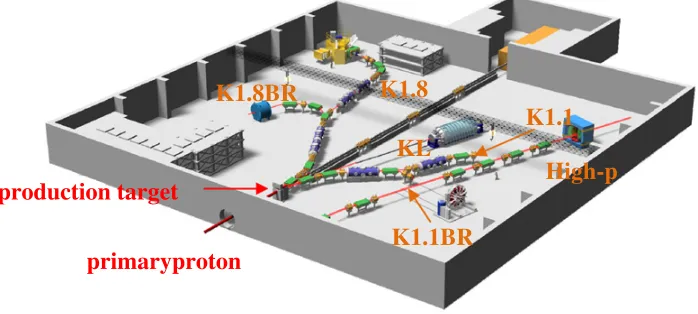
The Hadron Experimental Hall was completed in July 2007, and the first primary beam has been successfully extracted and transported to the beam dump on Jan. 27, 2009. The current layout of the hadron hall is shown in Fig.1. The primary proton beam is injected into the production target, whose interaction length is 30%. To handle the beam line components under high radiation environment,
K1.8BR
K1.8
KL
primaryproton
High-p
K1.1
production target
K1.1BR
Figure 1. Schematic view of the J-PARC Hadron Experimental Facility.
radiation hardened magnets and remote maintenance system have been developed. The detail description of the devices at the hadron facility can be found in [2]. Secondary particles produced at the target are delivered into 3 beam lines named K1.8, K1.8BR and KL. The K1.8 beam line is the longest one equipped double-stage electrostatic separators to realize a good particle separation for a beam momentum up to 2 GeV/c. The expected intensity is 1.4 ×10⁶ K−/pulse with the primary beam power of 270 kW. The result of the beam line commissioning is reported in [3]. The K1.8BR is branched at a bending magnet located at the middle of the K1.8 beam line. This beam line is capable of transporting separated secondary particles whose momentum is up to 1.2 GeV/c [4]. The KL beam line provides neutral kaons for the KOTO experiment, which plans to measure the rare decay of neutral kaon to study a new source of CP violation. The K1.1BR is currently used as the test beam line. This is the shortest beam line which is suitable for stopped kaon experiments. The new beam line named as the high-momentum beam line is now being constructed at the south part of the hadron hall. It provides primary protons whose momentum is up to 31 GeV/c. Some fraction of the primary protons, which is 1010×12 protons/pulse, is branched at about 100 meters upstream part of the hall and delivered into the experimental area.
3. Experimental programs at J-PARC hadron facility
The recent results reported in physics programs performed so far were briefly reviewed.
3.1 Search for pentaquark+
]
2
Missing mass [GeV/c 1.42 1.44 1.46 1.48 1.5 1.52 1.54 1.56 1.58 1.6
2
Counts/MeV/c
0 50 100 150 200 250 300 350
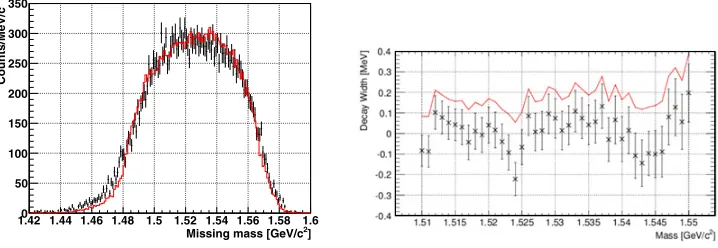
Figure 2. Left: missing-mass spectrum of the 1.92 GeV/c−p→K−X reaction. The black dots show data, the
red histogram is the simulated background spectrum [7]. Right: the 90% confidence level upper limit of the decay width of+as a function of the missing mass obtained from the combined analysis [8].
K1.8 beam line spectrometer which consists of a QQDQQ magnet system with a momentum resolution of 0.1% (FWHM). The scattered kaons were identified with the Superconducting Kaon Spectrometer (SKS) which provides a momentum resolution of 0.2% (FWHM). The missing-mass resolution for the+ production is estimated to be 1.4 MeV (FWHM). The first physics run was performed in the autumn of 2010. The obtained missing-mass spectrum of 1.92 GeV/c−p→ K−X reaction is shown in Fig.2(left). No significant structure corresponding the mass of+was observed on the spectrum. The 90% confidence level upper limit of the production cross section was obtained to be 0.26b/sr in the laboratory frame [7]. In 2011, the second data taking was performed with the beam momentum of 2 GeV/c which is the maximum of the K1.8 beam line. The preliminary result shows no evidence of the existence of+. The upper limit of the production cross section gave the upper limit of the decay width of+,, with the help of theoretical calculation [6]. The severest upper limit of, which is 0.39 MeV, has been derived from the combined analysis of the first and second data, as shown in Fig.2
(right) [8].
3.2 Search for kaonic nuclei
3.2.1 Search for kaonic nuclei K−pp in the d(+,K+) reaction
The K−pp system was proposed by Akaishi and Yamazaki based on the(1405) ansatz [9], in which the(1405) is assumed to be an I=0 quasibound state of K−N resulting from the strong interaction between K−and the nucleon. Experimental information on the properties of kaonic nuclei is important to understand the K−N interaction. It should be noted that kaonic nuclei would be an extremely dense system, since such a strong interaction might form such dense matter owing to the strong K−N attraction in balance with the hard-core nucleon–nucleon repulsion [10]. After the first discovery of reported by FINUDA collaboration [11], several possible existence was reported by several experimental groups. However, the observed structures are not universally accepted as the bound state of K−pp.
] 2 Missing Mass[GeV/c
2.05 2.1 2.15 2.2 2.25 2.3 2.35 2.4 2.45 2.5
co
un
ts/
2
Me
V
0 2000 4000 6000 8000 10000 12000
14000 Black=Simulation
Red=Data )
o
-16
o
=2
piK(Lab)
θ Missing Mass (
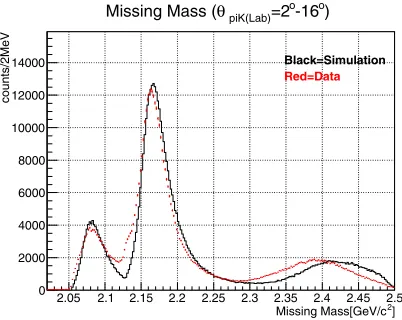
Figure 3.Missing-mass spectrum in the d(+,K+) reaction. Data are plotted with red points; the simulated spectrum
is shown in a black histogram [12].
toN-N coupling was observed at 2.13 GeV/c2. A shift was observed in a peak position of excited hyperons around 2.4 GeV/c2. The exclusive measurement of the reaction to require detecting emitted protons is now intensively analyzed and the final result will be reported soon.
3.2.2 Search for K−pp using3He(in-flight K−,n) reaction
The deeply bound kaonic nuclear state is also searched for in the E15 experiment with a helium-3 target at the K1.8BR beam line [4]. The in-flight kaon reaction is exclusively measured in the reaction 3He(K−,n)K−pp. The bound state is searched for both in the invariant-mass spectrum of the decay
products of the K−pp system and in the missing-mass spectrum with an escaping neutron. A neutron is detected with an array of scintillators placed 15 m apart from the final focus point, where the target system is located. Decay products of K-pp are measured with a cylindrical detector system comprises of a cylindrical drift chamber and TOF counters enclosed within a solenoid magnet. In May 2013, the first physics run was performed with the primary beam power of 24 kW. Figure4shows the missing-mass spectrum of the3He(K−,n) reaction [13]. The clear peak originates from the quasi-free process is seen on the spectrum at the mass of∼2.4 GeV/c2. As shown in the Fig.4, the enhancement was observed in the low-mass tail of the quasi-free peak measured by tagging K0
s with the CDS. The detailed analysis will be reported soon. A new data will be taken in 2014; the statistics will be much more improved.
4. Future prospects
The new beam line, named high-momentum beam line, is now being constructed from the switching point in the middle of the Switching-Yard (SY) to the hadron hall, as shown in Fig.5. It can deliver primary protons whose momentum is up to 30 GeV/c. The typical beam intensity is 1010 protons/pulse. The new beam line also transports secondary particles which are produced by installing a production target near the switching point. The experimental programs proposed so far are briefly described.
4.1 Dilepton measurement to investigate medium modification of vector meson mass
Figure 4.Missing-mass spectrum of the3He(K−,n) reaction. The black histograms shows data, the blue histograms is the spectrum obtained requiring K0s were identified with the CDS [13].
Main Ring
SM1
High-P beam line
Hadron hall
Figure 5.Layout of high-momentum beam line. The beam line is branched at the Switching Magnet 1(SM1) and
delivered the primary and secondary particles to the Hadron Hall.
is not established experimentally or theoretically. Since the di-lepton is almost free from the final state interaction, it is possible to study the mass modification of vector meson decaying into a lepton pair. The E16 experiment plan to construct a new spectrometer at the end of the high-momentum beam line [14]. To cope with the high intensity proton beam of 1010 ppp, GEM trackers and the Hadron Blind Detector (HBD) have been developed. An acceptance is designed to cover a low-momentum region where the medium modification is expected. The velocity and nuclear-mass number dependence of the mass modification on will be studied systematically. The construction of the spectrometer will be finished in FY 2015.
4.2 Charmed baryon spectroscopy
baryon, such a di-quark cluster would loosely interact to the heavy charm quark, therefore the properties of charmed baryon might reflect that of di-quark. Charmed baryons will be measured in the p(−,D*) reaction using the high-momentum pion beam with the missing-mass technique. Expected sensitivity is ~0.1nb assuming the production cross section of 1nb.
5. Summary
The J-PARC Hadron Facility gave us a new opportunity to extend our knowledge of new state of matter such as exotic hadrons, hypernucleus, and also to approach the hadron structure together with the origin of hadron mass. The three secondary beam lines are now in operation. The new beam line, high-momentum beam line will be constructed by the end of FY 2015. The recent results of experimental programs performed so far were briefly reported. Also the near future prospects are introduced.
References
[1] H. Sugimura et al., Phys. Lett. B 729,39(2014) [2] K. Agari et al., Prog. Theor. Exp. Phys., 02B009 (2012) [3] T. Takahashi et al., Prog. Theor. Exp. Phys. 02B010 (2012) [4] K. Agari et al., Theor. Exp. Phys., 02B011 (2012)
[5] T. Nakano et al., Phys. Rev. Lett.91, 012002 (2003) [6] T. Hyodo et al., Prog. Theor. Phys.128, 523-531 (2012) [7] K. Shirotori et al., Phys. Rev. Lett.109, 132002 (2012)
[8] M. Moritsu et al., Nucl. Phys. A914, 91-96 (2013), Phys. Rev. C. (to be submitted) [9] Y. Akaishi and T. Yamazaki, Phys. Rev. C65, 044005 (2002)
[10] Y. Akaishi, A. Dotè and T. Yamazaki, Phys. Lett. B613,140 (2005) [11] M. Agnello et al, Phys. Rev. Lett.94, 212303 (2005)
[12] Y. Ichikawa et al., proceedings of XV International Conference on Hadron Spectroscopy (Hadron2013), Proc. of Science (to be published)
[13] M. Tokuda et al., proceeding of 13thInternational Conference on Meson-Nucleon Physics and the Structure of the Nucleon (MENU2013), Proc. of Science (to be published); S. Enomotoet al., proceedings of XV International Conference on Hadron Spectroscopy (Hadron2013), Proc. of Science (to be published)
[14] E16 proposal for the J-PARC PAC, http://j-parc.jp/researcher/Hadron/en/pac_0606/pdf/p16-Yokkaichi_2.pdf
![Figure 4. Missing-mass spectrum of the 3He(K−,n) reaction. The black histograms shows data, the blue histogramsis the spectrum obtained requiring K0s were identified with the CDS [13].](https://thumb-us.123doks.com/thumbv2/123dok_us/8195516.1368879/5.482.57.422.272.418/missing-spectrum-reaction-histograms-histogramsis-obtained-requiring-identied.webp)
