O R I G I N A L R E S E A R C H
Evaluation Of
HHIP
Polymorphisms And Their
Relationship With Chronic Obstructive Pulmonary
Disease Phenotypes
This article was published in the following Dove Press journal:
International Journal of Chronic Obstructive Pulmonary Disease
Thiago Prudente Bártholo 1
Luis Cristovão Porto 2
Roberto Pozzan3
Adriana Nascimento 2
Claudia Henrique Da Costa 4
1Department of Pulmonology and
Tisiology, Rio De Janeiro State University (UERJ), Rio De Janeiro, Brazil;
2Laboratory of Histocompatibility and
Cryopreservation, UERJ, Rio De Janeiro, Brazil;3Department of Cardiology, Piquet
Carneiro Polyclinic, UERJ, Rio De Janeiro, Brazil;4Coordinator of the Department
of Pulmonology and Tisiology, Faculty of Medical Sciences, UERJ, Rio De Janeiro, Brazil
Purpose: We aimed to correlate three polymorphisms of the Hedgehog Interacting Protein (HHIP) gene with the three main phenotypes of the chronic obstructive pulmon-ary disease (frequent exacerbator (FE), asthma/COPD overlap (ACO), and emphysema with hyperinflation).
Patients and methods: A cross-sectional study was carried out in the Department of Pulmonology at the Rio de Janeiro State University from February 2015 to July 2018. A total of 81 patients diagnosed with COPD according to the criteria of the Global Initiative for Chronic Obstructive Lung Disease (GOLD) were enrolled. The subjects were divided into three distinct groups according to their phenotypes (FE, ACO and emphysema-hyperinfl a-tion). Three polymorphisms of theHHIPgene that are often reported as allegedly involved in the pathogenesis of COPD were analysed: rs1828591, rs13118928, and rs6537296. Real-time PCR - TAQMAN SNP Genotyping Assay was performed. The statistical analysis was carried out with the SPSS program with a multivariate analysis with a 95% confidence interval. Results: An increase in the frequency of the A allele of the rs13118928 HHIP gene polymorphism was observed in the group of subjects with COPD and
emphysema-hyperin-flation phenotype when compared with those in the FE phenotype (p=0.019) and subjects with ACO (p=0.04). However, the subjects with emphysema-hyperinflation phenotype pre-sented more often the A allele (p=0.04). The genotypic analysis confirmed the difference between the emphysema-hyperinflation and ACO phenotypes, with a higher prevalence of the AA genotype in the emphysema-hyperinflation group (p=0.04). The ACO and FE phenotype subjects showed no difference in these polymorphisms. No difference was found in the frequency of the polymorphisms rs1828591 (p= 0.552) and rs6537296 (p=0.296) in the three phenotypes evaluated.
Conclusion: The presence of the A allele in the rs13118928 polymorphism of the HHIP gene may be related to the emphysema-hyperinflation phenotype.
Keywords:Chronic obstructive pulmonary disease, ACO, hyperinflation, exacerbator, HHIP polymorphism
Introduction
The COPD presents some distinct phenotypes despite the same risk factors. They
are clinically heterogeneous, and the identification of each subgroup seems to be
important to define the therapeutic setting. The phenotypes may be related to
important prognostic factors such as the presence of symptoms, a higher or lower risk of exacerbation, the response to therapy, the rate of disease progression and
mortality.1–3Several recent studies have attempted to define phenotypes based on
Correspondence: Thiago Prudente Bártholo
Disciplina de Pneumologia e Tisiologia, Hospital Universitário Pedro Ernesto (UERJ), Boulevard 28 de setembro 77, Vila Isabel, Rio de Janeiro 20551-030, Brazil
Tel +55 21 981088883 Fax +55 21 22688238 Email [email protected]
International Journal of Chronic Obstructive Pulmonary Disease
Dove
press
open access to scientific and medical researchOpen Access Full Text Article
International Journal of Chronic Obstructive Pulmonary Disease downloaded from https://www.dovepress.com/ by 118.70.13.36 on 22-Aug-2020
various criteria. Miravitlles et al4described the three main phenotypes: asthma-COPD overlap (ACO), FE and
emphysema-hyperinflation.
The asthma-COPD overlap definition is highly variable.
Briefly, patients with ACO have a combination of the
fol-lowing factors: history of asthma and/or atopy, reversibility in the bronchodilator test, notable eosinophilia in respira-tory and/or peripheral secretions, high IgE, positive prick test to allergens and high concentrations of exhaled NO.4–9 The prevalence of this phenotype is estimated at 20% of
COPD patients, and it is more common among the elderly–
50% of the patients are above 50 years.10,11Furthermore, they commonly present a better response to corticoids.4,12
The exacerbator (FE) phenotype presents occasional episodes of clinical instability of the disease repeatedly
within a short period of time. The FE is defined when
patients present two or more exacerbations per year and the exacerbations are at least 4 weeks apart after the end of treatment or 6 weeks from the onset of symptoms in case patients have not received any treatment.1,4Patients who have been hospitalized in the previous year are also con-sidered exacerbators.4,11,13
The emphysema-hyperinflation phenotype has an
ana-tomical-pathological definition at the terminal bronchioles level. These patients clinical characteristics include the presence of dyspnea, exercise intolerance, signs of
hyper-inflation, and a tendency for low body mass index.1,4
Hyperinflation can be detected by the chest computed
tomography scans and/or a respiratory function examina-tion with assessment of the reduced diffusing capacity for
carbon monoxide (DLCO). These patients seem to better
benefit when treated with bronchodilator therapy involving
two long-acting bronchodilators.4,14
The Hedgehog interaction protein is encoded by the 4q31 chromosome and participates in a series of signalling path-ways that include pulmonary organogenesis and the response
to lung injury in response to cigarette smoking.15 Several
studies have been carried out in an attempt to correlate polymorphisms of the Hedgehog Interacting Protein gene
(HHIP) with the susceptibility to COPD. The reduced
expression of this protein seems to predispose to COPD. Two polymorphisms seem to be related to the reduction of
the triggering activity of this protein – rs6537296 and
rs1542725.16Two other polymorphisms that tend to occur
together, the rs1828591 and rs13118928, seem to facilitate the expression of an altered and non-functional protein, with
a greater risk for the development of the COPD.15,16 The
SNP rs11938704 correlates significantly with the forced
expiratory volume drop in the first second (FEV1) in the
COPD population.17 However, so far, there has been no
report of the association of the HHIPpolymorphisms with
a particular COPD phenotype.17,18
Materials And Methods
A cross-sectional study was carried out with outpatients at the Rio de Janeiro State University (UERJ). Patients enrolled in this study have had the COPD diagnosis in
accordance with the Global Initiative for Chronic
Obstructive Lung Disease (GOLD) 2018, with the spiro-metry revealing an obstructive ventilatory disorder (FEV1/ FVC after bronchodilator < 0.7) and a smoking history < 20 pack/year. Patients with non-controlled chronic dis-eases and those with previous lung disdis-eases other than COPD were excluded from the study. The study was approved by the the local ethics committee (Ethic
Committee of the Rio de Janeiro State University) – the
number of this manuscript is: 39,414,414.8.0000.5259. All individuals signed a free will and information consent form before they became subjects of the study procedures, in compliance with the Helsinki Declaration.
Study Procedures
Patients diagnosed with COPD were invited to participate and answered a questionnaire to enable the collection of epidemiological and clinical data. Patients with smoking history < 20 pack/year, with an alpha1-antitrypsin defi -ciency history or with acute exacerbation the month before were excluded.
The patients recruited underwent a respiratory function test with a spirometry parameter analysis, a measurement of carbon monoxide diffusion capacity and an assessment of the pulmonary volumes in an HD CPL device (nSpire Health Inc., Longmont, CO, USA), following the standardization and interpretation of the American Thoracic Society, 2005. The Knudson’s equations forflow and volume variables were adopted. Serum samples were obtained for the evaluation of genetic polymorphisms. The polymorphisms studied in the
HHIP gene (rs1828591, rs13118928, and rs6537296) were
evaluated by the real-time polymerase chain reaction (PCR) through the Taqman SNP Genotyping Assay. These three polymorphisms were selected because of their reported rela-tionship with COPD development.
Subjects were divided into three phenotypes (ACO, FE
and emphysema-hyperinflation) based on six parameters:
history of atopy, number of exacerbations in the last 12 months, response to bronchodilator test and values of
International Journal of Chronic Obstructive Pulmonary Disease downloaded from https://www.dovepress.com/ by 118.70.13.36 on 22-Aug-2020
diffusion for CO percentage, total lung volume percentage and residual volume percentage. Subjects who did not
fulfil the characteristics of one phenotype or who
pre-sented characteristics related to more than one phenotype
were excluded. The definition of each phenotype is
described in Table 1.
Statistical Analysis
The statistical analysis was performed with the IBM-SPSS statistics 25 program. Age, sex and pulmonary function data (forced vital capacity and forced expiratory volume in
thefirst second) are displayed as mean and standard
devia-tion. Allelic and genotypic frequencies are displayed as absolute numbers and percentages. The differences between groups were assessed using an independent sam-ple T student test, ANOVA and the chi-squared model,
where appropriate. Statistical significance was appointed
by p values of less than 0.05.
Results
A total of 81 patients with a confirmed COPD diagnosis met
the criteria to become subjects included in the study and were recruited. However, 20 patients could not be evaluated because they could not be classified in 1 of the 3 phenotypes studied (n= 6) or because they had been included in more than
one phenotype (n= 14). Of the 61 subjects included in the
study, 21 were FE phenotypes, 26 emphysema-hyperinflation
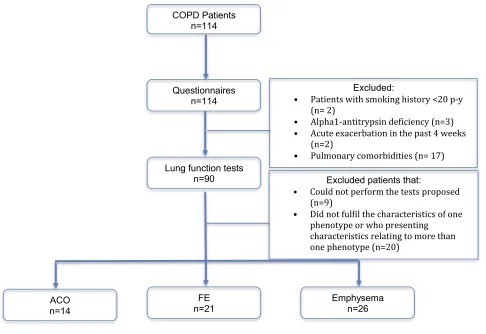
phenotypes, and 14 ACO phenotypes. Figure 1presents the
flow chart of the recruitment. There was no statistically sig-nificant difference between the groups regarding age, sex and forced vital capacity. The forced expiratory volume in thefirst second was statistically different because the ACO phenotype had higher values demonstrating a mild disease in our sample when compared to other phenotypes (Table 2).
When comparing these three phenotypes, there was no statistically significant difference when regarding the gen-otypic analysis of the rs1828591 (p= 0.552) and rs6537296
(p=0.296) HHIP polymorphisms. However, there was a
trend for statistical difference regarding the rs13118928 (p = 0.058) polymorphism. Although not very prevalent in the 3 groups, the G allele was not found in patients in
the emphysema-hyperinflation group. In the genotypic
analysis, we observed a higher percentage of patients
with the emphysema-hyperinflation phenotype with AA
genotype (Table 3). Thus, we performed a 2 × 2 analysis
tofind out a possible implication of the
emphysema-hyper-inflation phenotype in this statistical trend.
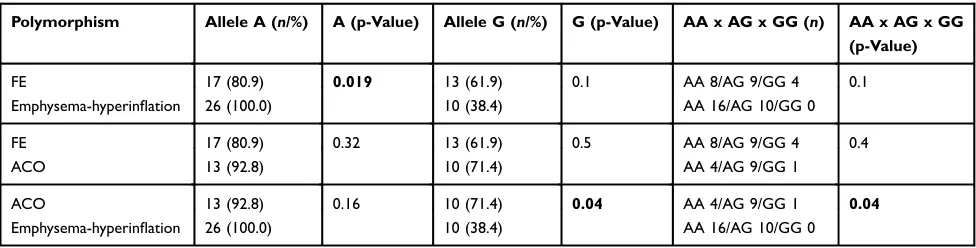
The separate 2 × 2 analysis of the 3 phenotypes revealed a statistically significant difference in the A allele when
com-paring FEs with emphysema-hyperinflation (p = 0.019), in
which the latter group presented this allele more frequently.
The analysis between ACO and emphysema-hyperinflation
also revealed a statistically significant difference in the com-parison between AA × AG × GG genotypes (p = 0.04), with a higher prevalence of the AA genotype in the emphysema-hyperinflation group, and a statistically significant difference in the G allele (p = 0.04) in this same group, and it was less frequently found in patients with the emphysema-hyperinfl a-tion phenotype. No statistically significant difference was found in allelic and genotypic analysis between ACO and FEs. Therefore, the presence of the A allele may be related to
the trend to develop the emphysema-hyperinflation
pheno-type and the presence of the G allele is possibly not related to this phenotype (Table 4).
Discussion
Much has been discussed about the different COPD
pheno-types, specially the ACO, the emphysema-hyperinflation,
and the FE phenotypes. In addition to these 3 phenotypes, Miravitlles et al described four other clinical phenotypes with their clinical nuances and the main therapeutic options for
each one.4Other authors have also reported several
pheno-types, in an attempt to identify a clinical spectrum to a better target therapy.6
Nevertheless, there are no studies that discuss a possi-ble distinct genetic origin of each of these phenotypes,
Table 1Characteristics Considered For Dividing Patients Into The Three Different Phenotypes
Phenotype History Of Atopy
Number of Exacerbations In The Previous 12 Months
Bronchodilation Post Salbutamol Spray 400 mcg
DLCO % Predicted
TLC% Predicted
RV% Predicted
FE Negative ≥2 Negative > 75 < 130 < 125
ACO Positive < 2 Positive > 75 < 130 < 125
Emphysema-hyperinflation
Negative < 2 Negative < 75 > 130 > 125
Abbreviations:ACO, asthma/COPD overlap; FE, frequent exacerbator; bronchodilator test was considered positive when an increment≥12% FEV1% predicted was associated to 200 mL of the absolute baseline FEV1, DLCO, carbon monoxide diffusion capacity; TLC%, total lung capacity % predicted; RV%, residual volume % predicted.
International Journal of Chronic Obstructive Pulmonary Disease downloaded from https://www.dovepress.com/ by 118.70.13.36 on 22-Aug-2020
especially the three most frequent ones already cited above. The logic of this discussion is based on the
fact that individuals exposed to the same risk factor –
smoking – developed distinct spectra of COPD. Thus,
the correlation of genetic polymorphisms and the different COPD phenotypes becomes imperative.
Several studies report polymorphisms possibly asso-ciated with the genesis of COPD, including those in the
HHIPgene (rs1828591, rs13118928, and rs6537296).17,18
After a statistical analysis comparing these three poly-morphisms with the three major COPD phenotypes, novel results were observed, the possible relationship of the presence of the A allele and absence of the G allele in
the rs13118928 polymorphism of theHHIPgene with the
emphysema-hyperinflation phenotype.
Our study presented some limitations, mainly regard-ing the determination of the phenotype within the daily basis clinical context. Some subjects were excluded from
COPD Patients n=114
Questionnaires n=114
Excluded:
• Patients with smoking history <20 p-y (n= 2)
• Alpha1-antitrypsin deiciency (n=3) • Acute exacerbation in the past 4 weeks
(n=2)
• Pulmonary comorbidities (n= 17)
Patients
Lung function tests n=90
ACO n=14
FE n=21
Emphysema n=26
Excluded patients that:
• Could not perform the tests proposed (n=9)
• Did not fulil the characteristics of one phenotype or who presenting
characteristics relating to more than one phenotype (n=20)
Figure 1Recruitmentflowchart.
Abbreviations:COPD, chronic obstructive lung disease; ACO, asthma/COPD overlap; FE, frequent exacerbator, pulmonary comorbidities included, tuberculosis sequelae, pulmonaryfibrosis and lung cancer.
Table 2Subjects’Demographic And Functional Characteristics
FE ACO Emphysema Hyperinflation P-Value
Age (years, mean ± SD) 67.0 ±7.8 60.7 ± 7.8 67.0 ± 7.8 0.06
Male gender (n/total) 15/21 7/14 13/26 0.99
Smoking load 46.7 ± 24.5 60.2 ± 27.6 48.5±30.2 0.33
FEV1% (mean ± SD) 58.4 ± 20.7 68.3 ± 15.3* 52.3 ± 16.3* 0.03
FVC% (mean ± SD) 92.0 ± 25.1 100.0 ± 19.0 91.3 ± 18.5 0.41
Notes:Used ANOVA for categorical numbers and chi-square for gender. *Multiple comparison showed difference between ACO and emphysema/hyperinflation groups (p=0.02). Bold text indicates statistical significance.
Abbreviations:ACO, asthma/COPD overlap; FE, frequent exacerbator; FEV1%, forced expiratory volume in thefirst second % predicted; FVC%, forced vital capacity % predicted.
International Journal of Chronic Obstructive Pulmonary Disease downloaded from https://www.dovepress.com/ by 118.70.13.36 on 22-Aug-2020
the sample for not meeting the criteria of a pure pheno-type. Another limitation is related to the fact that the history of atopy and asthma were based on patient-based history. The number of exacerbations that had occurred in
the year before the recruitment was confirmed in most
cases by medical notes, but some patients had been treated in the emergency room during the episodes of exacerba-tion, and for this study, all episodes in which the patients had received antibiotics or systemic corticosteroids were considered exacerbations, even if they had not happened in our institution.
Conclusion
In conclusion, this study demonstrates a possible relation-ship between the presence of the A allele and the absence
of the G allele at the rs13118928 HHIP polymorphism
with the emphysema-hyperinflation phenotype. This data
needs to be corroborated by subsequent studies, but it
opens the discussion of the relationship between the COPD phenotype and genotype.
Disclosure
The authors report no conflicts of interest in this work.
References
1. Chair JV, Agusti A, Anzuetto A, et al. The global initiative for Chronic Obstructive Pulmonary Disease-Global strategy for the diagnosis, manage-ment and prevention for chronic obstructive pulmonary disease-update. 2018. Available from:www.goldcopd.org. Accessed March 24, 2019. 2. Han MK, Agusti A, Calverley PM, et al. Chronic obstructive
pulmon-ary disease phenotypes: the future of COPD.Am J Respir Crit Care Med.2010;182:598–604. doi:10.1164/rccm.200912-1843CC 3. Agusti A, Sobradillo P, Celli B. Addressing the complexity of chronic
obstructive pulmonary disease–from phenotypes and biomarkers to scale free networks, system biology and P4 medicine.Am J Respir Crit Care Med.2011;183:1129–1137. doi:10.1164/rccm.201009-1414PP 4. Miravitlles M, Calle M, Soler-Cataluna JJ. Clinical phenotypes of
COPD: identification, definition and implications for guidelines.Arch Bronconeumol.2012;48:86–98. doi:10.1016/j.arbres.2011.10.007 Table 3Genotypic Frequency In The Phenotypes Studied
Polymorphism FE (n/%) ACO (n/%) Emphysema-Hyperinflation (n/%) p-Value
HHIPrs 1828591
AA 6 (28.5) 3 (21.4) 11 (42.4) 0.552
AG 11 (34.3) 8 (57.1) 13 (50.0)
GG 4 (19.0) 3 (21.4) 2 (7.6)
HHIPrs 13118928
AA 8 (38.1) 4 (28.5) 16 (61.5) 0.058
AG 9 (32.1) 9 (42.8) 10 (35.7)
GG 4 1(9.0) 1 (7.1) 0 (0.0)
HHIPrs 6537296
AA 5 (23.8) 5 (35.7) 12 (46.1) 0.296
AG 13 (61.9) 6 (42.8) 13 (50.0)
GG 3 (14.2) 3 (21.4) 1 (3.8)
Abbreviations:ACO, asthma/COPD overlap; FE, frequent exacerbator;HHIP, Hedgehog interaction protein.
Table 4Allelic And Genotypic Frequency In 2 × 2 Comparisons With The Rs 13118928HHIPGene Polymorphism
Polymorphism Allele A (n/%) A (p-Value) Allele G (n/%) G (p-Value) AA x AG x GG (n) AA x AG x GG (p-Value)
FE 17 (80.9) 0.019 13 (61.9) 0.1 AA 8/AG 9/GG 4 0.1
Emphysema-hyperinflation 26 (100.0) 10 (38.4) AA 16/AG 10/GG 0
FE 17 (80.9) 0.32 13 (61.9) 0.5 AA 8/AG 9/GG 4 0.4
ACO 13 (92.8) 10 (71.4) AA 4/AG 9/GG 1
ACO 13 (92.8) 0.16 10 (71.4) 0.04 AA 4/AG 9/GG 1 0.04
Emphysema-hyperinflation 26 (100.0) 10 (38.4) AA 16/AG 10/GG 0
Note:Bold text indicates statistical significance.
Abbreviations:ACO, asthma/COPD overlap; FE, frequent exacerbator;HHIP, Hedgehog interaction protein.
International Journal of Chronic Obstructive Pulmonary Disease downloaded from https://www.dovepress.com/ by 118.70.13.36 on 22-Aug-2020
5. Rhee CK. Phenotype of asthma-chronic obstructive pulmonary dis-ease overlap syndrome. Korean J Intern Med. 2015;30:443–449. doi:10.3904/kjim.2015.30.4.443
6. Alshabanat A, Zafari Z, Albanyan O, Dairi M, Fitzgerald JM. Asthma and COPD overlap syndrome (ACOS). A systematic review and meta analysis.PLoS One.2015;10:e0136065. doi:10.1371/jour-nal.pone.0136065
7. Corhay JL, Schleich F, Louis R. Phenotypes in chronic obstructive pulmonary disease.Rev Med Liège.2014;69:415–421.
8. Miravitlles M, Soler-Cataluña JJ, Calle M, et al. Spanish COPD guidelines (GesEPOC): pharmacological treatment of stable COPD. Spanish Society of Pulmonology and Thoracic Surgery. Arch Bronconeumol.2012;48:247–257. doi:10.1016/j.arbres.2012.04.001 9. Piras B, Miravitlles M. The overlap phenotype: the (missing) link
between asthma and COPD. Multidiscip Respir Med. 2012;7:8. doi:10.1186/2049-6958-7-8
10. Postma DJ, Rabe KF. The asthma–COPD overlap syndrome.N Eng J Med.2015;373:1241–1249. doi:10.1056/NEJMra1411863
11. Gibson PG, McDonald VM. Asthma-COPD overlap 2015: now we are six.Thorax.2015;70:683–691. doi:10.1136/thoraxjnl-2014-206740 12. Chen X, Xu X, Xiao F. Heterogeneity of chronic obstructive
pulmon-ary disease: from phenotype to genotype.Front Med.2013;7:425–432. doi:10.1007/s11684-013-0295-x
13. Suzuki T, Tada Y, Matsuura Y, et al. Clinical, physiological and radiological features of asthma-chronic obstructive pulmonary dis-ease overlap syndrome.Int J Chron Obstruct Pulmon Dis.2015; 10:947–954.
14. Burge S, Wedzicha JÁ. COPD exacerbations: definitions and classifi -cations. Eur Respir J. 2003;21:46s–53s. doi:10.1183/09031936.03. 00102002
15. Vestbo J, Agusti A, Wouters EFM, et al. Should we view chronic obstructive pulmonary disease differently after ECLIPSE? A clinical perspective from the study team. Am J Respir Crit Care Med. 2014;189:1022–1030. doi:10.1164/rccm.201306-1150OC
16. Celli BR. Chronic obstructive pulmonary disease phenotypes and their clinical relevance. Proc Am Thorac Soc. 2006;3:461–466. doi:10.1513/pats.200603-029MS
17. Zhou X, Baron RM, Hardin M, et al. Identification of chronic obstructive pulmonary disease genetic determinant that regulates HHIP.Hum Mol Gen.2012;21:1325–1335. doi:10.1093/hmg/ddr527 18. Durme YMTAV, Eijgelsheim N, Joos GF, et al. Hedgehog interaction protein is a COPD susceptibility gen: the Rotterdam study. Eur Respir J.2010;36:89–95. doi:10.1183/09031936.00129509
International Journal of Chronic Obstructive Pulmonary Disease
Dove
press
Publish your work in this journal
The International Journal of COPD is an international, peer-reviewed journal of therapeutics and pharmacology focusing on concise rapid reporting of clinical studies and reviews in COPD. Special focus is given to the pathophysiological processes underlying the disease, inter-vention programs, patient focused education, and self management
protocols. This journal is indexed on PubMed Central, MedLine and CAS. The manuscript management system is completely online and includes a very quick and fair peer-review system, which is all easy to use. Visit http://www.dovepress.com/testimonials.php to read real quotes from published authors.
Submit your manuscript here:https://www.dovepress.com/international-journal-of-chronic-obstructive-pulmonary-disease-journal
International Journal of Chronic Obstructive Pulmonary Disease downloaded from https://www.dovepress.com/ by 118.70.13.36 on 22-Aug-2020