Article
Evaluation of Shrimp Waste Valorization Combining
Computer Aided Simulation and Numerical
Descriptive Inherent Safety Technique (NuDIST)
Antonio Zuorro1*, Daylisney Cassiani-Cassiani2,§, Demmy A. Meza-González2,§, Kariana Andrea Moreno-Sader2, Ángel Darío González-Delgado2*1 Department of Chemical Engineering, Materials & Environment, Sapienza - University of Rome, Piazzale Aldo Moro, Italy, Rome, 00185
2 Chemical Engineering Department, Nanomaterials and Computer Aided Process Engineering Research Group (NIPAC), University of Cartagena, Avenida del Consulado St. 30, Cartagena de Indias, Colombia, 130015
*Author of correspondence: [email protected], [email protected] §These authors contribute equally to this work
Abstract: Nowadays, inherently safer designs are considered as key priorities to prevent or
mitigate serious incidents with devastating consequences. The need for process safety assessment during early design phases has motivated the development of several contributions related to computer-aided assessment methodologies in order to measure the inherent safety of chemical processes. In this work, the large-scale production of chitosan from shrimp wastes was evaluated from process safety point of view using the numerical descriptive inherent safety technique (NuDIST).To this end, simulation of the chitosan production was performed using Aspen Plus ® to obtain extended mass and energy balances. The assessment of all the chemicals involved within the process was carried out for the following safety parameters: explosivity (EXP), flammability (FL) and toxicity (TOX). The safety assessment of the process included the parameters of temperature (T), pressure (P) and heat of reaction (HR). The maximum chemical safety score was estimated in 171.01 with ethanol as main contributor to the parameter of explosivity and flammability. The score associated with operating data was calculated in 209.30 and heat of reaction reported to be the most affecting parameter. The NuDIST score was estimated in 380.30. This NuDIST value revealed the low hazards associated with the handling of substances such as shrimp wastes, chitosan and water, as well as the non-extreme temperature and pressure conditions. In general, the large-scale production of chitosan from shrimp shells showed to be an inherently safe alternative of waste valorization.
Keywords: Chitosan; Process safety; NuDIST; CAPE; Shrimp
1. Introduction
The increasing demand of shrimp worldwide has motivated shrimp industries to rise their production capacity generating higher amount of wastes. Such wastes are mainly composed of cephalothorax, shell and tail, which represent approximately 50% of the total shrimp weight [1]. Globally, the waste generation rate is around 1.4 billion ton/year [2]. In Colombia, the Caribbean and Pacific coasts most process shrimps according to market needs and have been environmentally affected by the generation of shrimp wastes. The major environmental issues are related to exoskeleton decomposition, attraction of insects, as well as diseases transmitted to humans [3].
To solve environmental-related problems of shrimp wastes generation, different alternatives have been proposed such as valorization of residues and production of high-value materials. Due to the high content of chitin and carotenoids in shrimp exoskeleton (about 20-30%), shrimp wastes are known as a promising source of chitosan and astaxanthin [4]. Chitosan is produced by enzymatic or chemical deacetylation of chitin [5]. This biopolymer is biocompatible, biodegradable, non-toxic and exhibits wide range of applications in textile, pharmaceutical food industries, among others [6]. Chitin and chitosan are of commercial interest because of their high percent of nitrogen (6.89%) compared to synthetically substitute cellulose (1.25%) and this makes chitin a useful chelating agent [7]. Astaxanthin is extracted using alkaline solutions at high concentrations and temperatures, without performing depigmentation processes to take advantage such byproduct [8]. It is a red carotenoid pigment classified as a xanthophyll, that occurs naturally in a wide variety of living organisms [9]. This carotenoid has several applications in cosmetic, pharmaceutical, medicinal and health supplement industries [10].
The extraction procedures for high value products from shrimp wastes have been the focus of several contributions. Despite these efforts, there is still a knowledge gap in the application of computer-aided assessment tools to evaluate the performance of chitin, chitosan and astaxanthin production from shrimp exoskeleton and identify improvement opportunities. One of the most important analysis to consider is the safety assessment. Major accidents have taken place in several industries causing economic losses, physical damages, death of employees, loss of reputation and credibility in the industry [11]. Therefore, the importance of safety analysis becomes evident. The main objective of process safety assessment is to eliminate all hazards, or else, mitigate the consequences of these [12].
Different metrics are proposed for quantification and measurement of safety performance. Gerbec, M. [13] proposed a new universal safety indicator method to support organizational learning in process safety incident investigation, which is determined from the outcome deficiencies observations and root-cause analysis of company incident investigations. Jafari et al. [12] stated the contribution of index-based approach to measure inherent safety of chemical process design and performed a systematic review about novel indicators developed within the period 1990-2017. They identified 35 indicators categorized according to the estimation approach (hybrid approach, equational based approach, graphical approach, advanced mathematical approach, risk-based approach, relative ranking). Some of the most popular are fuzzy logic-based inherent safety index, process stream index, integrated inherent safety index, fire and explosion index, among others. For early design phases, inherent safety metrics are widely employed, for example, the numerical descriptive inherent safety technique (NuDIST). This metric is a universal safety indicator method to support organizational learning in process safety incident investigation [14].
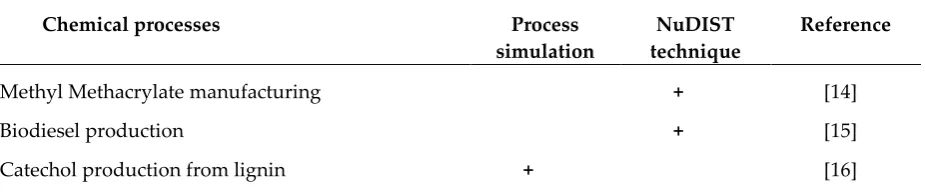
According to the contributions shown in Table 1, there is a limited open literature regarding the application of NuDIST assessment methodology in chemical processes, whose process data is gathered from modeling and simulation. Despite the efforts of such technique to overcome limitations of conventional index-based methods for safety assessment, it was identified a need to explore the use of NuDIST metric as decision-making tool for inherent safety designs of additional chemical processes. In this work, the NuDIST methodology is used to evaluate the performance of large-scale production of chitosan from shrimp wastes from process safety point of view.
Table 1. Summary of contributions about the application of NuDIST tool and Process
Simulation on chemical processes
Chemical processes Process
simulation
NuDIST technique
Reference
Methyl Methacrylate manufacturing + [14]
Biodiesel production + [15]
Fermentative hydrogen production from food waste + [17]
Palm oil recovery + [18]
Furfural and Biogas production using pentoses + [19] Production of chitosan from shrimp wastes + + This work
2. Methodology
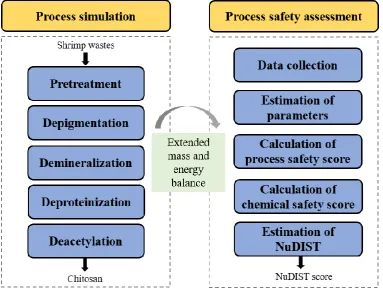
The general methodology applied for the process safety assessment of chitosan production from shrimp exoskeleton is depicted in Figure 1. Previously, authors performed the extraction of chitosan at lab-scale and used this experimental data to simulate the scaling up of such process using Aspen Plus® software [20]. The extended mass and energy balances provided by the software were used to perform NuDIST tool.
Figure 1. Schematic representation of the methodology
2.1. Process description
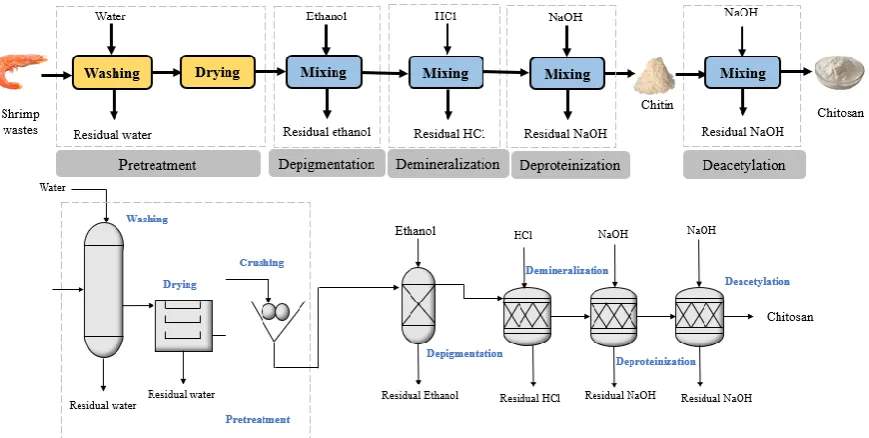
Figure 2 shows the process diagram for chitosan extraction from shrimp wastes with the following stages:
Pretreatment
Depigmentation
Demineralization
Deproteinization
Deacetylation
ethanol and the resulting stream is fed into the demineralization stage. To this end, hydrochloric acid is used for mineral fraction removal. This stream through a stage of deproteinization with sodium hydroxide to isolate the proteins and extract the chitin present in it. Finally, the extracted chitin undergoes a deacetylation process with sodium hydroxide to obtained chitosan. The final product is filtered, washed and dried.
Figure 2. Schematic representation of chitosan production from shrimp wastes
Gathering of process data from computer-aided simulation
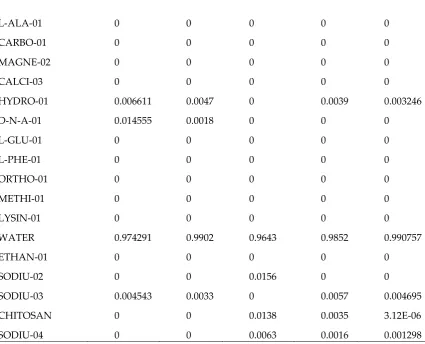
The simulation of large-scale chitosan production from shrimp wastes provided mass balances that indicate the composition of process streams. In this sense, the chemicals involved in such extraction procedure were identified according to the process data reported by Aspen Plus ® . Table 2 lists the mass fraction of compounds in the main process streams. It was found 23 chemicals including astaxanthin, calcium carbonate, sodium carbonate, carbon dioxide, L-alanine, hydrochloric acid, calcium phosphate, water, ethanol, sodium chloride, chitosan, sodium acetate, among others. The simulation flowsheet of the process is depicted in Figure 3. Detailed description of the equipment selection, thermodynamic property set and simulation environment is available in previous work [20].
Figure 3. Process simulation of the shrimp exoskeleton waste valorization [20].
Table 2. Mass composition of main process streams (continue) [20]
Mass flow rate (kg/h) 6602 6502.395 27714 27850.8 6365.288
Mass composition (wt.)
METHY-01 0.064 0.0009 0 0 0 ASTAX-01 0.0041 0 0 0.00107 0 CALCI-01 0.0513 0 0 0 0.05877 CALCI-02 0.129 0 0 0 0.14780 SODIU-01 0.0262 0 0 0 0.03002 MAGNE-01 0.0152 0 0 0 0.01741 L-ALA-01 0.0645 0 0 0 0.07390
CARBO-01 0 0 0 0
MAGNE-02 0 0 0 0
CALCI-03 0 0 0 0
HYDRO-01 0 0 0 0
D-N-A-01 0.3 0 0 0.0038 0.3269 L-GLU-01 0.1113 0 0 0 0.1275 L-PHE-01 0.042 0 0 0 0.0481
ORTHO-01 0 0 0 0
METHI-01 0.0377 0 0 0 0.0432 LYSIN-01 0.1103 0 0 0 0.1264 WATER 0.0446 0.999 0.15 0.1493 0 ETHAN-01 0 0.85 0.8458 0
SODIU-02 0 0 0 0
SODIU-03 0 0 0 0
CHITOSAN 0 0 0 0
SODIU-04 0 0 0 0
Table 2. Mass composition of main process streams (continue) [20]
Stream name 27 29 32 36 38
Mass flow rate
(kg/h) 141921.3 197886 100789 401939 489905.4
Mass composition (wt.)
METHY-01 0 0 0 0 0
ASTAX-01 0 0 0 0 0
CALCI-01 0 0 0 0 0
CALCI-02 0 0 0 0 0
SODIU-01 0 0 0 0 0
L-ALA-01 0 0 0 0 0
CARBO-01 0 0 0 0 0
MAGNE-02 0 0 0 0 0
CALCI-03 0 0 0 0 0
HYDRO-01 0.006611 0.0047 0 0.0039 0.003246 D-N-A-01 0.014555 0.0018 0 0 0
L-GLU-01 0 0 0 0 0
L-PHE-01 0 0 0 0 0
ORTHO-01 0 0 0 0 0
METHI-01 0 0 0 0 0
LYSIN-01 0 0 0 0 0
WATER 0.974291 0.9902 0.9643 0.9852 0.990757
ETHAN-01 0 0 0 0 0
SODIU-02 0 0 0.0156 0 0 SODIU-03 0.004543 0.0033 0 0.0057 0.004695 CHITOSAN 0 0 0.0138 0.0035 3.12E-06 SODIU-04 0 0 0.0063 0.0016 0.001298
2.2. Process safety assessment
For the safety assessment of large-scale chitosan production from the shrimp exoskeleton, it was employed the NuDIST safety indicator following the methodological procedure described by Ahmad et al.[15]. The hazards associated with the chemicals involved within the process are quantified by logistic equations summarized in Table 3. The chemical safety parameters that are considered by this metric are explosiveness (EXP), flammability (FL) and toxicity (TOX). To determine the numerical values of the selected parameters, a data collection was carried out such. Properties such as flash point, the upper and lower explosion limits and the TLV-STEL toxicity value were found in the Material Safety Data Sheet (MSDS) of the chemicals. The chemical safety total score (CSTS) was calculated for each chemical by Equation 1.
CSTS = SFL + SEXP + STOX (1)
The flash point and TLV-STEL toxicity values are directly replaced in the logistic function of the flammability and toxicity parameters (x), respectively. In the logistic function of the explosivity parameter, the difference in the upper and lower explosion limit values is replaced, that is, UEL-LEL.
Table 3. Logistic equation of NuDIST scoring for chemicals
Parameter Logistic Function
Explosiveness (SEXP)
Toxicity (STOX)
The flash point and TLV-STEL toxicity values are directly replaced in the logistic function of the flammability and toxicity parameters, respectively. In the logistic function of the explosivity parameter, the difference in the upper and lower explosion limit values is replaced, that is, UEL-LEL.
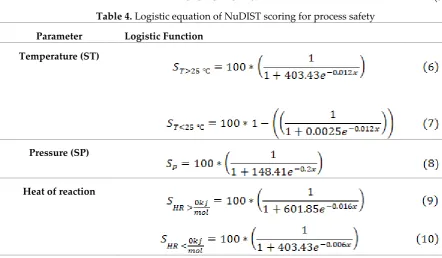
Subsequently, a safety assessment of the process involving the parameters of temperature (T), pressure (P) and heat of reaction (HR) was performed (see Table 4). To determine the temperature and pressure values of the process, only the highest temperature and pressure of the process units were taken into account and the heat of reaction was calculated considering the heat of reaction of all chemical reactions involved in the process stages. Then, the values obtained are replaced in the logistic equations of the NuDIST method providing a temperature, pressure and reaction heat score. The estimations for each parameter are entered to the following equation, with which the total safety score of the process (PSTS) is calculated.
PSTS = ST + SP + SHR (5) Table 4. Logistic equation of NuDIST scoring for process safety
Parameter Logistic Function
Temperature (ST)
Pressure (SP)
Heat of reaction
Finally, the total chemical safety score and the process safety score are incorporated to the total NuDIST score of the process using the Equation 11. The value of this safety indicator was compared with other processes in order to analyze how safe is the chitosan production from shrimp exoskeleton and identify opportunities of improvements.
3. Results and discussion
3.1. Chemical safety assessment
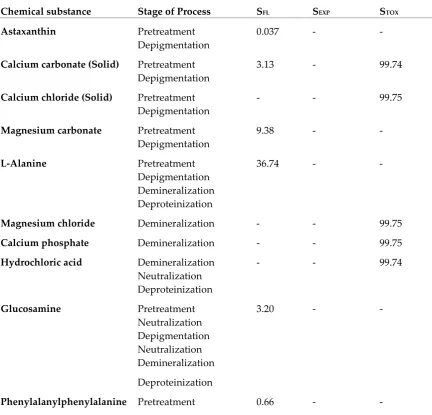
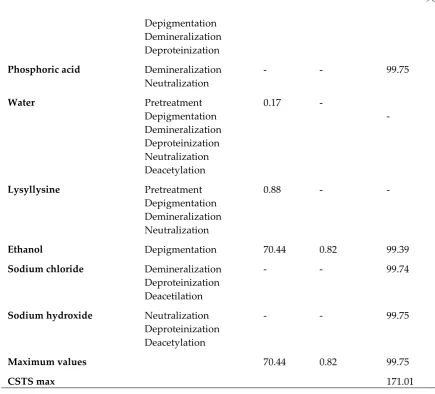
In other to carry out the inherent safety assessment, three property values were required: flash point, upper and lower explosion levels and TLV-STEL. Hence, the first step was to collect this information for each chemical shown in Table 2. As some compounds are considered as non-flammable, non-explosive or non-toxic; therefore, no values were found in literature and MSDS of the chemical. Table 5 shows the results of chemical safety parameters calculated with Equations 2-4. The chemicals with unavailable data were excluded from this table due to the parameters were not calculated. Considering that higher score indicates higher level of hazard. In term of flammability parameter, ethanol as the most hazardous solvent with SFL of 70.44 followed by
l-alanine with 36.74. In other words, Astaxanthin, Phenylalanylphenylalanine and Lysyllysine as safer in term of flammability compared to ethanol, l-alanine and to the rest of compounds. On the other hand, ethanol is the only compound with an explosive score, as no values were found for the other compounds when considered nonexplosive. Ethanol reported a SEXP score of 0.814. Finally, for
toxicity parameter, Calcium phosphate is the most hazardous solvent with STOX of 99.7527 followed
by calcium chloride and phosphoric acid with 99.7508 and 99.7505 respectively. The parameter value of toxicity for ethanol is similar to the values reported by Ahmad et al. [18] for n-hexane widely used as solvent.
Table 5. Chemical safety parameters of explosiveness, flammability and toxicity
Chemical substance Stage of Process SFL SEXP STOX
Astaxanthin Pretreatment
Depigmentation
0.037 - -
Calcium carbonate (Solid) Pretreatment Depigmentation
3.13 - 99.74
Calcium chloride (Solid) Pretreatment Depigmentation
- - 99.75
Magnesium carbonate Pretreatment Depigmentation
9.38 - -
L-Alanine Pretreatment
Depigmentation Demineralization Deproteinization
36.74 - -
Magnesium chloride Demineralization - - 99.75
Calcium phosphate Demineralization - - 99.75
Hydrochloric acid Demineralization Neutralization Deproteinization
- - 99.74
Glucosamine Pretreatment
Neutralization Depigmentation Neutralization Demineralization Deproteinization
3.20 - -
Depigmentation Demineralization Deproteinization
Phosphoric acid Demineralization
Neutralization
- - 99.75
Water Pretreatment
Depigmentation Demineralization Deproteinization Neutralization Deacetylation
0.17 - -
Lysyllysine Pretreatment
Depigmentation Demineralization Neutralization
0.88 - -
Ethanol Depigmentation 70.44 0.82 99.39
Sodium chloride Demineralization Deproteinization Deacetilation
- - 99.74
Sodium hydroxide Neutralization Deproteinization Deacetylation
- - 99.75
Maximum values 70.44 0.82 99.75
CSTS max 171.01
After estimating the scores for each parameter, the CSTS was calculated using Equation 1 in order to illustrate the combination of fire, explosion and toxic release incidents. Figure 4 shows the ranking of chemicals according to the values of CSTS. It is important to indicate that the less hazardous chemical is in the first place of the ranking (Rank 1), while more hazardous chemical is in the last place (Rank 9). Results reported that ethanol is the most hazardous chemical in the large-scale production of chitosan from shrimp wastes with a CSTS value of 170.65 followed by calcium carbonate and calcium phosphate with 102.87 and 99.7527, respectively. The hydrochloric acid and magnesium chloride showed CSTS value of 99.736354 and 99.745013, respectively. Despite this ranking presents chemicals with lower scores as safer, the safest chemicals were those that reported safety properties of zero or not applicable (N/A) such as water and chitosan. In addition, the presence of hazards associated with chemical handling is similar for compounds in rank position 1-7 because of the similarity in the CSTS values. The high values of CSTS achieved by chemicals listed in Figure 4 suggested that safeguards must be incorporated within the process in order to avoid release or spill of these chemical substances with chemical safety total score above 99.
Figure 4. Rank of CSTS score estimated for chemicals in the large-scale production of chitosan
from shrimp wastes
3.3. Process safety assessment
To carry out the inherent safety assessment of the process, three property values are required; temperature and pressure of the process and the heats of reaction involved in the chemical reactions that take place in it. Therefore, request a procedure to collect this information. The calculation of the reaction heat was made from the formation enthalpy of the substances involved in the reactions, These heats were obtained using the Aspen Plus software and the NIST Webbook [21]. Given the similarity in compositional characteristics between chitosan from shrimp and blue crab [22], the chitosan formation enthalpies reported by Ur'Yash et al [23] were used in this work. Table 6 lists the reactions considered per stage as well as the calculated global heat of reaction. The temperatures and pressures of the inlet and outlet streams of each equipment were averaged to obtain the global temperature and pressure at which the process works, obtaining the following values: temperature 36.48 ˚C and pressure 1 bar.
Table 6. Chemical reactions heat of reaction for demineralization, deproteinization, and
deacetylation stages [20]
Stage Reactions
Deacetylation (12) 1051
Demineralization
(14) 38670
Based on the logistic equations 6-10, the parameters were calculated to illustrate the combination of pressure, temperature and heats of reaction. Finally, the calculation of PSTS and the Nudist Total
Score is made, using equations 5 and 11. Table 7 shows the scores estimations for temperature, pressure and heat of reaction
Table 7. Process Safety Assessment results for the large-scale production of chitosan from shrimp
wastes
The value of PSTS max obtained for the process of obtaining chitosan from the shrimp exoskeleton reached a value of 209, with the chemical reactions that are carried out in the deacetylation and demineralization stages being the largest contributor to this value. This is mainly because these reactions are slightly exothermic [24], So its contributions to the total heat of reaction of the process are significant. The resulting PSTS is considered moderate compared to other processes such as Methyl methacrylate (MMA) based on the routes of acetone cyanohydrin and ethylene via propionaldehyde that were 241 and 232, while it was higher compared to the routes of ethylene via methyl propionate, propylene and tertiary butyl alcohol calculated in 163, 199 and 131 respectively[14]. The study process is considered moderately risky since the value of the NuDIST Total Score it is low compared to the values obtained for the acetone cyanohydrin (ACH) routes, ethylene through propionaldehyde (C2 / PA), ethylene through methyl propionate (C2 / MP), and propylene (C3) for the process for obtaining methyl methacrylate (MMA), which are 499, 574, 493 and 531 respectively[14] as shown in figure 5.
Figure 5. Comparison of NuDIST results for chitosan production and other processes
T Score P Score HR Score for Stage
0.3826 0.8163 Deacetylation 99.9
Demineralization 100 Deproteinization 8.10 HR Total Score 208.10 PSTS max 209.30
NuDIST Total Score 380.30
4. Conclusions
An inherent safety assessment methodology was applied to the large-scale production of chitosan from shrimp wastes in order to identify the presence of hazardous associated with chemicals substances involved within the process. The selected Numerical Descriptive Inherent Safety (NuDIST) technique was focused on three parameters: flammability, explosiveness and toxicity. According to the results, ethanol is the most dangerous compound with CSTS of 170.65 while the other ranked chemicals reported similar CSTS value around 99-102. The least hazardous chemicals considered as non-flammable, non-explosive or non-toxic were chitosan and water. The CSTS values estimated for chemicals in such process are significantly high in all rank positions. Hence, the large-scale production of chitosan is considered slightly dangerous and prone to fires, explosions and toxic releases and process safety strategies must be included for a safer design. The parameters associated with the process were also taken into account, such as temperature, pressure and heats of reaction reaching a PSTS of 209.3, therefore, on an industrial scale, the implementation of the process to obtain chitosan from shrimp exoskeleton is considered relatively safe; however, constant control must be kept on it to minimize risks of explosion and fires, specifically in the stages of depigmentation, demineralization and deproteinization, Finally, a Nudist Total Score of 380.3 is obtained within the range considered as normal and is mainly influenced by the parameters associated with the safety of the process. In this sense, this process is more likely to have an incident related to the process operation parameters than the handling of chemical substances.
Author Contributions: Conceptualization, A.G.-D. and K.M.-S.; methodology, D.M.-G. and D.C.-C.; software, A.G.-D.; validation, A.G.-D., A.Z. and D.C.-C.; formal analysis, D.M.-G. and A.G.-D.; investigation, D.M.-G. and D.C.-C.; resources, A.G.-D., D.M.-G., D.C.-C. and K.M.-S.; data curation, A.G.-D. and A.Z.; writing—original draft preparation, D.M.-G., A.G.-D. and D.C.-C.; writing—review and editing, K.M.-S., A.Z and A.G.-D..; visualization, A.G.-D. and A.Z.; supervision, A.G.-D. and A.Z.; project administration, A.G.-D.; funding acquisition, A.G.-D. All authors have read and agreed to the published version of the manuscript.
Funding: This research received no external funding.
Acknowledgments: Authors express their gratitude to University of Cartagena for providing support to conduct this research
Conflicts of Interest: The authors declare no conflict of interest.
References
1. Cahú,T.B.; Santos,S.D.; Mendes,A.; Córdula,C.R.; Chavante,S.F.; Carvalho,L.B.; Nader,H.B.; and
Bezerra,R.S. (2012). Recovery of protein , chitin , carotenoids and glycosaminoglycans from Pacific
white shrimp ( Litopenaeus vannamei ) processing waste. Process Biochemistry, 47(4), 570–577.
2. Hamed,I.; Ozogul,F.; and Regenstein,J. (2016). Industrial applications of crustacean by-products (chitin,
chitosan, and chitooligosaccharides): A review. Trends in Food Science & Technology, 48, 40–50.
3. Cabarcas,M.; Marimon,W.; and Miranda,M. (2011). Diseño de un proceso económico y competitivo
para la extracción de quitina y producción de quitosano a partir de exoesqueletos de camarón.
4. Elieh-Ali-Komi,D.; and Hamblin,M. (2016). Chitin and Chitosan: Production and Application of
Versatile Biomedical Nanomaterials. International Journal of Advanced Research, 4(3), 411–427.
5. Srinivasan,H.; Velayutham,K.; and Ravichandran,R. (2018). Chitin and chitosan preparation from
shrimp shells Penaeus monodon and its human ovarian cancer cell line , PA-1. International Journal of
Biological Macromolecules, 107, 662–667.
6. Cogollo-Herrera,K.; Bonfante-Á lvarez,H.; De Á vila-Montiel,G.; Herrera Barros,A.; and
Production Process from Shrimp Shell Wastes. Chemical Engineering Transactions, 70, 2179–2184.
7. Islam,S. (2016). Production of chitin and chitosan from shrimp shell wastes. Journal of the Bangladesh
Agricultural University, 14, 253–259.
8. Nouri,M.; Khodaivan,F.; Razavi,S..; and Mousav,M. (2016). Improvement of chitosan production from
Persian Gulf shrimp waste by response surface methodology. Food Hydrocolloids, 59, 50–-58.
9. Kishimoto,Y.; Yoshida,H.; and Kondo,K. (2016). Potential Anti-Atherosclerotic Properties of
Astaxanthin. Marine Drugs, 14(35), 1–13.
10. Torres-carvajal,L.K.; González,Á .D.; Francisco,U.; and Santander,D.P. (2017). Astaxanthin Production
from Haematococcus pluvialis : Effects of Light Wavelength and Salinity. Contemporary Engineering
Sciences, 10(35), 1739–1746.
11. Kockmann,N.; Thenée,P.; Fleischer-Trebes,C.; Laudadio,G.; and Noel,T. (2017). Safety assessment in
development and operation of modular continuous-flow processes. Reaction Chemistry and Engineering,
2, 258–280.
12. Javad,M.; Mohammadi,H.; Reniers,G.; and Pouyakian,M. (2018). Exploring inherent process safety
indicators and approaches for their estimation : A systematic review. Journal of Loss Prevention in the
Process Industries, 52(December 2017), 66–80.
13. Gerbec,M. (2013). Supporting organizational learning by comparing activities and outcomes of the
safety-management system. Journal of Loss Prevention in the Process Industries, 26(6), 1113–1127.
14. Ahmad,S.I.; Hashim,H.; and Hassim,M.H. (2014). Numerical Descriptive Inherent Safety Technique
(NuDIST) for inherent safety assessment in petrochemical industry. Process Safety and Environmental
Protection, 92(5), 379–389.
15. Ahmad,S.I.; Hashim,H.; Hassim,M.H.; and Abdul,Z. (2016). Inherent Safety Assessment of Biodiesel
Production: Flammability Parameter. Procedia Engineering, 148, 1177–1183.
16. Mabrouk,A.; Erdocia,X.; Alriols,M.G.; and Labidi,J. (2018). Economic analysis of a biorefinery process
for catechol production from lignin. Journal of Cleaner Production, 198, 133–142.
17. Han,W.; Fang,J.; Liu,Z.; and Tang,J. (2016). Techno-economic evaluation of a combined bioprocess for
fermentative hydrogen production from food waste. Bioresource Technology, 202, 107–112.
18. Ahmad,S.I.; Yunus,N.A.; Hashim,H.; and Rashid,R. (2019). Inherent safety assessment of solvent
alternatives for palm oil recovery. Chemical Engineering Transactions, 72(November 2018), 49–54.
19. Aristizábal-Marulanda,V.; Poveda-Giraldo,J.A.; and Cardona Alzate,C.A. (2020). Comparison of
furfural and biogas production using pentoses as platform. Science of the Total Environment, 728, 138841.
20. Meramo-Hurtado,S.; Alarcón-Suesca,C.; and González-Delgado,Á .D. (2020). Exergetic sensibility
analysis and environmental evaluation of chitosan production from shrimp exoskeleton in Colombia.
Journal of Cleaner Production, 248.
21. Lemmon,E.W.; McLinden,M.O.; and Friend, and D.G. (2017). NIST Chemistry WebBook, NIST Standard
Reference Database.
22. Barros,I.; Guzmán,L.; and Tarón,A. (2015). EXTRACCIÓ N Y COMPARACIÓ N DE LA QUITINA
OBTENIDA A PARTIR DEL CAPARAZON DE Callinectes sapidus Y Penaeus vannameis
EXTRACTION AND QUANTITATIVE COMPARISON OF CHITIN OBTAINED FROM THE
SHELLOF Callinectes sapidus AND Penaeus vannamei. Rev. U.D.C.A Act. & Div Cient., 18(1), 227–234.
23. Ur’Yash,V.F.; Larina,V.N.; Kokurina,N.Y.; Bakulin,A. V.; Kashtanov,E.A.; and Varlamov,V.P. (2012).
Dependence of the ordering degree and thermochemical characteristics of chitin and chitosan on their
24. Gómez-Ríos,D.; Barrera-Zapata,R.; and Ríos-Estepa,R. (2017). Comparison of process technologies for
chitosan production from shrimp shell waste: A techno-economic approach using Aspen Plus® . Food
![Table 2. Mass composition of main process streams (continue) [20]](https://thumb-us.123doks.com/thumbv2/123dok_us/7940260.1318170/5.595.75.504.598.790/table-mass-composition-main-process-streams-continue.webp)