468
The indirect impact of the board of directors' composition on the firm's
performance: An international comparison
Zouari Ghazi
Assistant Professor and Habilitation Research in Finance at the University of Sfax, Faculty of Economic Sciences and Management, Tunisia
Zouari-Hadiji Rim
Assistant Professor in Finance at the University of Sfax, Faculty of Economic Sciences and Management, Tunisia
Abstract
As part of corporate governance theory, this article studies the relationship between the board of directors and the firm's performance from the angle of the R&D investment level in the international context. Our model seeks to show if the R&D investment level acts as a mediating variable between the internal mechanism of corporate governance and performance. This effect is sensitive to the national systems of governance. This empirical study is based on a sample of 174 U.S. and 179 Japanese firms for the period 2008-2012. The results of the linear regressions conducted showing the relationship between, on the one hand, the internal administrator and the non-dual structure, and on the other hand, the firm's performance, meditated by the firm's R&D investment-level.
Keywords: Internal administrator, dual structure, R&D, performance
Introduction
The ability of a firm to invest in Research and Development (henceforth R&D) is regarded as a determinant of its performance (Hall, 1998; Aboody and Lev, 2000; Yasuda, 2009). However, the works in corporate governance argue that without an appropriate control system reducing managerial discretion and asymmetric-information1 problems, the efficiency of R&D cannot
contribute to the improvement of corporate value. These phenomena are accentuated primarily by the characteristics of R&D: the long term horizon (Xu and Zhang, 2004), a higher risk rate (Nekhili and Poincelot, 2000) and specificity (Williamson, 1988; Shleifer and Vishny, 1992).
Because managers can be induced to under invest in R&D in order to maximize their own utility rather than the shareholder's wealth, works in corporate governance suppose that different control modes can be used by the latter to align interests and encourage such investment. The board of directors (henceforth BD) constitutes a system of internal control over managers. Indeed, most
Corresponding author’s
Name: Zouari Ghazi
Email address: [email protected]
1 Charreaux (2001) demonstrates that information asymmetry is usually considered as the major source of interests’ conflicts among stakeholders, leading to distortions in matters of R&D, especially through its features.
Asian Journal of Empirical Research
469
work on the relationship between Corporate Governance Systems2 and R&D investment are
primarily of U.S. and Japan origin (Hill and Snell, 1988; Baysinger et al., 1991; Porter 1992a and b; Bushee, 2001; Lee and O'Neill, 2003; Hosono et al., 2004; Lee, 2005; Zouari-Hadiji and Zouari, 2010a and b), and partly confirm the role played by the board of directors in reducing conflicts of interests prevalent among stakeholders and, therefore, the managers’ behaviour with regard to R&D investment.
Based on corporate governance theory, we intend to justify the theoretical association prevailing between the BD and R&D investment. To our knowledge, it has been discovered that studies attempting to incorporate the three dimensions BD, R&D investment and performance into a single perspective are very scarce. This leads to the justification of the theoretical foundation of these complex relationships. These interrelationships must be specified by including the mediating concept of R&D activities. This implies that the direct relationship between the BD and performance is rather indirect through the influence of the firms’ R&D investment-level. In this configuration, the R&D investment-level acts as a mediating variable between the internal governance mechanism and performance.
Taking into account the rarity of works and the divergent results, our research goal is to answer the following question: To what extent does the composition of the BD have an indirect effect on the firm’s performance through its R&D investment-level? And according to what systems of governance?
To address this problem, a hypothetico-deductive approach has been adopted to treat the following two sections. The first section presents the theoretical model which postulates that BD can have a certain influence on performance. Within this direct relationship, some variables interfere prominent among which is the R&D investment-level. In addition to its being influenced by BD, this variable influences, in turn, the firm’s performance. As for the second empirical section, it aims at testing the R&D investment-level potential effect as a mediator between the BD and performance, in three separate models (one model for each BD component).
Literature review and hypotheses
The characteristics of R&D investment (high risk, long term horizon and high asset specificity) represent sources of conflicting interests between different stakeholders. Governance mechanisms are therefore necessary to align these interests, act on each source of conflict and, consequently, privilege the R&D investment, creator of value3. The managers’ tendency to opt for such an investment to achieve performance depends on the composition of the BD which differs from one financial system to another.
Fama (1980); Fama and Jensen (1983a and b) assign the BD the mission of controlling managers to ensure the maximization of shareholder wealth. The influence of BD on the nature of decisions made by managers depends in part on its composition. The latter is limited to the distinction
2 At firm level, any decision to invest in R & D requires financing which can be either: financing based on the market (Anglo-Saxon system) or a financing bank oriented (Germano-nippon system). These two forms of financing are two alternative systems of corporate governance in which interests’ conflicts between shareholders and managers is more or less attenuated. Charreaux (1997b, p. 421) defines corporate governance as “the set of mechanisms that has the effect of delimiting powers and influencing the decisions of managers, in other works, of governing their conduct and defining their discretionary space”.
470
between inside directors (insiders)4 and outside directors (outsiders)5. As legal representatives of
shareholders, outside directors are supposed to be more independent and more competent than inside directors to exercise more effective control over the managers.
The respective situation of both categories of directors (internal and external), the accumulation / separation of decision functions (CEO) and control (Chair) and the size of the board lead to differences in the pattern of BD in different countries and induce different attitudes to the performance of the control task. In principle, it seems that the nature of directors, through financial and / or strategic controls6, as well as the structure providing the separation or
overlapping of functions can influence the manager’s discretionary latitude towards favoring R&D investment and increasing the firm’s performance. The R&D investment mediating role in the relationship between the BD and the performance varies significantly according to the nature of national governance.
The dominance of inside directors, R&D investment and the firm’s performance
Agency theory Theorists show that the tendency of the managers to increase the performance of the firm by making investments in R&D depends on the presence of a dominant structure in BD which differs significantly according to the nature of national governance.
In the United States, the high degree of separation of ownership and control in firms is offset by the increased role of BD (Weisbach, 1988; Hermalin and Weisbach, 1991; Denis and Sarin, 1999). This organ is characterized by the dominance of outside directors who are likely to be objective and independent. Their experience and their particular circumstances enable them to exercise effective control over managers (Weisbach, 1988; Shivdasani, 1993). Those administrators who choose to evaluate managers on the basis of synthetic financial criteria practice financial controls. Through these controls, outside directors transfer some risk to the managers. However, the manager is risk-averse and seeks to adopt a strategy of protection to ensure their job security (Amihud and Lev, 1981; Jensen and Meckling, 1976). Financial assessment in boards dominated by outside directors leads managers to invest less in R&D projects.
American BD’s take the initiative in dismissing managers who realize poor performance. In assessing managers on the basis of accounting criteria, they increase the intensity of managerial efforts in favor of the maximization of short-term profits. Goold and Quinn (1990) posit that the controls based on financial or budgetary indicators generally focus on short-term performance.
Several studies support this reflection. Fischel and Bradley (1986), Hoskisson and Hitt (1988), Hill and Snell (1988), Baysinger et al. (1991), Ellstrand et al. (2002) Xie et al. (2003) and Zouari-Hadiji and Zouari (2010a) found a significant negative relationship between the dominance of outside directors in the board and R&D investment. This reduces the firm performance. Instead, Krivogorsky (2006) finds a positive and significant relationship between the dominance of outside directors and the firm’s performance.
In Japan, BD’s are dominated by inside directors. Osterloh and Frey (2005) show that in virtue of their position in the company they have a fairly thorough knowledge of the firm and take changes in the environment into account. Maintaining interactive and open relationships with managers, they are able to evaluate the quality of decision-making and the conditions for the implementation
4 These directors are executives or employees that hierarchically depend on the management.
5 Outside directors serve on the BD but don't exercise any function of management within the firm. For a deeper definition see Kaplan and Minton (1994) and Charreaux (1997a).
471
of the Strategy. Relying on subjective and complex methods of performance evaluation, internal administrators practice strategic control (Godard, 1996). By this type of control they encourage managers to undertake R&D investments, and therefore improve the firm’s performance. Thus, the presence of inside directors on the board will result in the increased value of the firm through an effective policy of investment in R&D.
In the same vein, Goold and Quinn (1990) find that inside directors are more oriented towards the long term as they take into account the competitive position of the firm and use qualitative data. These evaluation mechanisms are not only set goals over the long term, but they also establish references in the short term (launching a new product, a new service ...) that guide to long-term objectives. In general, strategic controls give greater priority to the growth of the market and the long-term performance of the firm. The positive effect of the dominance of inside directors over investment in R&D is confirmed by the results of the studies by Hill and Snell (1988, 1989), Baysinger et al. (1991) and Zouari-Hadiji and Zouari (2010a).
Based on the foregoing, the influence of the BD on performance through the R&D investment-level varies according to the percentage of inside directors. The BD that is dominated by inside directors helps to improve the performance of Japanese firms through the realization of R&D investments. In contrast, the dominance of outside directors over the BD reduces the performance of U.S. firms through a diversification strategy. We deduce the following hypothesis:
H1: There is a positive (negative) relationship between the BD dominated by inside directors (external) and the performance of Japanese (American) firms mediated by the R&D investment level.
The dual functions, R&D investment and the firm’s performance
The separation of the functions of Director General and Chairman of the board, as one of the BD characteristics used to stimulate the managers’ efforts (Jensen, 1993), is an important determinant of R&D investment and, therefore, performance. In this context, Goyal and Park (2002) find that the firm’s performance is more sensitive to the separation of the two functions of decision and control in the case of the combination of these functions. The tendency of managers to undertake R&D investments and increase performance comes from the dominant decision-making structure (separation or combination) which varies from one country to another.
In the U.S., the BD is characterized by a dual structure (Daily and Dalton, 1994) not allowing the board to fully play its role because of the confusion of powers and responsibilities (Roe, 1994; Thaddée, 2000). Freed from the board’s control, American managers are encouraged to pursue their own interests at the expense of shareholders. in this respect, they emphasize diversification strategies whose performance is short-term. The combination of functions is associated with low levels of R&D investment (Kor, 2006; Zouari-Hadiji and Zouari, 2010a), contributing to reduction of the firm’s value.
In Japan, the BD, supposed to represent and protect the interests of different stakeholders, consists of two organs, an Executive Board7 and a Supervisory Board8 that are completely separated at the
institutional and functional levels. Fama and Jensen (1983a and b) show that in firms where agents making decisions are not the main owners, decision systems, to be effective, must be designed in such a way that a decision initiated and implemented by a given agent is not ratified and controlled by the same agent. The dissociation of the two organs enhances the ability of the
7 The Executive Board is principally engaged in defending the interests of shareholders and making quick and decisive choices to ensure the efficient operation of the firm.
472
Supervisory Board to fulfill its control function, to orient managers’ decisions to the choice of investment in R&D (Rechner and Dalton, 1991; Pi and Timme, 1993; Daily and Dalton, 1994; Baliga et al., 1996; Core et al., 1999), and therefore, to favor a decision process maximizing the firm’s performance (Chen et al., 2007).
In the context of corporate governance, value creation is then based on the ability to invest in R&D on a continuous basis. It turns out that the non-dual functions of decision and control can encourage investment in R&D, and therefore increase the firm’s performance. Therefore, the non-dual structure has a direct and especially indirect effect on the firm’s performance. The indirect effect is mediated by the establishment of an R&D investment policy, an essential component of value creation.
H2: There is a positive (negative) relationship between an independent structure (dual) and the performance of Japanese (American) firms mediated by the R&D investment level.
As in the foregoing, we consider two variables that determine the firm’s performance through the R&D investment: the dominance of inside directors and the dual structure. The theoretical predictions are presented in the following table.
Table 1: Summary of the main explanatory variables of the firm’s performance through R&D investment
Hypotheses Explained
variables
Mediator variables
Explanatory variables
Expected signs
USA JP
H1 Firm’s performance R&D Investment Dominance of inside
directors + +
H2 Firm’s performance R&D Investment Dual structure - -
Empirical analysis
This section aims to test the indirect effect of BD on the firm’s performance through R&D investment. Initially, we will present our sample, the explained and explanatory variables and the method of multivariate analysis (hierarchical regression). The presentation and interpretation of the results of this study will make up a second sub-section.
Presentation of data and variables measurements
The study data come from two databases (Osiris and Thomson One Banker) and the annual reports of publicly traded U.S. (NYSE) and Japanese (NIKKEI 225) firms over the period 2008-2012. These firms belong to industrial, commercial, tourism, technology and service sectors. The sectional heterogeneity can establish the external validity and generality of results (Lee, 2005). The financial institutions were excluded because of their atypical behaviour in financial policy. The firms whose number of employees was less than 500 were also removed to get the most interesting theoretical plausibility9. For comparative statistical analysis, we selected all the firms
for which we have data on the composition of BD, R&D investment (risk and horizon) and performance, that is, 353 firms (174 American and 179 Japanese).
Given that the return of R&D appears only in the long term (Xu and Zhang, 2004), we must choose an indicator of long-term performance to study the relationship between R&D investment and firm performance. Lin and Chen (2005) point out that five years seems to be appropriate for
473
the evaluation of the fallout of R&D strategies for the firm’s performance10. Thus, and as in
previous studies (Kothari et al., 2002; Yang et al., 2007; Karjalainen, 2008; Pandit et al., 2011), we define the firm’s performance by two measurements, namely the average operating return on five consecutive years (Return On Assets "ROA" = operating income before depreciation and R&D / total sales, Aboody and Lev, 2000; Ding et al., 2007; Yang et al., 2007) 11 and the average
stock returns (Market to Book "MTB " = market capitalization / book value of equity, Bracker and Krishnan, 2011; Nekhili et al., 2012; Başgoze and Cem Sayin, 2013; Pramod et al., 2013) .
To measure the "R&D investment level" ("R&D")12, we use the indicators found in the literature.
It can be defined as the total expenditure on R&D divided either by the asset total (Hosono et al., 2004; Hung et al., 2006; Kor, 2006; Di Vito et al., 2008), by the employees' number (Hill and Snell, 1988; Graves, 1988; Baysinger et al., 1991) or by the sales total of the firm (Eng and Shackell, 2001; O'Neill and Lee, 2003; Dutta et al., 2004; Berrone et al., 2007). In this study, we chose the last measurement of the intensity of R&D. It has been widely used in previous studies. This measurement allows the standardization of the R&D investment level with respect to the firm’s size.
The proportion of inside directors is a quantitative variable measured by the number of inside directors over the total number of directors. Those working in the firm and having family ties with its managers were considered inside directors (Godard and Schatt, 2005; Zouari-Hadiji and Zouari, 2010a).
The cumulative function of CEO and Chairman of the BD is a dichotomous variable taking the value 1 if the two functions are held by the same person and 0 if otherwise. This measurement has been used by several previous researches such Kor (2006), Chen et al. (2007) and Zouari-Hadiji and Zouari (2010a).
For more reliable results, we introduced two control variables corresponding to the firm’s size and activity sector. The firm’s size is measured by the natural logarithm of the total assets of the firm. This measurement has been used in several studies such as Nekhili et al. (2012), Zouari and Zouari-Hadiji (2013) and Liano (2013).
The activity sector is a dummy variable taking the value 1 if firms belong to high-technology industry and 0, if otherwise. This measurement has been used by several studies such as Kor (2006), Chen et al. (2007), Zouari-Hadiji and Zouari (2010a) and Zouari and Zouari-Hadiji (2013) The explanatory and control variables influence the realization of R&D investment and verify its multidimensionality. They are also distinct from each other and present, as shown in Tables 2 and 3 in the appendix, a low and /or non-significant correlation between them.
10 Some authors argue that the positive effect of R&D investment on stock returns is realized over periods ranging from five to seven years (Sougiannis, 1994; Lev and Sougiannis, 1996; Lev and Zarowin, 1998). 11 This measurement of the accounting performance has the advantage of eliminating the effect of accounting choices related to the treatment of R & D in the financial statements largely subject to the opportunism of managers.
474
Hypotheses modeling
We test the existence of a mediating effect by means of the hierarchical regressions method13 for
the purpose of comparing the overall effect of the variables blocks. The verification of this effect is achieved by constructing three models in which each variable constituting the BD is treated through a specifically-pertinent model.
Baron and Kenny (1986) propose four conditions to test a complete mediating effect of M in the context of an X-Y relationship depicted as follows:
• Condition (1): variable X should have a significant impact on variable Y. • Condition (2): variable X should have a significant impact on M.
• Condition (3): The supposed-mediator variable M must significantly influence variable Y, when the influence of the variable X on Y is controlled.
• Condition (4): The significant influence of the variable X on Y must vanish when the effect of M on Y is statistically controlled.
We then distinguish four stages related to three hypotheses to affirm the existence of a mediating effect of R&D investment: (1) the BD significantly influences the firm’s performance (2) the BD significantly influences the R&D investment level, (3) when the influence of R&D investment on the firm’s performance is taken into account, the BD will have no significant effect on performance and finally, (4) the direct effect of BD on performance should be null or reduced by the insertion of the mediator variable (R&D investment) to deduce its mediating effect within the relationship.
Econometrically, we will estimate the models one to three testing the indirect relationship between the dominance of the inside directors on the BD and the firm’s performance. These models would enable us to validate the hypothesis H1 (H1.1, H1.2, H1.3 and H1.4).
i i 3 i 2 i 1 0
i β β ADMINT β LOGTA β SECT ε
PERF ………... (1)
i i 3 i 2 i 1 0
i β β ADMINT β LOGTA β SECT ε
D &
R ……….……... (2)
i i 4 i 3 i 2 i 1 0
i β β ADMINT β R&D LOGTA β SECT ε
PERF …… (3)
The equations four to six would test the indirect relationship between the dual structure and the firm’s performance through the R&D investment effect. These equations would enable us to validate the hypothesis H2 (H2.1, H2.2, H2.3 and H2.4).
i i 3 i 2 i 1 0
i β β DUAL β LOGTA β SECT ε
PERF ………. (4)
475
i i 3 i 2
i 1
0
i
β
β
DUAL
β
LOGTA
β
SECT
ε
D
&
R
……… (5)i i 4 i 3
i 2 i 1
0
i β β DUAL β R&D LOGTA β SECT ε
PERF ……….. (6)
With,
• PERFi: firm i performance measured by ROA and MTB ratios,
ADMINTi : Number of inside directors / total number of directors of the company i, R&Di : Total expenditure on R&D / total sales of firm i,
DUALi : A binary variable that takes the value 1 if the two functions of CEO and Chairman
of the BD are held by the same person of firm i and 0 if otherwise,
LOGTAi: The natural logarithm of total assets of firm i,
SECTi: A binary variable which takes the value 1 if the firm i belongs to a high-tech industry
sector, and 0 inversely,
β0,β1,β2,3,β4,β5: Parameters to be estimated,
ε
i: The random error,Presentation and interpretation of results
This section presents the results of testing the influence of the two variables of BD (the dominance of inside directors and the dual structure) over the firm’s performance mediated by the R&D investment level.
Verification of the model hypotheses "dominance of inside directors / R&D investment / firm’s performance"
The purpose of this hypothesis is to test the mediating role of the R&D investment-level variable ("R&D") in the relationship between the dominance of inside directors ("ADMINT") and the firm’s performance ("ROA" and "MTB"). To present our hypothesis, we have estimated some distinct regression-models regarding each of the four steps of the Baron and Kenny (1986) procedure.
Model 1 (reduced model) encompasses the independent variable as well as the control variables while predicting the firm’s performance. As for model 2 (reduced model), it seeks to explain the variation of the variable "R&D" (a third-step mediating variable) through the variable "ADMINT", along with some control variables. Regarding model 3 (full model), it includes all the variables: the independent variable (ADMINT), the mediating variable (R&D) together with the control variables (size and sector) in a bid to explain the firm’s performance.
Interpretation of results for U.S. firms
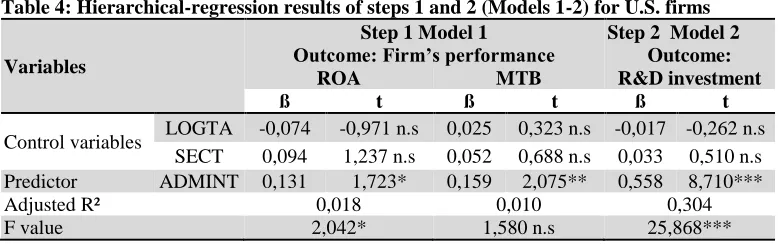
Based on the results of Table 4, the first condition is satisfied, as model 1 (which tests the relationship between the variable "ADMINT" and "ROA") shows a weak explanatory power (adjusted R² = 0.018). The overall quality of the model is significantly acceptable (F = 2.042, p < 10%). It is likely that at least one of the explanatory variables brings a significant contribution amidst the overall fluctuations marking the Return On Assets (ROA). However, once performance is measured by "MTB", the concerned model turns out to have a weak explanatory power (adjusted R² = 0.010) along with an insignificant Fisher’s test (F
1.580 ; p > 10%). As for the Student tests, they reveal that the variable "ADMINT" has a positive and significant impact on performance regardless of the measurement applied (for "ROA" : ß
0.131, t
1.723, p < 10%
; and for "MTB" : ß
0.159, t
2.075, p < 5%
). Indeed, this result does validate the sub-hypothesis (H1-1).476
second condition of the Baron and Kenny (1986) approach is verified. These results enable us to accept the sub-hypothesis (H1-2).
Table 4: Hierarchical-regression results of steps 1 and 2 (Models 1-2) for U.S. firms
Variables
Step 1 Model 1 Step 2 Model 2
Outcome: Firm’s performance Outcome:
R&D investment
ROA MTB
ß t ß t ß t
Control variables LOGTA -0,074 -0,971 n.s 0,025 0,323 n.s -0,017 -0,262 n.s SECT 0,094 1,237 n.s 0,052 0,688 n.s 0,033 0,510 n.s Predictor ADMINT 0,131 1,723* 0,159 2,075** 0,558 8,710***
Adjusted R² 0,018 0,010 0,304
F value 2,042* 1,580 n.s 25,868***
Thresholds: *** significant at 1 %, ** significant at 5 %, * significant at 10 %, n.s: non significant
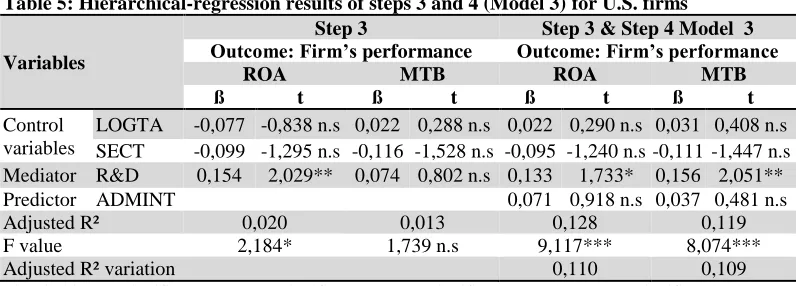
An examination of Table 5 results reveals a positive and significant relationship between the R&D investment level ("R&D") and one of the two indicators of the firm’s performance ("ROA"). So the R&D investments appear to help improve the firm’s economic performance in conformity with the studies conducted by Jarrell et al. (1985), McConnell and Muscarella (1985), Chan et al. (1990), Godard (1996), Zouari-Hadiji and Zouari (2013).
Model 3 (full model) helps to verify the third R&D mediating condition between the variable "ADMINT" and the firm’s performance ("ROA" and "MTB"). The hierarchical-regression analysis results indicate that R&D investment (as a potential mediating variable) remains significant in explaining the dependent variable (both forms of the firm’s performance) after considering the predictor variable. The statistical coefficient of the variable "R&D" has had a positive and significant value relative to the ROA (ß
0.133, p < 10%) and also in respect of the MTB (ß
0.156, p < 5%
). Based on these results, the third condition proves to be, in turn, entirely fulfilled. This result allows us to support the sub-hypothesis (H1-3).The last condition that needs to be verified is the effect of the predictor variable ("ADMINT") on the dependent variables ("ROA" and "MTB"), which should not be significant once the potential mediator ("R&D") has been considered. Table 5 results show that the coefficients associated with the variable "ADMINT" are by no means statistically significant whatever the performance measurement applied, though they have been statistically significant in the first stage of Baron and Kenny’s (1986) approach. The regression coefficients of the "ADMINT" variable show positive and non significant signs in respect of the "ROA" (ß
0.071 ; t
0.918 ; p> 10%) and also compared to the "MTB" (ß
0.037 ; t
0.481 ; p> 10%). It follows that mediation through the R&D investment level is complete between the dominance of the inside directors on the BD and the firm’s performance. These results allow us to accept the sub-hypothesis (H1-4), andconsequently, hypothesis H1 is validated by U.S. firms.
477
significant (11% and 10.9%). This shows that this variable appears to be an effective predictor of the dependent variable, i.e. the firm’s performance.
Table 5: Hierarchical-regression results of steps 3 and 4 (Model 3) for U.S. firms
Variables
Step 3 Step 3 & Step 4 Model 3
Outcome: Firm’s performance Outcome: Firm’s performance
ROA MTB ROA MTB
ß t ß t ß t ß t
Control variables
LOGTA -0,077 -0,838 n.s 0,022 0,288 n.s 0,022 0,290 n.s 0,031 0,408 n.s SECT -0,099 -1,295 n.s -0,116 -1,528 n.s -0,095 -1,240 n.s -0,111 -1,447 n.s Mediator R&D 0,154 2,029** 0,074 0,802 n.s 0,133 1,733* 0,156 2,051**
Predictor ADMINT 0,071 0,918 n.s 0,037 0,481 n.s
Adjusted R² 0,020 0,013 0,128 0,119
F value 2,184* 1,739 n.s 9,117*** 8,074***
Adjusted R² variation 0,110 0,109
Thresholds: *** significant at 1 %, ** significant at 5 %, * significant at 10 %, n.s: non significant
It is worth noting that introducing the "R&D" mediating effect in the full model leads to a significant increase in its explanatory power. In this respect, it must be argued that on the basis of the results attained the low explanatory power of the traditional governance model could find its explanation in the quasi-absence of analysis regarding the mediating effect of the intermediate variables that are major determinants of the causal relationship between the corporate-governance mechanisms and performance.
Interpretation of results for Japanese firms
The results of Table 6 confirm the first condition, as model 1 (which tests the relationship between the variable "ADMINT" and "ROA") shows a weak explanatory power (adjusted R² = 0.018) that is significantly acceptable ((F
3.174, p < 5%). However, once performance is measured by "MTB", the concerned model turns out to have a weak explanatory power (adjusted R² = 0.002) along with an insignificant Fisher’s test (F
1.095; p > 10%). As for the Student tests, they reveal that the variable "ADMINT" has a positive and significant impact on performance regardless of the measurement applied (for "ROA": ß
0.166, t
2.211, p < 5%
; and for "MTB": ß
0.133, t
1.738, p < 10%
). Indeed, this result does validate the sub-hypothesis (H1-1).Model 2 shows that its overall quality is statistically significant at a threshold of 1% and that the variable "ADMINT" is positively and significantly associated with the "R&D" of Japanese firms (ß
0.232, t
3,145, p < 1%, see table 6). Thus, the second condition of the Baron and Kenny (1986) approach is verified. These results allow us to accept the sub-hypothesis (H1-2).Table 6: Hierarchical-regression results of steps 1 and 2 (Models 1-2) for Japanese firms
Variables
Step 1 Model 1 Step 2 Model 2
Outcome: Firm’s performance Outcome:
R&D investment
ROA MTB
ß t ß t ß t
Control variables LOGTA 0,118 1,570 n.s 0,052 0,675 n.s 0,116 1,564 n.s SECT 0,053 0,707 n.s -0,019 -0,254 n.s 0,068 0,911 n.s Predictor ADMINT 0,166 2,211** 0,133 1,738* 0,232 3,145***
Adjusted R² 0,036 0,002 0,050
F value 3,174** 1,095 n.s 4,101***
478
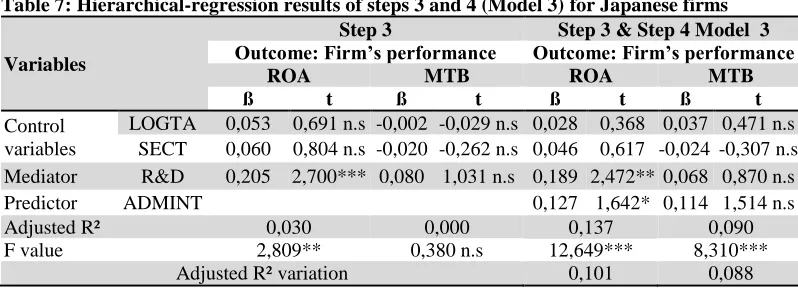
An examination of Table 7 results reveals a positive and significant relationship between the R&D investment level ("R&D") and one of the two indicators of the firm’s performance ("ROA"). So the R&D investments appear to help improve the firm’s economic performance in conformity with the studies conducted by Jarrell et al. (1985), McConnell and Muscarella (1985), Chan et al. (1990), Godard (1996), Zouari-Hadiji and Zouari (2013).
Model 3 (full model) helps to verify the third R&D mediating condition between the variable "ADMINT" and the firm’s performance ("ROA" and "MTB"). The hierarchical-regression analysis results indicate that R&D investment (as a potential mediating variable) remains significant in explaining the dependent variable (one of the two forms of the firm’s performance) after considering the predictor variable. The statistical coefficient of the variable "R&D" has had a positive and significant value relative to the ROA (ß
0.189, p < 5%). Based on these results, the third condition proves to be, in turn, partially fulfilled. This result allows supporting the sub-hypothesis (H1-3).The results in Table 7 indicate that if we monitor "R&D", a less important but significant link persists between the "ADMINT" and "ROA" (ß
0.127, t
1.642, p < 10%
). Thus, the significance of such a relationship ("ADMINT" and "ROA") is less important than that reached in the first condition verifying the Baron and Kenny (1986) procedure. Similarly, model 3 also shows that the variable "ADMINT" is positively associated with the "MTB", although this relationship does not appear to be statistically significant (ß
0.114, t
1.514, p > 10%
).The fourth condition necessary for a variable to be considered a mediator is not entirely respected. In this case, R&D investment acts as a partial mediator between "dominance of inside directors" and "firm’s performance". In fact, the effect of X on Y occurs both directly and indirectly. This result enables us to support the partial hypothesis of the mediating-effect. Thus, hypothesis (H1-4)
can be accepted and, consequently, hypothesis H1 is validated by Japanese firms.
Table 7: Hierarchical-regression results of steps 3 and 4 (Model 3) for Japanese firms
Variables
Step 3 Step 3 & Step 4 Model 3
Outcome: Firm’s performance Outcome: Firm’s performance
ROA MTB ROA MTB
ß t ß t ß t ß t
Control variables
LOGTA 0,053 0,691 n.s -0,002 -0,029 n.s 0,028 0,368 0,037 0,471 n.s SECT 0,060 0,804 n.s -0,020 -0,262 n.s 0,046 0,617 -0,024 -0,307 n.s Mediator R&D 0,205 2,700*** 0,080 1,031 n.s 0,189 2,472** 0,068 0,870 n.s
Predictor ADMINT 0,127 1,642* 0,114 1,514 n.s
Adjusted R² 0,030 0,000 0,137 0,090
F value 2,809** 0,380 n.s 12,649*** 8,310***
Adjusted R² variation 0,101 0,088
Thresholds: *** significant at 1 %, ** significant at 5 %, * significant at 10 %, n.s: non significant
479
This shows that this variable appears to be an effective predictor of the dependent variable, i.e. the firm’s performance.
Verification of the model hypotheses "dual structure / R&D investment / firm’s performance"
To be able to of identify the mediating role of the R&D investment level, Baron and Kenny (1986) affirm, as mentioned above, that four conditions need to be checked in order to test our research hypothesis. Both models 4 (reduced model) and 5 (reduced model), contained the independent variable (dual structure "DUAL") along with the control variables while predicting the successive dependent variables, namely; the firm’s performance (measured by ratios "ROA" and "MTB") and the R&D investment level (a third-step mediating variable). As for model 6 (full model), it includes all the variables: i.e. the independent variable ("DUAL"), the mediating variable ("R&D"), the control variables (size and sector), together with the dependent variable, i.e. the firm’s performance.
Interpretation of results for U.S. firms
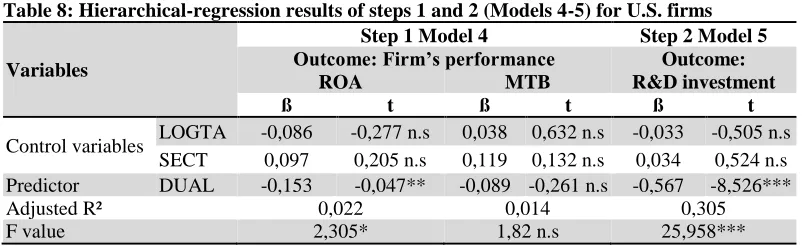
The results reached in Table 8 show that the explanatory power of the "ROA" through the "DUAL" variable is moderately weak (adjusted R² = 0.022). The model’s overall quality is statistically acceptable (F = 2.305, p <10%). However, regarding the case in which performance is measured through "MTB", the concerned model appears to have a weak explanatory power (adjusted R²=0.014). The model’s overall quality is insignificant (F
1.820; p>10%). It is, noteworthy, at this level, that no control variable contained in model 4 enables us to predict the U.S. firms’ performance.The Student tests reveal only one negative and statistically significant (at a 5 % threshold) relationship between the dual structure "DUAL" and the economic performance of the firm "ROA" (ß
-0.153; t
-0.047; p< 5%). This consolidates the fact that the dual structure has a direct and significant impact on the firm’s performance. Thus, the first condition is satisfied, confirming the sub-hypothesis (H2.1).The second condition consists in highlighting a significant impact of the independent variable "DUAL" on the mediating variable "R&D" considered as a dependent variable to be explained in a regression analysis of XM (mediating variable) on X (explaining variable) in the presence of
control variables. It stems from model 5 (reduced model) that this relationship is statistically significant at a threshold of 1 % (F = 25.958, see Table 8). In addition, the regression coefficient associated with the variable "DUAL" is negative (ß = -0.567) and significant at 1%. Hence, the second condition is also satisfied allowing the acceptance of the sub-hypothesis (H2.2).
Table 8: Hierarchical-regression results of steps 1 and 2 (Models 4-5) for U.S. firms
Variables
Step 1 Model 4 Step 2 Model 5
Outcome: Firm’s performance Outcome:
R&D investment
ROA MTB
ß t ß t ß t
Control variables LOGTA -0,086 -0,277 n.s 0,038 0,632 n.s -0,033 -0,505 n.s SECT 0,097 0,205 n.s 0,119 0,132 n.s 0,034 0,524 n.s Predictor DUAL -0,153 -0,047** -0,089 -0,261 n.s -0,567 -8,526***
Adjusted R² 0,022 0,014 0,305
F value 2,305* 1,82 n.s 25,958***
480
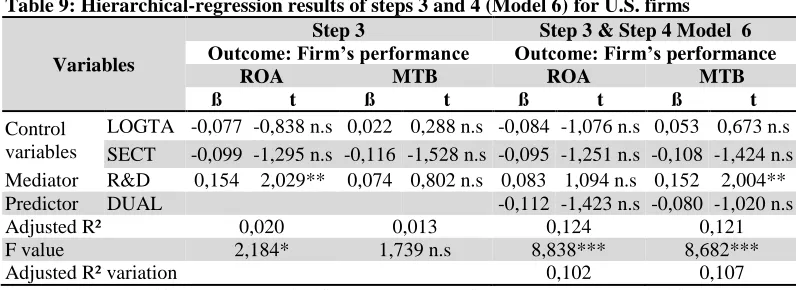
The results in Table 9 indicate that the "R&D" (potential mediating variable) remains significant in explaining the dependent variable (firm’s performance measured by the "MTB" variables) after having taken the predictor-variable into account. The regression coefficient of the variable "R&D" has a positive and significant value relative to the "MTB" (ß
0.152; t
2,004; p < 5%). Based on these achieved results, the third condition proves to be, in turn, partially fulfilled. This result allows supporting the sub-hypothesis (H2-3).The ultimate step in the Baron and Kenny (1986) approach enables us to evaluate the partial or complete nature of the mediation by examining the significance of the direct links between the independent and dependent variables. Table 9 results show that the coefficients associated with the variable "DUAL" are by no means statistically significant whatever the performance measurement applied, though they have been statistically significant over the first step of Baron and Kenny’s (1986) approach. The "DUAL" variable regression coefficients show negative and non significant signs in respect of the "ROA" (ß
-0.112 ; t
-1.423 ; p > 10%) and also compared to the "MTB" (ß
-0.080 ; t
-1.020 ; p > 10%). It follows that the mediation through the R&D investment level is then complete between the dual structure and the firm’s performance. These results allow us to accept the sub-hypothesis (H2-4), and consequently,hypothesis H2 is validated by U.S. firms.
Table 9: Hierarchical-regression results of steps 3 and 4 (Model 6) for U.S. firms
Variables
Step 3 Step 3 & Step 4 Model 6
Outcome: Firm’s performance Outcome: Firm’s performance
ROA MTB ROA MTB
ß t ß t ß t ß t
Control variables
LOGTA -0,077 -0,838 n.s 0,022 0,288 n.s -0,084 -1,076 n.s 0,053 0,673 n.s SECT -0,099 -1,295 n.s -0,116 -1,528 n.s -0,095 -1,251 n.s -0,108 -1,424 n.s Mediator R&D 0,154 2,029** 0,074 0,802 n.s 0,083 1,094 n.s 0,152 2,004**
Predictor DUAL -0,112 -1,423 n.s -0,080 -1,020 n.s
Adjusted R² 0,020 0,013 0,124 0,121
F value 2,184* 1,739 n.s 8,838*** 8,682***
Adjusted R² variation 0,102 0,107
Thresholds: *** significant at 1 %, ** significant at 5 %, * significant at 10 %, n.s: non significant
The direct effect of the dual structure on performance is non-significant when the R&D investment level is introduced as a mediating variable. However, it significantly and negatively affects the R&D. These R&D activities, in turn, positively affect performance, and as a result, the dual-structure direct effect on the firm’s performance decreases. Thus, one can conclude that the impact of the dual structure on the firm’s performance remains indirect due to the perfect mediation of the R&D investment level.
It is worth noting that introducing the mediating effect in the full model enables us to improve the model’s overall significance. The inclusion of the mediating variable "R&D" leads to a significant increase in the explanatory power of the full model in terms of adjusted R². At this level, it should be underlined that, following these results, the weak explanatory power of the traditional governance model could be explained by the quasi absence of analysis relevant to the mediating effect of the intermediary variables which are critical determinants of the causal relationship between the corporate-governance mechanisms and the firm’s performance.
Interpretation of results for Japanese firms
481
However, once performance is measured by "MTB", the Fisher’s test of model 4 is non-significant (F
0.236; p>10%). As for the Student tests, they reveal that the "DUAL" variable has a negative and significant impact on economic performance (ß
-0.194, t
-2.604, p < 1%
). Indeed, this result does partially validate the sub-hypothesis (H2-1).Model 5 shows that the overall quality is statistically significant at a threshold of 5% and that the "DUAL" variable is positively and significantly associated with the "R&D" of Japanese firms (ß
-0.221, t
-2.992, p < 1%, see table 10). Thus, the second condition of the Baron and Kenny (1986) approach is verified. These results lead to the acceptance the sub-hypothesis (H2-2).Table 10: Hierarchical-regression results of steps 1 and 2 (Models 4-5) for Japanese firms
Variables
Step 1 Model 4 Step 2 Model 5
Outcome: Firm’s performance Outcome:
R&D investment
ROA MTB
ß t ß t ß t
Control variables LOGTA -0,029 -0,392 n.s 0,014 0,186 n.s -0,034 -0,455 n.s SECT 0,066 0,891 n.s -0,019 -0,251 n.s 0,086 1,160 n.s Predictor DUAL -0,194 -2,604*** 0,060 0,794 n.s -0,221 -2,992***
Adjusted R² 0,028 0,000 0,038
F value 2,696** 0,236 n.s 3,313**
(Thresholds: *** significant at 1 %, ** significant at 5 %, * significant at 10 %, n.s: non significant)
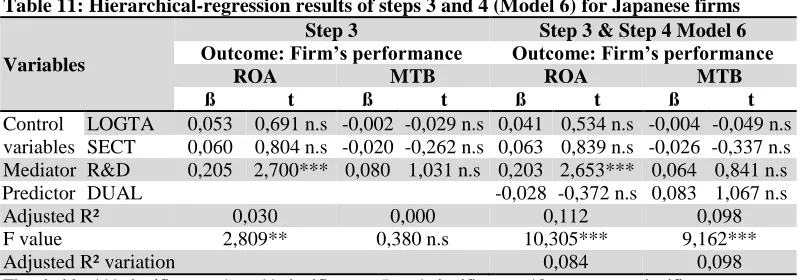
The hierarchical-regression analysis results of model 6 indicate that R&D investment (as a potential mediating variable) remains significant in explaining the dependent variable (one of the two forms of the firm’s performance) after considering the predictor variable. The statistical coefficient of the "R&D" variable has had a positive and significant value relative to the ROA (ß
0.236, p < 1%, Table 11). Based on these results, the third condition proves to be, in turn, partially fulfilled. This result allows us to support the sub-hypothesis (H2-3).The test for the last condition, that is to say the effect of the predictor variable ("DUAL") on the dependent variables ("ROA" and "MTB") which should not be significant once the potential mediator ("R&D") has been considered, is validated. Monitoring the "R&D", the coefficients associated with the variable "DUAL" are by no means statistically significant whatever the performance measurement applied, though they have been statistically significant for the first condition. It follows that the mediation through the R&D investment level is then complete between the dual structure and the firm’s performance. These results allow us to accept the sub-hypothesis (H2-4), and consequently, hypothesis H2 is validated by Japanese firms.
Table 11: Hierarchical-regression results of steps 3 and 4 (Model 6) for Japanese firms
Variables
Step 3 Step 3 & Step 4 Model 6
Outcome: Firm’s performance Outcome: Firm’s performance
ROA MTB ROA MTB
ß t ß t ß t ß t
Control variables
LOGTA 0,053 0,691 n.s -0,002 -0,029 n.s 0,041 0,534 n.s -0,004 -0,049 n.s SECT 0,060 0,804 n.s -0,020 -0,262 n.s 0,063 0,839 n.s -0,026 -0,337 n.s Mediator R&D 0,205 2,700*** 0,080 1,031 n.s 0,203 2,653*** 0,064 0,841 n.s
Predictor DUAL -0,028 -0,372 n.s 0,083 1,067 n.s
Adjusted R² 0,030 0,000 0,112 0,098
F value 2,809** 0,380 n.s 10,305*** 9,162***
Adjusted R² variation 0,084 0,098
482
The indirect effect of the dual structure on the firm’s performance is then reliable. Through its effect on the firm's R&D activities, the combining functions can significantly reduce the firm’s performance. Indeed, Table 11 shows that the regression model 6 (full model) presents a sufficient explanatory power with regard to both measurements of the firm’s performance. Thus, taking into account the mediating effect of the R&D investment, this model helps increase the percentage of explained variance in respect of model 4. As for the case in which performance is measured by the "ROA", the adjusted R² passes from 0.028 to 0.112 and the F value proves more significant at the threshold of 1 %. Similarly, when performance is measured through the "MTB", the adjusted R² goes from 0.000 to 0.098 and the F statistic confirms that the model 6 becomes significant in respect of model 4 (as a non-significant model). This increase in adjusted R² is naturally related to the consideration of the R&D investment-level mediating effect. Thus, the inclusion of the mediating variable is significantly important, which highlights the fact that this variable presents an effective predictor of the dependent-variable (i.e. the firm’s performance).
In general, the results of this study have important implications for theory and practice. On the one hand, our research provides a further contribution to the existing knowledge by proposing an integrative model allowing us to measure the simultaneous effect of the BD characteristics on R&D investment and performance. Mediating-variable modelling regarding the current corporate-governance research has not yet been developed. Nevertheless, this study provides an initial early-stage response to both conceptual and methodological levels.
On the other hand, our results demonstrate that U.S and Japanese firms prove to have interesting motives and benefits leading them to invest in R&D activities, encouraged by the desire to significantly increase their performance. Moreover, if one is to focus on the individual effects of governance mechanisms, our results suggest that these firms would benefit from giving great importance to the internal administrator and the non-dual structure. In fact, two variables seem to be positively and significantly associated with the firm’s performance through the R&D investment level. The R&D mediating effect, though partial, has been demonstrated for these variables.
Conclusion
As part of corporate governance theory, this article studies the efficiency of the control exerted by the BD on managers for the purpose of privileging investment in R&D, creator of value. This efficiency is sensitive to national systems of governance. The modeling of the relationships between the three concepts, namely "BD, R&D investment and performance", can be summarized as follows. Given the fact that R&D investment could act as a mediating variable for a particular variable of the BD characteristics and not for another, the assessment of such a mediating effect has been achieved by the development of a two-model framework in accordance with the number of BD variables used in this study.
483
In this regard, our results indicate that all variables, "dominance of inside directors" and "dual structure" are relevant to determining the mediating effect on the basis of the Baron and Kenney (1986) methodology. Indeed, taking into account the mediating variable, the R&D investment level proves to significantly improve the explanatory power of two models pertaining to the "dominance of inside directors / R&D / performance" and "dual structure / R&D / performance". It follows that the impact of the variables related to the BD characteristics of U.S and Japanese firms’ performance appears to be simultaneously direct and indirect. Hence, the impact turns out to be indirect through the quasi-total mediation of the "R&D investment-level" variable.
Thus, it seems that the "firm’s performance" is related to the "dominance of inside directors" over BD, who favor "R&D investment" strategies. The loss of the significance of the direct effect of the dependent variable on the "firm’s performance" (measured by the "ROA" and / or "MTB") is a particularly important finding. In this case, it appears that the effect of the variable "dominance of inside directors" over BD is almost completely mediated by the "R&D" variable. Therefore, the more inside directors on the board, the more the firms engage in R&D and show high performance.
In addition, hierarchical-regression results show that the explanatory power of the model "duality / R&D / performance" has improved significantly compared to the results of the reduced model without mediating variable. This proves the importance of adding the mediating variable (R&D investment level) in improving the explanatory power of the final model.
If this research contributes to the understanding of the determinants of the firm’s performance through R&D investment, it has, however, limits and still leaves many questions about the issue of investment open. In addition to BD roles, which we studied, the model should incorporate external and internal control mechanisms to represent a more complete reality. These mechanisms include: the ownership structure, the financial market, the labour market and the market for goods and services, etc, which have an impact on managerial discretion, and therefore on the choice of R&D investment, creator of value. Finally, we will consider a future theoretical and empirical improvement. It would be interesting to extend the theoretical framework to the contributions of cognitive governance and empirically examine modeling with Tunisian firms.
References
Aboody, D., & Lev, B. (2000). Information asymmetry, R&D and insider gains. Journal of Finance, 55, 2747-2766.
Amihud, Y., & Lev, B. (1981). Risk reduction as a managerial motive for conglomerate mergers. Bell Journal of Economic, 12, 605-617.
Baliga, B. R., Moyer, R. C. & Rao, R. S. (1996). CEO duality and firm performance: What’s the fuss? Strategic Management Journal, 17, 41-53.
Baron, R. M., & Kenny, D. A. (1986). The moderator-mediator variable distinction in social psychological research: conceptual, strategic and statistical considerations. Journal of Personality and Social Psychology, 51(6), 1173-1182.
Başgoze, P., & Cem, S. H. (2013). The effect of R&D expenditure (investments) of firm value: case of Istanbul stock exchange. Journal of Business, Economics & Finance, 2(3), 5-12. Baysinger, B. D., Kosnik, R. D., & Turk, T. A. (1991). Effects of board and ownership structure
on corporate R&D strategy. Academy of Management Journal, 34(1), 205-214.
Berrone, P., Surroca, J., & Tribo, J. A. (2007). Do the type and number of block holders influence R&D investments? New evidence from Spain. Corporate Governance: An international Review, 15(5), 828-842.
484
Bushee, B. J. (2001). Do institutional investors prefer near-term earnings over long-run value? Contemporary Accounting Research, summer, 18(2), 207-246.
Chan, S. H., Martin, D. J., & Kensinger, J. W. (1990). Corporate research and development expenditures and share value. Journal of Financial Economics, 26, 255-276.
Charreaux, G. (1997a). Modes de contrôle des dirigeants et performance des firmes, In Le gouvernement des entreprises, Théorie et Faits, Charreaux, G. (éd.), Economica, pp: 17-54. Charreaux, G. (1997b). Vers une théorie du gouvernement des entreprises, InLe gouvernement
des entreprises, Théorie et Faits, Charreaux, G. (éd.), Economica, pp: 421-469.
Charreaux, G. (2001). L’approche économico-financière de l’investissement, in Images de l’investissement, Charreaux, G. (éd.), FNEGE, p: 13-60.
Chen, A., Kao, L., Tsao, M., & Wu, C. (2007). Building a Corporate Governance Index from the Perspective of Ownership and Leadership for Firms in Taiwan. Corporate Governance, 15(2), 251-261.
Core, J., Holthausen, R., & Larcker, D. (1999). Corporate governance, chief executive officer compensation, and firm performance. Journal of Financial Economics, 51(3), 371–406. Daily, C. M., & Dalton, D. R. (1994) bankruptcy and corporate governance: the impact of board
composition and structure. Academy of Management Journal, 37(6), 1603-1617.
Denis, D. & Sarin, A. (1999). Ownership and board structures in publicly traded corporations. Journal of Financial Economics, 52, 187-224.
Di Vito, J., Laurin, C., & Bozec, Y. (2008). Corporate ownership structure and innovation in Canada. Actes du 29ème congrès de l’Association Francophone de Comptabilité, Cergy Mai 2008.
Ding, Y., Stolowy, H., & Tenenhaus, M. (2007). R&D productivity: An international study. Review of Accounting and Finance, 6(1), 86-101.
Dutta, S., Kumar, U., Kumar D., & Zhu, P. (2004). Determinants of corporate R&D intensity: Canadian evidence. 32nd Annual Administrative Sciences Association of Canada Conference, ASAC Quebec, 2004.
Ellstrand, A., Tihanyi, L. & Johnson, J. (2002). Board structure and international political risk, Academy of Management Journal, 45(4), 769–777.
Eng, L. L., & Shackell, M. (2001). The implications of long term performance plans and institutional ownership for firm’s research and development expenses. Journal of Accounting Auditing and Finance, 16(2), 117-139.
Fama, E. F. (1980). Agency problems and the theory of the firm. Journal of Political Economy, 88(2), 288-307.
Fama, E. F., & Jensen, M. C. (1983a). Agency problems and residual claims. Journal of Law and Economics, 26, 327-350
Fama, E. F. & Jensen, M. C. (1983b). Separation of ownership and control. Journal of Law and Economics, 26, 301-326.
Fischel, D., & Bradley, M. (1986). The role of liability rules and the derivate suit in corporate law: a theoretical and empirical analysis. Cornell Law Review, 71, 261-283.
Godard, L. (1996). Conseil d'Administration, Stratégie et Performance Financière, Thèse de Doctorat en Sciences de Gestion (finance), IAE Dijon, Université de Bourgogne.
Godard, L. & Schatt, A. (2005). Caractéristiques et fonctionnement des conseils d’administration français : Un état des lieux. Revue Française de Gestion, 31, 69-87.
Goold, M., & Quinn, J. J. (1990). The paradox of strategic controls. Strategic Management Journal, 11(1), 43-57.
Goyal, V. K., & Park, C. W. (2002). Board leadership structure and CEO turnover. Journal of Corporate Finance, 8, 49-66.
Graves, S. B. (1988). Institutional ownership and corporate R&D in the computer industry. Academy of Management Journal, 31(2), 417-428.
485
Hermalin, B., & Weisbach, M. (1991). The effects of board composition and direct incentives on firm performance, Financial Management, 20: 101-112.
Hill, C. W. L., & Snell, S. A. (1988). External control, Corporate strategy and Firm performance in research intensive industries. Strategic Management Journal, 9, 577-590.
Hoskisson, R. E., & Hitt, M. A. (1988). Strategic control systems and relative R&D investment in large multiproduct firms. Strategic Management Journal, 9, 605-621.
Hosono, K., Tomiyama, M., & Miyagawa, T. (2004). Corporate governance and research and development: evidence from Japan. Economic of Innovation and New Technology, 13(2), 141-164.
Hung, S. C., Lee, Y., & Lin, B. W. (2006). R&D intensity and commercialization orientation effects on financial performance. Journal of Business Research, 59(6), 679-685.
Jarrell, G. A., Lehn, K., & Marr, W. (1985). Institutional ownership, tender offers, and long-term investments, Washington D.C: Office of the Chief Economist, Securities and Exchange Commission.
Jensen, M. C. (1993). The modern industrial revolution, exit and the failure of internal control systems, The Journal of Finance, 48(3), 831-880.
Jensen, M. C., & Meckling, W. H. (1976). Theory of the firm: managerial behavior, agency costs, and ownership structure. Journal of Financial Economics, 3(4), 305-360.
Kaplan, S., & Minton, B. (1994). Outside intervention in japanese companies: its determinants and its implications for managers. Journal of Financial Economics, 36(2), 225-258.
Karjalainen, P. (2008). R&D investments: The effects of different financial environments on firm profitability. Journal of Multinational Financial Management, 18(2), 79-93.
Kor, Y. Y. (2006). Direct and interaction effects of top management team and boards compositions on r&d investment strategy. Strategic Management Journal, 27(5), 1081-1099.
Kothari, S. P., Laguerre, T. E., & Leone, A. J. (2002). Capitalization versus expensing: evidence on the uncertainty of future earnings from capital expenditure versus R&D outlays. Review of Accounting Studies, 7(4), 355-382.
Krivogorsky, V. (2006). Ownership, board structure, and performance in continental Europe. The International Journal of Accounting, 41, 176-197.
Lee, P. M. (2005). A comparison of ownership structures and innovations of US and Japanese firms. Managerial and Decision Economics, 26, 39–50.
Lee, P. M., & O’Neill, H. M. (2003). Ownership structures and R&D investments of US and Japanese firms: agency and stewardship perspectives. Academy of Management Journal, 46(2), 212–225.
Lev, B., & Sougiannis, T. (1996). The capitalization, amortization, and value-relevance of R&D. Journal of Accounting and Economics, 21(1), 107-138.
Lev, B. & Zarowin, P. (1998). The market valuation of R&D expenditures. Working paper, New York Stern University.
Liano, C. H. (2013). R&D performance and credit ratings. Journal of Accounting, Finance and Economics, 3(2), 53 -71.
Lin, B. W., & Chen, J. S. (2005). Corporate technology portfolios and R&D performance measures: A study of technology intensive firms, R&D Management, 35(2), 157-170. Mansfield, E. (1969). Industrial research and technological innovation, Norton, New York. McConnell, J. J., & Muscarella, C. J. (1985). Corporate capital expenditure decisions and the
market value of the firm. Journal of Financial Economics, (14), 399-422.
Nekhili, M., & Poincelot, E. (2000). La fonction R&D ET la latitude managériale: une analyse théorique. Finance Contrôle Stratégie, 3(1), 167-215.
486
Osterloh, M., & Frey, B. S. (2005). Shareholders should welcome employees as directors, Working papers n° 228, University of Zurich.
Pandit, S., Wasley, C. E., & Zach, T. (2011). The effect of R&D inputs and outputs on the relation between the uncertainty of future operating performance and R&D expenditures. Journal of Accounting, Auditing and Finance, (26), 121-144.
Pi, L., & Timme, S. G. (1993). Corporate control and bank efficiency. Journal of Banking and Finance, 17, 515-530.
Porter, M. E. (1992a). Capital Choice: Changing the Way America invests in Industry. Boston, MA: Council on Competitiveness / Harvard Business School.
Porter, M. E. (1992b). Capital disadvantage: America's failing capital investment system. Harvard Business Review, 70(5), 65-85.
Pramod, K. N., Narayanan, K., & Padhi, P. (2013). R&D intensity and market valuation of firm: a study of R&D incurring manufacturing firms in India. MPRA Paper No. 37299.
Rechner, P. L., & Dalton, D. R. (1991). CEO duality and organizational performance: a longitudinal analysis, Strategic Management Journal, 12, 155-160.
Roe, M. J. (1994). Strong Managers, Weak Owners, the Political Roots of American Corporate Finance. Princeton, NJ: Princeton University Press.
Scherer, F. M. (1984). Innovation and growth: Schumpeterian perspectives. MIT Press, Cambridge, MA.
Shivdasani, A. (1993). Board composition, ownership structure and hostile takeovers. Journal of Accounting Economics, 16, 167-198.
Shleifer, A., & Vishny, R. W. (1992). Liquidation values and debt capacity: a market equilibrium approach. The Journal of Finance, 47(4), 1343-1366.
Sougiannis, T. (1994). The accounting based valuation of corporate R&D. The Accounting Review, 69(1), 44-68.
Thaddée, N. N. F. (2000). Le cumul des fonctions de président et de directeur général: quel effet sur la performance de l’entreprise? Revue française de gestion, mars-avril-mai 2000, pp: 4-15.
Weisbach, M. (1988). Outside directors and CEO Turnover. Journal of Financial Economics, 20, 431-460.
Williamson, O. E. (1988). Corporate finance and corporate governance. Journal of Finance, 43(3), 567-591.
Xie, X., O’Neill, H., & Cardinal, L. (2003). Boards as agents of innovation: How board characteristics affect R&D intensity and R&D performance in research intensive firms. Paper Presented at Academy of Management Annual Meeting, Seattle, WA.
Xu, M., & Zhang, C. (2004). The explanatory power of R&D for the cross-section of stock returns: Japan 1985–2000. Pacific-Basin Finance Journal, 12, 245– 269.
Yang, Y. W., Searcy, D. W. L., & Tatum, K. W. (2007). The role of corporate governance on long-term financial performance and market valuation of R&D investments in the biotechnology industry, Working paper, Proceedings of the Midyear Conference of the, Auditing Section of the American Accounting Association , January, 11-13, 2007.
Yasuda, H. (2009). Comparison of growth process through finance activities between US and Japanese firms. International Journal of Business and Systems Research, 3(1), 19 - 33. Zouari, G., & Zouari-Hadiji, R. (2013). Ownership structure, innovation and firm performance:
evidence from Tunisia. International Journal of Governance, 3(2), 79-107.
Zouari-Hadiji, R., & Zouari, G. (2010a). Internal governance systems and R&D investment: an international comparison, corporate board: role, Duties & Composition, 6(1), 39-56. Zouari-Hadiji, R., & Zouari, G. (2010b). Institutional Investors and R&D Investment: an
487
APPENDIX
Table 2: Correlations matrix (American Firms) (1)
Percentage of inside directors Duality Firm’s size Activity sector
Percentage of inside directors 1,00
Duality -0,172 1,00
Firm’s size 0,030 0,273 1,00
Activity sector 0,027 0,063 0,093 1,00
Table 3: Correlations matrix (Japanese Firms) (1)
Percentage of inside directors Duality Firm’s size Activity sector
Percentage of inside directors 1,00
Duality -0,110 1,00
Firm’s size 0,113 0,017 1,00
Activity sector 0,134 0,088 0,057 1,00